Skip to content

A custom bag RFQ often begins with something deceptively simple: a product photo, a target quantity, a logo file, and a request for the “best price.” The problem is that three factories can look at exactly the same message and imagine three different products. One may assume stock polyester and generic hardware, another may price custom-dyed nylon and upgraded zippers, while a third may exclude packaging, testing, or special labels altogether. All three quotations can look professional, yet comparing them line by line may tell you very little about which manufacturer is actually more competitive.
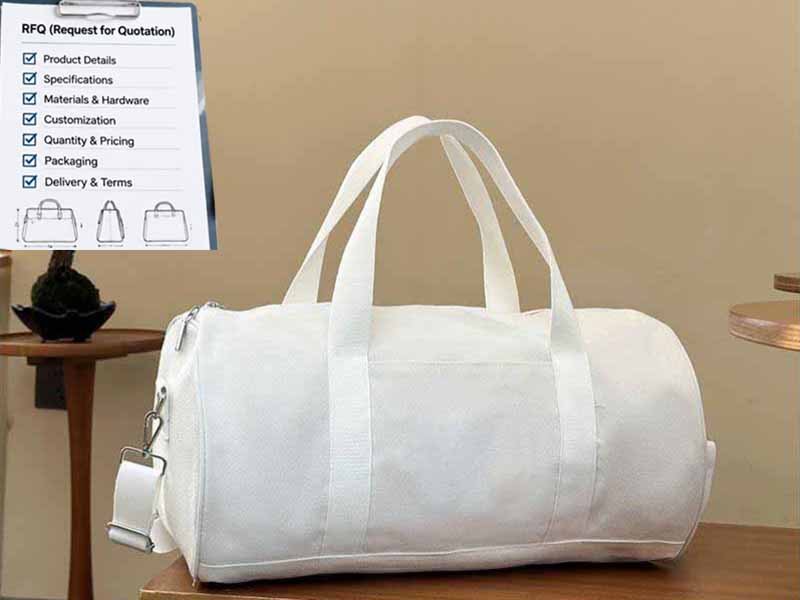
A strong custom bag RFQ should clearly define the product, intended use, dimensions, construction, materials, branding, quantity, packaging, quality requirements, delivery expectations, and quotation basis. It should also identify which requirements are fixed, which are flexible, and which still need factory input. The purpose is not to eliminate every unknown before contacting a manufacturer, but to make important assumptions visible so different quotations can be compared on a common basis.
That distinction becomes important very quickly. Imagine receiving prices of $5.40, $6.15, $6.80, and $7.35 for what appears to be the same travel bag. The natural reaction is to focus on the lowest number, but the more useful question is whether all four suppliers have priced the same material, zipper level, logo process, packaging format, inspection scope, quantity split, and shipping term. A well-prepared RFQ helps answer that question before a low initial quotation turns into repeated revisions, extra charges, and avoidable delays.
What Should a Custom Bag RFQ Include?

A custom bag RFQ should include enough information for a manufacturer to understand the product, estimate material and labor requirements, and explain any assumptions behind the price. At minimum, define the bag type, use case, reference files, dimensions, construction, materials, branding, quantity, packaging, quality expectations, delivery destination, and required timing. Open decisions should be identified rather than silently left for the factory to guess.
What Product Are You Asking the Factory to Quote?
Start by explaining the product in practical terms rather than relying only on a category name. “Backpack,” “tote bag,” “cosmetic pouch,” or “duffel bag” tells a factory what general family the product belongs to, but it does not explain the job that product needs to perform. A commuter backpack designed for a 16-inch laptop, for example, may require structured padding, reinforced shoulder straps, internal organization, coated fabric, and a more refined zipper specification than a simple promotional backpack of a similar external size.
The product description should therefore explain who will use the bag, what it needs to carry, where it will be sold, and which features matter most. A short statement such as “20-liter commuter backpack for urban professionals, designed for a 16-inch laptop and daily essentials, with a clean matte finish, water-resistant exterior, padded straps, and retail-ready packaging” gives a development team significantly more useful information than “please quote our custom backpack.”
Context also helps a manufacturer make better recommendations. A bag intended for an outdoor brand may need to prioritize abrasion resistance, water resistance, reinforcement, load distribution, and durable hardware. A beauty pouch sold through retail may put more emphasis on surface appearance, lining cleanliness, zipper feel, color control, and packaging presentation. The more clearly the intended use is explained, the easier it becomes to separate truly necessary specifications from features that add cost without adding meaningful value.
Which Reference Files Should You Include?
Send the strongest references you already have. A complete tech pack is valuable, but it is not the only useful starting point. A manufacturer can often learn a great deal from dimensioned drawings, marked-up photographs, a physical sample, an existing product, sketches, a preliminary BOM, logo artwork, Pantone references, or packaging files. The key is to make clear which references control the quotation and which are only being used for inspiration.
Version control matters more than many teams expect. A quotation may be calculated from one drawing while the development team later discusses another file that has slightly different dimensions, pocket locations, or materials. That is how arguments begin about whether the supplier “changed the price” when, in reality, the product itself changed between versions. A simple reference such as “RFQ V3 – September 2026” is far safer than keeping several files named “final,” “final new,” and “final latest.”
Photographs should also be annotated whenever possible. If a reference bag has six visible features but you only want to keep three of them, say so directly. Mark the elements to keep, remove, resize, upgrade, or relocate. A few clear notes such as “keep overall silhouette,” “remove side mesh pocket,” “add padded laptop sleeve,” and “change front pocket to zipper closure” can prevent an early cost estimate from being built around the wrong construction.
How Should Quantity Be Defined?
Total quantity is only one part of the costing picture. A 3,000-piece order in one fabric color with one logo is usually easier to plan than 3,000 pieces divided among six colors, three artworks, and multiple packaging versions. The total number is identical, but purchasing minimums, cutting efficiency, printing setups, labeling, color changes, and production organization may be very different.
The RFQ should therefore show the total quantity together with the actual SKU breakdown. If the order contains 1,500 black units, 900 navy units, and 600 olive units, put those numbers into the request rather than waiting until after quotation. If different colors use different artwork or packaging, make that visible as well. This is especially important when custom-dyed fabric, printed lining, custom webbing, molded components, or specially colored hardware are involved.
For products likely to scale, it can also be useful to request realistic price levels instead of a single quantity. A first order may be 1,000 pieces, while later replenishment could reach 3,000 or 5,000. Asking for those three levels helps reveal where cost savings actually come from and whether a factory can support the project economically as volume grows.
| RFQ Item | Weak Input | More Useful Input |
|---|---|---|
| Quantity | 3,000 pcs | 1,500 black, 900 navy, 600 olive |
| Dimensions | Medium size | 42 × 30 × 15 cm finished |
| Logo | Custom logo | 80 × 32 mm, 2-color embroidery |
| Packaging | Individual pack | 1 pc/polybag, barcode label, 20 pcs/carton |
| Timing | ASAP | Target production completion by June 15 |
| Reference | See photo | Drawing V4 + annotated product photos |
| Pricing | Best price | Quote 1,000 / 3,000 / 5,000 pcs if practical |
Which Product Specs Affect the Quote Most?

The specifications that usually influence a custom bag quotation most are dimensions, construction complexity, fabric, lining, padding, zippers, hardware, webbing, reinforcement, branding methods, custom components, and packaging. Two bags can look almost identical in photographs while having very different material consumption and sewing time. Accurate quotations therefore depend on how the bag is built, not simply on how it looks.
How Do Size and Construction Change Cost?
Finished dimensions affect fabric consumption, lining consumption, zipper length, reinforcement requirements, packaging size, and shipping volume. Use a consistent measurement order such as width × height × depth and state whether those measurements are final or still approximate. If certain dimensions are critical, identify them clearly. A laptop sleeve opening, bottle pocket, luggage sleeve, or fitted compartment may require tighter control than the overall width of a soft tote.
Construction can have an even greater effect than size. A simple tote bag may consist of relatively few pattern pieces and sewing operations, while a technical backpack can contain dozens of individual components. Internal dividers, foam, binding, webbing anchors, reinforced shoulder straps, shaped panels, concealed pockets, piping, lining, compression straps, and multiple zipper sections all increase the number of operations required to complete the product.
This is why a bag that looks visually simple may not be inexpensive to produce. Hidden construction often determines labor. Narrow sewing areas, multiple material layers, curved binding, carefully aligned panels, padded three-dimensional components, and difficult reinforcement points can add substantial production time even though those details are not obvious in a product photograph. A good RFQ should make those features visible before the factory calculates its first price.
Which Materials and Components Need Detail?
Generic material descriptions create some of the biggest gaps between quotations. “Polyester,” “nylon,” “canvas,” or “PU” is not enough when several quality levels and constructions exist within each material family. Even “600D polyester” may leave unanswered questions about coating, backing, actual weight, texture, color, surface finish, hand feel, and supplier grade.
The same applies to zippers and hardware. A #5 zipper description is more useful than simply writing “zipper,” but a complete decision may still involve coil versus molded teeth, slider type, puller design, finish, expected quality level, and brand preference. Buckles and hooks may be plastic, zinc alloy, aluminum, or custom-made metal components, each with very different cost and minimum-order implications.
When the exact specification is not yet decided, describe the performance target instead. A phrase such as “matte, lightweight, water-resistant nylon suitable for an urban commuter bag” gives an experienced development team room to recommend suitable options. That is often better than choosing a technical specification only because it appeared on another product.
| Component | Common Specification Variables | Typical Cost Influence |
|---|---|---|
| Main fabric | Fiber, denier, weight, coating, finish, color | High |
| Lining | Material, weight, print, color | Medium |
| Zippers | Size, type, slider, puller, quality level | Medium–High |
| Foam | Thickness, density, location | Medium |
| Webbing | Width, thickness, weave, color | Medium |
| Hardware | Plastic, alloy, aluminum, custom mold | Medium–High |
| Branding | Print, embroidery, patch, metal badge | Low–High |
| Packaging | Polybag, dust bag, box, gift packaging | Low–High |
How Should Branding Be Specified?
“With our logo” leaves too much room for interpretation. The final cost can change depending on whether the logo is screen printed, heat transferred, embroidered, woven, debossed, applied as a rubber patch, or produced as a custom metal plate. Logo size, number of colors, placement, artwork complexity, surface material, and order quantity can also affect setup and production.
A useful RFQ should identify the preferred logo method when known, along with finished dimensions, position, color references, and artwork files. If the product also requires woven labels, care labels, size labels, hangtags, branded zipper pullers, printed lining, or custom hardware, those requirements should be shown at the same stage rather than introduced after the initial quotation.
When the decoration method is still open, ask for controlled alternatives instead of giving the factory an unlimited brief. For example, request one economical branding option and one more premium option while keeping the same approximate logo size and position. That gives the manufacturer room to use its production experience while still allowing meaningful price comparison between suppliers.
How Do You Request a Quote Without a Complete Tech Pack?

A complete tech pack is helpful, but it is not always necessary for an early custom bag quotation. A reference photo, sketch, sample, approximate dimensions, intended use, material direction, quantity, branding needs, and target market can support an initial review. The important point is to distinguish an early budget estimate from a production-ready quotation and to make unresolved specifications visible.
What Kind of Quote Can You Expect at Each Stage?
Different development stages naturally produce different levels of pricing certainty. A concept supported only by photographs and approximate measurements can usually support a budget discussion, but it should not be treated as a final production price. As dimensions, materials, components, artwork, packaging, and construction become more defined, the quotation should become more precise as well.
A development quotation usually sits between those two extremes. At this stage, the main product structure may be clear, but the final material, zipper, padding, label, or packaging decisions may still be open. The manufacturer should state which assumptions are being used so that any later changes can be traced back to actual specification changes rather than appearing as unexplained price increases.
By the time a purchase order is released, the project should normally be supported by a substantially confirmed specification, approved sample, or controlled technical reference. At that point, the quotation should reflect the product that will actually enter bulk production, rather than the simpler product that existed during the first conversation.
Can You Start From a Photo, Sketch, or Physical Sample?
Yes, but each reference type has limits. A photograph communicates shape and visual direction but cannot reliably show hidden reinforcement, foam thickness, seam allowances, internal construction, fabric weight, exact dimensions, or the quality level of components. A physical sample contains much more information, but the factory still needs to know which parts should be copied and which parts should be changed.
A useful way to work with a physical reference is to separate “keep” and “change” decisions. You may want to keep the overall silhouette and compartment layout while changing the fabric, adding a laptop sleeve, upgrading the zipper, moving the logo, and simplifying one pocket. Writing those changes next to the reference makes the development task far clearer than simply saying, “Make something similar to this.”
The same idea applies to early sketches. A rough drawing can be enough to start a meaningful discussion if it includes basic dimensions, product use, quantity, branding direction, and the most important functional features. The manufacturer can then identify which missing details are necessary before sampling or final costing.
Which Specs Can Remain Open?
Not every technical decision needs to be finalized before the first RFQ. What matters is that the status of each decision is clear. A practical project can classify major specifications as fixed, flexible, unknown, or supplier-recommended. That simple distinction prevents blank fields from being interpreted differently by different factories.
For example, the finished dimensions may be fixed because they are based on a specific use case, while the main fabric can remain flexible within a defined performance range. The logo dimensions might already be approved, while the zipper supplier can be left for recommendation. Foam density may remain unknown until the first physical sample is evaluated.
This approach is useful because it avoids two common problems. The first is over-specifying technical details without understanding their effect. The second is leaving important information blank and allowing every supplier to make a different assumption. A controlled open decision is much safer than an invisible one.
How Do You Make Bag Quotes Comparable?

Custom bag quotations become comparable when each supplier prices the same product revision, material direction, quantity breakdown, branding, packaging, quality scope, and trade terms. The unit price alone is rarely enough. Suppliers should also identify assumptions, exclusions, substitutions, setup charges, MOQ restrictions, sample fees, and delivery terms so differences can be understood before a sourcing decision is made.
Are You Comparing the Same Product?
Suppose three factories quote a 5,000-piece travel bag at $6.20, $6.75, and $7.10. At first glance, the difference between the lowest and highest offer is $4,500 across the order. That number looks significant, but it may not represent a real saving if the three factories have priced different material grades, zipper levels, logo methods, packaging formats, inspection scopes, or shipping terms.
The lower quotation may use stock polyester, generic hardware, a basic polybag, and EXW pricing. The higher quotation may include custom nylon, upgraded zippers, retail packaging, more structured inspection, and FOB terms. Until those differences are normalized, comparing the three unit prices can create the illusion of accuracy without providing a fair commercial comparison.
A useful quotation comparison sheet therefore looks beyond price. It asks whether each supplier has interpreted the product in the same way and whether all important cost elements are included. When one supplier proposes an alternative material or component, record that difference separately rather than letting it disappear inside the final number.
| Comparison Item | Supplier A | Supplier B | Supplier C |
|---|---|---|---|
| Quantity | 5,000 pcs | 5,000 pcs | 5,000 pcs |
| Shell | Stock polyester | Custom polyester | Custom nylon |
| Zipper | Generic #5 | Mid-level #5 | Premium #5 |
| Logo | 1-color print | Embroidery | Embroidery |
| Packaging | Basic polybag | Polybag + barcode | Retail pack |
| Inspection | Final check | Final inspection | Inline + final |
| Trade Term | EXW | FOB | FOB |
| Unit Price | $6.20 | $6.75 | $7.10 |
Which Costs Should Be Separated?
Ask manufacturers to separate non-recurring costs from the normal unit price whenever practical. Sampling fees, pattern development, printing screens, embroidery setup, molds, custom zipper puller tooling, metal badge tooling, laboratory testing, or special packaging setup may apply only to the first development cycle or may be reusable on future orders.
This is particularly important when comparing a first order with expected repeat production. A custom metal badge mold may make the first 1,000 pieces look expensive, but that tooling cost may not apply in the same way to later 5,000-piece orders. If all one-time costs are hidden inside a single unit price, long-term comparisons become harder to understand.
Price breaks should also be requested at quantities that reflect the actual purchasing plan. There is little value in asking for 50,000-piece pricing if the realistic order range is 1,000 to 5,000 pieces. Useful quantity levels reveal when material minimums are being absorbed, when setup costs become less significant, and when production efficiency begins to improve.
What Assumptions Should the Supplier State?
Ask every factory to identify important assumptions and exclusions. A simple instruction such as “Please state any assumptions, substitutions, exclusions, MOQ limitations, or specifications that require confirmation before the quotation is final” can reveal problems that would otherwise remain hidden until sampling or production.
The factory may explain that its price assumes one fabric color per 1,000 pieces, standard lining, generic hardware, one artwork version, basic export cartons, or no third-party testing. Those assumptions are not automatically bad. In many cases they are perfectly reasonable. The important thing is that they are visible and can be accepted, rejected, or adjusted before the project progresses.
The quality of those explanations can also tell you something about the manufacturer. A team that notices conflicting dimensions, unrealistic materials, difficult construction, unnecessary custom components, or MOQ risks before sending a quotation may be demonstrating more useful production knowledge than a supplier that simply returns the lowest number within a few hours.
What Quality, Packaging, and Delivery Details Should You Add?
Quality, packaging, and delivery details belong in the RFQ whenever they influence cost, approval, or production planning. Define the sample reference, critical dimensions, workmanship expectations, inspection requirements, packaging format, labels, carton needs, destination, trade terms, and key dates. Testing requirements should reflect the actual product, destination market, retailer, or performance claim rather than being copied from unrelated projects.
How Specific Should Quality Requirements Be?
Avoid phrases such as “high quality,” “premium workmanship,” or “no defects” unless they are supported by measurable expectations. A production team needs to know which dimensions are critical, what sample controls appearance, what logo position is acceptable, what hardware finish is approved, and which functions must be checked.
For example, a pocket opening specified at 180 mm ± 5 mm provides a measurable requirement. “Approximately 18 cm” may be sufficient during early development, but it is less useful when the product enters controlled production. The same principle applies to logo position, strap length, buckle placement, zipper length, and other details that affect fit, appearance, or function.
Quality requirements should also reflect risk. A decorative internal label does not normally deserve the same attention as a shoulder-strap attachment carrying weight. A minor visual variation inside a lining may be less important than a zipper that fails under repeated use. Identifying critical features helps production and inspection teams focus their effort where failure would have the greatest effect.
When Should Testing Be Included?
Testing and compliance requirements should be considered early when they are relevant to the product, destination, retailer, materials, or marketing claims. Children’s products, medical-related bags, food-delivery products, waterproof products, fire-resistant products, high-load bags, or projects sold under major retailer programs may need additional review compared with a simple promotional tote.
If your organization already has a restricted-substance list, test protocol, retailer manual, or performance standard, include it with the RFQ. Doing so allows the factory to consider material selection and testing cost before agreeing on the commercial basis. Discovering those requirements only after a sample has been approved can lead to unnecessary redesign, retesting, or material changes.
Performance language should also be precise. Water-resistant, waterproof, and submersible describe different expectations. Fire-resistant and fireproof should not be treated as interchangeable claims. When a product will be marketed around a specific performance feature, the RFQ should make clear what level of evidence or testing is expected rather than relying only on advertising language.
How Should Packaging and Delivery Be Defined?
Packaging is part of the product cost and should be described before the quotation is considered complete. A standard polybag has a very different cost and shipping profile from a printed dust bag, retail box, gift box, molded insert, or multi-piece presentation package. Packaging can also change carton dimensions and freight efficiency even when the bag itself remains unchanged.
State whether you need individual polybags, warning labels, barcodes, FNSKU labels, hangtags, insert cards, retail boxes, gift packaging, specific carton quantities, or shipping marks. Once packaging is reasonably defined, ask for estimated carton dimensions, pieces per carton, gross weight, and net weight if those numbers are important for logistics planning.
Delivery dates should also be described carefully. “Needed September 1” can mean production completion, vessel departure, warehouse arrival, or retail launch. Those dates can be weeks apart. If the product is tied to a promotion, trade show, seasonal launch, retailer delivery window, or ecommerce launch, communicate the actual commercial deadline so production and shipping can be planned backward from the date that matters.
How Do You Check an RFQ Before Sending It?
Before sending the RFQ, read it as if you had never seen the project before. Confirm that the current drawing revision, quantity breakdown, materials, dimensions, branding, packaging, quality scope, destination, and timing are understandable without private background knowledge. Most importantly, identify unresolved specifications and require manufacturers to state assumptions instead of quietly filling gaps with their own interpretation.
Is the RFQ Internally Consistent?
Many sourcing problems begin before the RFQ reaches the factory. The drawing may show one dimension while the written specification contains another. The artwork may show a logo width of 80 mm while the tech pack says 70 mm. The packaging file may refer to a product name that belongs to an earlier version. These small inconsistencies create questions that slow quotation and can later create costly sample revisions.
A final internal review should therefore compare the RFQ, tech pack, BOM, artwork, reference photographs, packaging files, and quantity sheet. Make sure that each document points to the current project version and that any previous versions are clearly archived rather than mixed into the same working folder.
The revision system does not need to be complicated. A project code, file type, revision number, and date are usually enough. What matters is that sourcing, product development, design, factory engineering, quality control, and packaging teams can all tell which information currently controls the project.
What Questions Should You Ask Before Accepting the Quote?
The final RFQ should invite useful manufacturing feedback instead of simply asking, “What is your best price?” Ask which specification is currently the biggest cost driver, which component has the highest MOQ, which material has the longest lead time, and whether any construction detail may be difficult to manufacture consistently.
Also ask which requirements should be confirmed with a physical sample, what has been excluded from the quotation, which assumptions could change the price, and whether custom tooling is required. If the manufacturer sees a more efficient material, construction, or component choice that preserves the intended user experience, ask them to explain it rather than changing the product without discussion.
These questions make the RFQ more useful because they turn quotation into an early manufacturing review. An experienced team should be able to identify potential problems before material is ordered and production begins. A supplier that can explain risks clearly may ultimately reduce more cost than one that simply provides the lowest initial price.
Is the Project Ready to Move Into Sampling?
An RFQ is not normally the final product specification. It is the first controlled commercial and technical version of the project. After the initial quotation, questions may be clarified, materials adjusted, construction improved, and samples produced before the product becomes ready for bulk manufacturing.
A typical project may move from RFQ review into initial quotation, technical clarification, sample development, sample revision, approved sample, final specification, confirmed production quotation, purchase order, and bulk production. The exact sequence varies by product complexity, but the basic principle remains the same: the closer a project gets to production, the fewer uncontrolled assumptions should remain.
If materials, construction, branding, or packaging change during sampling, the quotation should be reviewed again. That is not unnecessary paperwork. It ensures that the final commercial agreement still describes the product that will actually be manufactured rather than the earlier concept that existed when the first price was issued.
For projects that begin with only a reference image, physical sample, early drawing, or partial tech pack, Szoneier can review the available information and help clarify materials, construction, sampling, packaging, and production requirements before the project moves toward bulk manufacturing. The objective is not to force every decision to be final on day one, but to turn early product ideas into specifications that can be quoted, sampled, approved, and produced with fewer surprises.
A good custom bag RFQ does much more than collect prices. It creates a shared understanding of what is being developed, which requirements are already fixed, which decisions remain open, and what each manufacturer has included in its quotation. That clarity makes supplier comparisons more meaningful, sampling more efficient, and production planning more predictable. When the RFQ is treated as the first controlled version of the project rather than a simple price request, sourcing becomes easier to manage from the first conversation through repeat production.
What information does a custom bag manufacturer need for a quote?
A custom bag manufacturer normally needs the product type, intended use, approximate or final dimensions, construction details, material direction, logo requirements, quantity, SKU breakdown, packaging, destination, and target timing. Reference photos, sketches, physical samples, tech packs, and artwork files can make the quotation more accurate. If some details are still unknown, identify them clearly and ask the manufacturer to state the assumptions used in the price.
Do I need a tech pack before requesting a custom bag quote?
Not always. A complete tech pack is particularly useful when you need a production-ready or highly comparable quotation, but an early estimate can often be prepared from photographs, drawings, a physical sample, approximate measurements, material direction, quantity, and intended use. The important point is to understand the level of certainty behind the quotation and update the price when major specifications change during product development.
Can a bag manufacturer quote from a photo?
A manufacturer can often provide a preliminary estimate from a clear photograph when basic information such as dimensions, quantity, materials, branding, and intended use is also available. However, a photograph cannot reliably show hidden reinforcement, fabric weight, lining, foam, internal pockets, seam construction, or component quality. For that reason, photo-based quotations should usually be treated as early estimates until the product is better defined or a physical sample is reviewed.
What specifications have the biggest effect on custom bag pricing?
The biggest pricing influences usually include fabric and lining, overall size, construction complexity, zipper and hardware level, padding, reinforcement, number of pockets, branding process, custom components, quantity per SKU, and packaging. A visually simple bag can still be expensive when it requires many sewing operations or specialty components. Material minimums and custom colors can also affect small and medium production runs more than many first-time purchasers expect.
How can I compare quotes from different bag manufacturers?
Make sure each factory is quoting the same product revision, quantity breakdown, materials, logo method, packaging, inspection scope, and trade term. Then compare assumptions, exclusions, setup costs, sample charges, tooling, lead times, and MOQ restrictions alongside the unit price. When specifications differ, normalize them before deciding which quotation is lower. Otherwise, the cheapest number may simply represent a different product or a narrower service scope.
What should I ask a bag manufacturer after receiving a quotation?
Ask what assumptions were used, what has been excluded, which specification drives the most cost, which component has the highest MOQ, whether any material has a long lead time, and which details should be confirmed through sampling. It is also useful to ask whether alternative materials or construction methods could improve cost, durability, or manufacturability without changing the intended appearance and function of the product.
When should the final custom bag price be confirmed?
The final production price should normally be reconfirmed after the major materials, dimensions, construction, branding, packaging, quantity, and commercial terms have been settled, ideally with an approved sample or controlled final specification. If the product changes materially during sampling, the original quotation may no longer describe the same item. Reconfirming the price before the purchase order helps ensure that both sides are working from the same production basis.