Skip to content

Choosing a bag manufacturer for a pet product brand sounds straightforward until the first prototype is placed on a table and everyone realizes that the product has to satisfy two very different users at the same time: the pet inside and the person carrying it. A manufacturer may be excellent at sewing backpacks or travel bags yet still overlook details such as ventilation placement, escape resistance, bottom stability, claw contact, pet hair, cleaning, load shift, owner comfort, or the way a zipper behaves when an animal pushes against the opening.
The best bag manufacturer for a pet product brand is one that combines proven bag-making experience with pet-specific product development, material knowledge, structured sampling, quality control, realistic commercial terms, and reliable repeat production. Brands should compare evidence across engineering, safety, sample-to-bulk consistency, materials, MOQ, lead time, production capacity, packaging, communication, and long-term supply stability before placing a production order.
The costly sourcing mistakes are rarely dramatic at the beginning. They usually start with something that looked insignificant during sampling: a mesh panel that stretches more than expected, a base board that bends under real weight, a zipper layout that becomes awkward during daily use, or a material replacement that was never formally approved. By the time these details appear in hundreds or thousands of finished units, they are no longer small. The real challenge is therefore not finding a factory that can make one attractive sample. It is finding a manufacturing partner that can understand the product, control the details, and reproduce the approved result consistently as the brand grows.
What Should Pet Brands Look for in a Bag Manufacturer?

A pet product brand should look beyond sewing capacity and compare manufacturers on relevant product experience, development capability, material control, sampling discipline, quality systems, communication, production flexibility, and repeat-order reliability. The strongest supplier is not necessarily the largest or cheapest factory. It is the one that can understand the product, identify risks early, document decisions clearly, and reproduce the approved result consistently at scale.
A useful way to evaluate a manufacturer is to separate what can be seen easily from what actually needs to be verified. Product photos, factory videos, certificates, equipment lists, and sample-room displays can all help, but they do not automatically prove that the supplier can manage your specific project. A pet carrier may require a combination of structural sewing, mesh, padding, reinforcement, hardware, removable components, labeling, packaging, and repeated revision control. The important question is not whether the factory has made “pet bags” before, but whether it has managed products with a similar level of complexity.
A capable manufacturer should also be able to explain its own limitations. If a factory says yes to every material, every construction, every lead time, every target price, and every order quantity without asking difficult questions, the conversation may be moving too quickly. Experienced manufacturers usually identify trade-offs early. They may point out that a certain mesh will affect structure, that a custom buckle will create a higher minimum order, or that a particular zipper layout could make loading a pet inconvenient. These are not objections. They are signs that the supplier is thinking about the product rather than only about the quotation.
Szoneier’s documented positioning is relevant in this context because the company describes itself as a factory-based custom bags and soft goods OEM/ODM manufacturer rather than a trading-only supplier, with manufacturing coverage that includes pet bags alongside backpacks, travel bags, functional bags, neoprene products, leather goods, and other sewn soft goods. The more important point for a brand, however, is still to verify how those capabilities apply to the actual pet product being developed.
Category Experience
Relevant category experience reduces the number of problems that have to be discovered for the first time on your project. A treat pouch, dog walking waist bag, soft-sided pet carrier, pet backpack, car-seat carrier, travel organizer, and airline-oriented carrier may all involve sewing, but their engineering priorities are very different. A factory that has worked mainly on promotional totes may technically be able to produce a carrier, yet it may need to learn important structural lessons during your development process.
The best evidence is not a gallery with dozens of unrelated pet products. It is a small group of products with construction similar to yours. If your design includes large mesh panels, a rigid removable base, dual openings, padded shoulder straps, internal tethering, and reinforced load points, ask to see examples containing those features. If you are developing a pet backpack, experience with high-quality travel backpacks may also be valuable because load distribution, harness design, back-panel structure, and strap reinforcement transfer directly into that product category.
Experience should also be judged by the supplier’s ability to explain previous problems. A factory that can describe why a mesh specification was changed, why a handle reinforcement was redesigned, or why a base panel needed additional support is often demonstrating deeper understanding than one that shows only finished photographs. Product development is rarely perfect on the first attempt, so the ability to recognize and solve problems is more important than pretending they never occur.
Factory Control
Pet brands should understand exactly who controls sampling, material purchasing, bulk production, inspection, packaging, and corrective action. There is nothing inherently wrong with a manufacturer using specialist partners for printing, embroidery, molded components, coating, labels, packaging, custom hardware, or selected production processes. The important issue is whether responsibility remains clear and whether the project is still managed through one controlled manufacturing system.
During a factory visit or video review, follow the workflow rather than simply touring the building. Look at where materials are received, how samples are developed, where patterns are stored, how production instructions reach sewing teams, how semi-finished products are checked, and where completed goods are inspected and packed. Ask who approves a material substitution, who signs off the pre-production sample, who decides whether a defect requires rework, and how the factory prevents different sample versions from being mixed during production.
Repeat orders deserve the same attention. The first order is often closely watched because everyone knows the product is new. The second or third order may be more revealing because the factory must reproduce the same materials, dimensions, workmanship, labeling, and packaging without relying on the memory of the original development team. A good manufacturer should be able to explain how approved specifications are stored and how repeat production is checked against them.
Technical Communication
Fast communication is useful, but accurate communication is more important. A salesperson who replies within three minutes is not necessarily providing better service than a project team that spends an hour checking a specification before answering. In custom product development, the quality of the information matters more than the speed of the notification.
Good manufacturers convert conversations into controlled product information. If a brand asks for “more support in the bottom,” the supplier should clarify whether that means a thicker board, larger support panel, additional foam, stronger outer fabric, different seam construction, or less deformation under a specific load. If the request is “more breathable,” the factory should consider whether that means additional mesh area, larger ventilation openings, a different mesh construction, or a structural change that prevents the mesh from being compressed.
This is especially important when development starts from photos, sketches, or competitor samples instead of a complete technical pack. A photograph can communicate appearance but does not show material weight, seam allowance, reinforcement, hidden structure, lining construction, hardware grade, or tolerances. A capable development team gradually turns those missing details into decisions. By the time a final sample is approved, the project should depend less on chat history and more on written specifications, approved components, measurements, and documented revisions.
Which Pet-Specific Product Capabilities Matter Most?

The most important pet-specific capabilities are structural support, ventilation, escape resistance, closure security, load management, suitable materials, cleaning, user comfort, and repeatable construction. A good manufacturer should convert each requirement into measurable specifications rather than relying on words such as “strong,” “breathable,” or “premium,” because those descriptions are too subjective to reproduce consistently in mass production.
A pet carrier is not simply a travel bag with mesh added to the sides. It contains a moving load, and that load may shift suddenly, push against a panel, lean on an opening, or change the balance of the product while the owner is walking. This changes how the bottom, side walls, handles, shoulder straps, webbing, hardware, seams, and reinforcement points need to work together.
The intended use case also changes the design. A compact carrier for short urban trips may prioritize low weight and easy storage. A backpack used for longer outdoor travel may need stronger load distribution, better back-panel ventilation, and more structured support. A carrier intended for road trips may emphasize washable surfaces, removable padding, wider openings, and accessible storage. A travel-oriented product may need to consider the external dimensions and rules of the specific airlines or transport providers the brand plans to target.
The manufacturer should therefore ask about the pet, the owner, and the use scenario before recommending a structure. A supplier that selects materials immediately without understanding the expected pet weight, carrying time, climate, target retail price, and selling claims is working backward.
Structure and Load Paths
A pet carrier should be evaluated as a complete load-bearing system rather than as a collection of strong individual parts. A durable fabric does not compensate for weak handle attachment. A rigid bottom board does not prevent side-wall collapse. High-quality hardware does not solve poor reinforcement around the webbing.
During development, trace where the pet’s weight moves through the product. The load typically starts at the bottom structure, moves into the surrounding panels and seams, then transfers into the handle or shoulder system. If the animal shifts to one side, that distribution changes again. This is why a sample that looks perfect when empty may behave very differently under working conditions.
Physical evaluation should therefore include realistic loading. If a product is intended to carry a pet weighing around 6 kg, the structure should be assessed at the planned working load rather than judged only by appearance. The same principle applies to handles, shoulder straps, base support, buckles, internal tether points, and reinforcement stitching. The goal is not to make every part unnecessarily heavy. The goal is to make sure the complete structure performs predictably.
Materials and Components
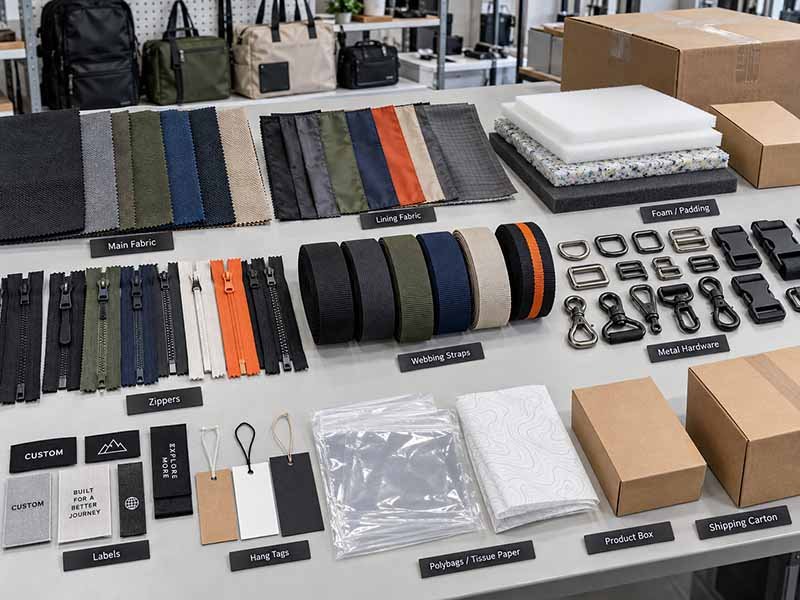
Material selection should begin with the use case rather than the fabric swatch book. Polyester, nylon, Oxford cloth, canvas, mesh, foam, EVA, PE or PP board, webbing, coated textiles, and different lining materials can all work well in pet products, but each combination creates different trade-offs in durability, weight, appearance, cleanability, cost, structure, and production difficulty.
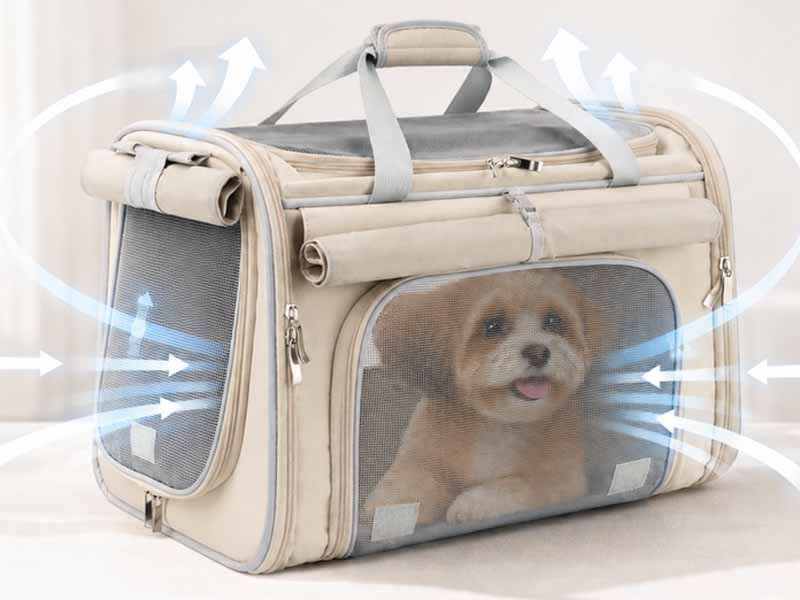
Mesh deserves particular attention because it may serve as ventilation, visibility, containment, and part of the visual design at the same time. A soft mesh can feel comfortable but may stretch too much under pressure. A heavier construction may offer better resistance but increase weight or reduce flexibility. A fine mesh may improve containment while changing airflow and visibility. The final selection should therefore be approved as a specification rather than described only as “breathable mesh.”
Zippers, sliders, buckles, hooks, webbing, padding, and internal tether points should also be treated as functional components. The exact specification matters because a visually similar replacement can behave differently. In repeat production, component consistency can be as important as fabric consistency.
| Product Area | Weak Requirement | Better Development Requirement |
|---|---|---|
| Intended pet | “Small dog” | Target animal size plus planned maximum working load |
| Bottom support | “Strong bottom” | Board material, thickness, cover, removability and acceptable loaded deformation |
| Mesh | “Breathable mesh” | Mesh type, panel size, stretch expectation and approved reference |
| Zipper | “Heavy-duty zipper” | Zipper type, slider arrangement, opening direction and security requirement |
| Carrying system | “Comfortable straps” | Strap width, padding, adjustment range and reinforcement |
| Interior | “Easy to clean” | Wipe-clean lining, removable washable pad or defined surface treatment |
| Branding | “Logo on front” | Method, exact size, color, placement and approved artwork |
| Travel sizing | “Airline size” | Exact external dimensions based on intended airline or transport requirement |
The key lesson is that the factory cannot consistently reproduce what the brand has never clearly defined.
Pet and Owner Experience
A successful pet carrier has two users. The animal needs appropriate space, ventilation, stable footing, safe surfaces, containment, and reasonable comfort. The owner notices product weight, shoulder pressure, handle balance, pocket placement, opening convenience, folding, storage, cleaning, and overall appearance.
These priorities can conflict. Increasing structure may improve stability but add weight. Enlarging mesh panels may improve airflow but reduce stiffness. Adding pockets may improve organization but increase material, labor, and visual complexity. Thick padding may feel premium while making the product warmer and more difficult to fold.
The objective is therefore not to maximize every feature. It is to build the right combination around a defined use scenario. A pet backpack intended for hiking may justify stronger structure and a more sophisticated harness system. A lightweight carrier for short city trips may need a simpler construction. A premium travel carrier may place more emphasis on refined materials, hidden reinforcement, quieter hardware, and easy-clean interiors.
Brands should give the manufacturer context, not just dimensions. Explain who will use the product, what kind of pet it is intended for, how long it may be carried, where it will be used, how it will be sold, and what retail price the product must support. Those inputs help the factory make engineering decisions that serve the product rather than simply adding features.
How Should Sampling and Product Development Work?

A strong sampling process should move from product brief to material review, pattern development, prototype construction, functional evaluation, documented revision, and final approval. The purpose is not simply to create one attractive sample. It is to build a production-ready reference that defines dimensions, materials, components, workmanship, branding, packaging, and critical performance expectations clearly enough for bulk manufacturing to repeat.
Sampling is one of the best places to judge a manufacturer because it exposes how the team responds when a product is still uncertain. A weak sampling process treats the prototype as an object: make one, send it, wait for comments, and change whatever the customer mentions. A stronger process treats every version as a series of decisions that gradually converts the concept into a controlled production specification.
The first prototype does not need to be perfect. In many cases, a sample that reveals five important problems is more useful than a beautiful sample that hides unresolved structural issues. The goal is to identify problems when they are still inexpensive to change. Adjusting a pattern, mesh panel, opening, strap position, or bottom board during sampling is far less costly than reworking hundreds or thousands of finished units.
Product sampling should also be realistic. Carriers should be loaded, lifted, worn, opened repeatedly, folded if applicable, and evaluated from both the pet and owner perspective. The product should be judged as something that will be used, not simply photographed.
From Brief to Prototype
Good sampling begins before the first piece of fabric is cut. The manufacturer should first identify what is already known and what still needs to be decided. A complete technical pack is helpful, but many successful products begin with far less: a reference sample, hand sketch, competitor link, CAD image, product photograph, or written concept.
A useful development brief should normally cover:
Product type and intended use
Target pet type and size
Planned maximum working load where relevant
Overall dimensions
Main fabric and lining
Mesh construction
Openings and closures
Handle or shoulder system
Storage requirements
Internal components
Branding method
Packaging concept
Target quantity
Sales market
Target price range
The first prototype then becomes a physical interpretation of that brief. It allows the brand and factory to evaluate proportions, access, structure, carrying comfort, visual balance, component placement, and manufacturability.
Rather than asking whether the sample is “good,” evaluate specific questions. Is the opening wide enough to load a reluctant pet? Does the base stay reasonably flat under the intended weight? Do the handles pull the product evenly? Is the mesh too soft around the front panel? Can the removable pad be taken out easily? Are pockets accessible while the bag is being carried?
That level of feedback moves development forward much faster than comments such as “make it better” or “feels a little weak.”
Revision Control
Sample revision becomes difficult quickly when changes are not documented. Imagine a product that reaches version four. Version two corrected the mesh. Version three changed the zipper and pocket size. Version four adjusted the shoulder straps and bottom board. If those decisions exist only across email and messaging threads, the risk of mixing versions increases significantly.
A simple version system is usually enough:
V1——V2——V3——Pre-Production Sample——Approved Production Sample
Each version should record what changed and why. The records do not need to be complicated, but numerical changes should be numerical whenever possible. “Front opening increased by 20 mm” is clearer than “opening made slightly bigger.” “Bottom board changed from 2.0 mm to 2.5 mm” is clearer than “make base stronger.”
Revision control also helps with costing. A larger pocket, thicker foam, additional reinforcement, custom zipper, or different packaging may affect material and labor. When every change is documented, the quotation can be updated transparently instead of creating disagreements after the product is already finalized.
Multi-SKU development makes this even more important. If several colors, sizes, or related styles are being developed together, a structured version system prevents one design’s correction from being applied incorrectly to another.
Approval to Production
An approved physical sample is extremely valuable, but it should not be the only production reference. A physical product cannot explain its own tolerances, component codes, color references, intended substitutions, or inspection priorities.
The approved sample should therefore be supported by a controlled specification containing important measurements, materials, components, logo details, labeling, workmanship points, and packaging requirements. Key materials and components should be identified clearly enough that purchasing and production teams know exactly what was approved.
Change control becomes especially important after the first order. Suppose a carrier performs well in a 500-unit launch, but the original mesh becomes unavailable six months later. A supplier finds something visually similar and uses it without approval. The replacement stretches more and feels rougher. From the factory’s perspective, the mesh was “close enough.” From the customer’s perspective, the product has changed.
This is one of the most common ways repeat-order inconsistency begins. Any substitution that may affect appearance, durability, function, compliance, or customer experience should be reviewed before production.
The purpose of documentation is not to create paperwork for its own sake. It is to protect the product decisions that made the approved sample acceptable.
How Do You Verify Quality, Safety, and Compliance?
Quality should be verified through measurable specifications, incoming checks, production inspections, functional checks, final inspection, and documented shipment release. Pet-product QC should pay particular attention to seams, mesh, zippers, hardware, load-bearing attachments, internal components, dimensions, cleanliness, branding, and packaging. Compliance should be reviewed according to the actual product, materials, target market, sales channel, and claims rather than assumed from generic factory certificates.
Almost every manufacturer says it has strict quality control, so the phrase itself provides very little information. A better evaluation asks when inspections occur, what is checked, who is responsible, what reference is used, and what happens when an issue is discovered.
A useful quality system begins before sewing. Fabric, mesh, lining, webbing, zipper, hardware, logo components, and packaging should be checked before they enter production. Once sewing starts, inline inspections can identify shape variation, incorrect seam construction, missing reinforcement, component placement problems, and workmanship issues while corrective action is still relatively inexpensive.
Final inspection has a different role. It verifies whether the completed lot is acceptable for shipment. It should not be the first time the product is seriously evaluated.
Build a Quality File
“Good quality” is not an inspection standard. Inspectors need to know what they are measuring, what they are comparing, and what constitutes a defect. That information should be developed alongside the product rather than created only after production has started.
Start with the approved sample and add measurable information wherever possible. Dimensions should have appropriate tolerances. Materials should be identified. Colors should be linked to approved references. Hardware and zippers should match confirmed specifications. Logo placement should have an agreed location. Important reinforcement points should be shown clearly.
Defects should also be considered by severity. A minor loose thread is not equivalent to a failed closure that could affect containment. Cosmetic and functional defects should be classified differently so the factory and inspection team understand the business impact.
For lot inspection, manufacturers and third-party inspectors commonly use statistical sampling approaches based on recognized systems such as ISO 2859. The appropriate inspection level and acceptance criteria should be decided according to the product and risk. Statistical sampling is useful, but it does not replace a product specification. An inspector cannot enforce a requirement that has never been defined.
For critical functional points, brands may choose more intensive checks. Some closure functions, labels, accessories, or other risk-sensitive items may justify 100% verification depending on the product and the consequence of failure.
Inspect the Right Points
Inspection is most effective when a problem is detected at the stage where it is created. Discovering incorrect fabric after cutting is expensive. Discovering the wrong zipper after sewing is even more expensive. Discovering missing reinforcement after the lining is closed may require partial disassembly.
A practical pet-bag quality plan can include:
| Stage | Main Check | Practical Reference |
|---|---|---|
| Incoming materials | Fabric, mesh, webbing, zipper, hardware, color | Approved specifications and swatches |
| Pre-production | Construction and final component combination | Approved pre-production sample |
| Cutting | Panel size, material direction, matching | Pattern and measurement requirements |
| Sewing | Seam quality, reinforcement, alignment, placement | Approved workmanship standard |
| Functional checks | Zippers, closures, straps, tether points, removable parts | Defined functional requirements |
| Finished dimensions | Length, width, height and key openings | Agreed tolerances |
| Appearance | Shape, stains, wrinkles, loose threads, logo | Approved sample and defect standard |
| Final inspection | Quantity, workmanship, function, assortment | Approved inspection plan |
| Packaging | Unit pack, labels, SKU, carton quantity | Packaging specification |
| Shipment release | Unresolved defects and inspection result | Formal acceptance before shipment |
The strongest quality system does not necessarily involve the greatest number of inspections. It checks the most important characteristics at the most useful stages.
If mesh specification is critical to performance, checking it before cutting is more valuable than finding the wrong mesh during final inspection. If handle reinforcement is important, inspecting it during sewing is better than trying to evaluate the internal structure once the bag is complete.
Quality is easier to build into a product than to inspect into it afterward.
Handle Safety and Claims Carefully
Pet carriers deserve additional attention because the product may affect the containment and welfare of a living animal. This does not mean every pet-related bag requires the same testing program. A treat pouch, grooming organizer, walking bag, and enclosed carrier present very different risks.
Testing and compliance should follow the actual product, material composition, use scenario, destination market, retail channel, and marketing claims. Brands should avoid collecting certificates simply to make a supplier file look impressive. The useful question is whether the documentation is relevant to the materials and product being sold.
Travel claims need particular care. Terms such as “airline approved” can create confusion because airlines may maintain their own policies concerning dimensions, pet weight, booking procedures, routes, and in-cabin acceptance. A carrier that fits one airline’s current dimensional rules may not automatically meet another airline’s requirements.
The safer approach is to define the intended use, verify relevant dimensions and requirements, and use accurate wording in product descriptions and packaging. A responsible manufacturer should help the brand understand what has actually been designed or tested rather than simply agreeing to any marketing claim.
Good compliance management protects the brand twice: first by reducing product risk, and second by reducing the risk of making claims that the product cannot reliably support.
What MOQ, Lead Time, and Capacity Fit Your Brand?
The right MOQ, lead time, and production capacity depend on the brand’s stage, product complexity, material minimums, color count, packaging, SKU structure, forecast, and reorder needs. Low MOQ can reduce inventory exposure but may increase unit cost or limit customization. Large production capacity matters only when the manufacturer can allocate enough of that capacity to your order during the production window you actually need.
MOQ is one of the first questions brands ask, but the headline number often provides less information than expected. A factory may accept 300 finished units, while a custom fabric supplier requires enough material for 1,000. A printed lining, custom buckle, molded component, zipper color, or branded carton can create separate minimums.
Color splitting also changes the economics. An order of 1,000 black carriers is much easier to manage than 1,000 units divided among ten colors. Both orders contain the same total quantity, but the second requires more materials, cutting changes, thread changes, component control, packaging separation, inspection, and inventory coordination.
The useful question is therefore not simply, “What is your MOQ?” It is, “What creates the MOQ for this product?”
Understand the Real MOQ
Brands should ask manufacturers to explain minimums at several levels:
Total order MOQ
MOQ per SKU
MOQ per color
Custom fabric minimum
Custom hardware minimum
Custom packaging minimum
Repeat-order minimum
Minimum for custom-dyed or printed materials
This becomes especially important when launching multiple styles. Five products multiplied by four colors already creates 20 SKU-color combinations before sizes or packaging variants are included. The total order may look large, while each individual combination is still small.
Szoneier’s objective company documentation states that selected custom bag projects can start from 200 pieces, while the exact minimum varies with material availability, color quantity, product structure, logo process, accessories, packaging, tooling, and testing requirements. This is a useful example of how MOQ should be treated: as an output of the actual product specification rather than as a universal factory number.
Lower MOQ is not always automatically better. A mature brand that sells thousands of units reliably may benefit from larger production runs, lower unit cost, more secure material reservations, and simpler replenishment planning. A startup validating a new design may prefer a higher unit cost in exchange for lower inventory exposure.
The right MOQ is therefore the quantity that balances product economics with inventory risk.
Plan Lead Time Backward
“Production takes 30 days” is not the same as “your product will arrive in 30 days.” A commercial launch may include product development, sample revision, custom material preparation, pre-production approval, bulk manufacturing, inspection, packaging, shipment booking, transit, customs, and warehouse receiving.
Planning should start from the required warehouse or launch date and work backward.
A realistic timeline may include:
Destination receiving buffer
International transportation
Export preparation
Final inspection
Packaging
Bulk production
Material preparation
Pre-production approval
Sample revision
Initial sample development
A simple product using stock fabric, standard hardware, and basic packaging can move much faster than a highly customized carrier with custom-dyed fabric, molded components, printed packaging, and several sample versions.
Instead of asking for one lead-time number, ask the manufacturer to separate sample time, material lead time, production time, packaging time, inspection time, and shipment preparation. This exposes the real bottlenecks and gives the brand options.
For example, if a custom zipper color adds several weeks to the schedule while a standard color produces almost the same appearance, the brand can decide whether the distinction is commercially worthwhile. Good sourcing decisions often come from understanding these trade-offs before the launch calendar becomes critical.
Capacity for Repeat Orders
Total factory capacity means very little unless some of that capacity is available when your order needs to be produced. A factory may truthfully state that it can produce 100,000 units per month while already having most of that production booked.
Ask what capacity can realistically be allocated to your program during the expected production window, especially around seasonal peaks and major holidays.
For growing products, material availability can become a larger bottleneck than sewing. If the approved fabric and hardware are standard and readily available, a repeat order may move much faster than the first launch. If the product relies on custom-dyed fabric, custom components, or specialized packaging, those upstream lead times remain.
Forecasting can help without requiring the brand to commit to unrealistic inventory. A three- or six-month rolling forecast gives the manufacturer visibility into possible reorder volumes and allows both sides to identify potential material or capacity constraints early.
This becomes even more important in multi-SKU programs. Five products, three colors, two sizes, and two packaging formats can create dozens of production combinations. The supplier should have a system for controlling versions, labels, materials, quantities, and shipment allocation.
Brands rarely outgrow a supplier because the factory suddenly forgets how to sew. They often outgrow suppliers because increasing product complexity becomes difficult to control.
How Do You Compare Manufacturers Before Choosing One?

Compare manufacturers with a structured scorecard covering product development, pet-specific engineering, sample execution, materials, quality systems, production capability, commercial fit, communication, logistics, and factory transparency. Price should remain part of the decision, but it should not dominate it. After shortlisting suppliers, validate the strongest candidate through sample development and, where practical, a controlled first production order before committing a large inventory budget.
Supplier selection becomes less reliable when decisions depend mainly on impressions. One factory has the nicest showroom. Another sends the fastest quotation. A third offers the lowest unit price. A fourth produces the strongest sample. Without a common framework, the team may give too much weight to whichever variable is easiest to see.
A structured scorecard creates discipline without pretending that supplier selection can be reduced to perfect mathematics. The purpose is not to claim that a factory scoring 91 is scientifically better than one scoring 89. The value is that the purchasing and product teams must explain why each supplier receives its score and which risks they are willing to accept.
Use a Weighted Scorecard
The weighting should reflect the product. A technically complex pet backpack may put more emphasis on engineering, sampling, and quality control. A simple branded treat pouch may place more weight on cost, color consistency, material availability, and delivery.
The following 100-point model provides a practical starting point:
| Evaluation Area | Suggested Weight | What to Verify |
|---|---|---|
| Product development | 15 | Ability to turn ideas, samples or tech packs into production specifications |
| Pet-specific engineering | 15 | Structure, load, ventilation, containment and usability understanding |
| Sample execution | 10 | Accuracy, revision quality and problem-solving |
| Quality system | 15 | Incoming, inline, final and corrective-action processes |
| Materials and components | 10 | Sourcing, consistency, alternatives and traceability |
| Production capability | 10 | Relevant equipment, workflow, capacity and repeatability |
| Commercial fit | 7 | MOQ, price structure and cost transparency |
| Communication | 5 | Technical accuracy and documentation |
| Packaging and logistics | 5 | SKU control, labeling and shipment preparation |
| Factory transparency | 8 | Process visibility and evidence of manufacturing control |
| Total | 100 |
The exact weight can change, but the principle remains useful. If one supplier is 8% cheaper but weak in sample control and material traceability, the team can decide whether that saving compensates for additional risk. Without a framework, that trade-off may never be discussed until something goes wrong.
Ask Questions That Expose Risk
Most suppliers are prepared for standard questions such as MOQ, price, sample time, production lead time, and logo customization. Those questions are necessary, but they rarely show how deeply the manufacturer understands the product.
Ask questions that force the supplier to analyze risk:
Which part of our design will be hardest to manufacture consistently?
What would you change before sampling?
Which component creates the highest supply risk?
What typically causes defects in this type of product?
Which construction point should be inspected during production?
What happens if the approved material becomes unavailable?
What would become the bottleneck if our volume doubled?
Which feature is adding cost without adding much user value?
Experienced manufacturers usually have opinions. They may point out that the proposed mesh opening is too close to a stress seam, the selected bottom board will make folding difficult, the chosen fabric is unnecessarily expensive, or a custom buckle creates an avoidable MOQ problem.
That does not mean every suggestion should be accepted. It means the supplier is thinking about the product rather than simply calculating material and labor.
One of the most useful questions is also one of the simplest: What could go wrong with this product during bulk production?
A manufacturer that identifies realistic risks and explains how they would be controlled is often more valuable than one that promises there will be no problems.
Validate with Real Production
A strong sample does not automatically guarantee a strong production relationship. Sampling is concentrated work. A skilled sample technician may spend hours refining one unit. Bulk production asks a different question: can the same result be repeated across hundreds or thousands of units while materials, operators, quality checks, packaging, deadlines, and documentation are managed simultaneously?
A controlled first production order can therefore reveal much more than the sample itself.
Evaluate the manufacturer throughout the project, not only after the cartons arrive. Track quotation accuracy, material approval, sample revisions, documentation quality, production updates, change management, inspection results, packaging accuracy, shipment preparation, and the response to unexpected problems.
After products reach customers, continue learning. Returns, reviews, customer-service messages, and warranty claims can reveal issues that were invisible during development. Perhaps the shoulder strap becomes uncomfortable after extended use. Maybe one zipper direction feels awkward. Perhaps pet hair collects around a specific closure. Some of these issues may be design problems, while others may be manufacturing inconsistency.
Share useful feedback with the manufacturer before the next production run.
This is where long-term manufacturing relationships become valuable. The second order should be easier to control than the first. The third should be more stable than the second. Approved improvements should remain in the specification rather than disappearing when staff or production lines change.
The objective is not simply to find a factory that can make one acceptable bag. It is to build a manufacturing system that can learn, repeat, and scale the product without losing control.
Conclusion
Choosing a bag manufacturer for a pet product brand is ultimately a risk-management decision disguised as a sourcing decision. The sewing itself is only one part of the process. The more important questions concern whether the manufacturer understands the product, converts vague ideas into controlled specifications, identifies structural and material risks early, manages sample revisions, protects sample-to-bulk consistency, and remains reliable when the order grows from a trial run into repeat production.
A good supplier should make the product easier to understand, not more confusing. As development progresses, dimensions should become clearer, materials should become more defined, component choices should become more deliberate, testing and quality points should become easier to explain, and commercial expectations should become more predictable. If uncertainty increases rather than decreases after multiple sampling rounds, that is usually a warning sign.
For pet carriers and other functional pet bags, the best results come when brands treat the manufacturer as part of the product-development process rather than as a sewing resource selected after the design is finished. The factory should be able to challenge difficult details, suggest practical alternatives, explain manufacturing limitations, and turn approved decisions into repeatable production controls.
That approach also makes supplier evaluation more objective. Instead of choosing a factory because it has the lowest quotation, the most polished website, or the fastest salesperson, compare evidence across development capability, pet-specific engineering, materials, sampling, quality, capacity, commercial fit, communication, and transparency.
The final principle is simple: buy evidence before buying promises. Review relevant products, understand the manufacturing workflow, test the sample in realistic conditions, define measurable requirements, confirm quality checkpoints, understand MOQ and lead-time drivers, and evaluate repeat-production capability before committing a large inventory budget.
A manufacturer that can support this process is not merely making a bag. It is helping the brand build a product that can survive real use, customer expectations, repeat orders, and long-term growth.
Frequently Asked Questions
What should I ask a pet bag manufacturer before placing an order?
Before placing an order, ask about similar products the factory has made, sample-development procedures, materials, component sourcing, MOQ per SKU and color, production lead time, quality checkpoints, inspection standards, packaging, and repeat-order planning. You should also ask which parts of your design the manufacturer considers difficult or risky. The answer often reveals more technical knowledge than a standard company presentation because experienced factories usually understand where problems may appear before bulk production begins.
What is a reasonable MOQ for custom pet bags?
There is no single industry-wide MOQ because the minimum depends on product complexity, materials, colors, accessories, logo method, packaging, and whether custom components are required. Some manufacturers can support a few hundred units for selected designs using available materials, while highly customized projects may require larger quantities. Brands should request MOQ by total order, SKU, color, fabric, hardware, and packaging rather than relying only on one headline number.
How long does custom pet carrier production take?
The total timeline should include product development, sample revisions, material preparation, pre-production approval, bulk production, inspection, packaging, and shipment preparation. A simple design using stock materials can move much faster than a carrier using custom-dyed fabrics, specialized hardware, printed packaging, and several prototype rounds. Instead of asking for one overall lead-time number, request separate estimates for sampling, materials, production, packaging, inspection, and shipment preparation so launch planning is more realistic.
How do I know if a pet bag factory has good quality control?
Ask the factory to explain its quality-control process by production stage. A stronger system normally checks incoming materials, pre-production samples, cutting, sewing, critical functional points, finished dimensions, appearance, packaging, and final shipment quality. Ask to see inspection criteria and examples of how defects are classified. The most reliable suppliers can explain what happens when something fails inspection, who approves corrective action, and how the same issue is prevented from appearing in repeat production.
Should I choose the pet bag manufacturer with the lowest price?
The lowest quotation can be attractive, but price should be compared with development quality, materials, workmanship, defect risk, MOQ, lead time, communication, packaging, and repeat-order reliability. A supplier that is several percent cheaper may become more expensive if materials change unexpectedly, revisions are poorly controlled, shipments are delayed, or customers return products. Compare total commercial risk rather than unit price alone, especially for products where structure and durability affect the customer experience.
What materials are commonly used for pet carriers?
Common materials include polyester, nylon, Oxford fabrics, mesh, webbing, foam, EVA, PE or PP board, coated fabrics, and various lining materials. The correct choice depends on the carrier’s intended pet weight, structure, ventilation, cleaning requirements, appearance, price, and use scenario. Material specifications should be agreed during sampling and recorded carefully because two fabrics or mesh constructions that look similar may perform differently when exposed to load, abrasion, pet claws, cleaning, or repeated use.
How can I keep repeat pet bag orders consistent with the first order?
Consistency improves when the approved sample is supported by written specifications for dimensions, materials, components, colors, branding, packaging, and critical workmanship details. The manufacturer should maintain version control and require approval before changing important materials or components. Before every repeat order, confirm whether the original fabrics, mesh, hardware, packaging, and other key materials are still available. Comparing repeat production against the approved reference helps prevent gradual changes that customers may notice even when the SKU name remains the same.