Skip to content
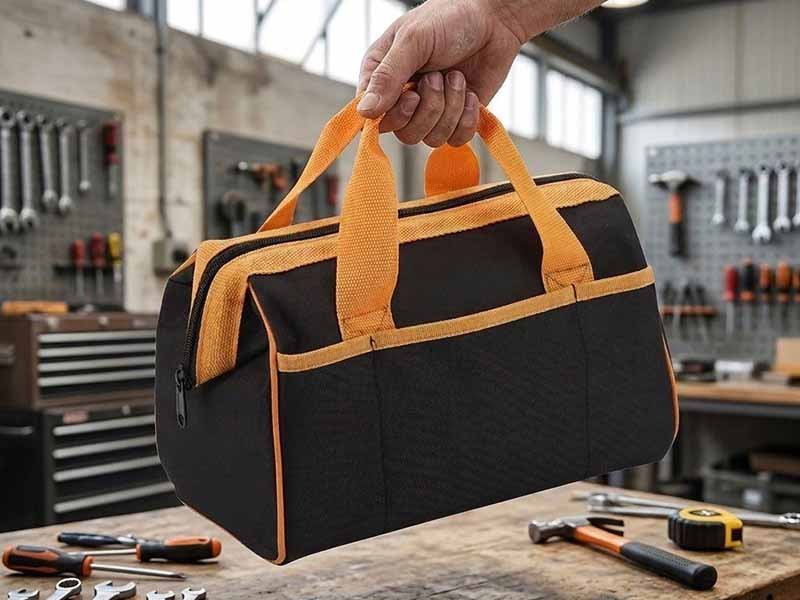
A professional tool bag often looks much simpler than it really is. From the outside, it may appear to be little more than fabric, handles, pockets, zippers, and a reinforced bottom. Once tools are loaded into it, however, every part of the product begins interacting with every other part. Heavy pliers pull against pocket seams, drill batteries push against bottom panels, loaded handles transfer force into side walls, and repeated opening and closing places stress on zippers, sliders, stitching, and surrounding fabric. A design that looks excellent in a showroom can behave very differently after months of daily use on a construction site, in a service vehicle, or inside an industrial maintenance environment.
Choosing a tool bag manufacturer is therefore not simply a matter of finding a factory that can sew the shape shown in a drawing. Industrial brands need a manufacturing partner that understands how the product will be used, where it is likely to fail, which materials and structures are appropriate, how the sample should be validated, and how the approved design can be reproduced consistently in bulk production.
The right tool bag manufacturer should combine relevant functional-bag experience, material and structural knowledge, controlled sample development, reliable quality management, transparent production processes, and repeat-order discipline. Price is important, but a lower quotation has little value if the factory cannot control reinforcement, components, sample-to-bulk consistency, production quality, delivery, and future reorders.
Consider a common sourcing situation. A brand approves a visually impressive sample, places an order for several thousand pieces, and later discovers that the bulk production uses slightly softer webbing, a different zipper slider, shallower tool pockets, and weaker handle reinforcement. None of those changes may look dramatic when each one is viewed separately, yet together they can turn a strong prototype into a disappointing commercial product. The purpose of supplier selection is to reduce that gap before the purchase order becomes expensive.
What Makes a Tool Bag Manufacturer Reliable?

A reliable tool bag manufacturer combines relevant product experience, engineering judgment, controlled development, production visibility, documented quality checks, and the ability to repeat an approved product over time. Factory size, catalog size, and low pricing can be useful commercial indicators, but they do not prove that a supplier can manage an industrial bag program. Reliability becomes visible when the manufacturer can explain how a product will be developed, tested, produced, inspected, corrected, and reproduced.
Relevant Manufacturing Experience
Industrial bag experience should be evaluated by construction difficulty rather than product name alone. A factory that has produced thousands of lightweight shopping bags may be highly efficient at simple sewing but still have limited experience with thick multi-layer assemblies, rigid boards, dense pocket systems, molded components, large zippers, heavy webbing, and load-bearing attachment points. Tool bags require the factory to understand how different components behave together after the product is filled with metal tools and repeatedly carried.
Relevant manufacturing experience may come from tool bags, technician bags, electrician bags, tactical bags, hunting bags, medical equipment cases, work backpacks, meter cases, or other functional sewn products. What matters is whether the supplier has solved similar engineering problems. A manufacturer that has already worked with structured bottoms, heavy handles, reinforced pockets, hard components, and repeated load-bearing seams is usually better prepared for industrial applications than a factory whose experience is mainly decorative or promotional products.
When reviewing previous products, examine details rather than product photographs alone. Look at how far handle webbing extends into the body, how external pockets are reinforced, whether bottom corners are protected, how thick seam intersections are handled, and whether hardware is supported by backing materials. These details reveal manufacturing knowledge far more clearly than a large catalog containing hundreds of unrelated styles.
Useful points to verify include:
Products carrying similar expected loads.
Experience with 600D, 900D, 1200D, or 1680D-class woven fabrics.
Experience with #8 or #10 zipper constructions where appropriate.
38–50 mm webbing used in handles or carrying systems.
PE, PP, EVA, or molded reinforcement components.
Multi-pocket products requiring controlled spacing.
Products combining fabric, foam, boards, hardware, and retail packaging.
These figures are not universal quality standards. They simply provide concrete comparison points that help brands evaluate whether the supplier has worked with similar materials and construction challenges.
Product Understanding
A strong manufacturer normally asks more questions than a quotation-only supplier. Before finalizing materials or construction, the factory should understand what the bag will carry, how much the finished load is expected to weigh, which tools are used most frequently, whether the product will be exposed to moisture or abrasive surfaces, and whether users will carry it occasionally or repeatedly throughout a working day.
A service technician carrying electronic meters has different needs from a construction worker carrying drill batteries, hammers, and large hand tools. An electrician may value rapid access to many narrow pockets, while a maintenance team may prioritize shoulder comfort and secure vehicle storage. These differences influence pocket dimensions, zipper opening geometry, bottom rigidity, handle routing, fabric selection, reinforcement, and total product weight.
A manufacturer that immediately quotes from a rendering without discussing the use environment may still be able to sew the bag, but it may not be evaluating the product as a functional system. A development-focused factory is more likely to ask practical questions about loaded weight, tool dimensions, access frequency, floor contact, working conditions, and expected product life before recommending a final construction.
That conversation is often one of the best early indicators of whether the supplier understands industrial products or is simply converting a drawing into labor minutes and material cost.
Process Control
A custom tool bag may contain far more individual variables than it appears to have. Main fabric, lining, webbing, zipper tape, sliders, buckles, hooks, reinforcement boards, foam, binding, thread, labels, printing, embroidery, molded components, packaging, and carton requirements may all need to be coordinated. If these decisions are scattered across several uncontrolled suppliers, small changes can enter the product without being noticed until bulk production is nearly complete.
A reliable manufacturing process connects development directly to production. The approved sample should be supported by measurements, material references, component specifications, construction information, artwork files, packaging requirements, and inspection points. Production teams should be able to identify which version is current and which previous versions are obsolete.
The most useful QC question is therefore not simply, “Do you have inspectors?” A better question is, “What is checked before sewing, during production, and before packing?” A supplier that can explain incoming material inspection, first-piece review, in-process checks, final inspection, and defect correction has a more meaningful quality system than one that only promises “strict QC.”
Finding a handle-position problem after the first 20 units is manageable. Finding the same problem after 3,000 completed bags is expensive. Good process control is largely about finding problems at the stage where they are still inexpensive to correct.
Evidence Before Trust
Supplier claims become useful only when they are supported by evidence. Statements such as “professional manufacturer,” “high quality,” and “strict quality control” are common throughout the industry, but they do not allow a procurement or product team to judge actual capability. Practical evidence gives the brand something concrete to compare.
Useful evidence may include similar finished products, detailed production photographs, factory videos, material swatches, approved sample records, inspection sheets, test reports where relevant, packaging examples, and live factory reviews. Each piece of evidence should support a specific manufacturing claim instead of simply decorating a company profile.
| Supplier Claim | Useful Evidence | What It Helps Verify |
|---|---|---|
| Relevant tool bag experience | Similar finished products | Construction knowledge |
| Heavy-duty capability | Reinforcement samples and loaded tests | Structural understanding |
| Stable materials | Swatches and BOM records | Repeat-order consistency |
| Controlled QC | Inspection records | Production management |
| Stable bulk production | Sample-to-bulk comparison | Reproducibility |
| Repeat-order support | Retained specifications | Long-term program control |
A strong evidence chain is easy to understand: requirement, material specification, approved sample, production standard, inspection record, test evidence, and shipment approval. When those steps connect clearly, sourcing becomes less dependent on promises and more dependent on verifiable manufacturing behavior.
Which Materials Work for Industrial Bags?

Industrial bag materials should be selected according to load, abrasion, moisture, weight, structure, appearance, cost, and expected service conditions. Polyester, nylon, Oxford constructions, canvas, coated fabrics, reinforcement boards, webbing, and molded components can all perform well when used correctly. The best material is not automatically the heaviest option, because finished-product durability depends on fabric construction, coating, seams, reinforcement, hardware, and the way the load is distributed.
Fabric Selection
One of the most common mistakes in industrial bag development is treating denier as a complete measure of quality. Terms such as 600D, 900D, or 1680D are useful descriptions of yarn size, but they do not tell the entire story. Two fabrics carrying the same 600D label can differ noticeably in weave density, yarn quality, coating, finished weight, hand feel, abrasion resistance, and actual breaking performance.
A well-made 600D polyester can be entirely appropriate for a general-purpose tool organizer, while a heavier 1200D or 1680D-class fabric may be better suited to high-wear panels or a premium heavy-duty product. Nylon can offer an attractive strength-to-weight balance in applications where the budget supports it, while canvas works well for brands seeking a traditional workwear character and natural surface appearance.
The important question is not, “What is the strongest fabric available?” The better question is, “What construction provides sufficient performance for this use without adding unnecessary weight, stiffness, cost, or manufacturing complexity?”
| Material Type | Common Application | Strength | Trade-Off |
|---|---|---|---|
| 600D polyester | General organizers and tool bags | Cost-effective, widely available | Quality varies greatly by construction |
| 900D polyester/Oxford | Medium-heavy functional bags | More body and abrasion potential | Increased weight and cost |
| 1200D–1680D fabric | High-wear or heavy-duty areas | Rugged structure and appearance | More stiffness and sewing difficulty |
| Nylon | Premium functional applications | Strong toughness-to-weight potential | Higher cost |
| Canvas | Workwear-style products | Natural, durable visual character | Heavier and more moisture-sensitive |
| TPU/PVC-coated fabric | Wet or dirty environments | Cleanability and moisture protection | Added construction complexity |
Many strong industrial designs use several materials instead of one fabric everywhere. A bag may use a moderate-weight body fabric, heavier material on the bottom and corners, additional backing behind handles, and specialized coated material in areas exposed to dirt or moisture. This selective approach can improve durability while keeping the empty bag lighter and more comfortable to use.
Coatings and Surface Protection
Coatings can change the behavior of a textile significantly. PU-backed fabrics are commonly used when improved water resistance is needed without making the material excessively rigid. PVC-coated textiles can provide a heavier protective surface that is easier to clean in certain industrial environments. TPU materials may be considered where flexibility, moisture control, or more advanced performance characteristics are important.
The key distinction is between fabric performance and finished-bag performance. A fabric itself may resist water well, but a sewn bag still contains needle holes, zipper openings, bound seams, and construction details through which moisture can enter. Calling a fabric waterproof does not automatically make the finished bag waterproof.
Product teams should define the actual requirement before choosing a material. A bag exposed to occasional rain needs a different construction from one that must sit on wet concrete for extended periods. A workshop product exposed to grease and dirt may prioritize cleanability, while an indoor technician bag may prioritize appearance, lighter weight, and a softer hand feel.
Clear performance language matters. “Water-resistant,” “wipe-clean,” “splash-resistant,” and “waterproof” do not describe the same product. The more precise the requirement is during development, the less likely the final marketing claim will exceed what the product can actually deliver.
Zippers, Webbing, and Hardware
A tool bag can use an excellent main fabric and still fail because of a weak zipper, poorly attached handle, underspecified buckle, or thin webbing. These components deserve the same level of attention as the body material because they often experience concentrated stress and repeated operation.
Larger zipper sizes such as #8 or #10 are often considered for heavier bag constructions, but zipper size alone does not guarantee durability. Chain type, slider quality, puller design, installation geometry, sewing method, and the amount of pressure placed on the opening all affect long-term performance. A large zipper that must constantly close against an overfilled opening may perform worse than a smaller zipper used in a better-designed structure.
Webbing should also be evaluated beyond width. A 38 mm or 50 mm handle can still vary in fiber, thickness, weave, elongation, surface feel, and actual strength. More importantly, the way the webbing is attached to the product can matter as much as the webbing itself. A strong strap connected to a weak panel still creates a weak system.
Buckles, D-rings, snap hooks, rivets, molded feet, binding, hook-and-loop closures, and shoulder hardware should all be treated as controlled components in long-term programs. When a product is expected to remain unchanged across repeat orders, these seemingly small parts can have a large influence on consistency.
Material Stability
Material stability becomes particularly important after a successful first production run. A black industrial bag may contain several different black materials, including body fabric, lining, webbing, zipper tape, binding, plastic hardware, and printed or molded parts. If each component changes slightly between orders, the finished product can look noticeably different even though every part is still technically described as black.
For long-term programs, approved swatches, component samples, color references, BOM information, packaging records, and a finished approval sample should be retained. The supplier should also have clear rules for material substitution. Some components can be replaced by an equivalent option with minimal impact, while others should not change without written approval.
This becomes especially important when the original material supplier discontinues a construction or when a custom color is no longer available at the same MOQ. A responsible manufacturer should identify the issue before production begins, present the proposed alternative, and obtain approval rather than quietly changing the specification.
Repeat-order consistency is not only a manufacturing requirement. It is also a brand requirement. Customers who buy the same product again often expect the same texture, stiffness, color, zipper feel, and overall appearance. A controlled material system protects that expectation.
How Is a Heavy-Duty Tool Bag Engineered?

A heavy-duty tool bag is engineered by controlling how force moves through handles, webbing, seams, panels, pockets, bottoms, and hardware. Strong fabric alone cannot compensate for poor load distribution. Durable products normally place reinforcement where forces concentrate, protect high-wear areas, and maintain functional access without turning the empty bag into an unnecessarily heavy or rigid object.
Stress Points and Load Paths
Every loaded bag has a mechanical path through which force moves. When a user lifts a 12 kg tool bag, that load is transferred from the contents into the bottom, side structure, handle webbing, stitching, and grip. If the handle webbing ends close to the top edge of a thin side panel, much of the stress may concentrate in a relatively small area. If the webbing continues farther down the body or integrates into the bottom structure, the force can be distributed across a larger region.
The same principle applies to shoulder-strap anchors, large external pockets, zipper ends, divider panels, and hardware attachments. A pocket carrying several kilograms of metal tools may pull heavily at its upper corners, making those small areas more important than large sections of the bag that carry almost no stress.
Common reinforcement methods include bar tacking, box-and-cross stitching, backing patches, multiple stitching rows, webbing overlays, extra fabric layers, folded structural seams, and rivets. Each method has a purpose, but none should be added simply because it looks heavy duty.
A useful development exercise is to identify every point where the user lifts, pulls, opens, closes, drops, or loads the bag. Those areas should receive the closest engineering review because they are where long-term failure is most likely to begin.
Handles and Bottoms
Handles and bottom structures carry a large share of the mechanical work in a professional tool bag. Handle performance depends on more than the grip itself. Webbing width, thickness, attachment length, sewing pattern, spacing, backing material, and the path of the webbing through the body all influence how effectively the load is distributed.
Bottom construction should be selected according to the environment. A simple organizer may only require doubled fabric, while a larger technician bag may benefit from PE or PP board, EVA, additional textile layers, reinforced corners, molded feet, or a complete molded base. Products that are repeatedly placed on concrete or rough industrial floors need more abrasion protection than bags used mainly inside service vehicles.
The interior of the bottom also deserves attention. Screwdrivers, drill bits, batteries, and other rigid tools can create concentrated pressure from inside the bag. A hard board with unprotected edges can eventually damage the surrounding fabric, while a poorly designed rigid base can create uncomfortable weight and packing inefficiency.
A molded base may provide excellent stability and moisture separation, but it adds tooling, component MOQ, storage volume, weight, and supply-chain complexity. The most appropriate construction is therefore not necessarily the most rigid. It is the simplest structure that reliably meets the actual use requirement.
Pocket Layout
Pocket count has become a common marketing feature, but a high number of pockets does not automatically create a useful product. A bag with 25 well-designed compartments may be more practical than one with 45 poorly sized pockets because professional users care about access speed, visibility, tool security, and ergonomic movement.
Pocket development should begin with an inventory of real tools. Record the longest item, widest tool, thickest grip, heaviest single object, frequently used items, and any sharp-edged components that require extra protection. Those measurements provide a practical foundation for sleeve width, pocket depth, elastic spacing, divider structure, and opening angle.
The design also needs to be tested after the main compartment is fully loaded. A pocket that appears spacious on an empty prototype may become difficult to use when a drill or battery pushes against it from the opposite side. External pockets may become compressed when the bag is placed against a wall or inside a vehicle compartment.
Physical testing remains one of the best development tools. Load the prototype with realistic objects, carry it, place it on the floor, open it while standing, retrieve frequently used items, and repeat the process while wearing gloves if that reflects the actual working environment.
The goal is not to create the largest number of features. It is to make professional work faster and more predictable.
Strength Without Excess Weight
Industrial brands often focus so strongly on durability that they unintentionally create a product that is heavier than necessary. If every panel uses very heavy fabric, every seam receives multiple reinforcement layers, every wall contains thick foam, and every section includes rigid board, the empty bag may become burdensome before any tools are loaded.
The effect can be significant. If a technician carries 10–15 kg of tools and the bag itself is unnecessarily 1 kg heavier than required, the additional dead weight represents roughly 7–10% of the total carrying load in that example. For a user moving through several service calls during a day, that difference can be noticeable.
A good prototype review should therefore measure more than strength. Useful data includes:
Empty bag weight.
Intended loaded weight.
External dimensions.
Usable internal dimensions.
Opening width.
Handle drop.
Shoulder-strap adjustment range.
Bottom dimensions.
Pocket depth and width.
Stability when loaded.
A strong industrial product is not one that uses the maximum amount of material. It is one that uses the correct amount of material in the correct places. This approach usually improves carrying comfort, production efficiency, cost control, and visual balance at the same time.
How Do You Verify Quality Before Production?
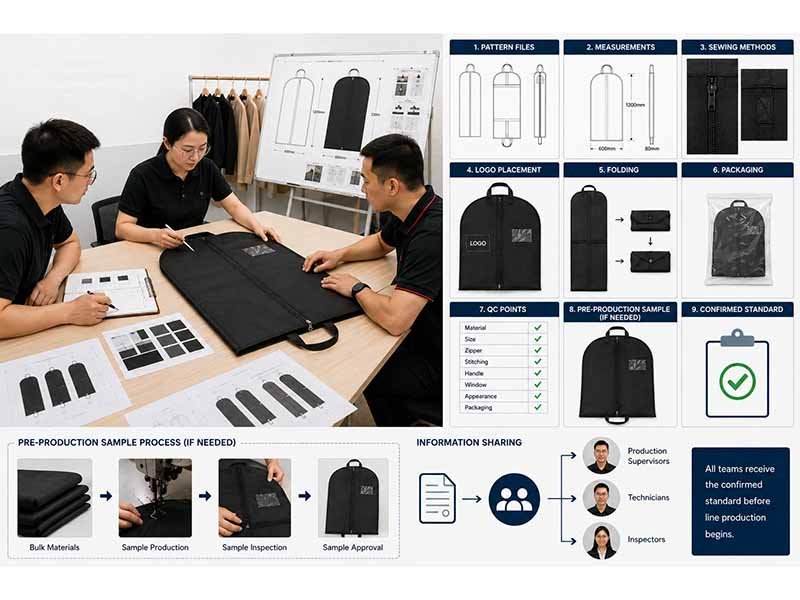
Quality should be verified before mass production by converting the approved design into measurable specifications. Materials, dimensions, reinforcement, hardware, branding, packaging, and important performance requirements should be confirmed before the production line runs at full volume. The approved sample, measurement chart, BOM, workmanship standards, and relevant test requirements then become references for material inspection, in-process control, final inspection, and future reorders.
Prototype Validation
A prototype should answer practical questions rather than simply show how the finished bag might look. The first question is whether the design works. Can the intended tools fit? Does the opening provide enough access? Does the product stand correctly when loaded? Do pockets remain usable? Does the bottom deform? Does the zipper move smoothly when the bag is full?
The second question is whether the construction can be produced consistently. A skilled sample technician can sometimes build a complicated design through slow manual adjustment, but that does not guarantee efficient mass production. Thick seam intersections, inaccessible stitching areas, complicated binding, difficult hardware positions, and excessive component counts can create significant variation on a production line.
The third question is whether visual expectations are measurable. Comments such as “make the pocket deeper,” “move the logo slightly,” or “make the handle longer” are too subjective for controlled manufacturing. Product teams should replace those instructions with finished dimensions, defined positions, and measurable revision points.
A strong sample process also records revisions clearly. If Sample 2 changes handle construction, pocket dimensions, and bottom reinforcement, those changes should be documented rather than left inside a messaging thread. This makes later production approval much easier and creates a useful technical history for repeat orders.
Sample and Specification Lock
The final approved sample is one of the most important production references, but a physical sample alone is not enough. It communicates shape, hand feel, overall stiffness, visual balance, and many three-dimensional details effectively, yet it does not explain which dimensions are critical, which components may be substituted, or what level of variation is acceptable.
A controlled specification package may include finished dimensions, tolerance ranges, fabric references, lining, webbing, zipper specification, hardware, foam, reinforcement board, thread, logo artwork, label position, packaging method, barcode information, and any important workmanship instructions.
Tolerance should be applied carefully. A few millimeters may be commercially insignificant on a large flexible outer panel but very important on a tool sleeve, molded component, zipper opening, or location where the bag must fit into a defined vehicle compartment.
Not every dimension needs the same tolerance, and not every visual detail carries the same risk. Product teams should identify critical dimensions separately from less important cosmetic measurements.
For long-term products, these records should remain available after the first shipment. Repeat orders made twelve months later should be compared against the controlled standard rather than the memory of the original development team.
Testing the Right Risks
There is no single universal tool bag test that proves every product is suitable for every application. Testing should follow the most likely failure modes of the specific design. A large open tool tote may require particular attention to handle attachments and bottom abrasion, while a technician backpack may place greater importance on shoulder anchors, zipper operation, and carrying comfort.
| Risk Area | Possible Verification | What It Helps Reveal |
|---|---|---|
| Handle attachment | Static or repeated loaded lift | Weak stitching and load concentration |
| Main fabric | Tensile, tear, or abrasion testing | Material durability |
| Zipper | Strength and operating checks | Closure reliability |
| Seams | Seam-strength evaluation | Construction weakness |
| Bottom | Abrasion and loaded-use simulation | Wear resistance |
| Shoulder strap | Loaded attachment testing | Anchor durability |
| Hardware | Pull or attachment checks | Component security |
| Moisture exposure | Water-resistance evaluation | Actual protection level |
Standardized textile and zipper methods can provide repeatable laboratory procedures, but the test method and acceptance requirement are separate decisions. A brand still needs to determine what performance level is appropriate for its product, its intended working load, and the claims it plans to make in the market.
Internal simulation is also valuable. Loading a prototype with a controlled weight and performing repeated lifts can reveal handle deformation, seam movement, bottom sagging, or hardware problems that may not be visible during a simple visual inspection.
Claims should always reflect the available evidence. Water-resistant fabric should not automatically become a waterproof product claim. Reinforcement should not automatically become “industrial grade.” Testing should identify what was tested and under what conditions whenever the distinction matters commercially.
Production Quality Control
Good production quality control begins before sewing starts. Incoming material checks can confirm that the correct fabric, webbing, zipper, hardware, colors, and other components have arrived. This prevents incorrect materials from entering the production line and becoming expensive finished-product problems.
Early production review is equally important. The first completed units should be compared with the approved sample and controlled specification before the entire order is produced. This is a practical stage for checking handle reinforcement, critical dimensions, pocket positions, logo placement, zipper installation, bottom construction, and hardware attachment.
In-process inspection then helps prevent repeated defects. If a pocket depth is incorrect on the first production batch, correcting the pattern or sewing guide immediately is much more efficient than reworking hundreds of finished pieces.
Final inspection evaluates finished workmanship, measurements, function, quantity, packaging, labeling, and carton information. For larger orders, AQL-based sampling may be part of the agreed inspection plan, but it should be understood as an acceptance method rather than a replacement for production control.
The most meaningful difference between weak and strong QC is timing. Weak systems discover defects after they have been created. Strong systems try to prevent the same defect from being repeated throughout the order.
Can the Factory Scale OEM/ODM Production?
A factory can scale OEM/ODM production when it can move from development to repeat orders without losing control of specifications, materials, quality, production timing, or communication. Brands should evaluate more than a stated monthly capacity figure. The more useful questions concern how the factory handles tech packs, early-stage ideas, MOQ, custom components, multi-SKU programs, peak-season scheduling, production revisions, and repeat-order records.
OEM and ODM Capability
OEM and ODM projects begin at different points in product development. In a mature OEM program, the brand may already have a complete tech pack, finished dimensions, material specifications, artwork, Pantone references, packaging files, and testing requirements. The manufacturer’s primary job is to interpret those documents correctly and reproduce the design with discipline.
An ODM project may start with far less information. A customer might provide reference photographs, a rough sketch, a list of tools, an approximate size, a target price, and a desired market position. The manufacturer then needs to contribute more heavily to materials, structure, pattern development, pocket organization, reinforcement, sampling, and manufacturability.
Neither model is more professional than the other. They simply require different supplier capabilities.
A useful way to evaluate a factory is to send the type of information your team normally works with and study the questions that come back. A technically experienced supplier may identify conflicting dimensions, materials that are difficult to sew in a proposed seam, missing tolerance information, or an unsupported handle structure before the sample is made.
Those questions are valuable because they demonstrate how the supplier thinks about the product.
For brands that require development support, the ability to identify problems before sampling can save more time than simply producing the first prototype quickly.
MOQ and Commercial Scale
MOQ is often discussed as though it were a single number controlled by the bag factory, but the real minimum may come from several different sources. The sewing factory may be willing to produce 300 pieces, while a custom-dyed fabric mill requires a larger material quantity, a molded component requires tooling and its own production minimum, and printed retail packaging has a different MOQ again.
For this reason, one of the most useful questions is not “What is your MOQ?” but “Which components determine the MOQ for this project?”
A new product can often reduce initial risk by using more stock components. Stock black fabric, standard black webbing, standard zipper colors, existing buckles, and a custom logo may allow the brand to validate demand without committing to every custom detail in the first run.
Once the product proves itself, later generations can introduce custom-dyed fabric, proprietary zipper pullers, molded hardware, specialized packaging, or other higher-MOQ elements.
This does not mean every brand should simplify its first product. Premium positioning may require custom components from the beginning. The purpose is to understand where the commercial pressure comes from and decide whether each custom feature creates enough value to justify the initial commitment.
MOQ becomes easier to manage when it is treated as a product-engineering variable rather than a fixed website number.
Multi-SKU Management
Industrial product programs frequently grow from one bag into a family of related products. A brand may eventually sell an open tool tote, technician backpack, drill bag, meter case, small organizer, belt pouch, and several sizes of the same platform.
At that point, the challenge changes. Sewing capacity remains important, but information control becomes equally important.
Each SKU may have its own patterns, fabric combinations, colors, hardware, barcode, artwork, packaging, carton quantities, and revision history. A ten-SKU program can easily create hundreds of controlled details.
Every product should therefore have a clear style number or design identifier, an approved revision, and a traceable set of production references. If Version 3 of one style changes the handle width while a related style remains on Version 2, the production team must be able to distinguish them clearly.
Useful controls include:
Approved sample version.
BOM.
Measurement chart.
Artwork revision.
Color specification.
Packaging file.
Barcode or SKU data.
Production quantity.
Inspection status.
Shipment allocation.
A factory can have excellent sewing operators and still create commercial problems if the wrong artwork, packaging, or product revision enters production. Multi-SKU manufacturing is therefore partly a production challenge and partly a project-management challenge.
Capacity and Repeat Orders
Headline capacity figures can be misleading because output depends heavily on product complexity. A production line capable of producing a large number of simple tote bags each month may deliver far fewer complex tool bags containing dozens of pockets, multiple reinforcement layers, rigid components, heavy zippers, and custom packaging.
Lead time also depends on more than sewing. Material production, custom dyeing, hardware procurement, printing, embroidery, molding, cutting, assembly, inspection, packaging, and shipment preparation can all become part of the critical path.
A more useful approach is to review the timeline stage by stage:
Material preparation.
Custom component sourcing.
Branding processes.
Cutting.
Sewing.
Assembly.
Inspection.
Packaging.
Shipment preparation.
The slowest important component may control the entire schedule even when the sewing floor has spare capacity.
Repeat orders introduce a different type of risk. The question is no longer whether the supplier can make the product once, but whether the same product can be reproduced six or twelve months later.
Patterns, material references, BOM information, measurements, artwork, packaging, and workmanship requirements should therefore be retained. If an original component is no longer available, the proposed substitute should be reviewed before production begins.
The first order demonstrates development capability. The third or fifth order demonstrates manufacturing discipline. For brands building long-term industrial product lines, the second capability usually becomes more important over time.
What Should You Check Before Choosing?

Before choosing a tool bag manufacturer, compare suppliers using the same technical and commercial specification. Review product engineering, materials, sampling, quality systems, testing support, production control, MOQ, capacity, lead time, communication, compliance, and repeat-order stability. A cheaper quotation is only meaningful when the suppliers are pricing equivalent fabrics, hardware, reinforcement, packaging, inspection, and production assumptions.
Build a Better RFQ
Quotation quality begins with RFQ quality. If one supplier assumes 600D polyester, another assumes a heavier fabric, and a third assumes completely different zippers and reinforcement, the three prices cannot be compared fairly even though all suppliers are quoting the same drawing.
A useful industrial bag RFQ should include as much practical information as possible. Overall dimensions, intended application, approximate working load, expected order quantity, target market, preferred fabric, color, logo method, pocket requirements, hardware, packaging, testing expectations, delivery target, and reference photographs all help reduce assumptions.
If a tech pack exists, provide the revision number. If it does not, annotated photographs and clear written requirements can still be highly effective.
For tool bags, information about the actual contents is particularly valuable. Photographs of tools alongside dimensions can help the factory understand pocket design and load distribution more accurately than a generic statement such as “for professional tools.”
A realistic target price or retail position can also improve development. It allows the manufacturer to recommend where premium construction is valuable and where unnecessary cost can be removed.
A good RFQ therefore does more than generate a price. It creates a technical conversation and gives the brand an opportunity to compare how different suppliers interpret the same project.
Ask Better Questions
Supplier evaluation improves immediately when questions require explanation rather than simple confirmation. “Can you make this bag?” almost always produces a yes. “Do you have QC?” produces the same result. Those answers reveal very little about how the manufacturer actually thinks.
More useful questions include:
Which areas of this design are most likely to fail?
How would you reinforce the handles for a 12 kg working load?
Which component has the longest sourcing lead time?
Which construction area is hardest to control in bulk production?
Would you use the same fabric on every panel?
Where could cost be reduced without affecting user experience?
Which features should be inspected during early production?
Experienced manufacturers usually recognize trade-offs. Heavier fabric can improve durability but increase weight. Custom components increase MOQ. Thick assemblies slow sewing. Shorter lead times may increase sourcing risk. More pockets increase labor and dimensional-control requirements.
A supplier that explains those trade-offs may be more valuable than one that agrees to every request immediately.
Manufacturing is full of limits, and professional suppliers are normally comfortable discussing them. An honest explanation of what is difficult, expensive, unnecessary, or risky can be far more useful than an enthusiastic promise that everything is possible.
Normalize Quotations
Unit prices should not be compared until the underlying specification has been normalized. Two bags can look nearly identical in a rendering while using very different fabrics, zippers, foam, webbing, hardware, reinforcement, packaging, and inspection requirements.
A lower price may result from a more efficient manufacturing method, which is valuable. It may also result from thinner materials, simplified reinforcement, generic components, reduced inspection, or different packaging. Without normalization, procurement teams cannot tell which explanation applies.
Create a comparison that includes:
Main fabric construction.
Lining.
Coating.
Foam and reinforcement.
Zipper size and type.
Webbing.
Buckles and hardware.
Reinforcement methods.
Logo process.
Packaging.
Tooling.
Testing.
Inspection.
Shipping terms.
One-time development costs should also be separated from recurring product cost. A $1,500 mold adds $1.50 per unit if it is allocated entirely across 1,000 units, but only $0.075 per unit across 20,000 lifetime units. That does not automatically make the mold economical, but it shows why first-order cost and long-term program cost should be considered separately.
The most useful sourcing question is therefore not simply, “Which supplier is cheaper?” It is, “Which supplier offers the required product and production control at an acceptable total cost and risk?”
Watch for Red Flags
Some manufacturing problems become visible before the first purchase order is placed. A firm quotation issued despite missing dimensions and material information usually means assumptions are hidden somewhere. Vague descriptions such as “high-density waterproof Oxford” are another concern when a product is expected to remain stable across several years of repeat orders.
Other warning signs include weak sample version control, unexplained component substitutions, unrealistic lead times, no clear inspection stages, reluctance to provide factory evidence, no retained production information, and no process for correcting repeated defects.
Be especially careful when a supplier promises every commercial advantage simultaneously. Extremely low MOQ, maximum customization, premium materials, very low pricing, maximum durability, and unusually short lead time rarely coexist without trade-offs.
A professional manufacturer may tell a brand that a custom component increases MOQ, that a requested fabric is unnecessarily heavy, that a target delivery date is too aggressive, or that a performance claim needs testing before it can be used confidently.
Those answers can initially sound less attractive than “no problem,” but they often indicate stronger manufacturing judgment.
The final sourcing decision should answer a simple but demanding question: can this manufacturer reproduce the product your brand approved not only in one sample, but across bulk production, future reorders, and the normal complications that appear in a real industrial product program?
Choosing a tool bag manufacturer is ultimately a risk-management decision as much as a purchasing decision. The visible product contains fabrics, pockets, zippers, handles, reinforcement, hardware, and packaging, but the brand is purchasing something larger: the manufacturer’s ability to translate requirements into a controlled product and repeat that product consistently. When material decisions, structural engineering, sample approval, quality control, production planning, and repeat-order records are treated as one connected system, supplier selection becomes more predictable and product failures become easier to prevent.
A strong manufacturing relationship should therefore begin with the use environment rather than the quotation. Define the tools, load, users, conditions, dimensions, materials, commercial target, packaging, market requirements, and expected production scale. Then evaluate factories based on relevant construction experience, technical questions, evidence, sample performance, process control, and long-term consistency. The right factory should not merely tell you that the bag can be made. It should help you understand how it will be made, where it could fail, how those risks will be controlled, and how the approved product can still be reproduced correctly when the next order arrives.
Frequently Asked Questions
How do I choose a reliable tool bag manufacturer?
A reliable tool bag manufacturer should demonstrate relevant experience with load-bearing or functional bags, understand the intended working environment, provide controlled sample development, explain material and reinforcement choices, and show how bulk production is inspected. It is also important to confirm how the factory manages repeat orders, component substitutions, quality issues, and production revisions. A supplier that can explain these processes clearly usually provides more useful evidence than one relying mainly on low pricing or broad claims about factory size.
What material is best for a heavy-duty tool bag?
There is no single best material for every heavy-duty tool bag because the correct choice depends on load, abrasion, moisture, empty weight, cost, and product structure. 600D or 900D polyester can work well for many general applications, while 1200D or 1680D-class fabrics may be useful in higher-wear areas. Nylon, canvas, TPU-coated fabrics, reinforcement boards, and molded components may also be appropriate. Finished durability depends on the entire construction rather than denier alone.
Is 1680D fabric better than 600D for tool bags?
1680D is not automatically better than 600D for every application. A heavier denier can provide a more rugged structure and may suit high-wear areas, but it also adds weight, stiffness, cost, and sewing difficulty. Fabric quality also depends on yarn, weave density, coating, backing, and finishing. A properly engineered 600D construction can outperform a poorly specified heavier fabric in some applications, which is why material selection should be based on actual use requirements and testing.
What should be included in a tool bag RFQ?
A useful tool bag RFQ should include overall dimensions, intended use, expected working load, order quantity, target market, preferred materials, colors, logo method, pocket layout, hardware, packaging, testing expectations, and delivery requirements. Providing tool dimensions, photographs, drawings, or a tech pack can significantly improve quotation accuracy. The more clearly the product is defined, the easier it becomes to compare manufacturers on equivalent specifications rather than comparing prices based on different assumptions.
How should tool bags be tested before mass production?
Testing should focus on the product’s most likely failure points. Depending on the design, this may include loaded handle tests, seam-strength evaluation, fabric abrasion or tensile testing, zipper checks, hardware attachment tests, bottom wear simulation, repeated lifting, and moisture-resistance evaluation. The approved test method and pass criteria should reflect the intended use rather than applying one universal standard to every tool bag. Realistic loaded-use trials are also valuable during prototype development.
What is a reasonable MOQ for custom tool bags?
MOQ varies according to materials, colors, custom hardware, molded components, logo methods, packaging, and construction complexity. A bag built largely from stock fabrics and standard components can often support a lower starting quantity than one requiring custom-dyed textile, proprietary hardware, or molded tooling. Rather than asking only for the finished-product MOQ, brands should ask which individual components create the minimum-order requirement. This makes it easier to decide where customization creates enough value to justify the additional commitment.
How can brands prevent sample-to-bulk quality differences?
The best way to reduce sample-to-bulk differences is to convert the approved sample into a controlled production specification. This normally includes the BOM, measurement chart, material swatches, zipper and hardware references, artwork, packaging instructions, and critical workmanship requirements. A pre-production sample made with intended bulk materials should be approved, and early production units should be compared against it before the full order is completed. Any material or component substitution should be approved before use.