Skip to content
A bag can look remarkably simple once it reaches a Shopify product page. Customers see a clean photograph, a few color options, a short description, and a checkout button. Behind that polished page, however, sits a much more complicated chain of decisions involving fabric, lining, zippers, webbing, hardware, reinforcement, stitching, logo application, packaging, inspection, freight, inventory planning, and repeat production. One weak link in that chain can turn a promising product into delayed stock, poor reviews, unexpected costs, or a product that no longer feels consistent with the brand that created it.
For a Shopify or DTC brand, the right bag manufacturer is not simply the factory willing to quote the lowest price or accept the smallest first order. A suitable manufacturer should be able to understand the product, develop or reproduce it accurately, control materials and workmanship, explain MOQ and cost drivers, support realistic launch timing, prepare retail-ready packaging, and reproduce the same approved product when orders become larger or more complex.
This distinction matters because ecommerce brands rarely stay at the same stage for long. A first order may be 200 or 500 units. A successful launch may quickly turn into a 1,500-unit reorder, followed by additional colors, related products, new packaging, and multiple warehouse destinations. The supplier that appears inexpensive during the first quotation can become surprisingly costly if every new order requires the product to be rediscovered from scratch.
The real question, then, is not simply whether a factory can sew a bag. It is whether that manufacturing system can support the journey from an initial idea to a stable product, and from the first launch to repeatable long-term supply.
What Should You Define Before Choosing a Bag Manufacturer?

Before comparing manufacturers, define the product, customization level, target quantity, intended retail position, destination market, and expected launch schedule. A factory cannot provide an accurate quotation, realistic MOQ, or reliable lead time if the project brief leaves too much open to interpretation. The clearer the specifications are at the beginning, the easier it becomes to compare suppliers on the same basis and avoid expensive misunderstandings later.
Product Requirements
A surprising number of sourcing problems begin before a supplier is selected. A brand sends one reference image to several factories and asks for a price, then receives quotations that appear comparable because each supplier has written a unit cost next to the same picture. In practice, those factories may have priced completely different products. One may assume lightweight polyester, another heavier nylon, one may include a lining, another may not, and one may quote standard hardware while another includes custom metal parts.
A useful first product brief does not need to be a perfect technical document. It simply needs to remove the largest areas of uncertainty. At minimum, it should define the bag category, approximate dimensions, intended use, main material direction, lining requirement, number of major compartments, type of handles or straps, closure system, logo method, color direction, packaging expectation, estimated first quantity, destination country, and required delivery period.
Material descriptions deserve particular attention. Words such as “nylon,” “canvas,” “leather,” or “polyester” describe broad material families rather than precise specifications. Weight, coating, weave, thickness, surface finish, softness, stiffness, abrasion resistance, and water resistance can all change the appearance, performance, cost, and production behavior of a finished bag. If the exact fabric specification is unknown, describe what the material needs to achieve rather than forcing an artificial technical answer too early.
Dimensions should also be linked to real use. If a backpack needs to fit a 16-inch laptop, provide the actual laptop dimensions rather than simply asking for a “laptop pocket.” If a cosmetic case must hold specific bottles, tools, or devices, test the intended contents against the sample. A difference of only 20 or 30 millimeters can affect function, shape, fabric consumption, zipper lengths, packing volume, and even the overall visual balance of the product.
OEM, ODM, or Private Label
The right manufacturing model depends on how much of the product has already been developed. OEM normally works best when most of the specification is controlled by the brand. This may include a finished reference sample, technical drawings, measurements, a tech pack, material requirements, artwork, hardware details, and packaging instructions. In that situation, the factory’s role is largely to reproduce a defined product accurately and convert the approved specification into stable bulk production.
ODM becomes more relevant when the concept is less complete. A brand may understand the customer, intended use, price level, style direction, or competitive references, but still need help deciding dimensions, pocket layout, material combinations, construction, reinforcement, hardware, or overall manufacturability. In that case, development capability matters just as much as sewing capacity because the factory is helping transform a commercial idea into a product that can actually be sampled and reproduced.
Private label projects often begin with an existing or mature base style and use customization to create brand distinction. Color, logo, labels, trims, zipper pulls, hangtags, dust bags, or packaging may change while the underlying construction remains relatively stable. This route can be useful for faster launches because fewer structural decisions need to be developed from zero, but it offers less differentiation than a fully customized product.
| Product Readiness | Typical Inputs Available | Most Suitable Approach |
|---|---|---|
| 80–100% defined | Tech pack, BOM, measurements, finished sample, artwork | OEM |
| 50–80% defined | Sketches, references, dimensions, material direction | Collaborative OEM/ODM |
| Below 50% defined | Concept, customer use case, price target, inspiration | ODM |
| Existing base design | Logo, color, labels, packaging | Private label |
The terminology itself matters less than the actual working process. A brand should understand who will make technical recommendations, how sample changes are recorded, which details must be approved before production, and what happens when part of the design remains unresolved. A professional manufacturer should be able to explain that process clearly rather than relying on broad claims such as “OEM and ODM available.”
First-Order Goals
A first Shopify order often serves two purposes at the same time. It creates inventory, but it also tests assumptions about the product and the market. A 600-piece first run may be divided between several colors to discover which version customers actually prefer. A product may look balanced on a mood board while one color ultimately sells three or four times faster than another, giving the brand valuable information for future replenishment.
Before confirming the first production quantity, decide what the initial launch needs to prove. You may be testing whether customers accept the retail price, whether the product photographs well, whether a certain color performs better, whether the packaging survives fulfillment, whether the return rate stays acceptable, or whether customers complain about weight, strap length, zipper access, internal capacity, or other functional details.
This is also a reason to avoid excessive customization during the earliest production stage. Custom-dyed fabrics, special zipper teeth, molded metal hardware, jacquard webbing, custom lining, complex printed boxes, and several unique trims can make a product more distinctive, but every additional custom component can increase MOQ, development cost, lead time, and supply-chain risk. The first version should prioritize the details customers genuinely notice and value.
A well-planned first order should create a useful technical baseline for the future. Material references, approved measurements, final logo placement, packaging instructions, and sample revisions should be recorded from the beginning. That way, if the product succeeds, the second order starts with knowledge rather than another round of guesswork.
Which Bag Manufacturer Fits a DTC Brand Best?

The best manufacturer for a DTC brand is the one whose product expertise, sampling process, material resources, quality controls, communication, MOQ structure, and production capacity fit both the current project and the brand’s likely next stage. The largest factory is not automatically the best choice, and the lowest quotation is rarely enough. The real test is whether the supplier can make the product correctly, document what was approved, and reproduce it as orders grow.
Factory or Trading Company
Asking whether a supplier is a factory is useful, but it does not reveal everything that matters. The more useful question is who actually controls the work that determines whether the product succeeds. A brand should know where patterns are made, where samples are sewn, who purchases fabrics and trims, where bulk production occurs, who approves substitutions, who performs quality checks, and who takes responsibility when something does not match the approved standard.
Some companies describe themselves as factories while outsourcing large parts of the order. Others may use approved specialist production partners for selected categories while keeping sampling, specification control, quality requirements, communication, and delivery responsibility under one management system. From the brand’s perspective, operational control matters more than the wording on the company profile.
Verification should therefore go beyond photographs. Live video walkthroughs can be useful because the brand can ask to see specific areas such as sample rooms, pattern-making tables, cutting sections, sewing lines, QC stations, packaging areas, material storage, and finished-goods warehouses. Physical samples of similar construction are equally useful because they show what the organization can actually produce rather than what it claims online.
For larger projects, a third-party factory audit may be worthwhile. For smaller trial orders, a combination of video verification, legal business information, sample quality, technical communication, inspection documentation, and clear production explanations can reveal a great deal. Szoneier’s documented model, for example, combines factory-based sampling and production management with approved satellite capacity while keeping project communication, standards, quality requirements, and delivery responsibility under centralized control.
A supplier that becomes vague when asked where production occurs or who controls quality deserves closer investigation. Transparency before the order is usually a good indicator of how communication will work once money, inventory, and deadlines are involved.
Category Experience
Bag manufacturing is not one universal skill. A basic canvas tote and a structured travel backpack may both be sewn products, but they require very different technical knowledge. A tote may be sensitive to handle reinforcement, fabric distortion, print quality, and bottom construction, while a backpack introduces shoulder straps, foam, binding, internal compartments, zipper installation, load-bearing seams, and ergonomic considerations.
Cooler bags add insulation, lining, temperature-related materials, and cleaning requirements. Leather products bring edge finishing, grain selection, reinforcement, surface protection, and hardware appearance into the discussion. Neoprene behaves differently during cutting and sewing, while waterproof or protective bags may require specialized materials, seam construction, or functional testing.
When reviewing category experience, look for evidence of similar construction rather than simply similar names. A factory may say that it makes “backpacks,” but the important question is whether it has experience with the same complexity level, materials, hardware, pocket structure, and intended use as your product. A simple promotional backpack does not prove capability to manufacture a structured technical commuter bag.
Technical conversations often reveal more than catalogs. Ask which parts of the design could create production difficulty. Ask whether the strap attachment should be reinforced differently, whether a zipper curve is too tight, whether the fabric is suitable for the desired structure, or whether the selected logo process could distort the panel. The quality of these answers provides a practical view of the factory’s experience.
A supplier that identifies a potential weakness before sampling may be more valuable than one that simply says every request is possible. Manufacturing expertise often appears as informed disagreement, practical trade-offs, and specific questions rather than constant agreement.
Development Capability
Many Shopify and DTC products do not begin with complete engineering documents. They may start with a sketch, a competitor product, a mood board, a collection idea, a target retail price, or a list of customer frustrations the brand wants to solve. In these projects, sewing capacity alone is not enough. The supplier needs a development process that can turn incomplete commercial ideas into production-ready specifications.
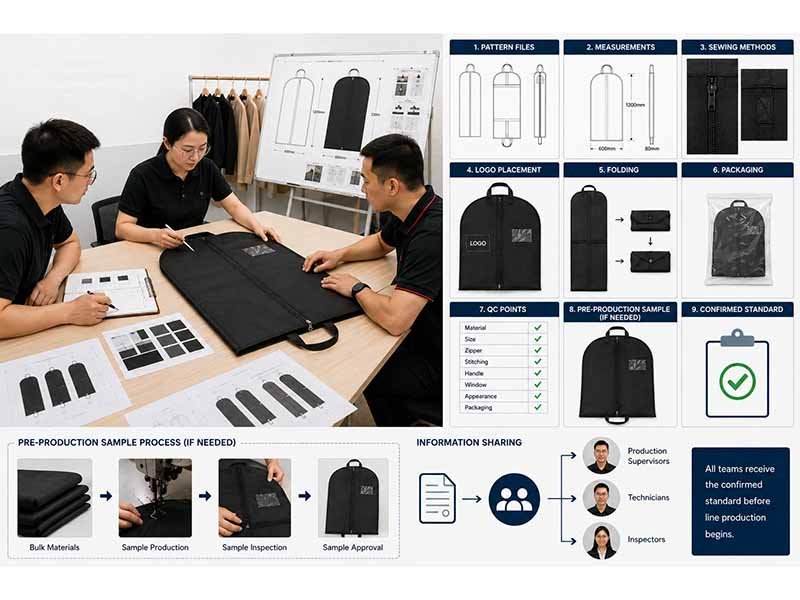
A practical development sequence usually moves from concept review to material selection, pattern development, first sample, evaluation, revision, approval, and production preparation. The important point is that uncertainty should decrease at each stage. Once a material is approved, it should be recorded. Once a logo position changes, the new position should replace the previous one. Once a hardware finish is selected, the production team should not have to guess which version was accepted.
Version control is especially useful when the product goes through several revisions. Sample V1 may establish the original structure, Sample V2 may shorten the shoulder strap and widen an internal pocket, while Sample V3 may move the logo and change the zipper. Without a clear record, old comments and old samples can accidentally influence production.
The manufacturer should also be able to explain whether a requested feature is practical at the planned quantity. Certain custom materials, hardware, or construction details may look appealing during design but create disproportionate MOQ or production difficulty. A capable development team helps the brand decide where customization adds meaningful customer value and where it mainly adds complexity.
Szoneier’s documented scope includes material selection, structural development, pattern making, sampling, sample revision, sewing production, in-line inspection, final quality control, packaging, and export shipment coordination, reflecting the kind of end-to-end development process that brands should look for when evaluating manufacturing partners.
How Do MOQ, Cost, and Lead Time Affect Your Launch?

MOQ, unit cost, and lead time are connected. Lower quantities usually spread setup and development costs across fewer units, while specialized materials and components may introduce separate supplier minimums. Short deadlines can also limit material options or increase freight expense. A healthy first order balances inventory exposure, product differentiation, landed cost, margin, launch timing, and realistic production conditions rather than focusing only on the lowest unit price.
MOQ Structure
MOQ should never be treated as one simple number without understanding what sits behind it. A manufacturer may quote an MOQ of 300 units, but that does not automatically mean every component can be customized economically at that level. The finished bag may have a 300-unit production MOQ while a custom buckle manufacturer requires 1,000 pieces, a printed box supplier requires 500 units, or a fabric mill requires a much larger quantity for a custom color.
This is one reason two visually similar bag projects can have very different minimum quantities. A design built around available fabrics, standard colors, common zippers, mature construction, existing webbing, simple logos, and standard packaging is normally easier to produce at a lower quantity than a design requiring custom-dyed materials, molded branding, exclusive hardware, custom zipper pulls, jacquard webbing, and specialty packaging.
The MOQ should therefore be broken into several questions. Is the quantity per style or per total order? Is it per color? Can multiple colors share the same base material? Do special trims have separate supplier minimums? Does packaging have a separate MOQ? Is a tooling quantity different from the finished product quantity?
Color fragmentation deserves particular attention. A 600-piece order split into six colors produces only 100 units per color. That sounds attractive from a merchandising perspective, but it can create more cutting setups, material combinations, packing variations, barcode management, and inventory complexity. Two or three stronger colors may generate cleaner production economics and more useful sales data.
Szoneier’s own documented MOQ starts from 200 pieces for many standard custom bag projects, while special fabrics, custom colors, molded logos, jacquard webbing, special zipper pullers, complex packaging, and functional materials may require higher quantities. That distinction reflects a broader industry reality: professional low-MOQ manufacturing is usually based on choosing components that remain commercially workable at smaller volumes.
True Product Cost
The factory quotation is not the same as the real inventory cost. A Shopify brand ultimately needs to understand the cost of placing sellable products into the warehouse or fulfillment location where customer orders will be shipped. That means the useful number is closer to landed cost than to the factory unit price.
Consider an illustrative 500-piece order:
| Cost Element | Example Total | Cost per Unit |
|---|---|---|
| Factory product cost | $5,000 | $10.00 |
| Custom packaging | $350 | $0.70 |
| Inspection | $250 | $0.50 |
| International freight | $1,100 | $2.20 |
| Duty and import fees | $400 | $0.80 |
| Illustrative landed cost | $7,100 | $14.20 |
These numbers are examples rather than market quotations because freight rates, destination, product size, packing efficiency, duties, and materials can change the result substantially. The important lesson is that a $10.00 factory price can become a $14.20 landed inventory cost before domestic fulfillment, payment processing, customer acquisition, returns, or warehouse fees are considered.
Development expenses should also be separated from recurring production expenses. Pattern work, metal molds, logo tooling, custom zipper-pull tooling, printing screens, packaging plates, or special jigs may be one-time costs that can be reused. The first order may therefore have a higher effective cost than the second or third order, even if the basic factory unit price remains similar.
When a product needs to become less expensive, do not automatically reduce material quality. Ask what is actually driving the cost. A design may become 8% or 10% cheaper by simplifying an internal pocket, improving pattern efficiency, changing a metal component, reducing unnecessary packaging volume, increasing order quantity, or using a high-quality standard trim instead of a custom one.
A manufacturer that can explain cost drivers gives the brand more control over the product. A supplier that only provides one unexplained number makes meaningful optimization much more difficult.
Launch Timing
Lead time should be planned backward from the date inventory needs to be available for customer orders rather than from the date the factory expects to finish sewing. A product may leave the sewing line on time and still miss the launch because inspection, packing, export preparation, freight, customs clearance, warehouse receiving, relabeling, or inventory check-in takes longer than expected.
A realistic launch plan usually includes product approval, material preparation, branding components, production, inspection, packing, international transport, and warehouse receiving. Some projects also require laboratory testing, special packaging approval, or barcode verification before shipment.
The critical path is often controlled by a component that appears minor. A custom zipper pull or special metal plate may require more preparation time than the entire sewing process. Custom-dyed material may need additional approval before cutting begins. Printed retail boxes may need their own sample approval and production window. The brand should ask the factory which component has the longest lead time rather than focusing only on the sewing schedule.
Schedule buffer also matters. If every stage must finish on exactly the planned day, a small delay immediately threatens the launch. Material deliveries can shift, packaging colors can be rejected, sample corrections can take longer than expected, and inspections can identify issues that require rework. A strong launch schedule leaves room for those normal manufacturing realities.
Replenishment timing should also be discussed during the first order. If the product sells quickly, can approved materials be sourced again? Can long-lead components be reserved earlier? Does the factory keep the specifications needed for a faster reorder? The first production run should create not only inventory, but also a repeatable supply-chain blueprint.
How Should You Test Samples and Quality Control?
A production sample should prove that the bag looks correct, functions as intended, and can be reproduced consistently in volume. Sample approval should include dimensions, materials, stitching, hardware, comfort, logo placement, function, and packaging rather than appearance alone. Once the sample is approved, it should become part of a controlled production reference supported by written specifications, material records, production checks, and final inspection.
Sample Approval
The sample stage is one of the easiest places for a brand to become overly optimistic. After waiting through development and revisions, receiving a sample that finally looks attractive can create strong pressure to approve it immediately. That is precisely when the product should be tested more carefully, because problems found during sampling are far cheaper to correct than problems found after hundreds or thousands of units have been produced.
Use the bag the way a customer will use it. Load the intended contents. Carry it for a realistic period. Adjust the shoulder strap several times. Open and close all zippers repeatedly. Put actual items into the pockets instead of judging their dimensions visually. If the product is marketed as a laptop bag, test the intended laptop size. If it is a travel organizer, fill it with the real categories of objects customers are expected to carry.
The sample should also be tested against packaging. Some structured bags recover poorly after compression. Metal parts can scratch nearby surfaces. Light-colored fabrics may need extra protection. Certain coatings or leather finishes can be sensitive to heat, pressure, or extended contact with packaging materials.
Photography is another practical test. A fabric may appear slightly different under studio lighting from how it looks in the sample room. Coatings, metallic hardware, textured materials, and some dark colors can behave differently in photographs. The sample should therefore be evaluated not only as a physical object but also as the product customers will see online.
Finally, subjective comments should be converted into measurable decisions. “Make the strap slightly shorter” should become a specific final measurement. “Move the logo a little lower” should become a defined position measured from a fixed seam or edge. Production quality improves when personal judgment is translated into references that can be checked.
Bulk Consistency
The greatest quality risk is often not a poor prototype. It is a good prototype that becomes less consistent during bulk production. Samples are produced in tiny quantities, often by experienced sample makers who can spend much more time on each unit. Mass production introduces multiple workers, larger material lots, repeated operations, additional accessory batches, and tighter productivity targets.
Consistency therefore needs a control process rather than a general instruction to “make it the same.” A useful sequence is approved sample, confirmed material, confirmed trims, approved logo, production specification, pre-production confirmation, in-process inspection, and final comparison.
Material substitution deserves particular attention. A fabric described as “the same quality” may still differ in weight, coating, stiffness, texture, sheen, color, or shrinkage. A replacement zipper may look nearly identical but feel different in operation. Hardware plating may shift from warm gold to a cooler tone. Small differences can change the overall product impression even when no single defect appears severe.
The project should therefore establish a simple rule: visible or functional components should not change without approval. That includes changes made for seemingly reasonable reasons such as material shortages or supplier delays. A technically acceptable substitute may still affect photography, product descriptions, retail consistency, or customer expectations.
Szoneier’s documented sample-to-bulk control process, for example, includes approved sample sealing, material and accessory records, logo process confirmation, packing standards, pre-production samples, in-process inspection, and final comparison before shipment. These are the types of controls a brand should expect a serious manufacturer to be able to explain.
Practical QC Checks
Quality control is most effective when problems are detected close to the production stage where they are created. Waiting until 2,000 finished bags are packed before discovering incorrect logo placement or an unstable seam creates far more disruption than identifying the same issue during early production.
Incoming checks can confirm fabrics, zippers, webbing, hardware, labels, colors, and printed components before they are used. In-process checks can focus on pocket position, seam alignment, reinforcement, measurements, zipper installation, logo placement, binding, and other details that become expensive to repair once the product is finished. Final inspection then confirms overall appearance, function, quantities, packaging, labeling, and shipment readiness.
| Check | Practical Sample Test | What to Watch |
|---|---|---|
| Zipper function | Open and close repeatedly | Snagging, separation, poor alignment |
| Strap construction | Load to intended use condition | Slippage, seam stress, deformation |
| Dimensions | Measure agreed control points | Deviation from approved specification |
| Logo position | Measure from fixed seams or edges | Placement consistency |
| Pocket function | Insert intended real objects | Capacity and accessibility |
| Packaging | Pack and unpack the finished bag | Creasing, scratching, deformation |
| Hardware | Operate buckles, snaps, and adjusters | Security and smooth operation |
| Stitching | Inspect stress points closely | Skipped stitches, loose threads, weak reinforcement |
The exact loads, repetitions, tolerances, and laboratory methods should be selected according to the product, target market, and any formal performance claims rather than copied blindly from another bag type. If the product makes claims involving safety, waterproof performance, fire resistance, RFID blocking, food-contact materials, or other regulated or technical functions, recognized testing methods should be used rather than informal factory demonstrations.
Good QC is not about creating more paperwork. Its purpose is to stop preventable defects before they reach customers, where the cost becomes returns, replacements, bad reviews, customer service, lost advertising efficiency, and damaged brand trust.
How Do Branding and Packaging Support a Shopify Brand?
Branding and packaging should be developed as part of the product rather than added after sewing is complete. Logo methods must suit the material, expected wear, retail position, MOQ, and target cost, while packaging must protect the bag through international shipping and fulfillment. For Shopify brands, the customer experiences the product only after that entire journey, so manufacturing and packaging decisions directly shape perceived quality.
Branding Methods
The best logo method is not automatically the most expensive one. It is the process that looks appropriate on the selected material, survives normal use, can be reproduced consistently, fits the retail positioning, and remains commercially sensible at the planned order quantity.
Screen printing can work efficiently on many canvas and synthetic products, but the final result depends on surface texture, ink system, artwork detail, and expected abrasion. Embroidery offers texture and durability but may distort lightweight or padded panels. Woven labels are highly repeatable and can create a consistent identity across several product categories. Rubber or silicone patches offer a strong visual element but normally require tooling and may bring separate component minimums.
Metal logos can produce a premium appearance, but they also add plating control, weight, installation steps, tooling, and potentially higher MOQs. Debossing or embossing can create a quieter premium effect on compatible leather or synthetic materials, although the definition depends on material thickness, surface structure, heat, pressure, and artwork detail.
Always approve branding on the actual production material. A digital mockup is useful for positioning, but it cannot show exactly how a fine line will embroider, how a print will sit on textured fabric, how a debossed mark will appear on a particular PU, or how a metal plate will look against the final color.
Brand consistency can also be created across a product family without putting a large logo on every item. Repeating the same metal finish, label style, zipper pull language, color system, trim design, or packaging detail across multiple products can create a stronger overall identity than aggressive branding on each individual piece.
Packaging Experience
Packaging has two jobs. It must protect the product, and it must present the product in a way that feels appropriate for the brand. Protection comes first because even beautiful packaging has little value if the bag arrives scratched, crushed, dirty, or permanently creased.
Structured products may require internal support or more controlled folding. Metal parts may need individual wrapping to prevent scratching. Light fabrics may need stronger contamination protection. Leather and coated materials may require attention to pressure, temperature, and prolonged contact with plastic or printed surfaces.
Presentation should then match the product and retail price. A basic item may need only a clean protective bag and correct labels. A more developed DTC presentation might add a hangtag, branded sticker, printed polybag, insert card, tissue, or dust bag. Premium products may use retail cartons, mailers, or gift packaging when that added experience is valuable to customers.
More packaging is not always better. Large rigid boxes can significantly increase shipping volume, warehouse requirements, and parcel costs. A product that is naturally soft and durable may not gain enough value from bulky packaging to justify the extra logistics expense. The best packaging creates a deliberate customer experience without making the supply chain unnecessarily expensive or difficult.
Barcode and SKU management should also be considered at the packaging stage. Each color, size, or model may need its own identifier. A visually perfect product can still create operational problems if the barcode is wrong, labels are placed incorrectly, or warehouse teams cannot distinguish variants accurately.
Delivery Readiness
Manufacturing is not finished when the last thread is trimmed. Inventory still needs to move through packing, carton labeling, export preparation, freight, customs, receiving, and warehouse intake before it becomes available for sale.
For ecommerce projects, confirm the unit packaging method, barcode position, SKU label, carton quantity, carton marks, destination, and whether inventory will be divided between several locations. Multi-SKU orders become much easier to manage when production, packing, logistics, and receiving teams are working from the same shipment matrix.
A simple order might include 300 black bags, 200 sand-colored bags, and 100 green bags. If the black and sand variants go to a U.S. fulfillment center while the green version is allocated to another market, that information needs to be reflected correctly in labels, cartons, packing lists, and shipment instructions.
Delivery terms should also be clear. EXW, FOB, air freight, sea freight, express delivery, and DDP arrangements involve different responsibilities, costs, and levels of control. The cheapest freight option is not necessarily the right one if it causes the inventory to arrive after the planned launch.
For brands using third-party fulfillment, retail distribution, or marketplace warehouses, the factory should understand that shipping preparation is part of product readiness. Szoneier’s documented support for ecommerce projects includes low-MOQ trial orders, packaging labels, FBA preparation, and replenishment planning. The broader principle is that products should leave the factory ready for the next step in the selling system, not simply packed into cartons.
How Do You Know a Manufacturer Can Scale With You?

A manufacturer can scale with a brand when it can reproduce approved products, preserve technical records, manage larger volumes, coordinate additional colors and SKUs, and allocate production capacity without losing control over quality or timing. Scalability should be verified through production evidence, repeat-order systems, documented specifications, capacity planning, and realistic discussion of how the supplier would respond if the next order became several times larger.
Evidence to Verify
Manufacturing claims become more useful when they are supported by evidence. “We have strong development capability” is only a statement until the brand can see the sample room, pattern development, revision records, materials, and actual product-development process. “We have strict quality control” means little unless the supplier can explain where inspections occur, what is checked, how problems are recorded, and what happens when production does not meet the approved standard.
Useful evidence may include live factory walkthroughs, sampling areas, cutting and sewing operations, material storage, QC stations, packing areas, production schedules, similar finished products, inspection records, sample revisions, packaging specifications, and examples of repeat production.
Evidence tied to the actual project is more valuable than generic promotional material. A factory may have excellent photographs but still manage a particular development project poorly. The strongest proof appears when the supplier receives your own product information, identifies realistic risks, develops a controlled sample, records the changes, and can explain how that same product will be transferred into production.
Capacity claims should be examined in the same way. “Large monthly capacity” is less useful than knowing how many sewing lines work on related products, how many orders are managed at the same time, what happens during peak season, and how additional capacity is controlled.
Szoneier’s current company documentation describes a manufacturing system with 8 sewing lines, 160+ production and support machines, 180+ team members, 120+ production-related staff, reported monthly capacity of 120,000–200,000 pieces across its system, the ability to manage 20–35 orders in parallel, and 10+ approved satellite partner factories. These figures are company-specific rather than general industry benchmarks, but they illustrate the level of operational detail that makes a capacity claim easier to evaluate.
Repeat-Order Control
Repeat production should not depend on someone remembering the previous order. The more successful the product becomes, the more important it is to preserve its technical history in a form that survives staff changes, supplier changes, and long periods between orders.
A useful repeat-order record may include the product code, pattern version, approved sample, main material, lining, color reference, zipper, webbing, hardware, logo artwork, logo position, measurements, labels, packaging, barcode information, carton specifications, and any quality issues corrected in the previous production run.
Before production restarts, the supplier should confirm whether anything has changed. The original fabric may no longer be available. A coating formulation could change. Hardware may come from a new production batch. The brand may have updated artwork or packaging. A fulfillment warehouse may require a different barcode position.
Color continuity is another practical challenge. Fabric produced months later may come from a different dye lot, so even an apparently identical specification can show some variation. Physical approved samples, material references, and color standards help make repeat-order comparison more objective.
A mature reorder process therefore does not mean “make the same thing again without checking.” It means “repeat the approved product using controlled confirmation.” When that process is working well, repeat orders can move faster because development knowledge is already available instead of being recreated.
Growth Scenarios
Growth should be discussed before it becomes urgent. One useful test is to ask the manufacturer how it would handle several realistic scenarios rather than simply asking for maximum capacity.
The first scenario is a modest replenishment. Your 500-piece launch sells more slowly than expected and you need only another 300 units. Can the supplier economically support that quantity without changing the materials or quality?
The second scenario is normal growth. The next order becomes 1,500 pieces and adds a second color. Can the same fabric, hardware, logo, packaging, and workmanship be maintained while the production volume increases?
The third scenario is rapid growth. A campaign performs unexpectedly well and the brand needs 5,000 units as quickly as is practical. What would change? Would the factory reserve more lines, book material earlier, split production, add approved capacity, or arrange partial shipments?
These discussions are valuable because growth usually increases complexity as well as volume. A successful brand rarely orders only more units of the original product forever. It may add new colors, matching pouches, backpacks, accessories, travel products, or seasonal variations. One SKU can eventually become six or twelve SKUs with different barcodes, packaging, materials, and delivery dates.
A manufacturing partner that can support that development path becomes more useful over time because the team already understands the brand’s quality expectations and product history. Rebuilding the supply chain for every new product may produce occasional short-term price savings, but it can also repeatedly reset the learning process.
Warning Signs
Many supplier risks appear long before the first bulk order. Vague answers about production location, extremely fast quotations based on incomplete information, inconsistent MOQ explanations, reluctance to produce proper samples, no written revision history, and unclear quality procedures are all signs that deserve more investigation.
A quotation that is substantially lower than comparable offers also deserves a technical explanation. A real cost advantage may come from better material purchasing, production efficiency, simpler construction, or existing tooling. If the supplier cannot explain the difference, the missing cost may later reappear through weaker materials, excluded packaging, unexpected charges, substitutions, or lower workmanship.
Communication quality should also be evaluated early. Custom manufacturing requires dozens of small decisions, and those decisions become more numerous as the product becomes more complicated. If communication is confusing during the quotation stage, it will rarely become easier during a production problem that needs a decision within hours.
A professional manufacturer should also be willing to say that certain requests are impractical. Statements such as “that material requires a higher MOQ,” “this zipper curve may be unstable,” “this packaging will increase freight volume,” or “that delivery date requires a different material or shipping method” can be valuable. They show that the supplier is thinking about production consequences rather than simply trying to win the order.
Choosing a bag manufacturer for a Shopify or DTC brand ultimately comes down to building controlled growth. The first objective is to create the right product. The second is to reproduce it consistently. The third is to preserve that consistency when quantities, colors, packaging, SKUs, and delivery requirements become more complicated.
The strongest manufacturing relationship is therefore not defined by the first sample or the lowest quotation. It is defined by how well product knowledge is preserved, how quickly problems are identified, how clearly trade-offs are explained, and how reliably the approved product can be reproduced after the excitement of the first launch has passed. A manufacturer that can support those fundamentals gives a growing brand something more valuable than cheap inventory: a supply chain that becomes more predictable as the business becomes larger.
FAQ
What Is a Good MOQ for a New Shopify Bag Brand?
There is no single ideal MOQ because the right quantity depends on product complexity, material availability, color count, packaging, cash flow, and expected demand. For many standard sewn bags using available materials and simple branding, several hundred pieces can be commercially practical. Highly customized fabrics, molded logos, special hardware, or complex packaging may require larger quantities because component suppliers often have their own production minimums.
How Can I Verify a Bag Manufacturer Before Ordering?
Start by reviewing relevant product samples, business information, production photographs, and technical communication. A live video factory tour can help confirm sampling, cutting, sewing, QC, packing, and warehouse areas. For larger orders, third-party audits or inspections may also be useful. Verification should focus not only on whether the facility exists, but also on who controls materials, sample revisions, bulk production, inspection, and delivery.
Should a DTC Brand Choose OEM or ODM Bag Manufacturing?
OEM is usually more suitable when the brand already has a mature specification, tech pack, physical sample, materials, measurements, and artwork. ODM is more useful when the concept still needs development involving dimensions, construction, material selection, pockets, hardware, or production feasibility. Many projects sit between the two models, so the most important question is how much development work the manufacturer can reliably support before bulk production.
How Do I Make Sure Bulk Bags Match the Approved Sample?
Use the approved sample together with written specifications, material records, trim details, logo standards, measurements, packaging instructions, and controlled revision history. Production should include material verification, pre-production confirmation, in-process inspection, and final comparison with the approved standard. Any visible or functional material substitution should be approved before it enters bulk production, rather than being accepted automatically as an equivalent replacement.
How Long Does Custom Bag Manufacturing Usually Take?
The total project schedule includes more than sewing. It may involve specification review, material sourcing, sample development, sample revisions, custom hardware, packaging production, bulk manufacturing, inspection, freight, customs clearance, and warehouse receiving. Standard materials and existing components can shorten the process, while custom-dyed fabrics, molds, special hardware, testing requirements, or complex packaging can add significant time. Brands should plan backward from the required inventory-arrival date rather than relying only on quoted production days.
What Should I Include When Requesting a Custom Bag Quotation?
Provide the bag type, approximate dimensions, reference images or drawings, main material direction, lining, important pockets or features, logo artwork, preferred colors, packaging, expected order quantity, destination country, and target delivery period. If available, include a tech pack, BOM, existing physical sample, or competitor reference. Better information allows the manufacturer to quote the actual intended product instead of making assumptions that later create price changes.
What Makes a Bag Manufacturer Suitable for Long-Term Growth?
A long-term manufacturer should be able to preserve product specifications, maintain sample-to-bulk consistency, manage repeat materials, control multiple SKUs, provide realistic capacity planning, support replenishment, and communicate clearly when conditions change. The strongest sign is not a large capacity claim on its own, but a repeatable system that keeps approved materials, construction, branding, packaging, and quality stable as order quantities and product lines expand.