 Skip to content
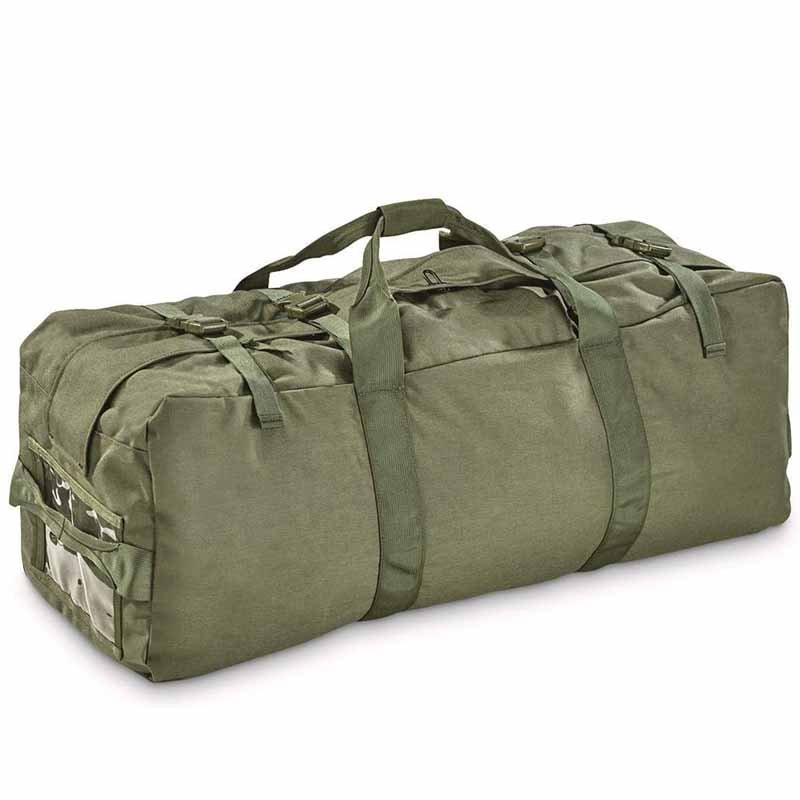
Military duffle bags are not just oversized travel bags. They are engineered tools designed to survive extreme loads, rough handling, unpredictable climates, and repeated long-term use. From airborne deployments and naval transport to desert training grounds and overseas logistics hubs, these bags must perform reliably where failure is not an option. That reality raises an important question for buyers, brands, and product developers alike: what are military duffle bags actually made of—and why?
At first glance, many military duffle bags look simple. But beneath that simplicity lies a carefully selected combination of fabrics, coatings, reinforcements, and construction techniques. Every material choice reflects trade-offs between durability, weight, cost, weather resistance, and manufacturability. A fabric that works for civilian travel may fail quickly under military conditions. Conversely, a bag built to military standards often exceeds what most commercial users expect. Military duffle bags are typically made from heavy-duty synthetic fabrics such as nylon (600D–1000D), polyester, or reinforced canvas, combined with strong webbing, industrial stitching, and protective coatings like PU or TPU. These materials are chosen for their high tear strength, abrasion resistance, load-bearing capacity, and ability to withstand harsh environments, making them suitable for military, tactical, and heavy-duty commercial use.
Understanding these materials is not only useful for military procurement. Today, many outdoor brands, tool bag companies, and premium luggage labels adopt military-grade material standards for their own products. In the sections below, we’ll break down what these bags are called, what materials they use, and how those materials affect real-world performance—step by step.
What Is a Military Duffle Bag
A military duffle bag is a heavy-duty load-carrying bag engineered for extreme durability, high weight capacity, and long-term field use. Unlike ordinary travel duffel bags designed for convenience or aesthetics, military duffle bags are built as logistical tools—intended to survive rough handling, repeated transport, harsh climates, and unpredictable usage scenarios without structural failure.
At its core, a military duffle bag prioritizes function over form. It is typically large-capacity, minimally structured, and constructed from reinforced materials that can withstand dragging, stacking, overloading, and exposure to dirt, moisture, heat, and abrasion. These bags are widely used for transporting uniforms, boots, protective gear, tools, and personal equipment during training, deployment, storage, and relocation.
From an engineering perspective, a military duffle bag is not defined by shape alone. What truly distinguishes it are material specifications, construction standards, and performance expectations—all of which exceed those of standard civilian luggage.
What Are Military Duffle Bags Called?
Military duffle bags are known by several names, depending on military branch, region, and historical usage:
- Army Duffle Bag – Common term for ground-force issued gear bags
- Military Duffle / Military Duffel – General classification
- Sea Bag – Traditional term used by naval forces, especially in the U.S. Navy
- Deployment Bag – Refers to duffle bags packed for long-term missions
- Tactical Duffle Bag – Commercial or modern interpretation with military-grade features
These terms often signal subtle differences in design intent. For example, a sea bag typically emphasizes large volume and simple drawstring closure, while a tactical duffle may incorporate reinforced handles, modular attachment points, or upgraded closures for specialized use.
Understanding these naming conventions is important for buyers and brands, as they directly influence material selection, construction complexity, and user expectations.
How Is a Military Duffle Bag Different from a Regular Duffle Bag?
The difference lies less in appearance and more in engineering philosophy.
A standard civilian duffle bag is usually designed for:
- Short-term travel
- Evenly distributed loads
- Controlled environments (airports, hotels, vehicles)
A military duffle bag, by contrast, is designed for:
- Uneven, heavy loads (25–40+ kg)
- Repeated mechanical stress
- Rough logistics handling (cargo holds, containers, ground transport)
- Outdoor exposure across multiple climates
As a result, military duffle bags use thicker fabrics, stronger webbing, higher stitch density, and simplified structures to reduce failure points. Comfort features may be secondary, while durability and reliability are non-negotiable.
What Is a Military Duffle Bag Used For?
Military duffle bags serve a wide range of practical functions, including:
- Transporting personal gear during deployment
- Long-term storage of uniforms and equipment
- Shipment of supplies between bases or training facilities
- Field use where rigid luggage would fail
Because of these demanding roles, military duffle bags are also widely adopted outside the military by:
- Tactical and outdoor brands
- Firefighters and emergency responders
- Industrial workers and contractors
- Expedition travelers and overland users
This crossover explains why “military-grade” duffle bags have become a benchmark for durability in commercial markets.
What Materials Are Military Duffle Bags Made Of
Military duffle bags are made from purpose-selected heavy-duty materials engineered for strength, durability, and environmental resistance, not for appearance or lightweight comfort. The materials used must tolerate extreme loads, abrasion, repeated transport, and harsh climates while remaining scalable for mass production.
Unlike civilian duffel bags, which may use fashion fabrics or lightweight synthetics, military duffle bags rely on high-denier synthetic textiles, reinforced structural components, and protective surface treatments. Each material choice directly affects how long the bag lasts, how much weight it can safely carry, and how it performs in real-world military or tactical conditions.
Primary Fabric Materials Used in Military Duffle Bags
1. High-Denier Nylon (Most Common Material)
Nylon is the dominant material used in modern military duffle bags due to its superior strength-to-weight ratio.
Typical specifications include:
- 600D Nylon – standard duty, balanced weight and durability
- 900D Nylon – enhanced abrasion resistance
- 1000D Nylon – extreme-duty tactical and deployment use
Key reasons nylon is preferred:
- High tear and tensile strength
- Excellent abrasion resistance
- Good flexibility under heavy loads
- Compatible with PU, TPU, and waterproof coatings
In military logistics, nylon performs reliably when bags are dragged, stacked, overfilled, or exposed to dirt and moisture.
2. Polyester Fabrics (Cost-Efficient Alternative)
Polyester is widely used in large-scale military-style and OEM production, especially when cost control and color consistency are priorities.
Advantages of polyester:
- Strong dimensional stability
- Better UV resistance than nylon
- Excellent colorfastness for standardized military colors
- Lower raw-material cost
While polyester is slightly less abrasion-resistant than nylon, high-quality polyester with reinforced construction can still meet demanding military-grade performance requirements, especially for storage, transport, and training applications.
3. Heavy-Duty Canvas (Cotton or Blended)
Canvas is one of the oldest materials used in military duffle bags and is still used in specific scenarios.
Characteristics:
- Extremely high abrasion resistance
- Thick, rigid structure
- Natural fiber (cotton) or cotton-poly blends
Limitations:
- Heavier than synthetic fabrics
- Absorbs moisture unless treated
- Slower drying time
Canvas duffle bags are often chosen for heritage military designs, abrasion-heavy environments, or users who prioritize structural toughness over weight reduction.
Structural and Reinforcement Materials
Military duffle bags are not defined by fabric alone. Structural materials play a critical role.
4. High-Strength Webbing (Load-Bearing System)
- Usually made from nylon or polyester
- Tensile strength often exceeds 1,000 kg
- Runs under the bag body to support heavy loads
Webbing handles and straps are the true load carriers, preventing fabric panels from tearing under stress.
5. Industrial Sewing Thread
- Bonded nylon or bonded polyester thread
- High resistance to friction and UV exposure
- Maintains seam integrity under constant tension
Thread quality directly affects seam longevity and is a key indicator of military-grade construction.
Protective Coatings and Surface Treatments
6. PU (Polyurethane) Coating
- Common, cost-effective water resistance
- Maintains fabric flexibility
- Suitable for most military transport conditions
7. TPU (Thermoplastic Polyurethane) Coating
- Higher abrasion resistance than PU
- Superior cold-weather flexibility
- Better long-term durability
TPU-coated nylon is increasingly used in high-end tactical and premium military-style duffle bags.
8. PVC Coating (Limited Use)
- Strong waterproofing
- Heavier and less breathable
- Less environmentally friendly
PVC is typically avoided unless full waterproofing is required.
Material Selection by Use Scenario
| Use Scenario | Recommended Material |
|---|---|
| Heavy deployment loads | 900D–1000D Nylon |
| Cost-sensitive OEM orders | Reinforced Polyester |
| Marine or humid environments | TPU-coated Nylon |
| Abrasion-heavy transport | Canvas or Ripstop Nylon |
| Cold weather operations | TPU-coated Nylon |
Why Are These Materials Used in Military Duffle Bags
Military duffle bags use specialized materials because failure is not an option. These bags are designed to carry heavy, irregular loads, endure harsh handling, and remain functional across extreme environments. The materials chosen are not arbitrary—they are the result of decades of military logistics experience, field testing, and engineering trade-offs between strength, weight, durability, and manufacturability.
Unlike civilian duffel bags, which prioritize comfort or style, military duffle bags must perform reliably when dragged, overfilled, stacked, exposed to weather, and transported repeatedly over long distances. Every material used addresses a specific mechanical or environmental challenge.
1. To Handle Heavy and Uneven Loads
One of the most important reasons for using high-denier nylon, reinforced polyester, or canvas is load stress distribution.
Military duffle bags rarely carry evenly packed items. Boots, tools, body armor, metal components, and rigid equipment create concentrated pressure points. Lightweight fabrics would stretch, tear, or fail at seams under these conditions.
High-strength synthetic fibers offer:
- High tensile strength to resist tearing
- Controlled elongation to absorb shock
- Compatibility with reinforced webbing systems
These properties allow military duffle bags to safely carry 25–40 kg or more without structural collapse.
2. To Resist Abrasion, Tearing, and Puncture
Military logistics environments are abrasive by nature. Duffle bags are dragged across:
- Concrete floors
- Metal cargo holds
- Rough vehicle beds
- Gravel and dirt terrain
Materials like nylon and canvas have superior fiber resilience, meaning they resist surface wear and internal fiber breakage. Ripstop constructions further prevent small cuts from spreading into catastrophic tears.
This abrasion resistance directly extends product lifespan, reducing replacement frequency and long-term cost.
3. To Perform Reliably in Harsh Environments
Military duffle bags must operate across:
- Hot deserts with high UV exposure
- Humid jungles with mold risk
- Cold climates where materials can crack
- Marine environments with salt exposure
Synthetic fabrics outperform natural fibers in these conditions. Coatings such as PU and TPU enhance water resistance, while additives improve UV and mildew resistance. TPU, in particular, maintains flexibility in cold temperatures, preventing coating failure.
These material properties ensure the bag remains functional regardless of climate.
4. To Balance Strength with Weight Efficiency
Durability alone is not sufficient—weight matters. Every kilogram added to a bag increases transport cost and user fatigue.
Nylon and polyester provide high strength at relatively low weight compared to canvas. This strength-to-weight advantage allows military duffle bags to remain portable while still meeting performance requirements.
The result is a bag that is tough enough for combat logistics yet practical for air transport and personal carrying.
5. To Reduce Failure Points Through Simpler Construction
The materials used in military duffle bags support minimalist design philosophies. Strong fabrics allow simpler shapes, fewer seams, and reduced hardware—each reduction lowers the chance of failure.
For example:
- Thick fabric panels reduce the need for internal frames
- Reinforced webbing replaces fragile fabric handles
- Coated fabrics reduce reliance on complex linings
Material strength enables construction simplicity, which directly improves reliability.
6. To Support Mass Production and Quality Consistency
Military procurement and OEM production require:
- Repeatable material performance
- Stable supply chains
- Predictable quality across large batches
Synthetic materials meet these needs better than natural fibers. Yarn specifications, coating thickness, and color standards can be tightly controlled, ensuring consistent performance across thousands of units.
This scalability is critical for both military supply contracts and commercial private-label manufacturing.
Which Material Is Best for Military Duffle Bags
There is no single “best” material for all military duffle bags. The optimal choice depends on how the bag will be used, how often it will be loaded, what environment it will face, and how much weight and cost the user can accept. Military-grade performance is achieved not by choosing the strongest material alone, but by selecting the right material for the right mission profile.
In practice, high-denier nylon is the most versatile option, polyester offers cost and color stability advantages, and canvas delivers unmatched abrasion resistance. Each material excels under different conditions.
Best Overall Choice: High-Denier Nylon
For most military and tactical duffle bags, high-denier nylon (600D–1000D) is the best all-around material.
Why nylon leads:
- Exceptional strength-to-weight ratio
- High tear and abrasion resistance
- Maintains flexibility under heavy loads
- Compatible with PU and TPU coatings
- Performs reliably across hot, cold, and humid climates
Nylon is especially well-suited for deployment bags, where weight, durability, and weather resistance must be balanced. TPU-coated nylon is increasingly preferred for premium and long-life military-style duffle bags.
Best Cost-Controlled Option: Reinforced Polyester
Polyester is the best choice when cost efficiency and visual consistency matter.
Key advantages:
- Better UV resistance than nylon
- Excellent colorfastness for standardized military colors
- Stable pricing and supply
- Sufficient durability when reinforced properly
Polyester performs well in training, storage, and logistics-focused duffle bags, especially in large-volume OEM production. While it does not match nylon’s abrasion resistance, proper construction can compensate for this gap.
Best for Abrasion-Heavy Use: Canvas
Canvas remains relevant in scenarios where surface wear is extreme.
Why choose canvas:
- Extremely thick and rigid structure
- Outstanding abrasion resistance
- Traditional military aesthetic
However, canvas is heavier and absorbs moisture unless treated. It is best suited for ground transport, industrial use, or heritage-style military duffle bags, rather than modern air-transport-heavy deployments.
Ripstop vs. Non-Ripstop: Structural Choice Matters
Ripstop fabrics incorporate a reinforcement grid that prevents small tears from spreading.
- Ripstop nylon is ideal for environments with puncture risk
- Plain-weave fabrics may offer smoother abrasion resistance
The choice depends on whether tear propagation or surface wear is the primary risk.
Best Material by Environment
| Environment | Recommended Material |
|---|---|
| Desert / High UV | Nylon with UV treatment |
| Jungle / Humid | Polyester or TPU-coated nylon |
| Marine / Coastal | TPU-coated nylon |
| Cold Weather | TPU-coated nylon (flexible at low temps) |
| Rough Ground Transport | Canvas or ripstop nylon |
Best Material by Use Case
| Use Case | Best Material Choice |
|---|---|
| Deployment & combat logistics | 900D–1000D nylon |
| Training & storage | Reinforced polyester |
| Premium tactical gear | TPU-coated nylon |
| Industrial / abrasion-heavy | Heavy canvas |
| Cost-sensitive OEM projects | Polyester with reinforced webbing |
Why “Overbuilt” Is Not Always Better
A common mistake is assuming thicker materials are always superior. Overbuilding increases:
- Bag weight
- Manufacturing cost
- User fatigue
The best military duffle bags are engineered, not exaggerated. Material choice should match realistic load and environment expectations, not worst-case assumptions.
How Are Military Duffle Bags Constructed
Military duffle bags are constructed using reinforced structural layouts, heavy-duty materials, and industrial sewing techniques designed to prevent failure under extreme loads and harsh handling. Construction quality is as important as material selection—strong fabrics alone cannot compensate for weak seams, poor reinforcement, or flawed load paths.
Unlike fashion or travel duffel bags, military duffle bags are engineered with a failure-prevention mindset, focusing on stress distribution, redundancy, and simplicity. Every construction decision aims to extend service life while minimizing weak points.
1. Structural Layout: Designing the Load Path
At the core of military duffle bag construction is the load path design—how weight travels through the bag when carried, lifted, or dragged.
High-quality military duffle bags use:
- A continuous webbing system that runs beneath or around the bag body
- Load-bearing straps integrated into the structure, not stitched superficially
- Minimal reliance on fabric panels to carry weight
This approach ensures that heavy loads are transferred to webbing and seams designed to handle stress, reducing the risk of fabric tearing.
2. Reinforced Stitching and Seam Engineering
Stitching is one of the most critical construction elements.
Military duffle bags typically use:
- High stitch-per-inch (SPI) seams for strength and durability
- Bonded nylon or polyester thread resistant to UV and abrasion
- Double-stitched or triple-stitched seams in high-stress areas
Key reinforcement techniques include:
- Bar-tack stitching at handles, strap joints, and closure points
- Box-and-cross stitching to spread load across larger areas
These techniques prevent seam failure even when bags are overloaded or mishandled.
3. Stress Point Reinforcement
Stress points are the most common failure areas in duffle bags.
Military-grade construction reinforces:
- Top and side handles
- Shoulder strap anchors
- Base corners and edge seams
- Closure drawstring or zipper zones
Additional fabric layers or reinforcement patches are often added at these locations to absorb repeated mechanical stress.
4. Closure Systems: Reliability Over Convenience
Military duffle bags prioritize closure reliability.
Common systems include:
- Drawstring with metal or reinforced grommets (classic sea bag design)
- Heavy-duty zippers (oversized coil or molded types)
- Roll-top closures for enhanced weather resistance
Zippers, when used, are protected by fabric flaps to prevent dirt intrusion and reduce abrasion.
5. Webbing, Handles, and Carry Systems
Webbing is the true structural backbone of a military duffle bag.
Characteristics of military-grade webbing:
- Nylon or polyester with high tensile strength
- Wide strap profiles to distribute load
- Heat-sealed or bartacked ends to prevent fraying
Handles are typically padded or wrapped for grip durability, not comfort aesthetics.
6. Hardware Selection and Attachment
Hardware must survive impact, temperature swings, and corrosion.
Typical hardware includes:
- Reinforced acetal plastic buckles
- Metal D-rings or hooks for load-bearing points
- Corrosion-resistant finishes
Hardware attachment points are always reinforced with additional stitching or backing layers.
7. Seam Binding and Interior Finishing
Interior finishing improves durability and longevity.
Military duffle bags often use:
- Seam binding tape to prevent fraying
- Reinforced seam edges to resist moisture penetration
For coated fabrics, proper seam finishing helps maintain water resistance.
8. Quality Control and Load Testing
Construction quality is validated through:
- Load testing (static and dynamic)
- Stitch tension inspection
- Abrasion and seam strength testing
These tests ensure that construction meets military or military-inspired performance standards.
Are Military Duffle Bags Weather-Resistant
Yes—most military duffle bags are weather-resistant, but not fully waterproof by default. They are designed to protect gear from rain, dust, mud, and short-term moisture exposure during transport and outdoor use. However, unless specifically engineered as dry bags, standard military duffle bags are not intended for full submersion or prolonged water exposure.
This distinction is critical. Military duffle bags prioritize durability, load capacity, and reliability, and weather resistance is achieved through a combination of material selection, surface coatings, construction methods, and design choices—rather than complete waterproof sealing.
Weather-Resistant vs. Waterproof: A Practical Definition
Understanding the difference helps avoid unrealistic expectations.
- Weather-resistant means the bag can repel rain, splashes, and surface moisture, keeping contents dry in normal outdoor conditions.
- Waterproof means the bag can withstand immersion in water without leakage—typically requiring roll-top closures and sealed seams.
Most military duffle bags fall into the weather-resistant category because full waterproofing adds weight, stiffness, and cost that are unnecessary for most military logistics scenarios.
How Military Duffle Bags Achieve Weather Resistance
1. Coated Outer Fabrics
The primary line of defense is the fabric coating.
Common options include:
- PU (Polyurethane) coating – Lightweight, flexible, and cost-effective; resists rain and splashes
- TPU (Thermoplastic Polyurethane) coating – Higher abrasion resistance, better cold-weather performance, longer lifespan
- PVC coating – Strong waterproof barrier but heavier and less flexible
Among these, TPU-coated nylon is increasingly favored in high-end military-style and tactical duffle bags due to its balance of durability and weather protection.
2. Tightly Woven High-Denier Fabrics
High-denier nylon or polyester fabrics naturally resist water penetration better than loose weaves. The tighter the weave and the heavier the yarn, the longer it takes for moisture to pass through—even before coatings are applied.
This is why 900D–1000D fabrics outperform lighter textiles in wet environments.
3. Construction Design That Limits Water Entry
Military duffle bags minimize water ingress through design choices such as:
- Fewer external seams
- Large fabric panels instead of multiple stitched sections
- Raised or reinforced bases to avoid ground moisture
Simpler construction reduces the number of stitch holes where water could enter.
Why Military Duffle Bags Are Not Fully Waterproof
From an engineering standpoint, full waterproofing introduces trade-offs:
- Sealed seams can crack under heavy load flexing
- Waterproof zippers increase failure risk and cost
- Roll-top closures reduce packing convenience for large volumes
Military logistics prioritize function, speed, and durability over immersion protection, which is why weather resistance—not full waterproofing—is the standard.
Performance in Different Environments
| Environment | Weather Resistance Performance |
|---|---|
| Rain & snow | Very good |
| Mud & dust | Excellent |
| Humid jungle | Good (with anti-mildew treatment) |
| Marine spray | Good (TPU-coated fabrics preferred) |
| Full submersion | Not recommended |
When a Fully Waterproof Military Duffle Bag Is Needed
In certain use cases—such as amphibious operations, river crossings, or marine transport—waterproof duffle bags are used instead of standard military duffles.
These bags typically feature:
- Roll-top closures
- Fully welded or sealed seams
- Thick TPU or PVC constructions
However, they are heavier, stiffer, and less suitable for carrying rigid or sharp equipment.
Common Buyer Misconceptions
- “Military-grade means waterproof” → Not necessarily
- “Thicker fabric always equals better waterproofing” → Coating matters more
- “Zippers are always waterproof” → Most are not without special sealing
Understanding these nuances helps buyers choose the right product specification.
Do Military Duffle Bags Differ by Branch or Application
Yes. Military duffle bags differ significantly by branch and by application, even when they appear similar in shape or size. Each military branch operates in distinct environments and logistics systems, which directly influence material choice, construction details, size, closure type, and performance priorities. In addition, the intended application—deployment, training, storage, or transport—often matters more than the branch itself.
Understanding these differences is essential for buyers, brands, and OEM developers who want to design or source military-style duffle bags that perform correctly in real-world use.
Army Duffle Bags
Army duffle bags are typically designed for maximum capacity and ruggedness. They are often large-volume, top-loading bags intended to carry heavy personal gear during long deployments or relocations.
Key characteristics:
- Heavy-duty nylon or polyester fabrics (often 900D–1000D)
- Simple cylindrical or rectangular shapes
- Reinforced drawstring or heavy zipper closures
- Emphasis on load-bearing strength over comfort
Army bags are frequently dragged, stacked, and overfilled, so abrasion resistance and seam strength are prioritized.
Navy Duffle Bags (Sea Bags)
Navy duffle bags—commonly called sea bags—are optimized for marine environments.
Typical features include:
- Moisture-resistant or TPU-coated fabrics
- Minimal external hardware to avoid corrosion
- Large single-compartment designs
- Drawstring closures for reliability
Water resistance and mildew prevention matter more than lightweight design, as bags are often stored aboard ships or in humid conditions.
Marine Corps Duffle Bags
Marine duffle bags balance ruggedness with mobility. Marines often operate across varied terrains, requiring bags that are tough but still manageable.
Common traits:
- High-denier nylon with reinforced bases
- Strong webbing systems for lifting and carrying
- Slightly more ergonomic carry options
- Compatibility with modular or tactical gear
Durability remains critical, but excessive weight is avoided where possible.
Air Force Duffle Bags
Air Force duffle bags tend to emphasize transport efficiency and handling.
Design priorities often include:
- Lighter-weight materials compared to Army bags
- More structured shapes for air cargo handling
- Zippered openings for quick access
- Clean, standardized appearance
While still durable, Air Force bags are often less overbuilt than those intended for ground combat logistics.
Differences by Application
In many cases, application matters more than branch.
Deployment Duffle Bags
Deployment bags are designed for long-term, heavy-duty use.
Characteristics:
- Thick fabrics and reinforced construction
- High load tolerance (often 30–40 kg or more)
- Weather-resistant coatings
- Simplified structures to reduce failure points
These bags are built for endurance, not convenience.
Training and Barracks Bags
Training or storage duffle bags are often lighter and more cost-efficient.
Typical features:
- Medium-denier fabrics
- Reduced reinforcement
- Focus on basic durability and affordability
They are used frequently but under less extreme conditions.
Transport and Logistics Bags
Logistics-focused duffle bags are optimized for stacking, storage, and movement, not personal carrying.
Design priorities:
- Uniform sizing
- Reinforced bases and sidewalls
- Easy identification and labeling
- Durability under mechanical handling
Specialized and Tactical Applications
Some military duffle bags are purpose-built for:
- Medical transport
- Tool and equipment storage
- Expedition or special operations use
These bags may use upgraded materials, compartmentalized interiors, or specialized coatings depending on mission requirements.
Branch vs. Application Focus
| Category | Primary Design Focus |
|---|---|
| Army | Maximum durability & capacity |
| Navy | Moisture resistance & simplicity |
| Marines | Durability with mobility |
| Air Force | Transport efficiency |
| Deployment | Heavy loads & long-term use |
| Training | Cost efficiency |
| Logistics | Stackability & durability |
How Do You Choose the Right Military Duffle Bag Material
Choosing the right material for a military duffle bag is not about picking the strongest fabric available—it’s about matching material performance to real-world use. The best choice depends on load weight, usage frequency, environment, handling method, cost target, and expected product lifespan.
Military duffle bags fail most often not because the material is “bad,” but because the material is wrong for the job. A structured decision process prevents overdesign, underperformance, and unnecessary cost.
Step 1: Define the Load and Usage Reality
Start with what the bag will actually carry, not what it might carry in theory.
Key questions:
- What is the average and maximum load weight? (e.g. 20 kg vs 40 kg+)
- Are contents rigid or sharp (tools, boots, metal gear)?
- Will the bag be overfilled regularly?
Material guidance:
- Heavy, uneven loads → 900D–1000D nylon
- Moderate loads → 600D nylon or reinforced polyester
- Abrasion-heavy rigid contents → ripstop nylon or canvas
Load reality determines fabric denier, reinforcement level, and webbing strength.
Step 2: Evaluate the Operating Environment
Environment has a direct impact on material lifespan.
Ask:
- Will the bag be used in rain, humidity, or marine conditions?
- Is UV exposure significant (desert, outdoor storage)?
- Will the bag face cold temperatures where coatings may crack?
Material guidance:
- Humid / marine → TPU-coated nylon
- Hot & UV-heavy → UV-treated nylon or polyester
- Cold climates → TPU-coated fabrics (remain flexible)
Environment often matters more than branch or aesthetics.
Step 3: Decide Between Nylon, Polyester, and Canvas
Each core material serves a different purpose.
| Material | Choose It When | Avoid It When |
|---|---|---|
| Nylon | You need best all-around performance | Extreme cost pressure |
| Polyester | Cost & color consistency matter | Very high abrasion risk |
| Canvas | Abrasion resistance is critical | Weight & moisture are concerns |
For most military-style duffle bags, nylon is the default best choice, unless cost or heritage aesthetics dictate otherwise.
Step 4: Choose the Right Fabric Structure
Beyond material type, fabric structure matters.
- Ripstop → Best when puncture or tearing risk exists
- Plain weave → Better for smooth abrasion resistance
- Tight weave + coating → Better weather resistance
This choice affects tear propagation, surface wear, and visual texture.
Step 5: Balance Durability vs. Weight vs. Cost
Overbuilding is a common mistake.
Problems with overbuilt materials:
- Unnecessary weight
- Higher shipping costs
- Reduced user comfort
- Increased unit cost
Problems with underbuilt materials:
- Early failure
- Warranty issues
- Brand damage
The goal is functional sufficiency, not maximum thickness.
Step 6: Align Material Choice with Construction Capability
Material choice must match manufacturing capability.
For example:
- Very thick fabrics require stronger machines and skilled operators
- TPU coatings need correct seam finishing to avoid cracking
- Canvas needs moisture treatment to prevent mildew
An experienced manufacturer will adjust stitch density, thread type, webbing layout, and reinforcement strategy to suit the chosen material.
Step 7: Match Material Choice to Market and Buyer Expectations
Material selection should reflect who will use the bag.
- Military / tactical users → prioritize durability
- Industrial users → abrasion resistance
- Outdoor / expedition markets → balance weight & weather protection
- Promotional or entry-level markets → cost-controlled polyester
There is no universal “military material”—only context-appropriate solutions.
Choosing the Right Material
| Requirement | Best Material |
|---|---|
| Heavy deployment use | 900D–1000D nylon |
| Cost-sensitive OEM | Reinforced polyester |
| Marine / wet environment | TPU-coated nylon |
| Abrasion-heavy transport | Canvas or ripstop nylon |
| Cold weather | TPU-coated nylon |
| Premium tactical brand | TPU-coated nylon + reinforced webbing |
Common Buyer Mistakes to Avoid
- Choosing denier without considering construction
- Assuming “military-grade” means waterproof
- Overbuilding for marketing instead of use
- Ignoring environment and handling conditions
Avoiding these mistakes saves cost and improves real-world performance.
Conclusion
Military duffle bags may look simple, but every material and construction choice reflects decades of real-world testing. From high-denier nylon and reinforced webbing to coated fabrics and industrial stitching, these bags are engineered for reliability under pressure.
If you are developing military-style duffle bags, tactical gear, or heavy-duty commercial bags, working with an experienced manufacturer makes the difference between a product that merely looks rugged—and one that truly performs.
Szoneier is a China-based bag manufacturer with over 18 years of experience in custom bag development and production.
Contact Szoneier today to discuss your military duffle bag project and receive professional material and construction recommendations tailored to your market.
manufacturer Categories
- Custom Tote Bags Manufacturer
- custom backpacks Manufacturer
- custom travel bags& Duffle bags manufacturer
- custom makeup bags & toiletry bags manufacturer
- custom cooler bags manufacturer
- custom drawstring bags manufacturer
- custom makeup bags & toiletry bags manufacturer
- custom golf bags manufacturer
- custom fireproof bags manufacturer
- custom dry bags manufacturer
- custom ski bags manufacturer
- custom gym & sports bags manufacturer
- custom laptop bags manufacturer
- custom tactical bags manufacturer
- custom beach bags manufacturer
- custom medical bags manufacturer
- custom camera bags manufacturer
- custom wetsuits manufacturer
- custom leather goods manufacturer
- more personalized products

Can't find the answers?
No worries, please contact us and we will answer all the questions you have during the whole process of bag customization.
Make A Sample First?
If you have your own artwork, logo design files, or just an idea,please provide details about your project requirements, including preferred fabric, color, and customization options,we’re excited to assist you in bringing your bespoke bag designs to life through our sample production process.
