Skip to content
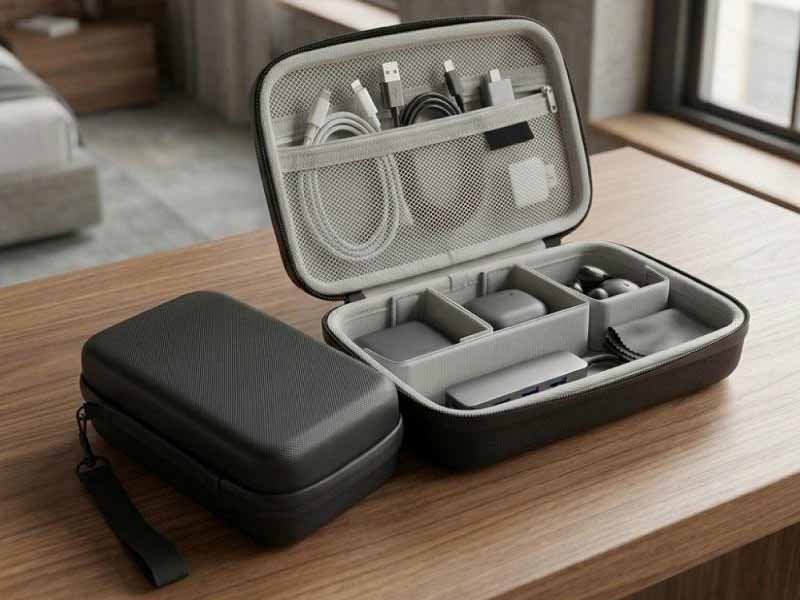
Tech organizer bags used to be simple zipper pouches for cables. Today, they have become one of the most practical soft goods categories for travelers, remote workers, digital creators, business users, Amazon sellers, retail brands, and B2B buyers. The reason is easy to understand: people now carry more electronic accessories than ever, but they do not want their backpack, tote, laptop bag, or suitcase to become a messy space full of tangled cables, scratched earbuds, missing adapters, and loose power banks.
The main trends in tech organizer bags are compact but structured layouts, elastic cable loops, visible mesh pockets, padded protection, water-resistant fabrics, slim everyday-carry sizes, larger double-layer travel versions, and stronger brand customization. For B2B buyers, the best opportunity is to develop organizers that balance real usability, material quality, visual branding, and stable production.
A good tech organizer is not only a place to store accessories. It is a portable desk drawer, a cable control system, a small protection case, and a daily carry habit. Imagine a traveler arriving at a hotel late at night, trying to find a charger before a morning meeting. The laptop battery is low, the phone cable is buried somewhere, and the power bank has scratched against keys all day. That small moment of frustration is exactly why this product category keeps growing.
What Are Tech Organizer Bags?

Tech organizer bags are compact soft goods designed to keep cables, chargers, adapters, earbuds, power banks, USB hubs, memory cards, and small digital accessories organized, protected, and easy to access. They are popular because modern users carry more electronics but want less clutter inside backpacks, travel bags, office totes, and luggage.
What They Really Solve
A tech organizer bag is not just a small pouch with a zipper. Its real job is to turn scattered electronic accessories into a visible, repeatable storage system. When a user opens the bag, each item should have a logical place. A charging cable should not be tangled with earbuds. A power bank should not scratch a portable SSD. A travel adapter should not move around freely and create a bulky, uncomfortable shape inside the bag.
From a product development point of view, the category sits between a soft pouch, a protective case, and a portable desk drawer. It is softer than a hard case, more organized than a simple pouch, and more portable than a desktop organizer. That is why structure matters more than many buyers first realize.
A flat cable pouch may work for daily commuting, but business travelers often need more volume, padding, and separated storage. A photographer may need small pockets for SD cards and batteries, while a remote worker may care more about charger storage, USB hub access, and quick cable retrieval.
The best tech organizer bags feel simple in use but are carefully planned inside. Good designs usually separate three types of items: flat items such as cables and cards, medium items such as chargers and earbuds, and heavier items such as power banks or mice. Once those groups are understood, the layout becomes much easier to design.
Common User Groups
Tech organizer bags are used by many different customer groups, and each group has different expectations. A commuter may want a slim pouch that disappears inside a backpack. A frequent traveler may want a larger organizer that opens flat on a hotel desk. A student may need something affordable and lightweight. A business buyer may want a polished product that can be sold as part of a laptop bag, travel bag, or work accessories collection.
For B2B buyers, this means the product should not be developed only from a factory sample or catalog image. It should start with the target user. What does the user carry every day? Where will the organizer be stored? Is it for a backpack, suitcase, briefcase, tote bag, or desk drawer? Does it need to look premium, casual, technical, outdoor, or corporate?
These questions affect every decision: size, fabric, lining color, zipper type, logo method, pocket layout, packaging, and final cost. A tech organizer made for corporate gifts may need clean branding and stable pricing. A tech pouch for an EDC brand may need premium fabric, better zipper pulls, and a more refined structure.
This is also why tech organizer bags are attractive for brand owners. The same product category can be repositioned for different markets: travel accessories, remote work gear, electronics accessories, promotional gifts, student supplies, camera accessories, gaming accessories, or business lifestyle products.
Tech Pouch vs Electronics Organizer
The terms “tech pouch,” “electronics organizer,” “cable organizer,” and “gadget organizer” often overlap, but they suggest different buyer mindsets. “Tech pouch” usually sounds more lifestyle-oriented and premium. “Electronics organizer” sounds more functional and travel-focused. “Cable organizer” often suggests a slimmer and more affordable product. “Gadget organizer” can cover a wider range of small digital items.
This matters because product positioning affects design. A tech pouch for a lifestyle brand may use a clean exterior, subtle woven label, soft lining, and semi-structured shape. An electronics organizer for travel may use double-layer storage, more elastic loops, mesh pockets, a carry handle, and padded panels. A cable organizer may focus on thinness and simple internal bands rather than heavy structure.
For brands and importers, the smartest approach is to define the search and sales language early. If the product will be sold on Amazon, clear functional terms such as “electronics organizer bag,” “travel cable organizer,” and “charger organizer pouch” may work better. If the product is part of a premium backpack or remote work collection, “tech pouch” may sound more appealing.
The product may be physically similar, but the buyer expectation changes with the name. That is why naming, product photography, feature icons, packaging copy, and SEO content should all match the intended use case.
Why Demand Is Growing
Demand is growing because daily carry has changed. A typical user may carry a phone charger, USB-C cable, laptop adapter, earbuds, power bank, mouse, USB hub, memory card reader, portable SSD, and travel adapter. These are small items, but together they create a real storage problem.
Remote work and travel have also blended together. Many people now work from home, coworking spaces, airports, cafés, hotels, and client offices. They want one small organizer that can move from bag to desk without repacking everything. A good tech organizer becomes a portable work kit.
For brands, this creates a strong product opportunity. Tech organizer bags are practical, giftable, easy to brand, and suitable for many channels, including Amazon, Shopify, retail, travel accessories, electronics accessories, corporate gifting, and lifestyle collections. Unlike highly seasonal products, a well-designed tech organizer can sell year-round because the use case is tied to everyday digital life.
From a manufacturing perspective, the category is also flexible. It can be developed as a simple cable pouch, a premium structured tech pouch, a travel electronics case, a business gift, or a full product series with multiple sizes and materials.
Which Functions Are Trending?

Trending functions include elastic cable loops, visible mesh pockets, padded compartments, clamshell openings, slim outer pockets, self-standing structures, and dedicated zones for chargers, power banks, earbuds, and adapters. Buyers increasingly prefer organizers that are easy to open, easy to scan, protective enough for daily electronics, and compact enough to fit inside larger bags.
Smarter Pocket Layouts
The strongest trend is not simply “more pockets.” The better trend is smarter pocket zoning. Many older electronics organizers added too many loops and pockets without considering how people actually pack. The result looked impressive in product photos but felt frustrating in daily use.
A useful pocket layout should separate small, flat, bulky, and fragile accessories. Cables need elastic loops or flat channels. Earbuds and USB drives need small mesh or zipper pockets. Chargers and adapters need deeper pockets. A power bank needs a more stable position so it does not swing around or deform the pouch.
A common medium tech organizer may include 8–14 storage points. A larger double-layer travel organizer may include 14–24 storage points, but only if the layout remains clear. When every pocket competes for space, the product becomes harder to use. When each pocket has a clear role, the user can build a repeatable packing habit.
| Accessory Type | Practical Pocket Design | Common Size / Spec Reference | Main Benefit |
|---|---|---|---|
| Charging cables | Elastic loops or webbing bands | 20–30 mm elastic width | Reduces tangling |
| Earbuds | Small mesh pocket | 80–120 mm pocket width | Quick visibility |
| USB drives / SD cards | Zipper pocket or tight mesh | Small secured section | Prevents loss |
| Wall charger | 3D fabric pocket | 35–60 mm pocket depth | Holds bulky shape |
| Power bank | Padded sleeve or elastic pocket | Fits common 100–400 g devices | Reduces movement |
| Mouse | Open 3D pocket | 40–70 mm depth | Easy removal |
| Portable SSD | Soft padded sleeve | 2–5 mm padding nearby | Scratch protection |
The key point is not to fill every panel with pockets. The goal is to create a layout that feels natural when the user is tired, traveling, or working quickly.
Elastic Cable Control
Elastic loops remain one of the most useful features because cables are the main source of mess. A cable that is not fixed will twist, knot, and spread inside the organizer. Once several cables are loose, even a large pouch starts to feel chaotic.
The elastic should be chosen carefully. Very thin elastic may look neat at first but can lose tension after repeated use. Very tight elastic makes it difficult to insert thicker braided cables or laptop charging cables. For many tech organizers, 20–30 mm elastic is a practical range for standard cable loops. Wider elastic can be used for bulkier accessories, while narrower elastic can work for USB drives or small adapters.
Spacing is just as important as elastic width. If loops are too close, cables overlap and create lumps. If they are too far apart, space is wasted. During sampling, the layout should be tested with real cables: a short USB-C cable, 1-meter charging cable, 2-meter cable, braided cable, and adapter cable. A good organizer should still close smoothly after everything is packed.
For bulk production, elastic tension must also stay consistent. If one batch uses elastic that is too loose and another batch uses elastic that is too tight, the same design will feel different to customers. This is why material confirmation before production matters.
Mesh and Visibility
Mesh pockets are still popular because they help users see small items quickly. Many digital accessories are black, gray, or very small. If the lining is also dark and the pockets are opaque, users waste time opening every section to find a dongle, SIM tool, memory card, or short charging cable.
Good mesh pockets are useful for earbuds, USB drives, SD card readers, charging heads, small adapters, and short cables. However, mesh should not be used for everything. Heavy chargers and power banks can stretch mesh too quickly, making the organizer look loose and poorly made. For heavier items, fabric pockets or padded sleeves are usually better.
The best approach is to combine mesh with fabric. Use mesh where visibility matters and use stronger fabric where support matters. A light-colored lining can also improve visibility without adding more pockets. For example, a black exterior with gray lining or navy exterior with beige lining can make the inside easier to scan while still looking professional.
Mesh quality also affects the final feel. Fine mesh can look cleaner and more premium. Coarser mesh may be stronger but can feel less refined. The choice depends on product positioning and target price.
Fast Access Design
A tech organizer bag should not force the user to dig. Fast access is one of the biggest reasons people buy this product. That is why clamshell openings, wide zipper openings, fold-flat panels, and self-standing shapes are becoming more popular.
A clamshell design opens like a book, making both sides visible. This works well for travel and desk use. A top-opening pouch works better for quick access inside a backpack, but it may hide smaller items at the bottom. A roll or fold style can look unique, but it must be easy to close when fully packed.
The zipper path affects the whole experience. If the zipper turns around tight corners, the user may feel resistance. If the opening is too narrow, bulky chargers are hard to remove. If the pouch opens too wide without enough pocket security, small items may fall out. A good access design balances visibility, retention, and smooth operation.
For B2B buyers, this is a detail worth testing repeatedly during sample review. Open the pouch on a desk, inside a backpack, on an airplane tray, and in a hotel room setting. If the user can find the right cable in just a few seconds, the design is doing its job.
How Are Materials Changing?

Materials are shifting toward water-resistant polyester, nylon, Oxford fabric, recycled textiles, PU-coated fabrics, soft linings, durable mesh, padded foam, and smoother zipper systems. Buyers want lightweight organizers that still feel protective. The trend is not just stronger fabric; it is better material matching across exterior, lining, padding, zipper, elastic, and finishing.
Exterior Fabric Choices
The exterior fabric sets the first impression. It affects hand feel, shape, durability, water resistance, color expression, and retail positioning. For entry-level organizers, polyester is still common because it offers good cost control and broad color availability. For mid-range products, 600D polyester, Oxford fabric, and nylon blends can provide better structure and durability. For premium products, high-density nylon, recycled nylon, coated fabric, ripstop, or laminated technical fabrics can create a more advanced look.
The right choice depends on the target channel. A corporate gift organizer may not need expensive fabric; it needs clean branding and reliable construction. A DTC travel brand may need better fabric texture and a more premium hand feel. An outdoor or EDC brand may prefer coated or ripstop fabric because it communicates toughness.
Fabric weight and stiffness should also match the pouch size. A very small pouch made from overly heavy fabric may feel stiff and bulky. A large organizer made from fabric that is too soft may collapse when packed. The best result usually comes from balancing outer fabric, lining, foam, and internal structure rather than relying on fabric alone.
| Material Area | Common Option | Typical Use | Practical Note |
|---|---|---|---|
| Outer shell | 300D–600D polyester | Entry to mid-range organizers | Good cost and color options |
| Outer shell | 420D nylon / Oxford fabric | Travel and work organizers | Better structure and hand feel |
| Premium shell | Recycled nylon / coated fabric | DTC, EDC, premium travel | Stronger brand story |
| Lining | 190T/210D polyester | Standard interior | Lightweight and cost-effective |
| Padding | 2–5 mm foam | Protective panels | Adds shape and shock absorption |
| Mesh | Polyester or elastic mesh | Small item pockets | Improves visibility |
| Zipper | #3 or #5 nylon zipper | Main closure | #5 is common for smoother daily use |
A good fabric decision should consider both the first sample and the repeat order. If the fabric is difficult to source consistently, bulk production and replenishment may become unstable.
Water Resistance
Water resistance is increasingly expected, especially for travel and work accessories. Users want protection from light rain, desk spills, and damp luggage environments. However, there is an important difference between water-resistant and waterproof.
Most tech organizer bags are water-resistant, not fully waterproof. A coated polyester or nylon exterior can help resist splashes, but water can still enter through seams, zipper gaps, stitching holes, or unsealed edges. Unless the product uses welded seams and a true waterproof zipper system, it should not be marketed as fully waterproof.
This distinction matters because product claims affect trust. If buyers overpromise waterproof performance, customer reviews may suffer. A more responsible claim is “water-resistant exterior,” “splash-resistant fabric,” or “helps protect accessories from light moisture.”
For most brands, water resistance should be treated as one layer of protection, not the only selling point. A good tech organizer should also protect against scratching, movement, clutter, and daily handling. Water-resistant fabric is valuable, but it works best when combined with reliable zippers, proper lining, padding, and good pocket structure.
Padding and Protection
Padding is becoming more common because small electronics are more valuable than they used to be. A compact SSD, wireless earbuds, camera battery, USB-C hub, or power bank may be expensive enough that users expect some level of protection.
The challenge is avoiding unnecessary bulk. A slim cable organizer may only need light foam or interlining. A medium tech pouch may use 2–3 mm foam in the front and back panels. A larger travel organizer may use 4–5 mm foam or structured padding around key compartments. If the organizer is too padded, it may become difficult to pack inside another bag.
Protection should also be placed intelligently. The outer panels need impact resistance. The internal sleeves need soft surfaces. The power bank section needs stability. The portable SSD area may need a smooth lining to reduce scratches. Small pockets do not need heavy padding if they only hold cables or cards.
During sample testing, pack the organizer fully and press it gently from different sides. If hard accessories push through the fabric too strongly, more structure may be needed. If the pouch looks swollen and awkward, the padding or pocket depth may need adjustment.
Zippers and Finishing
Zippers are one of the most important quality signals in a tech organizer bag. A user may open and close the pouch multiple times a day. If the zipper catches, feels rough, or jams around corners, the entire product feels cheaper.
For small flat cable organizers, #3 nylon zipper may be enough. For medium and larger tech pouches, #5 nylon zipper is often more suitable because it feels smoother and stronger. Water-resistant zippers can create a more technical look, but they may feel slightly stiffer and increase cost. Pullers should be easy to grip, especially for travelers using the pouch in airports, hotels, cars, or low-light settings.
Finishing details also matter: clean binding, even stitching, straight pocket lines, neat zipper ends, trimmed threads, smooth edge curves, and accurate logo placement. These are the details customers may not describe in technical language, but they immediately feel them.
A good tech organizer should look controlled when empty and stable when packed. That requires not only good materials, but also careful sewing, cutting accuracy, and finishing control.
Which Sizes Are Most Popular?

Popular tech organizer bag sizes usually fall into three groups: slim pouches under 1L, medium organizers around 1–2L, and larger travel organizers around 2–4L. Small sizes work for daily cables and earbuds, medium sizes suit work and commuting, while larger organizers serve business travel, digital nomads, and tech-heavy users.
Everyday Carry Sizes
Everyday carry users usually prefer slim or medium organizers. They do not want a bulky pouch that takes over the backpack. For this group, the best size is often under 1L or around 1–2L. It should hold the essentials: charging cables, earbuds, USB drive, small charger, power bank, and maybe a compact mouse or hub.
Slim pouches work well for laptop bags, briefcases, and tote bags. They can slide into side compartments or document sections without making the bag feel crowded. Medium pouches are more flexible because they can hold a fuller work setup while still fitting inside a backpack.
The key is thickness. A pouch can have a reasonable footprint, but if it becomes too thick when packed, users may stop carrying it. For EDC, the closed thickness should feel controlled. Many practical daily tech pouches stay within a slim-to-medium profile rather than becoming boxy.
A good everyday carry organizer should be easy to grab, easy to open, and easy to move between bags. If the user needs to repack everything every morning, the product has failed its purpose.
Business Travel Sizes
Business travel users usually need more capacity. They may carry a laptop charger, phone charger, travel adapter, power bank, mouse, earbuds, USB hub, HDMI adapter, charging cables, portable SSD, and sometimes a small notebook or passport. A small pouch may not be enough.
For business travel, 2–4L organizers are often more practical. Double-layer structures can work well because they separate flat cables from bulkier items. One side can hold elastic loops and mesh pockets, while the other side can hold chargers and power banks. This keeps the organizer cleaner and easier to use.
A business travel organizer should also look professional. Neutral colors such as black, charcoal, navy, gray, and dark green tend to work better than overly bright colors. The structure should be stable enough to sit on a desk, but not so rigid that it wastes luggage space.
| Size Category | Approx. Capacity | Typical User | Common Items | Design Priority |
|---|---|---|---|---|
| Slim pouch | Under 1L | Daily commuter | Cables, earbuds, USB drive | Thin and light |
| Medium pouch | 1–2L | Office / remote worker | Charger, mouse, power bank, hub | Balanced layout |
| Travel organizer | 2–4L | Business traveler | Multiple chargers, adapters, power bank | Capacity and protection |
| Hybrid tech sling | 2–3L | EDC user | Tech kit plus small personal items | Wearable access |
When developing a product line, brands may benefit from offering two sizes rather than trying to make one organizer serve every user.
Compact vs Large
Compact and large organizers serve different jobs. A compact organizer is about speed and minimal carry. It should be light, slim, and easy to place inside another bag. A large organizer is about capacity and full control. It should prevent a bigger tech setup from becoming messy.
Compact organizers should avoid overbuilding. If there are too many padded layers, thick dividers, or heavy zipper parts, the product loses the benefit of being compact. A few well-placed loops and pockets may work better than a crowded internal panel.
Large organizers need more structure. Without proper gussets, dividers, and pocket planning, large organizers become soft boxes where items move around. They may also become difficult to close when fully packed. For larger designs, the zipper path, panel stability, and pocket depth need more attention.
From a production perspective, larger organizers are more complex. More panels mean more cutting accuracy requirements. More pockets mean more sewing steps. More layers mean more chances for thickness problems at corners. That is why sample testing is especially important before bulk production.
Slim or Structured
Buyers like slim designs because they fit easily into daily bags. They like structured designs because they look premium and protect gear better. The strongest current direction is semi-structured design.
A semi-structured organizer holds its shape when opened but still has enough flexibility to pack well. This can be achieved with foam, interlining, reinforced zipper edges, flexible gussets, and balanced fabric stiffness. The result feels more premium than a soft pouch but less bulky than a rigid case.
Slim organizers are better for users who carry fewer items and care about lightness. Structured organizers are better for users who carry heavier accessories or want a product that stands on a desk. For B2B product planning, it may be useful to develop both options as part of a series: one slim cable pouch and one structured travel tech pouch.
The main rule is simple: the structure should support the way the product is used. It should not be added only to make the sample look better in photos.
How Do Brands Customize Tech Organizer Bags?
Brands customize tech organizer bags through fabric choice, color system, lining contrast, pocket layout, logo method, zipper pullers, labels, packaging, and OEM/ODM structural development. Good customization is not just adding a logo. It means designing the organizer around the brand’s target user, retail channel, price level, and long-term product line.
Logo and Branding
Logo placement should feel natural, not forced. For tech organizer bags, branding is often most effective when it is clean and controlled. The user may carry the product in business settings, airports, offices, or coworking spaces, so overly large decoration can reduce the product’s appeal.
Common logo methods include screen printing, heat transfer, woven labels, rubber patches, leather patches, embroidery, debossed PU labels, and custom zipper pullers. Each has a different cost, durability, and visual effect.
A simple promotional organizer may use screen printing or heat transfer. A retail-ready travel pouch may use a woven label or rubber patch. A premium organizer may use a subtle debossed label or custom zipper pull. For some brands, the lining color or zipper pull shape can become part of the brand identity without making the exterior too loud.
The logo method should match the fabric. Screen printing may work well on smooth polyester but may not look ideal on textured fabric. Embroidery can feel premium but may distort thin or padded panels. Rubber patches look modern but add cost and require careful placement.
Color and Material Identity
Color is more than decoration. It tells the buyer what kind of product this is. Black, charcoal, navy, gray, olive, beige, and sand are common for tech and travel accessories because they look practical, clean, and easy to match with backpacks, laptop bags, and luggage.
Interior color can be more functional. A light gray, beige, orange, or blue lining can make small black accessories easier to find. This is especially useful for users who carry adapters, USB drives, earbuds, and memory cards. A dark lining may look premium, but it can reduce visibility.
Brands should also consider whether they need stock fabric colors or custom-dyed colors. Stock colors usually support faster sampling, lower minimums, and better cost control. Custom colors can improve brand consistency but may require higher MOQ and longer lead time. For a first trial order, many buyers choose a stock exterior color and customize the logo, lining, or zipper pull instead.
Material identity is also important. Recycled polyester or recycled nylon can support a sustainability story. Coated fabric can support a technical travel image. Oxford fabric can create a practical and durable look. The fabric should match the brand’s market position.
Packaging Options
Packaging can increase perceived value, especially for retail, Amazon, Shopify, corporate gifts, and promotional sales. A simple polybag may be enough for bulk distribution, but a retail product often needs stronger presentation.
Common packaging options include individual polybag, kraft paper sleeve, hangtag, color box, zipper bag, paper belly band, or gift box. For e-commerce, packaging should protect the product, support barcode labeling, and keep the organizer clean during storage and shipping. For retail, packaging should explain the main benefits quickly.
A practical packaging layout may include product name, size, material, key features, barcode, QR code, care instructions, and brand story. Feature icons can help users understand the product quickly: cable loops, padded protection, water-resistant exterior, travel-ready layout, and compact storage.
Packaging should not be overbuilt. If the box is too large, shipping costs increase. If the packaging is too weak, it may arrive damaged. If the packaging uses too much plastic, it may conflict with sustainability expectations. Good packaging supports the product without creating unnecessary cost or waste.
OEM and ODM Paths
OEM and ODM are both useful, but they serve different buyers. OEM is best when the buyer already has a sample, tech pack, drawing, or exact design. ODM is better when the buyer has an idea, reference product, target market, or rough concept but still needs help turning it into a production-ready item.
For tech organizer bags, ODM support can be especially valuable because small layout changes make a big difference. A manufacturer may suggest adjusting elastic width, pocket depth, zipper direction, foam thickness, lining color, or logo placement. These are not just small factory details; they directly affect customer reviews.
A practical development path may look like this:
Share reference photo, sample, or sketchConfirm target user and use scenarioDefine size and accessory packing listChoose material and zipper levelCreate first sampleTest with real accessoriesRevise pocket layout and structureConfirm logo and packagingApprove pre-production sampleMove into bulk production
This process reduces the risk of launching a product that looks good online but feels inconvenient in real use.
What Should B2B Buyers Check?
B2B buyers should check structure, materials, zipper smoothness, pocket usability, elastic strength, padding, stitching, logo durability, sample accuracy, packaging, MOQ, lead time, and export support. The goal is not only to approve a nice sample, but to make sure the same quality can be repeated in bulk production.
Structure Review
The first thing to check is structure. A tech organizer bag should be reviewed while empty, half packed, and fully packed. Many samples look clean when empty but become bulky or uneven once real accessories are added.
Buyers should test the opening angle, zipper path, pocket depth, elastic tension, panel stiffness, gusset width, and internal visibility. The pouch should open naturally, show the items clearly, and close without forcing the zipper. If the zipper must be pulled hard to close around chargers and power banks, the structure may need more space or better pocket distribution.
The product should also be tested inside the bag where it will actually be used. A tech organizer for backpacks should fit without creating a hard lump. A travel organizer should pack well inside luggage. A desk-friendly organizer should open flat or stand in a stable way.
A strong sample review should include real accessories, not only measurements. Put in a charger, power bank, cables, earbuds, mouse, USB hub, and adapter. Then use the organizer the way a customer would.
Quality Details
Small quality details decide whether the product feels professional. Zipper alignment, stitching, binding, pocket symmetry, elastic tension, logo position, lining smoothness, and thread trimming all affect the final impression.
A common problem in tech organizer production is uneven internal pockets. Because there are many small sewing lines, even a few millimeters of variation can make the layout look messy. Elastic loops should be evenly spaced and firmly stitched. Mesh pockets should not wrinkle or sag. Zipper corners should run smoothly. Binding should sit flat without twisting.
Stitch density should match the fabric and structure. Too loose, and the bag may look weak. Too tight, and thin fabric may pucker. Reinforcement is important at stress points such as handles, zipper ends, pocket openings, and elastic attachment points.
| Inspection Point | What to Check | Practical Standard to Confirm |
|---|---|---|
| Zipper | Smooth opening and closing | No catching at corners |
| Elastic loops | Tension and spacing | Holds cables without twisting |
| Stitching | Straightness and density | No skipped stitches or loose thread |
| Mesh pockets | Shape and rebound | No sagging after packing |
| Padding | Even thickness | No hard lumps or empty spots |
| Logo | Placement and durability | Consistent position across bulk |
| Size | Length, width, depth | Matches approved sample tolerance |
| Packing | Label, barcode, carton | Meets sales channel requirements |
Sample Before Bulk
Samples are necessary for tech organizer bags because the product has many small functional details. Even a simple-looking pouch may include multiple pocket types, elastic loops, lining layers, padding, zipper curves, binding, logo process, and packaging.
A good first sample helps confirm the overall direction. A revised sample helps fix layout or material issues. A pre-production sample helps lock the final standard before bulk production. Skipping these steps may save a little time at the beginning but can create bigger problems later.
Buyers should test the sample with a real packing list and give feedback with photos, videos, or marked drawings. Vague comments such as “make it better” are difficult for any factory to execute. Specific comments are much more useful: “increase the charger pocket depth by 10 mm,” “move the logo 15 mm lower,” “change the lining to light gray,” or “make the elastic loops wider for thicker cables.”
The approved sample should become the reference for bulk production. Materials, colors, logo process, zipper, lining, pocket layout, and packaging should all match the confirmed standard.
Manufacturer Fit
The right manufacturer should understand more than sewing. Tech organizer bags require material selection, pattern accuracy, pocket planning, zipper control, logo application, packaging coordination, and quality inspection. A supplier that only quotes the lowest price may not be the best fit for a product with many small details.
B2B buyers should look for a manufacturer that can discuss the product’s actual use. Can they suggest a better pocket structure? Can they explain material differences? Can they adjust the sample based on real accessory testing? Can they support logo and packaging? Can they manage small trial orders and repeat bulk orders?
A practical manufacturer evaluation should include these questions:
Can you develop from a photo, sample, sketch, or tech pack?What material options fit my target price and market?Can you test the sample with real accessories?What zipper and elastic options do you recommend?Can you support woven labels, rubber patches, or custom pullers?What is the MOQ for this structure and material?Can you provide export packaging and carton labeling?How do you control consistency from sample to bulk?
A strong manufacturer does not only say “yes.” A strong manufacturer helps identify risks before production, improves the product during sampling, and keeps the final bulk order aligned with the approved sample.
For brands planning custom tech organizer bags, electronics organizer pouches, cable storage bags, or private label travel tech pouches, working with an experienced custom bags and soft goods manufacturer can reduce development risk. Szoneier supports OEM/ODM custom bag projects from reference photo, sketch, tech pack, material selection, sample development, logo application, packaging, quality inspection, and export delivery.
If you are developing a new tech organizer bag for retail, Amazon, Shopify, corporate gifting, travel accessories, or electronics accessory markets, send your product photo, drawing, target size, material preference, logo file, quantity, packaging requirement, and destination country to Szoneier for project review. A well-built tech organizer bag starts with a clear use case, a practical structure, and a production partner who understands how to turn small details into a reliable bulk product.