Skip to content
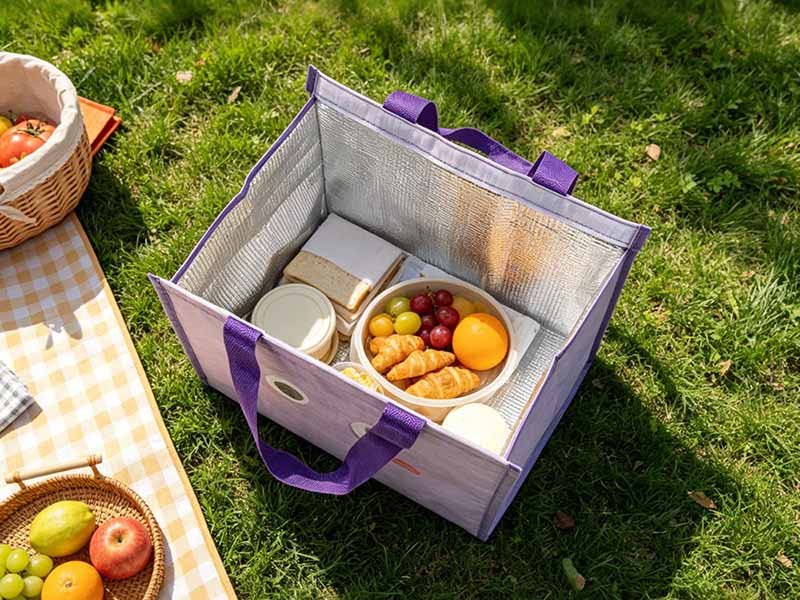
Two cooler bags can look almost identical on a retail shelf and behave very differently once they are loaded with food, beverages, gel packs, or ice. The difference is often hidden inside the walls. Outer fabric gets most of the visual attention, but cold retention depends on a much less visible combination of foam, liner, layer thickness, panel coverage, seams, lid construction, closure design, and the way those materials are assembled during production. This is the reason a shiny silver interior or a thick-looking wall should never be treated as proof of strong thermal performance.
Cooler bags normally use a layered insulation system built from a protective outer fabric, a foam insulation core, and a moisture-resistant inner liner. EPE and PE are common in economical everyday products, while XPE and EVA can provide stronger dimensional stability for upgraded designs. PEVA, TPU, PVC, and foil laminates mainly support cleaning, moisture control, leak resistance, or radiant-heat management rather than replacing the foam itself.
The most useful way to evaluate a cooler bag is therefore to stop asking which single material is “best” and start asking whether the complete material system fits the product’s actual use. A compact lunch cooler, a supermarket grocery tote, a delivery bag opened twenty times during a shift, and a premium outdoor soft cooler all face different thermal and mechanical demands. Once those use conditions are clear, insulation selection becomes far more practical, measurable, and cost-effective.
What Materials Are Used to Insulate Cooler Bags?

Cooler bags usually combine an outer shell, a foam insulation layer, and an inner liner, with zippers, seams, and closures completing the thermal envelope. EPE, PE, XPE, EVA, and PU foams are used to slow conductive heat transfer, while PEVA, TPU, PVC, and foil-based liners manage moisture, cleaning, leakage, and radiant heat. Finished performance comes from the complete construction rather than one material.
Main Insulation Layers
The outer shell protects the cooler during handling and gives the product its appearance, structure, branding surface, and abrasion resistance. Polyester and Oxford fabrics are common because they are widely available, easy to coat, printable, and suitable for many price levels. Nylon may be used when lower weight or a smoother premium appearance is required, while canvas can support lifestyle or gift-oriented designs where tactile quality and visual character matter as much as minimum product weight.
Behind the outer shell sits the material that provides most of the thermal resistance in a typical sewn soft cooler. This is generally a cellular foam such as EPE, PE, XPE, EVA, or another suitable insulation material. The small cells inside the foam contain air or gas, which slows the movement of heat through the wall compared with a dense, solid material of similar thickness. Foam thickness, density, cell structure, compression resistance, and panel coverage all influence the finished result.
The inner layer has a different responsibility. PEVA, TPU, PVC, and foil laminates are commonly selected because the inside of a cooler must handle condensation, food residue, repeated wiping, melted ice, and contact with bottles or containers. Some liners also contribute to radiant-heat management, while others are chosen mainly for flexibility, hygiene, weldability, or abrasion resistance. Treating this inner surface as a separate functional layer makes material specifications much clearer and reduces confusion during quotation and sampling.
| Layer | Main Function | Common Material Options | Practical Specification Point |
|---|---|---|---|
| Outer shell | Abrasion, appearance, structure | Polyester, Oxford, nylon, canvas | Fabric type, denier, coating |
| Insulation core | Slow heat transfer | EPE, PE, XPE, EVA, PU | Foam type, density, thickness |
| Inner liner | Moisture, cleaning, reflection | PEVA, TPU, PVC, foil laminate | Film type, thickness, seam method |
| Closure | Reduce air exchange | Zipper, flap, roll top | Length, overlap, sealing method |
| Seams | Maintain layer continuity | Sewn, bound, sealed, welded | Compression and leakage control |
Insulation and Lining Are Different
One of the most persistent cooler bag misconceptions comes from the silver-colored interior commonly seen in lunch bags, promotional coolers, and grocery bags. Because the reflective surface is highly visible, it is often described casually as “the insulation.” In most designs, however, the foam hidden behind that surface is providing a much larger share of the resistance to conductive heat transfer. The liner supports the system, but it does not automatically replace the need for a meaningful insulation core.
This distinction becomes important when quotations are compared. Two suppliers may both describe their construction as an “aluminum foil insulated cooler bag,” even though one proposal contains only a thin cushioning layer and the other contains a properly specified foam layer of several millimeters. The interiors may look almost the same in product photographs, yet the cold-retention performance, structural feel, and production cost can be noticeably different once the products are tested under the same conditions.
A useful cooler specification should therefore avoid vague phrases such as “thermal inside,” “silver insulation,” or “thick foam.” Product teams gain far more control when the construction identifies the outer fabric, foam family, nominal foam thickness, liner material, lid insulation, base insulation, closure type, and seam method separately. Those details also help explain legitimate price differences between factories, because a 3 mm economical EPE construction and an 8 mm XPE construction are not equivalent products even if the finished bags have similar dimensions.
How Heat Reaches the Contents
Heat can enter a cooler bag through conduction, convection, and radiation, and each pathway responds to a different part of the construction. Conduction occurs through the walls, which is where foam thickness and thermal conductivity matter most. Convection becomes important whenever warm air enters through an open zipper or poorly sealed closure. Radiation becomes more noticeable under strong sunlight or near hot surfaces, where reflective layers may contribute to overall thermal control when they are correctly integrated into the product.
There is also a practical manufacturing issue known as thermal bridging. Heat tends to move through the easiest path, which means thin areas around zippers, corners, bindings, handle attachments, compressed seams, or missing foam can weaken an otherwise good insulation system. This explains how a cooler made with an expensive foam grade can still underperform if the lid is poorly insulated or the foam stops short at the corners. Continuous coverage often matters more than the impressive name of one individual material.
For this reason, experienced product development focuses on the thermal envelope rather than on a single material specification. The foam must slow heat movement through the wall, the liner must handle moisture and cleaning, the closure must reduce uncontrolled air exchange, and the seams must preserve reasonable insulation continuity. When those elements are considered together, material decisions become easier to evaluate, reproduce, and improve during later production runs.
Which Foam Insulation Is Best for Cooler Bags?
No single foam is best for every cooler bag. EPE and PE are widely used in economical, lightweight products; XPE offers improved dimensional stability; EVA provides stronger resilience and structure; and PU can deliver efficient insulation in constructions suited to its properties. The most appropriate choice depends on finished thickness, density, flexibility, compression resistance, manufacturing method, product positioning, and the performance target of the complete cooler.
EPE and PE Foam
EPE is widely used in cooler bags because it offers a practical balance of low weight, flexibility, cushioning, processability, and material cost. It works particularly well in products that need to remain soft or partially collapsible, such as lunch coolers, grocery bags, promotional coolers, bottle carriers, and simple picnic bags. These categories often need to ship efficiently and remain comfortable to carry, so excessive rigidity can be just as undesirable as insufficient insulation.
PE foam is a broader family, and two sheets sold under the same general name can behave differently in the finished product. Density, cross-linking, cell size, recovery, stiffness, lamination, and thickness tolerance can vary among grades. This is one reason a specification that says only “5 mm PE foam” leaves considerable room for variation. A softer low-density sheet and a more stable cross-linked sheet may share the same nominal thickness but respond differently to sewing pressure, carton compression, and repeated use.
In everyday commercial products, foam thickness commonly begins around 2–4 mm for lightweight promotional coolers, 3–6 mm for compact lunch bags, 5–8 mm for larger grocery or picnic applications, and 6–10 mm or more for stronger soft-cooler constructions. These figures should be treated as development ranges rather than guarantees of a particular cold-retention time. A well-designed 6 mm system with good lid coverage can perform more consistently than a poorly assembled 10 mm wall with large insulation gaps.
XPE and EVA Foam
XPE is cross-linked polyethylene foam, and the cross-linked structure can improve dimensional stability, resilience, surface consistency, and resistance to repeated compression. Those characteristics are useful when the cooler needs to hold a more controlled shape or recover better after storage and shipping. Compared with very soft EPE constructions, XPE can make the wall feel more engineered, which is attractive in outdoor, travel, and higher-value retail products where product handfeel contributes to the customer’s perception of quality.
EVA offers another useful combination of cushioning, resilience, water resistance, and structural support. Depending on its formulation and density, EVA can create a firmer and more substantial wall than common low-density expanded foams. This can improve the appearance of the lid, reduce collapsing around the sides, and help the cooler maintain a cleaner silhouette in product photography. Those benefits are especially relevant for lifestyle brands where the product must look premium before anyone has evaluated its actual thermal performance.
Higher-grade foam is not automatically the correct choice, however. A small lunch bag can lose too much usable internal volume if dense, thick EVA is added simply to make the specification sound premium. The same material may be entirely appropriate in a structured outdoor cooler expected to be carried repeatedly over several seasons. Product use, internal capacity, shipping volume, wall stiffness, target retail price, and expected service life all need to be considered before the extra material cost is justified.
PU and Material Trade-Offs
Polyurethane insulation is attractive because many PU foam systems achieve relatively low thermal conductivity compared with common flexible foam grades. From a purely thermal perspective, that can make PU interesting when a product needs greater resistance to heat transfer within a limited wall thickness. The challenge is that thermal conductivity is only one part of cooler design, and a material optimized for rigid insulated panels may not behave as conveniently inside a soft bag that must be sewn, folded, compressed, and transported.
Soft coolers experience mechanical conditions that laboratory insulation samples do not. They are squeezed into cartons, stacked in warehouses, repeatedly opened, carried by straps, folded during storage, and pressed against bottles or food containers. A material that performs extremely well in a rigid system may create manufacturing or durability problems if the surrounding product is expected to remain flexible. The better material choice therefore balances thermal efficiency with the actual physical behavior required during production and daily use.
The practical question is not which foam has the most impressive technical name. It is which material gives the product enough thermal resistance, structural support, recovery, and durability without adding unnecessary cost, weight, or shipping bulk. An approved physical sample is often more valuable than a material description alone because it shows how the foam behaves after lamination, sewing, compression, and final assembly. That physical reference can then be retained to help control repeat production.
How Do Liners Affect Cooler Bag Performance?

Cooler bag liners influence moisture control, hygiene, cleaning, flexibility, abrasion resistance, leakage risk, and perceived quality. PEVA works well in many everyday designs, reflective foil laminates are common in cost-sensitive thermal products, and TPU can suit more demanding or premium constructions. The liner should always be evaluated together with the seam method because waterproof or water-resistant film does not automatically create a leakproof finished cooler.
PEVA and Foil Liners
PEVA is frequently used because it is flexible, relatively lightweight, easy to wipe, and suitable for many conventional sewn constructions. In lunch coolers, picnic bags, and grocery products, it can provide a clean interior without making the bag excessively stiff. It also works well when the cooler needs to fold or compress during transport. The actual performance still depends on film grade, backing, thickness, seam quality, and whether the liner is exposed to sharp corners or abrasive containers during use.
Foil-based liners create a different visual and functional effect. The metallic surface has become strongly associated with insulated products, particularly promotional coolers and supermarket bags, because consumers immediately recognize the appearance. The reflective surface can also contribute to radiant-heat management when it is part of a properly designed layer system. In practice, commercial “aluminum foil” interiors are usually laminated structures rather than loose foil, with polymer films, adhesives, backing materials, or reinforcement added to improve usability.
Very lightweight foil laminates can crease quickly and may show wear sooner when folded repeatedly, while heavier constructions can improve appearance and durability at a higher cost. The correct choice depends on the expected product lifetime and retail positioning. A short-term promotional campaign may not need the same liner construction as a reusable premium picnic cooler intended to be carried every weekend for several years.
TPU and Leakage Control
TPU becomes attractive when a project places greater emphasis on flexibility, abrasion resistance, welded construction, moisture containment, or a premium interior finish. It can perform well in designs that aim for stronger leak resistance, but the finished bag still depends on how the liner is joined. If an impermeable material is penetrated by conventional sewing needles along every seam, each needle hole becomes a potential path for water, especially around corners and areas that experience repeated flexing.
This is why the terms “waterproof material,” “water-resistant liner,” and “leakproof cooler” should not be treated as interchangeable. A film can be highly resistant to water while the assembled product still leaks through zipper ends, bindings, liner joins, bottom corners, drain structures, or attachment points. A lunch bag designed to contain condensation around sealed containers faces a much easier task than a cooler expected to hold several liters of melted ice without any visible leakage.
A simple prototype leak test can provide useful comparative information before formal testing is considered. A product team might add a defined water depth, keep the bag upright on absorbent paper, wait for a fixed period, and inspect corners, seams, and exterior fabric. A practical internal development condition could use approximately 30–50 mm of water for 30–60 minutes, with the acceptance criterion defined before testing. The exact procedure should match the intended claim and product risk.
Liner Choice and Long-Term Use
The liner should be evaluated after the cooler has been used rather than only when the sample arrives from the factory. A fresh interior can look excellent, yet repeated folding, wiping, loading, condensation, and temperature cycling may reveal creasing, delamination, punctures, seam stress, or surface wear. Product teams gain far more useful information by opening the bag repeatedly, loading actual containers, cleaning the liner, and compressing the lid than by judging the interior only from a photograph.
A premium TPU liner placed over very thin foam will not turn a basic cooler into a high-performance thermal product. Similarly, a thick insulation core paired with a fragile interior may deliver respectable cold retention while producing poor durability in daily use. The foam, liner, seams, and closure should therefore be developed as one system. A successful construction has to protect temperature, survive cleaning, tolerate mechanical stress, and still feel appropriate for the intended retail position.
Szoneier’s documented cooler bag capabilities include material selection, insulation structure development, packaging, production, and product-specific quality control, which makes this layered approach especially relevant when a custom cooler is being developed from a reference product or new concept. A practical development process should define the liner according to actual use rather than selecting it only because it looks familiar or premium.
How Do Thickness and Construction Affect Cold Retention?

Greater insulation thickness generally increases thermal resistance, but thickness alone cannot predict how long a cooler will stay cold. Foam density, compression, lid design, zipper leakage, panel coverage, internal volume, cooling-source weight, ambient temperature, and opening frequency all affect the finished result. A carefully assembled 8 mm cooler can outperform a poorly constructed 10 mm product when its insulation envelope is more continuous and its closure is better controlled.
Thickness and Density
The basic physical relationship is relatively simple: when the same insulation material becomes thicker, heat must travel through a longer path before reaching the cooled compartment. Thermal resistance can be approximated conceptually by dividing material thickness by thermal conductivity. This relationship helps explain why increasing foam from 3 mm to 8 mm normally produces a meaningful change in wall resistance, but it does not mean the product will keep contents cold for a proportionally longer number of hours.
The complete cooler contains many other heat-transfer paths. Zippers, seams, corners, openings, and the temperature of the contents themselves all influence the final result. A bag with twice the wall thickness will not automatically stay cold twice as long. Density introduces another variable because denser foam may provide stronger structural support and better resistance to compression, yet the relationship between density and thermal conductivity is not perfectly linear across every material family or formulation.
Common development ranges can still be useful as starting points when they are treated carefully. Promotional coolers may use approximately 2–4 mm foam, lunch coolers often fall around 3–6 mm, grocery and picnic products commonly begin around 5–10 mm, and delivery or performance-oriented designs can use thicker systems depending on required capacity and test conditions. These ranges help structure prototype discussions, but finished cold-retention claims should always come from testing rather than from thickness alone.
Zippers, Seams and Corners
Zippers are convenient for users but they are difficult from a thermal perspective because they interrupt the insulated wall. A large U-shaped opening provides excellent access but creates more closure length than a short straight zipper, and every opening introduces warmer outside air into the compartment. This is especially important in food-delivery applications where the cooler may be opened repeatedly during a route rather than staying sealed for several hours.
Seams create similar issues because foam is frequently compressed where panels are bound or stitched together. A side wall may measure 8 mm through the middle while the insulation becomes much thinner at the seam allowance. Corners are particularly sensitive because several panels must meet in a small area, and poorly cut foam can leave gaps that are invisible after the liner is closed. These weak points can become easier paths for heat even when the central panels use good material.
For performance-focused development, lid thickness, zipper length, zipper flap geometry, corner continuity, base insulation, and the way insulation terminates around pockets should all be reviewed during sampling. A cooler opened twice during a six-hour picnic faces very different thermal conditions from a delivery bag opened every ten or fifteen minutes. Realistic product testing therefore needs to reproduce the intended use pattern rather than simply leaving every sample sealed in the same room.
Foam Placement and Compression
Foam coverage should be specified by panel because a single number can hide important construction differences. A supplier may state that a bag uses “8 mm insulation,” while only the front and back walls actually contain 8 mm material. The lid might use 3 mm, the base could be heavily compressed, and the corners may contain very little continuous insulation. Technically, the product contains 8 mm foam, but the description does not represent the overall thermal envelope.
A more reliable tech pack defines the construction for the front wall, back wall, side panels, lid, base, and any insulated divider. Compression should also be considered after assembly because raw foam thickness and finished wall thickness are not always the same. Lamination pressure, seam binding, stitching, reinforcements, and carton packing can all change how thick the insulation remains in the finished product, particularly near the edges and bottom.
The documented cooler bag quality-control points used by Szoneier include checks on lining material, insulation thickness, insulation placement, zipper installation, sewing, finished shape, and related production details. For more complex programs, keeping one approved cut-open reference sample can also be useful because it preserves a physical record of hidden layers that cannot be checked easily once the final seams are closed.
Which Insulation System Fits Each Cooler Bag Use?

The best insulation system depends on the cooler’s actual job. Promotional and lunch coolers usually emphasize light weight and controlled cost, grocery bags must balance insulation with load strength, picnic and beach products benefit from thicker and more stable walls, while delivery and premium soft coolers can justify upgraded foam, liners, closures, and testing. Product use should determine the insulation system rather than the other way around.
Lunch and Promotional Coolers
Lunch bags normally need to balance compact size, useful internal capacity, moderate cold retention, and affordable retail pricing. Adding very thick insulation can reduce the usable space so much that the product becomes less convenient even though its wall performance improves. For this reason, moderate foam thickness combined with good lid coverage and a reasonably well-controlled zipper can be more useful than simply maximizing the amount of insulation inside a small product.
Promotional cooler bags place additional pressure on cost because even a small material change becomes significant at larger quantities. An upgrade of only $0.20 per unit adds $1,000 to a 5,000-piece program, $2,000 to a 10,000-piece program, and $4,000 to a 20,000-piece program before freight or other changes are considered. This does not make the upgrade wrong, but it means the improved feature should produce a benefit that is relevant to the actual campaign.
For large promotional orders, product engineering often produces better results when foam thickness, bag dimensions, carton packing, outer material, and printing are optimized together. A slightly simpler liner may allow more budget for better handles, while a more efficient rectangular shape can reduce carton volume without weakening thermal performance. Cost control works best when it is spread intelligently across the total product rather than achieved by reducing one hidden material without understanding the consequences.
Grocery, Picnic and Beach Coolers
Grocery coolers carry larger and often heavier loads, which means insulation cannot be separated from mechanical strength. Several kilograms of food can place significant stress on the bottom, side seams, and handle attachments. Increasing foam thickness may improve thermal performance, but additional reinforcement around the base or handles may have a greater effect on the product’s useful life. The most successful construction therefore balances insulation with the forces created by the expected load.
Picnic and beach coolers often justify more substantial insulation because they remain outside longer and are more likely to experience high ambient temperatures. Foam around 6–10 mm or thicker can be a reasonable prototype range depending on product size, while stronger lid insulation, a reinforced base, heavier zipper, shoulder strap reinforcement, and durable outer fabric may also be appropriate. These decisions should be tested together because strengthening one area can affect weight, flexibility, and production cost elsewhere.
Direct sunlight deserves particular attention in beach applications. A dark fabric placed in full sun can become much warmer than the surrounding air, increasing the heat load on the insulation. A cooler that performs acceptably at 23°C indoors may behave differently in a 35°C outdoor environment. Material color, surface treatment, shade, load temperature, and opening frequency therefore need to be considered when realistic performance expectations are established.
Delivery and Premium Soft Coolers
Food delivery creates a demanding operating pattern because the bag may be opened repeatedly during a single route. Every opening allows warmer air to enter, so a thick wall alone cannot solve the entire problem. Closure speed, flap design, divider placement, cleaning requirements, foam recovery, and wall stability can all influence how the product behaves over a full working day. The cooler must also remain manageable when it is fully loaded, which limits how much unnecessary material can be added.
Premium soft coolers generally allow more room for performance upgrades because consumers expect stronger shape, better durability, reliable closures, comfortable carrying systems, and improved cold retention. XPE, EVA, TPU, thicker multi-layer systems, reinforced bottoms, and stronger hardware become easier to justify in this category, but premium development should still remain disciplined. Simply increasing the thickness of every component can create a product that feels heavy and bulky before it has even been filled.
| Product Type | Typical Development Focus | Approximate Foam Starting Range | Common Liner Direction |
|---|---|---|---|
| Promotional cooler | Cost, branding, light weight | 2–4 mm | Foil laminate / PEVA |
| Lunch cooler | Compact size, everyday use | 3–6 mm | PEVA / foil laminate |
| Grocery cooler | Capacity, load strength | 5–8 mm | PEVA / foil laminate |
| Picnic cooler | Longer use, better shape | 6–10+ mm | PEVA / upgraded film |
| Delivery cooler | Repeated opening, cleaning | 8–15+ mm | PEVA / TPU |
| Premium soft cooler | Retention, structure, durability | 8–20+ mm | TPU / premium liner |
These ranges are practical development references rather than industry standards or guaranteed performance levels. Product volume, geometry, foam grade, closure design, cooling source, ambient temperature, and test conditions can change the result significantly, so a prototype should always be evaluated as a complete product before a final specification is approved.
How Should Brands Test and Specify Cooler Bag Insulation?
Brands should define cooler insulation with measurable specifications covering foam type, thickness by panel, liner material, seam method, closure type, intended capacity, cooling source, ambient temperature, opening frequency, and acceptance criteria. Finished-product testing is essential because material data alone cannot predict real cold retention. Repeatable test conditions also make supplier comparisons, sample approval, production quality control, and future repeat orders much more reliable.
Build a Clear Product Specification
A useful specification begins with the intended use rather than with a favorite material. The development team should first identify what the cooler will carry, how much it will hold, how long temperature control is expected, how frequently it will be opened, and where it will normally be used. A six-can beach cooler, an insulated grocery tote, a breast-milk cooler, and a large restaurant delivery bag should not begin with the same insulation specification simply because they are all called coolers.
The performance target also needs to be described in measurable terms. “Keep food cold for a long time” is too vague to guide product development or compare two samples. A more useful internal target might evaluate a defined load for six hours at approximately 30°C using a specified quantity of frozen gel packs. That condition still needs product-specific refinement, but it creates a common baseline that can be repeated whenever a foam grade, liner, zipper, or wall thickness is changed.
A detailed specification also makes quotations easier to compare. Without it, one manufacturer may price a 4 mm economical construction while another prices 10 mm insulation with an upgraded liner and reinforced lid. The second quotation may appear expensive even though it represents a substantially different product. Clear inputs reduce this uncertainty and make value engineering more transparent.
| Specification Item | Example Development Requirement |
|---|---|
| Capacity | 15 L |
| External size | 38 × 25 × 28 cm |
| Foam | EPE, XPE, EVA or approved grade |
| Side insulation | 8 mm nominal |
| Lid insulation | 10 mm nominal |
| Base insulation | 8 mm nominal |
| Liner | PEVA or specified TPU |
| Closure | No. 8 zipper with insulated flap |
| Test ambient | 30 ± 2°C |
| Cooling source | 2 × 500 g frozen gel packs |
| Test duration | 6 hours |
| Opening condition | Closed or defined intervals |
| Acceptance | Agreed internal temperature limit |
Test the Finished Cooler
Raw foam data can help narrow material options, but consumers use completed bags rather than laboratory sheets. Finished-product testing is therefore the most useful way to compare two insulation systems. The goal does not have to be a universal scientific certification during early development; it needs to be a controlled, repeatable comparison in which important variables remain the same from one sample to another.
Ambient temperature, starting load temperature, gel-pack weight, bag volume, internal load, opening frequency, sensor position, and test duration should all be recorded. Temperature sensors should not be placed directly against a frozen gel pack because that reading may represent the cooling source rather than the average product temperature. More useful points include the center of the load, an area near the wall, and the upper part of the compartment where warm air may accumulate.
Recording readings every ten or fifteen minutes can reveal performance patterns that one final measurement might hide. Two coolers could both reach the same temperature after six hours, yet one might remain stable for four hours before warming quickly while the other rises gradually from the beginning. Those curves provide more useful information when the team needs to decide whether additional foam, better lid coverage, or an improved closure would create the most meaningful improvement.
Control Bulk Production
Insulation quality becomes especially important during mass production because much of the construction is hidden after the liner and outer shell are sewn together. Incoming foam identity, nominal thickness, liner material, lamination quality, cutting size, panel placement, lid coverage, seam compression, liner condition, zipper installation, and final bag shape should therefore be controlled before the finished product makes those details difficult to inspect.
Material codes and retained physical samples are particularly useful for repeat orders. A note saying “use the same foam as last time” can become unreliable after several months if the material supplier, production staff, or foam grade changes. A better record identifies the approved source, material code, nominal thickness, density or grade where relevant, liner reference, approved sample, revision date, and any thermal test result used during product development.
Szoneier’s cooler bag records specifically cover material selection, insulation structure, production coordination, and cooler-specific quality checks, supporting the use of a controlled sample-to-bulk process rather than relying only on the appearance of the finished product. The strongest custom cooler programs keep hidden materials just as controlled as visible items such as logo placement, fabric color, zipper style, and packaging.
A reliable cooler bag is ultimately the result of many small decisions working together. Foam selection matters, but so do thickness, panel coverage, compression, liner durability, seams, lid design, closure behavior, and the test conditions used to approve the product. When these details are documented before production, the project becomes easier to quote, sample, inspect, repeat, and improve without relying on vague descriptions such as “premium insulation” or “extra thick thermal lining.”
For brands developing a new cooler bag, the most practical approach is to begin with the intended use and required performance rather than copying one material from an existing product. Szoneier can support custom cooler bag projects with material selection, insulation structure development, sampling, bulk production, and product-specific quality control, allowing the construction to be refined around the target market, product position, cost range, and real use conditions rather than around one material name alone.
Frequently Asked Questions
What is the best insulation material for a cooler bag?
There is no single best insulation material for every cooler bag because product size, use time, structure, cost, and expected durability all influence the decision. EPE and PE are practical for many everyday and promotional products, while XPE and EVA are useful when better resilience or structure is needed. Higher-performance constructions may use different foam systems, but the finished result still depends on thickness, lid coverage, seams, and closure design.
Is EVA better than EPE for cooler bags?
EVA can provide stronger resilience, firmer structure, and better shape retention than many basic EPE grades, which makes it attractive for premium or structured soft coolers. EPE remains highly useful because it is lightweight, flexible, economical, and suitable for large-volume lunch, grocery, and promotional programs. The better choice depends on the required wall feel, thickness, internal capacity, shipping volume, price target, and thermal performance established during prototype testing.
How thick should cooler bag insulation be?
Many lightweight promotional coolers begin around 2–4 mm, lunch bags often use approximately 3–6 mm, grocery and picnic products commonly fall around 5–10 mm, and delivery or performance-oriented coolers may use thicker constructions. These ranges are development references rather than performance guarantees. Foam grade, density, compression, bag volume, lid design, zipper geometry, ambient temperature, cooling source, and opening frequency can all affect actual cold retention.
Is aluminum foil enough to insulate a cooler bag?
A reflective foil liner can contribute to radiant-heat control, but it should not normally be treated as a complete replacement for a foam insulation layer. In most soft coolers, the foam provides much of the resistance to conductive heat transfer, while the foil-based liner provides a reflective, wipeable interior surface. A bag with a shiny liner and very little foam can therefore look highly insulated while offering relatively limited thermal resistance during real use.
Is PEVA or TPU better for cooler bag lining?
PEVA works well for many mainstream lunch, picnic, and grocery coolers because it is flexible, wipeable, relatively lightweight, and suitable for conventional sewn constructions. TPU becomes more attractive when a project requires greater abrasion resistance, higher-end moisture control, or welded construction. The final decision should also consider seam design because even a highly waterproof film can leak if needle holes, corners, zipper ends, or liner joints are not controlled appropriately.
How long can an insulated cooler bag keep food cold?
There is no meaningful universal number because cold-retention time depends on insulation type, thickness, bag volume, starting food temperature, quantity of ice or gel packs, ambient temperature, direct sunlight, opening frequency, and closure quality. A credible product test should therefore define these conditions before reporting a number of hours. Comparing samples under the same load and environment is usually more useful during product development than relying on broad claims taken from unrelated cooler designs.
How should cooler bag insulation be tested before mass production?
A useful development test controls ambient temperature, starting load temperature, cooling-source weight, bag volume, test duration, opening frequency, and sensor position. Several samples can then be compared under the same conditions to identify the effect of changes in foam, thickness, liner, lid, or closure. After the preferred structure is approved, the production specification should record the materials and layer arrangement so the bulk order can remain consistent with the tested sample.