Skip to content
A bag design can look perfect on a screen, attractive in a 3D rendering, and impressive in a handmade prototype, but still fail when it enters mass production. This is one of the most expensive lessons for brands, retailers, importers, and e-commerce sellers. A design that works for one sample may become slow to sew, difficult to inspect, costly to source, or inconsistent across 500, 5,000, or 50,000 units. That is why serious brands do not treat mass production as the final step after design. They build production thinking into the design from the beginning.
To optimize a bag design for mass production, brands should simplify the structure, choose scalable materials, define clear measurements, confirm sewing standards, control stress points, reduce unnecessary trims, lock the BOM, approve a golden sample, and set QC checkpoints before bulk production starts. The goal is to keep the bag attractive, functional, cost-controlled, and repeatable at scale.
The real question is not, “Can this bag be made?” Most experienced factories can make one sample if enough time and handwork are used. The better question is, “Can this bag be made consistently, efficiently, and profitably in bulk?” A beautiful bag that causes high defect rates, delayed delivery, unstable unit cost, or poor customer reviews is not truly production-ready. In this guide, we will look at bag design from the view of a factory engineer, product developer, sourcing manager, and brand owner at the same time.
What Makes a Bag Design Production-Ready?

A production-ready bag design is clear, measurable, repeatable, and realistic for bulk manufacturing. It should define size, materials, trims, logo placement, sewing details, tolerances, packaging, and quality standards before mass production starts. The goal is not only to make one good sample, but to make hundreds or thousands of bags consistently with controlled cost, stable quality, and fewer production surprises.
A bag becomes production-ready when creativity has been translated into manufacturing language. A sketch may show the idea. A sample may show the appearance. But production needs more than appearance. The factory must know what fabric to buy, how the panels are cut, where the zippers sit, how the handles are reinforced, how the logo is applied, what tolerance is acceptable, and how the finished bag should be packed.
This is especially important for custom bags because most designs combine soft materials, trims, sewing operations, and hand-finishing steps. Unlike molded products, sewn bags can shift slightly during cutting and stitching. Fabric thickness, coating, lining, foam, binding, zipper tape, and webbing all affect the final shape. If these details are not controlled before bulk production, the approved sample may not be repeated accurately.
A production-ready design should answer practical factory questions. Can the material be sourced in the required quantity? Can the color be repeated? Can the sewing line access each seam? Can the logo position be checked easily? Can the bag pass basic pull, load, and appearance checks? Can the packaging match the sales channel? If the answer is unclear, the design still needs optimization.
| Production-Ready Item | What to Define | Typical Practical Range or Checkpoint | Why It Matters |
| Main dimensions | Length, height, width, handle drop, gusset | Soft bags often need realistic tolerance, commonly around ±5–10 mm depending on size and structure | Prevents size disputes in bulk |
| Material specification | Fabric type, weight, coating, color, lining | Confirm fabric swatch, GSM or denier if applicable, coating feel, and color standard | Keeps sample and bulk consistent |
| Logo placement | Size, position, method, color | Position tolerance often needs tighter control than body size | Avoids visible branding errors |
| Sewing standard | Stitch type, stitch density, reinforcement | Many sewn bags use around 7–10 stitches per inch depending on material | Controls strength and appearance |
| Stress points | Handles, straps, zipper ends, pocket corners | Bartack, box stitch, X-stitch, or extra backing where needed | Reduces tearing and complaints |
| Packaging | Polybag, hangtag, carton, barcode, FBA label | Confirm carton quantity and label rules before shipment | Supports retail and e-commerce delivery |
Product Purpose
The first step is to define what the bag is expected to do. A tote bag for retail shopping, a cooler bag for food delivery, a makeup bag for beauty brands, and a tool bag for industrial use all need different production logic. If the purpose is not clear, the factory may choose materials and structures that look acceptable but fail in real use.
A production-ready design should connect every major detail to the user scenario. For example, if the bag is meant to carry heavy grocery items, handle reinforcement and bottom strength matter more than decorative stitching. If it is a cosmetic pouch, zipper smoothness, lining cleanliness, and logo appearance may be more important. If it is a travel bag, capacity, shoulder comfort, and compartment access must be reviewed carefully.
The more clearly the use case is defined, the easier it becomes to make practical decisions. Brands do not need to over-engineer every product. They need to engineer the right parts for the right use.
Clear Specifications
Clear specifications turn a design idea into something the factory can actually produce. A good specification does not need to be overly complicated, but it should remove guesswork. Terms like “premium fabric,” “strong handle,” “nice zipper,” or “large pocket” are too vague for production. Each one should be translated into a measurable detail.
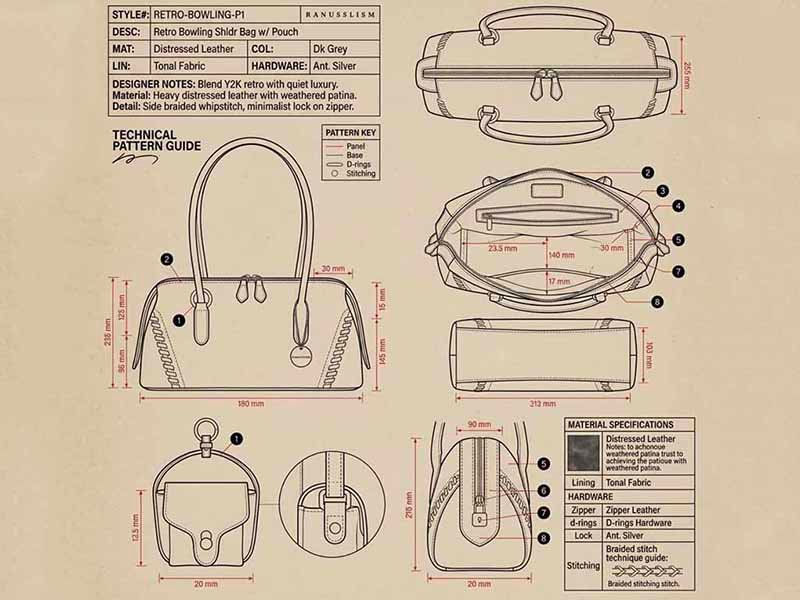
For example, “large pocket” can become “front zipper pocket, 180 mm wide × 120 mm high, zipper opening 160 mm.” “Strong handle” can become “38 mm polyester webbing, box stitch with X reinforcement at both handle bases.” Once the details are measurable, the sample room, sewing line, QC team, and buyer can all judge the product using the same standard.
This is where many custom bag projects become more efficient. Instead of revising samples because expectations were unclear, both sides can discuss exact changes: reduce pocket height by 10 mm, move the logo 15 mm upward, change the zipper from No.3 to No.5, or increase foam thickness from 3 mm to 5 mm.
Factory Feasibility
A design must be reviewed through factory feasibility before it is treated as ready for bulk production. Some details look simple on a drawing but are difficult in sewing. Tight curves, narrow openings, very thick seam intersections, oversized panels, hidden pockets, and complex lining structures can all slow down production or increase defect rates.
Factory feasibility is not about limiting design. It is about protecting the design from avoidable failure. A good factory may suggest changing the corner radius, adjusting seam allowance, replacing a difficult trim, simplifying a pocket, or moving a zipper slightly so the sewing line can produce the bag more consistently.
The best time to make these adjustments is before or during sampling. Once materials are purchased and production is scheduled, design changes become more expensive. A small change in the development stage can prevent hundreds of inconsistent pieces in bulk.
Tech Pack Control
A tech pack helps control the full journey from quotation to sampling to production. It gives the factory a shared document for dimensions, materials, trims, logo details, packaging, tolerances, and inspection requirements. For custom bag projects, even a simple but accurate tech pack is better than scattered messages and reference photos.
The tech pack is also useful for cost control. When specifications are complete, the quotation is more realistic. If important details are missing, the first price may change later after sampling reveals actual material, labor, or trim requirements. This can create tension between buyer and supplier.
For serious B2B projects, the tech pack should be updated after sample revisions. The final approved sample, BOM, measurement sheet, and production notes should all match. This creates a stable handover from product development to bulk manufacturing.
Which Materials Work Best at Scale?

Materials that work best at scale are stable, available, consistent in color, suitable for the product function, and practical for cutting, sewing, printing, packing, and repeat orders. For bag production, commonly scalable materials include polyester, nylon, Oxford fabric, canvas, PU, leather, neoprene, PVC, TPU, mesh, EVA, and non-woven fabric, depending on the use case.
The best material for mass production is not always the most expensive one. It is the material that supports the product’s promise while staying repeatable in bulk. A fabric may look beautiful in one sample, but if the color is difficult to reproduce, the coating is unstable, or the supplier cannot support the needed quantity, the design becomes risky.
For custom bags, material choice affects nearly every production step. It affects cutting waste, sewing speed, stitch appearance, printing result, logo durability, product weight, packaging volume, shipping cost, and customer experience. A thicker material may feel stronger, but it can also create bulky seams. A softer material may look premium, but it may collapse if the bag needs structure. A waterproof material may support function, but it may require special seam handling.
Brands should choose materials by balancing appearance, function, price, availability, and production behavior. A trial order may benefit from stock colors and mature materials. A long-term product line may justify custom colors, branded trims, or more specialized fabric development. The key is to understand the trade-off before approving the sample.
| Material | Common Bag Applications | Practical Strength | Production Watch Point |
| 600D Polyester | Backpacks, tool bags, promotional bags, outdoor pouches | Cost-effective, widely available, good structure | Coating quality, color consistency, abrasion level |
| Nylon | Travel bags, sports bags, premium soft goods | Strong, lighter hand feel, smooth surface | Higher cost and different fabric grades |
| Oxford Fabric | Totes, backpacks, utility bags | Durable, structured, versatile | Denier, coating, and stiffness must match use |
| Canvas | Tote bags, lifestyle bags, retail bags | Natural texture, strong brand feel | Shrinkage, dye lot variation, thickness |
| PU Leather | Cosmetic bags, fashion pouches, leather-look products | Premium surface, flexible colors | Peeling resistance, surface durability, odor |
| Neoprene | Lunch bags, bottle holders, sports sleeves | Soft, protective, elastic | Thickness, lamination, edge finishing |
| PVC / TPU | Clear bags, waterproof bags, protective pouches | Transparent or waterproof function | Compliance, smell, cracking, sewing or welding method |
| Mesh | Beach bags, sports bags, pockets | Breathable, lightweight | Tensile strength, edge fraying, elasticity |
Fabric Stability
Fabric stability is one of the most important factors in bulk production. Stable fabric means the factory can source enough quantity, match the approved color, cut panels accurately, sew without excessive slipping or stretching, and keep the finished bag close to the approved sample.
For example, polyester and Oxford fabrics are popular in many bag categories because they are available in many deniers, coatings, and colors. Canvas is strong and attractive, but it may shrink or vary more between dye lots. PU can give a premium look, but lower-grade PU may crack, peel, or wrinkle after sewing and packing. Neoprene feels soft and protective, but thickness and lamination quality must be controlled.
A good material review should include more than appearance. The factory should check hand feel, thickness, backing, coating, color, odor, cutting behavior, sewing behavior, and logo compatibility. For larger orders, it is also useful to confirm whether the fabric supplier can support repeat production in future batches.
Trim Consistency
Trims can decide whether a bag feels cheap or reliable. Zippers, sliders, pullers, buckles, D-rings, snaps, hooks, webbing, elastic, labels, binding tape, foam, and lining all influence the final product. These parts may look small, but they are touched, pulled, opened, closed, and tested by the end user every day.
Trim consistency is a common reason why samples and bulk orders look different. A sample may use an available zipper puller from the sample room, while bulk production uses another puller because the first one was not confirmed. Webbing may have the same color but a different thickness. A buckle may look similar but have weaker tension. A lining may be replaced with a cheaper substitute that changes the whole hand feel of the bag.
To avoid this, trims should be confirmed together with the main material. For important trims, buyers should approve physical swatches or component samples. For long-term products, it is better to record supplier direction, color code, size, finish, and replacement rules.
Color and MOQ
Custom colors can create strong brand identity, but they also increase MOQ and lead time. Dyeing fabric, zipper tape, webbing, lining, binding, and elastic may each require separate minimum quantities. Even when the same Pantone color is requested, different materials may not match perfectly because they absorb dye differently.
For a first trial order, stock colors are often more practical. They reduce development time, lower material risk, and allow the brand to test the market faster. For a repeat product or brand series, custom colors can be worth the investment because they create consistency across multiple SKUs.
The decision should be based on business stage. If a brand is still validating demand, it may be smarter to choose a close available color and focus budget on structure, logo, and packaging. If the product is part of a long-term retail line, custom color control may be necessary. A good factory should help buyers understand where exact color matters and where a practical match is acceptable.
Function Match
Material must match the function of the bag. A cooler bag needs insulation and lining that can handle temperature and cleaning expectations. A beach bag may need mesh, waterproof lining, or sand-friendly construction. A makeup bag may need easy-clean lining, smooth zipper operation, and a surface that supports a clean logo. A tool bag needs stronger fabric, reinforced seams, and durable webbing.
Problems happen when a material is chosen only for appearance. A soft PU may look elegant but may not hold shape for a structured pouch. A thick canvas may feel durable but may create heavy seams in a small cosmetic bag. A clear PVC may look trendy but may require attention to odor, cold resistance, and compliance expectations in certain markets.
Material selection should always begin with the user. What will the bag carry? How often will it be used? Will it be folded, washed, pulled, exposed to sunlight, stored in a car, or shipped flat? These questions help prevent material choices that look good in sampling but fail in real life.
How Should Bag Structure Be Simplified?

Bag structure should be simplified by keeping useful features, removing unnecessary complexity, combining panels where possible, improving sewing access, reducing difficult curves, and making pockets, openings, straps, and reinforcements easier to repeat in bulk. Good simplification does not make the bag cheap. It makes the design cleaner, more stable, easier to inspect, and more cost-efficient.
A well-designed bag does not need to be complicated to feel valuable. Many successful bags are strong because their structure is clear. They have the right number of panels, useful pockets, comfortable handles, stable openings, clean seams, and reinforcement only where it is needed. Overly complex structure often creates hidden production cost without improving the user experience.
Every panel, seam, pocket, zipper, trim, and reinforcement adds a production step. Some steps are necessary. Others are decorative or inherited from reference products without real purpose. During production optimization, the key question is not “Can we remove this detail?” The better question is “Does this detail improve function, durability, appearance, or brand value enough to justify its cost and risk?”
Simplifying structure is also helpful for quality control. A bag with fewer unnecessary operations is easier to keep consistent. It is easier to measure, easier to sew, easier to inspect, and easier to pack. This is especially valuable for repeat orders because production efficiency improves when the design logic is stable.
Panel Design
Panels affect cutting efficiency, sewing time, shape control, and fabric waste. A design with too many panels may look interesting, but it can create more seams, more alignment work, more cutting operations, and higher defect risk. If two panels do not serve a functional or visual purpose, they may be combined.
However, panel reduction must be done carefully. Some panels are necessary for structure. A backpack needs panels for shape, padding, compartments, and load distribution. A duffle bag may need side panels to control volume. A structured cosmetic bag may need gusset panels to stand properly. Removing the wrong panel can damage function.
The best approach is to review the pattern with production in mind. Large panels should be checked for fabric utilization. Curved panels should be reviewed for sewing difficulty. Directional fabrics should be checked for cutting layout. The goal is to keep the bag’s intended shape while reducing operations that do not add meaningful value.
Pocket Layout
Pockets are useful, but they are also labor-intensive. Every pocket needs material, cutting, folding, positioning, stitching, and inspection. Zipper pockets also need zipper tape, sliders, pullers, end stops, lining, and alignment. Mesh pockets may need elastic binding. Inner organizer panels may require many small sewing steps that increase cost more than buyers expect.
A practical pocket layout starts with user behavior. A travel bag may need passport, laptop, and cable compartments. A gym bag may need a shoe pocket or wet pocket. A makeup bag may need brush slots or a wipeable inner pocket. A promotional tote may only need one simple inner pocket or no pocket at all.
Brands should avoid adding pockets just because competitors have them. Unused pockets make the bag more expensive without improving the customer experience. A smaller number of well-placed pockets is usually better than many pockets that are hard to access, difficult to sew, or rarely used.
Opening and Access
The opening of the bag affects both user experience and production efficiency. If the opening is too narrow, users may struggle to access the inside. If the zipper path is too curved or tight, sewing becomes slower and zipper smoothness may suffer. If thick materials meet at the opening, the seam can become bulky and uneven.
For mass production, openings should allow reasonable machine access. The operator needs enough space to control the fabric, zipper, lining, and seam allowance. This is especially important for small pouches, structured cosmetic bags, cooler bags, and backpacks with multi-layer construction.
A strong design balances shape and access. A wide opening may improve usability but change the look. A curved opening may look elegant but require more careful sewing. A straight zipper may be easier to produce but may not fit the design style. The right choice depends on the product’s purpose, material thickness, and target price level.
Reinforcement Logic
Reinforcement should be placed where the bag actually receives stress. Common reinforcement areas include handle bases, shoulder strap joints, D-ring loops, buckle points, zipper ends, pocket corners, bottom corners, and heavy-load seams. Adding reinforcement everywhere is not always better. It can increase cost, create bulky seams, and make the bag harder to sew.
Good reinforcement is targeted. A tote bag may need stronger handle stitching and an inner backing patch. A backpack may need bartacks at shoulder strap ends and top handle points. A cooler bag may need stronger seams because insulation makes the structure thicker. A tool bag may need extra bottom support and stronger webbing.
The reinforcement method should match the material. Thin fabric may need backing support before bartacking. Thick PU may need careful stitch control to avoid perforation damage. Mesh may need binding or folded edges to prevent tearing. Reinforcement works best when it is designed into the pattern, not added as an afterthought.
How Do Sewing Details Affect Bulk Quality?

Sewing details affect bulk quality because they control strength, shape, durability, appearance, and user trust. Stitch density, seam allowance, thread type, reinforcement, zipper sewing, binding, strap attachment, and corner handling all influence whether the approved sample can be repeated consistently in mass production and whether the final bag can survive real use.
In bag manufacturing, sewing is not just assembly. It is the product’s structure. A strong fabric can still fail if the seam is weak. A beautiful design can still look cheap if the stitches are uneven. A premium zipper can still perform poorly if it is sewn with waves or tension. A handle can still tear if reinforcement is missing.
Bulk quality depends on sewing standards that are clear enough for both production and inspection. If the approved sample has neat topstitching but production does not define stitch density or seam allowance, the bulk result may vary from worker to worker. Soft goods naturally have some tolerance, but key sewing details must still be controlled.
Sewing optimization also helps reduce customer complaints. In many bag categories, complaints often focus on broken straps, stuck zippers, torn seams, loose threads, weak handles, crooked pockets, and poor lining. These issues are usually preventable when the design, sample, and QC checklist define sewing requirements clearly.
| Sewing Detail | Common Practical Standard | What to Check | Risk If Not Controlled |
| Stitch density | Often around 7–10 SPI depending on material and function | Even stitch length, no skipped stitches | Weak seams or poor appearance |
| Seam allowance | Often 6–10 mm depending on bag type and structure | Consistent seam width | Size variation and seam weakness |
| Bartack | Used at handles, straps, pockets, zipper ends | Position, length, thread tension | Tearing at stress points |
| Topstitching | Distance from edge should be consistent | Straightness and symmetry | Cheap appearance |
| Binding | Width matched to thickness and curve | No twisting, exposed edge, or puckering | Fraying and messy finish |
| Zipper sewing | Smooth tape, aligned teeth, secure ends | No waves, jams, or uneven pull | Poor user experience |
| Strap stitching | Box stitch, X-stitch, or reinforced seam as needed | Pull strength and symmetry | Handle or strap failure |
Stitch Standards
Stitch standards should be based on the material, bag function, and expected load. A lightweight drawstring bag does not need the same stitching as a heavy-duty tool bag. A premium cosmetic pouch may need fine, neat stitching for appearance, while an outdoor bag may need stronger thread and reinforcement.
Stitch density is one of the easiest details to see but one of the most commonly overlooked. Too few stitches may reduce strength and make the bag look rough. Too many stitches may slow production, perforate delicate materials, or create puckering on certain fabrics. Many sewn bags use around 7–10 stitches per inch, but the correct standard depends on fabric thickness and construction.
The sample should establish the stitch style, stitch density, thread color, seam allowance, topstitch position, and reinforcement method. Once approved, these details should be included in the production notes and QC checklist. This makes inspection more objective and reduces arguments later.
Seam Strength
Seam strength depends on fabric, thread, seam type, stitch density, seam allowance, and reinforcement. A seam is only as strong as the weakest part of that system. If the fabric is strong but the seam allowance is too narrow, the seam may pull out. If the thread is weak, the stitching may break. If the stress point is not reinforced, the bag may tear even if the general seam looks fine.
Different bag types need different seam strength. A shopping tote carrying groceries needs strong handle attachment. A backpack needs load-bearing seams at straps and top handles. A duffle bag needs side and bottom seams that can handle weight. A cosmetic bag may not carry heavy loads, but it still needs clean seams that resist daily opening and closing.
Seam strength should be reviewed during sampling. Simple pull checks, load simulation, and repeated use tests can reveal problems early. Even if formal laboratory testing is not required, practical in-house checks are valuable for reducing risk before bulk production.
Zipper Handling
Zippers are one of the most important user-touch points on a bag. A zipper that looks slightly uneven in production can become a daily frustration for the customer. Zipper problems often come from poor alignment, wrong zipper size, weak slider quality, tight curves, thick seam intersections, or unstable sewing tension.
The zipper size should match the product. A small pouch may use a lighter zipper, while a backpack, duffle bag, or tool bag may need a stronger zipper. The zipper tape color, teeth color, puller style, slider finish, and opening length should be confirmed before bulk. If the zipper is part of the product’s visual identity, it should be treated as a design feature, not just a functional trim.
During production, QC should check zipper smoothness, end security, alignment, and appearance. The zipper should open and close without catching. It should sit flat without waves. Zipper ends should be secured properly so they do not fail after repeated use.
Strap Attachment
Strap attachment is one of the highest-risk areas in bag production because it carries repeated load. Handles, shoulder straps, backpack straps, crossbody straps, and D-ring loops all need appropriate reinforcement. If the strap fails, the customer usually sees the whole product as defective.
The right attachment method depends on the bag type. A light tote may use reinforced box stitching. A heavier tote may need X-stitching or an extra backing layer. A backpack strap may require bartacks and internal reinforcement. A detachable strap may require strong hardware and secure D-ring loops.
Strap length and symmetry also matter. If one side is slightly longer, the bag may hang poorly. If strap stitching is crooked, the bag may look cheap even if it is strong. A good production standard should define strap width, length, placement, stitching type, reinforcement method, and acceptable tolerance.
How Can Cost Be Reduced Without Hurting Quality?
Cost can be reduced without hurting quality by simplifying structure, improving material efficiency, using scalable trims, standardizing colors, choosing the right logo method, reducing unnecessary pockets, optimizing packaging, and planning MOQ wisely. The goal is not to make the bag cheaper in a hidden way, but to remove waste that does not improve user experience.
The wrong way to reduce cost is to downgrade the parts customers depend on. Weak zippers, thin webbing, poor lining, low-grade coating, weak stitching, and reduced inspection may lower the quotation, but they can damage the brand after the product reaches the market. The smarter way is to redesign the bag so it is easier to produce while still delivering the same value to the user.
Cost optimization should happen before the final sample is approved. Once the sample is locked, reducing cost becomes more difficult because every change may affect appearance, function, or approval. Early-stage optimization allows the brand and factory to compare different materials, structures, logo methods, trims, and packaging choices before making a final decision.
Cost is also connected to volume. A 200-piece trial order will usually have a higher unit cost than a 2,000-piece order because material purchasing, sample development, setup, cutting, and production preparation are spread across fewer units. Brands should use small orders to test the market, then improve cost through repeat orders, better planning, and more stable material usage.
| Cost Factor | Why It Raises Cost | Better Optimization Method |
| Too many pockets | More cutting, sewing, trims, and inspection | Keep pockets that solve real user needs |
| Custom-dyed fabric | Higher MOQ, longer lead time, dye lot risk | Use stock color for trial orders when possible |
| Heavy metal hardware | Higher component cost and shipping weight | Use metal only where it adds brand value |
| Complex logo method | More setup and higher defect risk | Match logo process to material and volume |
| Irregular panels | More cutting waste and slower sewing | Adjust pattern for better fabric utilization |
| Thick padding everywhere | More material cost and bulky seams | Use targeted padding in key zones |
| Retail packaging | Printing, labels, inserts, carton planning | Match packaging to actual sales channel |
| Multi-material design | More sourcing and production control | Limit material types in early production |
Cost Drivers
The main cost drivers in bag production are material, size, structure, labor time, trims, logo method, packaging, and quantity. Labor is especially important because bags usually require multiple sewing and hand-positioning steps. A small bag is not always cheap if it has complex structure, many pockets, premium trims, and difficult logo placement.
For example, a basic tote bag may be cost-efficient because it uses fewer panels and simple sewing. A backpack costs more because it includes straps, padding, compartments, lining, zippers, buckles, and reinforcement. A cosmetic bag may be small, but PU material, metal zipper, custom lining, and retail packaging can quickly increase the unit cost.
A professional quotation should explain what is driving the price. This allows the buyer to make smart choices. Instead of asking for a lower price in general, the buyer can decide whether to simplify one pocket, switch a trim, use a stock color, adjust packaging, or increase order quantity.
Smart Simplification
Smart simplification removes details that do not improve function, appearance, or brand value. It does not remove the details that protect durability or user experience. This distinction is important. A bag can be simplified and still feel premium if the important details are protected.
For example, reducing unnecessary inner compartments may lower labor cost without affecting the main selling point. Changing a decorative seam to a clean single panel may improve appearance and production efficiency. Using a standard zipper puller for the first order may be more practical than opening a custom metal mold. Choosing one strong handle construction instead of a visually complex but weak handle design can improve both quality and cost.
Smart simplification should be discussed during sampling. The sample stage is the best time to compare options. Once the factory shows how different details affect production, the buyer can decide which features are worth paying for and which can be simplified.
Material Efficiency
Material efficiency affects cost more than many buyers realize. Fabric is purchased in rolls, cut into panels, and affected by width, pattern direction, coating, defects, and layout. If the bag uses irregular shapes or oversized panels, cutting waste may increase. If the fabric has a directional print, the factory may have less flexibility in layout.
Improving material efficiency does not always mean changing the design dramatically. Sometimes a small adjustment in panel size, gusset width, pocket shape, or seam allowance can improve cutting yield. For larger orders, even small savings per piece can become meaningful.
Material efficiency also includes choosing the right material level. A product does not always need the heaviest fabric. If the bag is designed for light daily use, a medium-weight material with good stitching may perform better than an unnecessarily heavy material that increases cost, weight, and sewing difficulty.
Protected Quality
Some areas should not be downgraded without testing. These include zipper quality, handle strength, strap attachment, load-bearing seams, lining suitability, coating durability, logo durability, and final inspection. These are the areas that customers notice quickly when something goes wrong.
Cost reduction should never create hidden weakness. A cheaper zipper may save money but create bad reviews. Thinner webbing may reduce cost but fail under load. Lower-grade lining may tear or stain easily. Skipping reinforcement may make the sample look fine but fail after repeated use.
The safest approach is to protect the parts users touch, pull, carry, open, close, and rely on. Reduce cost by simplifying unnecessary complexity first. Only consider material downgrades after testing the effect on function, appearance, and durability.
How Do Samples Become Bulk Standards?
Samples become bulk standards when the final approved sample is locked as the golden sample, the BOM is finalized, measurements and tolerances are documented, sewing and logo standards are confirmed, and QC checkpoints are created. Without this handover, the sample remains only a reference, not a reliable production control tool.
Sample approval is not the end of product development. It is the point where the factory must convert the approved design into repeatable production instructions. This step is often where bulk problems begin. The buyer may approve the sample visually, but the factory may not fully document the material, trim, pattern, sewing sequence, logo position, or tolerance.
A proper sample-to-bulk process protects both sides. The buyer gets a clearer standard for inspection. The factory gets a clearer instruction for purchasing, cutting, sewing, packing, and QC. The production team does not need to rely on memory or guesswork. The QC team can compare bulk goods against both the golden sample and written standards.
For custom bags, this is especially important because soft materials naturally have some variation. A fabric bag may not measure exactly the same as a hard molded case. But the key points still need control: overall size, logo position, strap length, zipper placement, pocket size, stitching quality, color, material feel, and packing method.
Golden Sample
The golden sample is the final approved physical sample used as the production reference. It should represent the confirmed material, color, shape, stitching, logo, trims, lining, reinforcement, and overall appearance. It is not the first prototype. It is the version approved after revisions and ready to guide bulk production.
The golden sample should be labeled, protected, and kept available during production. Production managers, sewing supervisors, QC staff, and packing teams should be able to compare bulk goods against it. If a zipper puller looks different, a seam position shifts, or the logo appears too low, the golden sample helps identify the issue.
However, a golden sample alone is not enough. It cannot explain every detail clearly. It should work together with the BOM, measurement sheet, sewing notes, and inspection checklist. The physical sample shows the target result. The documents explain how to repeat it.
BOM Locking
The BOM, or bill of materials, should list every material and component used in the approved sample. For bags, this may include main fabric, lining, foam, interlining, zipper, slider, puller, webbing, binding, thread, label, hardware, logo material, polybag, hangtag, carton, and barcode label.
Locking the BOM prevents uncontrolled substitutions. If the approved sample used a certain zipper, but bulk production uses a different zipper without approval, the final product may feel different. If the lining changes, the bag may lose its expected hand feel. If the webbing thickness changes, strap strength may be affected.
For repeat orders, BOM control becomes even more valuable. The buyer can maintain product consistency across multiple batches. The factory can purchase more efficiently. If a material becomes unavailable, both sides can review and approve a substitute before production, rather than discovering the change after goods are finished.
Tolerance Control
Tolerance control is necessary because soft bags have natural variation, but that variation must still be managed. Tolerance should define acceptable differences in key dimensions, logo position, strap length, pocket placement, zipper length, and other measurable details.
The tolerance should match the product type. A small cosmetic pouch may need tighter tolerance because small differences are more visible. A large duffle bag may allow slightly wider tolerance because fabric tension and sewing movement are harder to control at larger size. Logo placement usually needs tighter control because even a small shift can look obvious.
Good tolerance control helps prevent unnecessary disputes. Without tolerances, one side may see a product as acceptable while the other sees it as defective. With tolerances, inspection becomes clearer. The question changes from “Does it look right?” to “Is it within the approved standard?”
QC Checkpoints
QC checkpoints keep production from drifting away from the approved sample. Production drift can happen gradually. A seam becomes slightly wider. A pocket shifts. A zipper starts to wave. A strap length varies. A logo moves a few millimeters. If these issues are not caught early, they can spread across the full order.
A practical QC plan usually includes material inspection, pre-production sample confirmation, cutting inspection, first-piece inspection, in-line inspection, semi-finished inspection, final inspection, and packing inspection. The exact checkpoints should match the bag type and order complexity.
For example, backpacks need careful checks on straps, padding, zippers, and load points. Cosmetic bags need attention to logo, zipper smoothness, lining cleanliness, and shape. Cooler bags need checks on insulation, lining, seams, and closure. Waterproof bags need more attention to material and seam performance.
QC should not be treated as a final gate only. It should be built into the production process. The earlier a problem is found, the easier and cheaper it is to correct.
Conclusion
Optimizing a bag design for mass production is not about removing creativity. It is about protecting creativity from production failure. A strong design should look good, feel right, work well, and still be realistic for bulk manufacturing. When materials, structure, sewing, cost, sampling, and QC are considered early, brands can avoid many of the problems that usually appear too late: delayed samples, unstable pricing, high defect rates, poor reviews, and bulk goods that do not match the approved sample.
The most successful custom bag projects usually follow a practical path: define the use case, simplify the structure, choose scalable materials, confirm trims, test stress points, approve a golden sample, lock production documents, and inspect the order through clear checkpoints. This approach helps brands move from product idea to approved sample, and from approved sample to stable repeat production.
Szoneier works with global brands, retailers, importers, wholesalers, Amazon sellers, Shopify brands, promotional companies, and B2B buyers that need custom bags and soft goods with reliable development and bulk production support. As a Shenzhen-based custom bags and soft goods OEM/ODM manufacturer with 18+ years of manufacturing experience, Szoneier helps buyers review product ideas, reference samples, tech packs, material concepts, logo applications, packaging needs, and production requirements before mass production begins.
If you are developing tote bags, backpacks, cosmetic bags, cooler bags, travel bags, drawstring bags, leather goods, neoprene bags, waterproof bags, tool bags, medical bags, EVA cases, or other sewn soft goods, you can send your design files, photos, target quantity, material direction, logo artwork, and delivery country to the Szoneier team.
A better bag starts before production. It starts when the design is built for real manufacturing.
Contact Szoneier to review your custom bag design and prepare it for scalable mass production.