Skip to content

Finding a factory that can make one attractive sample is not particularly difficult. Finding a manufacturer that can reproduce that sample six months later, manage four additional colors, source the same material grade, control dimensions across thousands of pieces, meet an agreed launch window, and still respond professionally when something goes wrong is a much harder task. For brands that expect repeat orders, the factory eventually becomes part of the operating system behind the product. Weak manufacturing creates hidden work for product managers, sourcing teams, quality staff, logistics teams, and customer service. Strong manufacturing gradually removes uncertainty from those same areas.
To find a custom bag manufacturer for long-term production, define the product and quality standard first, then verify category experience, materials, sampling control, production capacity, quality management, lead-time discipline, and repeat-order records. Compare suppliers using the same specification and test the strongest candidate through sampling and a controlled first order. The right partner should make quality, cost, delivery, and replenishment more predictable over time.
That difference is easy to miss during early sourcing because most factories look reasonably capable in a quotation sheet. Two suppliers may both send a good backpack sample, yet one simply copied what it saw while the other recorded the pattern, material, foam, zipper, reinforcement, artwork, packaging, and QC points needed to reproduce it later. The first supplier may feel easier during the sales process. The second is usually the one you will appreciate after the fifth reorder, when your product line is larger and the cost of changing factories has become much higher.
What Should You Define Before Sourcing?

Before sourcing, define the product, target market, quality standard, expected order volume, materials, branding, packaging, delivery destination, and launch timing. A clear brief makes quotations comparable and exposes weak assumptions early. It also helps manufacturers judge material availability, tooling, MOQ, sampling effort, production complexity, and lead time before money is committed, reducing expensive changes after development or bulk production has already started.
Product Specifications
A factory cannot evaluate a project accurately when the specification consists of little more than “custom backpack,” “premium cosmetic bag,” or a few reference photographs. Two bags that look similar from a distance can require very different fabrics, linings, foam densities, reinforcement methods, zippers, hardware, construction time, inspection points, and packaging. Even a small design choice, such as changing from a standard zipper puller to a custom molded puller, can introduce tooling cost, a separate MOQ, and additional lead time that was not present in the first quotation.
A practical sourcing brief does not need to resemble a 40-page engineering document, especially when the product is still being developed. It does, however, need to distinguish confirmed requirements from areas where you want technical recommendations. If the finished size, intended use, material family, logo method, quantity, packaging format, target market, and required delivery date are already known, put them in writing before asking several factories for prices. That one step prevents suppliers from quoting different assumptions and makes later cost comparisons much more meaningful.
| Specification Area | Information to Define | Practical Example |
|---|---|---|
| Product | Type and intended use | 24 L commuter backpack |
| Finished size | Length × width × height | 45 × 30 × 18 cm |
| Main fabric | Composition and grade | 600D polyester with PU coating |
| Lining | Material and approximate weight | 210D polyester |
| Structure | Compartments and pockets | Laptop sleeve + 5 pockets |
| Padding | Material and thickness | 8 mm shoulder strap foam |
| Reinforcement | Stress-point requirements | Bartack at strap anchors |
| Branding | Process and position | 60 mm front embroidery |
| Packaging | Unit and carton format | Polybag + barcode label |
| Quantity | First and expected reorder | 1,000 / 5,000 pcs |
| Market | Destination and channel | US e-commerce and retail |
A manufacturer with development capability can help refine the details after receiving the brief. Szoneier, for example, documents a workflow that can begin with a tech pack, physical sample, sketch, reference photo, or early product idea, then move through material confirmation, pattern making, sample sewing, internal review, revision, and final sample approval. The practical value of that process is not that a brand can avoid preparing information, but that unresolved details can be converted into controlled decisions instead of informal assumptions.
Volume and Quality Standards
Quantity affects far more than the price per piece. It can change how materials are purchased, whether fabric is sourced from stock or custom produced, how accessories are ordered, how the production line is arranged, how much capacity must be reserved, and how the finished goods are packed. A 300-piece launch order and a 30,000-piece annual program may use the same drawing, yet they can require completely different sourcing and production strategies.
A useful forecast normally includes an initial quantity, an expected replenishment quantity, and a realistic annual requirement. The word realistic matters because overstating future volume to obtain a lower quotation can create problems later when the supplier discovers that the material, accessory, or labor assumptions behind the price no longer apply. A growing brand is better served by a manufacturer that understands how an order could move from 500 to 2,000 and eventually 10,000 pieces than by one that gives an artificially low price based on an annual volume that may never occur.
Quality should be defined in measurable language wherever possible. Terms such as “premium,” “high quality,” and “retail quality” are useful for positioning but weak as production instructions. Dimensions can be given tolerances. Logo position can be measured. Colors can be tied to approved standards. Zippers can be tested for function, reinforcement can be inspected, and carton assortments can be checked against packing requirements. Once those standards are visible, a quality discussion becomes less subjective and far easier to repeat.
For many standard Szoneier custom bag projects, documented MOQ begins from 200 pieces, while custom-dyed fabric, molded accessories, special functional materials, more complicated structures, and customized packaging can require higher quantities. That is a useful example of how MOQ works in real manufacturing: it is usually the result of material, process, accessory, and production economics rather than one universal number applied to every bag.
OEM or ODM Requirements
A mature product and a new product should not be sourced in exactly the same way. If you already have a complete tech pack, approved physical sample, BOM, packaging file, artwork, and established QC standard, your main requirement is usually disciplined OEM execution. The factory needs to reproduce an existing standard, control materials, document any approved changes, and make future production behave as much like the first approved order as possible.
A younger project may need more ODM support. You may know that you want a waterproof travel organizer, a premium cosmetic case, or a technical tool bag without knowing the ideal fabric weight, lining, pocket construction, reinforcement, zipper specification, foam, or logo method. In that situation, a manufacturer that can discuss material behavior, pattern development, cost engineering, structure, and manufacturability can remove a large amount of trial and error before the product reaches bulk production.
Neither OEM nor ODM is automatically superior. The important point is to identify what work you expect the factory to perform. A sourcing team replacing an existing supplier may not need design creativity at all; it may need accurate sample replication, material matching, BOM control, and proof that future batches can stay consistent. A new brand may need the opposite and benefit more from technical input before the specification is frozen. The sourcing brief should therefore describe not only the bag you want but also the role you expect the manufacturer to play in developing it.
Which Manufacturer Fits Your Bag?

The best manufacturer is the one whose normal production experience matches your bag’s structure, materials, performance requirements, quality level, and sales channel. Category fit matters more than a long product list. A factory that excels at promotional totes may still be a poor choice for insulated cooler bags, technical backpacks, medical bags, structured leather goods, EVA cases, or reinforced tool bags.
Category Experience
The question “Have you made bags like this before?” is useful only when you define what “like this” means. A casual backpack, laptop backpack, hiking backpack, camera bag, and medical response backpack may all share shoulder straps and zippers, yet the production risks are very different. The factory must understand the areas where that particular construction normally fails, the materials that are difficult to sew consistently, and the features that should receive extra inspection during production.
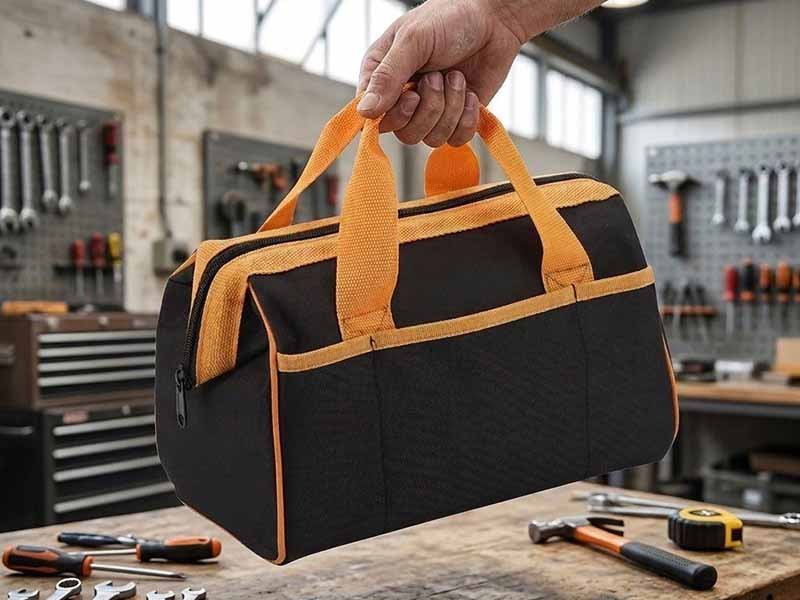
A cooler bag illustrates the difference clearly. The outer fabric is only one part of the product. Foam thickness, insulation, lining construction, binding, odor, zipper closure, seams, and cleanability all influence performance. A tool bag presents another set of challenges involving heavy fabric, reinforced bottoms, thick webbing, concentrated loads, bartacks, hardware, and multi-layer sewing. A cosmetic pouch may be simpler structurally but far less forgiving about surface appearance, zipper smoothness, lining cleanliness, logo position, and small visual imperfections.
Instead of asking only for product photographs, ask technical questions about previous projects. Which parts were hardest to control? Where did production need reinforcement? Which materials created the longest lead time? Which components caused MOQ issues? Which defects appeared most often during inspection? An experienced manufacturer should be able to talk about failure points and trade-offs rather than merely showing finished samples.
Szoneier’s documented production scope includes backpacks, tote bags, cooler bags, cosmetic bags, travel and duffle bags, tool bags, medical bags, waterproof products, leather goods, neoprene products, EVA cases, and other sewn soft goods. Its quality documentation also separates inspection priorities by category, such as shoulder straps and laptop compartments for backpacks, insulation systems for cooler bags, and load-bearing construction for tool bags. That category-specific thinking is a more useful indicator than simply claiming to manufacture “all kinds of bags.”
Material Capability
Material knowledge is one of the clearest differences between a sewing workshop and a manufacturer capable of supporting product development. A specification such as “600D polyester,” “Oxford fabric,” or “PU leather” sounds precise until several mills provide versions that differ in weight, weave, backing, coating, texture, color fastness, abrasion resistance, hand feel, and price. Those differences can affect appearance, durability, shipping weight, sewing efficiency, and the ability to reproduce the same product next season.
A good material conversation includes trade-offs. Heavier fabric may improve structure and abrasion resistance but also increase weight, cutting difficulty, needle requirements, carton weight, and freight cost. Softer PU can improve hand feel and photography but may need backing or reinforcement. TPU may be appropriate for welded or water-resistant products but requires a very different production process from conventional polyester sewing. Neoprene thickness influences flexibility, protection, edge treatment, needle performance, and the overall bulk of the product.
The manufacturer should also explain long-term availability. A fabric that looks perfect in a sample may be risky if it comes from a one-time stock lot with no repeatable mill specification. For products expected to remain in a collection for several years, material continuity can be more important than saving a few cents on the first order. Ask whether the chosen material is regularly produced, whether a mill reference can be retained, and what approved alternative would be used if the original version is discontinued.
Szoneier’s documented material range includes polyester, nylon, Oxford, canvas, cotton, neoprene, PU, genuine leather, PVC, TPU, EVA, mesh, RPET, and related functional fabrics. Its selection process considers cost, hand feel, appearance, strength, water resistance, abrasion resistance, weight, and long-term production stability rather than treating fabric selection as a simple color choice.
Process and Channel Fit
A bag that sells through a corporate promotional program is not evaluated in the same way as a premium DTC cosmetic case or a retail backpack program. Promotional products may prioritize cost efficiency, printing consistency, simple packaging, and the ability to deliver a large quantity on a fixed event date. Premium online brands may care more about material hand feel, zipper behavior, visual finishing, interior cleanliness, logo refinement, photography appearance, and unboxing experience.
Amazon-oriented products can introduce another group of concerns around packaging efficiency, barcode accuracy, carton labeling, product-review risk, replenishment timing, and dimensional weight. Retail programs may have tighter requirements for hangtags, SKU labeling, assortment, carton markings, distribution-center standards, delivery windows, and third-party inspection. A factory that understands these channel requirements can catch problems before they become warehouse rejections or customer complaints.
Depending on the product, production may involve embroidery, screen printing, heat transfer, woven labels, rubber patches, metal plates, embossing, binding, bartacking, quilting, waterproof construction, insulation, laminated materials, molded elements, or structural reinforcement. Szoneier documents conventional sewing, high-post sewing, walking-foot sewing, computer-controlled sewing, binding, bartacking, cutting, sample-making, inspection, and packaging equipment, with specialized processes evaluated according to the project.
Equipment by itself is not proof of competence. A stronger sign is whether the factory can tell you when a requested process is inappropriate, unstable, too expensive for the expected order size, or likely to create an unnecessary MOQ. An experienced manufacturer occasionally creates more value by recommending that a feature be changed than by agreeing to every design request without questioning how it will behave in production.
How Do You Verify a Bag Factory?

Verify a bag factory by examining the real manufacturing system behind the quotation: sampling, pattern making, material storage, cutting, sewing, quality control, packing, production planning, and shipment preparation. Use live video, factory visits, third-party audits, production records, and category-specific samples where appropriate. The goal is to confirm who will actually manufacture the goods and who remains accountable when something changes.
Factory or Trading Company?
A trading company is not automatically unreliable, and a factory is not automatically professional. Some trading businesses manage excellent manufacturing networks, while some factories have weak development, quality, and export management. The sourcing risk appears when the structure is unclear and the company presenting itself as the manufacturer quietly moves orders between unknown facilities based on price, free capacity, or temporary convenience.
Ask where the sample is made, where bulk production will take place, who buys the fabric and accessories, who owns or stores the patterns, who performs in-line inspection, and whether production can be moved to another facility without approval. These questions reveal much more than asking, “Are you a factory?” If several steps are outsourced, that is not necessarily a problem, provided the supplier explains which steps are external and how quality, material, timing, and accountability are controlled.
Some larger manufacturing systems combine an in-house factory with specialist or satellite partners. This can be an advantage during peak season or when different product categories require different production skills, but only when responsibility remains centralized. Approved samples, material requirements, production instructions, QC standards, packaging specifications, and delivery responsibility should follow the product regardless of which approved line performs the sewing.
Szoneier describes itself as a factory-based custom bags and soft goods manufacturer with in-house sampling and production coordination rather than a trading-only supplier. Its documented system also uses controlled satellite factories for additional capacity and specialist production while keeping approved samples, material standards, QC requirements, packing standards, communication, and delivery responsibility under centralized management. The important lesson is transparency: you should know which production system you are buying before placing the order.
Factory Evidence
A useful factory review follows the path the product will actually take. Do not spend the entire visit or video call in a polished sample showroom. Ask to see raw-material storage, patterns, sample development, cutting, sewing, semi-finished products, inspection, packing, finished-goods storage, and shipment preparation. The condition and organization of these areas often reveal more about repeatability than marketing photographs.
Look at how patterns are labeled, how approved samples are identified, how material lots are separated, how work-in-progress is tracked, and how QC records are associated with specific orders. A large factory can still have weak control if the information system behind the physical production is disorganized. Conversely, a smaller operation can perform well when the product category is appropriate and the manufacturing discipline is strong.
The following documented Szoneier figures illustrate the type of measurable information that can be requested when evaluating a manufacturing system. The value of these numbers is not the numbers themselves; it is the ability to connect space, people, equipment, capacity, sampling, and quality resources to the actual products being produced.
| Factory Metric | Documented Szoneier Reference |
|---|---|
| Factory-based manufacturing system | 20,000+ m² |
| Sample showroom | 500+ m² |
| Pattern and sampling workshop | 300+ m² |
| Production and support equipment | 160+ units |
| Sewing lines | 8 |
| Production-related team | 120+ people |
| Monthly production capacity | 120,000–200,000 pcs |
| Parallel project capability | 20–35 orders |
| Controlled satellite factories | 10+ |
Capacity figures should always be interpreted according to product complexity. A factory capable of making 150,000 simple pouches in one month may not be able to produce 20,000 highly structured backpacks in the same period. What matters is whether the supplier can translate its total resources into a realistic line plan for your specific product.
Capacity and Audit Checks
Theoretical monthly capacity is different from available capacity. A supplier might genuinely have the machinery and workforce to manufacture 200,000 pieces per month while already having most of that capacity committed during your launch window. A sourcing team therefore needs to understand not only what the factory can produce in ideal conditions but also when the relevant production resources are actually available.
Ask about normal monthly output, typical output for your category, current line utilization, expected line assignment, peak-season loading, material lead time, number of projects running in parallel, backup capacity, and the earliest realistic production start. A factory that says your order cannot begin for 18 days because its relevant lines are occupied may be giving you a more useful answer than a competitor promising immediate production without checking the schedule.
Live video reviews can be effective during early screening. Instead of accepting a pre-recorded factory film, ask for a real-time walk through the sample room, cutting area, sewing lines, QC area, packing department, and warehouse. For larger annual programs, factory visits and third-party audits can provide deeper verification of working conditions, quality processes, production resources, and documentation. Szoneier’s documented manufacturing services include video factory review, scheduled customer visits, and third-party inspection or audit support for qualified projects.
Factory verification is not about approaching every supplier as if it is hiding something. It is simply the process of understanding the production system before your inventory, launch timing, and customer experience depend on it. The earlier you verify who controls materials, samples, production, and QC, the fewer surprises you are likely to face after the purchase order has been placed.
How Is Sample-to-Bulk Consistency Controlled?

Sample-to-bulk consistency is controlled by turning the approved sample into production records that purchasing, sewing, QC, and repeat-order teams can follow. Patterns, BOMs, materials, colors, hardware, logo files, dimensions, packaging, and inspection requirements should be frozen or formally controlled before production begins. The factory then needs checkpoints during material receiving, pre-production approval, sewing, final inspection, packing, and across repeat production cycles.
Approved Sample Control
A finished approval sample should not be treated merely as the version everyone liked. It should become the physical reference around which production information is organized. Once the sample is approved, the manufacturer needs to record what created it. Depending on the product, that may include patterns, measurements, BOM information, fabric references, lining, foam thickness, zippers, hardware, webbing, logo artwork, Pantone references, stitch construction, reinforcement, labels, packaging, and revision history.
Consider a backpack approved with a particular shoulder-strap curve, 8 mm foam, a certain zipper puller, and a specific coated polyester. Six months later, the original sample maker may be working on another project and one material supplier may have changed. If the factory has only photographs and an old quotation, the reorder becomes a partial redevelopment exercise. If it has an approved sample, pattern, BOM, material record, accessory specification, artwork, and QC notes, the product can be rebuilt from controlled references.
Szoneier’s documented production system uses approved samples, pre-production samples, patterns, BOM information, material records, accessory specifications, logo files, packaging files, and QC checkpoints to control the transition into bulk production. This type of recordkeeping becomes increasingly valuable as products are reordered, updated, or expanded into additional colors and SKUs.
Material Change Control
A large percentage of apparent “quality problems” are actually change-control problems. A zipper is replaced by another model, foam becomes slightly thinner, lining comes from a different supplier, a metal finish shifts in color, or the webbing changes weave. None of these substitutions may appear catastrophic in isolation, yet several small uncontrolled changes can make bulk production look and feel noticeably different from the approved sample.
A practical material-control system separates components into fixed specifications, approved alternatives, and changes requiring new approval. A fixed specification should not be changed without authorization. An approved alternative can be used under defined conditions because it has already been evaluated. Anything outside those two groups should be shown to the customer before it enters production.
The descriptions themselves should be specific enough to be useful. “Black zipper” is weak information. Zipper gauge, tape color, teeth finish, supplier, puller, length, and waterproof requirement may all matter. “Webbing” can similarly be recorded by width, thickness, weave, color, and load requirement where relevant. The same principle applies to foam, buckles, labels, hooks, magnets, lining, printed artwork, and packaging.
Szoneier’s quality documentation for repeat production states that materials, zippers, hardware, webbing, logo position, dimensions, and packaging should not be changed arbitrarily, while partner production facilities are required to follow approved samples and production records. A substitute material is not necessarily a problem. An unrecorded substitute used without approval is the much greater long-term risk.
Production QC
Final inspection is essential, but final inspection alone is a weak way to control a custom bag project. If the shoulder-strap reinforcement is incorrect across 8,000 fully assembled backpacks, discovering the problem only after production is finished leaves very few inexpensive options. Effective quality systems therefore place inspection points at the stages where defects are created rather than relying on one final look before shipment.
Incoming materials should be checked against approved specifications before they enter cutting. The production team should review the approved sample and critical workmanship points before the line starts. Cutting should be checked for size, orientation, matching, and obvious defects. Sewing inspections should focus on seams, reinforcement, alignment, hardware, pocket position, binding, and other construction details specific to the product. Semi-finished inspection can catch structural problems while rework is still practical, while final inspection verifies finished dimensions, appearance, function, and overall conformity.
Szoneier documents QC checkpoints covering incoming materials, accessories, pre-production samples, cutting, sewing, semi-finished products, final goods, and packaging before shipment. Different products should also have different inspection priorities. Shoulder straps and laptop compartments matter more in many backpacks, insulation construction matters in cooler bags, and bottom reinforcement and load-bearing areas deserve more attention in tool bags.
The quality process should also explain what happens when something fails. Who stops production? Who identifies the root cause? How are defective pieces separated? How is rework inspected? Does the production instruction change? Is the problem added to the repeat-order record? A manufacturer should not be judged by the unrealistic expectation that defects never occur. Manufacturing always contains variation. The better measure is whether variation is found early, corrected systematically, and prevented from quietly repeating.
What Makes Production Reliable Long Term?
Reliable long-term production depends on realistic capacity, stable material sourcing, controlled specifications, repeat-order records, multi-SKU planning, predictable lead times, and early communication when conditions change. A strong manufacturer does not merely promise to support growth. It can explain how production slots, materials, quality checks, packaging, logistics, and historical product information will be managed as order volume and product complexity increase.
Scalable Capacity
Scalability matters when the business no longer looks like it did during the first order. A 500-piece test may become 3,000 pieces, then 8,000 pieces in four colors, followed by two additional styles and quarterly replenishment. The sewing volume increases, but so do material allocations, cutting plans, accessories, SKU separation, packaging formats, inspection records, warehouse space, and production scheduling.
This is why it is useful to discuss several future-volume scenarios during supplier evaluation. Ask what changes at 500, 2,000, 5,000, 10,000, or 20,000 pieces. Would the product remain on the same production line? Would the material purchasing strategy change? Would color MOQ increase? Would additional QC staff be assigned? Would part of the order move to another approved production facility? A thoughtful answer shows that the manufacturer is looking beyond the first PO.
Szoneier’s documented manufacturing system includes eight sewing lines, monthly production capacity of approximately 120,000–200,000 pieces depending on product mix and scheduling, the ability to progress roughly 20–35 orders in parallel, and more than 10 controlled satellite production partners for additional or specialist capacity. Those figures are useful because they illustrate that capacity is not one number; it combines lines, workforce, product complexity, scheduling, sourcing, QC, and backup resources.
A large factory is not automatically the best choice for every program. Some very large facilities prefer standardized high-volume orders and may be less flexible with frequent sample revisions, small color runs, or evolving product lines. Smaller specialist factories can be excellent when the category matches their strengths. The practical objective is to find capacity that fits both the current order and the likely direction of the business.
Lead Time and SKU Planning
A quoted lead time becomes useful only when everyone agrees on when the clock starts. A company may interpret “30 days” as 30 days from deposit, while the factory means 30 days after materials arrive and the pre-production sample is approved. That difference can easily move a launch by several weeks, especially when custom-dyed fabric, molded logos, special zipper pullers, packaging, or testing is involved.
A realistic production schedule separates specification approval, material purchasing, accessory preparation, pre-production confirmation, cutting, sewing, finishing, inspection, packaging, and shipping preparation. It should also identify which steps can happen at the same time and which depend on earlier approvals. This allows the sourcing team to see where delays are most likely to occur and where quick decisions are needed from its own side.
The following Szoneier reference ranges show how construction complexity can influence normal bulk production timing. They are planning references rather than universal guarantees because quantity, materials, branding, packaging, factory loading, and season can change an actual production schedule.
| Product Type | Typical Production Reference |
|---|---|
| Simple tote / drawstring bag | About 20–30 days |
| Pouch / cosmetic bag | About 25–35 days |
| Cooler / lunch bag | About 30–40 days |
| Backpack / duffle bag | About 35–45 days |
| Tool / pet / medical bag | About 40–55 days |
| EVA / rolling / complex functional bag | About 45–60+ days |
Multi-SKU programs add another layer of planning. Shared fabrics and accessories may be purchased together, while different colors, artwork, packaging, or labels need to remain clearly separated. Szoneier’s documented multi-SKU approach evaluates mixed styles and colors according to shared materials, production scheduling, packing, and SKU management. This kind of planning becomes especially important for collections that ship to different warehouses, sales channels, or regions.
Predictability is often more valuable than the shortest advertised lead time. A factory that repeatedly delivers in 40 days can be easier to plan around than one promising 25 days but frequently finishing in 45. Long-term production becomes easier when realistic schedules, production milestones, approval deadlines, and shipping plans are visible before the order reaches the sewing line.
Repeat-Order Records
One of the most revealing supplier-evaluation questions is simple: “What will you still have on file when we reorder this product next year?” A professional manufacturing system should preserve enough information to reproduce the approved product without restarting from photographs, old emails, or a previous invoice.
Useful repeat-order records include the approved sample, patterns, BOM, material references, colors, zipper and hardware specifications, logo artwork, packaging files, QC standards, SKU information, previous production problems, and approved modifications. These records save time, but their greater value is consistency. They provide a reference when a different production team, material batch, accessory supplier, or project coordinator becomes involved in a later order.
Szoneier documents the ability to archive patterns, BOMs, materials, logo files, packaging files, QC standards, SKU records, and repeat-order revision history. Its repeat-order process also retains approved-sample references, color information, logo-process details, packing standards, QC notes, and previous-order feedback so replenishment does not begin from zero each time.
Repeat production will never be completely static. Materials are discontinued, dye lots change, brands update artwork, regulations affect packaging, and product improvements are introduced. The objective is not to pretend that nothing changes. It is to identify each change, compare it with the approved standard, obtain the necessary approval, update the documentation, and ensure that everyone involved in the next order works from the same version.
When that discipline exists, the relationship becomes more efficient with time. The second order requires less explanation than the first. The third order has better QC priorities because previous production issues are known. Future material decisions become easier because approved references already exist. That gradual reduction in uncertainty is one of the strongest signs of a genuinely useful long-term manufacturing relationship.
How Do You Compare and Choose?
Compare manufacturers with one standardized product brief and evaluate category fit, technical development, sample accuracy, material control, manufacturing ownership, QC, capacity, communication, quotation transparency, lead-time realism, and repeat-order discipline. Normalize prices before comparing them, investigate unexplained differences, and use sampling plus a controlled first production run to verify actual performance. The lowest quotation matters less than a supplier’s ability to repeat the agreed standard reliably.
Supplier Questions
Supplier evaluation becomes much more useful when the questions become specific. “Can you make this?” usually produces the same answer from almost every factory. Instead, ask which part of the product will be hardest to manufacture, which component creates the longest lead time, where reinforcement is recommended, which material has an MOQ risk, how the approved sample will be documented, where bulk production will happen, and which inspection points the factory considers critical.
The questions a manufacturer asks in return can be equally revealing. A factory that asks about intended load, target channel, material weight, packaging format, replenishment volume, or delivery destination is trying to understand production conditions. A supplier that asks only for quantity and logo may be treating a technically complex product as a simple quotation request.
Experienced manufacturers sometimes give answers that sound less convenient during sourcing. They may say that a custom zipper creates an impractical MOQ, that an available stock fabric would be more sensible for the first launch, that a structure needs reinforcement, or that a delivery target is unrealistic without changing the material or shipment method. These answers can feel less attractive than “everything is possible,” but they often protect the project from problems that would become much more expensive after sampling or production begins.
Communication should also be evaluated as an operational capability rather than a personality trait. Fast replies are helpful, but clear decisions, documented revisions, production updates, and early escalation are more valuable over time. The strongest factory contact is not simply someone who answers quickly; it is someone who can coordinate technical, production, quality, packaging, and logistics information without losing important details between departments.
Quote Comparison
Never compare quotations until you confirm that the factories are quoting the same product. One supplier may assume a lighter fabric, another may use a more expensive zipper, another may omit retail packaging, and another may have included delivery under a different Incoterm. The unit prices appear to compete with one another even though the underlying configurations are not the same.
Normalize finished dimensions, outer fabric, lining, foam, reinforcement, zippers, hardware, webbing, logo method, packaging, quantity, tooling, inspection requirements, payment assumptions, Incoterm, and freight before judging which quote is lower. Szoneier’s documented quotation framework identifies size, material, thickness, structure, pockets, zippers, hardware, branding method, packaging, quantity, samples, molds, special materials, urgency, and shipping as major cost variables.
A price that is 8% lower may be perfectly reasonable because one factory has better purchasing terms, a more efficient construction method, or more suitable machinery. A price that is dramatically lower deserves investigation, not automatic rejection. Ask exactly which specification, material, accessory, packaging item, or service creates the difference.
Warning signs include vague fabric descriptions, unclear production locations, repeated specification misunderstandings, unwillingness to show the manufacturing site, unrealistic lead times, unexplained subcontracting, inconsistent answers from sales and technical staff, and pressure to pay before important technical details are settled. Low price itself is not the problem. A low price that cannot be connected to a clear manufacturing configuration is much harder to trust.
Trial Order and Final Selection
A sample tests whether the factory understands the product. The first bulk order tests whether the organization can actually manufacture it. This distinction matters because a skilled sample maker can spend extra time producing one excellent prototype, while bulk production involves material purchasing, cutting, production-line management, operator consistency, QC, packing, warehouse handling, labeling, and shipment coordination.
Use the first production run to evaluate technical communication, sample-revision accuracy, material consistency, production updates, response to problems, QC reporting, packaging accuracy, lead-time performance, and shipment preparation. For Szoneier projects, documented sample references are approximately 3–7 days for relatively simple samples, 7–12 days for standard custom samples, and 12–20 days or longer for more complex products depending on materials, structure, logo processes, and packaging.
For selected standard custom bag projects, a starting MOQ around 200 pieces can provide a practical way to test production before moving into larger replenishment when the material, structure, branding, and packaging are suitable. The purpose of a trial order is not simply to buy fewer units. It is to test whether the factory’s sales promises become production behavior.
Do not judge a first order only by whether everything was completely frictionless. Real manufacturing can involve delayed materials, sample adjustments, packaging changes, or corrective work. A more meaningful test is what happens when the unexpected occurs. Did the supplier identify the issue before it became an emergency? Was the cause explained clearly? Were realistic solutions offered? Was the correction recorded? Did the same problem reappear on the next order?
A useful manufacturing relationship should become easier rather than harder over time. Product files get clearer, material decisions become more predictable, inspection priorities improve, replenishment requires less repeated explanation, and production planning becomes more accurate because both sides understand the same standard. That is usually the point where a company has moved beyond simply finding a factory and has built a manufacturing system capable of supporting the product for the long term.
The goal is not to find a supplier that promises perfection, the fastest sample, the lowest MOQ, and the lowest price at the same time. Those promises can sound attractive during early sourcing but rarely define a stable supply chain. The more useful objective is a manufacturer that understands the category, can translate an approved sample into controlled production records, communicates limitations early, keeps quality visible during production, and has enough flexibility to support the product as quantities and SKUs grow.
Szoneier is structured around that type of long-term custom bag and soft goods production, combining sampling, material sourcing, pattern development, production coordination, quality control, packaging, and export support. Its manufacturing records show a system designed to carry projects from early development through bulk production and future replenishment rather than treating every purchase order as an isolated transaction. For companies evaluating a new manufacturing relationship, the same standard should apply to any supplier: look beyond the first quotation and ask whether the system will still work when the product becomes successful.
How do I find a reliable custom bag manufacturer?
Start with manufacturers that have direct experience with the type of bag, material, structure, and quality level you need, then verify the factory instead of relying only on website claims. Send the same sourcing brief to shortlisted suppliers, compare equivalent quotations, review similar samples, discuss material and production risks, and ask how QC and repeat orders are controlled. A good candidate should be able to explain the manufacturing process in practical detail and identify potential problems before you place a bulk order.
What should I ask a custom bag manufacturer before ordering?
Ask where sampling and bulk production will happen, what materials are recommended, which components have MOQ requirements, how sample approval is documented, what quality checks occur during production, how much relevant capacity is available, and how repeat-order specifications are stored. You should also clarify production lead time, packaging, testing, shipment requirements, and what happens when a material becomes unavailable. Specific questions produce much more useful answers than simply asking for the lowest price or fastest delivery.
How can I know whether a bag manufacturer is a real factory?
A real factory or factory-based manufacturing system should be able to show sampling, pattern making, cutting, sewing, QC, packing, material storage, production personnel, and actual work in progress. Live video reviews and factory visits are useful because you can request specific production areas in real time. Third-party audits can provide additional verification for larger programs. The key is not whether every single process happens under one roof, but whether production locations, outsourced processes, quality responsibility, and project ownership are transparent.
What is a reasonable MOQ for custom bags?
There is no universal MOQ because it depends on fabric availability, color, structure, accessories, branding, packaging, tooling, and the production process. Standard bags using available fabrics, regular zippers, simple logos, and conventional packaging may support lower quantities, while custom-dyed materials, molded hardware, jacquard webbing, functional fabrics, and specialized packaging often require higher volumes. Szoneier documents MOQ from around 200 pieces for many standard custom bag projects, with project-specific adjustments where more specialized materials or processes are required.
How do manufacturers keep bulk bags consistent with an approved sample?
Consistency requires more than keeping the sample on a shelf. The manufacturer should preserve patterns, measurements, BOM information, material references, accessory specifications, artwork, packaging files, and QC requirements, then use those references during pre-production and line inspections. Materials and components should not be substituted without a controlled approval process. Szoneier documents approved samples, pre-production samples, patterns, BOMs, material records, accessories, logo files, packaging files, and production-stage quality checkpoints as part of its sample-to-bulk control process.
How long does custom bag production usually take?
Production time varies significantly with construction complexity, order quantity, material availability, logo processes, packaging, factory loading, and season. Simple sewn bags can move faster than technical backpacks, EVA cases, medical bags, or products using custom hardware and functional materials. Szoneier’s documented planning references range from roughly 20–30 days for simple tote and drawstring styles to approximately 45–60 days or longer for EVA, rolling, and complex functional bags, after required approvals and material preparation.
Is it better to choose the cheapest custom bag manufacturer?
The cheapest quotation can be the best value when the factory has genuinely better purchasing terms, efficient production, and the same specification, but price should never be compared in isolation. Confirm that fabrics, linings, foam, zippers, hardware, reinforcement, branding, packaging, inspection, and commercial terms are equivalent before deciding. A slightly higher unit cost can be less expensive overall if it reduces rejected goods, launch delays, repeated sample development, emergency freight, returns, and the need to change suppliers after the product is already selling.