Skip to content


It has never been easier to find a company online that describes itself as a bag manufacturer. A professional website can be built quickly, factory photographs can be collected from several sources, and product catalogs can contain hundreds of bag styles even when the company itself produces very few of them. This creates a difficult sourcing problem: before discussing price, MOQ, or lead time, you first need to know who is actually developing and manufacturing the product you plan to buy.
A real bag manufacturer is best identified through a connected set of evidence rather than one impressive document, photograph, certificate, or sales claim. The company identity should make sense, the production location should be verifiable, technical staff should understand bag construction, samples should be developed through a traceable process, production should have defined quality controls, and payment information should connect logically to the company responsible for the order. When these pieces agree with one another, factory claims become much more credible.
This matters most once a project becomes customized. A standard promotional tote may tolerate a relatively simple sourcing structure, but a technical backpack, cooler bag, medical bag, tool bag, cosmetic case, leather product, or multi-SKU retail program requires far tighter control over materials, patterns, hardware, stitching, reinforcement, packaging, and inspection. Before sending a deposit, it is worth asking a more useful question than “Are you a factory?” The better question is: “Can you show me enough consistent evidence to understand who will actually make my bags?”
What Makes a Bag Manufacturer a Real Factory?
A real bag manufacturer should be able to demonstrate direct control over the main activities that determine whether a custom order succeeds: product development, material confirmation, pattern making, sampling, cutting, sewing, production coordination, inspection, packing, and shipment preparation. The strongest proof is not the word “manufacturer” on a website, but a consistent manufacturing system that can be observed, questioned, and verified.
What “Real Factory” Means
The term “factory” can mean different things in the bag industry. Some companies operate their own development rooms, cutting areas, sewing lines, quality departments, and warehouses. Others primarily manage orders and rely on independent factories for almost every production step. There are also factory-based manufacturing companies that keep the core development and sewing processes under their own control while using specialist partners for selected operations such as printing, embroidery, metal hardware, molded components, EVA shaping, or specific heat-processing techniques.
For a sourcing team, the important distinction is not whether every operation takes place under one roof. Modern bag production regularly depends on specialized material and process partners. What matters is whether the company you are working with understands the product, controls the production plan, defines the approved standards, monitors the outside processes, inspects the components when they return, and remains accountable for the finished order.
A genuine factory-based manufacturer should be able to describe the manufacturing path in practical terms. Your project normally moves from design information and material selection to pattern development, sample construction, revisions, pre-production approval, cutting, sewing, in-process checking, final inspection, packing, and shipment. If a company cannot explain where these steps happen, who controls them, or how an approved sample becomes a bulk-production standard, its manufacturing role needs further investigation.
Szoneier’s documented manufacturing structure includes its own factory and sampling system, with capabilities covering material confirmation, pattern development, sample making, sewing production, semi-finished inspection, finished-product inspection, packing, and shipment coordination. This type of connected workflow is more meaningful than a general statement such as “we have many years of factory experience,” because it shows how responsibility moves through an actual custom bag project.
Factory, Trader, or Manufacturing Partner
A trading company is not automatically an unsuitable sourcing option. Some businesses intentionally work with traders because they want one contact to manage multiple unrelated products, consolidate shipments, or coordinate several specialist factories. Problems arise when a company presents itself as the direct manufacturer, but important sample, production, and quality decisions are actually controlled by factories that the customer cannot identify or communicate with.
The difference becomes clearer when a project requires revisions. A custom backpack may involve a specific outer fabric, lining, foam, shoulder-strap construction, zipper specification, internal dividers, laptop protection, reinforcement stitching, custom hardware, branded labels, and retail packaging. Even a small change can affect several pattern pieces or production operations. When technical information passes through several layers of intermediaries, the possibility of misunderstood instructions increases.
| Supplier Model | Sample Development | Production Control | Technical Access | Typical Limitation |
|---|---|---|---|---|
| Trading-only company | Usually external | Indirect | Mainly through another factory | More information can be lost during revisions |
| Small sewing workshop | Usually direct | Direct | Direct but limited team depth | Capacity, documentation, or QC systems may be limited |
| Factory-based manufacturer | Internal or closely managed | Direct or structured | Access to development and production teams | Must still verify actual capabilities |
| Manufacturing group | Internal plus controlled partners | Coordinated across several resources | Multi-department access | Production responsibility must be clearly mapped |
A real manufacturing partner should also be comfortable explaining what it does internally and what it does through specialist partners. A company that openly says, “We sew and inspect the bag here, but this molded EVA component is produced by an approved specialist and checked before assembly,” is often more credible than one that claims every possible process is completed internally.
The key issue is transparency. Outsourcing a specialist process can be perfectly normal. Hiding where the complete order is being produced is very different.
Which Factory Claims Matter Most
Many sourcing teams begin by looking at easy-to-see signals such as website design, exhibition photos, marketplace badges, factory videos, or the number of products shown in an online catalog. These materials can be useful, but they should not carry too much weight until the underlying operation has been verified. A supplier showing 500 product styles does not necessarily manufacture all 500 products, and a factory photograph does not automatically prove that the company showing it operates that facility.
Start with claims that can be tested independently. Confirm the company identity, understand the production location, speak with people who understand bag construction, review the sample development process, observe relevant equipment, and ask how production quality is controlled. Once those points are established, large capacity numbers and factory-size claims become much more meaningful.
Szoneier’s internal factory documentation records a 20,000+ square meter factory-based manufacturing system, 160+ production and support machines, 180+ team members, 120+ production-related personnel, eight sewing production lines, and reported manufacturing capacity of approximately 120,000–200,000 pieces per month across its production system. These figures are useful only when they are supported by observable departments, workers, machinery, warehousing, sampling, and active production processes.
An experienced sourcing team therefore looks for consistency rather than the largest number. A real manufacturer should become easier to understand as questions become more detailed. If each new question produces a different factory address, unexplained company name, vague technical answer, or new intermediary, the risk has not been reduced.
Which Documents Prove Factory Identity?
Documents help establish the legal identity of a supplier, but they should be treated as the beginning of verification rather than the end. A business license can show that a company legally exists, while contracts, invoices, company addresses, bank information, audit reports, and certificates can help clarify the relationship between the legal entity and the facility producing your goods. Strong verification comes from matching these records with physical production evidence.
Business License and Legal Identity
When evaluating a Chinese manufacturer, begin with the registered Chinese company name rather than relying entirely on the English trading name displayed on the website. English names are often used for branding, exhibitions, export communication, and overseas marketing, while the registered legal company operates under a Chinese name. This difference can be perfectly normal, but the relationship should be understandable before a serious order is placed.
A business license normally provides several useful points for verification, including the registered company name, Unified Social Credit Code, registered address, establishment information, company status, legal representative, and registered business scope. These fields help establish that the supplier is a real legal business and provide information that can be cross-checked against other records.
Business scope is useful, but it should not be interpreted too narrowly. Registration wording varies, and a company’s legal description does not tell you whether its sample makers understand backpack construction, whether its sewing department can handle thick multilayer material, or whether its QC team controls finished dimensions properly. The document establishes corporate identity; it does not replace a manufacturing audit.
Factory location should therefore be checked separately. Some manufacturing companies have commercial offices and production facilities at different addresses. That structure is common and does not automatically indicate a trading company. The important questions are straightforward: where is the registered company, where is the factory, where is the sample produced, and where will the bulk order be made? A serious manufacturer should be able to explain all four without creating a new layer of confusion.
Contract, Invoice, and Payment Chain
One of the most practical checks before paying a significant order deposit is to compare the company information across all of your commercial records. Many sourcing problems do not begin with manufacturing; they begin because nobody carefully checked who the contracting party and payment beneficiary actually were.
Review the legal company name appearing on the quotation, proforma invoice, purchase agreement, invoice, and bank beneficiary details. If different entities appear, ask the supplier to explain their relationship in writing before transferring money. Manufacturing groups may legitimately use separate production companies, export entities, brand companies, or overseas companies, so a mismatch is not automatically suspicious. The problem is an unexplained mismatch.
| Record | Main Item to Verify | Practical Question |
|---|---|---|
| Business license | Registered legal entity | Which company legally operates the business? |
| Quotation | Supplier identity | Is this a brand name or registered company? |
| Proforma invoice | Contracting entity | Who accepts responsibility for this order? |
| Factory information | Production operator | Which company controls the production site? |
| Bank beneficiary | Payment recipient | Why is payment going to this entity? |
| Audit or certificate | Named facility | Does this document cover the factory making the order? |
Payment information deserves particular attention when it changes unexpectedly. If a supplier suddenly provides a different bank account immediately before deposit payment, confirm the change through a previously verified communication method. Do not rely entirely on the new message containing the banking instruction, especially for higher-value production orders.
A simple principle keeps this process manageable: know who you are contracting with, know who is manufacturing the product, and know who will be accountable if the order fails to meet the agreed standard.
Certificates and Factory Audits
Factory certificates and audit reports can strengthen a verification file, but only when their scope is understood. A certificate displayed on a website may look impressive while covering a different company, different facility, different product category, or expired period. Always check the details rather than treating a logo as proof.
Useful items to review include the company name on the document, manufacturing address, certificate number, issuing body, issue date, expiration date, audit scope, and product scope. If the certificate is important to your purchasing program, verify it with the issuing organization or appropriate database where possible.
Factory audits are especially useful for larger programs because they can examine details that are difficult to judge through a normal sales conversation. Depending on the audit scope, this may include production organization, personnel, equipment, quality systems, traceability, social compliance, safety, capacity, documentation, and other operational controls.
A historical audit provides background information, but current operations still need to be considered. Machinery changes, management systems change, factory utilization changes, and production resources can move over time. For a larger or technically demanding order, an updated third-party factory assessment can provide valuable confirmation.
Szoneier’s documented manufacturing system supports scheduled video factory reviews, customer factory visits, and third-party factory inspections for suitable projects. This type of access matters because a supplier’s documentary evidence becomes much stronger when the physical manufacturing environment can also be examined.
How Can You Verify a Factory Remotely?
A structured live factory tour is one of the most efficient ways to verify a manufacturer without traveling immediately. Instead of relying on a polished promotional video, ask the supplier to walk through relevant areas in real time. A good remote review should connect the sample room, material area, pattern and cutting operations, sewing lines, QC, packing, and warehouse into one understandable production flow.
Run a Live Factory Walk
Recorded videos can help you understand a factory, but they are controlled entirely by the supplier. A live video call is more useful because you can request specific views and ask spontaneous questions. The purpose is not to make the call uncomfortable; it is to confirm that the people, production areas, equipment, and processes being discussed are part of the supplier’s normal operation.
A practical walkthrough for a custom bag manufacturer can begin at the office or factory entrance, then move through the sample room, material area, pattern-making and sampling section, cutting department, sewing lines, quality area, packing operation, and finished-goods warehouse. A useful review may take around 20–45 minutes depending on the size of the operation and complexity of your project.
During the call, ask for ordinary actions rather than rehearsed presentations. The person holding the camera can walk continuously between departments, show another sewing line, turn toward a work-in-progress board, open a material rack, show a current non-confidential sample, or introduce a technician who understands your product category. These small requests help establish whether the factory is operating as described.
There may be legitimate restrictions. Many manufacturers handle confidential or unreleased products that cannot be filmed openly. A refusal to show one customer’s design should not be treated as suspicious. A professional factory can normally explain the confidentiality limitation and show another production area, generic process, or non-sensitive project instead.
Szoneier’s documented video factory review can cover the sample room, materials, cutting area, sewing production, semi-finished goods, QC, packing, storage, relevant material examples, similar samples, and production-process explanations. This gives remote sourcing teams a practical way to connect sales information with observable manufacturing activity before committing to a larger order.
Look Beyond the Showroom
One of the easiest mistakes during supplier evaluation is spending too much time in the sample room. A well-organized showroom can display hundreds of attractive products and demonstrate broad category knowledge, but it still does not tell you how those products are produced.
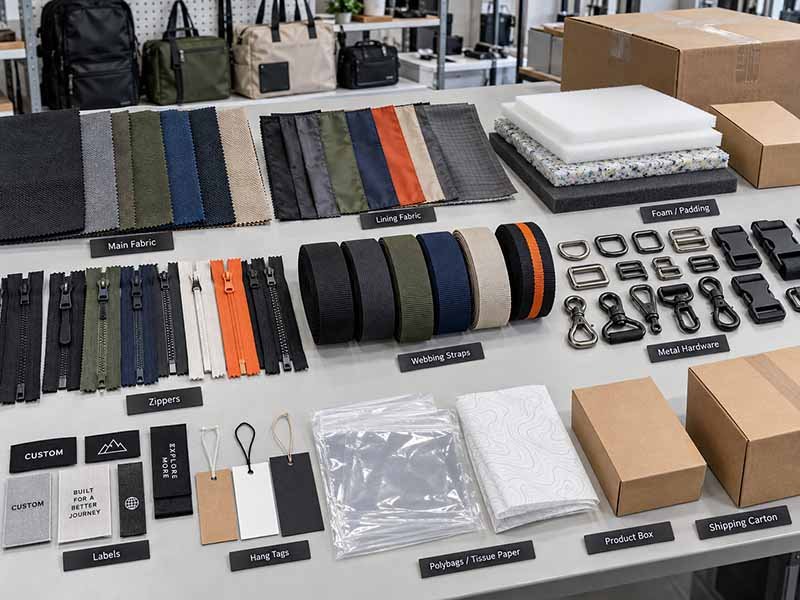
Move toward the departments where manufacturing decisions happen. In the material area, look for fabric swatches, rolls, linings, foams, webbings, zippers, hardware, or organized material references. In the cutting department, you may see cutting tables, templates, patterns, fabric preparation, and cut components. In the sewing area, pay attention to machine types, workstation layout, unfinished bags, reinforcement operations, and how components progress through assembly.
Quality areas should also look like working departments rather than decorative inspection tables. Ask what the inspectors are checking on current products. Depending on the bag, relevant controls can include dimensions, stitch quality, seam strength, zipper function, logo position, webbing alignment, reinforcement, appearance, cleanliness, accessory function, packing method, and carton requirements.
Szoneier’s company documentation records workshop imagery covering the factory exterior, office, sample room, material display, raw-material storage, cutting workshop, sewing workshop, sampling area, QC, packing, finished-goods storage, and shipment preparation areas. These photographs are most useful when they can be connected with an actual live operating environment rather than viewed as isolated marketing material.
Ask Technical Questions Live
A live factory tour becomes much more informative when visual evidence is combined with technical questions about your actual product. You do not need to be a textile engineer or professional pattern maker. Questions based on practical product use can reveal a great deal about whether technical knowledge exists behind the sales team.
For a backpack, ask how the shoulder straps are attached and reinforced. For a tool bag, ask how the factory manages several layers of heavy fabric, webbing, foam, and reinforcement. For a cooler bag, ask how insulation thickness affects seam construction and finished shape. For a cosmetic bag with curved piping, ask how feeding and edge consistency are controlled during sewing.
A good sales representative does not need to answer every technical question immediately. In fact, a response such as “I need our pattern maker to confirm this” can be a positive sign when the question is then passed to someone who provides a detailed manufacturing answer. Real factories are supported by different specialists, and technical knowledge is rarely concentrated in one salesperson.
Szoneier’s documented organization includes international sales, project follow-up, product management, bag design, pattern making, sampling, sourcing, production, quality control, and logistics coordination. The value of this structure is not the number of departments by itself; it is the ability to bring the correct person into a discussion when a project requires a technical decision.

How Do You Check Bag Production Capability?
Confirming that a factory exists is only the first step. The next question is whether that factory is suitable for your particular product. Equipment, materials, sample development, pattern making, workforce organization, quality control, product experience, and realistic production capacity should all match the construction and complexity of the bag you intend to manufacture.
Match Equipment to the Product
There is no universal machine list that proves a factory can produce every kind of bag. Equipment requirements depend heavily on material thickness, construction, reinforcement, shape, seam style, binding, foam, hardware, and finishing processes.
Common custom bag manufacturing equipment may include flat sewing machines, walking-foot machines, high-post machines, binding machines, bartack machines, computer-controlled sewing equipment, cutting machinery, sample-making machines, inspection tools, and packing equipment. More specialized products may require additional processes that are completed internally or through qualified specialist partners.
Szoneier’s documented production equipment includes regular sewing machinery, high-post machines, walking-foot machines, computer sewing machines, binding machines, bartack machines, cutting equipment, sampling equipment, inspection tools, and packing equipment, while specialist processes are confirmed according to the product requirement.
Equipment counts should always lead to a more useful manufacturing question: how will the equipment be used on your product? If your bag has a high-load handle, ask how the attachment will be reinforced. If your design combines thick foam with multilayer fabric, ask how the sewing department handles the thickness. If a curved panel uses piping, ask how the factory maintains an even seam around the radius.
Manufacturing experience is often revealed by the limitations a factory recognizes. Experienced teams usually understand that changing material thickness, foam density, coating type, hardware, or reinforcement can affect construction. A supplier that answers every technical question with “no problem” without discussing consequences may not have examined the design carefully enough.
Test Sampling and Pattern Making
Sampling is one of the most revealing stages of supplier evaluation because it forces a factory to translate design information into a real physical product. A strong sample can begin with a detailed tech pack, but experienced manufacturers can also work from a reference sample, drawing, photograph, sketch, dimensional information, competitor product, target material, or functional requirement.
The important part is what happens after the information arrives.
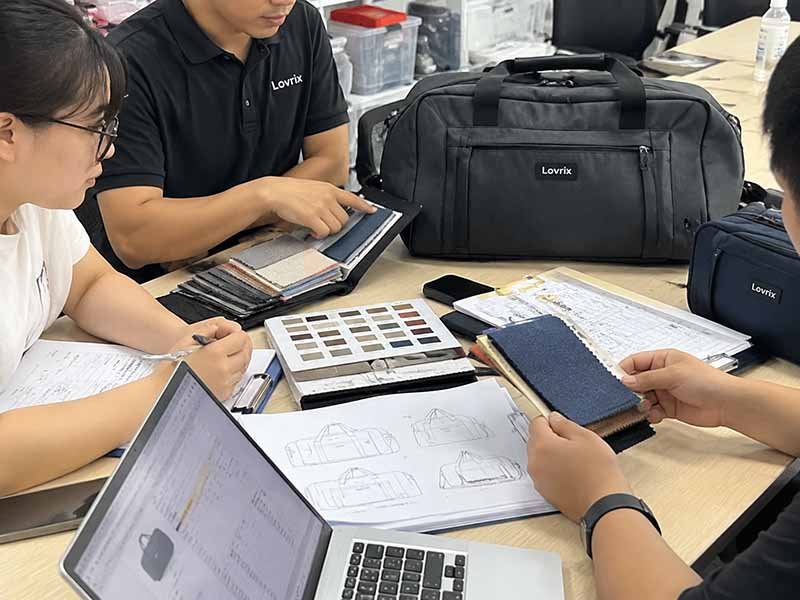
A development team that understands custom bags normally asks questions. It may need to confirm intended product use, load requirement, fabric construction, lining, foam thickness, zipper specification, pocket dimensions, reinforcement, tolerance, webbing thickness, hardware, logo process, packaging, and target cost. These questions are not a sign of uncertainty. They show that the team is translating an idea into production decisions.
Szoneier’s documented sampling process includes material confirmation, pattern development, sample sewing, internal inspection, photo or video review, sample shipment, revision, and final approval. A structured process is important because the approved sample should eventually become part of the production standard rather than remaining an isolated prototype.
The first sample should not be the only test. Ask for a meaningful revision when appropriate. Change a pocket dimension, handle length, material thickness, internal structure, reinforcement method, or logo position and observe how the factory manages the change. When a development team has good pattern control, it should understand which pattern pieces, measurements, and instructions need to be updated.
Repeated unrelated mistakes after every revision can indicate weak documentation, poor sample control, or communication gaps between the company presenting the project and the people actually making it.
Evaluate Capacity Realistically
Monthly capacity is one of the most commonly quoted factory numbers and one of the easiest to misunderstand. A production facility can manufacture a much larger quantity of simple drawstring bags than complex backpacks during the same month, so a generic “pieces per month” number should never be used alone to judge whether a factory can meet your schedule.
Ask how capacity applies to your product. Relevant questions include how many sewing lines could realistically support the project, what daily output can be achieved after the line stabilizes, how many workers are required, how long materials will take to prepare, which production step is likely to be the bottleneck, and how other active orders affect the schedule.
Szoneier’s documented production system includes eight sewing lines, more than 120 production-related personnel, over 160 production and support machines, and stated monthly system capacity of approximately 120,000–200,000 pieces, depending on product mix and manufacturing requirements. Its manufacturing model also incorporates controlled satellite production resources for capacity support, specialist categories, and multi-order coordination.
For an actual purchase decision, the most useful capacity figure is not the factory’s maximum promotional number. It is the realistic output for your product at the quality standard you have approved. A complicated technical bag with many components and reinforcement operations should be scheduled differently from a simple tote, even when both orders contain the same number of units.
How Do Samples and QC Reveal Factory Control?
Samples and quality control show whether a manufacturer can convert a product idea into repeatable bulk production. A capable factory does not depend only on the phrase “same as approved sample.” Important materials, dimensions, accessories, stitching details, reinforcement, logo placement, construction, and packaging should be converted into usable production references and checked at appropriate stages.
Turn the Approved Sample Into Standards
A physical approved sample is extremely useful because it gives both sides a visual and functional reference. However, a sample by itself does not explain every measurement, tolerance, material specification, or packaging requirement. Bulk production becomes more controllable when important product details are also documented.
| Control Item | Example Reference |
|---|---|
| Finished dimensions | Length, width, height, and agreed tolerance |
| Main material | Approved fabric construction or physical swatch |
| Color | Approved swatch, lab dip, or Pantone reference where appropriate |
| Zipper | Type, size, finish, and approved reference |
| Webbing | Width, thickness, construction, and color |
| Padding | Material and agreed thickness or construction |
| Logo | Process, size, position, and artwork |
| Reinforcement | Stitching or bartack positions |
| Packaging | Individual packing, labels, carton requirements |
The exact level of documentation depends on the product. A simple cotton pouch may require fewer control points than a structured backpack with multiple fabrics, EVA components, custom hardware, branded lining, special foam, and retail packaging. The principle is the same: the more important the feature is to appearance, performance, or customer experience, the less it should depend on memory.
Materials also behave differently. Soft fabric products naturally have manufacturing tolerances, and the tolerance suitable for a flexible pouch may not be appropriate for a structured protective case. These standards should therefore be agreed before mass production rather than debated after the shipment is completed.
Check Quality Before Final Inspection
Final inspection remains an important quality gate, but experienced manufacturing teams know that many problems are cheaper and easier to correct much earlier. Quality should be checked where the risk is created rather than waiting until every unit has been sewn and packed.
For example, if the wrong material is identified before cutting, the issue can be corrected before thousands of components are produced. If handle reinforcement is incorrect during the early stage of sewing, the line can be adjusted and the affected work reviewed. If the same reinforcement problem is discovered only after several thousand bags are finished, repair may require unpacking, disassembly, reworking, additional inspection, repacking, and schedule changes.
Szoneier’s documented QC process includes checks on materials and accessories, pre-production sample confirmation, cutting inspection, sewing-process inspection, semi-finished products, final products, and packaging before shipment. This layered approach is particularly useful for custom products because many of the most expensive mistakes begin before the final product exists.
When evaluating another manufacturer, ask where quality checks occur and what each stage is intended to prevent. A meaningful answer should describe actual checks rather than simply saying “we have strict QC.” The more specific the explanation, the easier it is to understand whether quality is being managed as a process rather than treated as an inspection at the end.
Use Independent Inspection When Needed
Third-party inspection can be a useful additional layer for new supplier relationships, larger orders, complex products, retail programs, or projects where a failed shipment would cause significant downstream cost. An independent inspector can review production or finished goods against agreed specifications and report findings to the purchasing company.
Third-party inspection should complement the factory’s internal quality system rather than replace it. A factory that relies entirely on an external inspector has missed the opportunity to prevent defects during production. The better arrangement is internal process control followed by independent verification when the order or risk level justifies it.
Inspection planning can vary according to product type, order quantity, destination market, customer requirements, and the consequences of defects. Some programs use statistical sampling, while others require additional performance testing, packaging verification, or laboratory testing for specific materials and functions. The exact inspection plan should be agreed before production begins.
Szoneier’s documented manufacturing system allows third-party inspections in addition to scheduled video reviews and physical factory visits. Openness to reasonable inspection is useful because serious manufacturing relationships should not depend on blind trust. The factory should be able to explain its own control process while still allowing the customer to verify the result independently when needed.
What Red Flags Should Buyers Check Before Paying?
The most important warning signs usually appear when different parts of the supplier’s story stop matching. Unexplained company names, unclear production sites, refusal of reasonable live verification, vague technical answers, unrealistic production claims, hidden subcontracting, or unusual payment changes all deserve attention before a deposit is transferred. One unusual detail may have an explanation; several unexplained inconsistencies create a pattern.
Watch for Identity Mismatches
Manufacturing companies can have complicated corporate structures, especially when they operate separate production, sales, export, or overseas entities. A complicated structure is not automatically risky. A structure that nobody can clearly explain is different.
Imagine a supplier whose website uses one company name, quotation uses another, business license shows a third, bank beneficiary displays a fourth, and factory sign shows a fifth. There may be legitimate relationships among all five entities, but the explanation needs to be established before money is transferred.
Ask which company is signing the contract, which entity operates the manufacturing location, which company will actually produce the goods, which entity receives payment, and who carries responsibility if the order does not meet the agreed requirements. For a meaningful production order, answers such as “same owner” or “all our company” are not sufficiently informative without supporting details.
Unexpected banking changes should receive particular attention. If payment instructions are changed after weeks of negotiation, confirm them through an already verified channel before sending funds. This protects against both supplier confusion and external payment fraud.
The goal is not to create unnecessary bureaucracy. It is to identify inconsistencies while your negotiating position is still strong. Investigating a supplier before paying a deposit is far easier than investigating after custom fabric has been purchased, production has begun, and substantial money is already committed.
Question Vague Technical Answers
Sales language can make almost every manufacturer sound capable. Phrases such as “any design can be customized,” “quality is very good,” “we make all kinds of bags,” or “no problem” are common because they are easy to say and difficult to measure.
Manufacturing questions are more revealing.
Give the supplier one actual feature from your design and ask what could go wrong. Ask which seam will experience the highest load, how a heavier material will affect sewing, whether thicker foam will alter the finished shape, how a lining will be secured, which area of the product is most difficult to assemble, or which logo technique is appropriate for the material you selected.
The purpose is not to test a salesperson’s memory. It is to determine whether the company can reach people with real technical knowledge.
Szoneier’s documented team structure includes product management, bag design, pattern development, sampling, sourcing, production, quality control, logistics, and international project communication. In practice, this type of structure allows technical questions to move to the person most qualified to answer them.
A company becomes more credible when someone is willing to say, “I need to confirm this with our pattern maker,” and then returns with a technically sensible answer. Pretending to know everything is less useful than having access to people who actually know the process.
Look for Hidden Subcontracting
Specialist subcontracting is normal in bag manufacturing. Printing, embroidery, certain hardware, specialty coatings, molded components, EVA shaping, and other processes may be handled by companies that specialize in those operations. A strong manufacturer coordinates those partners while maintaining responsibility for the final product.
Hidden subcontracting is different because the purchasing company loses visibility into where the order is actually being made. A supplier may show one facility during qualification, then move the bulk order to a different workshop without explaining the change. That can affect quality, capacity, materials, technical communication, and sample-to-production consistency.
Ask which processes are performed at the main production site, which operations use specialist partners, how those partners are approved, who checks outsourced components, and whether bulk production may be moved to another sewing facility without prior discussion.
Szoneier’s documented manufacturing system includes more than ten long-term satellite partner factories used to support particular categories, special processes, peak-season capacity, large-volume allocation, and multi-SKU programs. The documented model keeps project communication, approved samples, material requirements, quality standards, packing requirements, and delivery coordination under centralized management.
That distinction is important. Controlled production support can increase flexibility without removing accountability. Quietly sending an order to an unknown factory based only on the lowest production cost creates a very different level of risk.
Verify the Evidence Chain Before Deposit
Before placing a production order, stop evaluating each piece of evidence separately and look at the complete picture. You should know who the legal company is, where the product will be made, who developed the sample, who controls bulk production, who inspects the finished goods, and which company receives payment.
A practical internal evaluation can score each area from zero to two. Zero indicates that the point remains unclear, one means there is partial evidence, and two means the information has been clearly verified. This is not an official certification system, but it helps prevent one attractive feature—such as a very low quotation—from distracting attention from several unresolved risks.
A supplier with a beautiful showroom but an unclear production location still needs investigation. A supplier with strong technical knowledge but unexplained payment information also needs investigation. Trust becomes stronger when several independent pieces of evidence agree with one another.
For companies considering Szoneier, the same verification principle can be applied. Its documented factory-based system includes sample and pattern development, material coordination, sewing production, QC, packing, more than 160 production and support machines, eight sewing lines, live factory review, physical factory visits, and third-party inspection support. The company identifies itself as a factory-based custom bags and soft goods manufacturing partner rather than a trading-only supplier.
A serious manufacturer should not expect a new customer to believe every statement immediately. Reasonable verification is a normal part of professional sourcing, particularly when custom materials, development work, substantial deposits, or long-term product programs are involved.
Final Thoughts
Knowing whether a bag manufacturer is a real factory is less about finding one perfect piece of proof and more about building a consistent picture. Business registration tells you who legally exists. A live factory tour helps confirm the physical operation. Technical conversations show whether manufacturing knowledge exists inside the organization. Sampling reveals how well the team translates product ideas into production specifications, while in-process QC and final inspection show how the company protects the approved standard during bulk production.
The strongest suppliers tend to remain consistent as verification becomes more detailed. The legal company, factory location, sample development team, production workflow, QC system, contract, and payment structure should eventually connect into one understandable manufacturing relationship. Specialist processes or partner factories may still be involved, but their role should be transparent and controlled rather than hidden.
For brands, retailers, importers, and product teams developing custom bags, this approach does more than help identify a real factory. It also helps answer the more important question: whether that factory has the right people, processes, technical capability, and management structure for the product you actually want to manufacture. A factory can be completely real and still be the wrong manufacturing partner for a particular bag.
Szoneier’s role in this process is straightforward: custom bag projects can be evaluated through materials, development, sampling, production, inspection, packaging, and delivery rather than through sales claims alone. The objective is to make manufacturing more visible and understandable before a project moves from an approved sample into bulk production. That transparency is ultimately what turns a supplier relationship into a manufacturing relationship that can support repeated orders over time.
Frequently Asked Questions
How can I tell if a bag supplier is a factory or a trading company?
Start by checking the legal company identity, production address, live manufacturing environment, sampling capability, technical knowledge, and production workflow. Ask who makes the sample, which facility will produce the bulk order, and who controls QC. A trading company may still be a legitimate sourcing partner, but it should explain its role honestly. A direct or factory-based manufacturer should be able to connect its sales team with real development, production, and quality operations.
What should I ask to see during a bag factory video tour?
Ask to see the sample room, material area, pattern-making or sampling section, cutting department, sewing lines, quality-control area, packing operation, and finished-goods warehouse. Request a live walkthrough rather than relying only on recorded promotional footage. During the call, ask spontaneous questions about current non-confidential production, material selection, equipment, or your own product construction. A genuine operating factory should normally be able to move between these areas in a logical production sequence.
Does a Chinese business license prove that a supplier owns a factory?
No. A business license helps verify that a legal company exists and provides useful information such as its registered name, Unified Social Credit Code, address, establishment details, and business scope. It does not prove that the company owns the factory shown on its website or that it has suitable manufacturing capability for your product. Registration records should therefore be matched with live factory evidence, technical knowledge, sample development, production information, contracts, and payment details.
Is it normal for a bag factory to outsource some production processes?
Yes. Custom bag manufacturing often involves specialist suppliers for printing, embroidery, hardware, molded components, EVA shaping, coatings, labels, packaging, or other processes. Outsourcing becomes risky when it is hidden or uncontrolled. A reliable manufacturer should explain which operations are performed internally, which use approved specialist partners, how outsourced parts are checked, and who remains responsible for the finished product. Transparency and process control matter more than claiming that every operation happens in one building.
How can a sample help verify a custom bag manufacturer?
A sample tests much more than sewing ability. It shows whether the manufacturer can understand specifications, select suitable materials, develop patterns, identify construction problems, apply logos, manage components, document revisions, and communicate technical changes. The most useful test is often not the first prototype but the revision process. A capable development team should be able to change dimensions, materials, structures, or reinforcement without creating unrelated errors elsewhere in the product.
Should I use a third-party factory audit before placing a large order?
For larger orders, new supplier relationships, complex products, retail programs, or projects with significant quality or compliance risk, a third-party factory audit can provide useful independent evidence. The audit scope can include factory identity, equipment, personnel, capacity, quality systems, documentation, production controls, and other relevant areas. It should complement rather than replace your own supplier evaluation. A strong manufacturer should already have internal controls and should generally be comfortable with reasonable external verification.
What is the biggest red flag before paying a bag manufacturer?
The strongest warning sign is usually not one specific problem but several inconsistencies that remain unexplained. Examples include different company names across documents, unclear factory locations, refusal of reasonable live verification, vague technical answers, sudden changes in payment information, unrealistic capacity claims, or uncertainty about who will actually produce the order. Before paying a substantial deposit, make sure the legal entity, production site, manufacturing responsibility, quality control, contract, and payment beneficiary form a logical and verifiable chain.