Skip to content

Choosing a bag manufacturer for a travel brand often looks easier from a distance than it does once product development begins. Many factories can produce an attractive first sample, quote a competitive price, and promise an acceptable delivery schedule. The real differences usually appear later: how accurately the factory interprets the design, whether materials remain consistent from sample to bulk production, how stress points are reinforced, whether revisions are documented correctly, how quality problems are handled, and whether the same product can be reproduced six or twelve months later without quietly changing important details.
The right bag manufacturer for a travel brand should understand the intended product, target customer, materials, construction, quality expectations, order size, sales channel, and long-term supply needs. A strong manufacturing partner should be able to turn a sketch, reference sample, tech pack, or product concept into controlled samples and repeatable production, while explaining technical risks, material trade-offs, MOQ, pricing, lead times, quality procedures, packaging, and future reorder requirements clearly.
This matters especially for travel products because they live harder lives than many fashion accessories. A weekender may be carried through airports, placed on floors, loaded with 10 kilograms or more of clothing and equipment, compressed into overhead storage, opened dozens of times during a trip, and repeatedly lifted from the same handles and shoulder-strap anchors. A travel backpack may combine padded compartments, curved zippers, multiple pockets, mesh, webbing, foam, buckles, and several layers of reinforcement. A toiletry bag may need completely different materials and cleaning characteristics. When a manufacturer does not understand those real-use conditions, the weaknesses may not become visible until the products are already in customers’ hands.
Imagine approving an impressive travel duffle sample in March and launching the bulk order in April. The sample uses firm fabric, smooth zippers, comfortable webbing, and solid reinforcement around the handle base. When the production arrives two months later, the shell feels slightly softer, the zipper is harder to operate, the webbing is thinner, and the handle reinforcement has been simplified. No single change looks catastrophic, but the product no longer feels like the one your team approved. That situation is exactly why choosing the manufacturer should be treated as part of product development rather than as a simple purchasing decision.
What Should Travel Brands Look for in a Manufacturer?

Travel brands should look for a manufacturer that understands the exact product category, intended user, materials, structure, quality level, order size, sales channel, and repeat-order requirements. Relevant product experience matters more than broad claims about factory size or years in business. The supplier should also demonstrate a clear process from product briefing and sampling through bulk production, quality inspection, packaging, and future replenishment.
Product Fit Matters More Than Factory Size
One of the most common sourcing mistakes is asking whether a factory “makes bags” instead of determining whether it understands the particular type of bag being developed. A factory that produces hundreds of thousands of simple promotional totes may have excellent sewing efficiency, yet that experience does not automatically translate into expertise with structured weekenders, carry-on backpacks, garment bags, travel duffles, packing cubes, or multi-compartment organizers. These products involve different pattern logic, hardware, reinforcements, assembly sequences, tolerances, and user expectations.
A medium-sized travel duffle can easily include a large main opening, long zipper path, reinforced handles, detachable shoulder strap, trolley sleeve, shoe compartment, internal pockets, padded bottom, binding, labels, and several types of hardware. Each added feature creates another production step and another place where consistency can be lost. What matters is not whether the supplier has sewn something that looks vaguely similar. The useful question is whether the factory has previously managed comparable materials, construction complexity, load requirements, quality expectations, and order volumes.
When reviewing a manufacturer’s portfolio, ask for structurally similar products rather than visually similar ones. If your design has load-bearing shoulder straps, examine how previous products were reinforced at the strap anchors. If your design includes a large U-shaped zipper opening, ask how the factory prevents zipper distortion when the bag is full. If you are developing a carry-on travel backpack, ask about experience with padded shoulder systems, laptop compartments, compression straps, hidden pockets, trolley sleeves, and structured back panels.
A capable manufacturer should also be able to discuss the bag from the traveler’s perspective rather than only from the sewing line’s perspective. A development team may ask what will actually be stored in a pocket, how quickly it needs to be accessed, whether the user will open it while the bag is upright, how the load shifts while walking, or whether the product must fit under an airline seat. Those questions are often more revealing than a long list of machines.
OEM or ODM Support
Travel brands reach manufacturers at very different stages of product development. Some already have detailed tech packs containing finished dimensions, materials, construction instructions, Pantone references, stitching details, artwork, packaging, and inspection requirements. Others may have only a hand sketch, competitor reference, physical sample, target retail price, mood board, or list of desired functions. The manufacturer needs to be able to work effectively with the level of information that actually exists.
OEM manufacturing is usually appropriate when the product has already been defined in detail. In that situation, the factory’s responsibility is to source suitable materials, reproduce the specified construction, make development samples, correct discrepancies, control approved components, and move the final standard into bulk production. The challenge is not deciding what the product should be but reproducing what has already been approved.
ODM support becomes more important when significant product decisions remain open. A manufacturer may need to recommend alternative materials, change pocket construction, improve reinforcement, adjust panel proportions, simplify a zipper route, modify padding, or suggest a more production-friendly approach that keeps the appearance while reducing cost. Good ODM support is not simply selecting a catalog bag and placing a logo on it. It means helping turn an incomplete concept into a manufacturable product.
Szoneier’s documented manufacturing model supports both situations. The company states that projects may begin with product ideas, reference photographs, physical samples, tech packs, material requirements, logo artwork, or packaging requirements, with support covering material selection, pattern making, sampling, revisions, production, quality inspection, packaging, and shipment coordination.
Evidence Matters More Than Sales Claims
Terms such as “professional manufacturer,” “high quality,” “competitive price,” and “experienced factory” are easy to place on a website. They are difficult to use as supplier-selection criteria unless the factory can provide evidence behind them. A manufacturer claiming strong travel-bag experience should be able to show relevant samples, discuss common construction failures, explain appropriate materials and hardware, describe how revisions are controlled, and demonstrate how the approved product is transferred into mass production.
Factory experience also needs context. Twenty years in the bag industry can be valuable, but the relevant question is what the factory has been doing during those years. Experience producing lightweight promotional bags is different from developing travel backpacks with multiple compartments, structured panels, padded straps, load-bearing hardware, and retail packaging. A manufacturer that understands your category should be able to identify risks before you discover them in a sample.
The same principle applies to quality control. Instead of accepting the phrase “strict QC,” ask where inspection happens, what is checked at each stage, who has authority to stop production, how rejected units are handled, and whether important specifications are recorded. Good manufacturing evidence usually becomes increasingly specific when you ask better questions. Weak evidence remains general.
For a serious travel brand, supplier evaluation is therefore similar to product due diligence. You are not trying to find a factory that says yes to every request. You are trying to find a team that understands which questions must be answered before the product can be made reliably.
Which Travel Bag Capabilities Matter Most?

The most important travel-bag manufacturing capabilities include material knowledge, zipper and hardware selection, pattern engineering, reinforcement, sewing consistency, and multi-SKU control. Travel products are repeatedly loaded, lifted, opened, closed, compressed, stacked, and transported. The manufacturer therefore needs to understand how fabrics, linings, webbing, foam, zippers, hardware, seams, and stress points work together rather than selecting each component separately.
Materials and Components
Material selection should begin with the product’s real use instead of a material name that happens to sound premium. Polyester, nylon, Oxford fabric, canvas, PU, leather, TPU-coated textiles, mesh, RPET, neoprene, and other materials can all work for travel products, but they solve different problems. The right choice depends on the desired appearance, weight, abrasion resistance, structure, water resistance, hand feel, printing compatibility, cost, and supply stability.
Fabric descriptions can also be misleading when considered alone. Two suppliers may both offer something described as 600D polyester, yet the fabrics may differ in total weight, weave density, yarn quality, surface finish, coating, backing, stiffness, color consistency, and abrasion behavior. An experienced product team therefore compares physical material swatches and relevant specifications instead of making an approval based on the words “600D polyester.”
Zippers need the same level of attention. A large main opening on a loaded duffle experiences different forces from a small interior pocket. The main zipper may require a larger size, stronger slider, more stable zipper tape, or smoother installation around curves. Webbing and hardware also need to match expected loads. Strap width, hook dimensions, D-ring shape, buckle design, plating, and attachment method can all change the way a travel product performs and feels.
The following example shows how a medium travel duffle might be specified for supplier comparison. The figures are illustrative development ranges rather than universal requirements, because actual specifications should always depend on the product.
| Component | Typical Development Option | What to Verify |
|---|---|---|
| Main shell | 420D–600D polyester/nylon or equivalent | Weight, backing, abrasion, hand feel |
| Lining | 190T–210D polyester | Tear resistance, color, smoothness |
| Main zipper | #8 coil zipper for many medium duffles | Smoothness, slider, tape stability |
| Pocket zipper | #5 coil zipper | Function and consistency |
| Shoulder webbing | Approx. 38–50 mm depending on design | Comfort, density, load behavior |
| Handle webbing | Approx. 25–38 mm depending on structure | Grip and reinforcement |
| Padding | Approx. 5–10 mm where structure requires it | Compression and recovery |
| Hardware | Sized to strap width and expected load | Fit, finish, deformation risk |
| Bottom structure | Reinforced textile, foam, or internal board | Shape and abrasion performance |
Szoneier’s documented material and accessory sourcing range includes polyester, nylon, Oxford, canvas, cotton, neoprene, PU, leather, PVC, TPU, EVA, mesh, RPET, foam, linings, webbing, zippers, hardware, and packaging materials. That range matters because brands often need to compare several material combinations before deciding which version best balances cost, appearance, function, MOQ, and lead time.
Stress Points and Construction
Most travel bags do not fail in the center of an untouched fabric panel. Problems usually appear where force is concentrated: handle bases, shoulder-strap anchors, D-ring tabs, zipper ends, trolley sleeves, pocket openings, bottom corners, and seams connecting heavily loaded sections. These locations need to be understood during sample development instead of being treated as something final inspection can solve.
Consider a duffle designed to carry around 10–15 kilograms of clothing and travel equipment. When the user lifts the bag using one handle, that load is not distributed evenly across the entire shell. A large portion of the force travels through a narrow handle and into the small area where the handle is attached. If reinforcement is only decorative or stops too close to the visible seam, repeated loading can cause stitches to pull through the fabric even when the fabric itself is strong.
Reinforcement can include box-and-cross stitching, bar tacks, backing patches, longer webbing extensions, additional fabric layers, internal binding, structural panels, or stronger thread. The best solution depends on the material, load, seam construction, panel design, and intended appearance. Adding more layers everywhere is not automatically better because excessive thickness can make sewing difficult, distort seams, create stiff areas, or increase cost without improving the right part of the structure.
During prototype review, ask the manufacturer to identify the five or six highest-load locations on the product and explain how each one is constructed. This simple conversation reveals whether the supplier is thinking about the entire product as a load-bearing system or simply following visible stitching lines from a reference image.
Multi-SKU Control
Travel brands rarely remain single-product companies for long. One successful weekender may quickly expand into three colors, a smaller version, a travel backpack, toiletry bag, packing cube set, passport pouch, and other accessories. As the collection grows, the sourcing challenge changes from producing one good sample to controlling dozens of similar but different combinations.
Suppose a collection contains five styles in four colors. That already creates 20 SKUs. If the same products are sold in two markets using different barcodes, labels, or packaging languages, the operation may require 40 packing combinations. Sewing capacity is only one part of the challenge. Each SKU may have its own material color, zipper tape, artwork, barcode, woven label, packaging, carton identification, and quantity allocation.
A manufacturer should therefore have a method for controlling style codes, material references, artwork versions, labels, packaging files, carton marks, and approved samples. During material preparation and final packing, similar colors and styles should remain clearly separated. For larger programs, barcode verification and SKU-specific packing records can reduce warehouse problems that have nothing to do with sewing quality.
Product standardization can also reduce risk without making a collection feel generic. If six products can share the same hardware finish, black webbing, zipper family, lining, woven label, and packaging format, the supply chain becomes easier to manage. Good manufacturing partners can help brands identify which components should remain common and which ones create meaningful product differentiation.
How Should You Evaluate Samples and Materials?

Travel-bag samples should be evaluated as working production prototypes rather than attractive presentation pieces. A useful sample should confirm dimensions, materials, structure, capacity, carrying comfort, zipper performance, pocket function, reinforcement, logo execution, and manufacturability. Every approved detail should then be recorded so that bulk production can reproduce the same product instead of depending on memory or informal conversation.
Treat the Sample as a Working Product
The most common sample-review mistake is placing the new bag on a conference table, checking the color and logo, and deciding that it “looks good.” Travel products need to be evaluated while performing the job for which they were designed. A bag can look excellent when empty yet become difficult to carry, open, pack, or balance once real contents are added.
If the sample is a weekender, load it with clothing, shoes, toiletry items, electronics, and travel accessories similar to what the end customer might actually carry. Lift it from every handle. Use the shoulder strap for several minutes. Place it over a luggage trolley handle. Open the main compartment while the bag is full. Fill the shoe compartment and check whether it steals too much space from the main compartment. Test every pocket rather than simply checking whether it exists.
Practical use often exposes problems that are invisible during visual inspection. A zipper may move smoothly on an empty bag but bind once the panels are under tension. A narrow shoulder strap may look elegant but become uncomfortable under an 8–10 kilogram load. A trolley sleeve may technically fit a suitcase handle but sit too low, causing the travel bag to lean backward.
Review comments should therefore become measurable instructions. Replace “the strap is too short” with “increase maximum usable length from 118 cm to approximately 128 cm.” Replace “the pocket needs to be bigger” with a finished measurement or a definition of what the pocket must hold. The clearer the instruction becomes, the easier it is for the factory to make and verify the revision.
A consistent sample-scoring system can also help internal teams compare several revisions without focusing only on visual appearance.
| Sample Review Area | Example Weight | Typical Checks |
|---|---|---|
| Overall appearance | 10% | Shape, symmetry, finishing |
| Dimensions | 10% | Major finished measurements |
| Materials | 15% | Shell, lining, foam, hand feel |
| Zippers & hardware | 10% | Function, strength, finish |
| Construction | 15% | Seams, binding, reinforcement |
| Functional use | 15% | Pockets, access, loading behavior |
| Carrying comfort | 10% | Handles, balance, shoulder strap |
| Branding | 5% | Logo size, position, execution |
| Workmanship | 5% | Threads, stains, puckering |
| Packaging readiness | 5% | Folding, labels, presentation |
Control Revisions and Materials
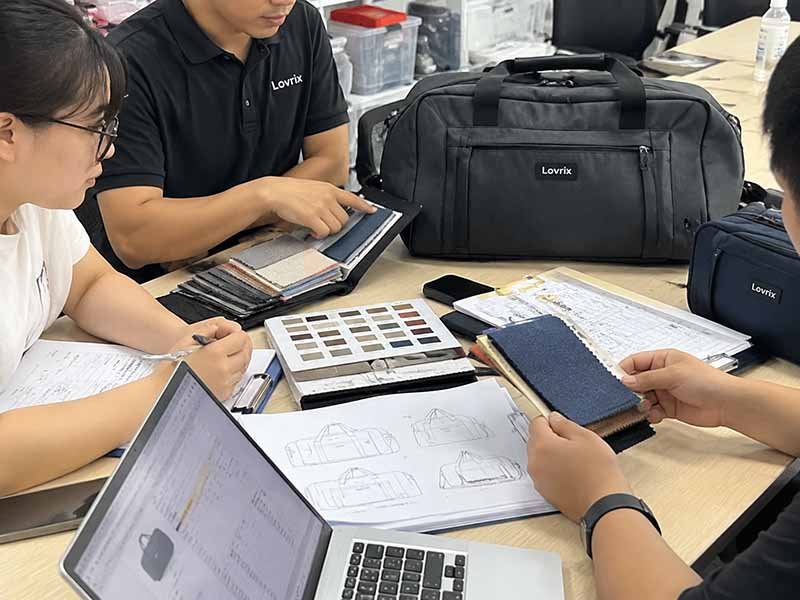
Sample revision becomes risky when instructions are scattered across emails, messaging apps, meeting notes, annotated photographs, and voice messages. A reliable development process should bring all approved changes into one controlled revision document. Each sample needs a clear version such as V1, V2, and V3, together with the date, list of changes, measurements, material substitutions, photographs where necessary, and approval status.
A travel product may use more than a dozen different material categories even before packaging is considered. Outer fabric, lining, mesh, foam, webbing, zipper tape, zipper sliders, pullers, hooks, D-rings, buckles, binding, thread, labels, patches, and internal reinforcement can all be important to the finished result. A bill of materials helps define exactly which components have been approved instead of leaving the factory to interpret a finished sample visually.
Color also deserves more attention than it usually receives. A black nylon shell, black polyester webbing, black zipper tape, black plastic buckle, and black coated metal hook may all be sold as “black,” yet they can look noticeably different beside one another. A travel brand should decide whether exact matching is important or whether coordinated tonal variation is acceptable. For brand-critical colors, approving physical references is generally more reliable than relying only on colors viewed on computer screens.
When custom-dyed fabric, special zipper tape, branded webbing, or custom hardware is involved, material approval also affects MOQ and lead time. That connection should be understood before the final design is frozen, particularly for first orders where inventory risk matters.
Protect Sample-to-Bulk Consistency
The approved sample should become a physical production reference, but it should not be the only production reference. A sample can show what the product looks like, yet it cannot always communicate the supplier code of the approved fabric, acceptable dimensional tolerance, exact zipper specification, artwork file version, packaging instruction, or hidden reinforcement detail.
Bulk production should therefore be supported by a controlled technical package containing the final specification sheet, measurement chart, BOM, artwork, approved colors, packaging requirements, key tolerances, and sample status. Before production begins, these records should be compared with the final approved sample so that both the manufacturing team and quality team are working from the same standard.
Material sourcing creates another important risk. A development sample may use a few meters of an available fabric, while mass production may require an entirely new material batch. Zippers, hardware, and coatings can also come from different production lots. Even when the supplier intends to reproduce the same specifications, small differences may occur. For complex or quality-sensitive travel products, a pre-production sample made from actual bulk materials can therefore be valuable.
The goal is not to pretend manufacturing variation can be eliminated completely. It is to determine which characteristics matter, define acceptable ranges, and ensure that substitutions are discussed rather than made silently. Szoneier describes its manufacturing role as supporting the transition from product ideas and reference samples into production-ready custom bags while improving sample-to-bulk consistency.
How Do You Verify Quality and Factory Control?

Quality control should be evaluated by looking at how the manufacturer prevents defects, identifies problems, records results, and responds when production falls outside the approved standard. Effective control should begin with materials and continue through cutting, sewing, in-process inspection, finished-product inspection, packing, and shipment preparation. Final inspection alone cannot protect a travel brand from every manufacturing problem.
Check Quality at Multiple Stages
Final inspection receives a lot of attention because it happens just before shipment, but many serious defects have already become expensive to correct by that point. If 2,000 bags have been sewn with an incorrect zipper, an inspector can identify the problem but cannot easily reverse the production cost. If reinforcement was omitted inside a closed handle anchor, repairing the issue may require dismantling part of the product.
Incoming material inspection is therefore the first useful control point. Depending on the design, this can include checking shell fabric color, coating, surface defects, width, webbing, zipper operation, hardware finish, foam thickness, printed labels, and other project-specific materials. The purpose is not to test everything that exists but to make sure the components most likely to affect product performance are within the approved standard before they enter production.
In-process inspection then focuses on characteristics that become difficult to change later. Panel dimensions, zipper installation, reinforcement position, seam allowance, handle placement, pocket construction, logo location, binding, and lining assembly are common examples. The final inspection can then concentrate on finished measurements, overall appearance, symmetry, zipper function, straps, handles, stains, loose threads, labels, packing accuracy, and quantities.
For a typical custom travel duffle, a focused QC plan might concentrate on 10–20 product-critical characteristics rather than hundreds of generic checklist lines. The best inspection system is the one that understands which defects create the greatest functional, visual, or commercial risk for that specific product.
Know Which Defects Matter Most
Not every manufacturing defect should carry the same importance. A slightly uneven hidden stitch and a shoulder-strap anchor that fails under normal load are clearly different problems. Brands benefit from separating defects into categories such as critical functional defects, major visual or construction defects, and minor cosmetic issues.
Functional problems may include broken hardware, open seams, zipper failure, missing reinforcement, incorrectly installed straps, unusable pockets, or serious dimensional errors. These issues can make the product difficult or impossible to use. Major visual defects may include noticeably crooked logos, asymmetrical handles, obvious color differences, heavily puckered seams, poor bag shape, scratched visible hardware, or stains. Minor issues may include isolated loose threads or small workmanship variations that remain within agreed standards.
A defect reference library can make these expectations much easier to communicate. Photographs are especially useful because terms such as “good stitching” or “acceptable appearance” can be interpreted very differently. Over several production runs, the defect library can become one of the most useful quality references shared between a brand and manufacturer.
Travel brands selling online should be especially sensitive to problems that customers can identify easily in public reviews. Broken zippers, uncomfortable straps, poor stitching, chemical odors, incorrect dimensions, weak buckles, and misleading capacity are simple for customers to describe. Small manufacturing savings can become expensive when repeated across hundreds of products and reflected in product ratings.
Verify the Factory Behind the Quote
Professional sales communication does not automatically prove manufacturing control. Before committing to a meaningful production program, brands should understand who is actually making the product and how the operation works. Factory visits are useful when practical, but live video reviews can also provide a surprising amount of information when the right questions are asked.
Ask to see more than the sample showroom. Pattern development, sample making, material storage, cutting, sewing, in-process products, quality inspection, packing, and finished-goods areas create a more complete picture of the operation. While viewing those areas, ask how approved specifications are transferred to production, how first units are checked, how rejected products are separated, how different SKUs are controlled, and who has responsibility for correcting a problem.
The organization of communication matters as much as physical equipment. A factory may have many machines but weak coordination between sales, development, production, and QC. Another may have more modest scale but clearer project ownership and stronger documentation. For brands working across languages and time zones, communication failures can create as much risk as sewing problems.
For larger programs, third-party audits or independent inspections may also be appropriate. Compliance should be evaluated separately according to the product, market, retailer, materials, and claims involved. A general factory certificate does not automatically prove that every individual travel product satisfies every market requirement.
Szoneier’s documented process allows qualified customers to review the sample room, material options, sewing production, quality process, and shipment preparation through video factory reviews before committing to an order.
What Do MOQ, Cost, and Lead Time Tell You?
MOQ, cost, and lead time tell you how naturally your product fits a manufacturer’s materials, production system, and supply chain. A credible quotation should explain what creates the minimum order, which product specifications drive cost, and when the production clock actually begins. These three numbers become useful only when the assumptions behind them are clear.
Understand the Real MOQ
Minimum order quantity is often treated as a single number set by the factory, but custom travel products can contain several different minimums. The sewing factory may be comfortable producing 300 units, while a custom-dyed fabric mill requires a larger material quantity. A metal zipper puller may require tooling and its own production minimum. Printed lining, jacquard webbing, molded rubber patches, custom buckles, branded boxes, or special zipper tape can introduce additional thresholds.
That is why asking only “What is your MOQ?” can produce a misleading answer. A more useful question is, “Which parts of this design are driving the MOQ?” Once that is clear, the brand can decide which custom elements are essential and which ones can use available components during the first production run.
Low-volume launches are generally easier when they use ready fabrics, standard colors, common zipper sizes, existing hardware, regular webbing, conventional branding methods, and simple packaging. Highly customized materials and components tend to push MOQ upward even when the factory itself is flexible.
Szoneier documents an MOQ starting from 200 pieces for many standard custom-bag projects, while explicitly noting that the final minimum can vary according to material availability, structure, color quantity, logo process, accessories, packaging, and other production requirements. This distinction is important because a low stated MOQ should never be interpreted as applying automatically to every possible custom configuration.
Compare Cost on the Same Specification
Price comparison is useful only when all suppliers are quoting the same product. One factory may quote basic polyester, generic zippers, lightweight lining, standard hardware, thin foam, and simple packaging. Another may be quoting heavier coated material, stronger zippers, reinforced handles, thicker webbing, higher-grade hardware, custom labels, and branded packaging. The second price may look higher even though the products are not equivalent.
Before selecting a factory, normalize the important specifications across quotations. Confirm shell fabric, lining, zipper size and grade, webbing, hardware, foam, reinforcement, logo process, packaging, inspection assumptions, MOQ per color, payment terms, and trade terms. Sample charges, molds, custom hardware tooling, testing, packaging development, and freight should also be shown separately when relevant.
| Cost Factor | Lower-Cost Configuration | Higher-Spec Configuration | Commercial Impact |
|---|---|---|---|
| Shell material | Standard polyester | Higher-density nylon or premium fabric | Feel, durability, cost |
| Zippers | Generic standard zipper | Higher-grade/branded zipper | Function, reliability |
| Hardware | Standard plastic/metal | Custom or premium hardware | Branding, load performance |
| Reinforcement | Basic construction | Additional stress-point reinforcement | Durability, sewing time |
| Logo | Screen print/woven label | Molded patch/custom metal | Tooling, MOQ, appearance |
| Packaging | Polybag | Dust bag/retail box | Presentation, freight |
| Inspection | Standard factory QC | Additional inspection requirements | Risk control, cost |
A simple cost calculation can illustrate why the lowest unit price is not automatically the least expensive business decision. If one supplier is $0.70 cheaper on a 5,000-piece order, the initial saving is $3,500. If the cheaper construction produces enough defects or customer complaints to create several thousand dollars of replacement, discounting, reverse logistics, and lost ratings, the apparent saving can disappear quickly.
The goal is not to avoid lower prices. Efficient factories can genuinely produce better value. The goal is to understand whether savings come from production efficiency or from removing specifications the brand actually needs.
Read the Lead Time Carefully
“Thirty-day production” rarely means the entire development project will finish in thirty days. Product development and bulk manufacturing operate on different clocks. A new travel product may need requirement confirmation, material sourcing, first sample development, sample shipping, internal review, revisions, final approval, bulk material purchasing, cutting, sewing, inspection, packaging, and transportation.
Consider a project where the first sample requires 10–12 days, international delivery takes 4–5 days, the brand needs a week for internal review, and the revised sample requires another 8–10 days. More than a month may pass before the bulk production timeline even begins. If custom hardware or packaging is still being developed, the schedule can extend further.
Brands should ask exactly when the quoted production lead time starts. Some factories count from the deposit date, while others begin only after sample approval and bulk material confirmation. A quoted 35-day production schedule can therefore result in very different final delivery dates depending on the development process.
Launch-sensitive companies should work backward from the date the product needs to reach the warehouse rather than forward from the purchase-order date. Include time for final inspection, potential correction, freight booking, customs clearance, and warehouse receiving. A realistic timeline usually contains contingency rather than assuming every stage will finish at the earliest possible date.
How Do You Choose a Long-Term Manufacturing Partner?
A long-term manufacturing partner should be able to reproduce approved products, control specification changes, manage multiple SKUs, communicate problems early, maintain material and quality records, scale production, coordinate packaging, and support future reorders. The strongest supplier is not simply the factory that gets the first order right. It is the one that remains predictable when the product reaches its fifth or tenth production run.
Capacity and Repeat Orders
Production capacity should always be discussed in relation to the product being manufactured. A factory may provide an impressive monthly output figure, but a simple tote and a complex travel backpack consume very different amounts of sewing time, skilled labor, materials, equipment, and inspection capacity. Ten thousand straightforward bags can sometimes be easier to schedule than five thousand multi-compartment products divided across several SKUs.
Ask potential manufacturers how they would schedule your actual order instead of relying on headline capacity. Useful questions include how many production groups may be involved, which processes are likely to become bottlenecks, how early materials need to be booked, how peak-season capacity is allocated, and what happens if demand increases significantly after launch.
Szoneier documents eight sewing production lines and regular monthly production capacity of approximately 120,000–200,000 pieces across different custom bag and soft-goods categories, with actual output depending on product type, material, structure, logo processes, packaging, and production schedules. The important point for a brand is not the headline number itself but whether enough appropriate capacity can be allocated to the specific product when it is needed.
Repeat orders depend heavily on records. Patterns, specifications, material references, artwork, logo files, packaging instructions, approved samples, and previous QC notes should remain accessible for future production. A second order should not require reconstructing the product from photographs.
Even with good documentation, a reorder still needs verification. Fabrics may be discontinued, coatings can change, dye lots vary, hardware finishes evolve, and packaging requirements are updated. Before every production run, brands should confirm what remains identical and what has changed. This becomes particularly important for successful products because repeat customers are often more sensitive to changes than first-time customers.
Packaging and Delivery
Manufacturing is not complete when the final stitch has been sewn. Packaging influences presentation, warehouse handling, freight cost, carton efficiency, and the physical condition of the bag when it reaches the customer. Travel products are especially interesting because they can occupy a large amount of volume relative to their weight.
Some soft travel bags can be folded or compressed, but aggressive compression is not suitable for every design. Thick foam, stiff reinforcement, coated fabrics, structured panels, PU details, molded logos, or internal boards can crease or deform. Packaging therefore needs to be tested during development rather than selected after thousands of units are finished.
Retail and e-commerce channels also create different requirements. Retail programs may require hangtags, barcode labels, shelf-ready packaging, price stickers, or specific carton markings. E-commerce operations may prioritize compact packing, fulfillment labels, clean presentation, and protection from warehouse dust or moisture. Multi-SKU programs need particularly clear carton identification because a correctly manufactured bag still creates a supply-chain problem if the wrong barcode or color reaches the wrong carton.
Before bulk production, confirm unit packing, folding method, labels, pieces per carton, carton markings, barcode requirements, shipping destination, and responsibility for export documentation. These details should be treated as part of the product specification rather than logistics administration added at the end.
Szoneier’s documented international-delivery capabilities include packaging coordination, carton labeling, FBA preparation, express delivery, air freight, sea freight, DDP options, and export shipment support.
Use a Final Supplier Scorecard
When two or three potential manufacturers have reached the final selection stage, a structured comparison can reduce the influence of one attractive quote or persuasive sales conversation. A 100-point scorecard can include relevant product experience, sample quality, material knowledge, QC process, communication, cost, lead-time credibility, production capacity, logistics support, and repeat-order management.
The weighting should match the way the brand actually operates. A premium travel company may place greater importance on material quality, workmanship, and sample accuracy. A fast-growing online brand may emphasize replenishment speed, inventory flexibility, packaging, and communication. A retailer launching many SKUs may place more weight on barcode control, carton accuracy, delivery scheduling, and multi-SKU project management.
The total score should never hide a critical red flag. A manufacturer could score very well overall while repeatedly substituting materials without approval, losing track of sample revisions, or providing unrealistic production dates. Those problems deserve more attention than a few points on a spreadsheet.
One question is particularly useful when evaluating long-term partners: which team is most likely to tell you about a problem before it becomes expensive? Manufacturing problems will occasionally occur even in strong factories. Materials arrive late. A dye lot looks different. Hardware does not meet the expected finish. A construction detail performs differently in production than in sampling. The supplier that raises the issue early and brings workable options is usually more valuable than the one that hides difficulty until delivery is already at risk.
Over several product cycles, a strong manufacturing partner begins accumulating knowledge about the brand itself. The factory learns preferred materials, logo standards, quality tolerances, packaging expectations, target prices, common product structures, and how previous problems were resolved. That retained knowledge can reduce repeated explanations, unnecessary sample rounds, development delays, and sourcing risk as the travel collection expands.
For manufacturers such as Szoneier, whose documented product scope includes travel bags and duffle bags as part of a broader custom soft-goods manufacturing system, the relevant value to a travel brand is not simply the ability to sew a single bag. It is the ability to connect material sourcing, sample development, sewing production, quality control, packaging, and export delivery into one repeatable project workflow.
Conclusion
Choosing a bag manufacturer for a travel brand is ultimately about controlling uncertainty. Price, MOQ, factory size, and production capacity all matter, but none of them should be considered independently. The manufacturer needs to understand how the product will actually be used, which materials and components support that use, where structural risks exist, how the design will be translated into samples, and how the final approved version will be reproduced consistently during bulk production.
The strongest sourcing process therefore begins well before a purchase order. Define the product clearly, compare factories with relevant experience, evaluate real samples under realistic use, document revisions, confirm materials, understand the reasons behind MOQ and pricing, verify quality procedures, and examine how the supplier will manage future production. These steps require more work than simply comparing three quotations, but they reduce the chance of discovering expensive problems after thousands of bags have already been made.
For travel brands developing a duffle, weekender, travel backpack, toiletry bag, packing cube system, organizer, or related soft-goods collection, one question can reveal a great deal about a potential manufacturing partner: “Here is what the product needs to do in the customer’s hands. Show us how you would make that performance repeatable in production.” A manufacturer that can answer that question clearly, with real materials, processes, samples, records, and evidence, is much closer to becoming a long-term manufacturing partner rather than simply another name on a supplier list.
Frequently Asked Questions
How do I find a reliable bag manufacturer for my travel brand?
Start by defining your product before contacting factories, including dimensions, materials, target quantity, important features, expected quality level, branding, packaging, target market, and desired delivery schedule. Shortlist manufacturers with experience in structurally similar travel products, then compare their sample-development process, material knowledge, quality control, MOQ, production capacity, communication, and repeat-order management. Factory videos, relevant samples, production records, and clear technical answers are more useful than general marketing claims.
What MOQ should I expect from a custom travel bag manufacturer?
There is no universal MOQ for custom travel bags because the minimum can be determined by fabric availability, custom colors, zippers, hardware, logo processes, packaging, structure, and production setup. Standard materials and existing components generally make smaller orders easier, while custom-dyed fabric, molded hardware, jacquard webbing, special zipper pullers, and printed packaging can create higher minimums. Some manufacturers support selected standard projects from around 200 pieces, but complex configurations may require more.
How many samples should I make before mass production?
There is no fixed number that applies to every project. A straightforward travel pouch may reach approval after one or two development rounds, while a complex backpack or weekender can require several revisions. The important issue is not minimizing the number of samples but making sure the final version proves dimensions, structure, materials, zippers, hardware, comfort, functionality, logo execution, reinforcement, and packaging. Every revision should be documented so the approved sample can be transferred accurately into production.
What materials are commonly used for custom travel bags?
Common travel-bag materials include polyester, nylon, Oxford fabrics, canvas, PU, genuine leather, TPU-coated fabrics, mesh, RPET, neoprene, foam, and various lining materials. The best choice depends on the product’s weight, desired appearance, abrasion exposure, water resistance, structure, target retail price, and sales channel. A lightweight packing cube and a structured premium weekender should not use the same material logic simply because both products are designed for travel.
How can I make sure bulk production matches the approved sample?
Use the approved sample together with controlled production documents rather than relying on the physical sample alone. Maintain a final specification sheet, measurement chart, bill of materials, artwork, color references, packaging instructions, tolerances, and change history. Confirm bulk materials before sewing and consider a pre-production sample when the product uses complex structures or newly produced materials. In-process inspections should focus on details that would be difficult to repair after the bag is completely assembled.
What should I ask a travel bag manufacturer before placing an order?
Ask about experience with similar products, sample-development procedures, material sourcing, zipper and hardware options, reinforcement methods, QC stages, MOQ by color or style, sample and production lead times, capacity during your required season, packaging, shipping support, and repeat-order control. You should also ask how design revisions are documented and what happens when materials or production results differ from the approved standard. The quality of these answers often reveals more than the quotation itself.
Is the cheapest travel bag manufacturer usually the best option?
Not necessarily. A lower price can come from genuine manufacturing efficiency, but it can also result from lighter fabric, cheaper zippers, thinner webbing, reduced reinforcement, simpler packaging, limited QC, or excluded costs. Compare suppliers using identical specifications and examine the total commercial cost rather than unit price alone. A slightly higher manufacturing price may create better value when it reduces defects, delays, replacements, negative reviews, and inconsistency between production runs.