Skip to content


Launching a private-label bag on Amazon is easy to underestimate. From the outside, the process can look like a short sequence: find a product idea, contact a factory, add a logo, place an order, ship the inventory to FBA, and start selling. In practice, the commercial result often depends on decisions made long before the first unit reaches an Amazon fulfillment center. Fabric construction, zipper quality, strap reinforcement, usable dimensions, foam density, packaging volume, carton configuration, barcode handling, and replenishment timing can all affect margins and customer reviews.
A custom bag project becomes much easier to control when the seller treats manufacturing as part of product development rather than as a purchasing transaction. Instead of beginning with the lowest unit price, the more useful starting point is a clear product brief: who will use the bag, which customer complaints should be solved, what level of durability is required, what price position the listing must support, and which details customers will actually notice in daily use.
For Amazon sellers, successful custom bag manufacturing means converting a product concept into a repeatable specification, validating it through sampling, controlling materials and workmanship during production, preparing every SKU correctly for fulfillment, and planning inventory early enough to avoid costly emergency replenishment. The goal is not simply to manufacture a bag cheaply, but to manufacture the same sellable product consistently across multiple production runs.
Consider two sellers launching similar travel backpacks at the same retail price. One selects the lowest quotation and approves the first sample quickly because the listing photography deadline is approaching. The other spends additional time checking shoulder-strap reinforcement, zipper movement, laptop-compartment dimensions, carton volume, and packaging instructions. Their bags may look almost identical in the first set of product photos. Six months later, however, differences in reviews, returns, replacement costs, stock availability, and repeat-order consistency may tell two completely different stories.
What Should Amazon Sellers Prepare Before Manufacturing?
Amazon sellers should prepare a clear product brief before asking a manufacturer for an accurate quotation. The brief should define product type, intended use, target dimensions, materials, important functions, branding, order quantity, SKU count, packaging, destination market, and launch timing. Clear input reduces factory assumptions, makes quotations easier to compare, shortens sampling discussions, and prevents avoidable changes after materials or production have already been arranged.
Product Brief
A marketplace screenshot alone is rarely enough to quote a custom bag properly. A backpack that looks simple from the outside can contain dozens of individual fabric, lining, foam, reinforcement, webbing, zipper, label, and hardware components. Two factories can look at the same photograph and make completely different assumptions about fabric weight, lining quality, foam thickness, zipper construction, sewing reinforcement, and packaging. Their prices may therefore differ significantly even though both quotations carry the same basic product name.
The most useful development brief explains what the bag needs to do rather than only what it needs to look like. A factory should know what the end customer will carry, how the bag will be opened and closed, which areas bear weight, whether the product needs to stand upright, whether the exterior should resist light rain, and which compartments have fixed size requirements. If a backpack must hold a 16-inch laptop, for example, the actual usable sleeve dimensions matter more than a generic statement such as “large laptop compartment.”
A practical starting package usually includes:
- Product type and intended use
- Reference photographs from several angles
- Target finished dimensions
- Estimated quantity
- Number of colors, sizes, or SKUs
- Preferred materials or required performance
- Important pockets and compartments
- Strap, handle, closure, and padding requirements
- Logo artwork and preferred branding method
- Individual packaging requirements
- Destination market or fulfillment channel
- Desired inventory-ready date
- Target cost range when commercially useful
A request such as “800 travel backpacks, two colors, approximately 45 × 30 × 18 cm, padded laptop compartment, luggage strap, separate shoe pocket, woven logo, individual packaging, FNSKU labeling, and delivery for Amazon US” gives the development team enough information to evaluate material availability, pattern complexity, accessory requirements, MOQ, packaging, and production planning. A message that only says “How much is this backpack?” usually produces quotations based on assumptions rather than a common specification.
Tech Pack or Reference Sample
A complete tech pack is extremely useful, but it is not required at the first conversation for every custom bag project. Many products begin with a physical sample, an existing Amazon product, a sketch, detailed photographs, a previous version, or a combination of these materials. What matters is that uncertain information gradually becomes measurable and documented before bulk production begins.
A physical reference sample is especially helpful when a seller wants to communicate shape, hand feel, foam density, opening behavior, structural stiffness, pocket access, or carrying comfort. These details are often difficult to understand from drawings alone. A tech pack becomes more valuable as the number of specifications increases. Multi-SKU programs, repeat orders, custom hardware, complex artwork, narrow dimensional tolerances, or long-term product lines all benefit from more formal technical documentation.
Before bulk production, subjective descriptions need to be converted into specifications wherever possible. “Premium fabric” should become an agreed material. “Thick padding” should become an approved foam construction. “Strong shoulder straps” should become defined webbing, reinforcement, stitching, and attachment methods. “Large front pocket” should become usable dimensions. This transition from descriptive language to measurable requirements is one of the most important steps in reducing misunderstandings between a seller and a factory.
Szoneier’s documented manufacturing system supports projects that begin with product ideas, reference photographs, physical samples, tech packs, material requirements, logo artwork, and packaging needs. Those inputs can then move through material selection, structure development, pattern making, sample production, revision, bulk sewing, quality inspection, packaging, and export delivery.
Review-Driven Development
Amazon reviews are not only a marketing resource. They are also a product-development database. Sellers can study one-star, two-star, and three-star reviews from their own listing and competing products to identify recurring problems that may be solved through better construction, materials, dimensions, or packaging. The key is to group comments by underlying cause rather than reading them as unrelated complaints.
A zipper complaint, for example, may come from several different causes. The zipper itself may be poor quality, but the problem could also come from incorrect sewing tension, an opening radius that is too tight, insufficient seam allowance, or poor alignment. Shoulder-strap failures may involve weak thread, but they can also result from insufficient reinforcement underneath the strap attachment. A bag that “feels cheap” may need better outer material, yet sometimes the real cause is thin lining, weak foam, lightweight webbing, or a structure that collapses too easily.
A practical way to prioritize improvements is to consider three factors together: frequency, severity, and fixability. A complaint that affects only a small percentage of users may still deserve immediate attention if it makes the product unusable. Conversely, a cosmetic preference mentioned occasionally may not justify a costly redesign that affects every unit. Product development works best when the factory and seller concentrate on changes that create visible customer value without adding unnecessary manufacturing complexity.
The company documentation specifically identifies Amazon sellers as customers who often need product differentiation, FBA packaging, carton labeling, stable replenishment, and greater control over quality issues that could contribute to negative reviews.
Which Materials and Features Should You Choose?
The right material depends on how the bag will be used, how long it is expected to last, what the customer should feel when touching it, how much structure is required, and what landed-cost level the listing can support. Polyester, nylon, Oxford, canvas, neoprene, PU, leather, PVC, and TPU can all work well in suitable applications. Material selection should always be connected to function rather than fabric name alone.
Material Selection
The outer fabric receives most of the attention during product development because it dominates appearance, but a finished bag is a system made from many materials. A durable shell combined with a poor zipper, weak webbing, low-quality buckle, or insufficient reinforcement can still create a disappointing product. Experienced product development therefore looks at the interaction between outer fabric, lining, foam, boards, webbing, zipper, hardware, stitching, and construction instead of judging each part separately.
Polyester is widely used for everyday backpacks, organizers, cosmetic bags, travel products, promotional bags, and many general-purpose soft goods because it provides a useful combination of price control, color availability, printing options, and manufacturing consistency. Nylon is often selected when lower weight, tear resistance, or a more technical appearance is required. Oxford fabrics are commonly used in travel, tool, school, outdoor, utility, and promotional products, but the term “Oxford” describes a broad family rather than one fixed quality level.
Canvas and cotton offer a more natural appearance and can work particularly well for lifestyle totes, retail products, reusable bags, and promotional merchandise. Neoprene provides stretch and cushioning for bottle carriers, laptop sleeves, cosmetic products, and protective soft goods. PU leather allows fashion-oriented surfaces and color consistency at a different cost structure from genuine leather. Genuine leather introduces additional considerations such as natural surface variation, cutting yield, hide selection, edge finishing, workmanship, and long-term appearance. TPU and PVC are useful in selected waterproof, transparent, welded, or protective products where barrier performance is important.
| Material | Common Applications | Useful Characteristics | Important Checks |
|---|---|---|---|
| 300D–600D Polyester | Backpacks, organizers, promotional bags | Cost control, color availability, printing | Coating, density, abrasion |
| 420D–840D Nylon | Travel and technical bags | Strength-to-weight, technical appearance | Tear strength, coating, hand feel |
| Oxford Fabric | Tool, travel, school, utility bags | Wide structural and price range | Composition, weave, coating |
| Canvas | Totes and lifestyle bags | Natural texture, strong visual identity | Shrinkage, colorfastness, fabric weight |
| Neoprene | Sleeves, bottle bags, pouches | Cushioning, flexibility | Thickness, lamination, odor |
| PU Leather | Fashion and cosmetic products | Consistent surface, design flexibility | Abrasion, backing, hydrolysis resistance |
| TPU/PVC | Waterproof or transparent products | Barrier and welding capability | Thickness, clarity, temperature performance |
A denier figure should never be treated as a complete quality grade. Two fabrics both described commercially as “600D polyester” may differ in yarn density, coating, surface finish, tear resistance, abrasion behavior, colorfastness, and actual weight. Whenever material performance matters, compare approved swatches, measurable specifications, or appropriate test results rather than relying on the material name printed on a quotation.
Components That Matter
The parts customers touch every day deserve more attention than they usually receive during early sourcing. Zippers, handles, shoulder straps, buckles, webbing, pocket openings, hooks, clips, and lining components directly influence usability. These are also common locations for failures because they experience repeated movement, friction, tension, or load.
A zipper can fail even when the zipper itself is acceptable. If it is sewn into an opening under excessive tension, installed around a sharp corner, or paired with a construction that forces the slider sideways, the user may still experience sticking or separation. A shoulder strap may use strong webbing but fail because the reinforcement patch underneath the attachment point is too small. A buckle that looks identical to a stronger version in listing photographs may perform differently under load, low temperature, or repeated opening.
Load-bearing bags require particular attention to the path of force through the product. The weight of the contents moves from the bottom and body panels through seams and reinforcement into handles or shoulder straps. Reinforcement needs to be positioned where force is transferred between materials rather than added only where it is visible. This is especially important for travel bags, tool bags, backpacks, medical bags, and other products expected to carry heavier loads.
Foam and reinforcement materials also influence customer perception. Light cushioning may use only a few millimeters of foam, while protective areas can require thicker or denser constructions depending on the product. The correct solution is not simply to use the thickest foam available. Density, compression recovery, seam bulk, product dimensions, and intended protection all matter. Excessive foam can increase sewing difficulty, product volume, and freight cost without improving the feature that customers care about.
Useful Differentiation
Strong Amazon differentiation solves a recognizable problem. Decorative changes can make a product look different, but functional improvements are usually easier to communicate and defend. A separate shoe compartment in a travel bag, wipe-clean lining in a cosmetic bag, reinforced molded base on a tool bag, improved bottle retention on a backpack, or more stable construction in a pet travel product all provide benefits that can be explained clearly in listing photographs and product copy.
Every proposed feature should pass three tests. First, customers should be able to understand the benefit. Second, the factory should be able to reproduce the feature consistently in bulk production. Third, the added material, labor, weight, or complexity should be justified by the commercial value of the feature. If a new detail is difficult to explain, difficult to manufacture, and expensive to add, it may be differentiation for the sake of differentiation rather than real product improvement.
Experienced development teams also know when to remove features. An unnecessary internal pocket may require extra fabric, lining, zipper, binding, sewing operations, inspection points, and product weight while delivering almost no additional value. A complicated opening can make the bag harder to produce and more likely to fail without improving how customers use it. The strongest bag designs are usually not the products with the largest number of parts. They are the products in which materials, components, and construction details each perform a clear job.
How Does Custom Bag Sampling and Production Work?
Sampling transforms a product concept into a physical reference that can be measured, tested, photographed, revised, and approved. A professional process typically moves from requirement review to material confirmation, pattern making, cutting, prototype sewing, internal inspection, customer review, revision, and final approval. Bulk production should begin only after important dimensions, materials, accessories, branding, workmanship, and packaging requirements are sufficiently clear to be repeated.
Prototype Development
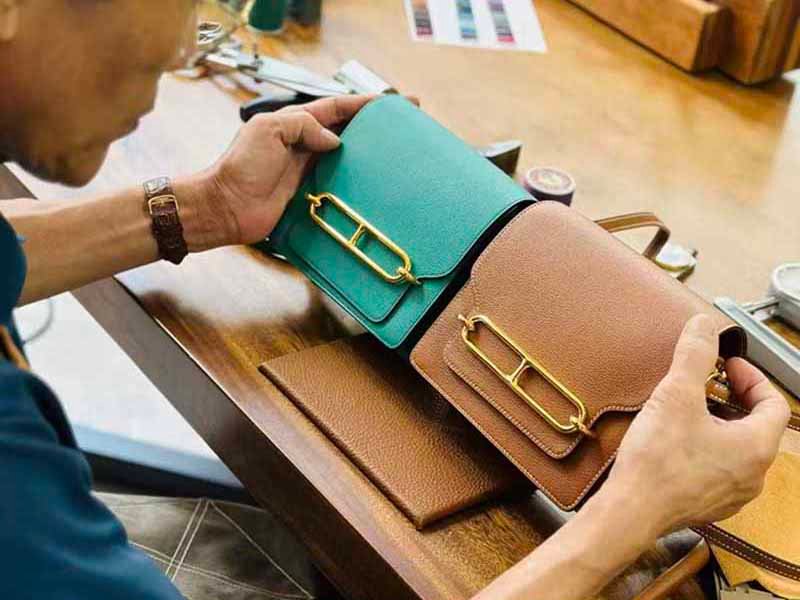
Soft bags are created by turning flat materials into three-dimensional shapes through cutting, folding, sewing, binding, padding, reinforcement, and assembly. This makes pattern development one of the most important stages in the process. A design drawing may show only a rectangular front pocket, but a pattern maker has to determine seam allowance, zipper opening, lining shape, reinforcement, attachment sequence, and how that pocket affects the geometry of the surrounding panel.
Small dimensional changes can travel through the product. An adjustment of only a few millimeters across several pattern pieces may change zipper alignment, pocket position, seam matching, finished dimensions, or overall symmetry. Foam thickness can also alter the finished size of a compartment. Binding adds bulk. Reinforcement changes flexibility. These effects are difficult to judge correctly from screen images alone, which is why a prototype remains essential for many custom bag projects.
A straightforward pouch may use relatively few cut pieces. A travel or technical backpack can contain dozens of individual outer panels, lining pieces, foam sections, reinforcement parts, pocket components, straps, handles, binding strips, and zipper constructions. The number of sewing operations increases with each added component, creating more places where accumulated tolerance or assembly errors can occur.
The first prototype should therefore be viewed as part of the engineering process rather than a pass-or-fail test. Its purpose is to expose questions while they are still inexpensive to correct. A pocket may be difficult to reach. A strap angle may feel wrong once the bag is loaded. The structure may collapse differently from the original drawing. A zipper opening may be too narrow. Discovering these problems in one sample is far better than discovering them in hundreds of finished units.
Sample Approval
Approving a sample only because it looks attractive is risky. A practical review should start with measurable requirements and then move into real-world use. Overall width, height, and depth should be checked, but functional dimensions often matter more. Laptop sleeves, bottle pockets, handles, straps, zipper openings, internal dividers, and specialty compartments should all be evaluated based on what the customer is expected to place inside them.
Materials and accessories should be compared with agreed references. Check outer fabric, lining, foam, webbing, zipper, hardware, thread, reinforcement, logo, and packaging rather than assuming that the visual impression of the complete bag is enough. Color should be reviewed under suitable lighting, and components that move should be operated repeatedly. The sample should then be used as the customer will use it instead of remaining empty on a table.
Load testing does not have to begin with a laboratory. If a backpack is intended to carry a laptop and daily travel items, load the sample with representative contents and carry it. If a tool bag will hold heavy tools, place comparable weights inside and observe the handles, bottom structure, seams, and pocket behavior. If a cosmetic organizer needs to hold bottles upright, test typical bottle sizes. These simple checks often reveal issues that listing photographs would never show.
Revision comments should be consolidated into a single controlled document whenever possible. Number each requested change, add measurements, and use annotated photographs to show exact locations. Instructions scattered across messaging apps, emails, voice recordings, and screenshots are one of the most common causes of misunderstandings in sample revision. Clear documentation saves time for both sides and creates a record that can later support bulk-production control.
Sample-to-Bulk Control
An approved physical sample is valuable, but it should not be the only production reference. A repeatable manufacturing package normally combines the approved sample with patterns, measurements, material information, color references, artwork, component specifications, packing instructions, and QC requirements. The more commercial importance a product has, the less reasonable it is to depend on memory or verbal descriptions.
A structured production reference can include:
- Approved physical sample
- Final patterns
- Measurement sheet and tolerances
- Bill of materials
- Fabric and lining references
- Zipper and hardware specifications
- Webbing and reinforcement information
- Logo artwork and placement
- Color standards
- Packaging specification
- QC checklist
- Approved change record
Material substitutions deserve special attention. Suppliers may occasionally face stock shortages, changed minimums, or availability problems. A different zipper slider, foam density, buckle material, lining weight, or fabric coating may appear similar while changing performance or customer perception. Any substitution that affects appearance, function, durability, packaging, or approved cost should be discussed before entering bulk production.
Szoneier’s documented workflow includes material selection, structure development, pattern making, sample production, sample revision, bulk sewing, in-line inspection, final quality control, packaging, and export shipment coordination. Maintaining continuity between these stages is particularly important for Amazon products because future reorders need to reproduce the same product that existing customers have already reviewed and rated.

How Do MOQ, Cost, and Lead Time Affect Amazon Launches?
MOQ, production cost, and lead time should be evaluated together because all three affect inventory risk. Smaller orders reduce initial cash exposure but may increase unit cost, while larger orders improve purchasing and production efficiency but create greater risk if the product needs revision. Amazon sellers should calculate landed inventory cost and complete replenishment time rather than making sourcing decisions from factory unit price alone.
MOQ Drivers
MOQ is usually created by several parts of the supply chain rather than by one arbitrary factory policy. A sewing factory may accept a relatively small production run, while the fabric mill, zipper supplier, hardware supplier, printing company, packaging supplier, or custom-component manufacturer may each have their own minimum quantity. These hidden minimums become more important as the product becomes more customized.
A 500-piece order using stocked fabric, a standard zipper, available webbing, common buckles, one logo process, and basic packaging is very different from 500 pieces divided across five custom colors with matching zippers, custom molded pullers, personalized hardware, jacquard webbing, and printed gift boxes. The total number of finished units is identical, but the second product creates several smaller purchasing lots that may fall below material-supplier minimums.
SKU planning therefore has a direct connection to production economics. Testing two colors at 250 units each is often easier than testing five colors at 100 units each. Fewer variations simplify material ordering, production scheduling, packing, inspection, inventory management, and replenishment. A seller can always expand the range after the strongest color or size combinations become clearer.
For selected standard custom bag projects, Szoneier’s documented MOQ starts from 200 pieces. Exact quantities depend on material availability, colors, product structure, logo process, accessories, packaging, and other customization requirements. The same documentation explains that lower quantities are intended to help serious brands and Amazon sellers reduce new-product testing risk rather than provide one-piece retail customization.
Landed Cost
Factory unit price is only one part of inventory economics. A meaningful cost comparison should include individual packaging, labeling, inspection, domestic logistics, export handling, international freight, applicable duties and taxes, and final delivery to the fulfillment center or warehouse. Two factories can quote different production prices yet produce the opposite result once shipping and quality factors are included.
Suppose one supplier quotes a bag at $7.80 while another quotes $8.20. Across 1,000 units, the second offer appears $400 more expensive. If the second manufacturer redesigns the folding method and carton configuration so the average logistics cost falls by $0.48 per unit, the production-price disadvantage disappears and the total inventory cost becomes lower even before defect rates or replacement costs are considered. The example is hypothetical, but the commercial principle applies widely to compressible soft goods.
Packaging volume deserves particular attention because many bags contain air space, foam, handles, straps, or structured panels that affect carton efficiency. A change in folding, inserts, unit packaging, or master-carton configuration may improve container utilization or chargeable volume. This does not mean products should be compressed until their shape is damaged. It means packaging should be engineered rather than treated as the final administrative step after production finishes.
Cost engineering also becomes more useful when the supplier explains major cost drivers. A custom metal buckle may add more cost than expected. A complicated logo patch may involve tooling, setup, and minimum quantities. Removing one unnecessary internal zipper can save not only the zipper but also fabric, lining, sewing time, and inspection work. The objective is to protect features customers notice while simplifying features that add cost without improving the experience.
Launch Timing
Amazon sellers should plan backward from the date inventory needs to be available for sale. The production period shown on a quotation is only one portion of the total timeline. Product definition, sample development, sample shipment, revisions, bulk material preparation, sewing, inspection, packaging, international transport, customs, and FBA receiving all need to fit into the calendar.
A practical planning range for a conventional custom bag project might look like this:
| Stage | Typical Planning Range* | Main Variables |
|---|---|---|
| Requirement review | 2–5 days | Clarity of information |
| Material selection | 3–10 days | Stock availability |
| Prototype development | 7–20 days | Product complexity |
| Sample review/shipping | 4–10 days | Destination and feedback speed |
| Revision if required | 7–15 days | Number of changes |
| Bulk material preparation | 10–30 days | Custom colors and components |
| Production | 20–45 days | Quantity and complexity |
| Final QC and packing | 3–7 days | Inspection and packaging |
| International delivery | Route dependent | Air, sea, DDP, customs |
- These are general planning ranges rather than guaranteed production commitments. Exact timing should always be confirmed for the actual product, materials, quantity, destination, and season.
Inventory planning becomes especially important once the listing gains stable sales. If a product sells 15 units per day and the complete replenishment cycle takes 70 days, approximately 1,050 units could sell during that period before safety stock is considered. Waiting until only 400 units remain would create a predictable stockout unless demand falls or more expensive freight is used.
Peak seasons add another layer of risk. Material suppliers become busier, factory schedules fill, freight space becomes tighter, ports may become congested, customs can slow, and fulfillment-center receiving can take longer. The factory controls only part of the calendar. Experienced sellers therefore separate factory production lead time from total inventory replenishment lead time and monitor both.
How Is Bag Quality Controlled for Amazon Sales?
Bag quality should be controlled through multiple checkpoints rather than relying only on an inspection after production is complete. Materials, accessories, pre-production standards, cutting, sewing, semi-finished products, final products, labels, and packaging all deserve appropriate checks. Early detection is especially valuable for Amazon inventory because one repeated defect can later appear through returns, review complaints, replacements, and expensive corrective work after goods are overseas.
High-Risk Defects
The commercial importance of a defect depends on what the defect does to the product. A slightly uneven hidden stitch and a shoulder strap that tears during normal use should not be treated as equivalent. One may be a minor cosmetic issue, while the other makes the product unusable and may create an immediate return.
Common high-impact bag defects include:
- Broken or sticking zippers
- Shoulder-strap separation
- Loose handle stitching
- Incorrect finished dimensions
- Weak buckles or hardware
- Insufficient padding
- Lining tears
- Pocket misalignment
- Missing accessories
- Incorrect logo placement
- Wrong SKU labels
- Packaging damage
- Stains or visible material defects
Even a small recurring defect percentage becomes meaningful when volume increases. A repeated 1% problem across 10,000 units means 100 products may be affected. A 2% problem represents 200 units. Those figures do not automatically equal the same number of negative reviews, but they demonstrate how an issue that looks small in percentage terms can become commercially important once production scales.
Defects are often classified as critical, major, or minor according to function, safety, appearance, and the agreed quality standard. A dangerous exposed component could be considered critical. A failed main zipper or detached carrying strap would normally be treated much more seriously than a small cosmetic imperfection. The classification and acceptance standard should match the actual product rather than being copied mechanically from an unrelated category.
Production QC
Quality control should begin before sewing starts. Incoming outer fabric and lining can be checked for color, visible defects, width, surface condition, and coating consistency where relevant. Accessories such as zippers, webbing, buckles, hardware, labels, foam, and reinforcement materials should be compared with the approved references before they are distributed to production.
Cutting inspection is important because errors introduced at this stage affect every later operation. Panel dimensions, grain or pattern direction, surface defects, and material orientation should be reviewed before large quantities of pieces move to sewing. Early sewing checks then confirm that the line is assembling the product according to the approved construction and that reinforcement, alignment, and stitching meet the required standard.
In-line inspection is one of the most useful controls in custom bag production because correcting a problem in the first several dozen units is much easier than discovering the same issue in thousands of completed products. Semi-finished inspection can also reveal shape, pocket, zipper, strap, or assembly problems before final components are attached and before the cost of correction rises.
A practical multi-stage system can include material inspection, accessory inspection, pre-production sample confirmation, cutting inspection, sewing-process checks, semi-finished inspection, final inspection, and packaging inspection. Szoneier’s documented QC framework specifically includes these checkpoints rather than relying on a single final-stage quality statement.
Product-specific checks should then be added. Backpacks need particular attention around shoulder straps, loaded seams, zipper operation, and compartment dimensions. Cooler bags require different checks around insulated construction and lining. Tool bags need stronger attention to handles, load distribution, base construction, and reinforcement. Cosmetic bags may require closer inspection of lining cleanliness, zipper operation, pocket dimensions, and visual finish.
Final Inspection
A final inspection should verify that completed products match the approved specification and are ready to ship, not merely count obvious cosmetic defects. Measurements, materials, colors, logos, zippers, buckles, straps, handles, compartments, accessories, packaging, barcodes, and carton assortment should all be checked where relevant to the project.
First-time orders, high-value programs, new constructions, or products with a history of defects may justify additional independent inspection. Many professional quality programs use statistically based sampling rather than opening every single carton and every unit. The exact inspection level, sample size, defect classification, and acceptance criteria should be established according to the order and purchasing standard rather than assumed.
Amazon-related orders need another layer of accuracy because the physical product and fulfillment data are connected. A correctly manufactured bag can still create a costly problem if the wrong FNSKU is attached, colors are mixed in cartons, an accessory is missing, or the carton information does not match the shipment plan. Packaging inspection should therefore be treated as part of product quality rather than as a separate warehouse task.
Final inspection is best understood as the last filter in a larger system. It is not a substitute for process control. Once thousands of products are completed and packed, every correction consumes more time and money. The most effective QC programs detect errors when they are still limited in quantity and comparatively easy to correct.
How Do You Choose a Manufacturer for FBA and Reorders?
A suitable custom bag manufacturer should be evaluated on more than unit price. Relevant product experience, material knowledge, sample development, production control, QC, communication, packaging, FBA preparation, logistics coordination, and repeat-order documentation all influence long-term results. A strong manufacturer should be able to reproduce an approved product across multiple batches while keeping materials, construction, labels, packaging, and quality standards sufficiently consistent.
Factory Evaluation
A polished website can show product photographs and certificates, but a real development project reveals how a factory works. Ask practical questions that require practical answers. Can the team explain the difference between suitable material options rather than simply showing the cheapest swatch? Can it identify which custom parts are creating MOQ pressure? Does the sample team record revisions? Can production explain how loaded seams are reinforced? Does QC inspect incoming components before sewing begins?
Supplier evaluation should also consider the complexity of the actual product rather than general company size. A large factory may be excellent at standardized high-volume orders but less flexible with small test launches and frequent sample revisions. A small specialist workshop may be very skilled in one narrow bag category but have limited material resources, quality systems, packaging experience, or international logistics support. The best fit depends on what the product requires now and what the sales program may require after it grows.
For more serious projects, a factory visit can provide useful evidence, but a structured video review can also reveal a great deal. Ask to see the sample area, material storage, cutting, sewing, semi-finished products, QC area, packaging, and comparable products. The goal is not to inspect every machine. It is to understand whether the company has a visible process from development through production and shipment.
Szoneier is documented as a Shenzhen-based custom bags and soft goods OEM/ODM manufacturer supporting global brands, retailers, importers, e-commerce sellers, and other commercial customers. Its manufacturing capabilities include design and material coordination, sampling, bulk production, quality inspection, packaging, and export delivery. The product range covers backpacks, totes, cooler bags, makeup bags, travel bags, duffle bags, tool bags, medical bags, waterproof products, leather goods, neoprene products, EVA cases, and other sewn soft goods.
FBA Preparation
Production is not complete for an Amazon seller when the last seam is finished. Inventory still has to be packed correctly, identified by SKU, labeled according to the current fulfillment plan, placed into cartons, and prepared for the selected shipping method. Depending on the marketplace and current Amazon requirements, this can involve FNSKU labels, individual packaging, polybag warnings, product barcodes, carton labels, carton assortment, and additional preparation requirements.
Amazon requirements can change, so the current instructions from Seller Central should always take precedence over an old packaging template. Factories that regularly work with e-commerce products may understand common workflows, but the seller remains responsible for supplying current shipment data and confirming the requirements associated with the actual fulfillment plan.
A practical packaging instruction should identify:
- SKU and color/size variant
- Product image
- FNSKU or required unit label
- Label size and placement
- Individual packaging method
- Included accessories
- Units per carton
- Target carton dimensions
- Target gross weight
- Required carton marks
- Destination
- Special preparation notes
Separate packing instructions are especially useful when several SKUs look similar. Relying on product names alone can create unnecessary mistakes on a busy packing line. Images, label references, color codes, and clear quantities provide workers and inspectors with faster visual confirmation.
The company documentation specifically states that Amazon sellers may require FBA packaging, outer-carton labels, stable replenishment, product differentiation, and better control over review-related quality risks. It also documents support for low-MOQ trial orders, packaging labels, FBA preparation, and replenishment planning.
Reorder Control
The first production run shows whether a product can be manufactured and sold. Reorders show whether the supply chain can remain stable. Once a product has been approved, its production information should be retained systematically so the next order does not depend on memory, old chat messages, or the availability of one employee.
A useful repeat-order record includes the final bill of materials, material codes, patterns, measurement sheet, approved color references, logo artwork, packaging specifications, QC requirements, carton configuration, and previous quality issues. The approved sample should remain an important physical reference where practical, but documentation is what allows several departments to reproduce the product consistently months later.
Sales velocity should then be connected to purchasing. If an ASIN sells an average of 12 units per day and the complete replenishment cycle takes 80 days, approximately 960 units may sell while the next order is being produced and delivered, before safety stock is added. If seasonal demand rises by 30%, the same period could consume approximately 1,248 units. These calculations are simple, but they are much more reliable than waiting until inventory appears visually low.
Repeat orders also create opportunities for controlled improvement. Return reasons and recurring review comments can be compared with QC records and product construction. If a genuine pattern appears, one or two clearly documented changes may improve the next batch. Changing fabric, zipper, foam, dimensions, hardware, packaging, and logo simultaneously is usually harder to evaluate because it becomes impossible to determine which change improved or damaged the customer experience.
A mature product should become increasingly predictable. Materials become easier to source, samples require fewer revisions, carton configurations become more efficient, QC teams understand recurring risks, and replenishment planning improves. That repeatability is one of the strongest signs that a custom bag has moved from an experimental Amazon product into a stable commercial program.
Conclusion
Custom bag manufacturing for Amazon sellers is ultimately an exercise in controlling risk across product development, inventory, quality, and logistics. The seller is balancing differentiation against manufacturing complexity, MOQ against cash exposure, durability against target cost, packaging against freight efficiency, and launch speed against the amount of time needed to approve the product properly.
The strongest projects usually begin with a clear product promise rather than a request for the lowest quotation. Define who will use the bag, which customer problems the product should solve, which specifications cannot be compromised, and which features have little commercial value. Once those decisions are clear, manufacturers can provide more useful material recommendations, more accurate quotations, better samples, and more realistic production schedules.
Sampling should then be treated as a development tool rather than an administrative hurdle. Use the sample to test dimensions, construction, comfort, access, materials, components, packaging, and real-world use. Turn every approved detail into a production reference. During bulk manufacturing, inspect quality at several stages rather than waiting until finished products have already accumulated. Before shipment, verify both the physical bag and the SKU, labeling, packaging, and carton information that Amazon fulfillment depends on.
For selected standard projects, Szoneier supports custom bag development beginning from a documented MOQ of 200 pieces, with exact minimums depending on material, structure, color, logo, accessories, and packaging. The manufacturing system covers material sourcing, sampling, bulk production, quality inspection, packaging, FBA-related preparation, export delivery, and replenishment support.
A successful first order is valuable, but the more important goal is to create a product that can be manufactured again without rebuilding the entire specification from the beginning. When materials, construction, quality standards, packaging, and replenishment planning remain controlled, one custom bag can develop into multiple SKUs, repeat orders, and a much more stable Amazon product line.
FAQ
What Is the Minimum Order Quantity for Custom Bags?
MOQ depends on the product structure, fabric availability, color quantity, logo process, hardware, packaging, and number of SKUs rather than on one universal industry number. Simple sewn bags using stocked materials and standard components are generally easier to manufacture in smaller quantities than molded, waterproof, highly structured, or heavily customized products. Szoneier documents a starting MOQ of 200 pieces for selected standard custom bag projects, with the exact quantity confirmed after the specification is reviewed.
How Long Does It Take to Manufacture a Custom Bag?
The complete timeline includes more than bulk sewing. Requirement review, material selection, prototype development, sample shipping, revision, material purchasing, production, inspection, packaging, freight, customs, and fulfillment-center receiving all contribute to the final inventory date. A conventional sewn-bag prototype may often be developed within a matter of days or weeks, while bulk production commonly requires several additional weeks. Exact timing varies with structure, custom materials, order quantity, season, and destination.
Do Amazon Sellers Need a Tech Pack to Make Custom Bags?
A complete tech pack is helpful but not always required to begin development. A factory can often start from a reference bag, physical sample, detailed photographs, drawing, existing product, or competitor item combined with clearly described changes. However, dimensions, materials, components, colors, branding, workmanship, and packaging should become increasingly well documented before bulk production. Repeat orders and multi-SKU programs benefit especially from a controlled tech pack, BOM, measurement sheet, artwork, and approved sample.
Can a Custom Bag Factory Apply FNSKU Labels and Prepare FBA Packaging?
Many factories experienced with Amazon projects can support unit labels, packaging, carton labels, SKU separation, and other common preparation work when the seller provides current requirements and shipment information. Amazon fulfillment requirements can change, so the seller should always verify the current instructions in Seller Central before packaging begins. Szoneier’s documented services include packaging labels, FBA preparation, outer-carton support, and replenishment planning for Amazon and other e-commerce customers.
How Can Amazon Sellers Reduce Bag Quality Problems Before Shipping?
The most effective approach is to control quality throughout manufacturing rather than relying only on a final inspection. Materials and accessories should be checked before production, the pre-production standard should be confirmed, cutting and sewing should be inspected during manufacturing, and semi-finished products should be reviewed before final assembly. Completed bags then require measurement, workmanship, function, branding, packaging, SKU, and carton checks. Early detection makes corrective action significantly easier than discovering the same defect after thousands of units are finished.
How Should Sellers Calculate the Real Cost of a Custom Bag?
The meaningful number is landed inventory cost rather than only the factory unit quotation. Manufacturing, branding, packaging, labeling, inspection, domestic transport, export handling, international freight, applicable duties or taxes, and final delivery should all be considered. Sellers should also examine carton volume and product weight because packaging design can influence logistics costs. Once inventory reaches Amazon, referral fees, fulfillment fees, storage, advertising, promotions, and returns become additional parts of the commercial calculation.
When Should an Amazon Seller Place a Reorder?
A reorder should be triggered by sales velocity and total replenishment lead time rather than by the moment inventory feels low. Multiply average daily sales by the realistic number of days required for production and delivery, then add an appropriate safety-stock allowance for seasonality, freight uncertainty, and demand changes. If a product sells 12 units per day and the full replenishment cycle is 80 days, approximately 960 units may sell before the replacement inventory arrives, even before safety stock is considered.