Skip to content

Choosing the right material is one of the most important decisions when developing a travel bag. A fabric that looks attractive in a showroom may not perform well after repeated airport handling, heavy packing, outdoor exposure, or months of daily use. The material affects much more than appearance. It determines the bag’s weight, durability, structure, water resistance, sewing performance, manufacturing cost, and the experience customers associate with a brand. For manufacturers and product developers, selecting the wrong material early can lead to repeated sampling, unnecessary cost increases, inconsistent production, and products that fail to meet their intended market expectations.
To choose the right materials for travel bags, first evaluate the intended use, expected load, durability requirements, weather exposure, target cost, and brand positioning. Compare polyester, nylon, Oxford, canvas, and coated fabrics by their weight, abrasion resistance, tear strength, water resistance, and construction suitability. Then confirm the selected material through physical samples, measurable specifications, and appropriate quality tests before approving bulk production.
At Szoneier, we approach material selection as part of the complete travel bag development process. A lightweight packing organizer, a premium business backpack, and a heavy-duty outdoor duffle may all require different fabric combinations, even when their designs appear relatively similar. Our experience in bag material sourcing, product development, sampling, and manufacturing has shown that successful products rarely depend on one expensive fabric. They depend on how well the exterior, lining, reinforcement, accessories, and construction work together. Understanding these relationships before production makes it easier to develop travel bags that perform reliably and remain commercially competitive.
What Should You Consider Before Choosing Travel Bag Materials?

The right travel bag material depends on the product’s intended use, expected load, environmental exposure, brand positioning, and target manufacturing cost. Before comparing fabric names, establish what the bag will carry, how frequently it will be used, and what performance customers expect. These requirements help determine whether polyester, nylon, Oxford, canvas, or a coated material offers the most practical solution.
What Will the Bag Carry and Where Will It Be Used?
The first step in selecting travel bag materials is understanding the actual job the bag needs to perform. A backpack designed to carry clothing and personal accessories has different requirements from a business travel bag carrying a laptop, documents, and electronic equipment. Similarly, a weekend duffle bag may need flexible construction and a reinforced bottom, while an outdoor travel bag may require stronger resistance to abrasion, moisture, and repeated contact with rough surfaces. These differences should be considered before selecting the exterior fabric.
At Szoneier, we evaluate the intended application before recommending a material. For example, a lightweight packing cube may work well with 210D or 300D polyester because it is stored inside another bag and does not experience the same external stress as a large travel backpack. An everyday backpack may benefit from 420D or 600D polyester, nylon, or Oxford fabric, depending on its construction. Outdoor products may require 900D or 1000D Oxford, ripstop nylon, ballistic nylon, or reinforced fabric in high-contact areas.
The expected contents also influence material selection. Clothing creates a different load distribution from laptops, cameras, tools, or sports equipment. Electronic devices may require padded compartments and protective foam, while travel accessories often prioritize flexibility and low weight. A fabric that performs well for clothing storage should not automatically be selected for a product intended to protect valuable equipment. Understanding the contents, carrying method, and storage environment helps Szoneier identify the appropriate material combination from the beginning.
How Much Weight, Abrasion, and Weather Exposure Must It Handle?
Travel bags experience several types of mechanical stress throughout their service life. The bottom panel repeatedly contacts floors, conveyor surfaces, vehicle compartments, and other luggage. Corners and side panels experience friction during transportation, while shoulder straps and handles transfer concentrated loads into relatively small attachment areas. These conditions explain why choosing a durable exterior fabric alone is not enough. The complete construction must distribute loads properly and protect the areas most likely to experience wear.
Several performance characteristics deserve attention when evaluating travel bag materials:
- Abrasion resistance: Measures how well a fabric withstands repeated rubbing. It is particularly important for bottoms, corners, and exterior panels.
- Tear strength: Indicates the force required to continue an existing tear, which matters when a bag encounters sharp edges or concentrated stress.
- Tensile strength: Evaluates the force a fabric can withstand when pulled, helping assess its suitability for demanding applications.
- Seam performance: Determines whether sewn connections can resist separation when the bag is loaded.
- Colorfastness: Helps establish whether the material maintains its color during rubbing, handling, or exposure to light.
- Coating durability: Evaluates whether a coated surface maintains its intended characteristics during repeated use.
Weather exposure requires an equally careful assessment. A travel bag mainly used in airports may only need protection against occasional splashes, whereas an outdoor bag may encounter sustained rain and wet surfaces. Water-resistant, waterproof, and leak-resistant are different performance requirements. A coated fabric may prevent water from penetrating the material itself, but needle holes, seams, zippers, and closures can still allow moisture inside. Szoneier therefore evaluates the expected exposure conditions together with the fabric, coating, lining, and construction rather than making waterproof claims based on the exterior material alone.
Which Brand Positioning, Sales Channels, and Cost Targets Matter?
Material selection also determines how a travel bag fits its intended market. A promotional travel bag may prioritize affordable materials, stable color availability, and straightforward logo application. A mid-range retail product needs a better balance between appearance, durability, and manufacturing cost. A premium collection may require high-density nylon, refined surface finishing, microfiber leather details, or advanced coated materials. The objective is to make the finished product feel appropriate for its price positioning rather than simply choosing the most expensive fabric available.
The sales channel influences the decision as well. E-commerce products need to account for finished weight, packaging dimensions, shipping costs, and the possibility of surface damage during transportation. Retail collections may place greater emphasis on color consistency, texture, and how several products look together. Brands planning repeat orders should also consider material availability and whether the selected specification can be reproduced consistently across different production batches.
Szoneier evaluates material choices according to the product’s positioning and target cost. A cost-focused promotional bag may use polyester, non-woven fabric, or basic canvas. A mid-range travel backpack may benefit from 600D Oxford, standard nylon, or suitable PU-coated fabric. Premium products may justify high-density nylon, microfiber leather, heavy canvas, or TPU-based solutions. These are practical starting points rather than fixed price categories. We also consider care requirements, packing efficiency, and shipping volume because a material that increases product weight or carton dimensions can affect the overall commercial value of a travel bag.
Which Materials Are Best for Travel Bags?

Polyester, nylon, and Oxford are three practical starting points for most travel bag projects because they offer different combinations of cost, weight, durability, and construction flexibility. Canvas, PU leather, microfiber leather, genuine leather, and RPET provide additional options for specific appearances and applications. The best choice depends on the required performance, finished appearance, and production conditions rather than the material name alone.
Is Polyester a Practical All-Round Material?
Polyester is widely used in travel bag manufacturing because it offers a practical combination of cost flexibility, availability, color options, and manufacturing convenience. It is suitable for travel backpacks, duffle bags, packing cubes, shoe bags, toiletry bags, and general travel organizers. For brands developing several products or multiple colors, polyester also provides a convenient starting point for maintaining a consistent material family across a collection.
Different denier specifications produce different fabric characteristics. Common polyester options include 210D, 300D, 420D, 600D, 900D, and 1200D. Lightweight 210D polyester may suit internal organizers and foldable bags, while 600D polyester is a common option for everyday travel backpacks and duffle bags. Higher-density constructions may be considered for products requiring a more substantial exterior, although the final result also depends on yarn quality, weave density, coating, and finishing.
Another advantage of polyester is its compatibility with different surface treatments. PU and PVC coatings can improve water resistance, while printing and other finishing processes provide additional customization possibilities. Brands can select matte, textured, printed, or coated surfaces according to the intended product appearance. However, polyester should not automatically be described as waterproof. Uncoated polyester, PU-coated polyester, and laminated polyester behave differently when exposed to moisture, and their actual performance needs to be confirmed through appropriate evaluation.
For many travel products, polyester provides sufficient functionality without creating unnecessary material costs. A travel organizer, for example, may not need a heavy-duty exterior, while its bottom or high-contact areas can use a stronger construction. Szoneier considers these differences when recommending polyester specifications, helping brands avoid the common mistake of using unnecessarily heavy fabric throughout an entire product.
When Is Nylon the Better Choice for Travel Bags?
Nylon is a strong candidate when a travel bag requires a combination of relatively low weight, flexibility, and abrasion resistance. It is frequently considered for travel backpacks, outdoor duffle bags, lightweight luggage accessories, and premium soft-sided products. Compared with polyester fabrics of similar construction, nylon often provides favorable mechanical performance, although actual results depend on yarn quality, fabric density, finishing, and test conditions.
For travel applications, common nylon specifications include 210D, 420D, 600D, and higher-density constructions. A 210D nylon may work well for lightweight internal compartments, while 420D nylon can provide a useful balance for everyday travel accessories. Outdoor backpacks and demanding travel products may require 600D, 900D, or 1000D nylon, depending on the expected load and abrasion exposure.
Ripstop nylon is another useful option. Its reinforced grid structure is designed to help limit the propagation of small tears, making it attractive for packable travel bags, lightweight outdoor backpacks, and products where reducing unnecessary weight is important. Ballistic nylon provides a different construction option for applications requiring a more substantial and abrasion-resistant surface, such as selected premium equipment bags and heavy-duty travel products.
Nylon also accepts different coatings and finishing treatments, including PU and TPU-based options. However, a higher-denier nylon is not automatically better for every travel product. A lightweight travel backpack may become unnecessarily heavy if its entire exterior uses a specification intended for heavy-duty equipment. Szoneier therefore considers the main body, bottom panel, internal lining, and reinforcement separately when comparing nylon options. This approach helps achieve a practical balance between durability, carrying comfort, and target manufacturing cost.
When Do Oxford, Canvas, PU Leather, and RPET Make Sense?
Oxford fabric is widely used in bag manufacturing because it provides a versatile woven construction that can be made with polyester or nylon yarns. It is suitable for backpacks, travel duffle bags, tool bags, and outdoor products requiring a more structured exterior. Common options include 300D, 600D, 900D, 1200D, and 1680D Oxford, depending on the intended application. The denier alone does not establish performance, so the fiber type, weave, coating, and finished weight should also be confirmed.
Canvas offers a different appearance and hand feel. Cotton canvas is often selected for lifestyle travel bags, weekenders, casual totes, and premium products that emphasize a natural textile appearance. Heavy canvas can provide a substantial structure, but it may also increase product weight and absorb more moisture than synthetic fabrics. These characteristics should be considered when the bag is intended for frequent outdoor use or wet environments. For premium canvas products, fabric weight, surface texture, color consistency, and stitching quality are particularly important.
PU leather and microfiber leather are useful when a brand wants a smooth, refined appearance without selecting genuine leather. They can be used for travel accessories, business bags, trim details, and selected premium products. Genuine leather provides natural grain variation and distinctive character, but thickness, color variation, surface condition, and finishing require more careful management. Szoneier can evaluate genuine leather, PU leather, and microfiber leather according to the product’s appearance, target price, and production requirements.
RPET is a recycled polyester material option for brands developing sustainability-oriented travel products. It can be used in backpacks, duffle bags, organizers, and other travel accessories. However, recycled-content claims must be supported by appropriate supplier documents and valid certification when required. RPET should be evaluated according to its actual composition, fabric performance, color consistency, and production suitability rather than assuming that every recycled fabric has identical environmental or technical properties.
| Material | Typical specifications or options | Main advantages | Suitable applications |
|---|---|---|---|
| Polyester | 210D–1200D | Cost flexibility, color availability, customization | Travel bags, organizers, backpacks |
| Nylon | 210D–1000D and higher | Lightweight options, flexibility, abrasion performance | Travel backpacks, outdoor bags |
| Oxford | 300D–1680D | Versatile woven construction, structural options | Duffle bags, backpacks, equipment bags |
| Canvas | Cotton and heavy canvas | Natural texture, distinctive appearance | Weekender bags, lifestyle travel bags |
| PU / Microfiber Leather | Specification varies by product | Smooth surface, refined appearance | Premium travel accessories |
| RPET | Recycled polyester specifications | Recycled-content material option | Sustainability-oriented collections |
How Do Fabric Specifications and Coatings Affect Performance?

Fabric performance is influenced by yarn size, GSM, weave construction, fabric density, coating, and finishing. Denier describes the yarn, while GSM measures the weight of the finished fabric per unit area. A higher denier does not automatically mean a better travel bag, and the correct coating depends on the required water resistance, flexibility, appearance, and manufacturing process.
What Do Denier (D) and GSM Actually Tell You?
Denier is a measurement of linear yarn density. One denier represents one gram of yarn per 9,000 meters. It is commonly used to describe synthetic yarns in polyester and nylon fabrics. GSM, or grams per square meter, measures the weight of the finished fabric over a defined area. These two measurements provide different information and should not be treated as interchangeable specifications when selecting travel bag materials.
For example, two fabrics may both be labeled 600D but have different GSM values. This can happen because of differences in weave density, yarn construction, coating, and finishing. A coated 600D polyester fabric may weigh more than an uncoated version, even when both use the same nominal yarn specification. Similarly, a dense construction can feel substantially different from a more open fabric with the same denier. The finished fabric weight should therefore be confirmed rather than estimated from the denier alone.
The following specifications provide practical starting points for material discussions:
| Fabric specification | Typical travel bag application | Main consideration |
|---|---|---|
| 210D | Lightweight organizers and internal compartments | Weight and flexibility |
| 300D | Travel pouches and lightweight bags | Cost and basic durability |
| 420D | Everyday travel accessories and backpacks | Balance of weight and construction |
| 600D | Standard backpacks and duffle bags | Structure and durability |
| 900D | Outdoor and heavy-duty travel products | Higher material weight |
| 1200D | Heavy-duty bag components | Stiffness and sewing difficulty |
| 1680D Oxford | Selected equipment and reinforced bags | Substantial construction |
These are application references rather than universal engineering rules. Actual suitability depends on the fabric’s construction and performance test results. When requesting material quotations, Szoneier recommends specifying both the denier and the required GSM range whenever the project has a defined fabric weight requirement. It is also important to confirm whether the quoted GSM includes coating or lamination, because different suppliers may otherwise describe materials using inconsistent measurement conditions.
Does a Higher Denier Always Mean Better Durability?
No. Higher denier often indicates a heavier yarn, but it does not guarantee superior tear strength, abrasion resistance, or finished product performance. Fiber type, yarn quality, weaving method, fabric density, coating, and reinforcement all influence the result. A well-constructed 420D nylon fabric may be more appropriate for a lightweight travel backpack than a much heavier fabric that adds weight without improving the product’s actual performance.
The same principle applies to different parts of a bag. The main body, bottom, pockets, lining, and reinforcement areas experience different stresses. Using one heavy material throughout the entire product may increase weight and material cost unnecessarily. A more effective construction may use 420D or 600D fabric for the main body, stronger fabric for the bottom, and lighter 210D or 300D material for internal pockets. This allows the product to remain comfortable while protecting areas exposed to greater wear.
Fabric thickness and stiffness also influence the manufacturing process. Excessively thick materials can create bulky seams, increase cutting difficulty, and make curved sections harder to sew. If the material is too soft, the finished bag may collapse or fail to maintain the intended shape. In some cases, adding a lining, foam layer, bottom board, or reinforcement panel can solve the problem more effectively than changing to a heavier exterior fabric.
At Szoneier, material recommendations consider fabric weight, thickness, coating, hand feel, structure, and target cost together. The objective is to choose a construction that satisfies the product’s actual requirements without adding unnecessary weight or expense. This is particularly important for travel products because customers notice the difference when a bag is comfortable to carry, easy to pack, and capable of maintaining its shape during repeated use.
Which Coating Is Better: PU, PVC, or TPU?
PU, PVC, and TPU coatings are used to modify fabric performance, but they have different characteristics and should be selected according to the intended application. PU coatings are commonly used on polyester and nylon fabrics to improve water resistance while maintaining a relatively flexible surface. They are practical for many everyday backpacks, travel bags, and organizers where a balance between flexibility and moisture protection is required.
PVC coatings can provide a more substantial coated surface and are useful in selected products requiring stronger moisture protection. However, depending on the formulation and thickness, PVC-coated fabrics may feel heavier or stiffer. These characteristics can influence folding, stitching, and the overall appearance of the finished bag. For a product that needs to remain flexible during storage, the stiffness of the selected PVC construction should be evaluated before approval.
TPU coatings are often considered for more technical applications where flexibility and functional protection are important. TPU-coated fabrics can be used in outdoor products and selected waterproof bag constructions. Their actual performance depends on the material formulation, thickness, lamination, and joining method. Brands should evaluate the complete material rather than assuming that every TPU fabric offers the same level of waterproof performance.
The distinction between water resistance and waterproof construction is particularly important:
- Water-resistant: Helps repel limited surface moisture, such as occasional splashes.
- Waterproof fabric: Designed to resist water penetration under defined conditions.
- Leak-resistant bag: Uses material and construction choices intended to reduce internal leakage.
- Fully sealed waterproof bag: May require compatible materials, welded seams, and suitable closures.
A coated exterior alone cannot guarantee a waterproof finished product. Stitching creates needle holes, zippers may allow water through, and poorly designed seams can become weak points. A roll-top closure or welded construction may be necessary for demanding applications. Szoneier evaluates coating selection together with the bag’s seams, lining, zipper, closure, and intended exposure conditions so that the final performance matches the product’s actual requirements.
Which Materials Suit Different Types of Travel Bags?

Different travel bag designs require different combinations of fabric, lining, reinforcement, and accessories. Travel backpacks need a balance of weight and load-bearing performance, duffle bags require dependable handles and bottom construction, while carry-on accessories often prioritize appearance and organization. Matching material specifications to each product component helps improve performance without making the entire bag unnecessarily heavy.
Which Materials Work Best for Travel Backpacks?
Travel backpacks need to balance carrying comfort, durability, structure, and overall weight. The exterior material should withstand regular contact with luggage racks, clothing, floors, and other surfaces. At the same time, the shoulder straps and back panel must support repeated loading without creating unnecessary weight for the user. A material that is too thin may wear prematurely, while an excessively heavy construction can make an already loaded backpack uncomfortable.
For everyday travel backpacks, 420D or 600D polyester and nylon are practical starting points. Polyester is suitable for cost-conscious and general-purpose products, while nylon may be preferable when lightweight performance and abrasion resistance are more important. Oxford fabric can provide additional structural options, especially when the design requires a more substantial exterior. Outdoor backpacks may require 900D or 1000D Oxford, ripstop nylon, or other reinforced materials, depending on the expected use.
The exterior is only one part of the product. A well-designed backpack also needs suitable internal materials and reinforcement:
- Main body: 420D or 600D polyester, nylon, or Oxford, depending on the intended use.
- Bottom panel: Stronger fabric or an additional reinforcement layer where necessary.
- Shoulder straps: Suitable webbing, padding, and reinforced attachment points.
- Back panel: Mesh and foam padding for comfort and ventilation.
- Laptop compartment: Protective foam or EVA-based padding where required.
- Internal pockets: Lightweight polyester or nylon lining.
For backpacks designed to carry laptops and electronic equipment, compartment protection becomes especially important. The exterior fabric may resist everyday abrasion, but it cannot independently protect delicate equipment from impact. Padding thickness, compartment dimensions, internal separation, and bottom clearance all contribute to the final result. Szoneier evaluates these details alongside the exterior fabric so that the finished backpack provides practical protection without becoming unnecessarily bulky.
What Fabrics Are Suitable for Duffle and Weekender Bags?
Duffle and weekender bags are designed to carry relatively large volumes of clothing, footwear, toiletries, and personal accessories. Their materials need to combine flexibility with sufficient resistance to repeated handling. Unlike a structured backpack, a duffle may be compressed during storage, loaded into a vehicle, placed on different surfaces, or carried by its handles for extended periods. These conditions make the bottom, handles, and side construction particularly important.
For standard travel duffles, 600D polyester and 600D Oxford are practical options. They provide a useful starting point for balancing appearance, cost, and everyday durability. Nylon is suitable for lightweight and premium designs, while 900D Oxford, 1000D nylon, or other reinforced materials may be considered for outdoor and heavy-duty applications. Canvas is also attractive for lifestyle weekenders where natural texture and appearance are important parts of the product identity.
The bottom panel deserves particular attention because it experiences frequent contact with rough surfaces and may carry a concentrated portion of the bag’s contents. Depending on the intended use, reinforcement can include stronger bottom fabric, an additional base layer, a removable bottom board, or improved stitching around the lower corners. These adjustments may be more effective than increasing the thickness of the entire exterior.
Handles and shoulder straps also require careful construction. The webbing specification, attachment length, stitching pattern, and reinforcement area should be evaluated together. Increasing the denier of the main body fabric does not automatically solve problems around weak handle attachments. For brands developing several sizes of duffle bags, material thickness should also be considered alongside folding, packaging, carton dimensions, and shipping efficiency.
Which Materials Work Best for Carry-On and Business Travel Bags?
Carry-on and business travel bags usually place greater emphasis on appearance, organization, and convenient access. Customers expect a clean exterior, functional compartments, smooth zippers, and enough structure to protect personal belongings. Nylon, premium polyester, structured Oxford, PU leather, and microfiber leather can all be considered, depending on the product’s price positioning and visual identity.
A business travel bag may include a padded laptop compartment, document sleeve, passport pocket, charging accessory section, and separate storage for personal items. Each component can use a different material specification. The exterior may prioritize abrasion resistance and appearance, while the internal compartments can use lightweight lining fabrics to reduce total weight. Protective sections may incorporate foam or EVA where additional cushioning is needed.
Travel organizers and packing cubes have different requirements. Since they are normally placed inside larger luggage, reducing unnecessary weight is often more important than selecting a heavy exterior. Lightweight 210D or 300D polyester and nylon are common starting points. Mesh panels can improve visibility and allow users to identify stored items without opening every compartment. The material should remain flexible enough for packing while providing sufficient resistance to repeated opening and handling.
A practical material combination might include:
- Premium business bag: Nylon exterior, polyester lining, padded laptop compartment, and selected PU leather details.
- Structured carry-on accessory bag: 600D Oxford with suitable lining and reinforced panels.
- Lightweight packing cube: 210D polyester or nylon with mesh sections.
- Premium travel organizer: Nylon or polyester with refined surface finishing and smooth zippers.
For a coordinated travel collection, the same color family or surface finish can be used across different products while adjusting the material weight to each application’s requirements. This helps maintain brand consistency without forcing every SKU to use an identical construction or cost structure.
How Can You Verify Material Quality Before Bulk Production?
Material quality should be verified through measurable specifications, physical samples, appropriate testing, and documented approval. A fabric description or supplier quotation alone cannot establish whether the finished bag will meet the required performance standards. Before bulk production, confirm the material composition, construction, weight, color, coating, and relevant test requirements, then connect these details to the approved sample and production BOM.
What Should a Complete Material Specification Include?
A complete material specification should contain enough information for the same fabric to be identified, purchased, inspected, and reproduced. Simply recording 600D polyester on a purchase document leaves several important questions unanswered. Two fabrics with the same denier may differ in GSM, weave density, coating, hand feel, color, and surface appearance. These differences can affect the finished product even when the material names appear identical.
For travel bag projects, the material specification should cover the following information:
- Fiber composition: Polyester, nylon, cotton, recycled polyester, or a defined blend.
- Fabric construction: Oxford, plain weave, ripstop, canvas, or another specified structure.
- Denier: The agreed yarn specification.
- GSM: The required fabric weight and whether the value includes coating or lamination.
- Coating: PU, PVC, TPU, or another defined treatment.
- Color: An approved physical sample or agreed color reference.
- Surface finish: Matte, glossy, brushed, textured, printed, or laminated.
- Performance requirements: Relevant abrasion, tear, tensile, colorfastness, and water resistance requirements.
- Supplier information: Material source and specification identification.
- Approval reference: The approved swatch, sample number, revision, and relevant documentation.
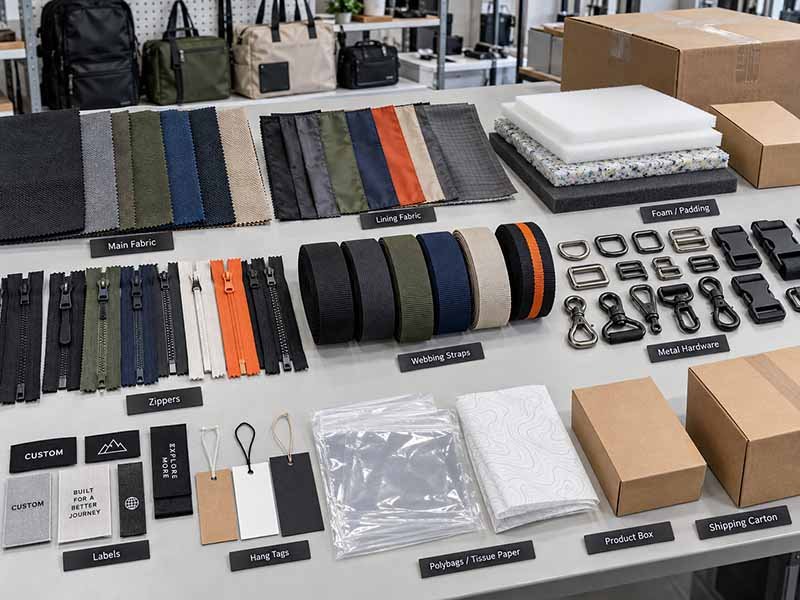
The specification should also identify the material used for different bag components. For example, a backpack BOM may list separate materials for the main body, bottom panel, lining, mesh pockets, foam padding, and reinforcement patches. This is more useful than recording one general fabric name for the entire product. It also gives production teams a clearer reference when checking materials during purchasing and incoming inspection.
For brands developing multiple colors or related SKUs, material records are particularly important. A change in supplier or coating specification may create visible differences even when the nominal fabric name remains unchanged. Keeping approved specifications and samples helps prevent unplanned substitutions during repeat production. Szoneier uses confirmed BOM details and material records to connect development decisions with purchasing and manufacturing requirements.
Which Tests Verify Abrasion, Tear Strength, Colorfastness, and Water Resistance?
Material testing should be based on the product’s actual performance requirements. Different travel bags face different risks, so not every material needs the same testing program. A lightweight organizer may prioritize colorfastness and seam quality, while an outdoor backpack may require more attention to abrasion, tear strength, and water resistance. The testing method and acceptance criteria should be agreed before the material is approved.
Commonly referenced test methods include:
| Performance requirement | Relevant test method | What it evaluates |
|---|---|---|
| Textile abrasion | ISO 12947-2 | Specimen breakdown of applicable textile fabrics |
| Coated fabric abrasion | ISO 5470-2 | Abrasion resistance of coated textile surfaces |
| Tensile strength | ISO 13934-1 | Maximum force and elongation under a strip test |
| Tear strength | ISO 13937 series | Resistance to tear propagation |
| Water repellency | AATCC TM22 | Resistance to wetting under a spray test |
| Colorfastness to rubbing | ISO 105-X12 | Color transfer during dry and wet rubbing |
These methods measure different properties and should not be used interchangeably. ISO 12947-2 addresses specimen breakdown under the Martindale abrasion method for applicable uncoated textile fabrics. It is not intended for coated or laminated fabrics. For abrasion evaluation of coated surfaces, ISO 5470-2 provides relevant wet and dry abrasion methods. Selecting the correct test is important because a result from one method cannot automatically be applied to a different material construction.
For more demanding products, additional evaluation may be necessary for coating adhesion, hydrostatic pressure, seam performance, zipper function, and finished bag load capacity. Test reports should identify the material, test method, specimen preparation, result, and applicable acceptance criteria. If a customer requires a particular performance level, that requirement should be confirmed before sampling rather than introduced after bulk production has started.
Szoneier evaluates material quality through incoming inspection and product-specific QC requirements. Checks can cover fabric color, thickness, weight, coating, hand feel, odor, colorfastness, surface defects, and water resistance where applicable. The actual acceptance criteria should be established according to the product requirements and the customer’s agreed standards, rather than using one universal pass level for every travel bag.
How Should You Evaluate Fabric Swatches, Samples, and Batch Consistency?
A fabric swatch is the first opportunity to assess a material physically, but it should not be treated as final proof of product performance. Examine the fabric under different lighting conditions and compare its color, texture, stiffness, thickness, and hand feel with the intended design. Bend and fold the material to observe whether the coating develops visible creases, whether the surface becomes damaged, and whether the fabric returns to its intended shape. These simple checks can reveal differences that are not obvious from a supplier’s specification sheet.
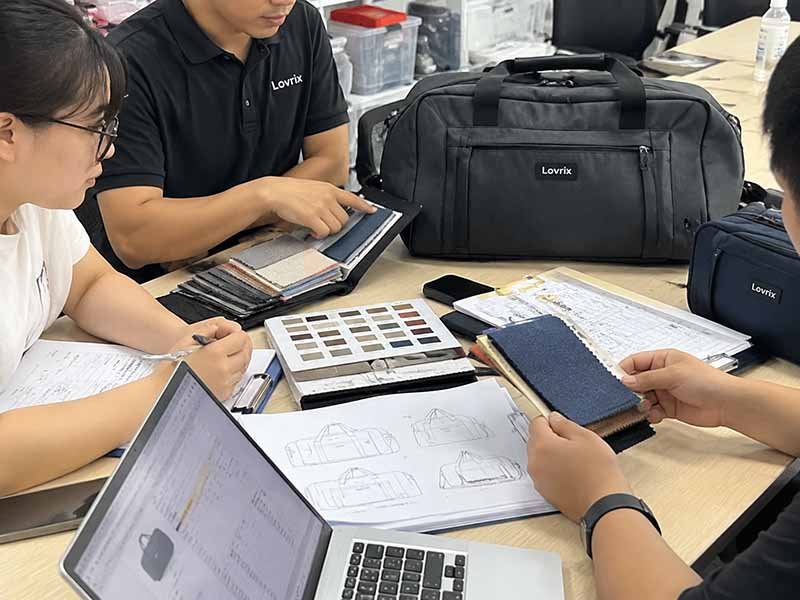
The next step is to evaluate the fabric in an actual sample. Cutting and sewing can reveal problems that are difficult to identify from a small swatch. These may include excessive stiffness around curved seams, bulky seam allowances, difficulty attaching zippers, inconsistent stitching, or insufficient support around handles and corners. A sample also allows the brand to evaluate how the material works with the lining, foam, webbing, hardware, and overall pattern. For products with several colors or material combinations, each important variation should be reviewed before approval.
Before bulk production, Szoneier uses approved samples, pre-production sample confirmation, BOM records, material batch information, accessory specifications, logo files, and packaging references to establish the production standard. Incoming material inspection checks relevant characteristics such as color, thickness, weight, coating, hand feel, odor, colorfastness, surface defects, and water resistance where applicable. This process helps identify material differences before they affect cutting and sewing.
For repeat orders, the approved sample should remain a physical reference. If a supplier proposes a material substitution, the change should be reviewed before production. Even materials with similar names may produce different finished results. Comparing replacement materials against the approved specification helps protect product consistency and prevents unexpected differences between the approved sample and the delivered order.
How Can a Manufacturing Partner Turn Material Selection into a Production-Ready Travel Bag?
A manufacturing partner helps turn a material choice into a complete product by connecting fabric specifications with pattern development, product structure, accessories, sampling, and bulk production. Szoneier evaluates these elements together so that the selected material is not only suitable in theory but also practical to cut, sew, finish, inspect, package, and reproduce consistently.
What Project Details Should You Share for a Material Review?
A useful material review begins with a clear understanding of the intended travel bag. You do not need a complete technical package to start the discussion. A reference photograph, rough sketch, existing sample, or preliminary product description can provide enough information for an initial assessment. The more details available, however, the easier it becomes to identify suitable fabrics and avoid unnecessary sampling changes.
For an initial material evaluation, Szoneier recommends preparing the following information:
- Product type: Travel backpack, duffle bag, weekender, carry-on accessory, or packing organizer.
- Dimensions: Approximate length, width, height, and intended capacity.
- Intended contents: Clothing, laptops, shoes, documents, equipment, or personal accessories.
- Usage environment: Business travel, everyday commuting, leisure travel, or outdoor activities.
- Material preference: Nylon, polyester, Oxford, canvas, coated fabric, or an open material selection.
- Performance requirements: Lightweight construction, abrasion resistance, water resistance, shape retention, or additional protection.
- Brand positioning: Entry-level, mid-range, premium, or specialized.
- Target cost: Preferred finished product cost or material budget.
- Branding requirements: Logo process, colors, labels, hardware, and accessories.
- Packaging requirements: Individual packaging, hangtags, barcodes, carton specifications, and shipping arrangements.
If the project involves several related products, provide the expected SKU range and color plan. A collection may use a common material family while requiring different specifications for backpacks, duffle bags, and organizers. Evaluating the complete range helps avoid unnecessary material variations and makes future purchasing easier. It also allows the manufacturing team to identify opportunities for using common fabrics, colors, or accessories across different products.
Reference products are also valuable. If you have an existing bag that feels right in terms of stiffness, texture, weight, or appearance, sharing it can help clarify expectations. Photographs are useful for understanding design, but a physical sample provides more reliable information about material behavior and construction. When the desired product is new, a preliminary specification can be developed together during the sampling process.
How Does Szoneier Match Materials with Product Structure and Target Cost?
Material selection should always consider how the fabric will behave within the finished bag. A fabric that performs well as a flat sample may become difficult to sew around curved panels or may produce excessive bulk where several layers meet. Likewise, a soft material may be suitable for a foldable travel bag but fail to maintain the structured appearance expected from a premium business product. These differences need to be considered before confirming the final material.
Szoneier evaluates material options by considering performance, appearance, cost, and manufacturing feasibility. For a lightweight travel backpack, we may compare 420D nylon, 600D polyester, and suitable Oxford fabrics. For a more substantial duffle bag, the assessment may include higher-density Oxford, nylon, reinforced bottom materials, and stronger webbing. A premium lifestyle weekender may require heavy canvas or a combination of canvas and refined synthetic or leather details.
The complete construction is reviewed alongside the exterior material. This includes the lining, foam, bottom support, pocket materials, zippers, webbing, reinforcement patches, and stitching requirements. If a bag needs to maintain its shape, changing the exterior fabric may not be the only solution. Additional lining, foam, a bottom board, or structural adjustments may produce a better result. This is particularly relevant when a product must remain lightweight while maintaining a defined shape.
Depending on the product’s commercial requirements, Szoneier can evaluate three broad material configurations:
- Cost-focused configuration: Uses practical, readily available materials and avoids unnecessary upgrades.
- Balanced configuration: Combines suitable exterior fabric, lining, reinforcement, and accessories to meet the intended performance.
- Premium configuration: Prioritizes refined surface texture, higher-grade materials, technical functionality, and coordinated finishing.
The best configuration is not necessarily the most expensive one. A successful travel bag uses its material budget where it creates meaningful value, such as improving abrasion resistance at the bottom, reinforcing load-bearing points, or adding protective padding to an electronic compartment. This approach helps brands develop products that meet customer expectations without creating unnecessary production costs.
How Are Material Confirmation, Sampling, Revisions, and Approval Managed?
Material confirmation is only one stage in product development. After the initial material direction is agreed, it needs to be coordinated with the product pattern, dimensions, lining, accessories, logo process, and packaging. A sample then allows the development team to evaluate whether the selected materials perform as expected when converted into an actual bag. This stage is important because the behavior of a finished product can differ considerably from the appearance of a flat fabric swatch.
During sampling, several details should be reviewed together:
- Whether the material has the correct color, texture, thickness, and hand feel.
- Whether the fabric can be cut and sewn without unexpected production difficulties.
- Whether the finished bag maintains the intended shape.
- Whether the lining, pockets, and reinforcement work with the exterior.
- Whether the handles and shoulder straps are attached securely.
- Whether the zipper, hardware, and accessories function properly.
- Whether the finished product matches the target cost and appearance.
If the first sample does not meet expectations, the material or construction can be adjusted. Changes may involve fabric weight, coating, color, lining, foam, bottom support, pocket layout, or reinforcement. These adjustments should be documented so that everyone involved works from the same updated specifications. A revised sample should be checked against the previous version to confirm which changes have been made and whether the intended improvements have been achieved.
Once the final sample is approved, the project moves into bulk preparation. Szoneier’s production control process covers order confirmation, BOM confirmation, material and accessory purchasing, incoming material inspection, pre-production sample approval, cutting, logo processing, sewing, semi-finished inspection, finished product inspection, packaging, and shipment checks.
Bulk consistency is maintained through several connected records and checkpoints:
- Approved and sealed sample.
- Confirmed BOM and material specifications.
- Saved patterns and agreed product dimensions.
- Confirmed material batches and accessory specifications.
- Approved logo artwork and packaging files.
- Cutting and sewing process inspections.
- Semi-finished and finished product inspections.
- Packaging and shipment inspection.
Quality control does not begin only when the finished products are ready to ship. It starts when materials and accessories arrive and continues throughout manufacturing. Different travel products also require different inspection priorities. Backpacks need particular attention to shoulder straps, back panels, laptop compartments, and zippers, while duffle bags require careful inspection of handles, bottom construction, reinforcement, and load-bearing areas.
For brands planning repeat orders, this structured process helps protect the relationship between the approved sample and future production batches. Material records, physical references, and inspection standards make it easier to identify changes before they affect an entire shipment. The result is a more dependable transition from an initial material decision to a finished travel bag collection.
Conclusion
Choosing the right travel bag material is ultimately about making a series of connected decisions rather than selecting a fabric based on appearance or price alone. Polyester, nylon, Oxford, canvas, PU, TPU, and RPET each offer different advantages, but their suitability depends on the intended load, construction, environment, product positioning, and manufacturing requirements. A well-designed bag may also combine several materials to improve performance without increasing the cost or weight of every component.
At Szoneier, we connect material selection with practical product development and manufacturing. From comparing fabric specifications and evaluating coatings to developing physical samples, confirming BOM details, and controlling bulk production, our approach helps turn material decisions into finished products. Whether you are developing a new travel backpack, a premium weekender collection, or a complete range of travel accessories, the right starting point is a clear understanding of how the bag will be used and what customers expect from it. The best material is the one that performs reliably, fits the product’s positioning, and can be reproduced consistently in production.
Frequently Asked Questions
1. What is the most durable material for travel bags?
High-density nylon, ballistic nylon, 900D Oxford, and 1680D Oxford are common options for demanding travel applications. However, durability depends on more than denier. Fiber quality, weave construction, coating, reinforcement, stitching, and actual use conditions all matter. For a specific project, Szoneier recommends comparing physical samples and relevant abrasion, tear, and tensile test results before selecting the final material. The bottom panel, corners, and handle attachment areas should also be evaluated because they experience different types of stress.
2. Is nylon or polyester better for travel bags?
Nylon is often preferred when lightweight performance and abrasion resistance are important, while polyester offers cost flexibility, color options, and broad manufacturing applications. Both can work well for travel backpacks and duffle bags. The better option depends on the intended load, target price, appearance, and required durability. Comparing equivalent fabric constructions is more useful than comparing fiber names alone. Szoneier can evaluate both materials according to the product design and the expected performance requirements.
3. What denier is best for a travel backpack?
There is no universal best denier for every travel backpack. A 210D fabric may suit lightweight internal compartments, while 420D or 600D fabrics are common starting points for everyday backpack construction. Outdoor or heavy-duty products may require 900D or higher specifications. Szoneier evaluates the main body, bottom, pockets, and reinforcement separately to avoid unnecessary weight. The final selection should also consider fabric construction, GSM, coating, and physical test results.
4. Is 600D Oxford fabric good for travel bags?
Yes. 600D Oxford is a practical material for many everyday travel bags because it can offer a useful balance of structure, durability, cost, and coating compatibility. It is commonly considered for backpacks, duffle bags, travel organizers, and outdoor accessories. Its actual performance still depends on whether it uses polyester or nylon yarn, the weave construction, coating, and finishing. For more demanding applications, 900D, 1200D, or 1680D Oxford may also be evaluated.
5. What is the difference between water-resistant and waterproof travel bags?
Water-resistant materials help repel limited moisture, such as splashes or light rain, while waterproof products are designed to resist water penetration under specified test conditions. A coated fabric alone does not make an entire bag waterproof. Seams, zippers, closures, and construction must also be considered. Fully waterproof applications may require TPU or PVC materials, welded seams, and suitable closure designs. The required protection level should be confirmed before selecting the material and production method.
6. Can recycled polyester (RPET) be used for travel bags?
Yes. RPET can be used for travel backpacks, packing cubes, duffle bags, organizers, and other travel accessories. It provides a recycled-material option while retaining many of the practical applications associated with polyester. However, recycled-content claims must be supported by appropriate supplier documentation and certification when required. Material availability, color consistency, coating options, and project MOQ should also be confirmed before production. Szoneier can evaluate RPET and other recycled-material options according to the product’s requirements and documentation needs.
7. How do you test the durability of travel bag materials?
Material durability can be evaluated through abrasion, tensile strength, tear strength, colorfastness, coating performance, and water resistance tests. Depending on the material, methods such as ISO 12947-2 and ISO 5470-2 may be relevant for abrasion evaluation. Finished bags should also be checked for stitching, zipper performance, handle attachment, reinforcement, and load-bearing construction. The test method and acceptance criteria should be agreed before bulk production so that material and finished-product results can be evaluated consistently.