Skip to content


A dark backpack can look flawless on an approval table and still become a costly problem after its first week in the market. The problem often appears when a black shoulder strap rubs against a white shirt, a burgundy lining stains pale accessories, or a dark travel bag transfers color after getting wet in the rain. These failures are difficult to predict by appearance alone because a material can look perfectly stable while loosely bound dye or surface pigment is waiting to move under friction, moisture, sweat, washing, or prolonged light exposure.
Bag colorfastness is tested by exposing colored fabrics, linings, webbing, prints, or other components to controlled conditions such as dry rubbing, wet rubbing, perspiration, washing, and light, then evaluating color change or staining. Rubbing tests commonly use methods such as ISO 105-X12 or AATCC TM8, while staining can be assessed with standardized grey-scale methods. The required passing grade depends on the product specification and intended use.
The important part is not simply obtaining a laboratory report. A useful colorfastness program connects the test to the way the finished bag will actually be used. Consider a commuter backpack made from dark navy fabric with black shoulder webbing and a light-grey lining. The body fabric may perform well, while the shoulder webbing transfers color when wet. Testing only the largest fabric panel would miss the component with the highest real-world risk. Good testing therefore begins with the finished product, its contact points, and the situations customers are likely to put it through.
What Is Bag Colorfastness?
Bag colorfastness is the ability of a dyed, printed, coated, or otherwise colored material to retain its appearance and resist staining other surfaces during normal use. For bags, the most important exposures usually include friction, moisture, perspiration, washing, and light. A material can retain its original shade while still transferring enough color to damage clothing, bag contents, packaging, or neighboring components.
Color Change vs. Color Transfer
Colorfastness actually covers two problems that are easy to confuse. The first is color change, where the original material becomes lighter, duller, uneven, or visibly different after exposure. The second is staining, where dye or pigment moves from the tested material onto another surface. A navy shoulder strap can therefore keep almost exactly the same appearance after use while leaving blue marks on a cream-colored jacket. From the customer’s point of view, that is still a serious colorfastness failure even though the strap itself has barely faded.
This distinction becomes especially important with bags because the finished product contains many contact surfaces. Exterior panels touch clothing, seats, luggage racks, and hands. Shoulder straps rub continuously against shirts and jackets. Linings stay pressed against wallets, headphones, cosmetics, notebooks, charging cables, and clothing. Dark webbing can rest against pale canvas during shipping, while printed panels may rub against other products inside the same carton. The question is therefore not only whether the bag keeps its color, but whether its color stays where it belongs.
Szoneier’s documented quality-testing scope reflects this broader view of colorfastness. Its project documentation identifies risks including dark fabric transfer, dark webbing transfer, rubbing loss from printed materials, contamination from linings, migration from leather or PU surfaces, and staining after contact with moisture. This is why colorfastness decisions should be made at component level rather than assuming that one fabric result represents the entire finished bag.
Where Problems Usually Appear
Color transfer tends to appear where strong color, repeated friction, pressure, and moisture meet. The largest panel is not necessarily the component carrying the greatest risk. A narrow 38 mm shoulder webbing may represent only a small fraction of the total material used in a backpack, yet it can rub against clothing thousands of times during normal use. A dark lining may remain invisible from the outside but stay in contact with pale personal items for several hours every day.
Deep black, navy, burgundy, red, dark green, purple, and other saturated shades often deserve closer evaluation because darker coloration may require a heavier concentration of dyes or pigments. That does not mean every dark material performs poorly. A well-dyed black nylon can achieve excellent performance, while another visually identical black fabric from a different dye lot may show noticeably more transfer. Color depth is therefore a risk indicator, not a substitute for testing.
Several bag constructions deserve additional attention because they concentrate these risks. Backpacks combine high-friction shoulder straps with sweat exposure. Sports bags regularly contact damp clothing. Beach bags encounter wet towels, swimwear, sunlight, and humidity. Cosmetic pouches may contain pale packaging that sits directly against the lining. Fashion bags often combine light and dark contrast panels, while promotional bags can contain large printed surfaces that are vulnerable to abrasion.
A useful material review therefore asks four practical questions before deciding whether testing is necessary:
- Is the component dark or highly saturated?
- Will it experience repeated rubbing?
- Can it become wet or contact perspiration?
- Will it touch a pale, valuable, or highly visible surface?
When several answers are yes, the component should normally receive greater attention during development and material approval.
What Poor Colorfastness Costs
Colorfastness failures can create unusually strong complaints because the bag may damage something more valuable than the bag itself. A consumer who discovers blue marks on a white shirt or pigment on a pale leather car seat is unlikely to view the issue as a minor cosmetic defect. The complaint may involve the retailer, customer service, refund processing, replacement inventory, product reviews, and questions about whether the remaining production lot has the same problem.
The risk becomes more significant as production volume grows. In a hypothetical 10,000-piece program, a 2% complaint rate would represent 200 customer cases. That does not mean every complaint would automatically be confirmed as a laboratory-defined colorfastness failure, but the brand could still face hundreds of investigations, refunds, replacements, service conversations, and negative reviews. Finding the problem while the material is still a small approval swatch is much less expensive than discovering it after cutting, sewing, packaging, and international distribution.
For this reason, good manufacturers do not treat colorfastness as an isolated compliance exercise. It belongs beside material approval, sample confirmation, incoming-material control, and production quality management. The commercial goal is not to chase the highest possible grade for every low-risk component. It is to identify realistic failure modes early, establish appropriate acceptance requirements, and prevent unsuitable material from becoming thousands of finished bags.
Which Colorfastness Tests Matter for Bags?
The right colorfastness test depends on how the finished bag will be handled and used. Dry and wet rubbing are usually the most relevant starting points because friction is unavoidable, but perspiration, washing, light, water, print, lining, or component-specific testing can matter for particular products. The strongest test plan reproduces credible use conditions rather than applying every available textile test without a clear reason.
Match the Test to Real Use
There is no single laboratory procedure that answers every question about bag colorfastness. Different tests reproduce different types of exposure, so test selection should begin with the product’s intended environment. A commuter backpack, washable cotton tote, cosmetic pouch, gym duffle, and outdoor pack may use similar fabrics but experience very different combinations of friction, moisture, sweat, cleaning, and sunlight.
For most sewn bags, rubbing deserves early attention because constant movement is built into normal use. ISO 105-X12 specifies a method for determining resistance of textile color to rubbing off and staining other materials, including separate dry and wet rubbing tests. AATCC TM8 addresses colorfastness to crocking with a Crockmeter and also uses controlled dry and wet procedures with white test cloth.
Other methods become useful as the use environment changes. AATCC’s published standards currently list TM15 for perspiration, TM61 for accelerated laundering, TM16-series methods for light, TM107 for water, and TM8 for crocking. These are separate methods because sweat, washing, light exposure, water, and friction do not affect colored materials in exactly the same way.
Bag or Component | Main Exposure | Useful Test Focus | Main Quality Question |
Backpack shoulder straps | Friction, sweat, moisture | Dry/wet rubbing, perspiration when relevant | Will the strap stain clothing? |
Tote bag handles | Repeated hand and clothing contact | Dry/wet rubbing | Will color transfer during carrying? |
Washable cotton tote | Washing and friction | Washing + rubbing | Will it fade or stain during cleaning? |
Gym or sports bag | Sweat, damp clothing, friction | Wet rubbing + perspiration | Will moisture increase transfer? |
Outdoor backpack | Light, rain, friction | Light + rubbing | Will the shade fade or transfer outdoors? |
Dark lining | Long contact with contents | Rubbing/transfer testing | Can the lining stain pale belongings? |
Printed panel | Surface abrasion | Print/rubbing performance | Will pigment wear or transfer? |
Dark webbing | Concentrated repeated friction | Webbing rubbing test | Will straps or handles mark clothing? |
The table is best used as a risk-selection guide rather than a universal testing specification. A product sold through a major retailer may have its own test manual, while another brand may define internal requirements according to price level, use environment, past complaint history, and target customer expectations.
Dry and Wet Rubbing
Dry rubbing represents friction without additional moisture and is especially relevant for shoulder straps, handles, exterior panels, linings, zipper tapes, webbing, and surfaces that repeatedly touch clothing. It is often the first practical indication of whether loosely bound color is sitting on the surface. If a dark fabric transfers obvious pigment during controlled dry rubbing, it deserves investigation before bulk cutting begins.
Wet rubbing makes the test more demanding because moisture can increase the movement of certain dyes or surface colorants. That is why a material can achieve a strong dry result and a noticeably lower wet result without there being any contradiction between the two tests. The conditions are different, and the wet test is often closer to what happens when a bag is used in rain, worn against perspiring clothing, placed beside wet towels, or exposed to humid environments.
A commuter backpack illustrates the difference well. During an ordinary office day, its shoulder strap mainly experiences dry rubbing against clothing. During a summer walk or sudden rainstorm, friction continues but the strap may also become wet. A product intended to work reliably across both situations should not be evaluated only under the easier condition. ISO 105-X12 and AATCC TM8 both recognize separate dry and wet rubbing procedures for this reason.
The results should also remain separate in the specification. Recording “rubbing test: pass” loses useful information. Recording dry Grade 4-5 and wet Grade 3-4 immediately tells the product team how performance changes with moisture and whether the weaker condition still meets the project’s defined acceptance requirement.
Perspiration, Washing, and Light
Perspiration testing becomes more relevant when the bag remains in close contact with the body. Backpack shoulder areas, running belts, waist packs, cycling bags, sports products, and gym equipment can experience repeated sweat exposure. Sweat is not simply water, so a material that performs acceptably in a wet rubbing check may still need separate perspiration testing when the intended use makes this exposure significant. AATCC currently lists TM15 specifically for colorfastness to perspiration.
Washing colorfastness matters most when the product is actually expected to be washed. Reusable cotton grocery bags, washable fabric totes, children’s textile bags, storage pouches, and some soft travel accessories may be cleaned repeatedly during their useful life. A structured PU handbag, by contrast, may never require a laundering test because putting it into a washing machine would not represent normal or recommended use.
Lightfastness becomes more important for outdoor and travel products. Backpacks, beach bags, hiking gear, cycling bags, outdoor storage products, and display items can receive prolonged light exposure. Color change from light can be especially noticeable when adjacent panels age differently. AATCC’s current list includes several TM16 lightfastness methods, including xenon-arc testing, which can be used where the relevant specification calls for controlled light exposure.
The practical rule is to choose tests that answer realistic product questions. More laboratory reports do not automatically produce a better bag. A focused plan that evaluates three important risks on the correct components can be more valuable than seven unrelated tests performed simply because they appear in a laboratory catalogue.
Material-Specific Decisions
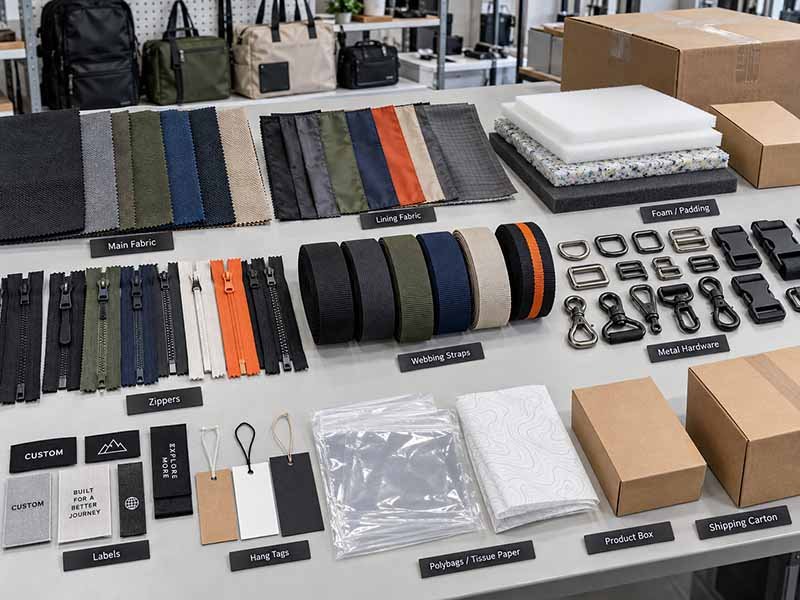
Bag construction can involve polyester, nylon, Oxford fabric, canvas, cotton, RPET, mesh, microfiber, neoprene, PU-coated textiles, PVC, synthetic leather, genuine leather, printed fabrics, laminated structures, and many other surfaces. These materials do not behave identically, and not every procedure should be applied without confirming that the test method is suitable for the specimen.
ISO 105-X12 specifically applies to textile materials of different fibers in yarn or fabric form, including dyed and printed textiles. That makes it directly useful for many bag fabrics, linings, tapes, and related textile components. Heavily coated surfaces, painted leather, certain PU constructions, polymer films, rubber decorations, and specialized finishes may require a material-appropriate method or a customer-defined performance procedure instead of simply applying a textile method to everything.
Before testing, the material record should therefore identify the fiber or base material, coating or lamination where relevant, exact color, product location, surface that will be exposed, and expected contact conditions. When a project contains a black polyester exterior, black nylon lining, polyester webbing, PU trim, and a printed logo, these should not automatically be treated as one “black material.” They may come from several suppliers and several completely different coloration processes.
Szoneier can coordinate dry rubbing, wet rubbing, washing, perspiration, light, print, webbing, and lining colorfastness testing according to the requirements of a particular custom bag project. The important point is that testing is selected according to the product and component rather than presented as a single generic certificate covering everything.
How Do You Test Rubbing Colorfastness?
Rubbing colorfastness is tested by rubbing a standardized white test cloth against the colored specimen under controlled conditions and then evaluating the color transferred to that cloth. Dry and wet tests are performed separately because moisture can change transfer behavior. Recognized methods such as ISO 105-X12 and AATCC TM8 provide controlled procedures so different materials, colors, and production lots can be compared on a consistent basis.
Standards and Equipment
ISO 105-X12:2016 is currently published as the ISO standard for textile colorfastness to rubbing. It covers resistance to rubbing off and staining other materials and provides for tests using both dry and wet rubbing cloths. The standard applies to textiles made from different fibers in yarn or fabric form, including dyed and printed materials.
AATCC TM8-2016e(2022)e is currently listed by AATCC as its Crockmeter method for determining the amount of color transferred from a colored textile surface through rubbing. Its published description explains that colored specimens are rubbed with white crock test cloth under controlled conditions and that transferred color is evaluated with the Gray Scale for Staining or Chromatic Transference Scale. It also includes both dry and water-wet test cloth procedures.
The equipment and consumables used depend on the selected method, but the principle normally requires a controlled rubbing device, standardized white test cloth, prepared specimens, and the appropriate assessment system. The key word is controlled. A technician rubbing a piece of white tissue against a black fabric by hand can reveal an obvious problem, but pressure, travel distance, number of strokes, moisture, and assessment conditions are not controlled well enough for that check to replace a standardized laboratory result.
Internal rub checks still have value. They are quick, inexpensive, and useful for comparing incoming material lots before production. The strongest quality process simply recognizes the difference: a quick factory check is a screening tool, while a standardized test creates repeatable data that can be written into a product specification and compared across samples, laboratories, and production lots.
Dry Rubbing Procedure
In a dry rubbing test, the actual colored material is positioned according to the selected method and rubbed with a standardized dry white test cloth. The transferred color visible on the white cloth is then evaluated. The test is intended to turn a subjective observation such as “this black fabric rubs off slightly” into a result that can be compared against a documented acceptance requirement.
Specimen selection is just as important as the mechanical procedure. The tested surface should represent the material that will actually appear on the finished bag. If the finished backpack uses a laminated 600D polyester, testing an untreated base fabric from the supplier’s sample book may not represent the final construction. If the product uses screen printing over the fabric, the print area can create a separate rubbing risk even though the base fabric already has a strong result.
Color selection matters as well. A certificate for light grey should not automatically be used to approve a deep navy version of the same fabric construction. Different colors can use different amounts or types of dye and different processing conditions. When a high-risk custom shade is being developed, especially a deep or saturated color that will contact light surfaces, the test specimen should come from the actual selected material and color whenever practical.
For bags, the highest-priority dry-rubbing locations commonly include:
- shoulder straps and shoulder-facing panels;
- tote and duffle handles;
- dark exterior body fabrics;
- linings touching pale contents;
- webbing and binding;
- zipper tapes;
- printed surfaces;
- contrast panels touching lighter components.
A useful result record should connect the grade to a material code, color, component location, test method, and production lot where relevant. That creates a record that can still be understood when the same bag is reordered six months later.
Wet Rubbing Procedure
Wet rubbing follows the same overall principle but uses a test cloth prepared with controlled moisture according to the selected standard. The added moisture matters because some dyes and surface pigments become easier to transfer when wet. A dark material may therefore perform very well under dry rubbing but show visibly greater staining under wet conditions.
Consider a hypothetical nylon fabric that records Grade 4-5 dry and Grade 3 wet. Those two results are not inconsistent. They describe two different exposure conditions. Whether the wet result is acceptable depends on the product specification rather than on the dry result. A fashion pouch used primarily indoors and a commuter backpack expected to be carried through rain may need different performance decisions even if both use similar-looking dark nylon.
Real bag use contains many situations that resemble wet rubbing more closely than dry laboratory handling. Sweat can dampen shoulder straps during summer. A sports duffle can press against wet clothing. A beach tote can remain beside towels and swimwear. Outdoor bags may be handled in rain. Travel products may sit in humid vehicles or luggage compartments. Testing wet performance becomes especially valuable when dark materials are intended to touch pale clothing in these situations.
The production team should also think beyond the end customer. Dark and pale materials can remain compressed against one another during packaging and shipping, sometimes for several weeks. If humidity is present, transfer can occur before the bag reaches retail. A prototype packaging check that stores finished bags under realistic contact conditions can therefore complement laboratory rubbing results, especially for strong contrast combinations.
Screening and Formal Testing
Quick internal screening is useful because obvious color-transfer problems do not always need a laboratory to be discovered. When a new black webbing lot arrives, rubbing it firmly with a clean white cloth can immediately reveal unusually loose surface color compared with the approved reference. If an obvious abnormality appears, the material can be isolated before it enters cutting or sewing.
That screening should not be confused with formal standard testing. The internal check is valuable for early material comparison, incoming inspection, batch monitoring, and root-cause investigation. Formal testing becomes more useful when a retailer specification requires a named standard, a major order needs independent evidence, a quality agreement sets numerical acceptance levels, or a disagreement must be resolved with traceable results.
A practical factory system can therefore use two levels rather than choosing one or the other:
- Routine screening:rapid checks on incoming or high-risk colored materials.
- Standardized testing:controlled ISO, AATCC, customer-specific, or laboratory methods where formal data is required.
- Production verification:targeted retesting when a supplier, dye lot, color formulation, coating, or finish changes.
- Complaint investigation:testing retained production samples against the originally approved method.
The benefit of this layered system is efficiency. Not every trim needs an expensive independent report, but critical components should not rely only on visual judgment. Szoneier’s broader quality system includes material inspection, pre-production confirmation, production-stage checks, final inspection, and packaging inspection, allowing colorfastness requirements to be placed at the stage where corrective action is still practical.

How Are Colorfastness Results Rated?
Colorfastness results are commonly expressed with standardized grading systems so performance can be compared consistently. For staining, higher grey-scale grades represent less visible transferred color, while lower grades indicate greater staining. ISO 105-A03:2019 is the current ISO standard for the grey scale used to assess staining. A passing grade is not universal; it must be defined by the product, retailer, brand, or applicable quality specification.
Understanding the Grey Scale
A rubbing test becomes far more useful when the staining on the white test cloth is converted into a recognized grade instead of being described with phrases such as “a little transfer” or “looks acceptable.” ISO 105-A03:2019 defines the grey scale for assessing staining of adjacent fabrics in colorfastness testing, and ISO confirms that this 2019 edition remains current following review.
The essential logic runs from Grade 5 at the strong end of performance toward Grade 1 at the severe-staining end. Intermediate half-steps such as 4-5, 3-4, 2-3, and 1-2 provide additional resolution when the appearance falls between whole grades. AATCC likewise explains that TM8 results can be assessed with a Gray Scale for Staining or Chromatic Transference Scale.
Grade | General Interpretation | Practical Meaning for Bag Development |
5 | No or virtually no visible staining | Very low transfer under the tested condition |
4-5 | Very slight staining | Strong performance with limited visible transfer |
4 | Slight staining | Commonly considered useful performance, subject to specification |
3-4 | Moderate but clearly visible staining | Requires comparison with the project’s acceptance level |
3 | Clear staining | May be inadequate for demanding contact applications |
2-3 | Strong staining | Significant transfer concern |
2 | Heavy staining | Usually signals a material or process problem |
1 | Severe staining | Major failure under the tested condition |
These descriptions help readers understand the direction of the scale, but they are not universal pass/fail requirements. A Grade 3 can be acceptable under one commercial specification and unacceptable under another. The relevant decision always comes from the agreed test method, condition, application, and acceptance requirement.
What Grade Should a Bag Pass?
There is no single colorfastness grade that every bag in every market must achieve. Test standards define how performance is measured; they do not automatically define the commercial requirement for every backpack, tote, handbag, cosmetic pouch, outdoor pack, or promotional product.
In practice, many product teams create separate requirements for dry and wet rubbing because wet rubbing can be more demanding. An internal commercial specification might, for example, use Grade 4 as a dry target and Grade 3 as a wet target for a particular general-use textile. A premium product expected to contact light-colored clothing may use stricter requirements. These numbers are examples of specification logic, not a universal rule that can be applied to every bag.
Performance margin also deserves attention. Suppose a specification requires at least Grade 3 for wet rubbing. Material A achieves exactly Grade 3 while Material B achieves Grade 4 under the same test. Both may satisfy the written requirement, but Material B has more room for normal production variation. If the program involves repeated orders, several dye lots, and a premium retail position, that extra margin may be commercially valuable even though the initial approval result for both materials says “pass.”
The acceptance decision should consider product price, intended use, component location, contact with clothing, color depth, target retailer requirements, previous complaints, and the consequences of failure. A hidden dark reinforcement that never contacts the user does not necessarily need the same standard as a black shoulder strap worn over pale apparel.
Reading a Test Report
A professional test report should allow someone who was not involved in the original development meeting to identify exactly what material was tested and what the result means. This becomes especially important for programs containing multiple black fabrics, several webbing widths, several lining colors, and numerous SKUs that can appear almost identical in photographs.
Start with specimen identification. “Black polyester” is too vague for a complex product. A useful record links the test to an internal material code, supplier reference, color code, product location, or production lot. Then verify the test method and condition. “Crocking test: pass” provides much less traceability than a report showing the selected standard, dry and wet conditions, individual grades, and required minimum levels.
A practical internal record may read:
- Material: 600D polyester
- Color: custom black
- Component: backpack exterior
- Test: wet rubbing
- Required result: project-defined minimum
- Actual result: Grade 4
- Lot: production dye lot reference
- Decision: approved for stated application
This information becomes valuable when the same material is reordered, when a new mill supplies an alternative lot, or when a complaint needs investigation. Without traceability, a strong laboratory report can become little more than an isolated PDF that nobody can confidently connect to the production material.
Quality teams should also keep the numerical grade rather than storing only the word “PASS.” If one approved lot achieved Grade 4-5 and a later lot only just meets a Grade 3 requirement, the difference may deserve attention even though both technically pass. Historical results make it easier to identify gradual deterioration before it becomes a customer-facing problem.
What a Failure Really Means
A failed colorfastness test tells you that the tested material did not meet the defined requirement under the specified condition. It does not automatically tell you why. The root cause may come from dye fixation, insufficient washing-off, excess surface pigment, printing conditions, coating quality, color depth, finishing variation, contamination, supplier inconsistency, or another material-processing factor.
Corrective action should therefore be followed by a repeat test under the same relevant method and condition. If a dark cotton canvas receives Grade 2-3 during wet rubbing, the dyeing mill may review the dye process or washing-off stage. When a corrected lot is produced, testing it again under the original method creates a meaningful comparison. If the new material achieves Grade 4, there is measurable evidence that the process changed.
Changing test conditions after failure removes that comparability. A poor wet-rubbing result should not be “resolved” by performing only a dry test and showing that the dry result is better. Those tests answer different questions.
The same disciplined approach improves conversations between brands, material mills, bag factories, and testing laboratories. “The material feels better now” is difficult to verify. “The original production lot achieved Grade 2-3 wet and the corrected lot achieved Grade 4 using the same method” gives every party a much clearer basis for deciding whether production can proceed.
Which Bag Parts Need Colorfastness Testing?
Priority should go to components that are dark, strongly colored, printed, frequently rubbed, exposed to moisture, or likely to touch light-colored clothing and valuable contents. Testing only the main exterior fabric can overlook important risks in shoulder webbing, lining, zipper tape, binding, prints, or contrast panels. The most effective selection method follows the actual contact points of the finished bag.
Exterior Fabrics and Linings
Exterior fabric naturally receives attention because it represents a large percentage of the visible bag and contacts clothing, hands, seats, luggage racks, floors, and surrounding objects. However, the lining can create equally serious problems. A dark lining may continuously touch pale wallets, clothing, notebooks, electronic accessories, cosmetic packaging, headphones, or other items that customers expect to remain clean.
The selected test specimen should represent the actual material and color rather than another variation that happens to share the same construction. A strong result for light grey polyester cannot automatically prove that the deep-black version will perform identically. The same applies to different production lots of one color when a custom dyeing process is involved.
Common textile materials requiring risk-based review include polyester, nylon, Oxford fabric, canvas, cotton, RPET textiles, mesh, microfiber, and other dyed or printed fabrics. The need for testing depends on shade, exposure, construction, use environment, and product requirements rather than on material name alone.
Linings deserve particular attention in handbags, laptop bags, cosmetic pouches, organizers, travel bags, and products that hold light-colored or valuable contents. The failure may remain invisible from the outside until a customer removes an item and discovers staining. For premium products, preventing that surprise can be just as important as controlling the appearance of the exterior.
Webbing and High-Friction Components
Webbing is easy to overlook because it is often sourced as an accessory rather than the main fabric, yet it can create some of the highest rubbing exposure on the entire bag. Shoulder straps, carry handles, crossbody straps, waist belts, binding tapes, drawcords, and zipper tapes can move against clothing and skin far more frequently than a large stationary body panel.
Two materials described as “black polyester” should not automatically be treated as equivalent. A 600D polyester body fabric may come from one mill, while a 38 mm polyester webbing is produced by another supplier using a separate yarn, dye system, and finishing process. Passing data for the body fabric therefore does not prove the webbing’s performance.
High-friction parts become especially important when the product uses strong color contrast. A black webbing handle stitched onto natural cotton canvas may rub or remain compressed against the pale body during packing and shipping. Under humid conditions, visible transfer can occur before the bag ever reaches the consumer. Prototype storage and packaging trials can help reveal this risk alongside formal rubbing testing.
For practical prioritization, shoulder straps and handles normally sit near the top of the review list because their contact frequency is high. Dark linings, exterior clothing-contact panels, webbing, zipper tape, binding, and printed areas follow according to the design. A component’s size should not determine whether it matters; the amount and type of contact should.
Prints, Trims, and Coated Surfaces
Printed graphics create another layer of colorfastness risk because the visible color may sit primarily on the surface rather than being created only by dye inside the fiber. Screen printing, pigment printing, transfer decoration, and other surface processes can show abrasion, pigment transfer, cracking, powdering, fading, or partial loss even when the underlying fabric itself has excellent rubbing resistance.
That distinction matters in quality records. “Fabric passed” and “printed surface passed” are not the same statement. If a large white logo is printed over a black tote, the base fabric, printed layer, and surrounding contact areas may behave differently. The evaluation should follow whichever surface the customer actually touches.
Other seemingly small components can also require attention, including zipper tapes, woven labels, embroidery, binding, piping, colored cords, synthetic-leather patches, PU trims, and textile-backed coated materials. When these components are dark and repeatedly touch pale fabric, their contribution to overall risk can be greater than their physical size suggests.
For heavily coated fabrics, PU surfaces, genuine leather, polymer films, painted components, or rubber decorations, the laboratory should confirm whether a textile rubbing method is directly appropriate or whether another material-specific or customer-defined procedure is more suitable. A bag contains many materials, but the word “bag” does not turn every surface into a textile specimen.
Szoneier’s documented testing scope includes coordination of colorfastness testing for fabrics, linings, webbing, prints, and dyed materials where the project requires it, particularly for dark colors, printed products, premium retail products, and items likely to contact moisture or light-colored goods.
Build a Component Risk Map
A simple risk map can make testing more focused without leaving important components unexamined. During sample development, list each colored component and score it according to the likelihood of friction, moisture exposure, direct contact with pale surfaces, and the commercial impact if staining occurs. Components that combine several risks should receive priority.
Consider a black travel backpack with grey lining, black webbing, orange printed graphics, and a hidden reinforcement panel. The black exterior has significant clothing contact and deserves rubbing review. The black shoulder webbing has concentrated movement and may deserve even greater attention. The grey lining requires assessment according to what it will hold. The printed graphic should be reviewed for surface abrasion, while the hidden reinforcement may carry much lower color-transfer risk because it never contacts the customer or visible pale materials.
This approach avoids both extremes. Testing almost nothing creates blind spots, while sending every thread and hidden trim to an external laboratory regardless of relevance wastes time and money. A risk map helps the development team direct formal testing toward the components most capable of creating a real-world complaint.
The resulting records also become useful for repeat orders. When a material supplier changes or a new color is introduced, the team can quickly see whether that component previously carried high, medium, or low color-transfer risk and decide whether retesting is justified.
How Do You Control Colorfastness Before Bulk Production?
Colorfastness is most effectively controlled before cutting and then monitored when materials, colors, dye lots, suppliers, coatings, or finishes change. A strong workflow defines the test method and acceptance level during development, tests critical production materials before bulk sewing, links results to actual dye lots, and preserves approved references for repeat orders. Waiting until finished-goods inspection makes correction far more expensive.
Test Before the Cost Multiplies
The same technical defect becomes progressively more expensive as the product moves through production. When a fabric fails before purchasing, the team can select another material. Once the fabric has arrived, replacement may involve freight and schedule delays. After cutting, those panels can become unusable. After sewing, the company may be dealing with thousands of finished bags rather than one problematic fabric roll.
For this reason, colorfastness should be connected to the ordinary product-development timeline instead of being treated as something that happens at the very end. Higher-risk colors and materials can be screened during sourcing. The selected material can be confirmed during prototype development. Production dye lots can be reviewed before cutting when the specification requires it, and major changes can trigger targeted retesting.
Production Stage | Practical Colorfastness Control | Useful Record | Main Risk if Skipped |
Material selection | Screen high-risk colors and surfaces | Material + color reference | Unsuitable material enters development |
Prototype | Confirm actual material used in sample | Sample BOM | Tested material differs from sample |
Pre-production | Verify critical production lots when required | Dye-lot or batch ID | Bulk material differs from approval |
Incoming inspection | Compare material with approved reference | Incoming QC record | Mixed or changed lots enter cutting |
Bulk production | Monitor supplier or lot changes | PO and material traceability | Variation becomes finished goods |
Final inspection | Review visible/contact concerns | Final QC record | Remaining issues reach shipment |
Repeat order | Review changed materials and previous data | Historical test record | Old approval applied to new material |
Szoneier’s documented QC workflow includes material inspection, accessory inspection, pre-production sample confirmation, cutting inspection, sewing-process inspection, semi-finished inspection, final inspection, and packaging inspection. That structure provides several practical opportunities to catch material-related problems before they become large quantities of finished inventory.
Control Dye-Lot Variation
An approval test is evidence for the material that was actually tested; it is not a permanent guarantee covering every future production lot. Textile production naturally involves variations in raw materials, dyeing conditions, washing-off, finishing, coating, print curing, and mill process control. Even when the supplier code and Pantone target remain unchanged, a later production lot can behave differently.
Retesting does not need to become an automatic expensive exercise for every delivery. The decision should follow risk. A new test becomes more valuable when the fabric mill changes, the supplier changes, the dye formula changes, the product moves into a deeper color, the coating or finish changes, previous results were close to the minimum requirement, or a complaint has already occurred.
Traceability makes these decisions much easier. A useful chain links the finished SKU to its bill-of-material component, material code, supplier, exact color, production dye lot, and relevant test result. When a product family contains ten SKUs using the same approved black webbing, the team can identify which items are affected by a new webbing batch rather than testing or quarantining everything unnecessarily.
This becomes especially important in long-running retail programs. A product may remain visually unchanged for two years while several fabric and accessory lots move through production. Historical test data allows the quality team to compare the new lot with the previous approved range and recognize deterioration before customers do.
Define the Requirement First
Testing works best when the acceptance criteria are written before the result arrives. Otherwise, a team can receive a weak score and gradually redefine “acceptable” around whatever number appears on the laboratory report. That defeats one of the main reasons for testing in the first place.
A useful specification identifies the component, material, color, selected standard, required condition, minimum result, testing stage, and action to take if the material fails. For rubbing tests, dry and wet requirements should remain separate. If an external laboratory is required, that should also be defined early enough to include the time and cost in the development plan.
A specification can therefore be written in a practical format such as:
- Component: black shoulder webbing
- Product: commuter backpack
- Test: colorfastness to rubbing
- Method: project-specified ISO or AATCC method
- Conditions: dry and wet
- Acceptance: project-defined grades
- Stage: production-material approval before cutting
- Retest trigger: supplier, dye lot, color formula, or finish change when risk warrants
This is much more useful than putting “colorfastness: good” into a tech pack. The manufacturer, sourcing team, laboratory, and quality inspector can all see the same requirement and evaluate the same material against it.
Szoneier can coordinate project-based colorfastness testing across fabrics, linings, webbing, prints, and dyed materials, including dry rubbing, wet rubbing, washing, perspiration, and light tests when required. The exact test plan should still be tied to the product, target market, customer specification, and intended use rather than presented as a fixed package for every bag.
Handle Failures Before Sewing
When a material fails, continuing production in the hope that the finished bag will somehow perform better is rarely a good strategy. The affected lot should first be identified and separated from approved inventory. The team can then compare it with the original sample, previous lots, supplier records, internal screening results, and laboratory data to understand whether the problem is isolated or systematic.
Possible corrective actions depend on the material and cause. A textile mill may review dye fixation or washing-off. A printing supplier may adjust curing. A coated-fabric supplier may need to correct its surface finish. In some situations, selecting another material or reducing the problematic color depth is more practical than trying to repair an unstable lot.
Whatever corrective action is chosen, the revised material should be evaluated using the same relevant test condition that identified the problem. A failed wet-rubbing result should not be replaced by an easier dry test and presented as proof that the issue has disappeared.
Internal testing can handle routine screening, while recognized third-party laboratories can be used when independent evidence is required by the project, retailer, or quality agreement. Szoneier’s documented project capabilities include coordination with recognized testing organizations where specific third-party verification is required.
The real objective is straightforward: keep a colorfastness problem at the material stage. Once thousands of bags have been cut, sewn, branded, packed, shipped, and placed into retail or e-commerce inventory, the same technical problem becomes a much larger commercial problem.
Conclusion
Colorfastness testing is most useful when it is treated as part of product development rather than as a certificate collected shortly before shipment. Start by looking at the finished bag and identifying where dark or strongly colored surfaces will rub, become wet, contact sweat, receive washing, or sit beside pale materials. Select the test that represents that exposure, define the acceptance level before testing, and connect the result to the exact component and production lot.
For brands developing custom bags, this approach creates a much clearer path from prototype to repeat production. Dry and wet rubbing tests answer different questions, linings and webbing can matter as much as the main fabric, and one successful development sample does not automatically represent every future dye lot. A manufacturer that understands these connections can help identify risks while changes are still inexpensive. Szoneier integrates material review, sampling, production control, quality inspection, and project-based testing coordination so that colorfastness issues can be addressed before they turn into stained clothing, customer complaints, returned inventory, or unstable repeat orders.
Frequently Asked Questions
What Is a Good Colorfastness Grade for Bags?
There is no universal grade that automatically passes every bag. Many commercial specifications use stronger requirements for dry rubbing than wet rubbing because moisture can increase color transfer, but the actual minimum should come from the brand, retailer, product specification, or agreed quality standard. A Grade 4 result generally represents less staining than Grade 3, while Grade 5 represents the strongest end of the common staining scale. The correct decision should also consider where the component is used and what it will contact.
What Is the Difference Between Crocking and Colorfastness?
Colorfastness is the broader concept describing resistance to color change or staining under exposures such as rubbing, washing, perspiration, water, and light. Crocking refers specifically to color transfer caused by rubbing. AATCC TM8 is currently listed as a test method for colorfastness to crocking using a Crockmeter, while ISO 105-X12 covers colorfastness to rubbing. Crocking is therefore one important type of colorfastness testing rather than another name for every colorfastness test.
What Is the Difference Between Dry and Wet Rubbing Colorfastness?
Dry rubbing measures color transfer under controlled friction without added moisture, while wet rubbing uses a prepared wet test cloth and evaluates transfer when moisture is present. The same material can perform differently in the two conditions because water can make certain dyes or pigments easier to move. Both ISO 105-X12 and AATCC TM8 include dry and wet rubbing procedures, making separate results useful for bags that may contact clothing under both ordinary and damp conditions.
Should Bag Linings Be Tested for Colorfastness?
Dark or strongly colored linings should be considered for testing when they can touch pale, valuable, or easily stained contents. Handbag linings can contact wallets and clothing, cosmetic-pouch linings can touch light product packaging, and backpack linings can stay pressed against electronics accessories, notebooks, or garments for long periods. A good exterior-fabric result does not automatically cover the lining because the two components may come from different suppliers and use different fibers, dyes, and finishing processes.
Does Black Fabric Always Have Poorer Colorfastness?
No. Black and other deep colors often deserve more attention because their high color depth can make transfer problems easier to notice, but a properly dyed and finished black material can achieve strong colorfastness. Performance depends on fiber type, dye chemistry, fixation, washing-off, finishing, surface structure, supplier control, and production lot. The safest approach is to test the actual selected black material when the application carries meaningful staining risk rather than judging performance from color alone.
When Should Bag Colorfastness Be Tested?
High-risk materials are best evaluated before bulk cutting, while there is still time to change the fabric, webbing, print, or process without remaking finished goods. Testing can begin during material development, continue through approval samples and production-lot confirmation, and be repeated when significant variables change. A new supplier, dye lot, color formulation, coating, finish, or complaint history can all justify renewed evaluation. Final inspection remains useful, but it should not be the first time color-transfer risk is considered.
Do I Need Third-Party Colorfastness Testing for Every Bag?
Not necessarily. Routine material screening and internal quality checks can be sufficient for many development decisions, while independent laboratory testing becomes more useful when a retailer requires a named standard, a large program needs documented evidence, a customer specification sets numerical grades, or a dispute must be resolved. Testing every minor component externally can add cost without improving decisions, so the better approach is to identify high-risk components and match the level of testing to the project’s commercial and technical requirements.