Skip to content
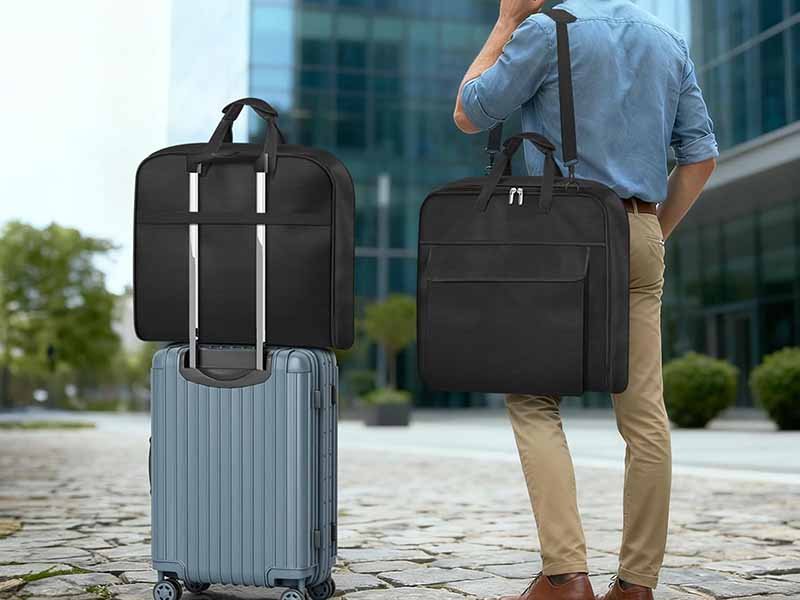
A suit garment bag may look simple on the surface, but for business travelers, it solves a very expensive problem. A single badly wrinkled suit can affect a sales meeting, trade show appearance, hotel check-in, wedding event, executive presentation, or client dinner. In business travel, clothing is not just clothing. It is part of the traveler’s image, confidence, and work readiness. That is why more brands, importers, wholesalers, and private label companies are paying closer attention to suit garment bag manufacturing. They are no longer looking for just a basic zip bag. They want structure, material stability, portability, smart storage, and a product that feels reliable in the hand.
The right suit garment bag manufacturing solution should protect suits from wrinkles, reduce pressure marks during transport, stay lightweight enough for travel, and offer durable construction that holds up after repeated use. For most business travel products, that means a careful balance of fabric selection, folding structure, zipper quality, handle strength, and internal layout. A good factory does not just sew panels together. It helps create a travel product that performs well in airports, hotels, cars, and overhead compartments.
For brands entering this category, the opportunity is real. Business travelers are willing to pay more for products that save time, reduce garment care stress, and look professional. A garment bag that arrives looking clean, opens smoothly, and keeps a suit ready to wear can quickly become a repeat-purchase product. The difference between an average product and a strong one is often hidden in the manufacturing details. That is where smart product development starts.
What Is Suit Garment Bag Manufacturing?
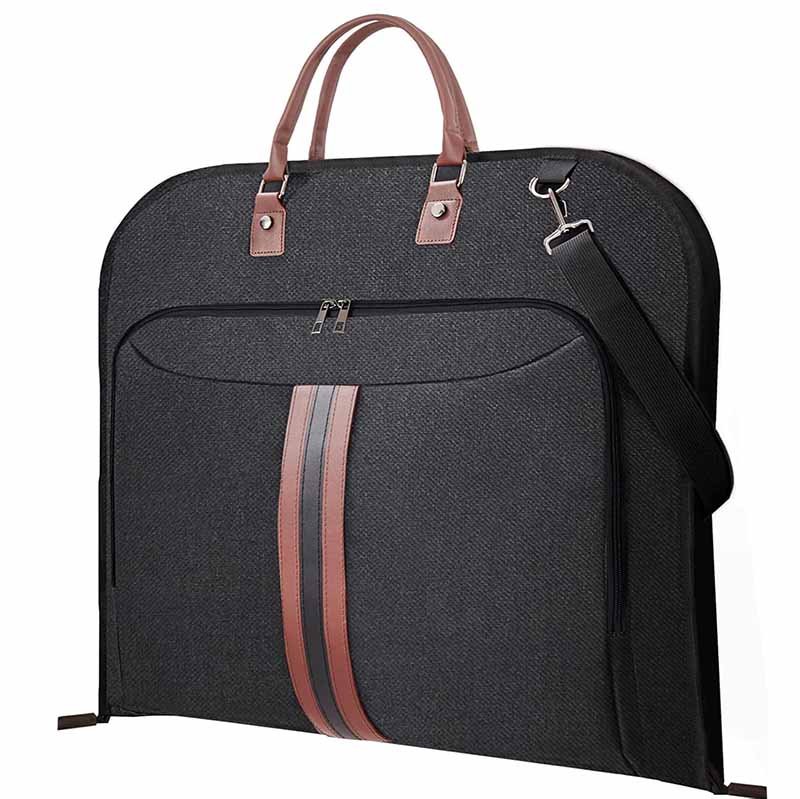
Suit garment bag manufacturing is the process of designing and producing travel bags that carry suits, shirts, dresses, and formalwear in a way that reduces wrinkles, protects fabric, and improves portability. It includes material choice, bag structure, inner layout, stitching method, hardware quality, and customization for brand positioning.
What is a suit garment bag
A suit garment bag is a travel bag designed to carry formal clothing in a flatter and more protected way than a normal suitcase or backpack. Its main job is to reduce creasing, prevent crushing, and help users arrive with clothing ready to wear. Most garment bags are made for suits, blazers, dress shirts, trousers, uniforms, dresses, or event clothing. Some are full-length hanging bags. Others are foldable or tri-fold travel bags with handles, shoulder straps, and extra compartments.
From a product development point of view, a suit garment bag is not just one large pocket with a zipper. It is a functional travel organizer. A well-made garment bag often includes a main garment compartment, fixing straps, hanger loop support, accessory pockets, shoe storage, zipper dividers, and reinforced carry handles. Higher-value models may also include trolley sleeves, laptop compartments, detachable shoulder straps, or padded sections for electronics and grooming kits.
The reason this category is attractive to brands is simple. It serves a very clear use case. Customers do not buy garment bags randomly. They buy them to solve a practical problem. That makes conversion easier when the product is designed well and described clearly.
In manufacturing terms, the product must meet several performance goals at the same time:
Core functions a suit garment bag must deliver
| Function | Why It Matters to Users | Manufacturing Impact |
|---|---|---|
| Wrinkle reduction | Helps clothing stay presentable | Requires proper panel layout and fold design |
| Fabric protection | Prevents dust, scratches, and moisture exposure | Needs lining, outer shell, and zipper quality |
| Portability | Easier for airports, taxis, trains, and hotels | Affects handle design, shoulder strap, weight |
| Storage efficiency | Keeps shoes, ties, belts, and shirts organized | Needs practical pocket planning |
| Durability | Product must survive repeated travel cycles | Depends on stitching, webbing, and hardware |
Many cheap garment bags fail because they only focus on appearance. They may look fine in product photos, but once loaded with a suit, shoes, laptop, and accessories, the weaknesses show up fast. Handles stretch, zippers jam, seams distort, and the internal layout collapses. Serious customers care about these details because product complaints often come from actual daily use, not from first impressions.
For that reason, experienced factories spend more time on structure development than many people expect. Small decisions, such as the angle of the fold line, the spacing of reinforcement stitches, or the choice between a coil zipper and molded zipper, can directly affect long-term user satisfaction.
Why business travelers need it
Business travelers often move fast and carry limited luggage. They may leave for a one-day meeting, a two-night trade event, or a multi-city client visit. In many of these situations, they need a suit, blazer, shirt, or formal outfit to look neat without relying on hotel ironing or dry cleaning. A garment bag solves that problem better than a standard suitcase because it gives clothing more space, better support, and less compression.
What business travelers care about most is not just style. They care about convenience, speed, and control. They want to pack in minutes, move easily through airports, and open the bag at the destination without finding deep fold lines across the jacket chest or trouser knees. This is especially important for consultants, sales teams, corporate executives, event staff, real estate professionals, and premium service industries.
The product also has strong emotional value. When a traveler opens a bag before an important meeting, they want certainty. They do not want to wonder whether the suit still looks good. That feeling of readiness is part of the product’s value, and it is one reason customers in this category often accept higher prices for better construction.
What business travelers usually expect from a garment bag
- Lightweight carry that does not feel bulky in transit
- Enough space for one or two suits plus shirts and accessories
- Separate organization for shoes, belts, ties, chargers, or toiletries
- Easy hanging function after arriving at hotel or venue
- Clean, professional appearance suitable for work environments
- Durable materials that do not look worn after limited use
A strong product in this category also reduces dependence on ironing. That matters more than many sellers realize. Time is limited during work trips. If a garment bag saves 20 to 30 minutes of clothing preparation before a meeting, that becomes a real practical advantage, not just a product feature.
This is why suit garment bag manufacturing has become more specialized. Customers are no longer comparing it only to other garment bags. They are comparing it to the full travel experience.
Suit garment bag vs suitcase
A suitcase is made for general packing. A garment bag is made for clothing presentation. That difference shapes the entire product structure.
In a suitcase, clothes are folded into layers and compressed with other items such as shoes, chargers, cosmetics, documents, or outerwear. This is efficient for volume, but not ideal for formal garments. Pressure points, hard corners, and repeated folding create wrinkles. Suit jackets are especially vulnerable at the shoulders, lapels, and chest area. Trousers often develop harsh fold lines if stacked too tightly.
A garment bag approaches the problem differently. It protects clothing by spreading the garment over a larger surface area. Even foldable travel garment bags are designed so folds happen in a more controlled way. Better designs also include internal straps to stop shifting during transport, which reduces extra creasing.
Comparison table: garment bag vs suitcase for business travel
| Item | Suit Garment Bag | Standard Suitcase |
|---|---|---|
| Best for formalwear | Excellent | Fair |
| Wrinkle reduction | Strong | Limited |
| Easy access to suit | Fast | Slower |
| Organization for shirts and ties | Good | Medium |
| Carry-on suitability | Good for selected sizes | Strong |
| Multi-purpose packing | Medium | Strong |
| Professional presentation | High | Medium |
This comparison matters for product positioning. If your target customer is a leisure traveler packing casual wear, a standard travel bag may be enough. But if your target user is traveling for meetings, events, or ceremonies, the garment bag has a clearer functional advantage.
That is why brands selling into this category need to understand the end use. A garment bag is not trying to replace every travel product. It is trying to do one high-value job better than anything else.
When to use garment bags
Suit garment bags are most useful when the trip involves formal clothing that must stay neat and wearable. That includes business meetings, conferences, exhibitions, weddings, award ceremonies, uniform transport, interviews, speaking events, and destination events. In these situations, presentation matters. The clothing is part of the purpose of the trip.
For short business trips, usually one to three nights, garment bags can be especially effective. Many users do not want to carry a large suitcase for a short trip, but they still need one suit, two shirts, shoes, a laptop, and accessories. A well-designed foldable garment bag can meet all of those needs in one compact product. This is why hybrid designs have become popular. Customers want one bag that protects garments while still acting like a travel organizer.
Most common use scenarios
| Use Scenario | Product Need |
|---|---|
| One-night business trip | Compact foldable garment bag |
| Two to three day conference | Garment bag with shoe and shirt storage |
| Wedding or formal event | Full garment protection and clean look |
| Sales travel | Easy carry and quick unpacking |
| Corporate gifting | Premium appearance and branding value |
This also creates a clear opportunity for customization. A bag designed for wedding rentals may need a different structure than one designed for airline consultants or sales managers. The more closely a factory understands the user scenario, the stronger the final product will be.
For importers and brand owners, this is an important lesson. The best-selling garment bag is rarely the one with the most features on paper. It is the one whose features match the real habits of the intended user.
Which Materials Are Used in Suit Garment Bag Manufacturing?
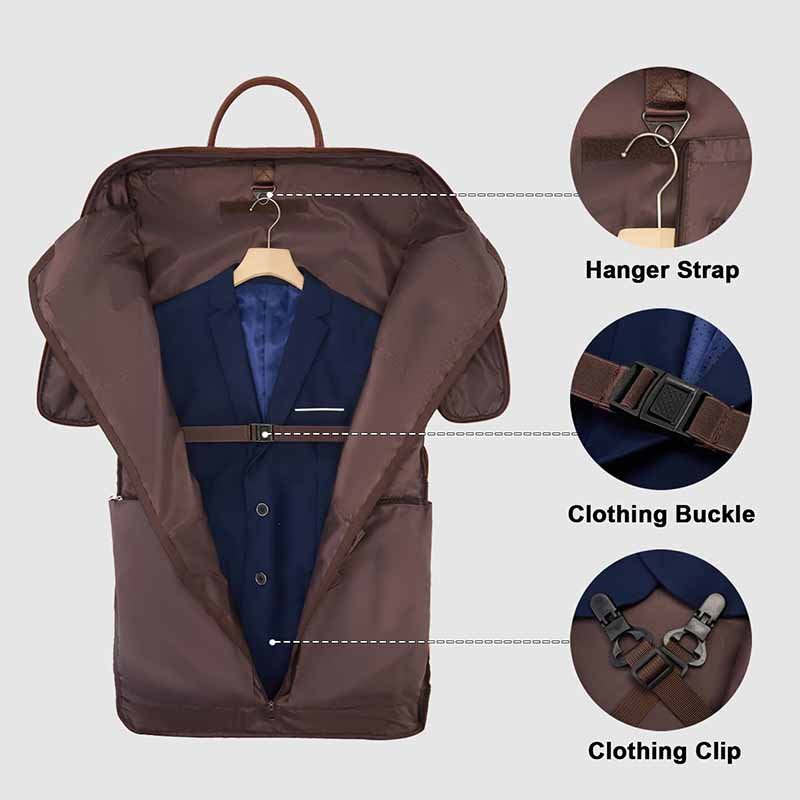
Suit garment bag manufacturing usually uses polyester, nylon, leather, PU, lining fabrics, webbing, foam, zipper systems, and in some premium designs, neoprene or coated materials. The right material mix affects weight, wrinkle protection, durability, appearance, cost, and final product positioning.
Polyester vs nylon vs leather
Material choice is one of the most important decisions in garment bag development because it affects almost every part of the product. It changes how the bag looks, how much it weighs, how long it lasts, how easy it is to clean, and what price range it can compete in. For most travel garment bags, polyester and nylon are the main choices. Leather and leather-look materials are used more often in premium or fashion-led categories.
Polyester is common because it is cost-effective, stable, and suitable for many bag structures. It works well for large-volume programs where the target price must stay controlled. It can also support a wide range of colors, coatings, and surface textures. For entry-level and mid-range products, polyester remains a practical option.
Nylon is usually seen as the stronger and more premium upgrade. It offers better abrasion resistance, often feels smoother, and can create a more technical or refined look. High-density nylon can support a cleaner structure and tends to perform better in repeated-use travel environments. It is a good choice for brands that want a more durable product without moving into very heavy luxury materials.
Leather creates a premium appearance, but it brings trade-offs. It adds weight, increases cost, and can require more maintenance. Full leather garment bags can look impressive, especially for executive or gifting categories, but they are not always the most practical choice for frequent air travel.
Material comparison table
| Material | Cost Level | Weight | Durability | Appearance | Best Fit |
|---|---|---|---|---|---|
| Polyester | Low to medium | Light | Good | Versatile | Value and volume programs |
| Nylon | Medium | Light | Very good | Clean and premium | Business travel and premium lines |
| PU leather | Medium | Medium | Good | Polished | Fashion-led products |
| Genuine leather | High | Heavy | Very good | Luxury | Executive and gifting segments |
Customers often focus on the surface fabric, but from a manufacturing perspective, the lining matters too. A rough or low-grade lining can create friction, reduce the user’s premium feeling, and wear out quickly around seams and pockets. For garment bags, the lining should feel smooth and stable because it is in direct contact with shirts, jackets, and trousers.
A practical approach for many brands is to combine materials strategically. For example:
- Nylon exterior for strength and a premium look
- Polyester lining for cost control
- Foam padding only where needed
- Reinforced webbing on handle zones
- Metal or premium plastic hardware based on price target
This kind of material engineering often creates a better product than choosing one expensive material everywhere.
Why neoprene is used
Neoprene is not the most common material in suit garment bags, but it has a clear role in special designs and premium segments. Szoneier has deep experience in neoprene material development and custom neoprene product manufacturing, which makes this material especially interesting when customers want something different from the standard woven-fabric market.
Neoprene offers several benefits. It has a soft hand feel, natural cushioning effect, water resistance, and a modern premium look. It can make a product feel more distinctive and tactile. In categories where the bag is not only functional but also expected to feel innovative, neoprene can help the product stand out.
That said, neoprene should be used carefully in garment bag manufacturing. It is heavier than many woven materials, and if the design uses too much neoprene, the final bag may become bulkier than ideal for air travel. The smarter approach is often to use neoprene selectively rather than fully. For example:
Where neoprene can add value in a garment bag
- Padded accessory compartments
- Laptop sleeve sections
- Handle wrap or shoulder support zones
- Front organizer pockets
- Reinforced panels needing shock absorption
This gives the bag extra softness and a more upgraded feel without making the whole product too heavy.
Neoprene performance overview
| Neoprene Property | Value in Garment Bags |
|---|---|
| Soft cushioning | Helps protect contents and improve touch |
| Water resistance | Adds protection in light rain or spills |
| Flexible structure | Good for curved or padded design areas |
| Premium feel | Supports product differentiation |
| Higher weight | Needs careful use in travel products |
For brands targeting younger professionals, premium corporate gifts, or design-led travel collections, neoprene can become a strong selling point. It is especially useful when the goal is to create a bag that feels more contemporary than standard polyester travel gear.
For factories, though, neoprene requires skill. Cutting, laminating, binding, printing, and stitching neoprene all behave differently from normal woven fabric. That is why working with a manufacturer that already has neoprene development experience can reduce risk and improve sampling speed.
Waterproof vs breathable
Many customers ask for waterproof garment bags, but in actual use, the goal is usually more specific. They want the bag to protect clothing from light rain, airport spills, taxi trunk moisture, or dirty surfaces. At the same time, they do not want trapped moisture inside the bag. This creates a balance problem between waterproof performance and breathability.
If the outer shell is fully sealed with no airflow consideration, the inside can hold humidity, especially when garments are packed immediately after use or in humid weather. That can create odor issues or make the inside feel damp. On the other hand, if the fabric is too breathable and uncoated, it may allow external moisture to penetrate too easily.
For most business travel garment bags, the best solution is not extreme waterproofing. It is controlled protection. That usually means a fabric with light to moderate water resistance, paired with a lining and structure that keeps garments isolated from direct moisture contact.
Practical material strategy for balanced protection
| Layer | Recommended Function |
|---|---|
| Outer fabric | Water-resistant surface or coating |
| Backing or laminate | Adds shape and extra barrier |
| Lining | Smooth inner surface for garment care |
| Zipper and seams | Reduce weak points in moisture entry |
This is why coated nylon and coated polyester are widely used. They provide enough water resistance for daily travel without turning the bag into a stiff outdoor dry bag. Business travelers usually care more about overall usability than extreme weather performance.
A smart factory should also advise customers based on real end use. If the product is for city travel, office commuting, and short flights, moderate water resistance is usually enough. If the product is meant for luxury or fashion travel, appearance may matter more than extreme weather specs. If the product is for uniform transport or field professionals, stronger protective materials may be needed.
The best result comes from matching material performance to actual customer behavior, not from adding the most aggressive coating possible.
Best materials for premium bags
Premium suit garment bags are expected to do more than just hold clothing. They need to feel elevated, look refined, and keep their shape after repeated use. In this category, material selection must support both performance and perception. Customers paying more are not only paying for function. They are also paying for confidence in the product.
Premium bags often use higher denier nylon, coated fabrics, smooth linings, stronger webbing, better zippers, and more stable internal reinforcement. Hardware quality becomes more important as price goes up. Poor zipper action or weak metal plating can quickly destroy the high-end impression of an otherwise good-looking product.
Common premium material choices
- 1680D ballistic nylon for abrasion resistance
- High-density twill nylon for a cleaner business look
- TPU-coated fabric for a modern technical finish
- Smooth polyester or satin-like lining for garment care
- EVA or foam reinforcement in key structural panels
- Branded zipper pulls or premium metal fittings
- Strong webbing handles with bartack reinforcement
Premium material effect on user experience
| Upgrade Element | Customer Benefit |
|---|---|
| High-density shell fabric | Better durability and cleaner appearance |
| Smooth lining | Less friction on shirts and jackets |
| Better zipper system | Easier opening and fewer complaints |
| Reinforced handle area | More confidence when carrying fully loaded bag |
| Structured body panels | Better shape retention and more premium feel |
From a product strategy point of view, premium materials should be visible or easily felt by the customer. If the product cost rises but the user cannot clearly notice where the value is, conversion becomes harder. That is why good brands prioritize material upgrades in areas the user touches and sees first, such as shell texture, zipper movement, handle comfort, inner organization, and overall shape.
For Szoneier, one advantage is flexible custom development. A customer does not have to choose between a low-cost basic bag and a fully luxury bag with no middle ground. The smarter route is often to build a product around a clear target price and then allocate material value where it matters most to the traveler.
That is how stronger products are developed: not by adding everything, but by choosing the right details for the right market.
How Does Suit Garment Bag Manufacturing Design Work?
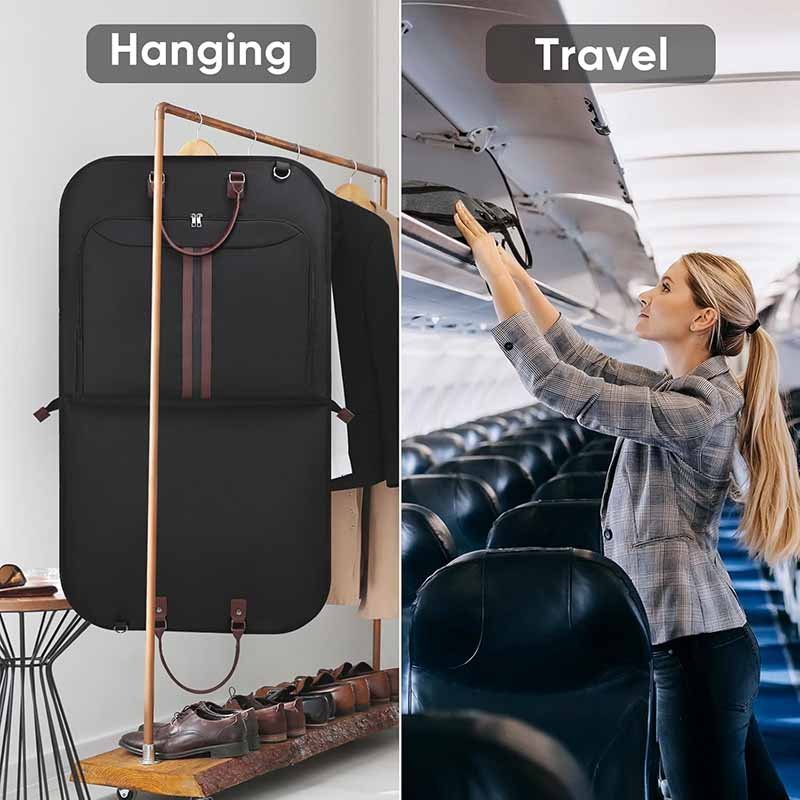
Suit garment bag manufacturing design focuses on balancing structure, fold logic, storage layout, and portability. A well-designed garment bag reduces wrinkles, improves packing efficiency, and enhances user experience during business travel.
How wrinkle-free design works
Wrinkle-free performance is not achieved by materials alone. It is primarily determined by structural design and fold engineering.
A suit jacket has natural stress points:
- Shoulder area
- Lapel fold
- Chest panel
- Sleeve joints
If these areas are compressed incorrectly, wrinkles will form regardless of fabric quality.
A well-designed garment bag controls this through:
- Wide folding radius instead of sharp folds
- Internal fixing straps to prevent shifting
- Layered compartments to reduce pressure stacking
For example, tri-fold designs typically divide the garment into three sections. However, cheaper versions create hard fold lines, while better versions use soft panel transitions and support padding.
Key design elements for wrinkle reduction
| Design Element | Function |
|---|---|
| Wide fold panel | Reduces sharp creases |
| Compression straps | Prevents garment movement |
| Inner hanger loop | Maintains vertical alignment |
| Smooth lining | Reduces fabric friction |
In real usage, wrinkle reduction is also affected by how users pack. That’s why smart brands include visual guides or instructions inside the bag, improving user experience and reducing complaints.
Foldable vs tri-fold styles
Garment bags mainly come in two structures: bi-fold (foldable) and tri-fold.
Each has its own advantages depending on travel habits.
Structure comparison
| Type | Advantages | Limitations | Best Use |
|---|---|---|---|
| Bi-fold | Larger garment space, fewer folds | Slightly longer size | Premium travel |
| Tri-fold | Compact, easier to carry | More fold pressure | Short trips |
Bi-fold designs are often preferred for:
- Longer suits
- Premium users
- Less wrinkle tolerance
Tri-fold designs are more common in:
- Carry-on travel
- Budget-friendly products
- Compact storage needs
From a manufacturing standpoint, tri-fold designs are more complex because:
- More hinges = more stress points
- Requires stronger reinforcement
- Needs better alignment control
A mistake many factories make is treating fold lines as simple seams. In reality, these areas require extra reinforcement stitching and flexible panel design to avoid long-term damage.
Key compartments and features
Modern business travelers expect more than just a garment compartment. A successful garment bag integrates multi-functional storage.
Common compartments in high-quality designs
- Main suit compartment (with straps)
- Shirt divider panels
- Shoe compartment (separate, ventilated)
- Tie and belt holders
- Toiletry or accessory pockets
- Laptop sleeve (in hybrid designs)
- External quick-access pocket
Feature priority based on user demand
| Feature | Importance Level |
|---|---|
| Wrinkle-free garment area | Very high |
| Shoe storage | High |
| Lightweight design | High |
| Laptop compartment | Medium |
| Waterproof pocket | Medium |
Overloading the bag with too many compartments can reduce usability. Good design is about balance, not maximum features.
For example:
- Too many pockets → confusing layout
- Too few → lack of function
Experienced manufacturers like Szoneier usually recommend modular layouts, where compartments are placed based on real travel behavior instead of design assumptions.
Best size for business travel
Size is a critical factor that directly affects:
- Airline compatibility
- Portability
- Packing capacity
Most business travelers prefer garment bags that can be used as carry-on luggage.
Recommended size range
| Type | Dimensions (approx.) | Use Case |
|---|---|---|
| Compact | 50–55 cm folded | 1-day trip |
| Standard | 55–60 cm folded | 2–3 days |
| Extended | 60–65 cm folded | Longer travel |
A common mistake is making the bag too large. While it increases capacity, it reduces convenience, especially in:
- Airplane overhead bins
- Taxi storage
- Walking mobility
Weight also matters. Based on user feedback:
- Ideal empty bag weight: 1.2–2.0 kg
- Over 2.5 kg → perceived as heavy
This is where material selection and structural efficiency must work together.
How Is Suit Garment Bag Manufacturing Done?
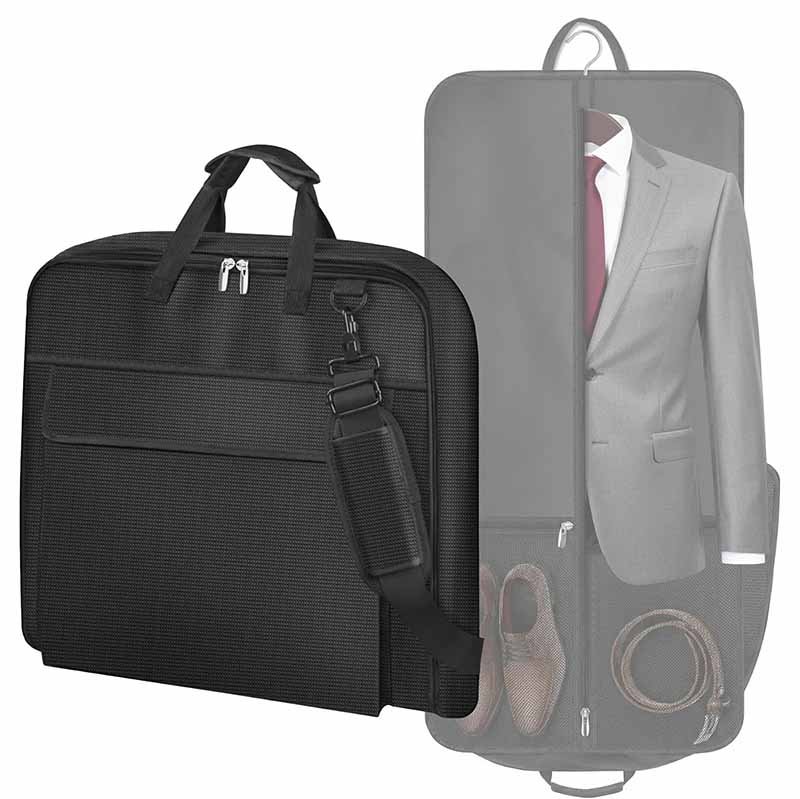
Suit garment bag manufacturing involves material cutting, panel assembly, stitching, hardware installation, and quality control. Each step affects durability, appearance, and long-term performance.
Cutting and stitching process
The manufacturing process starts with material cutting, which defines product accuracy.
Precision is critical because:
- Misalignment affects folding performance
- Incorrect panel size causes tension issues
- Inconsistent cutting leads to mass production defects
Key cutting methods
- Manual cutting (low volume, flexible)
- CNC cutting (high precision, large orders)
After cutting, stitching begins.
Important stitching techniques
| Stitch Type | Function |
|---|---|
| Lock stitch | Standard seams |
| Bartack stitch | Reinforcement (handles, stress points) |
| Binding stitch | Edge finishing |
| Double stitch | Extra durability |
High-stress areas include:
- Handles
- Shoulder straps
- Fold lines
- Zipper ends
Factories with experience will reinforce these areas automatically, while inexperienced suppliers often overlook them.
Quality control steps
Quality control is one of the biggest differences between a reliable factory and an average one.
A proper QC system includes:
1. Incoming material inspection
- Fabric thickness check
- Color consistency
- Coating quality
2. In-line production inspection
- Stitch consistency
- Alignment accuracy
- Defect detection
3. Final inspection
- Zipper smoothness
- Load testing
- Appearance check
4. Packing inspection
- Label correctness
- Quantity verification
Common defect rates (industry reference)
| Factory Level | Defect Rate |
|---|---|
| Low-end | 5–8% |
| Standard | 2–4% |
| High-quality (like Szoneier) | <1% |
Low defect rates are especially important for:
- Amazon sellers
- Brand owners
- Retail distribution
Because returns and negative reviews can quickly damage profitability.
OEM and private label options
Customization is where most brands create differentiation.
Common OEM options
- Logo printing (screen print, embroidery, heat transfer)
- Custom color matching
- Material upgrades
- Packaging design
- Hardware customization (zippers, buckles)
Private label customization levels
| Level | Description |
|---|---|
| Basic | Logo + color |
| Standard | Structure + materials + branding |
| Advanced | Full custom design + packaging + product development |
Szoneier supports low MOQ starting from 50 pcs, which is very important for:
- New brands
- Amazon sellers
- Market testing
Fast sampling (5–7 days) also helps customers reduce development time.
Production timeline and MOQ
Understanding production time helps buyers plan inventory and sales cycles.
Typical production timeline
| Stage | Time |
|---|---|
| Design confirmation | 1–3 days |
| Sample development | 5–7 days |
| Sample revision | 3–5 days |
| Mass production | 25–30 days |
MOQ (Minimum Order Quantity) is another key factor.
MOQ comparison
| Supplier Type | MOQ |
|---|---|
| Large factory | 300–1000 pcs |
| Flexible factory (like Szoneier) | 50–200 pcs |
Lower MOQ gives buyers:
- Lower risk
- Faster market testing
- Better cash flow control
This is especially important in today’s market, where trends change quickly and product validation is critical.
How to Choose Suit Garment Bag Manufacturing Supplier?
Choosing the right suit garment bag manufacturing supplier determines product quality, delivery reliability, and long-term business success. A good factory provides stable production, flexible customization, and consistent quality control that reduces risk for brands and importers.
What makes a good factory
A reliable factory is not defined only by price. It is defined by system capability.
From real sourcing experience, strong garment bag manufacturers usually have:
- In-house material sourcing or long-term supplier network
- Skilled sewing teams with bag-specific experience
- Structured production workflow
- Dedicated quality control system
- Ability to handle customization requests
Key factory evaluation checklist
| Capability | Why It Matters |
|---|---|
| Material sourcing | Ensures stable quality and cost control |
| Sampling ability | Faster product development |
| Production capacity | On-time delivery |
| QC system | Reduces defects and returns |
| Communication | Avoids misunderstandings |
Many buyers focus too much on unit price at the beginning. However, hidden costs often come from:
- Delays
- Rework
- Quality complaints
- Logistics issues
A slightly higher unit price from a reliable supplier often results in lower total cost over time.
Factories like Szoneier, with over 18 years of experience, typically offer a more stable system because they already understand common issues and prevent them early.
Why low MOQ matters
MOQ (Minimum Order Quantity) directly affects business flexibility.
For many buyers today, especially:
- Amazon sellers
- Startup brands
- Small wholesalers
High MOQ creates risk.
Impact of MOQ on business
| MOQ Level | Business Impact |
|---|---|
| 50–100 pcs | Low risk, fast testing |
| 200–500 pcs | Medium risk |
| 1000+ pcs | High inventory pressure |
Low MOQ allows:
- Faster product launch
- Testing different designs
- Lower upfront investment
For example, if a new product fails, a 1000-piece order can create heavy inventory pressure. But a 50–100 piece order allows quick adjustment.
Szoneier supports low MOQ from 50 pcs, which is highly valuable for:
- Market testing
- Seasonal product launches
- Custom brand development
Certifications and experience
Certifications are often used as a signal of factory reliability, but they should be understood correctly.
Common certifications in bag manufacturing
- BSCI (social compliance)
- ISO9001 (quality management)
- REACH / CPSIA (material safety)
These certifications indicate that the factory meets certain standards, but they do not guarantee product quality alone.
What matters more is:
- Production experience in similar products
- Understanding of export requirements
- Consistency across orders
Experience vs certification comparison
| Factor | Importance |
|---|---|
| Product experience | Very high |
| QC consistency | Very high |
| Certification | Medium |
| Factory size | Medium |
A factory that has produced thousands of garment bags understands:
- Where defects usually happen
- How to improve durability
- How to optimize structure
That experience reduces risk significantly.
Communication and service
Communication is one of the most underestimated factors in supplier selection.
A good supplier should:
- Respond quickly
- Understand product requirements clearly
- Provide practical suggestions
- Report problems honestly
Signs of strong communication
- Clear answers, not vague replies
- Willingness to suggest improvements
- Ability to provide photos/videos during production
- Fast response time (within 12–24 hours)
Signs of weak communication
- Delayed replies
- Avoiding technical questions
- No proactive updates
- Frequent misunderstandings
In international business, time zone differences already create challenges. If communication is poor, problems multiply quickly.
Factories like Szoneier focus on fast response and clear communication, which helps buyers reduce development time and avoid costly mistakes.
What Trends Impact Suit Garment Bag Manufacturing?
Suit garment bag manufacturing is evolving with changes in travel habits, sustainability demands, and product innovation. Brands that follow these trends can create more competitive products.
Smart and travel-friendly features
Modern garment bags are no longer just storage products. They are becoming travel systems.
Emerging features
- USB charging ports
- Anti-theft zippers
- RFID-blocking pockets
- Built-in laptop compartments
- Expandable storage sections
These features are especially popular among:
- Frequent business travelers
- Digital professionals
- International travelers
However, not all features add value. The key is practical integration.
Too many features can:
- Increase cost
- Complicate design
- Reduce usability
Smart design focuses on real use cases, not feature overload.
Eco-friendly materials
Sustainability is becoming a strong purchasing factor, especially in:
- European markets
- Premium brands
- Corporate clients
Popular eco-friendly options
- Recycled polyester (rPET)
- Organic cotton
- Water-based coatings
- Eco-friendly packaging
Market impact
| Factor | Trend |
|---|---|
| Demand for recycled materials | Increasing |
| Willingness to pay more | Moderate |
| Brand differentiation | Strong |
However, eco-materials must still meet performance requirements. A bag that is sustainable but not durable will not succeed.
Experienced factories can help balance:
- Sustainability
- Cost
- Performance
Lightweight design trends
Weight is one of the most important factors for travelers.
Ideal product targets
- Empty bag weight: 1.2–2.0 kg
- Carry comfort: easy for long walking
Heavy bags reduce user satisfaction, especially in:
- Airports
- Public transport
- Long walking distances
How manufacturers reduce weight
- Using high-strength lightweight fabrics
- Reducing unnecessary layers
- Optimizing structure
- Using lightweight hardware
The goal is not just to reduce weight, but to maintain strength-to-weight balance.
Custom branding demand
Customization is no longer optional. It is expected.
Branding elements customers request
- Logo printing or embroidery
- Custom color matching
- Packaging design
- Brand storytelling elements
Customization impact
| Level | Effect |
|---|---|
| Basic logo | Entry-level branding |
| Full customization | Strong market identity |
| Premium packaging | Higher perceived value |
Private label products allow brands to:
- Build recognition
- Increase margins
- Differentiate from competitors
Szoneier supports full OEM/ODM customization, helping brands move from generic products to unique branded solutions.
Conclusion: Start Your Custom Suit Garment Bag Project with Szoneier
Choosing the right suit garment bag manufacturing solution is not just about finding a supplier. It is about building a product that solves real travel problems, meets customer expectations, and supports your brand growth.
From material selection to structural design, from quality control to customization, every detail affects how your product performs in the market.
Whether you are launching a new product, expanding your catalog, or upgrading your current designs, working with the right factory makes the process faster, safer, and more profitable.
If you are looking to develop high-quality, competitive suit garment bags for business travelers, now is the right time to start.
Contact Szoneier today to get a quote, request samples, and turn your product idea into reality.