Skip to content
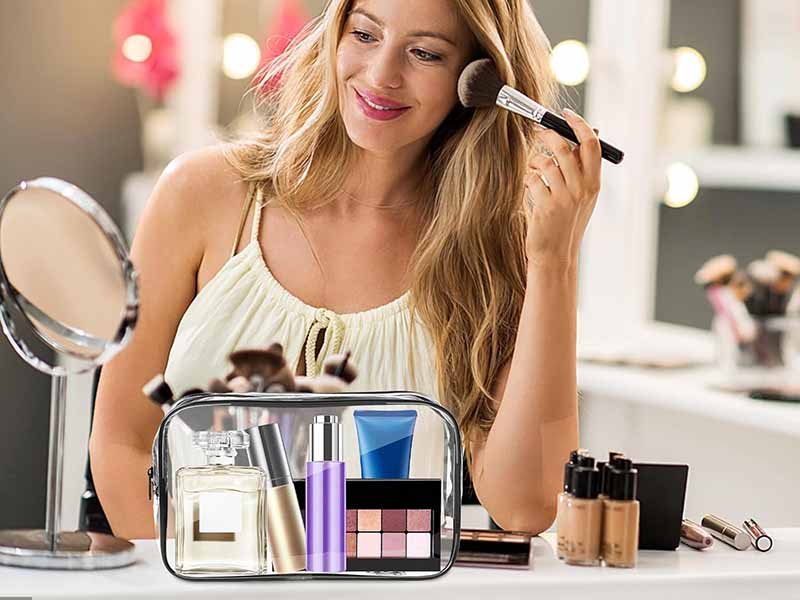
Clear makeup bags look “simple,” but they’re one of the easiest products to get wrong. Customers buy them for the clean, transparent look—then they judge them fast if the film turns yellow, smells strong, gets sticky, or looks cloudy after wiping with alcohol. From a brand perspective, these problems don’t just create returns; they create a story customers repeat: “It looked cheap after a few weeks.” For clear makeup bags, TPU usually keeps clarity longer, smells less, and is easier to manage for chemical compliance, especially in stricter markets. PVC is more cost-effective and easy to mass produce, but it can yellow faster and needs tighter control of plasticizers and stabilizers to avoid odor, tackiness, and compliance risk. The right choice depends on product tier, target market, and expected lifespan.
If you’ve ever seen two “identical” clear pouches age differently in a customer’s bathroom, you already know the truth: the film decides the reputation. Let’s break down TPU vs PVC in a way that helps you choose confidently—before you place a big order.
What is TPU vs PVC for clear makeup bags?
In clear makeup bags, TPU is a polyurethane-based flexible film that stays soft and stable without relying on migrating plasticizers. PVC is a vinyl film that becomes flexible through plasticizers; it’s economical and weld-friendly, but more sensitive to heat/UV aging and additive quality. If you need long-lasting clarity and lower odor, TPU is usually safer; if you need low cost for short lifecycle, PVC can work with proper testing.
What is TPU in clear makeup bags?
TPU (thermoplastic polyurethane) is chosen when brands want a clear pouch to feel soft, premium, and “clean” during unboxing and daily use. The biggest selling point is not a lab term—it’s what customers experience: less smell, less “cheap plastic feel,” and more stable clarity over time.
What customers care about with TPU (practical points):
- Low odor after opening sealed packaging (important for beauty kits and gift sets)
- Soft hand feel (doesn’t feel stiff or harsh on skin)
- Better folding recovery (looks cleaner after being packed into luggage)
- Lower tacky-surface risk because the film does not depend on migrating plasticizers
Common TPU film specs used in clear makeup bags:
- Thickness: 0.25–0.60 mm is most common
- 0.25–0.35 mm: light, budget-friendly TPU
- 0.40–0.55 mm: most “premium feel” range
- 0.60–0.80 mm: heavy-duty / structured pouch panels
- Surface options: glossy, matte, frosted, anti-scratch emboss
- Clarity control: low-haze film for “glass-like” look
- Yellowing control: aliphatic TPU (best clarity stability) vs aromatic TPU (lower cost, higher yellowing tendency)
A realistic way to explain TPU value to customers:
- It’s the choice when your clear pouch must still look good after bathroom humidity, travel folding, and regular cleaning.
What is PVC in clear makeup bags?
PVC (polyvinyl chloride) remains common because it’s efficient for large production: stable supply, easy processing, clean welding, and strong price competitiveness. Many best-selling clear cosmetic pouches are still PVC—especially in promotional programs and value retail.
Why brands select PVC:
- Lower material cost (important for price-sensitive channels)
- Fast production with mature welding processes
- Good structure holding for crisp boxy shapes
- Wide availability and consistent thickness tolerance (when sourcing from good suppliers)
Where PVC causes complaints (what customers actually say):
- “The corners turned yellow.”
- “It smells like plastic.”
- “It feels sticky after a while.”
- “It looks cloudy after cleaning.”
Those issues usually come from additives, not the base PVC polymer.
PVC flexibility depends on plasticizers. If plasticizer type and dosage are not well controlled, you may see:
- odor increase (especially in sealed packaging)
- surface tackiness after heat exposure
- faster yellowing under light/heat
- haze after contact with oils or alcohol wipes
PVC can absolutely be a good choice—just treat it like a controlled material, not a generic commodity.
Which feels clearer and softer in clear makeup bags?
Most customers do a “3-second test”:
- look at it
- squeeze it
- smell it
That’s why feel and odor are commercial issues, not just technical ones.
Side-by-side customer perception
| Factor customers notice | TPU clear makeup bags | PVC clear makeup bags |
|---|---|---|
| Touch | Soft, elastic, premium | Firm to soft (depends on plasticizer) |
| Clarity on Day 1 | Very clear (low haze grades) | Clear but can be slightly hazy |
| Fold lines after travel | Less visible, better rebound | Fold lines more obvious |
| Odor after unboxing | Usually low | Often stronger if sealed |
| “Sticky later” risk | Lower | Higher (migration-related) |
What specs influence “clear and soft” the most?
For TPU
- thickness (0.40–0.55 mm feels premium)
- haze level (lower haze = more “glass” look)
- surface texture (emboss helps hide scratches)
For PVC
- plasticizer quality/type
- stabilizer system
- processing temperature control (overheating can increase odor/haze)
Data points brands ask for before placing an order
When you move from sampling to mass production, these are the film questions brands usually ask (because they reduce surprise complaints):
| Item | What to specify | Why it matters |
|---|---|---|
| Material | TPU or PVC + grade | Different grades age differently |
| Thickness | 0.25 / 0.35 / 0.45 / 0.55 mm | Thickness changes feel + durability |
| Transparency | clear / smoke clear / frosted | Impacts retail look and masking scratches |
| Odor control | “low odor” + packaging plan | Prevents unboxing complaints |
| Yellowing plan | UV stabilizer or aliphatic TPU | Reduces aged/dirty appearance |
| Cleaning resistance | alcohol wipe / oil contact | Real usage in bathrooms/travel |
Quick selection map
| Your product goal | Recommended film | Reason |
|---|---|---|
| Premium beauty brand pouch | TPU | Low odor + better clarity retention |
| Travel toiletry pouch (hot climates) | TPU | Better heat stability / less tackiness risk |
| Subscription box / gifting | TPU | Unboxing smell and feel matters |
| High-volume promo giveaways | PVC | Cost advantage for short lifecycle |
| Budget retail with strict QC | PVC (controlled) | Works if additives and tests are managed |
What causes yellowing in TPU vs PVC clear makeup bags?
Yellowing in clear makeup bags is mainly triggered by UV light, heat, humidity, and contact with cosmetics or alcohol. PVC usually yellows faster because plasticizers and stabilizers break down or migrate, while high-quality TPU—especially aliphatic TPU—keeps clarity longer. Storage temperature, transport conditions, and daily chemical exposure often matter more than the material name itself.
Yellowing is not just a color issue. To customers, yellow = old, dirty, low quality. That perception is what drives refunds and bad reviews.
Does UV cause yellowing in TPU vs PVC?
Yes—UV exposure is the fastest real-world aging factor for clear plastic bags.
Even indoor environments matter:
- retail shelf lighting
- bathroom windows
- car interiors
- airport travel exposure
All of these slowly deliver UV energy.
What UV actually does to clear film
- breaks polymer chains → changes transparency
- oxidizes additives → creates yellow tint
- increases haze → bag looks cloudy instead of clear
Why PVC yellows faster under sunlight
PVC softness depends on plasticizers. Under UV:
- plasticizers oxidize
- stabilizers are consumed
- degradation products remain trapped in the film
Result: visible yellow edges and corners.
TPU behavior under UV
TPU is more stable, especially:
- aliphatic TPU → strongest anti-yellowing
- aromatic TPU → cheaper but yellows sooner
Realistic sun-exposure comparison
| Exposure time | TPU appearance | PVC appearance |
|---|---|---|
| 2 weeks near window | No visible change | Slight yellow tint |
| 1 month display | Minor tone shift | Clear yellowing at folds |
| UV chamber 72h | Light haze possible | Strong discoloration |
For displayed retail products, UV stability directly affects shelf appeal.
Do heat and humidity affect TPU vs PVC yellowing?
Yes—and during global shipping, heat is often the biggest hidden risk.
Typical logistics conditions:
- container temperature: 40–60 °C
- sea transport humidity: 70–90% RH
- warehouse storage: no climate control
These accelerate chemical aging.
What heat does inside the film
- speeds oxidation reactions
- increases additive movement
- softens structure → traps discoloration
PVC under heat and humidity
Most visible problems:
- yellowing becomes stronger
- surface turns slightly sticky
- dust sticks easily → looks dirty
The root cause is plasticizer migration toward the surface.
TPU under the same conditions
TPU:
- has no migrating plasticizer system
- keeps a dry, clean surface
- shows slower color change
Heat-aging comparison
| Condition | TPU result | PVC result |
|---|---|---|
| 50 °C dry heat | Slight softening | Noticeable yellowing risk |
| 70 °C oven aging | Mild tone shift | Strong discoloration |
| High humidity storage | Stable surface | Possible tackiness |
For brands shipping to tropical or summer markets, this difference is critical.
Do cosmetics and alcohol wipes yellow TPU vs PVC?
This is one of the most common real-life causes of discoloration, yet many brands forget to test it.
Daily exposure sources:
- foundation and sunscreen oils
- makeup remover liquids
- perfume leakage
- 70% alcohol disinfectant wipes (now extremely common)
PVC reaction to cosmetic chemicals
Possible outcomes:
- oil dissolves plasticizer → shadow stains
- alcohol causes whitening or haze
- perfume leaves yellow rings
These marks often appear within days or weeks, not months.
TPU reaction to the same exposure
TPU usually:
- resists oil penetration better
- tolerates alcohol wiping with minimal haze
- avoids permanent staining in most cases
Not perfect—but much more stable visually.
Simple 24-hour contact test used by factories
| Test liquid | TPU result | PVC result |
|---|---|---|
| Hand cream | No visible stain | Light shadow possible |
| Makeup remover | Stable | Slight dulling |
| 70% alcohol | Minor surface change | Whitening or haze |
| Perfume | Usually unchanged | Yellow ring risk |
Because cosmetics are chemically active, real bathroom use can age a bag faster than sunlight.
Which additives and film grades change yellowing speed?
Not all TPU or PVC behaves the same. Formulation quality matters more than the material label.
TPU factors affecting clarity life
- aromatic vs aliphatic TPU
- UV stabilizer package
- film purity and haze control
Higher-grade TPU costs more but:
- stays clear longer
- smells less
- reduces complaint risk
PVC factors affecting yellowing
- plasticizer type (phthalate vs alternative)
- stabilizer quality
- processing temperature control
- contamination during production
Two PVC films may look identical at sampling— but age very differently in customer use.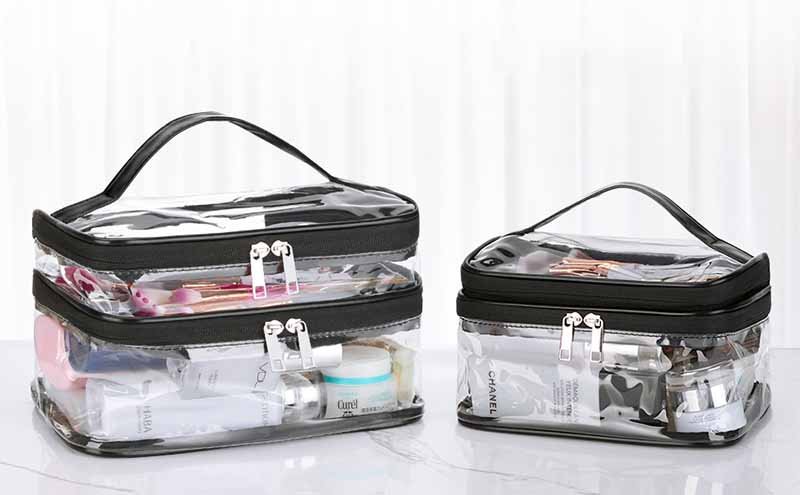
Yellowing risk by real usage scenario
| Usage environment | Yellowing risk | Safer material |
|---|---|---|
| Bathroom daily storage | High humidity + chemicals | TPU |
| Hot-climate travel | Heat pressure | TPU |
| Retail shelf display | UV exposure | TPU |
| Short-term promo giveaway | Low lifespan | PVC acceptable |
| Kids or family cosmetics | Higher safety concern | TPU preferred |
This reflects actual complaint patterns seen in production, not just laboratory theory.
What this means for your product decision
Yellowing rarely comes from one factor. It is usually the combined effect of light, heat, humidity, and chemicals.
From a business view:
- PVC saves money at purchase
- TPU saves reputation after sale
Smart brands compare: total lifecycle cost = material price + complaint risk + brand impact.
That’s why more mid-to-high-end cosmetic brands quietly shift toward TPU even when PVC looks cheaper on paper.
Which performs better, TPU or PVC clear makeup bags?
For daily cosmetic use, TPU clear makeup bags usually perform better in flexibility, odor control, anti-yellowing stability, and resistance to oils or alcohol. PVC performs well for short-term or low-cost products, especially when structure and price matter more than long-term appearance. The better choice depends on expected product life, shipping conditions, and how strongly your brand depends on visual quality.
In real markets, performance is judged after weeks of use, not in the factory sample room.
Which resists scratches in TPU vs PVC clear makeup bags?
Clear material makes every surface defect visible. Even fine abrasion changes how light reflects, so customers quickly notice wear.
Observed behavior in daily use:
TPU
- Shows light hairline marks under friction
- Maintains overall transparency
- Surface stays visually clean longer
PVC
- May resist very light scratching at first
- Develops cloudy scuff areas with repeated rubbing
- Wear becomes highly visible under bathroom lighting
Abrasion comparison from routine friction tests
| Friction scenario | TPU appearance | PVC appearance |
|---|---|---|
| Fabric rubbing (500 cycles) | Minor fine marks | Visible haze zone |
| Fingernail pressure | Light line only | Deeper visible scratch |
| Cosmetic brush contact | Stable clarity | Gradual dulling |
For premium cosmetic kits, surface appearance directly affects
review scores, repurchase rate, and perceived value.
Which stays flexible in TPU vs PVC clear makeup bags?
Makeup bags are constantly bent, folded, squeezed into luggage,
and exposed to cold airplane cabins or winter travel.
Flexibility determines whether the bag:
- springs back cleanly
- shows white fold marks
- cracks after repeated bending
TPU flexibility advantages
- Maintains elasticity below 0 °C
- Recovers shape after compression
- Lower risk of permanent crease whitening
PVC limitations in cold environments
- Becomes stiffer as temperature drops
- Fold lines remain visible
- Extreme cold increases micro-crack risk over time
Cold-temperature flex behavior
| Temperature | TPU | PVC |
|---|---|---|
| 0 °C | Flexible | Slightly stiff |
| −10 °C | Still bendable | Whitening risk |
| −20 °C | Usable (grade-dependent) | Crack risk rises |
For travel retail, outdoor use, or winter shipping,
flexibility alone often justifies choosing TPU.
Which smells less in TPU vs PVC clear makeup bags?
Smell is one of the most common reasons customers return cosmetic pouches,
especially in e-commerce where they cannot check before purchase.
Main odor sources
- Plasticizers in PVC
- Residual processing chemicals
- Sealed packaging without ventilation
Customer perception difference
TPU
- Usually neutral or very light smell
- Matches “clean beauty” positioning
- Safer for gift packaging
PVC
- Noticeable plastic smell in some grades
- Stronger when first opened
- May create negative first impression
Odor is not just comfort—it affects trust.
If a bag smells chemical, customers may assume it is unsafe for cosmetics
even when lab-compliant.
What compliance matters for TPU vs PVC clear makeup bags?
Compliance for clear makeup bags focuses on chemical safety laws such as EU REACH, California Proposition 65, CPSIA phthalate limits, and heavy-metal restrictions. TPU usually passes more easily because it does not rely on plasticizers. PVC can also comply, but only with controlled additives and verified lab testing. Missing documents can lead to shipment delays, product removal, or retailer rejection.
Compliance problems usually cost far more than material savings.
Which regulations apply to TPU vs PVC clear makeup bags?
| Regulation | Region | Why it matters |
|---|---|---|
| REACH | European Union | Controls hazardous substances in materials |
| Proposition 65 | California | Requires warnings for listed chemicals |
| CPSIA | United States | Limits phthalates and heavy metals |
| SVHC screening | Global retail | Confirms restricted substance absence |
Even when bags are not children’s items,
many retailers still request CPSIA-level testing as a safety baseline.
Is PVC higher risk than TPU for compliance?
PVC itself is not banned.
Risk comes from additives, especially:
- Certain phthalate plasticizers
- Lead-based stabilizers (now rare but still tested)
- Residual chemical impurities
Modern non-phthalate PVC can pass regulations,
but only when:
- raw materials are tightly controlled
- production contamination is avoided
- third-party lab reports are current
Without testing, compliance claims have no commercial value.
What tests are needed for TPU vs PVC clear makeup bags?
Professional cosmetic brands usually require:
| Test | Purpose |
|---|---|
| Phthalate content | Confirms restricted plasticizers |
| Heavy metals | Verifies stabilizer safety |
| SVHC screening | REACH compliance proof |
| Odor evaluation | Retail acceptance |
| Accelerated aging | Predicts yellowing risk |
Testing cost is tiny compared with recall risk.
One rejected shipment can erase the savings of cheaper material.
How to choose TPU vs PVC for clear makeup bags?
Choose TPU when you need premium appearance, long clarity life, low odor, and smoother compliance. Choose PVC when price pressure is strong and product lifespan is short—only with verified compliant formulation. The correct decision balances brand image, logistics environment, regulatory exposure, and customer expectations, not just raw material cost.
Smart sourcing focuses on total lifecycle value.
Which suits premium vs budget clear makeup bags?
| Product positioning | Better material | Reason |
|---|---|---|
| Premium beauty retail | TPU | Long-lasting clarity and low odor |
| Clean-beauty branding | TPU | Easier compliance perception |
| Travel kits in hot climates | TPU | Better heat stability |
| Promotional giveaways | PVC | Lowest cost |
| Mass discount retail | PVC | Acceptable for short lifecycle |
How to balance cost and yellowing in TPU vs PVC?
Think beyond unit price.
PVC:
- lower upfront cost
- higher long-term complaint risk
TPU:
- higher material cost
- lower return and reputation risk
The real comparison is:
Total cost = purchase price + complaints + brand impact
Many growing brands move to TPU
after experiencing customer feedback on PVC yellowing or odor.
What specs define TPU vs PVC clear makeup bags?
When preparing a production tech pack, include:
| Spec item | Example |
|---|---|
| Material | TPU or compliant PVC |
| Thickness | 0.35 mm / 0.45 mm / 0.55 mm |
| Transparency | clear / frosted / tinted |
| Odor level | low-odor requirement |
| Yellowing control | UV stabilizer or aliphatic TPU |
| Compliance docs | REACH / Prop 65 / CPSIA |
Clear specifications prevent quality disputes after shipment.
Custom TPU and PVC clear makeup bags from Szoneier
Material choice is only the beginning.
Consistent quality depends on:
- stable raw-material sourcing
- precise welding temperature control
- clean production handling
- verified compliance testing
- real-use aging evaluation
With more than 18 years of bag manufacturing experience,
Szoneier supports global cosmetic brands through:
- custom TPU and compliant PVC material options
- low-odor, anti-yellowing film sourcing
- low-MOQ sampling and fast development
- full compliance testing coordination
- private-label and OEM production
Whether you are launching a premium beauty pouch or optimizing a cost-efficient promotional bag, engineering decisions made early prevent market problems later.