Skip to content

A laptop bag is judged very quickly in real use. A customer may first notice the fabric, shape, zipper, logo, or color, but the part that quietly decides whether the bag feels reliable is usually the handle. People lift a laptop bag hundreds or even thousands of times during its service life. They grab it from the car seat, pull it off a shelf, carry it through airports, hold it while boarding trains, and swing it while walking to work. Every one of those movements puts repeated force on a very small area where the handle connects to the bag body. If that area is weak, even a beautiful bag can feel cheap after a short period of use.
Laptop bag manufacturing with reinforced handles is stronger because the load is not left to a single layer of fabric or one sewing line. Stronger bags use webbing cores, backing panels, higher stitch density, and better stress distribution around the handle base. The result is better load capacity, less tearing, less seam distortion, and a longer service life in daily use.
For importers, brand owners, and custom product developers, this is not a small technical detail. It affects return rates, review scores, product positioning, and long-term reorder confidence. One weak handle can cancel out all the work put into fabric sourcing, color development, packaging, and brand presentation. That is why handle engineering deserves more attention than many product teams first expect.
What Is Laptop Bag Manufacturing with Reinforced Handles?
Laptop bag manufacturing with reinforced handles means the handle system is designed as a true load-bearing structure, not as a decorative add-on. The handle, the stitches, the internal reinforcement, and the bag panel around the handle are all planned to work together, so the bag can carry daily weight without early failure.
Laptop bags are often expected to hold more than just a laptop. In actual use, customers may also add a charger, mouse, notebook, tablet, cables, documents, water bottle, and personal items. That is why the handle area needs far more structural attention than many low-cost products receive.
What are reinforced handles in laptop bags?
Reinforced handles are handles built with extra structure at the parts that receive the most force. In simple bags, the handle may be made from a folded fabric strip sewn directly onto the outer shell. That construction may look clean, but it often fails when the bag carries weight day after day. A reinforced handle uses multiple layers and a more deliberate connection method.
A stronger handle system usually includes the following parts:
- high-tensile webbing inside the handle
- outer wrap material for appearance and touch
- foam or soft filling when comfort is needed
- internal reinforcement patch behind the handle base
- stronger thread and denser stitch pattern
- stress-point stitching such as bartack or box-X
The difference is not only visual. It is structural.
| Handle Element | Basic Construction | Reinforced Construction |
|---|---|---|
| Core material | folded shell fabric | polyester or nylon webbing |
| Handle base | sewn onto shell only | sewn through shell + backing |
| Stitch pattern | single straight seam | box-X, bartack, double seam |
| Stress distribution | narrow area | wider area |
| Comfort | limited | optional foam padding |
| Durability | lower | higher |
In custom laptop bag manufacturing, reinforced handles can also be adjusted to suit different product levels. A slim office sleeve may need a softer low-profile handle. A business travel bag may need a wider handle with thicker webbing. A neoprene laptop bag may require different reinforcement logic from a canvas or polyester briefcase because the base fabric stretches differently under load.
This is why experienced factories do not treat the handle as a small accessory. They treat it as a structural component that must match the bag’s weight target, shape, fabric behavior, and user habits.
Why does laptop bag manufacturing focus on handles?
The handle is one of the highest-risk points in the whole bag. Most customers do not complain when a bag loses a little shape after long use. They complain when the handle feels loose, starts separating, or breaks while carrying a device. That kind of failure feels immediate, visible, and expensive.
From a product development point of view, the handle area is under repeated stress in three directions at the same time:
- upward lifting force
- outward pulling force
- swinging force during walking
That repeated motion creates fatigue at the stitch line and around the base panel. If the handle is only attached to the outer shell, the force stays concentrated in a small area. Over time, that can cause seam opening, thread cutting into fabric, wrinkling around the attachment point, or tearing.
Below is a practical view of why the handle matters so much:
| Daily Use Condition | What Happens at the Handle Base |
|---|---|
| lifting the bag from a desk | direct upward stress |
| carrying while walking | repeated swing stress |
| overpacking the bag | constant seam loading |
| lifting with one hand quickly | sudden impact load |
| commuting every day | long-cycle fatigue |
In product review terms, the handle affects more than strength alone. It also affects how the bag is perceived:
- a soft collapsing handle makes the bag feel lower grade
- narrow unpadded handles feel uncomfortable with heavier loads
- uneven stitching makes the product look inconsistent
- a handle that twists easily gives the impression of poor manufacturing control
For a factory like Szoneier, focusing on reinforced handles is not only about avoiding breakage. It is also about helping customers create a bag that feels more dependable when touched, lifted, tested, and compared against competing products.
Are reinforced handles necessary for durability?
For most laptop bags, yes. Reinforced handles are no longer a premium extra. In many market segments, they are the basic standard needed to support normal use.
A modern 15-inch or 16-inch laptop often weighs around 1.5 to 2.5 kg. Add a charger, mouse, notebook, cables, adapter, files, and a bottle, and the practical carry load often reaches 3 to 6 kg. In travel or commuter styles, it can go even higher. The bag may survive that weight for a short time with a simple handle, but long-term use is a different issue.
Durability is shaped by repeated cycles, not by one lift. A handle may seem strong during sampling because it holds weight once in a showroom. But after hundreds of lifts, weak construction starts to show.
A simplified comparison helps explain the difference:
| Structure Level | Suggested Carry Range | Use Expectation |
|---|---|---|
| simple handle, no backing | light load only | occasional use |
| webbing handle, single reinforcement | medium load | regular use |
| reinforced handle with backing and bartack | medium to heavy load | daily use |
| reinforced padded handle with full structural support | heavier commuter or travel use | high-frequency use |
Reinforced handles improve durability in several practical ways:
- they spread force over a wider area
- they reduce stress concentration at stitch holes
- they help prevent shell distortion near the handle base
- they support better comfort when the bag is fully loaded
- they lower the chance of return claims linked to seam failure
For brands developing custom laptop bags, reinforced handles also reduce hidden commercial risks. One failed handle can lead to customer complaints, refunds, replacement costs, and damage to product ratings. That is why many serious product teams now ask factories about handle webbing width, stitch method, backing material, and test standards early in development, not after mass production begins.
What details should customers check in a reinforced handle design?
Many customers ask for “strong handles,” but that request is still too broad for good manufacturing control. A better approach is to check the actual handle details that affect performance.
Important handle questions include:
- What is the webbing material, polyester or nylon?
- What is the webbing width?
- Is there an internal reinforcement patch?
- What stitch pattern is used at the handle base?
- Is padding included for comfort?
- Does the handle attach to the outer panel only, or into the structural body?
- What carrying weight is the design built for?
- Has the handle sample been load-tested?
The table below shows the kinds of details that matter during product review:
| Check Point | Why It Matters |
|---|---|
| webbing width | affects load spread and feel in hand |
| thread quality | affects seam stability over time |
| stitch density | affects resistance to loosening |
| backing panel size | affects tear resistance |
| handle drop height | affects grip comfort |
| foam thickness | affects carrying comfort |
| material matching | affects long-term seam integrity |
A good factory should be able to explain these points clearly, not just say the handle is “strong” or “upgraded.” Clear answers usually indicate stronger process control.
How Does Laptop Bag Manufacturing with Reinforced Handles Work?
Laptop bag manufacturing with reinforced handles works by combining materials, stitching, reinforcement layers, and assembly order into one controlled process. The handle is built to carry weight through multiple connected parts, so the force moves through the bag structure instead of attacking one weak seam.
This process starts long before final sewing. It begins at design review, where the factory decides what weight the bag is expected to carry, what fabric is being used, and how the handle base should be constructed to match the bag’s shape and purpose.
How are reinforced handles stitched?
Stitching is one of the biggest differences between a low-cost handle and a well-made one. Many weak handles fail not because the strap material is poor, but because the stitch pattern is too simple for the load.
The most common reinforcement patterns include:
- straight double stitch
- box stitch
- box-X stitch
- bartack
- multi-point reinforcement at the handle ends
Each pattern has a different role.
| Stitch Type | Main Purpose | Best Use |
|---|---|---|
| straight stitch | basic attachment | light-load products |
| double stitch | extra seam security | light to medium load |
| box stitch | wider load area | medium load |
| box-X stitch | strong multi-direction support | medium to heavy load |
| bartack | locks stress point tightly | high-stress ends |
A box-X pattern is widely used because it spreads force across several directions. That matters when customers lift, swing, and pull the bag at changing angles. Bartack is often added at the start or end of the handle base because those points receive concentrated force during sudden lifting.
Stitching quality is not only about pattern choice. It also depends on:
- thread thickness
- stitch density
- seam alignment
- machine tension consistency
- operator skill
If the thread is too thin, or if machine tension is not controlled, even a box-X pattern can fail earlier than expected. That is why stronger factories look at the whole sewing system rather than copying a stitch shape without process control behind it.
How does laptop bag manufacturing add strength?
Strength is built layer by layer. A reinforced handle works because the factory gives each layer a job. One part carries tension, one part improves comfort, one part protects appearance, and one part spreads force into the body panel.
A common reinforced handle structure may look like this:
- webbing core for tensile strength
- optional foam for grip comfort
- outer wrap material for look and touch
- shell panel connection
- internal backing patch to support the base
- multi-point stitching to lock the system together
This structure turns a simple handle into a small load-bearing assembly.
The strength of the final bag depends on how well these layers work together. For example:
- strong webbing without a backing patch can still tear the shell fabric
- thick foam without strong stitching improves comfort but not structural safety
- good stitching on weak shell fabric still creates a failure risk
- wide handles improve comfort, but base reinforcement still decides whether the bag lasts
This is why good laptop bag manufacturing does not rely on one single feature. A strong bag comes from the combination of design logic and production discipline.
The table below shows how each layer contributes:
| Layer or Part | Main Function |
|---|---|
| webbing core | carries the main tension load |
| outer fabric wrap | controls appearance and hand feel |
| foam filling | improves grip comfort |
| backing patch | protects against tearing |
| stitch pattern | locks parts together under movement |
| shell integration | transfers load into bag body |
For custom projects, the exact structure may change depending on whether the bag is slim, padded, soft-sided, rigid, neoprene-based, or travel-oriented. That is where an experienced OEM or ODM factory adds real value.
Do reinforced handles include extra layers?
Yes. In most durable laptop bags, extra layers are one of the biggest reasons the handle lasts longer. A weak handle is often too simple. It may look clean from the outside, but inside it lacks the parts needed to deal with long-term stress.
Extra layers are commonly added in three places:
- inside the handle itself
- at the handle base
- behind the shell panel
For example, a stronger handle may include:
- 1 layer of webbing as the structural core
- 1 layer of foam for comfort
- 1 outer cover layer matching the bag fabric
- 1 internal reinforcement patch where the handle is sewn
- optional hidden support tape at the seam area
That means a reinforced handle system can easily involve four or five structural elements, even if the customer only sees a soft wrapped grip from the outside.
Here is a practical comparison:
| Construction Type | Visible Appearance | Internal Structure |
|---|---|---|
| basic folded handle | simple | minimal |
| wrapped handle with webbing | better | moderate |
| padded reinforced handle | premium | stronger |
| padded reinforced handle with backing patch | premium | high durability |
Extra layers also help with comfort and shape control. A handle with foam padding usually feels better when the bag reaches 4 kg or more. A handle with proper backing usually sits flatter and more stable on the bag body. These differences may seem small during development, but customers notice them quickly in actual use.
Why do some reinforced handles still fail?
A handle can still fail even when the product description says “reinforced.” That happens because reinforcement is often claimed loosely in the market. Some suppliers add one extra seam and call the handle reinforced, but real durability depends on whether the whole structure is balanced.
Common reasons for failure include:
- shell fabric is too weak for the load
- backing patch is too small or missing
- stitch density is low
- thread quality is unstable
- bartack is placed incorrectly
- webbing width is too narrow
- handle length creates uneven pull angle
- production consistency changes across batches
Another common issue is mismatch between bag size and handle construction. A larger 17-inch laptop bag naturally carries more weight, but sometimes suppliers keep using the same handle design from smaller bags. That saves cost, but it also raises the risk of failure in real use.
The best way to reduce this risk is to review the handle system during sampling, not only after order confirmation. Customers should ask for:
- close-up handle photos
- internal structure explanation
- stress-point sewing details
- load test method
- sample carry-weight recommendation
That level of review helps separate a well-engineered bag from one that only looks strong in photos.
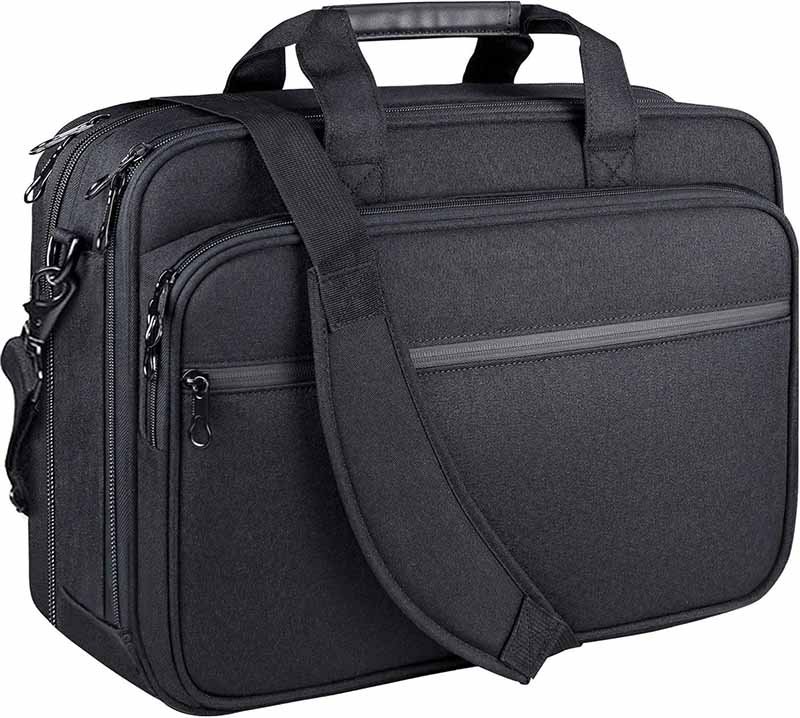
Which Materials Are Used in Laptop Bag Manufacturing with Reinforced Handles?
Laptop bag manufacturing with reinforced handles relies heavily on material selection. Even with strong stitching, the handle will not perform well if the materials are not matched correctly. The goal is to combine strength, flexibility, comfort, and long-term stability into one system.
Different materials serve different roles inside the handle structure. A well-designed handle is never built from a single material—it is always a combination.
Which webbing is used for reinforced handles?
Webbing is the core structural material inside most reinforced handles. It carries the majority of the load, while outer materials mainly affect appearance and comfort.
The two most common types are:
- Polyester webbing
- Nylon webbing
Each has its own characteristics:
| Property | Polyester Webbing | Nylon Webbing |
|---|---|---|
| Tensile strength | High | Very high |
| Stretch | Low | Medium |
| Water resistance | Good | Moderate |
| Cost | Lower | Higher |
| Shape stability | Strong | Slightly elastic |
In laptop bag manufacturing, polyester webbing is widely used because it offers a stable structure and cost efficiency. It does not stretch easily, which helps the handle maintain its shape over time.
Nylon webbing is stronger in pure tensile strength, but it has more elasticity. That elasticity can sometimes reduce the feeling of firmness when lifting heavier loads.
Webbing width is also critical:
- 20–25 mm → used for slim laptop sleeves
- 25–38 mm → standard laptop bags
- 38–50 mm → heavy-duty or travel bags
A wider webbing spreads force better across the hand and reduces pressure on stitching points.
Are fabric or webbing handles stronger?
Fabric alone is not strong enough for long-term load-bearing use. While some bags use folded fabric handles, these are usually limited to light-duty applications.
Webbing + fabric combination is the industry standard for reinforced handles.
Here is a direct comparison:
| Handle Type | Strength Level | Use Case |
|---|---|---|
| Fabric only | Low | lightweight sleeve |
| Fabric + interlining | Medium | casual bags |
| Webbing core + fabric wrap | High | standard laptop bags |
| Webbing + reinforcement + padding | Very high | premium or heavy-use bags |
Fabric handles may look clean and minimal, but they depend heavily on stitching strength. Over time, repeated lifting can cause the fabric to stretch or weaken.
Webbing handles provide:
- consistent strength
- better resistance to repeated stress
- improved load distribution
That is why most OEM laptop bags use hidden webbing even when the outside looks like soft fabric or neoprene.
How does padding improve reinforced handles?
Padding does not increase structural strength, but it improves usability and perceived quality. This matters more than many product teams expect.
When a bag reaches 3–5 kg, a thin handle can start to feel uncomfortable. Pressure concentrates in a narrow area of the hand, which reduces user experience.
Padding solves this by:
- increasing contact area
- reducing pressure points
- improving grip comfort
- adding a premium feel
Common padding materials include:
- EVA foam
- PE foam
- neoprene layers
Thickness typically ranges from 3 mm to 8 mm, depending on product positioning.
| Padding Type | Feel | Use Case |
|---|---|---|
| No padding | firm | slim, minimalist bags |
| Thin foam (3–4 mm) | moderate comfort | daily office bags |
| Medium foam (5–6 mm) | comfortable | commuter bags |
| Thick padding (7–8 mm) | soft grip | heavy load bags |
For custom laptop bags, padding is often used as a visual and tactile upgrade. Even if two bags have the same internal strength, the one with better handle comfort is usually perceived as higher quality.
What materials are used for outer handle wrapping?
The outer material affects how the handle looks and feels. It also needs to be compatible with the internal structure.
Common outer materials include:
- polyester fabric
- nylon fabric
- neoprene
- PU leather
- genuine leather
Each material creates a different product positioning:
| Material | Look & Feel | Market Position |
|---|---|---|
| Polyester | practical | mass market |
| Nylon | durable | outdoor/business |
| Neoprene | soft & flexible | tech/lifestyle |
| PU leather | smooth | mid-range premium |
| Genuine leather | natural | high-end |
Neoprene handles are popular for tech-style laptop bags because they feel soft and slightly elastic. However, neoprene alone is not strong enough, so it is always combined with webbing inside.
PU and leather handles focus more on aesthetics. They often require additional reinforcement because the outer layer can crack or deform over time if not properly supported.
Material matching is important. A strong webbing combined with a weak outer fabric can still lead to visible wear. A balanced structure ensures both performance and appearance last over time.
How Strong Are Laptop Bag Manufacturing with Reinforced Handles?
The strength of a reinforced handle is not just about how much weight it can hold once. What really matters is how it performs over time under repeated use.
A well-made reinforced handle should support daily carrying without deformation, seam damage, or structural fatigue.
What weight can reinforced handles carry?
Most reinforced laptop bag handles are designed to support 10–25 kg static load, depending on construction level.
However, real usage involves dynamic force, which is more demanding.
Here is a practical breakdown:
| Bag Type | Recommended Load | Reinforcement Level |
|---|---|---|
| Slim laptop sleeve | 3–5 kg | light reinforcement |
| Standard laptop bag | 5–8 kg | medium reinforcement |
| Business travel bag | 8–12 kg | strong reinforcement |
| Heavy-duty bag | 12–20 kg | advanced reinforcement |
Static load means the bag is held still. Dynamic load includes movement such as walking, lifting quickly, or swinging.
Dynamic stress can increase force by 1.5x to 2x, which is why safety margins are important.
Factories like Szoneier usually design handles with a higher safety factor than expected usage. For example:
- expected load: 6 kg
- tested load: 12–15 kg
This ensures the product remains reliable after long-term use.
How are reinforced handles tested?
Testing is a key part of manufacturing control. Without testing, even a well-designed handle can fail in production batches.
Common testing methods include:
- Static load test
- bag is filled with weight
- held for a fixed period (e.g., 24 hours)
- Dynamic lifting test
- repeated lifting cycles (e.g., 500–1000 times)
- Drop test
- bag is dropped with weight inside
- checks sudden impact resistance
- Seam inspection
- checks stitch integrity after testing
Example testing standard:
| Test Type | Condition | Purpose |
|---|---|---|
| Static load | 15 kg / 24h | check deformation |
| Dynamic cycle | 500 cycles | simulate daily use |
| Drop test | 1 m height | impact resistance |
| Seam check | visual + pull test | detect failure points |
Testing results help factories adjust:
- stitch density
- thread selection
- reinforcement size
- webbing width
Without these tests, product reliability depends too much on guesswork.
Do reinforced handles reduce tearing?
Yes, significantly.
Tearing usually starts at the stitch holes. When force is concentrated in a small area, the thread cuts into the fabric over time.
Reinforced handles reduce tearing by:
- spreading force across a wider area
- using backing materials to support the fabric
- increasing stitch density
- reducing movement at the seam
This can improve tear resistance by a large margin.
| Structure Type | Tear Risk |
|---|---|
| single stitch + no backing | high |
| double stitch + limited backing | medium |
| reinforced stitch + full backing | low |
The key factor is not just strength, but stress distribution.
How does long-term use affect handle performance?
Long-term performance depends on how well the handle resists fatigue.
After months of use, common issues include:
- thread loosening
- seam distortion
- fabric stretching
- handle twisting
Reinforced handles delay these issues because they are designed for repeated stress cycles.
Important factors affecting long-term durability:
- thread quality
- stitch consistency
- material compatibility
- load frequency
- user habits
For example:
- daily commuters create higher fatigue than occasional users
- heavy packing accelerates wear
- one-handed lifting creates uneven stress
A well-designed reinforced handle should maintain:
- shape stability
- seam integrity
- comfortable grip
even after extended use.
How to Choose Laptop Bag Manufacturing with Reinforced Handles?
Choosing the right factory for laptop bag manufacturing with reinforced handles is not only about price or sample appearance. The real difference shows in production consistency, handle durability, and how well the factory understands load-bearing structure.
A reliable manufacturer should be able to explain how the handle is built, how it is tested, and how they ensure the same quality across bulk orders—not just one good sample.
What should you check in a factory?
When evaluating a laptop bag factory, most customers focus on materials, pricing, and lead time. These are important, but for reinforced handle products, structural capability is just as critical.
Here are the key areas to review:
- handle construction method (webbing, layers, reinforcement)
- stitching techniques (X-box, bartack, stitch density)
- internal reinforcement (backing patches, stress distribution)
- production experience with similar products
- quality control process during sewing
- sample consistency vs mass production consistency
A simple checklist can help you quickly filter suppliers:
| Evaluation Area | What to Look For |
|---|---|
| Handle structure | multi-layer, not single fabric |
| Stitch quality | clean, dense, consistent |
| Reinforcement | visible bartack or X-box |
| Internal support | backing panel present |
| Sample strength | no deformation under load |
| Factory explanation | clear and detailed |
Factories that cannot clearly explain their handle construction usually rely on standard templates rather than engineered designs.
How to evaluate reinforced handle quality?
Many buyers receive samples that look strong but fail after bulk production. This happens because evaluation is often visual, not structural.
To properly evaluate reinforced handles, you should combine visual inspection + simple physical testing.
1. Visual inspection points:
- Are stitches evenly spaced and tight?
- Is there visible reinforcement at stress points?
- Does the handle sit flat and symmetrical?
- Is there any puckering or fabric distortion?
2. Manual testing:
- Load the bag with 5–10 kg and lift repeatedly
- Pull the handle outward slightly to check seam stability
- Observe whether the base area wrinkles or separates
3. Internal confirmation:
Ask the factory:
- Is there webbing inside the handle?
- Is there a reinforcement patch inside the panel?
- What thread is used?
- What is the stitch count per inch?
A strong supplier will answer clearly and consistently.
Which customization options are available?
Reinforced handles are not one-size-fits-all. Different markets require different designs.
A capable manufacturer should support customization in:
Structure customization:
- handle width (20 mm to 50 mm)
- padding thickness (3 mm to 8 mm)
- reinforcement size and position
- handle length and drop height
Material customization:
- polyester or nylon webbing
- neoprene, PU, leather wrapping
- soft-touch or textured finishes
Branding options:
- logo printing on handle
- embossed or debossed leather handles
- woven labels or rubber patches
- color matching with bag body
Functional upgrades:
- detachable handles
- reinforced grip zones
- anti-slip handle textures
Here is a simplified customization overview:
| Category | Options |
|---|---|
| Structure | width, padding, reinforcement |
| Material | webbing, neoprene, PU, leather |
| Branding | print, emboss, label |
| Function | detachable, ergonomic grip |
Factories like Szoneier often integrate handle customization into the full product development process, ensuring the handle matches the bag’s positioning—not treated as an afterthought.
Why does OEM/ODM capability matter?
OEM and ODM capability directly affect how well a factory can deliver reinforced handle products.
A basic factory can follow drawings. A strong factory can improve them.
With OEM/ODM support, you can:
- adjust handle structure based on target load
- optimize materials to balance cost and durability
- refine stitching methods for mass production stability
- develop samples faster with fewer revisions
- avoid common structural mistakes early
Without this capability, many issues only appear after bulk production begins, which increases cost and delays.
A factory with real development experience will often:
- suggest wider webbing for heavier bags
- increase reinforcement area for larger sizes
- recommend different stitch patterns for different fabrics
- adjust padding based on user comfort expectations
This kind of feedback saves time and reduces risk.
Final Section: Start Your Custom Laptop Bag Project with Szoneier
If you are developing a laptop bag product, reinforced handles should be treated as a core part of your design—not a small detail.
At Szoneier, reinforced handle construction is built into the product development process from the beginning. With over 18 years of experience in fabric and bag manufacturing, the team focuses on how materials, stitching, and structure work together in real use conditions.
Typical production workflow:
| Step | Description |
|---|---|
| Design review | confirm structure and materials |
| Sample development | build and test reinforced handle |
| Testing | load and durability checks |
| Production | controlled sewing and QC |
| Delivery | packaging and shipment |
Whether you are launching a new product line or upgrading an existing design, reinforced handles can directly improve product reliability and customer satisfaction.
A well-made handle reduces complaints, improves user experience, and helps your product stand out in a competitive market.
Send Your Inquiry Today
If you already have a design, Szoneier can help you refine the handle structure and improve durability before production.
If you are still at the concept stage, the team can recommend suitable materials, reinforcement methods, and cost-effective solutions based on your target market.
You can start with:
- a simple sketch
- reference photos
- or even just an idea
From there, Szoneier will help you turn it into a production-ready product.
Contact Szoneier today to get:
- free design consultation
- fast sample development
- professional manufacturing support
A stronger handle is a small change in structure—but a big upgrade in product quality.