A long garment bag looks like a simple product, but once it is made for formal clothing, the manufacturing standard becomes much higher than many people expect. A suit, gown, uniform, stage costume, or wedding dress does not just need a bag that covers it. It needs a bag that protects length, keeps shape, reduces wrinkles, prevents dust, and stays reliable during storage, transport, and repeated handling. That is where many low-quality products fail. They may look acceptable in photos, but once the clothing is packed, hung, shipped, or carried, problems begin to appear: dragging hems, crushed shoulders, weak zippers, poor hanging balance, and fabric creases that are difficult to remove.
Long garment bag manufacturing for formal clothing is the process of designing and producing extended garment bags that protect longer and more delicate garments without forcing them into tight folds. It includes choosing the right size, selecting suitable materials, building a structure that supports the garment naturally, and controlling production details such as stitching, zipper placement, gusset width, and reinforcement.
For clothing brands, wholesalers, uniform suppliers, wedding businesses, and retailers, this is not just packaging. It is part of the product experience. A good long garment bag makes formal clothing look more valuable, travel better, and arrive in better condition. A bad one can damage presentation, increase returns, and weaken trust in the brand. In many cases, the difference between a reusable, high-value garment bag and a disposable one is not only material cost. It is whether the factory understands how formal clothing behaves inside the bag. Once you look at the product from that angle, long garment bag manufacturing becomes much more than simple sewing. It becomes a small but important part of how a clothing business protects its reputation.
What Is a Long Garment Bag?
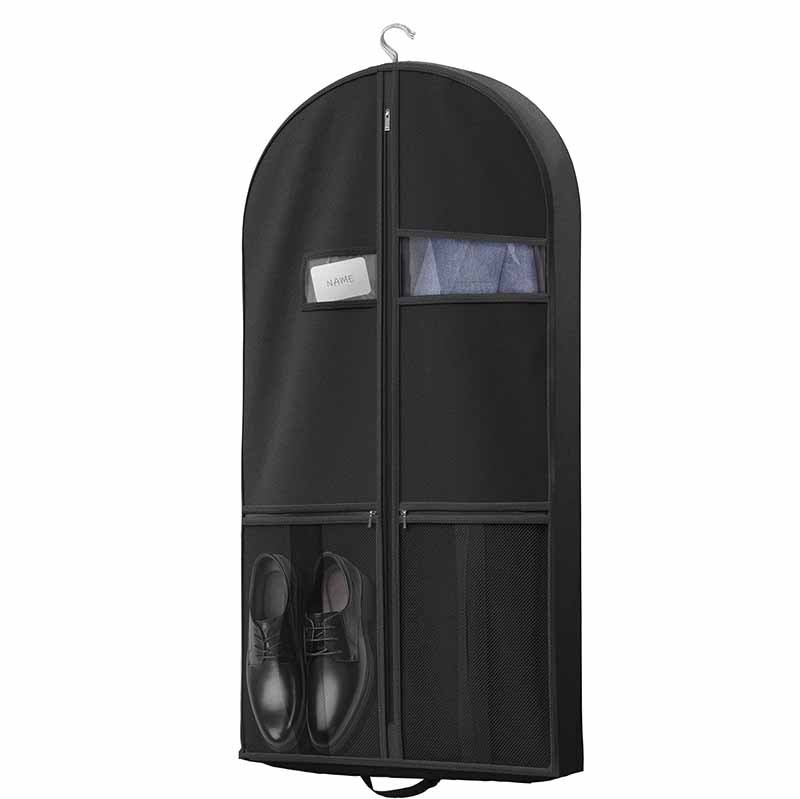
A long garment bag is a garment cover made to hold formal clothing at near-full length, so the clothing hangs more naturally and stays in better condition. It is mainly used for suits, coats, dresses, uniforms, robes, and gowns that should not be compressed into short bags. The key value of a long garment bag is simple: better protection for shape, fabric surface, and presentation.
What Size Is a Long Garment Bag?
The most practical way to understand a long garment bag is by its usable length. In manufacturing, “long” usually means the bag is made to protect clothing that cannot fit well inside common short garment covers. For most formal clothing projects, finished bag length often falls between 120 cm and 180 cm, depending on the garment type, target market, and whether the customer wants extra bottom clearance.
A business suit bag may work well at around 100–120 cm, while a long coat often needs 120–140 cm. Evening dresses and formal gowns usually require 140–160 cm, and wedding dress bags may need 160–180 cm or more, especially when the dress has extra length, a fuller skirt, or decorative lower sections that should not be pressed tightly.
The right size is not only about whether the clothing fits. It directly affects product value and user experience. If the bag is too short, the garment hem bends upward or must be folded, which increases wrinkle risk. If the bag is too long, the product becomes harder to carry, takes more storage space, and raises shipping cost.
Factories normally evaluate size using several points:
- Garment full length
- Shoulder width and thickness
- Skirt spread or coat volume
- Hanger height above the neckline
- Whether the bag will be folded for travel
- Whether the customer wants extra space at the bottom
Below is a practical size reference many customers use during product planning:
| Garment Type | Suggested Bag Length | Suggested Bag Width |
|---|---|---|
| Men’s suit | 100–120 cm | 55–65 cm |
| Long coat | 120–140 cm | 60–70 cm |
| Evening dress | 140–160 cm | 65–75 cm |
| Choir robe / uniform | 130–150 cm | 60–75 cm |
| Wedding dress | 160–180 cm | 70–90 cm |
For customers developing custom garment bags, this is why sampling matters so much. A few centimeters can change how the product performs in real use. A factory that understands garment structure will usually ask for clothing measurements, garment photos, or even fitting references before finalizing size.
Which Clothes Need a Long Garment Bag?
Not every clothing item needs a long garment bag. The product becomes necessary when the clothing has one or more of these characteristics: full length, structured shoulders, delicate outer fabric, decorative surfaces, or higher retail value. In simple terms, the more the clothing depends on presentation, shape, and clean delivery, the more important the garment bag becomes.
The most common clothing categories that need long garment bags include:
- Business suits and formal sets
- Long overcoats and trench coats
- Dresses and evening gowns
- Wedding dresses and bridesmaid dresses
- School, hotel, airline, and ceremonial uniforms
- Choir robes and academic gowns
- Performance costumes and stagewear
- Luxury fashion items sold with protective packaging
These garments are different from casual T-shirts, hoodies, or everyday items because their appearance can be damaged more easily by poor storage. Shoulder lines can collapse. Long hems can crease. Embellishments can rub against the wrong surface. Zippers, belts, or decorative trims can snag if the inside space is too tight.
From a business point of view, customers buying long garment bags usually care about more than simple covering. They care about what happens after packing:
- Will the clothing arrive ready to wear or display?
- Will the bag help reduce ironing or steaming work?
- Will it support premium product presentation?
- Will it protect garments during hanging, shipping, or showroom use?
- Will the garment bag itself make the brand look more professional?
That is why long garment bags are widely used by fashion brands, uniform programs, garment exporters, event companies, bridal businesses, and premium retailers. In many of these industries, the bag is part of the service promise. It helps the clothing look cared for before the customer even opens it.
Is a Long Garment Bag Better Than Standard Bags?
A long garment bag is not automatically better for every situation, but for formal clothing it is often the more suitable and more professional option. The real question is not “Which one is better in general?” but “Which one protects this garment better in real use?”
A standard garment bag works well for shorter items, lighter use, or low-cost packaging needs. It is cheaper to make, easier to store, and lower in shipping volume. But once the garment is longer, heavier, or more shape-sensitive, the limitations become obvious. The garment may fold too much at the bottom, press too tightly inside the bag, or lose its intended silhouette.
A long garment bag offers several practical advantages:
- It allows garments to hang with less folding
- It reduces crease pressure at the lower half
- It improves presentation for formal products
- It usually provides more balanced internal space
- It can better protect long zippers, trains, and decorated surfaces
That said, longer bags also require more from the factory. They use more fabric, need stronger suspension support, and often require better zipper selection and stronger top-end reinforcement because the bag carries more vertical load. If these details are not handled properly, a longer bag can still fail.
The comparison below helps explain why the decision should be based on clothing type, not only price:
| Item | Standard Bag | Long Garment Bag |
|---|---|---|
| Best for | Short garments | Formal and long garments |
| Wrinkle control | Moderate | Better |
| Material use | Lower | Higher |
| Shipping volume | Lower | Higher |
| Structure demand | Simpler | More demanding |
| Product perception | Basic | More premium |
For customers selling higher-value garments, the added cost of a long garment bag is often justified because it helps protect the clothing, reduces after-sale problems, and improves the customer’s first impression. In other words, the bag is not just an accessory. It becomes part of the product presentation.
What Materials Are Used in Long Garment Bag Manufacturing?
Material choice shapes nearly every part of a long garment bag’s performance. It influences durability, drape, hand feel, dust protection, breathability, moisture resistance, printing quality, and final cost. A bag made for a low-cost suit program needs very different material logic from a bag made for bridal wear or a premium private label fashion brand. That is why serious garment bag manufacturing starts with material matching, not random fabric selection.
Which Fabrics Are Used for Long Garment Bag?
Long garment bags are made from several common material families, and each serves a different business purpose. The most widely used options include non-woven fabric, polyester, nylon, cotton or canvas, PEVA or PVC window materials, and in some specialized cases, neoprene composites or padded constructions.
Non-woven fabric is often used for low-cost or promotional garment bags. It is lightweight and inexpensive, which makes it attractive for high-volume packaging programs. But it has limits in tear strength, long-term reuse, and premium appearance. It works better for short-term covering than for durable branded products.
Polyester is one of the most flexible choices for mid-range projects. It is widely available in different weights, easy to print, relatively stable in production, and suitable for both simple and upgraded structures. Common options like 210D, 300D, 420D, and 600D allow factories to balance weight, durability, and cost.
Nylon is often chosen when customers want lighter weight with stronger tensile performance. It works especially well in travel garment bag designs where portability matters. It usually feels smoother than some polyester options and can support a more refined product appearance.
Cotton and canvas are popular for customers wanting a natural look, softer touch, and more premium packaging feel. They are often used by brands that care about presentation and reusability. They can also be paired with linings, piping, or inner compartments to raise perceived value.
Here is a practical comparison customers often consider:
| Material | Main Advantage | Main Limitation | Best Use |
|---|---|---|---|
| Non-woven | Low cost | Lower durability | Promotional / entry-level |
| Polyester | Balanced choice | Less natural feel | General OEM / retail |
| Nylon | Light and strong | Higher material cost than some polyester | Travel / upgraded products |
| Cotton / Canvas | Better look and feel | Heavier and often more expensive | Premium garment bags |
| PEVA / clear window film | Visibility | Not ideal as full main body alone | Window sections |
For customers, the best fabric is the one that matches the clothing value, target price, and expected reuse cycle. A cheap material may reduce initial cost, but if the bag tears easily or looks disposable, it can hurt the clothing brand more than it helps.
Is Breathable or Waterproof Better for Long Garment Bag?
This is one of the most practical sourcing questions, because the answer changes depending on how the garment bag will be used. Breathable materials and waterproof materials solve different problems. One is not always better than the other.
Breathable garment bags are better for long-term closet storage, showroom use, and formal garments that benefit from airflow. Materials like cotton, canvas, and some non-woven fabrics help reduce trapped moisture and odor buildup. This matters when clothing will stay inside the bag for longer periods or when the garment fabric itself is sensitive to poor ventilation.
Water-resistant or waterproof materials are better when the garment bag will be used in travel, transport, shipping, or environments where the outer surface may be exposed to moisture. Polyester or nylon with coating can improve protection against rain, splashes, and surface contamination. For some commercial use cases, this is more valuable than maximum breathability.
The real decision usually depends on the business scenario:
- Retail packaging for home closet use → breathable is often better
- Travel garment bags for active carrying → water resistance matters more
- Bridal and formalwear transport → a balanced structure often works best
- Uniform supply and repeated logistics → durability plus surface protection is important
For many projects, the best solution is not choosing only one side. It is combining both ideas. For example, a garment bag can use a stronger outer shell with a smoother or lighter inner construction, or use breathable panels together with more protective main fabric.
This comparison helps customers make the decision more clearly:
| Requirement | Better Choice |
|---|---|
| Long-term home storage | Breathable fabric |
| Daily travel use | Water-resistant fabric |
| Premium presentation | Cotton / canvas / lined polyester |
| Rain or shipping exposure | Coated polyester / nylon |
| Lower odor risk | Breathable structure |
Customers should avoid using “waterproof” as a default selling point if the real product goal is garment care during closet storage. In many cases, better airflow protects formal clothing more effectively than heavy outer coating.
Do Premium Brands Choose Better Long Garment Bag Materials?
Yes, in most cases premium brands do choose better materials, but not only because they can afford them. They do it because better materials support better presentation, stronger reuse value, and more consistent brand perception. A long garment bag for a premium garment is part of the customer’s first physical impression. If the bag feels thin, noisy, weak, or disposable, it can lower the perceived value of the clothing inside.
Premium garment bag material upgrades usually show up in several ways:
- Higher fabric weight, such as moving from 210D to 420D or 600D
- Smoother lining or cleaner inner finishing
- Stronger zipper quality and better pullers
- More stable structure with piping or gusset reinforcement
- Better logo printing, embroidery, woven labels, or custom hardware
- Cleaner stitching and fewer loose threads
- Better touch and drape when hanging
Many premium brands also think in terms of reuse. A reusable garment bag stays with the customer longer, which means the brand identity remains visible for months or even years. That makes the bag part of long-term packaging value, not just shipping protection.
A simple comparison shows how this difference appears in finished products:
| Feature | Basic Product | Premium Product |
|---|---|---|
| Main fabric | Thin non-woven or light polyester | Heavier polyester, nylon, canvas |
| Logo method | Simple print | High-quality print, embroidery, label |
| Zipper | Standard | Smoother, stronger, better-finished |
| Structure | Flat and simple | Better support and cleaner shape |
| Reuse value | Low to moderate | High |
For factories, premium projects also demand more stable production control. Better materials alone do not create a premium result. The factory needs to cut accurately, sew neatly, align logos properly, and finish the bag cleanly. That is why customers looking for custom, private label, or OEM garment bags often prefer experienced suppliers that can support both development and quality consistency. For a factory like Szoneier, this kind of work is closely connected to its long experience in custom soft goods manufacturing, material selection, and small-to-medium MOQ project support.
How Does Long Garment Bag Manufacturing Work?
Long garment bag manufacturing is not just about cutting fabric and sewing it together. For formal clothing, the process must control shape, balance, internal space, and durability. A small mistake in structure or assembly can lead to visible problems like wrinkles, sagging, zipper failure, or poor hanging alignment.
From a factory perspective, production usually follows a clear workflow: design confirmation → material preparation → cutting → assembly → structural reinforcement → finishing. Each step affects the final performance.
For customers, understanding this process helps answer key questions:
- Why do some garment bags wrinkle clothing while others don’t?
- Why do some bags lose shape after a few uses?
- Why do some zippers fail quickly?
The answer is almost always related to how the bag is designed and manufactured—not just the material.
How Is a Long Garment Bag Designed?
Design is where most performance differences are decided. A long garment bag must hold clothing vertically, distribute weight evenly, and allow enough internal space without becoming bulky or unstable.
The first step is defining how the garment sits inside the bag. This includes:
- Shoulder width and hanger position
- Garment thickness (single suit vs multiple pieces)
- Length clearance at the bottom
- Whether the bag will be folded during travel
If these are not considered, the garment may press against the bottom, causing wrinkles, or hang unevenly, putting stress on the zipper and top seam.
Another key factor is panel layout. A simple flat design is cheaper but may not provide enough internal volume. More advanced designs include gussets or expanded sides, which allow garments to hang more naturally.
Factories also need to consider:
- Zipper direction (full front, half opening, L-shape)
- Handle placement for balanced carrying
- Reinforcement at load points
- Logo position and printing method
A well-designed garment bag reduces later production issues and improves the final user experience.
Here is how design choices affect performance:
| Design Element | Poor Design Result | Optimized Design Result |
|---|---|---|
| Bag length | Garment folds or wrinkles | Natural hanging |
| Gusset width | Clothing compressed | Better shape retention |
| Zipper path | Hard to access | Easy opening |
| Handle position | Uneven carrying | Balanced load |
| Top opening | Weak hanger support | Stable hanging |
Good design reduces complaints and improves repeat orders.
How Is a Long Garment Bag Made?
Once the design is confirmed, production moves into cutting and assembly. This stage directly affects consistency, durability, and overall product quality.
Cutting must be precise because long garment bags require alignment across large panels. Even small errors can cause visible distortion.
Factories typically use:
- Manual cutting for small orders
- Die cutting for bulk production
- Layer cutting for efficiency
After cutting, assembly begins. Unlike standard bags, long garment bags must handle vertical stress. The weight of the garment pulls downward, so the top area and zipper line must be reinforced.
Common assembly steps include:
- Panel stitching or joining
- Zipper installation
- Gusset attachment
- Handle sewing
- Edge finishing
Key production risks at this stage:
- Uneven stitching causing shape distortion
- Weak zipper ends leading to breakage
- Misaligned panels affecting appearance
- Poor reinforcement causing tearing
Factories with better control systems reduce these risks through:
- Standardized production steps
- Skilled workers for critical areas
- Consistent material handling
Below is a comparison of production quality levels:
| Production Factor | Low Control | High Control |
|---|---|---|
| Cutting accuracy | Inconsistent | Precise |
| Stitch quality | Uneven | Clean and strong |
| Zipper installation | Weak ends | Reinforced |
| Shape consistency | Variable | Stable |
| Defect rate | Higher | Lower |
For customers, this is why factory selection matters more than small price differences.
How Does a Long Garment Bag Prevent Wrinkles?
Wrinkle prevention is one of the main reasons customers choose long garment bags. However, not all long bags perform equally. The ability to reduce wrinkles comes from structure, not just length.
There are several key factors:
1. Internal Space
If the bag is too tight, the garment is compressed. This creates pressure lines and wrinkles. Proper gusset width allows clothing to hang freely.
2. Vertical Support
The top of the bag must support the weight of the garment evenly. If the hanger area is weak, the garment may tilt or sag, causing uneven pressure.
3. Fabric Smoothness
Inner surfaces should be smooth enough to avoid friction. Rough or low-quality materials can create drag and affect garment shape.
4. Limited Folding Points
Some travel garment bags include foldable designs. If folding is required, it should be controlled and supported, not random.
5. Structural Stability
The bag should maintain its shape during transport. If it collapses, the garment inside loses its natural form.
A well-made long garment bag often includes:
- Gusseted sides for extra volume
- Reinforced hanger opening
- Smooth inner lining or coating
- Balanced weight distribution
- Optional internal straps to stabilize garments
Here is a simple performance comparison:
| Feature | Basic Bag | Advanced Long Garment Bag |
|---|---|---|
| Internal space | Limited | Expanded |
| Wrinkle control | Moderate | Strong |
| Shape retention | Weak | Stable |
| Travel performance | Average | Better |
| User experience | Basic | Professional |
For customers selling formal clothing, wrinkle reduction directly affects product presentation and customer satisfaction.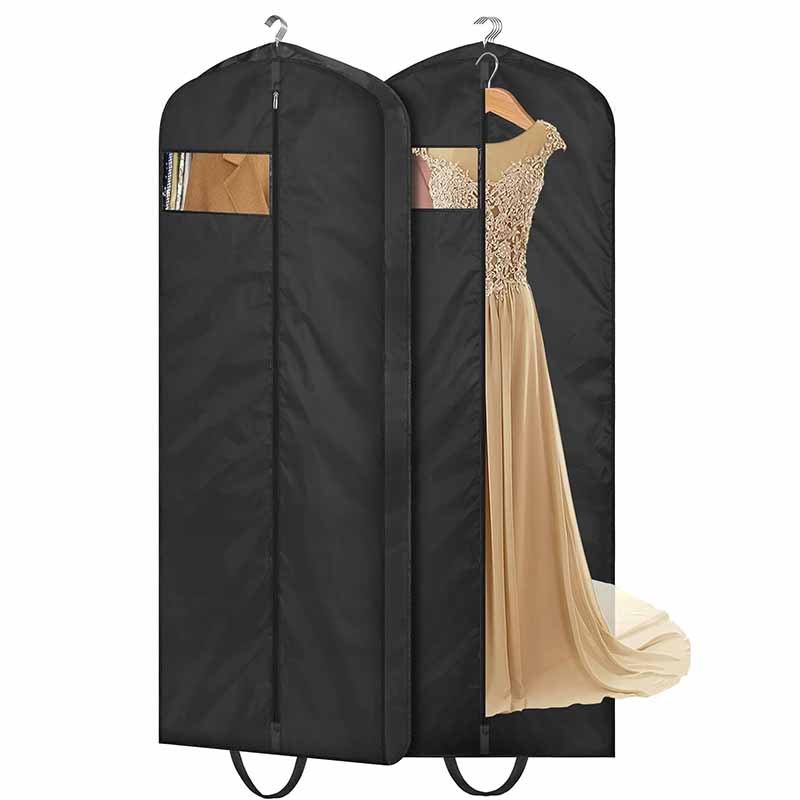
Which Features Make a Good Long Garment Bag?
A long garment bag is not defined only by size and material. Features play a major role in how the product performs in real use. The right features improve usability, durability, and overall value.
For customers, these details often decide whether a product feels “cheap” or “well-made.”
Does a Long Garment Bag Need Gussets?
Gussets are one of the most important features in a long garment bag. They create extra depth, allowing clothing to hang naturally instead of being pressed flat.
Without gussets:
- Garments are compressed
- Wrinkles form more easily
- Zippers experience more stress
With gussets:
- Clothing has more space
- Airflow improves
- Shape retention is better
Typical gusset widths range from 5 cm to 15 cm, depending on garment thickness.
| Gusset Width | Use Case |
|---|---|
| 3–5 cm | Single thin garments |
| 5–10 cm | Suits and coats |
| 10–15 cm | Dresses and bulkier items |
For formal clothing, gussets are strongly recommended.
Which Zipper Is Best for Long Garment Bag?
Zippers are one of the most common failure points in garment bags. Choosing the right zipper improves durability and user experience.
Common zipper types include:
- Standard nylon zippers (cost-effective)
- Reverse coil zippers (cleaner look)
- Metal zippers (premium appearance, heavier)
Important factors:
- Smooth opening and closing
- Strong zipper teeth or coil
- Reinforced ends to prevent tearing
- Proper stitching alignment
Zipper length also matters. Full-length zippers make access easier but require better reinforcement.
| Zipper Type | Durability | Cost | Use |
|---|---|---|---|
| Nylon coil | Good | Low | Standard bags |
| Reverse coil | Good | Medium | Retail products |
| Metal zipper | Very high | High | Premium bags |
A poorly installed zipper can fail even if the material is good.
How Do Handles Help a Long Garment Bag?
Handles may seem simple, but they directly affect usability. A long garment bag is often carried during travel or transport, so balance and strength are critical.
Key handle considerations:
- Position: centered for balanced weight
- Reinforcement: prevents tearing under load
- Length: suitable for hand or shoulder carry
- Stitching: strong enough for repeated use
Some designs include:
- Dual handles for better control
- Shoulder straps for travel convenience
- Reinforced top loops for hanging
If handles are poorly designed:
- The bag tilts during carrying
- Stress concentrates at weak points
- Product lifespan decreases
A well-designed handle system improves both function and perceived quality.
How Is Long Garment Bag Quality Controlled?
Quality control is where many garment bag projects succeed or fail. A sample may look good, but if production is not controlled properly, bulk orders can show problems such as uneven size, weak stitching, zipper defects, or inconsistent materials.
For customers, especially those ordering in bulk, the biggest concern is not whether a factory can make a good sample—it is whether they can repeat the same quality across thousands of units.
In long garment bag manufacturing, quality control usually covers three stages:
- Raw material inspection
- In-line production control
- Final product inspection
Each stage helps reduce risk before the product reaches the customer.
How Is a Long Garment Bag Tested?
Testing is the most direct way to confirm whether a garment bag meets real usage requirements. A professional factory will not rely only on visual checks. It will simulate real conditions to identify weak points.
Common testing methods include:
1. Load Testing (Weight Bearing Test)
This test checks whether the bag can support the weight of garments without tearing.
- Typical load: 5–15 kg depending on product
- Focus area: handle stitching, top seams, hanger opening
2. Zipper Cycle Test
The zipper is opened and closed repeatedly to test durability.
- Standard cycles: 500–3000 times
- Checks for smoothness, alignment, and failure points
3. Seam Strength Test
Measures how much force seams can handle before breaking.
- Important for long garment bags due to vertical stress
4. Hanging Stability Test
The bag is hung with garments inside to observe shape retention.
- Checks for sagging, tilting, or deformation
5. Folding and Transport Simulation
Used for travel garment bags that need to be folded.
- Ensures no permanent creases or structural damage
Here is a simple overview:
| Test Type | What It Checks | Why It Matters |
|---|---|---|
| Load test | Weight capacity | Prevents tearing |
| Zipper test | Durability | Reduces returns |
| Seam test | Strength | Ensures long-term use |
| Hanging test | Shape | Maintains garment form |
| Folding test | Flexibility | Improves travel usability |
Customers should always ask suppliers:
“What tests do you perform before shipment?”
Are Long Garment Bags Durable Enough?
Durability depends on how well the bag is designed and manufactured—not just the material. Two products using the same fabric can perform very differently.
A durable long garment bag should handle:
- Repeated opening and closing
- Frequent carrying
- Long-term hanging
- Environmental exposure (dust, light moisture)
Key durability factors include:
1. Fabric Strength
Higher denier fabrics (e.g., 420D–600D polyester) last longer than thinner materials.
2. Stitching Quality
Tight, even stitching improves strength and appearance.
3. Reinforcement Areas
Top corners, zipper ends, and handles must be reinforced.
4. Zipper Quality
A weak zipper can fail even if the bag body is strong.
5. Edge Finishing
Clean edges prevent fraying and improve lifespan.
Below is a durability comparison:
| Component | Low-End Product | High-Quality Product |
|---|---|---|
| Fabric | Thin, easy to tear | Strong, wear-resistant |
| Stitching | Loose or uneven | Tight and consistent |
| Zipper | Basic, short lifespan | Smooth and durable |
| Reinforcement | Minimal | Strong at stress points |
| Lifespan | Short-term use | Long-term reusable |
For many customers, durability is directly linked to cost efficiency. A slightly higher unit cost often results in:
- Fewer replacements
- Lower return rates
- Better customer reviews
- Stronger brand image
How Do Factories Ensure Long Garment Bag Quality?
Consistency is one of the biggest challenges in manufacturing. A factory may produce a perfect sample, but maintaining the same quality in bulk production requires system control.
Reliable factories usually follow these practices:
1. Material Batch Control
Using the same material batch for the same order to avoid variation in color, thickness, or quality.
2. Standardized Production Process
Clear production steps reduce variation between workers and shifts.
3. Skilled Workers for Key Steps
Critical areas such as zipper installation and handle reinforcement are handled by experienced workers.
4. In-Line Inspection
Checking products during production, not only at the end.
5. Final Random Inspection
Sampling finished products to ensure consistency before shipment.
6. Defect Tracking
Recording and analyzing defects to improve future production.
Here is how control level affects outcomes:
| Control Level | Result |
|---|---|
| Low control | High defect rate, inconsistent quality |
| Medium control | Acceptable quality, some variation |
| High control | Stable quality, fewer complaints |
For customers, choosing a factory with strong quality control systems is more important than choosing the lowest price.
Why Work With Szoneier for Long Garment Bag Manufacturing?
Choosing the right supplier is not just about production—it is about building a stable and reliable product line.
Szoneier has over 18 years of experience in soft material product development and manufacturing, including neoprene, fabric-based products, and custom bags.
What Makes Szoneier Different
1. Strong Material Experience
From polyester and nylon to neoprene and composite materials, Szoneier understands how different materials behave in real production.
2. Wide Product Range
Experience across bags, garment covers, sports supports, medical supports, wetsuits, and more. This helps in solving complex product requirements.
3. Low MOQ Support
Starting from around 50 pcs, making it easier for customers to test new designs.
4. Fast Sampling
Typical sample time: 5–7 days, helping customers move quickly.
5. Free Design Assistance
Support for structure optimization, material selection, and logo placement.
6. Stable Quality Control
Consistent production processes ensure repeatable quality.
7. Flexible OEM / ODM Service
Supports custom branding, private label, and full product development.
Final Thoughts: How to Choose the Right Long Garment Bag
When sourcing long garment bags, focus on practical performance instead of only price.
Ask these key questions:
- Does the size match the garment type?
- Is the material suitable for the intended use?
- Does the structure support wrinkle prevention?
- Are key features like gussets and zippers properly designed?
- Can the factory maintain consistent quality in bulk production?
A good long garment bag protects clothing, improves presentation, and reduces after-sale problems. A poor one does the opposite.
Call to Action
If you are developing custom long garment bags for formal clothing, working with an experienced factory can save time, reduce risk, and improve product results.
Send your inquiry today to get a free sample and quotation.
Let’s create a long garment bag that protects your products and strengthens your brand.