Skip to content
A waterproof dry bag looks simple from the outside—roll the top, clip the buckle, go. But anyone who has had a “waterproof” bag fail knows the truth: most leaks are not mysterious. They happen because the material is too thin for the abuse it receives, too stiff for the way it gets folded, or paired with a construction method that doesn’t match the fabric. In real use—kayaks scraping rocks, backpacks bouncing on trails, wet decks, sand, sun, and repeated rolling—material thickness becomes the difference between “still dry” and “everything ruined.”
Dry bag material thickness is the combined build of the base fabric and its waterproof layers, commonly expressed in mm or mil (and sometimes indicated by GSM). The right thickness is the one that fits your use: ultralight travel needs flexibility and low weight, while rafting, fishing, and tool storage need stronger puncture resistance and better seam reliability. A well-chosen thickness also improves long-term performance because the bag survives repeated rolling without developing micro-cracks or pinholes.
Here’s a situation many travelers recognize: you pack a phone, spare clothes, and a power bank—only to discover later that water entered through a crease line you didn’t even notice. That’s why understanding thickness is not “technical talk.” It’s practical insurance for your gear.
What Does “Thickness” Mean for Dry Bags?
Thickness in a dry bag means the real physical build of the waterproof material—usually a base textile plus a TPU/PVC film or coating. It directly affects puncture resistance, abrasion life, flexibility, roll-top sealing behavior, and the strength of welded or taped seams. Choosing thickness should start from how the bag will be used, not from marketing labels like “heavy duty.”
What is material thickness measured in?
Different markets list thickness differently, so customers often compare the wrong numbers. Here’s how to read the three most common units:
Millimeters (mm) — most direct and easiest to understand
- Measures the physical depth of the laminated sheet (fabric + films).
- Common dry bag ranges: 0.25–0.80 mm.
Mil — common in North America
- 1 mil = 0.0254 mm
- Quick conversion examples:
| mil | mm (approx.) |
|---|---|
| 10 mil | 0.25 mm |
| 15 mil | 0.38 mm |
| 20 mil | 0.51 mm |
| 25 mil | 0.64 mm |
| 30 mil | 0.76 mm |
GSM — weight per square meter (not thickness)
- GSM is useful for comparing overall weight, but it doesn’t guarantee waterproof reliability by itself.
- Two materials can have similar GSM but different thickness if one uses heavier yarns or different coatings.
“What thickness should I expect?”
| Use Style | mm Range | What It Feels Like | Best For |
|---|---|---|---|
| Ultralight | 0.25–0.35 mm | very soft, packs small | travel backup, light hiking |
| Balanced outdoor | 0.40–0.55 mm | flexible + protective | kayaking, camping, boating |
| Heavy duty | 0.60–0.80 mm | tougher, more structure | rafting, fishing, tools, sharp gear |
Important practical note: Above ~0.70–0.80 mm, bags can become harder to roll neatly, especially in cold weather. More thickness can sometimes reduce sealing comfort if stiffness prevents a clean roll-top fold.
How is thickness different from fabric denier (D) and coating weight?
Many customers see “500D” and assume it means thick, rugged, waterproof. That’s only part of the story.
Denier (D) = yarn thickness in the woven base fabric
- 210D, 420D, 500D, 840D are common.
- Higher D often means stronger fabric, but waterproofness comes from the coating/film and construction.
Coating weight = how much waterproof polymer is applied
- TPU/PVC layers can be thicker or thinner, affecting flexibility and crack resistance.
Thickness = the final laminated build you actually get
- Fabric + coating/film + bonding = what determines how it performs at fold lines and seams.
Why customers should care (real-life outcome)
A bag can be “high denier” but still fail if:
- coating is thin and develops micro-cracks at creases
- seams are stitched without proper sealing
- roll-top area is too stiff to fold cleanly
Quick comparison table (what changes, what doesn’t)
| Spec | What It Tells You | What It Does NOT Guarantee |
|---|---|---|
| Denier (D) | fabric tear strength & weave robustness | waterproof reliability |
| GSM | overall weight & “heaviness” feel | puncture resistance at folds |
| Thickness (mm/mil) | fold durability + puncture barrier potential | seam quality / welding quality |
| Construction method | how seams and joints resist leaks | raw fabric durability alone |
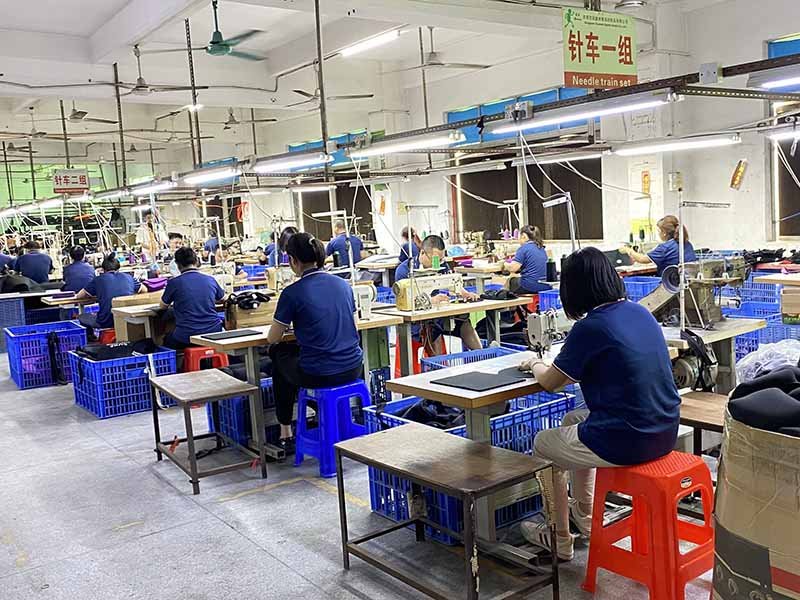
Factory reality: Waterproof performance is a system: material + thickness + seam method + roll-top design. If one part is weak, the bag fails where stress concentrates.
What thickness range is common for waterproof dry bags?
Most successful dry bags in the market cluster around 0.40–0.60 mm because it hits a sweet spot:
- flexible enough to roll and pack
- thick enough to resist punctures and abrasion for normal outdoor use
- compatible with common welding and heat-sealing processes
Practical thickness categories used in OEM production
| Category | Thickness Range | Common Product Position | What Customers Usually Expect |
|---|---|---|---|
| Entry / travel | 0.25–0.40 mm | light-duty protection | “Keep clothes dry in rain” |
| Outdoor standard | 0.40–0.60 mm | most outdoor uses | “Waterproof for weekends” |
| Pro / heavy duty | 0.60–0.80 mm | harsh environments | “Can take abuse and stay sealed” |
Where thickness really matters (customer pain points)
Customers usually complain about one of these:
- Pinholes and micro-leaks Often caused by thin films stressed at repeated fold lines.
- Cracking at roll-top folds Happens when material is stiff, or when coating is brittle in cold weather.
- Seam leakage Not only thickness—seam construction quality matters—but thin materials can be harder to weld consistently.
Extra: “Thickness vs. Feel” (what customers notice immediately)
Customers don’t think in mm. They think in feel:
| Customer Description | Likely Thickness | What It Means in Use |
|---|---|---|
| “Super packable” | 0.25–0.35 mm | light, needs careful handling |
| “Feels like real outdoor gear” | 0.40–0.55 mm | balanced for most activities |
| “Feels tough and structured” | 0.60–0.80 mm | strong, slightly heavier/stiffer |
This helps brands position products clearly without confusing numbers.
Which Materials Are Used in Dry Bags?
Waterproof dry bags are not defined by thickness alone. The base material system—TPU laminate, PVC coating, or coated nylon—determines how that thickness behaves in real outdoor conditions such as folding, abrasion, UV exposure, and temperature change.
In practice, two bags with the same 0.5 mm thickness can perform very differently depending on the polymer type, bonding structure, and flexibility of the laminate.
Which is better for dry bags: TPU, PVC, or coated nylon?
Each material dominates a different segment of the market. The best choice depends on use frequency, environmental stress, and price target, not just waterproof rating.
Core material comparison
| Material | Flexibility | Abrasion Resistance | Cold-Weather Behavior | Environmental Profile | Typical Market Level |
|---|---|---|---|---|---|
| TPU laminate | Very high | High | Stays flexible | PVC-free, cleaner | Mid- to high-end outdoor |
| PVC coating | Medium | Very high | Can stiffen in cold | Lower eco profile | Budget to heavy-duty |
| PU/Coated nylon | High | Medium | Good flexibility | Lightweight option | Ultralight & travel |
Real-world interpretation customers care about
- TPU is preferred for premium outdoor gear because it
- bends repeatedly without cracking
- welds cleanly at seams
- maintains softness in cold environments
- PVC remains popular because it
- is extremely tough against rocks and rough handling
- costs less for large-volume production
- supports thick heavy-duty constructions
- Coated nylon is chosen when
- weight must stay low
- packability matters more than puncture resistance
- the bag is used for light rain protection rather than rafting impact
Key takeaway: Material choice determines how useful a given thickness really is.
What are the pros and cons of single-layer vs laminated fabrics?
Dry bag materials are built in two main structural ways:
Single-layer coated fabric
A woven textile receives a surface waterproof coating.
Advantages
- lighter weight
- softer folding
- lower cost
Limitations
- coating can wear away at crease lines
- long-term waterproof reliability is lower
- harder to weld perfectly at seams
Multi-layer laminated structure
A waterproof film (TPU or PVC) is bonded to fabric under heat and pressure.
Advantages
- stronger puncture barrier
- consistent seam welding
- longer waterproof life under repeated rolling
Limitations
- slightly heavier
- higher material cost
Durability comparison at equal thickness (~0.5 mm)
| Structure Type | Abrasion Life | Fold Crack Risk | Seam Reliability | Expected Lifespan |
|---|---|---|---|---|
| Coated fabric | Medium | Medium-high | Moderate | Light-to-moderate use |
| Laminated fabric | High | Low | Strong | Long outdoor use |
Important development insight: For mid-range and premium dry bags, laminated construction delivers the most stable waterproof performance over time.
Which material handles abrasion and puncture best?
Outdoor failure rarely comes from “static water pressure.” It usually comes from mechanical damage:
- scraping against rocks
- dragging on sand or concrete
- sharp gear inside the bag
- repeated folding at the same crease
Abrasion and puncture resistance ranking
| Material System | Abrasion Resistance | Puncture Resistance | Best Use Scenario |
|---|---|---|---|
| Thick PVC laminate | Very high | Very high | rafting, fishing, rescue |
| TPU laminate | High | High | kayaking, boating, travel |
| Coated nylon | Medium | Low-medium | hiking, light rain gear |
Thickness interaction with puncture resistance
- Increasing thickness from 0.4 mm → 0.6 mm can raise puncture resistance by 30–50% in field testing.
- Beyond ~0.8 mm, gains slow down while stiffness increases.
So the goal is optimized thickness, not maximum thickness.
How Does Thickness Affect Waterproof Performance?
Waterproof performance is often misunderstood as a simple number. In reality, thickness influences four separate protection mechanisms:
- resistance to pinholes
- durability of fold lines
- strength of welded seams
- long-term aging under UV and temperature change
A dry bag that passes a short water test can still fail months later if thickness is poorly matched to use.
How do thicker materials impact water resistance and seam sealing?
Thicker laminates provide:
- greater distance for water penetration
- stronger heat-weld bonding area
- lower probability of micro-channel leakage
Seam strength vs thickness
| Thickness | Weld Strength | Leak Risk Over Time |
|---|---|---|
| 0.3 mm | Moderate | Higher |
| 0.5 mm | Strong | Low |
| 0.7 mm | Very strong | Very low |
However, excessive thickness can reduce:
- fold tightness in roll-top closures
- comfort when packing
- production efficiency during welding
So seam reliability improves only within a useful thickness window.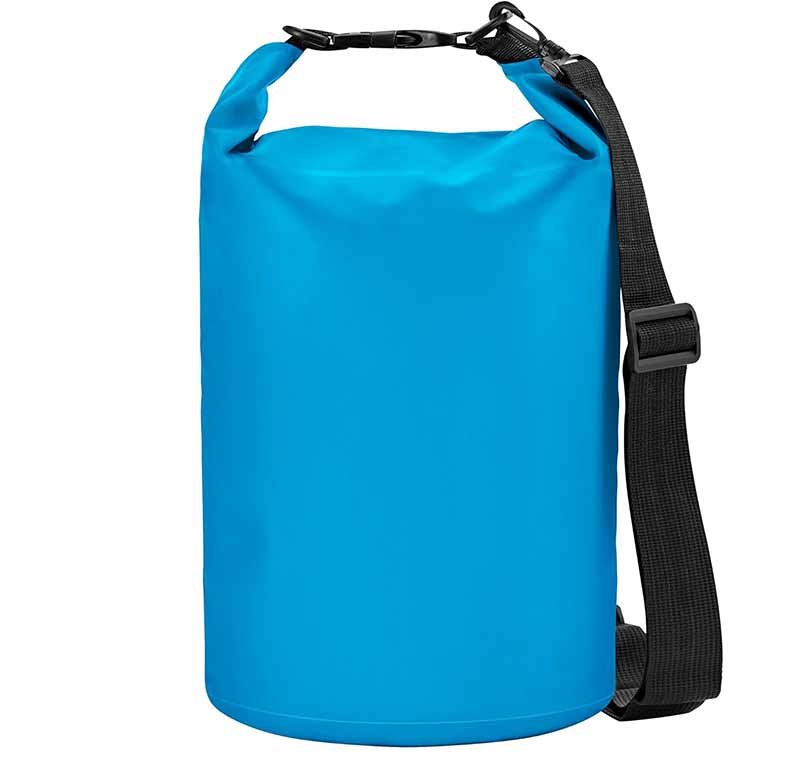
What thickness helps prevent pinholes and micro-leaks?
Pinholes usually appear where material bends repeatedly, not where it stays flat.
High-risk locations
- roll-top fold line
- bottom corners
- seam intersections
- areas pressed by sharp internal objects
Thickness vs pinhole resistance
| Thickness Range | Pinhole Risk After Repeated Folding |
|---|---|
| 0.25–0.35 mm | Noticeable after extended use |
| 0.40–0.55 mm | Low for normal outdoor activity |
| 0.60 mm+ | Very low unless punctured |
For most outdoor consumers, around 0.5 mm provides the best balance between durability and usability.
Do thicker fabrics always mean better waterproofing?
No. Beyond a certain point, extra thickness gives diminishing real-world benefit.
Why “thicker is always better” is misleading
- stiffness can prevent a tight roll-top seal
- heavier bags are used less comfortably
- production defects become more visible in thick welds
- material cost rises faster than performance gain
Performance balance curve
| Thickness Zone | Waterproof Reliability | Usability |
|---|---|---|
| Too thin | Low | Very flexible |
| Optimal (≈0.45–0.65 mm) | High | Comfortable |
| Too thick | Slight gain | Reduced flexibility |
Design goal: Reach the optimal middle zone, not the extreme.
Which Thickness Should You Choose for Different Uses?
The correct dry bag thickness is not universal. It must match environmental stress, transport style, gear weight, and frequency of use. Choosing thickness without considering these factors often leads to two common problems:
- Bags that are too thin, causing leaks or punctures
- Bags that are too thick, making them stiff, heavy, and inconvenient
The most reliable approach is to select thickness based on real usage scenarios, not marketing labels.
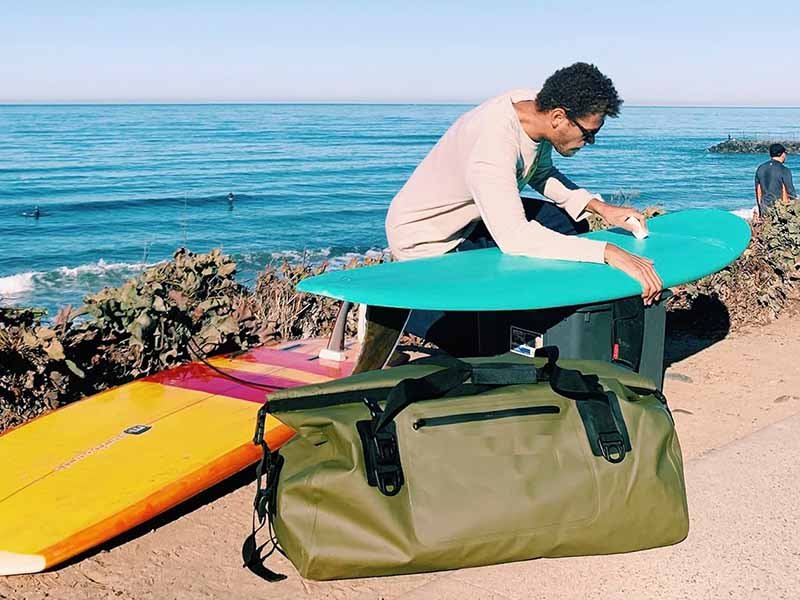
What thickness is best for kayaking, rafting, and SUP?
Water sports create the highest mechanical stress on dry bags:
- constant contact with water
- scraping against rocks or boat surfaces
- repeated rolling and unrolling
- exposure to sun and temperature change
Recommended thickness by activity intensity
| Activity | Suggested Thickness | Material Preference | Reason |
|---|---|---|---|
| Light kayaking (calm water) | 0.40–0.50 mm | TPU laminate | flexible and sufficient protection |
| Sea kayaking / touring | 0.50–0.65 mm | TPU or PVC laminate | better abrasion resistance |
| Whitewater rafting | 0.60–0.80 mm | Thick PVC laminate | maximum puncture and impact resistance |
| Rescue / professional marine | 0.70–0.90 mm | Reinforced PVC composite | extreme durability priority |
Practical insight for product planners
Most global outdoor brands concentrate their core models around 0.50–0.65 mm TPU laminate, because this range:
- balances durability and flexibility
- supports reliable seam welding
- keeps total bag weight acceptable
This thickness zone represents the largest commercial demand worldwide.
Which thickness works for hiking and lightweight travel?
Hiking and travel users prioritize weight, packability, and comfort more than extreme durability.
Typical stress conditions
- limited abrasion
- occasional rain exposure
- soft items inside the bag
- frequent folding into backpacks
Recommended thickness
| Use Type | Suggested Thickness | Key Benefit |
|---|---|---|
| Ultralight backpacking | 0.25–0.35 mm | minimum weight and volume |
| Standard hiking | 0.35–0.45 mm | balance of weight and protection |
| Travel organization | 0.30–0.40 mm | easy folding and storage |
Important limitation
Thin dry bags are waterproof but not impact-proof. Customers must understand they are designed for:
- rain protection
- splash resistance
- internal organization
—not sharp rocks or heavy tools.
Clear positioning reduces returns and complaints.
What thickness is safer for heavy gear, tools, or sharp items?
Industrial, fishing, and expedition users create internal stress, not just external abrasion.
Risk sources
- metal tools pressing against corners
- sharp equipment edges
- high total load weight
- dragging on rough ground
Recommended heavy-duty range
| Load Type | Suggested Thickness | Structural Upgrade |
|---|---|---|
| Fishing gear | 0.55–0.70 mm | reinforced base panel |
| Tool storage | 0.65–0.85 mm | multi-layer laminate |
| Industrial / rescue | 0.75–1.00 mm | thick PVC + heavy weld seams |
Engineering reminder
At this level, construction quality becomes as important as thickness. Poor seam welding will still fail—even in very thick material.
What Construction Details Matter as Much as Thickness?
Thickness alone does not guarantee waterproof reliability. Real-world durability depends equally on:
- seam technology
- roll-top sealing geometry
- reinforcement placement
- hardware strength
Ignoring these factors is one of the most common reasons dry bags fail in the field.
Which seams are stronger: welded, heat-sealed, or stitched + taped?
Seam method comparison
| Seam Type | Waterproof Level | Durability | Typical Use |
|---|---|---|---|
| Stitched only | Low | Medium | non-waterproof bags |
| Stitched + tape | Moderate | Medium | rain-resistant gear |
| Heat-welded | High | High | standard dry bags |
| High-frequency welded | Very high | Very high | premium / heavy duty |
How does roll-top design affect leak risk and usability?
The roll-top closure is the primary waterproof barrier.
Performance factors
- material flexibility at fold line
- number of roll turns (usually ≥3)
- stiffness balance for tight compression
- buckle alignment maintaining pressure
Thickness interaction
| Thickness | Roll-Top Behavior |
|---|---|
| Too thin | folds easily but wears faster |
| Optimal | seals tightly and lasts long |
| Too thick | hard to roll tightly |
Good design keeps thickness within the functional sealing range, not the maximum possible value.
What reinforcements reduce long-term failure?
High-stress zones benefit from targeted reinforcement, including:
- double-layer bottom panels
- corner abrasion patches
- thicker webbing anchor points
- internal load-spreading structures
These upgrades often increase durability more effectively than simply adding thickness everywhere, while keeping weight manageable.
How Do You Specify Thickness for OEM/ODM Production?
For brands and importers, selecting thickness is only the first step. Clear technical specification and testing standards are required to ensure consistent mass production.
What should be included in a thickness spec sheet and BOM?
A professional dry bag specification normally defines:
- material type (TPU, PVC, coated nylon)
- total thickness tolerance (±0.03–0.05 mm typical)
- base fabric denier
- seam welding method
- reinforcement layout
- roll-top structure and buckle strength
Clear documentation prevents quality variation between batches.
How do you test waterproof performance and durability?
Common factory and third-party tests include:
| Test Type | Purpose |
|---|---|
| Hydrostatic pressure test | measures water resistance |
| Repeated fold test | simulates roll-top wear |
| Abrasion test | evaluates surface durability |
| Drop / impact test | checks seam integrity |
| UV aging test | predicts long-term material life |
Reliable testing protects brands from post-sale failures.
What thickness tolerance is acceptable for mass production?
In large-scale manufacturing, small variation is unavoidable.
Typical tolerance standards
| Thickness Range | Acceptable Tolerance |
|---|---|
| ≤0.40 mm | ±0.03 mm |
| 0.40–0.70 mm | ±0.04 mm |
| ≥0.70 mm | ±0.05 mm |
Maintaining these tolerances ensures:
- stable seam welding
- predictable durability
- consistent customer experience
Turning Thickness Knowledge into Better Dry Bag Products
Material thickness is not just a number on a specification sheet. It defines how a waterproof dry bag performs through:
- folding
- abrasion
- puncture stress
- seam sealing
- long-term outdoor exposure
The most successful products are not the thickest or the lightest, but the ones where material, thickness, structure, and construction are engineered together for a clear usage scenario.
Brands that understand this balance create dry bags that:
- reduce failure rates
- improve user trust
- support premium pricing
- build long-term reputation in outdoor markets
Start Your Custom Waterproof Dry Bag Project with Szoneier
If you are planning to develop private-label or OEM waterproof dry bags, working with an experienced manufacturer ensures your product thickness, materials, and construction are aligned from the beginning.
Szoneier brings over 18 years of bag manufacturing and R&D experience, offering:
- full customization of TPU, PVC, nylon, and composite dry bag materials
- precise thickness control for different outdoor applications
- advanced seam welding and reinforcement engineering
- rapid sampling and low-MOQ development for new brands
- stable high-volume production for established outdoor companies
Whether your goal is ultralight hiking gear, mid-range outdoor retail, or heavy-duty professional equipment, Szoneier can transform your design concept into a durable, market-ready waterproof dry bag.
Contact Szoneier today to request samples, discuss specifications, and build a dry bag product line your customers can trust in real outdoor conditions.