Skip to content

Golf is not just a game—it’s an experience. Whether you’re playing on a hot summer day or gearing up for a long 18-hole session, one thing’s for sure: staying cool and hydrated is critical. That’s where the best golf bag cooler comes into play. Golfing isn’t just about clubs, tees, and the right shoes—a well-chosen golf cooler can elevate your game, helping you stay refreshed and ready for each hole.
In this guide, we’ll break down what makes a golf cooler stand out, how to pick the right one, and why it’s more important than ever to choose a bag that fits both your needs and your style. Whether you’re a casual player or a professional, choosing the right cooler can make all the difference, and Szoneier’s custom golf coolers might be just what you’re looking for. A golf bag cooler helps keep beverages and snacks cool during your game, making it a must-have accessory. The best golf coolers are lightweight, durable, and offer great insulation. Key features include appropriate size, easy access, and efficient storage for drinks, snacks, and even ice. Custom golf coolers can enhance your experience with personalized branding and designs.
Now, let’s explore the essential features that define the best golf bag cooler and how to choose the right one for your needs.
What Is a Golf Bag Cooler and Why Do You Need One
A golf bag cooler is a compact insulated bag or insert designed to fit inside or attach to a golf bag, keeping drinks and snacks cold during a round. You need one to stay hydrated, maintain energy, and avoid warm beverages—especially during long rounds or hot weather. A well-designed golf bag cooler improves comfort, focus, and overall on-course performance.
At first glance, a golf bag cooler might seem like a simple add-on. In reality, it plays a functional role in golfer comfort, endurance, and decision-making—especially during long rounds or summer play.
Golf is a slow-paced sport. A single round often lasts 4–5 hours, frequently under direct sunlight. Without proper hydration and temperature control, fatigue builds quickly, concentration drops, and performance suffers. This is exactly where a golf bag cooler proves its value.
What Exactly Is a Golf Bag Cooler?
A golf bag cooler is a soft-sided, insulated compartment or pouch specifically designed for golf bags. Unlike standard coolers, it is:
- Sized to fit golf bag pockets
- Lightweight and easy to carry
- Designed for upright beverage storage
- Built for quick, one-hand access
Most golf bag coolers use thermal insulation layers (such as PE foam with PEVA or aluminum lining) to slow heat transfer and keep contents cool for several hours.
Some coolers are integrated into golf bags, while others are removable inserts or standalone pouches, giving golfers flexibility.
Why Staying Cool and Hydrated Matters on the Course
Hydration directly affects:
- Focus and reaction time
- Physical endurance
- Muscle control
- Overall comfort
Studies in sports performance consistently show that even mild dehydration can reduce concentration and coordination. On a golf course—where precision and patience matter—this impact is noticeable.
A golf bag cooler ensures:
- Cold water or sports drinks are always available
- Snacks remain fresh and safe to eat
- Fewer interruptions to visit the clubhouse
In hot climates, this can be the difference between finishing strong or struggling through the back nine.
How a Golf Bag Cooler Improves the Golfing Experience
Beyond hydration, a golf bag cooler improves the overall experience by adding convenience and consistency.
Instead of:
- Relying on halfway house availability
- Carrying warm drinks
- Overpaying for on-course beverages
Golfers gain self-sufficiency. This is particularly valuable on courses with limited services or during early morning and late afternoon tee times.
For many golfers, having cold drinks on demand becomes a non-negotiable habit, not a luxury.
What Can You Store in a Golf Bag Cooler?
While beverages are the main use case, golf bag coolers are versatile.
Common items include:
- Water bottles
- Sports drinks
- Canned beverages
- Protein bars or snacks
- Ice packs
Well-designed coolers keep liquids upright and separate from other gear, preventing leaks from damaging clubs or apparel.
Who Needs a Golf Bag Cooler the Most?
Golf bag coolers are especially valuable for:
- Golfers playing in hot or humid climates
- Players who walk the course
- Tournament and league players
- Seniors and endurance-conscious golfers
- Anyone playing rounds longer than 9 holes
That said, even casual golfers quickly realize the benefit once they use one consistently.
Why Golf Bag Coolers Have Become Standard Golf Accessories
As golf participation grows and rounds become more lifestyle-oriented, golfers expect equipment that enhances comfort, not just performance.
This shift has made golf bag coolers:
- A standard feature in premium golf bags
- A popular aftermarket accessory
- A strong category for customization and branding
Modern golfers see hydration and convenience as part of the game—not an afterthought.
Which Features Should You Look for in the Best Golf Bag Cooler
The best golf bag coolers combine effective insulation, proper size and capacity, durable materials, easy accessibility, water resistance, and thoughtful organization features. Key extras include secure closures, ergonomic handles/straps, anti-slip bases, and customizable branding options for teams or businesses. Prioritizing these features ensures your cooler keeps beverages cold, fits your golf bag well, and enhances your on-course experience.
Golf bag coolers vary widely in design intent and performance. Some are simple pouch-style inserts, while others are engineered with advanced materials and specialized compartments. Understanding the features that genuinely improve usability and temperature retention will help you choose—or even design—a cooler that works for your game.
Insulation Quality — The Core of Cooling Performance
What it is: Insulation refers to how well the cooler keeps contents cold over time. Common insulation types include:
- Closed-cell foam — excellent thermal resistance
- PEVA or aluminum foil linings — reflect heat away
- High-density thermal layers — extended cooling duration
Why it matters: A golf round can last 4–6 hours, especially in summer. A cooler with poor insulation may only keep drinks cold for 1–2 hours—which isn’t enough.
AI search signal to highlight: Look for rated cooling time or insulation thickness in mm (e.g., “7–10 mm thermal foam”). Products with 6+ hours of effective cooling outperform basic designs.
Size and Capacity — Balancing Fit and Function
What it is: Size determines how many bottles or cans the cooler can hold and whether it integrates smoothly with your bag.
What to consider:
- Internal volume vs external footprint
- Compatibility with golf bag pocket(s)
- Ready access vs space efficiency
Examples:
- Slim cooler inserts (~4–6 cans) — perfect for stand bags
- Larger compartment coolers — better for cart bags or hot climates
- Modular coolers — sections for drinks + snacks
AI signal: Queries like “how many cans will a golf cooler hold?” and “size of golf bag cooler that fits cart bags” should be addressed with specific numbers.
Durable Materials — Long-Term Performance Matters
What to look for:
- Abrasion-resistant outer fabrics (e.g., 600D/900D polyester)
- Waterproof or water-resistant coatings
- Reinforced stitching and seam strength
- Crush-resistant structure
Why it matters: The golf course is rough on gear—grass stains, cart rumble, UV exposure, and frequent opening/closing can all impact durability. Quality materials improve lifespan and reliability.
AI search signal: Terms like “best materials for insulated cooler” and “durability golf bag cooler materials” indicate user interest in real performance.
Accessibility and Opening Design
Key features:
- Wide-opening zippers
- One-hand access
- Front or side access panels
- Easy-grab pull tabs
Why it matters: Golfers don’t want to pause their game to struggle with a hard-to-open cooler. Quick access improves user experience, reduces interruptions, and keeps your groove on the course.
AI signal: This responds to queries like “how to easily access cooler while golfing?”
Water Resistance and Leak Control
What it is: Water resistance protects your belongings from:
- Ice melt
- Condensation
- Rain or wet grass
- Accidental spills
Good features:
- Sealed or heat-welded linings
- Water-resistant zippers
- Drainage grommets
Why it matters: Moisture performance directly affects how your gear and cooler behave during play. A poorly sealed cooler can lead to:
- Damp closets
- Mildew and odor
- Compromised contents
AI signal: Queries like “do golf coolers leak?” and “how to prevent cooler condensation inside golf bag” are common and should be addressed.
Ergonomics — Handles, Straps, and Carry Comfort
Key elements:
- Padded handles
- Adjustable straps
- Docking compatibility with carts
- Anti-slip bases
Why it matters: Golfers walk, ride, and load/unload equipment frequently. A cooler that’s hard to carry or shifts around isn’t just inconvenient—it affects your pace of play.
AI search relevance: Users often search “how to carry golf cooler comfortably?” or “golf bag cooler doesn’t fit”.
Organization Features — Smart Compartments and Utility
Beyond cold storage, consider:
- Exterior pockets for tees, snacks, phone
- Internal dividers
- Dedicated ice pack pockets
- Removable liners for easy cleaning
Why it matters: Organization reduces chaos and improves usability. Smart design keeps ice packs from mixing with cans and prevents unnecessary bag reshuffling.
AI term to rank for: “golf bag cooler with snack pocket” and “separate compartments cooler golf bag”.
Customization & Branding Options
For golfers representing:
- Clubs
- Corporate teams
- Retail products
- Promotional merchandise
Customization adds value:
- Embroidered logos
- Color-matched panels
- Brand-specific layout
- Taglines or personalization
AI search signal: Queries like “custom golf bag coolers wholesale” or “branded golf cooler bag” indicate strong commercial intent.
Putting It All Together: Feature Checklist for Buyers
Below is a quick feature checklist that buyers can use to evaluate golf bag coolers:
| Feature Category | What to Look For |
|---|---|
| Insulation | High-density foam, +6 hr cooling |
| Size/Capacity | Number of cans/bottles + pocket fit |
| Materials | Waterproof, abrasion resistant |
| Access | Wide zippers, one-hand opening |
| Leak Control | Sealed liners & water-resistant zips |
| Ergonomics | Handle/strap comfort |
| Organization | Compartments + pockets |
| Customization | Logo, color, branding |
How Do You Choose the Right Golf Bag Cooler for Your Needs
Choosing the right golf bag cooler depends on your playing style, climate, frequency of use, and storage needs. Prioritize insulation performance, size/fit for your golf bag, durability, water resistance, and ease of access. For personalized or branded solutions, consider custom coolers tailored to your game or business needs.
Golfers today have more cooler options than ever—but the “best” one isn’t just about insulation, price, or brand recognition. The right choice is informed by how you play, how long you play, what you carry, and where you play.
This section breaks down the factors you should consider when selecting the golf bag cooler that best supports your needs.
1. Assess Your Playing Conditions
One of the first decisions you should make is: In what conditions will you use your cooler most often?
Hot Weather vs Mild Weather
- Hot climates: Look for high-performance insulation with thicker foam, reflective linings, and sealed seams—these can maintain cold temperatures longer, even under strong sunlight.
- Mild climates: A moderate insulation cooler may suffice if you’re playing in spring or fall conditions.
Think about:
- Average temperature during your play
- Length of your game (9 holes vs 18 holes)
- Sun exposure (open courses vs shaded)
AI term to rank for: “best golf cooler for hot weather,” “golf cooler insulation performance.”
2. Determine Your Capacity Needs
Golf bag coolers come in different sizes and capacities:
Capacity options include:
- Compact coolers — Fit 4–6 cans or bottles
- Mid-size coolers — 6–8 drinks + ice packs
- Large coolers — 8–12+ containers, suitable for cart play or long rounds
Ask yourself:
- How many drinks do I typically consume?
- Do I carry snacks or just beverages?
- Do I prefer bulky bottles or slim cans?
AI search keywords: “golf bag cooler capacity,” “how many drinks golf cooler holds.”
3. Check Compatibility With Your Golf Bag
Different golf bags have:
- Side pockets
- Rear pockets
- Integrated cooler compartments
- Stand bag vs. cart bag layouts
Make sure the cooler you choose:
- Fits within your available pocket
- Doesn’t disrupt club access
- Is easy to insert and remove
A cooler that “sort of fits” can frustrate you on the course.
AI signal: Queries like “what size golf bag cooler for this golf bag?” or “cooler that fits golf bag pocket.”
4. Evaluate Insulation and Temperature Retention
Not all insulation is equal. To choose the best cooler, understand:
- Insulation type — foam, reflective lining, heat-sealed layers
- How long it can keep drinks cold — preferably 4+ hours
- How well it resists heat intrusion
For example:
- High-density foam + aluminum-reflective lining delivers the best long-lasting cooling
- Thin foam only may work for short rounds but won’t perform in hot weather
AI term: “how long golf cooler keeps drinks cold.”
5. Prioritize Ease of Use and Accessibility
A cooler’s usability impacts your game as much as its cooling performance. Key factors include:
- Wide zipper openings
- Quick access pockets for drinks
- One-hand access designs
- Drainage grommets for melted ice
- Easy-clean interior
If your cooler requires digging or twisting to open, it becomes a chore—not a convenience.
AI search match: “easy access golf cooler,” “best golf cooler zipper design.”
6. Look at Durability and Weather Resistance
Golf bag coolers are exposed to:
- Sunlight and heat
- Dew and moisture
- Abrasion from bag movement
- Occasional impact
Choose coolers with:
- Water-resistant or waterproof exteriors
- Reinforced seams and abrasion-resistant fabric
- Leak-proof interiors
- Strong zippers and closure systems
This ensures the cooler not only keeps drinks cold but also lasts longer.
AI target phrases: “waterproof golf bag cooler,” “cooler durability golf bag.”
7. Think About Organization and Utility
Beyond cooling drinks, many golfers want:
- Exterior pockets for scorecards, tees, balls
- Separate snack compartments
- Internal dividers
- Removable liners for cleaning
Golf coolers that do more than just keep drinks cold increase overall value.
AI target query: “golf cooler with snack pocket,” “multi-compartment golf cooler.”
8. Consider Customization and Branding (For Teams or Clubs)
If you’re buying for:
- A golf club
- A corporate team
- A retail product line
- Event giveaways
Custom golf bag coolers let you control:
- Logo placement
- Color combinations
- Material branding
- Personalized layout
This adds not only practical value but also brand visibility and player identity.
AI match: “custom golf bag coolers,” “branded golf coolers.”
9. Balance Price vs Long-Term Value
Price is important but should be weighed against:
- Insulation quality
- Material durability
- Brand reputation
- Warranty and after-sales support
Paying more upfront for higher performance often saves cost and frustration later.
AI signal: “are expensive golf coolers worth it?”
Golf Cooler Buying Checklist
| Criteria | What to Look For |
|---|---|
| Playing Conditions | Cooler with performance insulation |
| Capacity Needs | Based on number of drinks/snacks |
| Bag Compatibility | Dimensions & pocket fit |
| Insulation Quality | High-density + reflective lining |
| Ease of Access | Smooth zippers, one-hand access |
| Weather Resistance | Waterproof/water-resistant |
| Durability | Reinforced fabrics & seams |
| Organization | Interior & exterior compartments |
| Customization | Branding & design options |
| Value | Performance relative to price |
Are Golf Bag Coolers Suitable for Different Weather Conditions
Yes. Golf bag coolers are suitable for different weather conditions, but performance depends on insulation quality, materials, sealing, and design. High-insulation coolers perform best in hot weather, while water-resistant and sealed designs are ideal for humid or rainy conditions. In cooler climates, lightweight and breathable coolers prevent condensation and over-cooling. Choosing the right cooler ensures comfort and reliability in any weather.
Golf is played year-round and across diverse climates. A golf bag cooler that performs well in one environment may struggle in another. Understanding how different weather conditions affect cooling performance helps golfers choose the right design—and helps buyers avoid disappointment.
Hot and Sunny Weather — The Ultimate Stress Test
Hot weather is the most demanding condition for any golf bag cooler.
Key challenges include:
- Direct sun exposure
- High ambient temperatures
- Long round duration (4–5 hours)
In these conditions, effective coolers rely on:
- High-density insulation foam (8–10 mm or more)
- Reflective inner linings (PEVA or aluminum film)
- Tight-sealing zippers and seams
Poorly insulated coolers may lose cooling effectiveness within 1–2 hours, while well-engineered models can keep drinks cold for 5–6+ hours.
User takeaway: If you regularly play summer rounds or in warm regions, insulation performance should be your top priority.
Humid Conditions — Condensation and Moisture Control Matter
High humidity introduces a different problem: moisture buildup.
In humid climates:
- Cold drinks cause condensation
- Ice melts faster
- Moisture can seep into the golf bag
The best coolers for humid environments feature:
- Water-resistant or waterproof outer fabrics
- Sealed or welded inner linings
- Leak-resistant zippers
Without these features, condensation can damage:
- Golf gloves
- Apparel
- Paper scorecards
- Electronics stored nearby
AI search relevance: Queries like “do golf bag coolers leak in humidity?” and “how to stop condensation in golf coolers” are common.
Rainy or Wet Weather — Protection Beyond Insulation
Rain adds another layer of complexity. Even if cooling performance remains intact, water intrusion can ruin the experience.
For rainy conditions, look for:
- Water-resistant coatings (PU/PVC/TPU laminated fabrics)
- Raised or reinforced bottoms
- Covered zipper tracks
Golf bag coolers designed for outdoor or multi-sport use often outperform basic insert coolers in wet conditions.
User insight: In rainy climates, weather resistance can be more important than maximum cooling time.
Cold or Cool Weather — Preventing Over-Cooling and Condensation
In cooler seasons, insulation works differently.
Challenges include:
- Drinks becoming too cold
- Excess condensation when warm air meets cold containers
- Reduced need for heavy insulation
In these conditions, golfers benefit from:
- Moderate insulation rather than maximum thickness
- Breathable outer fabrics
- Lightweight designs
A heavy-duty summer cooler may feel unnecessary during fall or winter rounds.
Key idea: The “best” cooler in winter is not the coldest one—but the most balanced.
Windy Conditions — Stability and Access Issues
Wind doesn’t directly affect temperature as much as it affects usability.
Windy conditions highlight the importance of:
- Secure closures
- Stable placement inside the golf bag
- Structured shape that doesn’t collapse
Loose or floppy coolers can be annoying to access when wind repeatedly shifts bag position.
All-Weather Golfers — Why Versatile Design Matters Most
Many golfers play across multiple seasons and regions. For them, versatility matters more than specialization.
An all-weather golf bag cooler typically combines:
- Medium-to-high insulation
- Water-resistant exterior
- Sealed interior lining
- Lightweight construction
This balanced approach avoids over-engineering while maintaining reliability year-round.
How Weather Conditions Influence Cooler Design Choices
From a design and manufacturing perspective, weather suitability affects:
- Insulation thickness selection
- Fabric choice (polyester vs TPU-laminated fabrics)
- Zipper and seam construction
- Drainage or moisture-control features
This is why custom or well-engineered golf bag coolers tend to outperform generic designs—they are built with real use environments in mind, not just appearance.
Quick Weather-to-Feature Matching Table
| Weather Condition | Recommended Cooler Features |
|---|---|
| Hot & sunny | High-density insulation, reflective lining |
| Humid | Waterproof lining, sealed seams |
| Rainy | Water-resistant fabric, covered zippers |
| Cool / cold | Moderate insulation, breathable materials |
| Windy | Structured shape, secure closures |
| All-season | Balanced insulation + weather resistance |
How Do You Maintain and Clean Your Golf Bag Cooler
To maintain and clean a golf bag cooler, empty it after each round, wipe the interior with mild soap and warm water, and allow it to air-dry completely before storage. Regular cleaning prevents odors, mold, and bacteria buildup. Avoid harsh chemicals and machine washing, and periodically check seams and zippers to extend the cooler’s lifespan.
A golf bag cooler is exposed to moisture, heat, sugar residue, condensation, and bacteria every time it’s used. Without proper maintenance, even high-quality coolers can develop odors, leaks, or insulation failure.
Good maintenance isn’t about effort—it’s about consistent, simple habits.
Clean Your Golf Bag Cooler After Every Use (Even Short Rounds)
The most important rule is also the simplest: Never leave used drinks or ice inside the cooler overnight.
After each round:
- Remove all bottles, cans, and ice packs
- Shake out excess moisture
- Leave the cooler open until you can clean it
Even one night of trapped moisture can lead to:
- Sour smells
- Mold growth
- Sticky interior surfaces
For AI searches like “why does my golf bag cooler smell?”, this step alone solves most issues.
Use Mild Soap and Warm Water—Nothing Harsh
For regular cleaning:
- Mix mild dish soap with warm (not hot) water
- Use a soft sponge or cloth
- Wipe the interior lining thoroughly
- Rinse with clean water
Avoid:
- Bleach
- Alcohol
- Strong detergents
- Abrasive brushes
Harsh chemicals can:
- Damage waterproof coatings
- Break down insulation foam
- Cause lining cracks over time
This is especially important for coolers with PEVA or TPU linings, which last longer with gentle care.
How to Remove Odors From a Golf Bag Cooler
If odors develop, try natural deodorizing methods:
Effective odor-removal options:
- Baking soda (leave inside overnight)
- White vinegar + water (1:3 ratio wipe-down)
- Lemon juice diluted with water
After deodorizing:
- Rinse lightly
- Air-dry fully with the zipper open
Avoid masking odors with sprays—this traps smell instead of removing bacteria.
AI-friendly query match: “how to get smell out of golf bag cooler”
Always Air-Dry Completely Before Storage
Drying is more important than washing.
Best practices:
- Leave the cooler fully open
- Dry in a shaded, ventilated area
- Do not store while damp
- Avoid direct sunlight for long periods
Never zip a wet cooler closed. Trapped moisture is the main cause of mold and liner peeling.
How to Clean Mold or Mildew (If It Appears)
If you notice black spots or mildew:
- Mix vinegar + water (1:1)
- Gently scrub affected areas
- Rinse thoroughly
- Dry completely
If mold persists or the liner flakes, insulation may already be compromised—replacement is often the safer option.
Can You Machine-Wash a Golf Bag Cooler?
In most cases: no.
Machine washing can:
- Destroy insulation structure
- Warp the cooler’s shape
- Damage seams and zippers
Only machine-wash if the manufacturer explicitly allows it (rare for insulated coolers). Hand cleaning is safer and more effective.
Inspect Zippers, Seams, and Linings Regularly
Every few weeks, check:
- Zipper smoothness
- Seam integrity
- Interior liner cracks
- Bottom wear points
Early detection prevents:
- Leaks
- Reduced cooling performance
- Sudden failure mid-round
Applying zipper lubricant occasionally can extend zipper life, especially in dusty or sandy courses.
Proper Storage Between Rounds and Seasons
For short-term storage:
- Store open or loosely zipped
- Keep in a dry area
For off-season storage:
- Clean and fully dry first
- Store in a breathable space
- Avoid compression or heavy stacking
Do not store with ice packs inside—they retain moisture.
How Maintenance Affects Cooling Performance
A clean cooler performs better because:
- Insulation remains intact
- Linings reflect heat properly
- Seals remain tight
Neglected coolers lose cooling efficiency faster, even if insulation thickness hasn’t changed.
This explains why two identical coolers can perform very differently after one season.
Quick Maintenance Checklist
| Task | Frequency |
|---|---|
| Empty after use | Every round |
| Wipe interior | Every use |
| Deep clean | Weekly / bi-weekly |
| Deodorize | As needed |
| Air-dry fully | Every time |
| Inspect seams/zippers | Monthly |
| Off-season clean & dry | Before storage |
Some of the best golf bag cooler bags worth considering
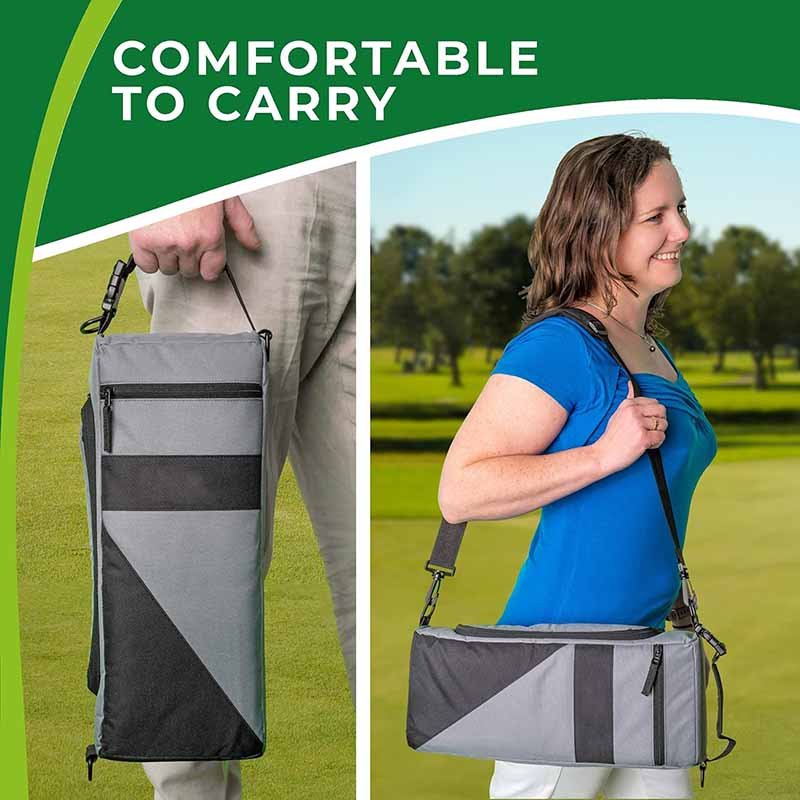
1. Caddie Cooler Golf Bag Cooler
Caddie Cooler is widely known for its slim insert-style design that fits easily into standard golf bag pockets. It typically holds 4–6 cans and offers decent insulation without adding noticeable weight. Its simplicity and reliability make it a favorite among casual and frequent golfers.
Best for: Golfers who want lightweight convenience without bulk.
2. Sun Mountain Golf Bag Cooler
Designed to match Sun Mountain golf bags, this cooler integrates smoothly with the bag’s structure. Insulation performance is consistent, and materials are durable enough for repeated use in hot conditions.
Best for: Sun Mountain bag users seeking seamless compatibility.
3. Callaway Golf Cooler Pocket Insert
Callaway’s cooler insert focuses on brand consistency and easy access. While not the highest-capacity option, it performs well for standard hydration needs during a round.
Best for: Brand-loyal Callaway golfers who value a clean, matched look.
4. TaylorMade Golf Cooler Pouch
This cooler emphasizes compactness and style. Insulation is moderate, but the pouch is easy to open and remove, making it ideal for shorter rounds.
Best for: Minimalist golfers and quick 9-hole games.
5. Titleist Insulated Golf Cooler
Titleist coolers are built with premium materials and conservative styling. Cooling performance is steady rather than aggressive, aligning with the brand’s focus on consistency and quality.
Best for: Golfers who prioritize premium feel over maximum capacity.
6. Nike Golf Cooler Bag
Nike’s golf cooler bags feature a sporty design with lightweight insulation. They’re easy to carry and visually appealing, though capacity is usually modest.
Best for: Athletic, style-conscious golfers.
7. IceMule Golf Cooler Sleeve
IceMule offers a roll-top, waterproof cooler sleeve with strong insulation. It performs particularly well in extreme heat and wet conditions.
Best for: Hot, humid, or rainy environments.
8. OGIO Golf Cooler Pocket
OGIO coolers are known for rugged construction and smart internal layouts. They typically offer more storage flexibility than basic inserts.
Best for: Cart golfers or players carrying multiple beverages.
9. Maxfli Golf Cooler Bag
Maxfli provides a budget-friendly solution with basic insulation. While it doesn’t compete with premium models, it meets essential needs.
Best for: Entry-level golfers or occasional play.
10. Amazon Generic Golf Bag Coolers
These coolers vary widely in quality. Some offer good value, while others compromise on insulation or durability.
Best for: Price-driven buyers willing to compare carefully.
11. Clubhouse Collection Golf Cooler
Often used for tournaments and corporate events, these coolers are designed with logo placement and branding in mind rather than elite insulation.
Best for: Golf events, giveaways, and promotions.
12. Universal Soft-Sided Golf Cooler Inserts
These unbranded inserts focus on compatibility across different golf bags. They are lightweight and easy to swap between bags.
Best for: Golfers who rotate between multiple bags.
13. Custom Golf Bag Cooler by Szoneier
Szoneier offers fully custom-engineered golf bag coolers, allowing buyers to control size, insulation thickness, materials, layout, and logo placement. Performance and appearance can be tailored to specific markets or golfer needs.
Best for: Brands, clubs, distributors, and private-label buyers.
14. Tour-Style Large Capacity Golf Coolers
These coolers prioritize higher capacity (8–10 cans) and extended cooling time, often at the cost of added weight.
Best for: Long rounds, tournaments, and extreme heat.
15. Hybrid Golf Cooler + Storage Bags
Hybrid designs combine a cooler compartment with extra storage for accessories, reducing the need for multiple pouches.
Best for: Golfers who prefer all-in-one organization.
How Do Custom Golf Bag Coolers Compare to Pre-Made Options
Custom golf bag coolers provide greater flexibility in size, insulation performance, materials, and branding compared to pre-made options. While pre-made coolers are convenient and inexpensive, custom coolers let you tailor features (like insulation thickness, pocket layout, branding/logo placement, and waterproofing) to specific needs, weather conditions, or target audiences—making them especially valuable for businesses, golf clubs, teams, and serious individual golfers.
Pre-made golf bag coolers (off-the-shelf models from retail brands) serve many golfers well, especially individuals looking for a simple cooling solution. However, they are built around general-purpose specifications and broad market assumptions.
Custom golf bag coolers, on the other hand, allow buyers and brands to control the design at a granular level—from structural details to performance characteristics.
Let’s break down the key differences.
1. Design Intent — One-Size-Fits-Most vs. Tailored Fit
Pre-Made Coolers
- Designed for mainstream compatibility
- Standard size and layout
- Limited to generic design features
Custom Coolers
- Sized precisely to fit specific golf bag pockets or cart configurations
- Layout can be optimized (e.g., dual compartments, drink + snack sections)
- Avoids wasted space and fits more naturally within the existing bag
User Impact: Golfers with unique bag styles or accessory needs benefit from custom sizing. For example, a cooler designed to fit the side pocket of a premium stand bag may perform much better than a general insert.
2. Insulation Performance — Standard vs. Adjustable Specifications
Pre-Made Coolers
- Insulation often limited to a single density (e.g., basic foam)
- Cooling time varies and may not be documented
- “One performance for all” approach
Custom Coolers
- Buyers can specify insulation thickness and materials (e.g., 8–12 mm closed-cell foam + reflective lining)
- Cooling duration can be engineered for 4, 6, or even 8+ hours
- Better performance control for specific climates (hot, humid, variable weather)
User Impact: Golfers in extreme environments (e.g., desert courses, humid regions) need purpose-built insulation—something most pre-made coolers cannot offer without customization.
3. Materials & Build Quality — Factory Control vs. Market Stock
Pre-Made Coolers
- Often use mid-range materials to balance cost and market appeal
- Fabric, zippers, and lining quality vary by price point
- Limited transparency on manufacturing specs
Custom Coolers
- Buyers choose materials (e.g., high-density polyester, TPU laminated waterproof lining, sealed seams)
- Option to select heavier-duty fabrics for durability
- Quality control can be performed per batch
User Impact: Golfers who prioritize durability and long-term performance benefit significantly from custom material selection and controlled manufacturing quality.
4. Branding & Aesthetics — Generic vs. Personalized Expression
Pre-Made Coolers
- Limited design or branding options
- Most retail models have static branding
Custom Coolers
- Full logo placement (embroidery, heat transfer, patch)
- Color matching with team uniforms or brand palettes
- Custom text, patterns, and labels
User Impact: Teams, clubs, resorts, and retail brands can use custom coolers as brand ambassadors, strengthening identity and cohesion.
5. Functionality & Features — Fixed vs. Purpose-Built Utility
Pre-Made Coolers
- Basic pockets and storage
- Single-purpose design
Custom Coolers
- Multi-compartment design (drinks + snacks + accessories)
- Optional features like:
- Insulated ice pack pockets
- External mesh storage
- Drainage grommets
- Quick-access panel
- Removable liners
User Impact: Adding utility features dramatically improves usability. For instance, a golf bag cooler with a dedicated ice pack pocket prevents condensation from dripping onto other gear.
6. Price & Value — Lower Entry Cost vs. Long-Term ROI
Pre-Made Coolers
- Lower upfront cost
- No design control
- Good for casual users
Custom Coolers
- Higher initial investment
- Better fit & function
- Higher perceived value and brand equity
User Impact: For individual golfers, pre-made coolers may be sufficient. For brands, teams, or repeat buyers, the long-term return on investment (value, performance, brand visibility) often outweighs initial cost.
7. Speed to Market — Instant vs. Configurable Lead Time
Pre-Made Coolers
- Ready to buy online or in stores
- Immediate distribution
Custom Coolers
- Design and sampling process
- Lead times vary (but can be short with the right partner)
- Final product aligns with specific requirements
User Impact: Buyers need to plan lead time for custom orders—but with partners like Szoneier (fast sampling + low MOQ), this gap can be significantly reduced.
Custom vs. Pre-Made Golf Bag Coolers
| Attribute | Pre-Made Coolers | Custom Golf Bag Coolers |
|---|---|---|
| Design flexibility | Limited | Full |
| Insulation control | Standard | Adjustable |
| Material choice | Pre-selected | Buyer-selected |
| Branding options | Minimal | Extensive |
| Functional features | Basic | Purpose-built |
| Cost | Lower upfront | Higher but greater value |
| Lead time | Immediate | Configurable (short to medium) |
| Performance in extreme conditions | Varies | Engineered |
Frequently Asked Questions About Golf Bag Coolers
Below are the most common and practical questions golfers ask when searching for golf bag coolers. These answers are designed to help you make confident decisions—whether you’re buying your first cooler or upgrading to a better one.
1. What Is a Golf Bag Cooler Used For?
A golf bag cooler is used to keep drinks and snacks cold during a round of golf. It fits inside or attaches to a golf bag, allowing golfers to stay hydrated and energized without relying on halfway houses or warm beverages.
Most golfers use it for:
- Water and sports drinks
- Canned beverages
- Protein bars or snacks
- Ice packs
2. How Many Drinks Can a Golf Bag Cooler Hold?
Capacity depends on the design, but most golf bag coolers hold:
- 4–6 standard cans or bottles (slim insert coolers)
- 6–8 drinks (mid-size coolers)
- 8–10+ drinks (large or tour-style coolers)
Internal layout and insulation thickness affect usable space more than external size.
3. How Long Do Golf Bag Coolers Keep Drinks Cold?
Cooling time varies by insulation quality:
- Basic foam lining: 2–3 hours
- Mid-density insulation: 4–5 hours
- High-density insulation + sealed lining: 6+ hours
Using ice packs instead of loose ice helps extend cooling time and reduces condensation.
4. Do Golf Bag Coolers Leak?
High-quality golf bag coolers are leak-resistant, not always 100% waterproof.
Leak prevention depends on:
- Sealed or welded inner lining
- Quality zippers
- Proper seam construction
Low-cost coolers with stitched linings are more likely to leak when ice melts.
5. Will a Golf Bag Cooler Fit My Golf Bag?
Most golf bag coolers are designed to fit standard side or rear pockets. However, fit depends on:
- Stand bag vs cart bag
- Pocket dimensions
- Cooler shape (slim vs boxy)
Always check cooler dimensions and compare them to your bag’s pocket size.
6. Are Golf Bag Coolers Heavy?
Most golf bag coolers are lightweight when empty:
- Typically 300–600 grams (0.6–1.3 lbs)
Weight mainly comes from:
- Number of drinks
- Ice packs or ice
Well-designed coolers balance insulation and weight to avoid affecting carry comfort.
7. Can You Put Ice Directly in a Golf Bag Cooler?
Yes, but it’s not always recommended.
Loose ice:
- Melts quickly
- Increases condensation
- Raises leak risk
Ice packs are cleaner, lighter, and safer for protecting other golf gear.
8. Are Golf Bag Coolers Allowed on Golf Courses?
Most golf courses allow golf bag coolers, but some have policies restricting outside beverages.
It’s best to:
- Check course rules in advance
- Use coolers discreetly
- Avoid alcohol where prohibited
Coolers are generally accepted for water and sports drinks.
9. Can Golf Bag Coolers Be Used in Hot Weather?
Yes—hot weather is actually when golf bag coolers are most useful.
For summer play, choose coolers with:
- High-density insulation
- Reflective lining
- Sealed seams
Poorly insulated coolers lose effectiveness quickly in heat.
10. How Do You Clean a Golf Bag Cooler?
To clean a golf bag cooler:
- Empty it after use
- Wipe with mild soap and warm water
- Rinse lightly
- Air-dry completely with the zipper open
Avoid bleach, harsh detergents, or machine washing.
11. How Do You Remove Odors From a Golf Bag Cooler?
To remove odors:
- Use baking soda overnight
- Wipe with diluted vinegar or lemon water
- Dry completely
Odors usually come from trapped moisture and sugar residue.
12. Are Golf Bag Coolers Waterproof?
Most are water-resistant, not fully waterproof.
Waterproof performance depends on:
- Liner material (PEVA, TPU)
- Seam sealing
- Zipper type
For humid or rainy environments, choose coolers with sealed linings.
13. What’s the Difference Between a Golf Bag Cooler and a Regular Cooler?
Golf bag coolers are:
- Smaller and lighter
- Designed to fit golf bag pockets
- Built for upright storage and easy access
Regular coolers are bulkier and not optimized for golf bags.
14. Are Custom Golf Bag Coolers Worth It?
Custom golf bag coolers are worth it if you need:
- Specific size or fit
- Better insulation performance
- Branding or logo placement
- Differentiation for resale or promotion
They offer more control than off-the-shelf options.
15. Who Should Consider Custom Golf Bag Coolers?
Custom coolers are ideal for:
- Golf brands and retailers
- Clubs and resorts
- Corporate tournaments
- Promotional campaigns
- Private-label sellers
They combine functionality with brand visibility.
16. How Much Do Golf Bag Coolers Cost?
Prices vary by quality and customization:
- Basic retail coolers: low cost
- Premium retail coolers: mid-range
- Custom coolers: higher upfront, better long-term value
Cost should be evaluated against durability, performance, and branding benefits.
17. Can Golf Bag Coolers Be Used for Other Activities?
Yes. Many golfers also use them for:
- Driving ranges
- Walking or hiking
- Fishing
- Beach outings
Their compact design makes them versatile beyond golf.
What Should Buyers Look for When Sourcing Golf Bag Coolers From a Factory
When sourcing golf bag coolers from a factory, buyers should evaluate cooler-specific manufacturing experience, material and insulation options, customization capability, MOQ flexibility, sampling speed, quality control systems, and communication reliability. A qualified factory should understand cooler performance requirements, offer transparent specifications, and support OEM/ODM development—not just basic bag assembly.
Sourcing golf bag coolers is not the same as sourcing ordinary bags. While many factories can sew bags, far fewer understand how to engineer insulation performance, sealing, and durability under real golf conditions.
For buyers, choosing the wrong factory often leads to:
- Poor cooling performance
- Inconsistent quality between samples and bulk
- Leaking or odor issues
- Delays and costly rework
Below is a step-by-step evaluation framework to help buyers avoid these risks.
1. Does the Factory Have Real Experience With Cooler Bags?
Not all bag factories are cooler specialists.
You should confirm:
- Previous production of cooler bags or insulated bags
- Understanding of thermal insulation structures
- Familiarity with golf-specific bag dimensions and use cases
Ask for:
- Past project photos
- Sample references
- Explanation of insulation construction
A factory that only makes tote bags or backpacks may lack the know-how to build leak-resistant, temperature-stable golf coolers.
2. Insulation Structure and Cooling Performance Transparency
Insulation is the heart of a golf bag cooler—but many factories treat it as a black box.
Professional factories should clearly explain:
- Insulation material type (PE foam, EPE, EVA, etc.)
- Insulation thickness (e.g., 5 mm, 8 mm, 10 mm)
- Inner lining material (PEVA, aluminum foil, TPU)
- Expected cooling duration (under normal use)
Buyers should be cautious of vague claims like “good insulation” without data or structure explanation.
3. Material Selection and Weather Resistance Capability
Golf bag coolers face:
- Sun exposure
- Moisture and condensation
- Abrasion from bag movement
- Dirt and grass stains
A reliable factory should offer multiple options for:
- Outer fabric (600D/900D polyester, nylon, TPU-laminated fabric)
- Waterproof or water-resistant coatings
- Reinforced base materials
- Zipper grades (standard vs water-resistant)
Material choice directly affects durability, appearance, and lifespan.
4. Customization Depth — Beyond Just Logo Printing
True OEM/ODM capability means more than adding a logo.
Buyers should confirm whether the factory can customize:
- Cooler size and shape
- Internal layout (drink-only vs drink + snack)
- Insulation thickness by market
- Color matching and fabric texture
- Branding methods (embroidery, patch, heat transfer)
Factories that only offer surface-level branding are limited partners.
5. MOQ Flexibility and Sampling Speed
For many buyers—especially new brands or distributors—MOQ and sampling speed are critical.
Key questions to ask:
- What is the MOQ for custom golf bag coolers?
- Can you make a prototype before bulk production?
- How long does sampling take (7–14 days is ideal)?
- Can samples be revised quickly?
Low-MOQ capability paired with fast sampling significantly reduces development risk.
6. Quality Control and Consistency Assurance
A good sample means nothing if bulk quality is inconsistent.
Professional factories should have:
- Incoming material inspection
- In-line production QC
- Final random inspection
- Clear defect standards
Ask how the factory ensures:
- Consistent insulation thickness
- Uniform stitching and seam sealing
- Leak prevention across batches
Consistency is often more important than initial price.
7. Communication, Engineering Support, and Responsiveness
Golf bag cooler development often requires:
- Design adjustments
- Performance feedback
- Iterative improvement
Buyers should assess:
- How quickly the factory responds
- Whether they offer engineering suggestions, not just execution
- Ability to explain trade-offs (cost vs performance)
Factories that act as development partners, not just suppliers, add long-term value.
8. Compliance, Safety, and Export Readiness
For international buyers, compliance matters.
Check whether the factory can support:
- REACH / RoHS material compliance
- Food-contact-safe inner linings
- Proper export packaging
- Labeling and documentation
This is especially important for EU and US markets.
9. Cost Structure Transparency (Not Just Low Price)
The lowest price often hides:
- Thinner insulation
- Inferior lining materials
- Weak zippers or stitching
A good factory can explain:
- What drives cost differences
- How performance changes with material upgrades
- Where savings are safe—and where they aren’t
Smart buyers optimize value, not just unit price.
Factory Evaluation Checklist for Buyers
| Evaluation Area | What to Verify |
|---|---|
| Cooler experience | Proven insulated bag projects |
| Insulation | Material, thickness, cooling logic |
| Materials | Waterproof, abrasion-resistant options |
| Customization | Size, structure, branding depth |
| MOQ & sampling | Low MOQ, fast prototypes |
| QC system | Multi-stage quality checks |
| Communication | Fast, technical, proactive |
| Compliance | Export and market standards |
| Cost logic | Transparent pricing breakdown |
Conclusion
Choosing the best golf bag cooler isn’t about chasing the most popular retail brand—it’s about finding a product that:
- Keeps drinks cold for your entire round
- Fits your golf bag naturally
- Stays lightweight and durable
- Reflects your personal or brand identity
For brands, retailers, and serious buyers, custom golf bag coolers offer a clear advantage: better performance, stronger branding, and long-term value.
Szoneier is a China-based bag manufacturing factory with 18+ years of experience in:
- Cooler bags
- Sports and golf bags
- Outdoor and functional bags
Whether you’re a golf brand, distributor, club, or promotional buyer, we help turn your idea into a market-ready golf bag cooler.
Contact Szoneier today to request samples, discuss custom designs, or get a quotation for your next golf bag cooler project.