Skip to content
A backpack can have great fabric, strong zippers, and a clean silhouette—and still feel terrible after 30 minutes. When users complain that a pack “pulls my shoulders forward,” “slides off,” or “feels unstable when I move,” the issue is often not the shoulder straps themselves. It’s the sternum strap design: where it sits, how easily it adjusts, and whether it stabilizes without restricting breathing. For hiking packs, camera backpacks, school backpacks, and travel packs, a well-designed sternum strap is one of the lowest-cost upgrades that can make a pack feel noticeably more premium.
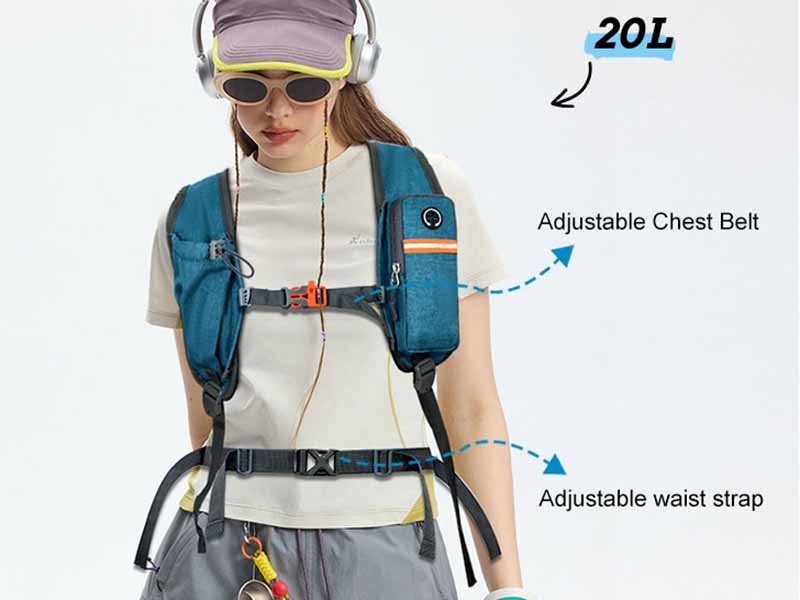
A good sternum strap should sit across the upper chest (not the throat), pull shoulder straps inward just enough to stop slippage, and adjust quickly in both height and length. In manufacturing terms, that means a reliable slider/rail system, a buckle that won’t pop open under movement, optional controlled elasticity, and placement that avoids pressure on the sternum, breast tissue, or upper ribs.
Here’s the “real life” moment that makes sternum straps matter: someone’s walking through an airport or hiking a steep trail, the pack shifts, one shoulder strap starts sliding, and they unconsciously shrug all day to keep the bag on. That constant micro-tension becomes neck and shoulder fatigue. The right sternum strap prevents that—quietly, all day.
What Is a Sternum Strap and Why It Matters?
A sternum strap (chest strap) is a short strap connecting the two shoulder straps across the chest. Its job is simple: keep shoulder straps from drifting outward and reduce front-to-back pack sway during movement. When designed well, it improves stability and comfort without feeling tight or “locked.”
What does a sternum strap do?
A sternum strap mainly does three practical things customers notice immediately:
- Stops shoulder strap slippage (especially on narrow shoulders or slippery jacket fabrics)
- Reduces pack sway when walking fast, climbing stairs, biking, or hiking
- Improves strap angle so pressure is spread more evenly on the shoulders
It does not carry the main load (that’s hip belts and back panels on technical packs). Instead, it improves control—like tightening a seatbelt slightly to stop shifting.
User complaint it solves: “The pack feels like it’s pulling me apart at the shoulders.”
Is it essential for all backpacks?
Not every backpack needs one. Customers usually benefit most when any of these are true:
- pack weight is > 4–5 kg (laptop + chargers + daily items)
- user walks long periods (commute, travel, hiking)
- shoulder straps tend to slip (narrow shoulders, smooth outerwear)
- pack is tall and top-heavy (camera packs, travel packs)
When it’s optional: small lifestyle packs under ~15 L that carry very light loads.
When it becomes “must-have”: hiking packs, camera packs, school packs for kids, and travel packs worn for hours.
How does it improve comfort and stability?
Comfort gains come from reducing the need to “hold the backpack” with your body.
Without a sternum strap, users often:
- shrug shoulders to keep straps from sliding
- tighten shoulder straps too much (creates trapezius pain)
- keep adjusting while walking
With a properly designed sternum strap:
- shoulder straps stay aligned
- less strap migration outward
- more stable center of gravity (less bounce)
| Situation | Without Sternum Strap | With Proper Sternum Strap |
|---|---|---|
| brisk walk / stairs | straps drift outward | straps stay centered |
| leaning forward | pack shifts, pulls shoulders | pack stays close |
| long wear (2–4 hours) | neck/shoulder fatigue rises | fatigue reduced |
| jacket / rain shell | straps slide more easily | slippage controlled |
Where Should the Sternum Strap Be Placed?
Correct placement is the difference between “helpful” and “annoying.” If the strap rides too high, it presses the throat and feels restrictive. Too low, it stops stabilizing the shoulder straps and may press the upper ribs or interfere with breathing mechanics.
The most practical placement zone is across the upper chest, roughly level with the armpit crease to mid-sternum region—high enough to prevent strap drift, low enough to avoid the throat.
Which position works best for adults?
For most adults, a reliable starting point is:
- strap centerline about 2–5 cm (0.8–2.0 in) below the clavicle
- buckle sits near the midline, not off to one side
- strap angle is close to horizontal (not sharply upward)
That said, body shape and pack geometry change the perfect spot. The real test: when tightened lightly, the strap should stop shoulder straps from sliding outward without compressing the chest.
Placement ranges that work in practice
| User Type | Comfortable Height Zone | Notes |
|---|---|---|
| average adult | 2–5 cm below clavicle | most common |
| broad chest | slightly higher | avoids rib pressure |
| narrow shoulders | mid-zone | improves strap control |
| high bust / sensitive chest | slightly lower + wider spacing | avoids breast tissue pressure |
How does placement affect shoulder strain?
Placement changes how the shoulder straps sit.
- Too high → pulls straps inward near the neck → creates trapezius pressure
- Too low → doesn’t stop outward drift → user compensates by shrugging
- Correct height → stabilizes straps at the chest level → reduces the “pull-apart” feeling
Design insight: the sternum strap should “catch” the shoulder straps at a point where the strap webbing naturally wants to move outward during walking.
Is placement different for men vs. women?
Yes, and it’s not about gender labels—it’s about anatomy and comfort zones.
Women often need:
- more vertical range (so the strap can sit above or between sensitive areas)
- softer strap edge finishing
- sometimes a slightly longer strap to avoid pulling straps too sharply inward
Men often need:
- a position that doesn’t ride up toward the neck when the pack is loaded
- a strap that maintains stability during shoulder rotation (sports movement)
Best factory solution for wide markets: Provide high vertical adjustability (longer rail/ladder range) so each user finds a comfortable height.
How Adjustable Should a Sternum Strap Be?
A sternum strap that “technically exists” but is hard to adjust is almost useless. Customers want quick, one-handed adjustability—especially when wearing gloves, moving, or changing layers.
A good system provides:
- height adjustment (moves up/down on shoulder straps)
- length adjustment (tight/loose)
- stable lock (doesn’t slip during motion)
What adjustability features matter?
These are the features that affect real use and customer satisfaction:
- Vertical adjust range (key for fit)
- target range: at least 8–12 cm for adult packs
- for kids: 6–10 cm (depending on age range)
- Smooth slider movement
- should adjust without fighting friction
- should not creep downward over time
- Easy length adjustment
- ideally one-handed pull tab
- webbing should not loosen by itself
- Buckle ergonomics
- easy to open with cold hands
- secure against accidental release
Adjustability checklist customers care about
| Feature | Good Standard | Common Problem if Poor |
|---|---|---|
| vertical range | 8–12 cm+ | strap never “sits right” |
| slider lock | strong anti-slip | strap slides down while walking |
| pull tab | glove-friendly | hard to tighten on the move |
| webbing hand feel | soft edge, not scratchy | neck/chest irritation |
How do you adjust height and width properly?
Height adjustment (most important):
- loosen strap length first
- slide sternum strap to a comfortable chest height
- reconnect buckle
- tighten until shoulder straps stop drifting outward
- check breathing and shoulder movement (raise arms)
Length adjustment:
- tighten only enough to stabilize
- over-tightening is a common mistake and makes the pack feel restrictive
Width adjustment (indirect): Most sternum straps don’t adjust “width” separately. Width comes from:
- shoulder strap spacing
- where the slider sits on the strap
- sternum strap length
So for OEM development, “width comfort” is influenced by shoulder strap pattern and angle, not sternum strap alone.
Do sternum straps need elastic segments?
Elastic can improve comfort, but only if controlled.
Why customers like a little stretch:
- breathing feels natural
- shoulder rotation feels less restricted
- reduces “tight chest” sensation
When elastic becomes a problem:
- too much stretch = the strap stops stabilizing
- rebound bounce increases during running/hiking
| Activity Level | Elastic Recommended? | Why |
|---|---|---|
| city commute | optional | stability matters more than stretch |
| hiking/trekking | light elastic (short segment) | comfort + breathing |
| running | controlled elastic + strong slider | reduces bounce + improves comfort |
| heavy load pack | minimal elastic | stability priority |
A smart approach is a short elastic insert (not full elastic webbing), so the strap holds shape but allows breathing.
Which Backpack Types Benefit Most From Sternum Straps?
Not all packs need the same sternum strap solution. Customers buy different packs for different movement patterns and loads.
Hiking and trekking backpacks
These need sternum straps because:
- loads are heavier (often 6–15 kg)
- movement is continuous
- terrain changes constantly
Key design preferences:
- wide adjustment range
- glove-friendly buckle
- optional whistle buckle
- strong anti-slip slider
Everyday backpacks
Even daily packs benefit when users carry:
- laptops + chargers
- textbooks
- camera gear
Good sternum strap design can reduce shoulder fatigue for office commuters, students, and photographers—especially when the pack is worn for > 30 minutes at a time.
Travel and camera backpacks
Travel packs are often:
- tall
- loaded unevenly
- worn for hours in airports/cities
Camera packs add:
- dense weight in the middle/back
- need for stability when bending or turning
Preferred features:
- smooth height adjustment
- strap that doesn’t interfere with quick-access zippers
- comfortable when wearing a jacket
 How to Test Sternum Strap Comfort Before Buying
Customers often test the wrong thing. The best test isn’t “Does it buckle?” It’s: Does it stay comfortable and stable while moving?
What movements should you try in a real fitting test?
The fastest way to judge a sternum strap is not by looking at it, but by moving like you normally would.
Many straps feel fine when standing still, yet become uncomfortable within minutes of walking.
During a store fitting or home trial, try these four essential movements:
- Raise both arms overhead
- The strap should not press the throat or restrict breathing.
- Shoulder straps should stay in position instead of sliding outward.
- Rotate your torso left and right
- The buckle should stay centered.
- No sharp rubbing should occur near the neck or collarbone.
- Walk quickly for at least 60–90 seconds
- The strap should remain at the same height.
- No gradual loosening or downward sliding should appear.
- Lean forward as if climbing stairs
- The backpack should stay close to your upper body.
- Excess sway usually means the strap tension or placement is incorrect.
These quick checks simulate real daily motion better than simply standing in front of a mirror.
How should you evaluate weight distribution and pressure points?
Comfort changes dramatically once the backpack is loaded with realistic weight.
Testing an empty bag gives misleading results.
Use these practical loading ranges:
| Backpack Type | Realistic Test Weight |
|---|---|
| daily commute | 4–6 kg |
| travel daypack | 6–9 kg |
| hiking backpack | 8–15 kg |
After loading:
- Tighten shoulder straps first.
- Then tighten the sternum strap only until strap drift stops.
- You should still breathe normally and expand your chest.
Signs of correct pressure balance
- Shoulder tension feels reduced within 30–60 seconds.
- No sharp pressure on collarbones or upper ribs.
- Pack sway decreases when walking fast.
Warning signs of poor balance
- Tingling in shoulders after 2–3 minutes.
- Chest feels compressed when inhaling deeply.
- Buckle area presses into the sternum bone.
If any of these appear, the issue is usually strap height, over-tightening, or poor shoulder-strap geometry.
How can you check adjustability and ease of use during motion?
A sternum strap is adjusted while moving, not while standing still.
Ease of use matters as much as comfort.
Test these points:
One-hand tightening:
You should be able to pull the webbing and tighten the strap in under 2 seconds.
Quick release:
The buckle should open smoothly with light thumb pressure, even with cold or slightly wet fingers.
Slider stability:
After walking for 1–2 minutes, the strap height should remain unchanged.
Downward creep indicates weak friction in the slider system.
| Feature | Comfortable Standard |
|---|---|
| tighten time | ≤ 2 seconds |
| buckle release force | firm but smooth |
| height drift after walking | none visible |
| glove usability | operable with light gloves |
These small usability factors strongly influence long-term satisfaction, especially for commuters and hikers.
What long-wear comfort signals should you observe after several minutes?
Short tests reveal positioning problems, but longer wear reveals real comfort.
Wear the loaded backpack for at least 5–10 minutes while walking indoors or outside.
Pay attention to:
- gradual neck rubbing
- heat buildup near the chest
- subtle shoulder fatigue returning
- strap edges pressing into skin through thin clothing
Comfort timeline reference
| Time Worn | What You Should Feel |
|---|---|
| 1 minute | stable, neutral pressure |
| 5 minutes | shoulders slightly more relaxed |
| 10 minutes | no new discomfort appearing |
If discomfort increases instead of decreases, the sternum strap design or placement is not suitable for your body.
Which common fitting mistakes should you avoid?
Many users judge sternum straps incorrectly because of simple fitting errors.
Avoid these frequent mistakes:
- Placing the strap too high → throat pressure and restricted breathing
- Over-tightening the strap → chest compression and fatigue
- Testing with an empty backpack → false comfort impression
- Ignoring shoulder-strap adjustment first → incorrect load balance
- Choosing rough webbing edges → neck irritation in warm weather
Correct testing focuses on movement, weight, and time, not just appearance.
Are There Additional Features Worth Considering?
Yes. Once the basic sternum strap function—placement, adjustability, and stability—is solved, the real difference between an average backpack and a highly rated one comes from small functional upgrades. These details are rarely visible in product photos, but they strongly influence:
- long-term comfort
- daily usability
- safety in outdoor situations
- product durability and return rates
Customers usually don’t ask for these features directly.
Instead, they describe problems like:
- “The strap feels scratchy after an hour.”
- “The buckle is hard to open with gloves.”
- “The strap loosens while I walk.”
Each complaint links to a specific design feature that can be engineered and improved.
Buckle Quality, Safety, and Real-World Reliability
The sternum buckle is one of the highest-failure components on a backpack because it experiences:
- repeated opening and closing
- sudden pulling force when bending forward
- temperature changes (cold outdoor use, hot car interiors)
| Performance Factor | Reliable Range | Customer Impact |
|---|---|---|
| Open/close lifespan | 2,000–5,000 cycles | prevents early breakage |
| Tensile pull resistance | 50–120 N (by pack type) | avoids accidental release |
| Cold resistance | −20 °C without cracking | safe for winter hiking |
| One-hand operation | <2 seconds to release | usable during movement |
Design details customers appreciate immediately:
- slightly curved buckle shape that follows chest contour
- textured thumb tabs for grip with gloves or wet hands
- audible click confirming secure closure
A low-quality buckle may look identical but often causes
unexpected opening, plastic whitening, or cracking within months.
Padding, Edge Finish, and Breathability at Contact Zones
Discomfort usually appears where the sternum strap or shoulder straps
touch the neck, collarbone, or upper chest.
The biggest causes of irritation are:
- sharp webbing edges
- stiff polyester yarn
- trapped heat and sweat
| Feature | Function | When It Matters Most |
|---|---|---|
| Rounded or folded webbing edges | reduces neck rubbing | summer, thin clothing |
| Soft-finish yarn surface | lowers friction | long walking periods |
| Perforated foam tabs near slider | improves airflow | hiking & travel |
| Moisture-resistant materials | prevents sweat absorption | humid climates |
Even 1–2 mm of softer edge finishing can noticeably reduce
skin irritation during 2+ hours of continuous wear.
Elastic Segments, Movement Freedom, and Anti-Bounce Control
Elastic sections are often misunderstood.
Too little stretch feels restrictive.
Too much stretch removes stability.
The goal is controlled flexibility, not softness.
| Use Scenario | Recommended Elastic Length | Reason |
|---|---|---|
| city commuting | none or very short | stability priority |
| day hiking | 10–20 mm elastic insert | breathing comfort |
| trail running | short elastic + tight slider | reduces bounce |
| heavy trekking loads | minimal elastic | load control first |
Well-tuned elasticity allows:
- natural chest expansion while breathing
- smoother shoulder rotation
- reduced strap pressure during uphill walking
Poor tuning leads to visible bouncing and loss of support.
Integration With Safety and Utility Functions
Modern sternum straps often include secondary functions that add value
without increasing weight or cost significantly.
| Feature | Real Benefit | Typical Users |
|---|---|---|
| emergency whistle buckle | signaling in outdoor emergencies | hikers, climbers |
| magnetic hose clip | holds hydration tube in place | trekking & cycling |
| reflective yarn or print | visibility at night | commuters, runners |
| quick-release safety buckle | fast removal in emergencies | kids’ backpacks |
Among these, the whistle buckle is one of the most requested
for outdoor backpacks because it adds safety with almost zero weight.
Noise Control, Strap Management, and Premium Feel
Small sensory details strongly affect how customers judge quality.
Common annoyance points:
- loose webbing ends flapping while walking
- plastic squeaking against webbing
- strap bouncing when running or climbing stairs
Design refinements that improve perceived quality
| Refinement | Effect on User Experience |
|---|---|
| elastic webbing keepers | prevents loose-end flapping |
| tighter slider tolerance | reduces micro-movement noise |
| matte-finish buckle surface | quieter contact with fabric |
| balanced strap tension range | smoother walking motion |
These upgrades are inexpensive in production but often lead to
better customer reviews and lower return rates.
Why Choose Szoneier for Your Custom Sternum Strap Backpack Designs?
Szoneier has over 18 years of experience in producing high-quality backpacks for a wide range of industries. We specialize in creating custom backpack solutions that are tailored to your specific needs, ensuring that every feature—from the sternum strap to the back panel—works in harmony to maximize comfort, durability, and performance.
Our services include:
- Custom sternum strap development tailored to your target audience
- Sourcing premium materials like POM buckles, elastic webbing, and high-density nylon
- Prototyping and small-batch manufacturing to ensure that your design works before going into full-scale production
- Low minimum order quantities (MOQs), so you can test designs without committing to large volumes
- Quick sample turnaround and rapid testing to make sure your design meets durability standards
If you are developing a new backpack line or looking to improve an existing model, Szoneier is here to help. Request a custom quote today, and let’s discuss how we can bring your sternum strap design to life with precision and comfort.