Skip to content

A beautiful prototype can create a surprising amount of false confidence. When an experienced sample maker spends several days perfecting one backpack, handbag, cooler bag, or travel bag, the result may look excellent on a meeting-room table. The real manufacturing test begins after approval. Can the same supplier reproduce that product across 2,000, 10,000, or several repeat production runs while keeping the fabric, dimensions, stitching, hardware, logo, packaging, color, and delivery schedule under control? For established brands, that gap between “making a good sample” and “running a reliable manufacturing system” is where many sourcing problems begin.
A good bag manufacturer for global brands combines relevant product experience, controlled sampling, material knowledge, documented specifications, repeatable production, multi-stage quality control, realistic capacity, compliance support, transparent commercial terms, export-ready delivery, and reliable repeat-order management. The strongest manufacturer is not automatically the cheapest or largest factory. It is the one that can consistently reproduce the approved product while keeping quality, timing, communication, and supply-chain risk under control.
Imagine approving a perfect sample in March for a September retail launch. Four months later, bulk production arrives with slightly thinner fabric, a different zipper pull, handles positioned several millimeters higher, and cartons that do not meet the distribution center’s receiving requirements. Each problem looks small when viewed separately. Together, they can delay a launch, create rework, increase freight costs, and damage retailer confidence. That is why experienced sourcing teams evaluate the manufacturing system behind the bag, not simply the bag in front of them.
What Makes a Bag Manufacturer Brand-Ready?

A brand-ready bag manufacturer can turn a commercial product requirement into a controlled and repeatable production program. It should demonstrate relevant product experience, development capability, material control, measurable production resources, documented quality checkpoints, packaging knowledge, and clear project ownership. These capabilities should be verified through samples, specifications, production evidence, factory reviews, quality records, and order-specific discussions rather than accepted as general marketing claims.
What Should Global Brands Expect from a Manufacturer?
The first question is not whether a factory can sew a bag. Most established soft-goods factories can manufacture a basic tote, pouch, backpack, or travel bag. A more useful question is whether the factory regularly works with the same level of structure, materials, components, finishing, performance expectations, packaging requirements, and order complexity as the product being developed. A promotional drawstring bag and a heavily reinforced tool bag are both “bags,” but their manufacturing requirements have very little in common.
A capable manufacturer should be comfortable discussing fabric weight, denier, coatings, linings, foam, reinforcement, webbing, zipper type, hardware, seam construction, stress points, logo processes, packaging, expected load, intended use, target market, and production volume. The discussion should move beyond phrases such as “high quality” and “premium material.” For example, if a shoulder bag is expected to carry 8–10 kilograms regularly, the factory should consider strap anchoring, webbing construction, reinforcement layers, seam direction, bartacks, and surrounding panel strength together rather than only recommending a thicker outer fabric.
Professionalism also shows in the ability to define limitations. A supplier that explains that a waterproof claim requires a particular construction method and testing is often more reliable than one that promises “100% waterproof” before reviewing the design. The same applies to recycled materials, custom hardware, unusually low order quantities, and extremely short delivery schedules. Mature manufacturing teams understand that technically possible, commercially practical, and reliably repeatable are three different standards.
Szoneier’s documented role is built around this broader manufacturing responsibility rather than simple order forwarding. Its operating model covers product development, material coordination, sampling, production management, quality inspection, packaging, and export delivery, with the stated objective of reducing development risk and improving consistency between approved samples and repeat bulk production.
Which Factory Capabilities Should Be Verified?
Factory capability becomes meaningful only when it can be connected to measurable resources and a real production plan. Statements such as “large capacity,” “professional team,” or “advanced equipment” give a sourcing team very little information. More useful figures include sewing-line count, sample-making resources, equipment categories, production staffing, QC resources, available floor space, regular monthly output, warehouse capacity, and the number of projects the factory can manage simultaneously without losing project visibility.
Szoneier’s documented manufacturing system includes 8 sewing production lines, 160+ production and support machines, 120+ production-related employees, a 500+ square meter sample room, a 300+ square meter pattern and sampling workshop, and regular monthly output of approximately 120,000–200,000 pieces depending on product construction, materials, logo processes, packaging, and production scheduling. The same documented system is designed to manage roughly 20–35 custom production orders in parallel under different project conditions.
Those figures still need context. Twenty thousand simple pouches and twenty thousand technical backpacks do not consume equivalent factory resources. A backpack containing multiple zipper compartments, foam layers, molded accessories, reinforcement structures, custom embroidery, and individual retail packaging may require several times more labor than a basic promotional tote. The correct capacity question is therefore not “How many bags can you make per month?” but “How many units of this construction can you make during our actual production window without compromising approved standards?”
| Factory Metric | Documented Reference | What a Brand Should Verify |
|---|---|---|
| Sewing lines | 8 lines | Which product types normally use those lines |
| Production/support equipment | 160+ machines | Whether the equipment suits the required construction |
| Production-related staff | 120+ people | Experience with comparable materials and bag structures |
| Sample room | 500+ sqm | Pattern, prototype, revision, and approval resources |
| Monthly output | Approx. 120,000–200,000 pcs | Actual available capacity for the specific project |
| Parallel projects | Approx. 20–35 orders | Ability to manage multi-SKU programs without losing control |
How Can Brands Verify a Real Factory?
Factory verification is most useful when it follows the product through the actual manufacturing flow. A polished showroom can be impressive, but it proves very little about production control. A useful review should cover material receiving, storage, pattern development, sample making, cutting, sewing, semi-finished inspection, final inspection, packing, finished-goods storage, and shipment preparation. Each area helps confirm whether the organization behind the sales presentation can actually support the proposed project.
For overseas sourcing teams, live video verification can be particularly useful. Rather than relying entirely on edited company videos, a brand can ask the supplier to walk through specific areas during a live call. The conversation may include the sample room, cutting area, sewing lines, QC section, material warehouse, finished-goods area, packing stations, and examples of products with similar structures. The objective is not to inspect every machine remotely but to see whether physical operations broadly match the supplier’s stated capabilities.
Szoneier supports scheduled video factory reviews and factory visits for qualified sourcing projects, allowing customers to review sampling resources, material options, sewing production, QC processes, packaging, and project-management arrangements. When several pieces of evidence agree—the equipment, team structure, production flow, sample capability, factory layout, and documentation—the supplier claim becomes much more credible than a single certificate, photograph, or marketing statement.
How Do Product Development and Sampling Work?

Product development converts an idea, drawing, reference product, or tech pack into a manufacturable specification, while sampling proves whether those decisions work in a physical product. A strong process should progressively remove uncertainty around dimensions, materials, construction, trims, branding, workmanship, function, packaging, and cost before bulk production begins, rather than using the sample only as a visual demonstration.
How Does an Idea Become a Production-Ready Bag?
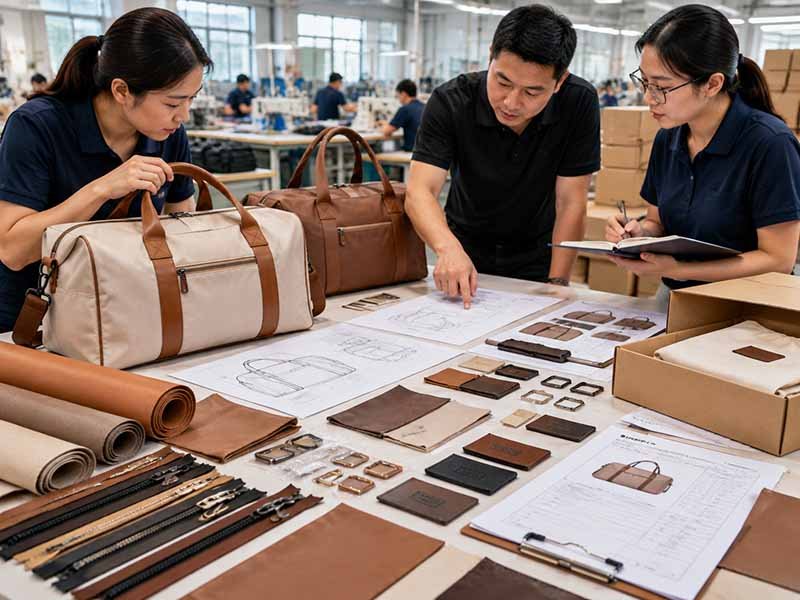
Brands approach manufacturers with very different levels of information. One product team may provide a detailed tech pack containing dimensions, tolerances, BOM data, Pantone references, artwork, seam instructions, hardware specifications, and packaging requirements. Another may send several reference photographs, a sketch, a competitor sample, and an explanation of the intended customer. Both projects can eventually reach production, but they require different levels of engineering and clarification before a reliable quotation or sample can be created.
The manufacturer’s first responsibility is to remove ambiguity. Important questions include what the product will carry, how often it will be used, expected finished dimensions, likely load, target material appearance, desired hand feel, required lining, reinforcement, foam, insulation, waterproofing, logo treatment, target order quantity, target price range, and destination market. The answers affect one another. A material change may alter structure, weight, sewing difficulty, packaging volume, lead time, and cost at the same time.
For an OEM project, the factory normally follows an established specification, reference sample, or production standard. For ODM development, the manufacturer may contribute more actively to fabric selection, pattern development, pocket arrangement, reinforcement, trim choices, dimensions, cost engineering, or manufacturability. Szoneier’s documented product-development scope supports both types of project, including programs beginning with complete technical documentation and programs beginning with images, sketches, physical references, ideas, or channel requirements.
A strong development process should make the project clearer with every conversation. Materials should move from “possible options” to “selected specification.” Measurements should move from assumptions to approved dimensions. Logo treatment should move from an idea to a defined size, method, color, and location. When those decisions remain vague until bulk production, the factory floor is forced to solve problems that should have been solved during development.
What Should a Good Sampling Process Include?
Sampling should be treated as a manufacturing validation process rather than simply the purchase of one handmade product. Its purpose is to determine whether the proposed pattern, fabric, lining, components, logo, reinforcement, dimensions, construction, finishing, and packaging can work together as intended. A good sample may reveal that a pocket opening is too narrow, the selected zipper is too heavy, the foam distorts the silhouette, or the logo method does not suit the chosen surface.
A disciplined sample process normally moves through requirement review, material confirmation, pattern development, cutting, sample sewing, internal checking, buyer review, physical sample shipment when required, revision, and final approval. Szoneier’s documented sampling workflow includes material confirmation, pattern making, sample sewing, internal checking, photo or video review, shipment, revision, and final sample approval. Each stage removes a different kind of uncertainty before the production order becomes larger and more expensive.
Revision control is especially important. A backpack may go through three sample rounds: the first changes the shoulder-strap angle, the second raises the front pocket by 15 millimeters, and the third replaces the zipper pull and modifies the logo size. If those changes remain scattered across emails and chat messages, an old specification can easily return during production. Good project management records changes by version and confirms which version becomes the final manufacturing reference.
Brands should also pay attention to how the supplier reacts to a failed sample. A serious factory does not simply remake the product without explaining the cause. It should identify whether the issue came from the pattern, material choice, construction method, workmanship, specification, or misunderstanding. That diagnosis is often more valuable than the sample itself because it shows whether the team can prevent the same issue from spreading through bulk production.
How Is the Final Sample Locked for Production?
An approved physical sample is valuable, but it should not be the only production reference. Before bulk manufacturing begins, the factory should connect that sample to a set of controlled specifications covering finished dimensions, tolerances, fabrics, linings, coatings, reinforcement, zipper types, webbing widths, hardware, logo size and location, colors, construction details, and packaging. When a question arises during production, the answer should come from approved records rather than from someone’s memory of a previous discussion.
The Bill of Materials is particularly important because bags contain many components that may look similar but perform differently. Two visually similar buckles can have different finishes or strengths. Two black polyester fabrics may come from different specifications or dye lots. Two foam sheets may have the same thickness but different densities. The more complex the bag, the more important it becomes to identify each critical component clearly before purchasing and production begin.
Repeat production makes documentation even more valuable. Szoneier’s documented repeat-order management can retain patterns, BOM information, material records, logo files, packaging documents, QC standards, SKU information, and revision history. This allows a successful product to return months later without being recreated from fragmented conversations. It also makes controlled expansion easier when a brand adds colors, sizes, packaging variations, or market-specific versions.
The purpose of locking the sample is not bureaucracy. It is to create one clear answer to a simple but important question: “What exactly did we approve?” When that answer is available to purchasing, pattern making, production, inspection, packing, and account management, the risk of gradual product drift becomes substantially lower.
Which Material and Construction Controls Matter?

Material and construction decisions shape the appearance, durability, weight, cost, function, and customer experience of a bag. A capable manufacturer should help match fabrics, linings, coatings, foam, reinforcement, webbing, hardware, zippers, and sewing methods to the actual use of the product. Good material decisions are based on specifications and application requirements rather than vague descriptions such as “premium fabric.”
Which Materials Fit Different Bag Programs?
There is no universally superior bag material because each material solves a different combination of commercial and technical needs. Polyester is widely used because it offers practical availability, cost control, durability, color options, and compatibility with many printing processes. Nylon is frequently selected for products requiring different abrasion characteristics, lower weight, or a particular hand feel. Oxford fabrics are common in backpacks, travel products, tool bags, outdoor bags, and functional soft goods because they are available in a wide range of constructions and coatings.
Canvas creates a different product language. It can feel more natural, structured, and lifestyle-oriented, but its weight, weave, shrinkage, color behavior, and finishing should still be specified carefully. Neoprene adds cushioning, elasticity, and a distinctive hand feel, making it useful for certain sleeves, cases, bottle carriers, lunch products, and protective applications. PU and genuine leather introduce completely different concerns around surface consistency, finishing, edge treatment, storage, workmanship, and price. PVC and TPU can support products requiring coated or welded constructions, while mesh, RPET, and other specialized fabrics serve additional functional or sustainability objectives.
Szoneier’s documented material sourcing scope includes polyester, nylon, Oxford, canvas, cotton, neoprene, PU, leather, PVC, TPU, mesh, RPET, and other functional fabrics. The important point is that material names alone do not define performance. Two fabrics described as “600D polyester” may differ noticeably in yarn construction, density, coating, backing, thickness, appearance, abrasion behavior, hand feel, and cost.
How Should Materials Be Selected?
Material selection should begin with the product’s real use rather than with a price list. A lightweight promotional drawstring bag intended for an event does not require the same abrasion resistance, seam reinforcement, and structural support as a tool bag expected to carry several kilograms of equipment. A cosmetic pouch may place more emphasis on cleanability, appearance, zipper smoothness, lining behavior, and dimensional consistency, while an outdoor backpack may prioritize weight, abrasion resistance, reinforcement, weather protection, and carrying comfort.
Material thickness is also frequently misunderstood. Thicker does not automatically mean better. Excessive thickness can increase product weight, reduce flexibility, complicate folding, slow sewing, increase needle or thread requirements, consume more carton volume, and raise freight costs without improving the parts of the product that customers actually value. In some applications, a lighter fabric combined with correctly positioned reinforcement can perform better than simply increasing the weight of every panel.
| Product Type | Common Material Direction | Main Construction Priority | Practical Question |
|---|---|---|---|
| Promotional tote | Cotton, canvas, polyester | Cost, appearance, printability | Will the fabric hold the expected shape at target cost? |
| Backpack | Polyester, nylon, Oxford | Load, abrasion, comfort | Are straps and stress points reinforced correctly? |
| Tool bag | Heavy Oxford/polyester | Wear, structure, base support | Can handles and base withstand repeated loading? |
| Cosmetic bag | Polyester, PU, TPU, canvas | Appearance, lining, cleanability | Will zipper and lining remain smooth in production? |
| Cooler bag | Outer fabric + insulation + liner | Thermal structure and seams | Do all insulation layers work as one system? |
| Dry bag | TPU/PVC-type constructions | Seam sealing and water protection | Does construction support the claimed protection level? |
| Premium handbag | PU, leather, coated fabrics | Surface, hardware, finishing | Can appearance remain consistent across production lots? |
Material selection also affects MOQ and lead time. A stock fabric in an available color may be practical for a small trial order, while custom-dyed material can require a higher minimum and additional preparation time. Custom coatings, special finishes, recycled content, fire-related performance, or other functional requirements may introduce testing or sourcing considerations that should be resolved before the final quotation is treated as fixed.
How Are Trims and Stress Points Controlled?
Many bag failures begin somewhere other than the main fabric. Shoulder-strap attachments, handles, zipper ends, buckles, webbing anchors, seam intersections, bottom panels, piping, pocket corners, binding, and high-load areas often determine whether a product survives real use. A bag made from expensive fabric can still fail quickly when a handle is attached to an insufficient reinforcement area or when repeated force concentrates on a weak seam.
For backpacks and duffle bags, handle and shoulder-strap construction should be evaluated as a system. Webbing width, material, attachment depth, reinforcement layers, bartack placement, seam allowance, surrounding panel structure, and load direction all matter. Strengthening only the webbing may simply transfer the failure to the fabric beside it. For tool bags, bottom-panel construction and handle anchoring can be more important than the decorative surface treatment. For cooler bags, exterior material, foam, lining, zipper, insulation continuity, and seam construction should be evaluated together.
Specifications help turn subjective expectations into measurable controls. Depending on the product, a technical record may include webbing width in millimeters, foam thickness, zipper size, hardware finish, pocket dimensions, logo offsets, panel dimensions, stitch or reinforcement locations, and finished-size tolerances. Exact values must be determined by the product rather than copied from a universal standard, but the principle remains consistent: critical construction details should be defined before the production floor is asked to repeat them thousands of times.
Environmental and material claims require the same discipline. Szoneier’s documented policy states that material-related certifications such as GRS or OEKO-TEX should be confirmed according to the actual supplier, material batch, certificate scope, and validity instead of being assumed to cover every material automatically. This approach protects brands from using broad claims that the supporting documents do not actually cover.
How Is Bulk Quality Kept Consistent?

Consistent bulk quality comes from matching production to the approved sample and controlling the product at several stages rather than relying entirely on a final inspection. Strong quality systems review incoming materials, components, pre-production references, cutting, sewing, semi-finished goods, finished products, and packaging so that problems are identified close to the stage where they originate and corrected before they spread across an entire order.
What QC Checkpoints Matter?
The cost of a quality problem usually increases as production progresses. If the wrong fabric shade is discovered before cutting, the disruption may involve replacement material and a scheduling adjustment. If the same problem is discovered after 10,000 finished bags have been sewn, branded, inspected, packed, and allocated to different markets, the commercial impact becomes far more serious. This is why quality control should begin before the first production stitch rather than after the last one.
A practical quality system checks incoming materials and accessories against approved specifications before they enter production. Cutting inspection helps control panel dimensions, material direction, alignment, and obvious defects. Sewing-process inspection identifies seam, thread tension, alignment, reinforcement, zipper, hardware, and workmanship problems while operators can still adjust the method. Semi-finished inspections can identify structural issues before linings or panels make those areas difficult to access. Final inspection reviews the completed product, while packaging inspection protects SKU, quantity, barcode, labeling, and shipment accuracy.
Szoneier’s documented quality workflow includes material inspection, accessory inspection, pre-production sample confirmation, cutting inspection, sewing-process inspection, semi-finished inspection, final inspection, and packaging inspection. Eight stages alone do not guarantee a perfect shipment, but they represent a more useful quality philosophy than relying on a single final check after most production decisions can no longer be changed easily.
AQL-based sampling is commonly used in international soft-goods inspections. Some commercial inspection programs use reference levels such as AQL 2.5 for major defects and AQL 4.0 for minor defects, but those figures should not be presented as a universal rule. The inspection level, sample size, critical defect policy, major/minor classification, and acceptance criteria should be agreed according to the brand, product risk, order size, retailer requirements, and prior production history.
How Is Sample-to-Bulk Consistency Controlled?
The transition from sample room to production line deserves special attention because sample making and bulk manufacturing operate under very different conditions. A skilled sample maker may spend several hours adjusting a difficult zipper, pocket, seam, or corner until the prototype looks perfect. A production line must reproduce the same construction efficiently hundreds or thousands of times using several operators who may each be responsible for only one stage of assembly.
The first production units therefore provide important evidence. They show whether the factory has successfully transferred the approved sample into production instructions. Practical comparison points include finished measurements, fabric, lining, color, zipper, hardware, logo, reinforcement, pocket location, seam construction, stitching appearance, overall shape, function, and packaging. If the early production units consistently match the approved reference, the factory has a much stronger basis for continuing the run.
Unapproved substitution is one of the most common ways product consistency can deteriorate. A zipper pull described as “almost identical” may still look visibly different beside an earlier production batch. A slightly different black fabric can become obvious under retail lighting. A foam replacement can change the silhouette even if thickness appears similar. For brands with replenishment programs, small substitutions become especially visible because old and new inventory may be sold side by side.
A safer approach is straightforward: any material, trim, artwork, construction, or packaging change that affects the approved product should be communicated and approved before it reaches bulk production. The purpose is not to prevent factories from solving supply problems, but to make sure those solutions remain controlled decisions rather than invisible changes.
How Should Defects Be Evaluated?
Not every defect has the same commercial significance. A loose thread hidden inside a lining should not be treated exactly like a failed shoulder-strap attachment, an incorrect barcode, a broken zipper, or a sharp metal component. Effective quality standards distinguish between defects according to their effect on safety, function, appearance, customer experience, packaging, and distribution.
Critical defects normally involve safety, prohibited materials, dangerous components, or conditions that make the product unacceptable for sale. Major defects can include failures that materially affect function, appearance, dimensions, branding, or expected use. Minor defects are generally smaller workmanship or cosmetic deviations that do not materially affect function and remain within an agreed tolerance. Packaging defects need separate attention because an excellent product in the wrong SKU carton can still cause warehouse rejection or fulfillment problems.
| Defect Level | Typical Example | Typical Response |
|---|---|---|
| Critical | Safety issue, dangerous sharp component, prohibited material | Stop affected shipment and investigate |
| Major | Broken zipper, handle failure, wrong dimensions, incorrect logo | Repair, replace, segregate, or reject affected units |
| Minor | Limited cosmetic issue not affecting function | Evaluate against agreed tolerance and sampling plan |
| Packaging | Wrong SKU, barcode, label, carton quantity | Correct before shipment or warehouse delivery |
Third-party inspection can add another independent layer, especially for first orders, large programs, retailer-controlled shipments, or projects where the brand cannot send its own team. It should complement rather than replace the factory’s internal process. An external inspector can sample what has already been produced, but only a functioning production-quality system can prevent the same mistake from being repeated across thousands of units before the inspector arrives.
How Do Capacity, Compliance and Delivery Reduce Risk?
Capacity, compliance, and delivery determine whether a technically successful product can become a commercially successful program. A manufacturer needs enough usable production capacity for the actual launch window, testing and documentation appropriate to the destination market, and packaging and logistics capable of moving finished products into the required warehouse or retail system. These questions should be resolved before production leaves the brand with fewer options.
Is the Factory Capacity Scalable?
Published factory capacity is useful only when it is interpreted in relation to a real product. A supplier may be able to produce very large quantities of basic pouches or totes while producing much smaller quantities of structured backpacks during the same period. The number of sewing operations, material preparation, reinforcement, custom hardware, printing, embroidery, SKU count, finishing, individual packaging, and inspection all influence practical output.
Szoneier documents regular monthly capacity of approximately 120,000–200,000 pieces across its custom bags and soft-goods manufacturing system, with annual capacity of roughly 1.5–2.4 million pieces. The company also documents the ability to manage approximately 20–35 production orders in parallel depending on product complexity, material readiness, SKU quantity, packaging, and required delivery timing. The conditions attached to those figures are just as important as the figures themselves.
A useful capacity conversation should therefore describe the actual order. A statement such as “18,000 units, four colors, two packaging versions, production required between May and July” allows the factory to discuss line allocation, material preparation, bottlenecks, and realistic completion dates. Asking only for the supplier’s theoretical monthly maximum may produce an impressive figure that has little relationship to the program being planned.
Long-term programs also need peak-season planning. A factory that has enough capacity in February may have very different availability before major retail seasons. Brands with regular replenishment should discuss forecast sharing, material reservations, production slots, long-lead components, and backup resources before demand becomes urgent. The objective is not simply to find a factory capable of producing one large order, but to understand whether capacity can remain predictable when the brand’s volume and SKU complexity increase.
Which Compliance Requirements Should Brands Verify?
Compliance should always be connected to the specific product, component, material, destination market, and claim being made. A certificate displayed on a supplier website does not automatically prove that every product produced by that company is covered. Brands should examine the issuing organization, legal entity, manufacturing site or material supplier, product or material scope, report number where relevant, validity period, testing method, and whether the documentation actually applies to the SKU being purchased.
Environmental claims deserve particular care because marketing language often becomes broader than the supporting documentation. A bag described as recycled may contain a recycled outer fabric while other components remain conventional. An OEKO-TEX-related material document may cover one supplier and one material family rather than the entire finished product. GRS documentation may depend on the certified supplier, transaction chain, component, and scope. These distinctions should be understood before sustainability language appears on packaging or product pages.
Szoneier’s documented approach states that materials such as RPET, recycled fabrics, organic cotton, or PVC-free alternatives can be sourced according to project requirements, while certifications such as OEKO-TEX or GRS must be checked against supplier, material batch, certificate scope, and validity. This is a more defensible approach than assuming that one material certificate automatically applies to every order.
For products entering the European Union, REACH-related requirements may also need to be reviewed according to the materials and components involved. Szoneier’s documented support includes coordinating REACH-related testing for selected materials or finished products based on project requirements, with scope, components, colors, laboratory, cost, and lead time confirmed before bulk production. Compliance becomes much more useful when it is treated as an order-specific verification process rather than a collection of logos.
How Should Packaging and Delivery Be Managed?
A bag is not commercially finished when the last sewing operation is complete. It is finished when the correct SKU reaches the correct warehouse, retailer, fulfillment center, distributor, or business destination in the expected packaging with the correct labels and documents. Packaging mistakes can cause chargebacks, delays, re-labeling labor, warehouse rejection, or inventory confusion even when every physical bag inside the carton is acceptable.
Packaging requirements should therefore be confirmed before bulk production. Depending on the sales channel, that may include individual polybags or alternative packaging, hangtags, inserts, barcode labels, SKU labels, FNSKU labels, carton labels, carton quantities, carton dimensions, gross-weight limits, shipping marks, packaging artwork, and retailer-specific instructions. A multi-SKU order needs particular care because a simple labeling or carton-allocation error can create expensive fulfillment problems after the products leave the factory.
Szoneier’s documented logistics support includes sample delivery, express shipping, air freight, sea freight, DDP services, Amazon FBA preparation, carton-label handling, barcode support, split shipments, and multi-address delivery. This type of support becomes especially relevant when one production order must be divided between an Amazon fulfillment center, a third-party warehouse, retail distribution, and other business destinations.
The manufacturer does not need to own an international freight company to manage this stage professionally. What matters is whether production, packing, labeling, documentation, booking, shipment planning, and destination requirements are coordinated instead of treated as unrelated tasks. A technically excellent bag can still become an operational problem if the shipment is not prepared for the system that receives it.
How Do Brands Choose a Long-Term Manufacturing Partner?
Brands should choose a long-term manufacturing partner by looking beyond the first quotation and first prototype. The stronger relationship is usually built with a supplier that communicates accurately, explains cost and MOQ drivers, preserves approved specifications, documents revisions, identifies risks early, manages repeat orders reliably, and supports additional colors, sizes, packaging versions, SKUs, channels, and production volumes without losing control as complexity increases.
How Should Communication and Commercial Terms Be Evaluated?
Fast responses are useful, but response speed alone is a poor measure of manufacturing communication. The more important question is whether conversations become accurate production decisions. If a product manager asks for a “stronger handle,” a capable manufacturing team should clarify whether the requirement involves different webbing, greater attachment depth, additional reinforcement, revised bartack positioning, a different seam method, or a specific load expectation. Simply replying “OK” leaves the manufacturing problem unresolved.
Good communication creates records. Materials, measurements, artwork changes, sample revisions, packaging changes, delivery decisions, cost assumptions, and approved deviations should be traceable. This becomes increasingly important as a project grows. A program may involve sales, product development, pattern making, purchasing, production, quality inspection, packaging, logistics, and the customer’s own design and sourcing teams. When important information exists only in one person’s memory, the risk of interpretation errors increases with every handoff.
Commercial transparency follows the same principle. A useful quotation should explain the assumptions behind material, quantity, logo method, accessories, packaging, and shipping scope. If an apparently simple specification change materially increases cost, the supplier should be able to explain the reason. A custom zipper pull, special fabric color, molded hardware part, premium gift box, or performance-testing requirement may create minimums or setup costs that do not exist in a standard configuration.
Lead time should also be treated as a chain rather than a single optimistic number. Product development, sample revision, custom materials, trim purchasing, production, inspection, packing, and international shipping each consume time. Professional suppliers sometimes need to tell a brand that a requested combination of quantity, price, specification, and delivery date is unrealistic. That answer may be inconvenient, but it is much safer than discovering the conflict after the deposit has been paid.
Are MOQ and Pricing Transparent?
MOQ is rarely determined by only one factory rule because a custom bag is assembled from several supply chains. The bag factory may be able to sew 200 units efficiently, while a fabric mill, zipper supplier, buckle factory, printing process, custom mold, or packaging supplier may each have different minimum quantities. The practical MOQ of the finished project is influenced by whichever critical component creates the strongest constraint.
Szoneier documents MOQ starting from 200 pieces for many standard custom bag projects, particularly when products use available fabrics, stock colors, mature structures, commonly sourced accessories, practical logo processes, and regular packaging. Projects requiring custom colors, specialty materials, custom hardware, molded components, complex structures, custom packaging, or specific functional testing can require higher minimum quantities. This conditional explanation reflects how real custom manufacturing works more accurately than advertising one MOQ for every product.
Pricing should be analyzed in the same way. Material consumption, usable fabric width, lining, foam, reinforcement, zipper, hardware, logo technique, embroidery stitch count, printing setup, sewing time, order quantity, color split, SKU count, individual packaging, inspection, and freight terms can all affect unit cost. A price reduction created by silently removing reinforcement or substituting material is not an equivalent lower price; it is a different specification.
Experienced sourcing teams therefore compare quotations at the specification level. When one quotation is significantly lower, they investigate which material, component, process, packaging assumption, quality standard, or commercial term differs. The cheapest figure becomes much less attractive if the savings return later as sample revisions, inconsistent quality, rework, delayed launches, excess inventory, or customer complaints.
How Are Repeat Orders Kept Consistent?
Repeat production is where the quality of a supplier relationship becomes easiest to evaluate. The pattern already exists, the material has already been selected, the packaging has been approved, and the factory already understands the construction. In theory, the second and third production runs should become more predictable. In practice, repeat orders often reveal weak documentation because a different fabric lot, replacement component, new project manager, revised artwork, or new production line can slowly change the product.
A strong repeat-order system preserves the critical history of the product. Szoneier’s documented process can archive patterns, BOM information, material records, logo files, packaging documents, QC standards, SKU information, and revision history. These records allow a new order to be compared with the original approved standard instead of being reconstructed from old chat conversations.
This becomes particularly important when a brand adds new versions. One successful travel pouch may later expand into four colors, two sizes, different zipper finishes, a gift-pack version, an Amazon package, and a retailer-exclusive SKU. If the original product is well documented, these variations can be managed as controlled extensions. If it is poorly documented, every addition creates another opportunity for materials, dimensions, artwork, and construction to drift.
Useful repeat-order measurements include material consistency, dimensional consistency, defect levels, delivery performance, unapproved substitutions, packaging accuracy, and whether corrective actions from earlier orders were actually carried forward. The goal is not to demand that nothing ever changes. Materials and suppliers sometimes do change. The goal is to make those changes visible, approved, and traceable.
Can the Manufacturer Support Brand Growth?
A strong manufacturing partner becomes more useful as the product line becomes more complex. The first successful product may begin with one material, one color, and one package. Over time, the brand may add a premium version, a lower-cost version, additional sizes, different colorways, channel-specific packaging, seasonal editions, matching accessories, or an entirely related collection using the same design language.
Szoneier’s documented long-term development model includes extending approved products into additional colors, sizes, materials, packaging versions, price tiers, channel-specific SKUs, and related product lines while retaining material records, production standards, and project documentation. This is a more meaningful form of scalability than simply increasing the number of pieces on one purchase order.
The real test is whether increasing complexity causes decreasing control. A manufacturer may perform well when managing one tote in one color but struggle when the project becomes eight SKUs with different packaging and staggered delivery dates. Project-management capacity, purchasing coordination, production scheduling, SKU identification, inspection planning, and documentation become more important as the program expands.
A healthy supplier relationship should therefore become more predictable over time. The second order should require less clarification than the first. New colors should reuse established structural standards. Revised packaging should not accidentally reopen material decisions. New SKUs should benefit from previous lessons. When each successful order adds usable knowledge to the next one, the manufacturer is doing more than supplying products; it is becoming part of the brand’s product-development and supply-chain infrastructure.
Conclusion
The most dependable bag manufacturer is rarely identified by the lowest unit quotation, the largest factory photograph, or the longest list of products on a website. Global brands need a supplier whose development, materials, sampling, production, quality, documentation, packaging, and delivery systems remain connected from the first conversation through repeat production. The difference becomes visible when an approved sample has to be reproduced consistently across thousands of units, several SKUs, different markets, and multiple reorder cycles.
A practical supplier evaluation should therefore focus on evidence. Review comparable products, material specifications, sampling records, production resources, quality checkpoints, factory operations, capacity planning, testing arrangements, packaging knowledge, and repeat-order documentation. Ask how changes are approved, how production problems are escalated, and how a successful SKU will be reproduced six or twelve months later. Those questions reveal much more about manufacturing reliability than generic claims of “best quality” or “competitive price.”
For brands developing custom bags and soft goods, Szoneier operates around this full project cycle, including material selection, pattern and sample development, production coordination, multi-stage quality inspection, packaging, shipment preparation, and repeat-order management. The practical objective is straightforward: turn a design, reference sample, tech pack, or product idea into something that can be approved, produced, delivered, and ordered again with less uncertainty each time.
Frequently Asked Questions
What should I look for in a good bag manufacturer?
A good bag manufacturer should demonstrate relevant experience with your product category, structured sample development, reliable material sourcing, documented specifications, suitable production capacity, multi-stage quality control, packaging knowledge, and repeat-order management. Do not judge capability only from a finished sample or company presentation. Ask how the factory controls materials, production changes, first production pieces, inspection, packing, and reorders, because these processes determine whether approved quality can be repeated consistently.
How can I verify a bag manufacturer before placing a large order?
Begin with product-specific questions rather than only requesting certificates. Review comparable samples, manufacturing equipment, sample-making resources, material options, QC procedures, typical production volume, and project-management structure. A live video factory review or physical visit can help confirm that the sample room, cutting area, sewing lines, QC section, warehouse, and packing operations match the supplier’s claims. A trial sample and controlled first production order can then provide stronger evidence before larger commitments.
What is the difference between a bag supplier and a bag manufacturer?
The terms are often used interchangeably online, but the operating models can be very different. A manufacturing partner is directly involved in product development, material coordination, pattern making, sampling, production, inspection, packaging, and manufacturing problem solving. A trading-only supplier may coordinate some of these activities through external factories. Neither model should be judged only by the label; brands should verify who actually controls sampling, production decisions, QC, component sourcing, documentation, and corrective actions.
How do I make sure bulk production matches the approved bag sample?
The approved sample should be supported by controlled specifications rather than used as the only reference. Record measurements, tolerances, fabric, lining, hardware, zipper, reinforcement, webbing, logo, colors, construction, packaging, and BOM information before production. The first production units should then be compared with the approved reference. Material or component substitutions should require approval, while in-line and final inspections should confirm that the agreed specifications remain stable throughout the production run.
What MOQ is normal for custom bag manufacturing?
There is no universal MOQ because minimum quantity depends on product structure, materials, colors, hardware, logo processes, packaging, and individual component suppliers. Some relatively standard custom bag projects can begin around a few hundred units when stock fabrics, available colors, common trims, and straightforward packaging are used. Custom-dyed materials, molded hardware, specialized functions, complex packaging, or testing requirements can raise the practical minimum substantially, so MOQ should always be evaluated at project level.
Which quality inspections are important for custom bags?
Useful quality control normally begins with materials and accessories before cutting, continues through cutting and sewing, and includes semi-finished, final-product, and packaging checks. Product-specific controls should also address the most important functional risks, such as handle attachment, zipper operation, seam strength, insulation construction, dimensions, hardware, or waterproof-related workmanship where relevant. Final random inspection can add confidence, but it works best when production quality has already been controlled throughout the manufacturing process.
How do global brands manage repeat orders with the same manufacturer?
Reliable repeat ordering depends on documentation. Patterns, BOM records, approved materials, colors, artwork, logo specifications, packaging files, QC standards, SKU information, and revision history should remain available after the first shipment. Before each reorder, the factory should confirm whether any material, component, artwork, packaging, or production condition has changed. This allows the brand to expand into new colors, sizes, packaging versions, and related SKUs without gradually losing consistency with the original approved product.