Skip to content
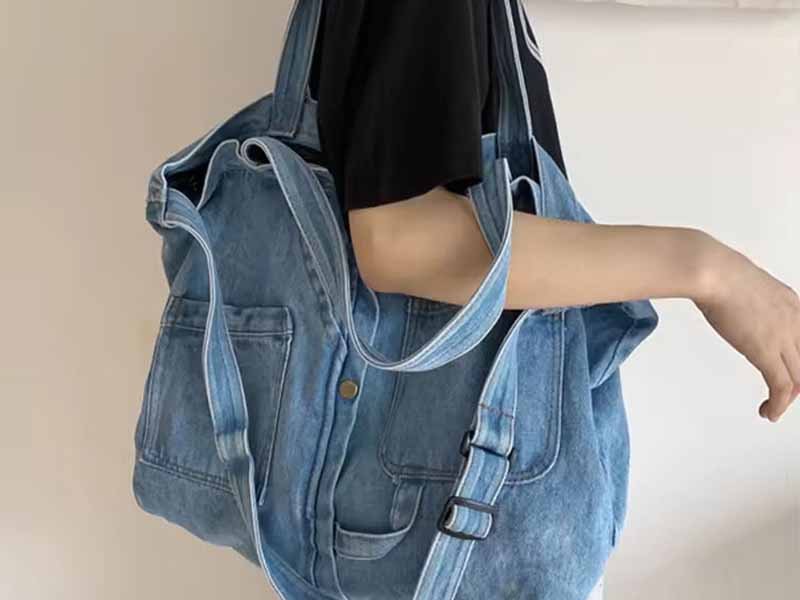
A denim tote bag looks simple until production begins. Two body panels, two handles, and one opening can still create dozens of decisions involving fabric weight, shrinkage, color transfer, seam construction, wash treatment, logo stability, handle reinforcement, packing volume, and final cost. A bag may look attractive in a photograph but lose shape after loading, rub indigo onto light clothing, shrink below the approved size, or develop broken stitches around the handle roots.
Denim tote bags are manufactured by selecting denim according to load and appearance, testing shrinkage and colorfastness, developing compensated patterns, cutting panels by shade group, applying logos, reinforcing handles and bottom seams, assembling the body, completing any washing process, and inspecting dimensions, workmanship, color, strength, and packaging before shipment.
Every design decision affects another part of production. A softer wash may improve hand feel but increase shrinkage. Heavier fabric may improve structure but create bulky seams. A larger logo may improve shelf impact but cause embroidery puckering. A lower price may be achieved by removing lining, pockets, or reinforcement, yet those savings may shorten product life.
One poorly planned tote can pass a quick visual inspection and still fail after a customer puts a laptop, water bottle, notebook, and charger inside. The real manufacturing test begins when the bag is filled, carried, placed on the floor, folded, washed, and used again.
What Is a Denim Tote Bag?
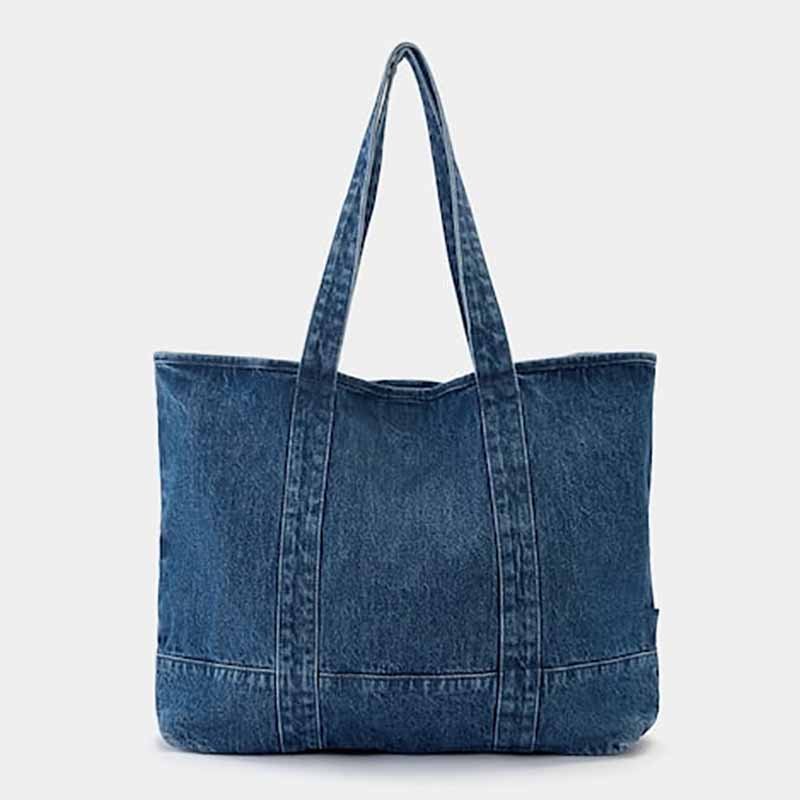
A denim tote bag is a reusable carry bag made from woven denim fabric, usually using colored warp yarns and lighter filling yarns in a twill construction. Its appearance comes from the yarn color, weave, wash, and abrasion effect, while its performance depends on fabric weight, seam structure, handle design, reinforcement, shrinkage control, and intended carrying load.
Denim Construction
Denim is usually identified by diagonal lines visible on the fabric surface. Those lines come from twill weaving rather than printing. The warp yarns are commonly darker, while the filling yarns remain lighter. As the surface wears or receives washing treatment, lighter yarns become more visible and create the familiar faded appearance.
For tote bag production, the weave influences more than style. A dense weave can provide a firm body and better resistance to abrasion. A looser weave may feel softer but can stretch around seams, distort at pocket corners, or lose shape when carrying heavier products.
Several denim constructions may be considered:
- 100% cotton denim for a natural hand feel and traditional appearance
- Cotton-polyester denim for improved dimensional stability and faster drying
- Cotton-elastane denim for softer fashion bags requiring limited flexibility
- Recycled cotton blends for collections with traceable recycled content
- Colored denim using black, grey, brown, green, red, or custom-dyed yarns
- Coated denim for water resistance, surface gloss, or a leather-like finish
- Lightweight chambray-style fabric for foldable or decorative bags
Stretch content should be handled carefully. Fabric developed for jeans may contain elastane for body movement, but a tote bag carries static weight rather than following body movement. Excessive stretch can cause the body to grow downward and make the opening, pockets, and handles lose alignment.
A stable non-stretch or low-stretch denim is usually easier to control for shopping totes, book bags, promotional bags, and structured retail bags.
Denim and Canvas
Denim and canvas are often compared because both materials are used for reusable totes. The key difference lies in weave, surface, visual character, and finishing behavior.
| Area | Denim | Canvas |
|---|---|---|
| Common weave | Twill weave | Plain weave |
| Surface appearance | Diagonal texture and tonal depth | Flat and even |
| Color character | Fades and develops abrasion marks | Usually remains more uniform |
| Common style | Fashion, casual, vintage, workwear | Natural, promotional, utility |
| Printing surface | May be uneven after washing | Usually easier for large prints |
| Embroidery effect | Rich and dimensional | Clean and stable |
| Shrinkage risk | Strongly affected by wash treatment | Usually easier to predict |
| Color transfer risk | Higher with dark indigo | Often lower with reactive-dyed canvas |
| Structure | Soft to very rigid, depending on weight | Soft to firm |
| Cost influence | Wash and shade control add cost | Finishing can be simpler |
Canvas may be the stronger option for a low-cost printed promotional bag requiring a flat graphic area. Denim may be more suitable when the bag must look like a retail product rather than disposable packaging.
A fashion label may choose washed blue denim with embroidery and contrast topstitching. A cosmetics company may choose black denim with a small woven label. A bookstore may require heavy denim, a boxed bottom, and reinforced handles for carrying several books. The best material depends on use, not on trend alone.
Bag Durability
A durable denim tote depends on the complete construction system. Heavy denim cannot compensate for weak thread, narrow seam allowances, poor handle placement, or missing reinforcement.
The main stress areas normally include:
- Handle attachment points
- Top opening corners
- Side seam intersections
- Bottom corners
- Gusset junctions
- Zipper ends
- Pocket openings
- Snap and rivet positions
- Areas around metal rings or hooks
A flat tote used for lightweight event materials may only need moderate reinforcement. A tote designed for books, laptops, beverages, or grocery products requires a more controlled structure.
Useful reinforcement methods include:
- Box-and-cross stitching at handle roots
- Bar tacks at the upper and lower handle edges
- Internal denim or nonwoven reinforcement patches
- Handles extending 60–100 mm below the top opening
- Full-length webbing running down the bag body
- Double stitching along side and bottom seams
- Binding around exposed internal seams
- Folded top hems with multiple fabric layers
- Base inserts for bags carrying rigid products
A load target should be agreed before sample development. “Strong handles” does not provide enough information for engineering or inspection.
A simple approval plan may use the following references:
| Intended Use | Suggested Working Load | Sample Test Load | Main Structure |
|---|---|---|---|
| Event giveaway | 1–2 kg | 3 kg | Flat body, basic reinforced handles |
| Daily shopping | 3–5 kg | 6–8 kg | Bottom reinforcement and wider handles |
| Books or documents | 5–7 kg | 8–10 kg | Reinforced handle roots and strong bottom |
| Laptop and accessories | 5–8 kg | 10–12 kg | Lining, padded section, reinforced base |
| Grocery or utility tote | 8–12 kg | 12–15 kg | Wide webbing, boxed bottom, double seams |
The figures above are development references rather than universal standards. Final loads should match the product claim, construction, market, and agreed inspection method.
Testing should examine more than immediate breakage. Inspectors should also look for:
- Permanent handle stretching
- Stitch holes becoming larger
- Fabric tearing around reinforcement
- Side seams opening under outward pressure
- Bottom panels sagging
- Top edges twisting
- Embroidery distorting under load
- Hardware pulling through the fabric
A tote that remains attached but becomes badly deformed has not passed a meaningful performance check.
Product Applications
Denim totes can serve as retail products, branded packaging, employee gifts, event merchandise, subscription-box packaging, school bags, bookstore bags, travel accessories, music merchandise, and seasonal fashion items.
Each application creates different construction requirements.
A clothing retailer may focus on wash character, embroidery quality, hangtags, and shelf presentation. A bookstore may care more about handle strength, bottom width, and seam security. A beauty brand may require a clean lining, compact size, and protection against indigo transfer onto pale packaging. A food or beverage company may ask for washable lining, bottle dividers, or water-resistant internal coating.
Before asking for a quotation, prepare the following information:
- Finished width, height, and depth
- Flat tote or gusseted structure
- Expected contents
- Approximate carrying weight
- Hand-carry or shoulder-carry handle length
- Desired denim color and wash
- Lining requirement
- Pocket quantity and position
- Zipper, snap, hook, or open-top closure
- Logo size and decoration process
- Packaging format
- Order quantity
- Delivery country
- Target shipment date
Missing information often leads suppliers to quote different constructions. One quotation may include lining and reinforcement, while another may cover only an unlined basic tote. A lower price can appear attractive simply because important components were excluded.
A complete product specification makes prices easier to compare and reduces revisions during sampling.
Which Denim Material Should You Choose?
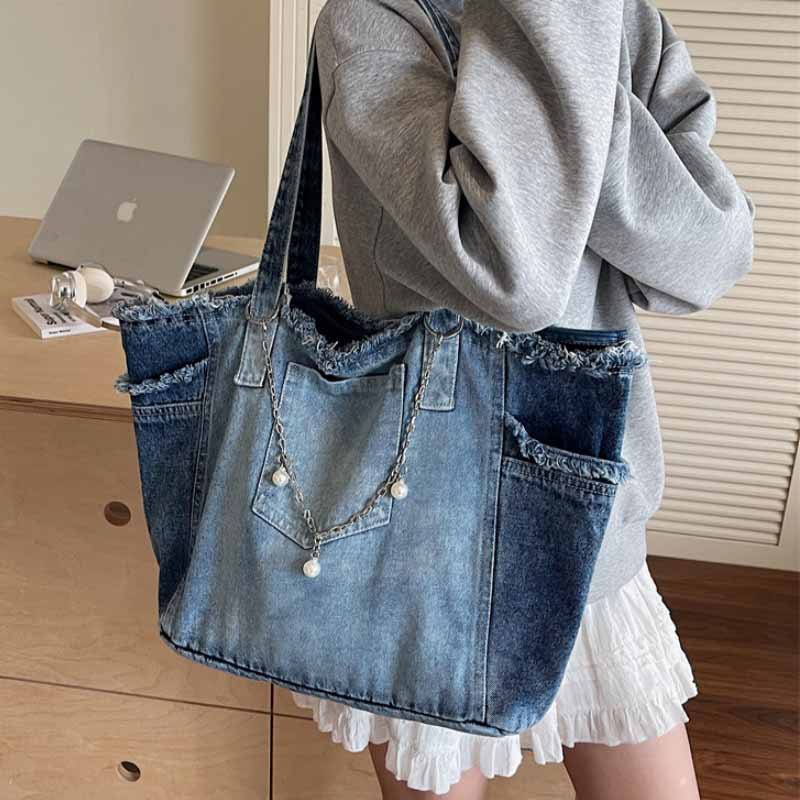
Choose denim by matching fabric weight, fiber composition, weave density, wash response, colorfastness, shrinkage, structure, logo method, and carrying load. Medium-weight denim works well for many retail totes, while lightweight denim suits foldable designs and heavyweight denim supports rigid utility bags. Final selection should be based on tested fabric after the planned wash process.
Fabric Weight
Denim weight is commonly stated in ounces per square yard. Converting the value into grams per square meter can make comparison easier for teams more familiar with GSM.
One ounce per square yard is approximately 33.9 GSM.
| Denim Weight | Approximate GSM | Hand Feel | Suitable Products | Main Production Concern |
|---|---|---|---|---|
| 5–6 oz | 170–203 GSM | Light and soft | Foldable totes, pouches, event bags | May sag or require lining |
| 7–8 oz | 237–271 GSM | Flexible | Fashion totes, small shoppers | Handle roots need reinforcement |
| 9–10 oz | 305–339 GSM | Balanced | Retail totes, daily shopping bags | Good balance of structure and sewing |
| 11–12 oz | 373–407 GSM | Firm | Book bags, workwear totes | Thick intersections require control |
| 13–14 oz | 441–475 GSM | Heavy | Structured utility totes | Higher sewing and freight cost |
| Above 14 oz | Above 475 GSM | Very rigid | Special workwear or premium bags | Bulky seams and reduced foldability |
An 8–10 oz denim often provides enough body for a daily tote without making the finished bag excessively heavy. A lining can increase structure more efficiently than moving directly to very heavy denim.
Heavier fabric affects more than material cost. It may also increase:
- Needle and thread requirements
- Sewing time at folded areas
- Difficulty around boxed corners
- Handle bulk
- Washing time
- Drying time
- Carton weight
- International freight cost
- Storage volume
- End-user carrying comfort
For example, moving from 8 oz to 14 oz denim increases fabric mass by roughly 75% before lining, hardware, labels, or packaging are added. The heavier option may look more premium, but it should serve a clear structural purpose.
Ask for a full-width fabric cutting or a sewn blank sample rather than approving from a small swatch alone. A small swatch cannot show how the material drapes across a 400 mm bag body or how several layers behave at the top hem.
Fiber Composition
Fiber composition influences strength, hand feel, shrinkage, recovery, drying speed, and appearance after repeated use.
100% cotton denim offers a natural touch and familiar fade pattern. It can shrink more than blended fabric and may remain damp longer after washing.
Cotton-polyester denim generally provides better dimensional stability and abrasion resistance. The surface may feel less traditional, depending on yarn ratio and finishing.
Cotton-elastane denim feels flexible but may grow under a sustained load. It is better suited to soft fashion designs than heavy-duty totes.
Recycled cotton denim can support environmental goals, but shorter recycled fibers may reduce yarn strength. Blending recycled cotton with virgin cotton or polyester can improve stability.
A sourcing specification should state exact composition rather than using broad terms such as “cotton denim.”
Examples include:
- 100% cotton
- 80% cotton, 20% polyester
- 70% cotton, 30% recycled cotton
- 60% cotton, 40% recycled polyester
- 98% cotton, 2% elastane
Even a small elastane percentage can change panel growth and handle behavior. A sample should remain loaded for several hours to check whether the bag returns to its original shape after unloading.
Raw Denim
Raw denim has not received a garment-style wash after weaving and finishing. It normally has a dark surface, firm hand feel, and cleaner workwear appearance.
Raw denim can be suitable for:
- Premium dark-blue retail totes
- Workwear collections
- Minimalist fashion accessories
- Bags designed to fade naturally
- Products using leather patches or metal hardware
The main risks include color transfer, first-wash shrinkage, crease marking, and uneven fading.
Raw denim should not be assumed to have zero shrinkage. A fabric may look raw while still receiving sanforization or another finishing process. The mill should provide shrinkage information, but bag-level testing remains necessary because seams, folded hems, handles, linings, and embroidery can react differently from a single fabric sheet.
A useful sample procedure includes:
- Measure the bag at agreed points before washing.
- Record width, height, gusset, opening, handle length, and pocket position.
- Wash using the care method planned for the final product.
- Dry under the intended conditions.
- Allow the bag to rest before measuring again.
- Record shrinkage in both warp and weft directions.
- Check twisting, seam puckering, color loss, and handle distortion.
- Adjust the pattern based on measured results.
A 3% reduction in a 400 mm width equals 12 mm. A 7% reduction equals 28 mm. Such differences are visible and may affect whether a laptop, folder, box, or promotional set fits properly.
Denim Washes
Washing controls shade, softness, surface abrasion, and vintage character. It also changes dimensions, fabric strength, thread color, label appearance, and logo performance.
Common options include:
| Wash Process | Visual Result | Hand Feel | Main Risk |
|---|---|---|---|
| Rinse wash | Clean dark blue | Slightly softer | Limited but still measurable shrinkage |
| Enzyme wash | Even fading | Soft | Shade variation between loads |
| Stone wash | Strong vintage effect | Soft and worn | Abrasion and fiber damage |
| Bleach wash | Light blue or pale tone | Dry to soft | Reduced strength and uneven shade |
| Acid-style wash | High contrast | Textured | Strong unit-to-unit variation |
| Snow wash | Irregular pale effect | Vintage | Difficult repeatability |
| Overdye wash | Custom color cast | Depends on recipe | Color migration and shade control |
| Garment softener | Limited shade change | Softer | Odor or residue if poorly controlled |
Wash names alone are not enough for approval. “Medium vintage wash” can mean different things to different mills and factories.
A wash standard should cover:
- Approved shade
- Permitted shade range
- Surface abrasion level
- Seam contrast
- Softness
- Crease marks
- Odor
- Shrinkage
- Color transfer
- Logo appearance
- Label appearance
- Hardware condition
A complete tote should be used as the approval reference where possible. A flat washed panel cannot show abrasion around seams, handle roots, top hems, pockets, and gusset corners.
Bulk washing requires load consistency. Machine capacity, water level, chemical dosage, temperature, processing time, drying method, and the number of bags per load all influence the result. Two production loads may not look identical even when the same written recipe is followed.
The production agreement should define acceptable natural variation. Denim gains much of its appeal from variation, but the range still needs boundaries.
Shrinkage Control
Shrinkage can affect bag size, handle drop, pocket location, zipper alignment, logo position, lining fit, and carton quantity.
Pattern compensation should be based on sample data. A single compensation percentage should not be applied to every direction or component.
A fabric may shrink:
- More in length than width
- More after tumble drying than line drying
- Differently around heavy seams
- Differently when combined with polyester lining
- Differently after enzyme or bleach washing
- Differently between dark and light wash recipes
A working measurement table can be used during development:
| Measurement Point | Before Wash | After Wash | Change | Pattern Action |
|---|---|---|---|---|
| Bag width | 410 mm | 395 mm | -3.66% | Increase cut width |
| Bag height | 370 mm | 348 mm | -5.95% | Increase cut height |
| Gusset depth | 120 mm | 116 mm | -3.33% | Minor compensation |
| Handle length | 650 mm | 623 mm | -4.15% | Extend handle pattern |
| Pocket width | 200 mm | 191 mm | -4.50% | Adjust pocket and placement |
The table should be created from the actual fabric, thread, construction, and wash process. Data from a different denim lot may not provide enough control.
Lining also needs attention. If cotton denim shrinks more than a polyester lining, the lining may become loose and bunch inside the bag. If the lining shrinks more, it may pull the outer shell inward. Pre-shrinking, compatible material selection, or adjusted lining patterns can reduce the problem.
Colorfastness
Dark denim may release loose indigo during rubbing, moisture exposure, washing, or storage. A bag worn against a white shirt can create a serious complaint even when sewing quality is excellent.
Colorfastness should be checked under both dry and wet conditions. Rating systems commonly run from Grade 1 to Grade 5, where a higher grade indicates less transfer or color change.
A project may set internal approval targets such as:
| Test Area | Possible Project Target | Main Concern |
|---|---|---|
| Dry rubbing | Grade 4 or above | Transfer during normal carrying |
| Wet rubbing | Grade 3 or above | Transfer from rain or perspiration |
| Washing shade change | Grade 3–4 or above | Visible fading after care |
| Staining on adjacent fabric | Grade 3–4 or above | Transfer onto lining or clothing |
Targets should be confirmed according to fabric type, intended use, market, and retailer requirements. Indigo denim often performs differently from reactive-dyed solid fabrics, especially during wet rubbing.
Color transfer can also occur during packaging. Dark totes packed against:
- White cotton dust bags
- Pale tissue paper
- Light-colored handles
- Cream linings
- Printed paper boxes
- White garments in a gift set
may create staining during humid storage or long-distance shipping.
Protective measures may include individual polybags, separation tissue, controlled moisture, colorfast lining, and avoiding direct contact between dark denim and pale products.
A factory should not wait until final inspection to discover poor rubbing performance. Fabric-level tests should take place before bulk cutting, followed by bag-level checks after washing and finishing.
Recycled Denim
Recycled denim can be used successfully when the material source, composition, yarn quality, weave stability, certification, and performance are clearly documented.
Recycled content may come from:
- Pre-consumer cutting waste
- Spinning waste
- Post-consumer garments
- Recycled cotton yarn
- Recycled polyester made from plastic feedstock
- Blends combining recycled and virgin fibers
A sustainability claim should state the actual percentage. “Eco denim” provides little useful information.
A clear specification may read:
- 70% virgin cotton
- 20% post-consumer recycled cotton
- 10% recycled polyester
- 10 oz finished weight
- Dark enzyme wash
- Supporting recycled-content documentation required
Documents and physical performance serve different purposes. Certification may confirm recycled content and chain of custody, while testing confirms whether the tote can perform during use.
Recycled denim should still be evaluated for:
- Tensile strength
- Tear resistance
- Seam behavior
- Abrasion resistance
- Shrinkage
- Colorfastness
- Pilling
- Odor
- Shade consistency
- Wash durability
A recycled tote that tears early and is discarded after limited use does not support a strong environmental message. Durability, repairability, material efficiency, and packaging reduction should be considered alongside recycled percentage.
Szoneier can review denim weight, composition, wash requirements, bag structure, logo process, reinforcement, packaging, and order quantity before sampling. Clear product information allows the development team to recommend a material that meets appearance, performance, and cost goals rather than selecting denim from color alone.
How Are Denim Tote Bags Made?
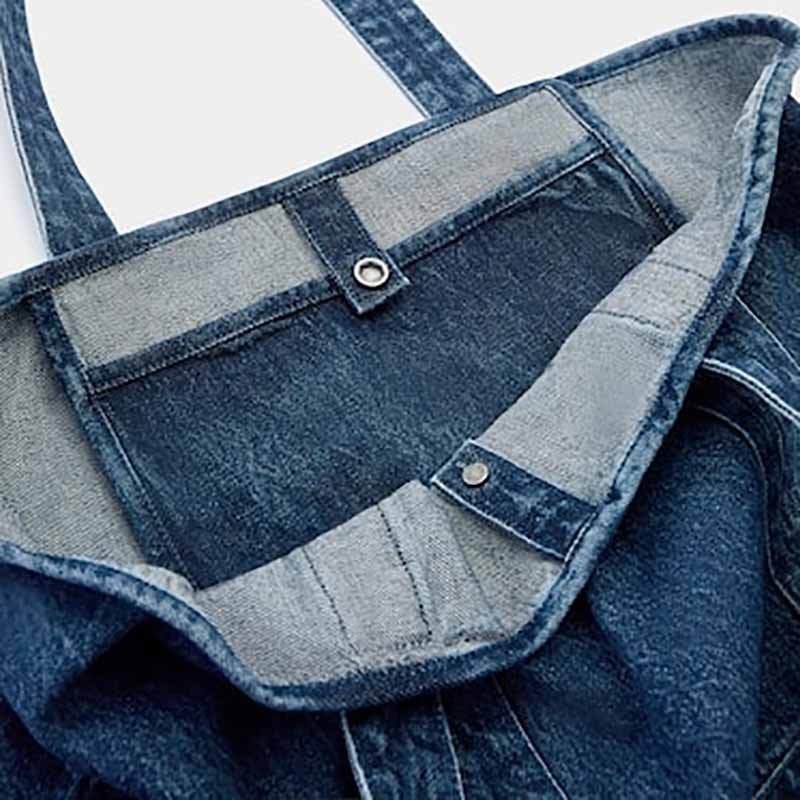
Denim tote bags are made through specification review, fabric testing, pattern development, shrinkage compensation, shade-controlled cutting, logo application, structural sewing, handle reinforcement, washing, finishing, inspection, and packing. Each stage must follow the approved sample because small changes in denim weight, wash conditions, seam allowance, or handle placement can alter the bag’s size, strength, appearance, and cost.
Specification Review
Production should begin with a written specification rather than a reference photograph alone. A photograph can show style, but it cannot confirm fabric weight, internal construction, seam allowance, carrying capacity, pocket dimensions, handle drop, wash treatment, or logo size.
A usable denim tote specification normally includes:
- Finished width, height, and depth
- Top opening width
- Bottom shape
- Handle width, length, and drop
- Fabric composition and weight
- Denim color and wash
- Lining material
- Pocket size and position
- Closure method
- Thread color
- Logo dimensions and position
- Reinforcement method
- Label and packaging requirements
- Measurement tolerances
- Expected carrying weight
Different dimensions must be clearly separated. A 400 mm bag width may refer to the finished body, the top opening, or the flat measurement including side gussets. Confusion at this stage can produce a sample that looks similar but cannot hold the intended products.
The intended contents should also be explained. A tote developed for folded clothing needs different internal space from a tote carrying books, cosmetics, bottles, or a laptop.
For example, a 13-inch laptop may physically fit inside a 350 mm-wide tote, yet the opening may become too narrow after adding seam allowance, lining, binding, and a zipper. A sample should therefore be tested with real contents rather than approved while empty.
Pattern Development
Pattern development converts the approved dimensions into individual fabric components. Depending on the structure, a denim tote may include front and back panels, side gussets, bottom panel, top facing, lining panels, pockets, zipper extensions, handle pieces, reinforcement patches, base support, binding strips, and logo placement templates.
A basic flat tote may use only four to six main components. A lined utility tote with multiple pockets and a zipper can require more than twenty cut components.
| Tote Structure | Approximate Main Components | Production Complexity |
|---|---|---|
| Flat unlined tote | 4–6 | Low |
| Boxed-bottom tote | 6–9 | Low to medium |
| Full-gusset tote | 8–12 | Medium |
| Lined zipper tote | 12–18 | Medium to high |
| Multi-pocket utility tote | 18–28 | High |
| Laptop tote | 20–35 | High |
Pattern engineers must consider seam allowances, fold lines, zipper clearance, fabric direction, top-edge construction, pocket access, and final washing.
A finished bag measuring 400 × 350 × 120 mm cannot be created by cutting panels at those exact dimensions. Seam allowance, gusset construction, turning space, top folds, and shrinkage compensation all increase the required cut size.
Denim grain direction also affects the finished shape. Main panels are normally aligned with the warp running vertically because warp yarns generally provide better length stability. Handles cut in an unstable direction may stretch after loading. Pocket panels cut in a different direction from the body may show a contrasting shade after washing.
Pattern pieces should include clear marks for:
- Fabric face direction
- Warp direction
- Pocket position
- Logo centerline
- Handle placement
- Zipper start and end points
- Notches for panel alignment
- Reinforcement location
- Label position
- Stitching guides
A well-developed pattern reduces sewing variation and prevents operators from estimating positions during production.
Shrinkage Compensation
Denim intended for washing must be tested before the production pattern is finalized. Compensation cannot be based only on general mill data because the completed bag contains seams, folded areas, thread, lining, labels, embroidery, and reinforcements that react differently from a flat fabric sample.
Shrinkage is calculated separately for each direction:
Shrinkage percentage =
Original measurement minus washed measurement, divided by original measurement, multiplied by 100.
For example:
- Original panel width: 420 mm
- Washed width: 403 mm
- Width reduction: 17 mm
- Calculated shrinkage: 4.05%
If the desired finished width is 400 mm, the pattern may need to be increased accordingly. Extra allowance should not be added blindly, because too much compensation creates an oversized bag.
| Component | Before Wash | After Wash | Change |
|---|---|---|---|
| Body width | 420 mm | 403 mm | -4.05% |
| Body height | 380 mm | 357 mm | -6.05% |
| Handle length | 680 mm | 651 mm | -4.26% |
| Gusset depth | 125 mm | 120 mm | -4.00% |
| Pocket width | 210 mm | 200 mm | -4.76% |
Height often shrinks more than width because warp and weft yarns behave differently. Handle pieces may also respond differently because they contain multiple folded layers.
The test should use the same:
- Fabric lot
- Thread type
- Interlining
- Lining
- Stitch density
- Wash recipe
- Drying temperature
- Drying time
- Machine loading method
Changing from line drying to tumble drying can produce different dimensions. A sample approved after air drying may not represent a bulk order dried at higher temperature.
Shrinkage testing should also check whether the bag twists. Twisting may result from fabric skew, uneven grain direction, unbalanced panel cutting, or wash tension. A twisted tote cannot be corrected through pressing alone.
Fabric Inspection
Bulk denim should be inspected before cutting. Fabric defects become more expensive after logo application and sewing, so early identification protects both quality and production time.
Inspection normally covers:
- Fabric width
- Weight
- Shade
- Weave defects
- Broken yarns
- Slubs
- Holes
- Stains
- Oil marks
- Creases
- Bowing
- Skew
- Surface contamination
- Coating consistency
- Odor
Some denim slubs are intentional and form part of the fabric character. The approved sample should clarify which surface variations are acceptable and which must be rejected.
Fabric weight should be checked against the specification. A difference of 20–30 GSM may noticeably affect hand feel, shape, seam thickness, and final unit weight.
Roll width also influences cost. If the quoted fabric width is 150 cm but the delivered usable width is only 144 cm, marker efficiency may decrease and consumption may rise.
Shade control is especially important for indigo denim. Rolls from the same production order can still show slight tonal differences. Factories may divide fabric into shade groups before cutting.
A shade-grouping system can include:
- Group A: approved standard shade
- Group B: slightly darker
- Group C: slightly lighter
- Group D: outside acceptable range
Panels within one bag should come from the same shade group. Mixing a dark front panel with a light side gusset creates an obvious mismatch after washing.
Fabric rolls should also be relaxed before cutting when necessary. Tension created during rolling can distort panels after cutting. Relaxation time may range from several hours to a full day depending on fabric construction and finishing.
Cutting Control
Denim panels can be cut using straight knives, band knives, die cutting, laser cutting, or automated cutting systems. The chosen method depends on order volume, panel shape, fabric thickness, and available machinery.
Cutting control should focus on accuracy, direction, shade consistency, and bundle traceability.
The spreading team must keep the fabric face and direction consistent. Reversing one panel can create a visible shade difference because twill reflects light differently depending on direction.
Marker planning should balance fabric efficiency with product quality. Extremely tight nesting may save material but leave insufficient space around irregular shapes or cause distortion near fabric edges.
Cut components should remain within agreed tolerances.
| Component | Suggested Cutting Control |
|---|---|
| Main body panel | ±2 mm |
| Pocket panel | ±1.5 mm |
| Handle strip width | ±1 mm |
| Zipper opening | ±1 mm |
| Reinforcement patch | ±2 mm |
| Logo placement notch | ±1.5 mm |
Actual tolerances depend on bag size and structure. Small pouches usually need tighter control than large shopping totes.
Bundles should be labeled by:
- Style number
- Color
- Wash type
- Fabric roll
- Shade group
- Quantity
- Panel name
- Production batch
Traceability becomes valuable when a problem appears later. If several finished bags show a darker gusset, the production team can identify whether all affected pieces came from one fabric roll.
Small hidden components should not be ignored. A missing reinforcement patch may not be visible during final visual inspection, yet the handle can fail during use.
Logo Application
Most logos are applied before the bag body is assembled because flat panels are easier to position and process. Embroidery, screen printing, heat transfer, appliqué, and patches each require a different production sequence.
The logo position should be measured from fixed edges rather than estimated from the center of an unfinished panel. Seam allowance and wash shrinkage must be considered.
For example, a logo intended to sit 80 mm below the finished top edge cannot simply be placed 80 mm below the raw cut edge. The top hem may use a 30 mm fold, while washing may reduce the panel height.
A placement calculation may include:
- Finished distance below top: 80 mm
- Top fold allowance: 30 mm
- Expected vertical shrinkage: 5%
- Required raw placement: adjusted above 110 mm depending on construction
Embroidery requires special control on denim. Dense stitching can pull the fabric inward, causing puckering or distortion. Backing material helps stabilize the panel, but excessive backing may make the bag stiff.
Embroidery development should review:
- Stitch count
- Thread type
- Thread color
- Minimum letter height
- Minimum line thickness
- Backing type
- Trim quality
- Needle marks
- Puckering
- Wash resistance
Small text below 5–6 mm in height may become difficult to read, especially on textured or washed denim.
Screen printing works well for bold artwork, but the ink must remain stable on the chosen wash and fabric finish. Dark denim may require a white underbase before applying bright colors. More ink layers can increase hand feel and cracking risk.
Heat-transfer graphics require adhesion tests. Silicone finishes, coatings, softeners, or irregular washed surfaces may reduce bonding.
Logo approval should include both appearance and position:
| Logo Item | Inspection Point |
|---|---|
| Width and height | Match approved artwork |
| Position | Within agreed tolerance |
| Color | Match approved standard |
| Orientation | Straight and centered |
| Surface | No cracking, lifting, or puckering |
| Wash result | No excessive fading or distortion |
| Reverse side | Clean backing and trimmed threads |
A logo may be positioned correctly before washing but move after the panel shrinks. Final approval should therefore take place on a completed sample using the actual wash process.
Handle Construction
Handle engineering has a major effect on comfort and service life. Width, length, material, folding method, attachment depth, stitch pattern, and internal reinforcement must match the expected load.
Common denim handle constructions include:
- Four-fold self-fabric handle
- Two-fold handle with internal webbing
- Denim-covered cotton webbing
- Exposed cotton webbing
- Polyester webbing
- Leather handle
- Synthetic leather handle
- Rope handle
- Full-body continuous strap
A four-fold denim handle hides raw edges and creates a clean appearance, but thick denim can produce six to eight fabric layers where the handle meets the top hem.
For 12 oz or heavier denim, bulky intersections may require:
- Reduced folding layers
- Skived synthetic components
- Thinner reinforcement
- Hammering or compression
- Stronger needles
- Slower sewing speed
- Longer stitch length
- Carefully adjusted thread tension
Handle width should reflect the carrying weight.
| Handle Width | Suitable Use | Comfort Consideration |
|---|---|---|
| 15–20 mm | Small promotional bag | Uncomfortable under heavy load |
| 25 mm | Light shopping tote | Suitable for moderate use |
| 30–35 mm | Daily shoulder tote | Better pressure distribution |
| 38–50 mm | Books, laptop, utility use | More comfortable for heavier contents |
| Above 50 mm | Fashion or heavy-duty style | May feel bulky on smaller bags |
Handle drop determines how the bag is carried.
- 100–150 mm: hand carry
- 180–230 mm: elbow carry
- 250–320 mm: shoulder carry
- Above 320 mm: longer shoulder or relaxed fashion style
Body size and seasonal clothing should be considered. A 230 mm handle drop may work over a light shirt but feel tight over a winter coat.
Handle ends should usually extend below the attachment zone. A 20 mm overlap provides limited load distribution. Extending the handle 60–100 mm down the body spreads force across a larger area.
Common attachment patterns include:
- Two horizontal stitch rows
- Box stitching
- Box-and-cross stitching
- Bar tack reinforcement
- Multiple parallel rows
- Hidden reinforcement under top facing
Box-and-cross stitching is widely used because it distributes tension in several directions. Stitching should remain inside the reinforcement area. A large stitch box sewn only through the outer denim may still tear the fabric.
Seam Engineering
Seams hold the bag body together and must resist both downward load and outward pressure. Construction should be selected according to fabric weight, lining, wash process, and desired interior finish.
Common seam options include:
- Plain lockstitch seam with overlocked edges
- Double-needle seam
- Bound seam
- Flat-felled seam
- French seam for lighter fabric
- Welt seam
- Lapped seam
- Piped seam
A plain seam with overlocking is economical and suitable for many lined or promotional totes. Bound seams create a cleaner unlined interior and reduce exposed fraying. Flat-felled seams provide strong construction and a workwear appearance but create multiple layers.
Seam allowance should normally remain wide enough to prevent yarn slippage and fraying. A narrow 5 mm allowance may save fabric but provide insufficient security for a heavy tote.
Typical working ranges may include:
| Area | Possible Seam Allowance |
|---|---|
| Main side seam | 10–12 mm |
| Bottom seam | 12–15 mm |
| Lining seam | 8–10 mm |
| Pocket seam | 7–10 mm |
| Zipper seam | 8–12 mm |
| Bound seam | Based on binding width |
Stitch density must also be controlled. Very short stitches may perforate the fabric and weaken it like a tear line. Very long stitches may open under pressure.
Medium denim may use approximately 3–4 stitches per centimeter, depending on thread size and seam type. Heavy decorative topstitching often uses longer stitches.
Thread selection should match fabric and load. Polyester thread is commonly used because it offers good strength, abrasion resistance, and dimensional stability. Cotton-wrapped polyester can provide a more traditional appearance while retaining a strong core.
Needle size should suit the denim thickness and thread. A needle that is too small may deflect or break. An oversized needle may leave visible holes or damage yarns.
Bag Assembly
Assembly follows a planned sequence to prevent inaccessible seams and unnecessary handling. The exact order varies by structure, but a lined zipper tote may follow the sequence below:
- Inspect cut panels.
- Apply embroidery or printing.
- Attach external pockets.
- Prepare handles.
- Attach handle reinforcement.
- Sew handles to body panels.
- Prepare zipper opening.
- Join outer body panels.
- Form bottom or gusset.
- Prepare internal pockets.
- Assemble lining.
- Insert base reinforcement if required.
- Join lining to outer shell.
- Turn the bag.
- Close turning opening.
- Complete topstitching.
- Trim threads.
- Conduct in-line inspection.
Each operation should have a defined quality point.
Pocket placement should be measured before sewing. A pocket positioned 10 mm too high may interfere with the top fold or zipper. Uneven handle spacing can make the bag lean when carried.
At side and bottom intersections, seam allowances should lie in the approved direction. Random seam direction creates uneven bulk and can change the exterior appearance after washing.
Lined bags require additional dimensional control. The lining should fit inside the outer shell without pulling or excessive looseness.
A polyester lining paired with cotton denim may require pattern adjustment because the materials shrink differently. Bagging out the lining too large can create folds inside the finished tote. Cutting it too small can pull the outer denim inward.
Washing Process
A denim tote may be washed as loose panels or as a completed bag. Completed-bag washing usually creates more natural seam abrasion and vintage character, while panel washing offers easier dimensional control.
Garment washing can involve:
- Rinsing
- Desizing
- Enzyme treatment
- Stone treatment
- Bleaching
- Neutralization
- Softening
- Extraction
- Drying
- Final pressing
The process must protect labels, zippers, metal accessories, embroidery, and reinforcement materials.
Hardware may be added after washing when there is a risk of scratching, corrosion, coating loss, or impact damage inside the washing machine.
Zippers need careful treatment. Cotton zipper tape may shrink differently from polyester tape. Metal sliders can strike the denim and create marks. Closed zipper bags may trap water or wash chemicals.
Wash recipes should specify:
- Machine type
- Load quantity
- Water ratio
- Temperature
- Chemical dosage
- Treatment time
- Rinse count
- Neutralization method
- Softener dosage
- Extraction speed
- Drying temperature
- Drying duration
Overloading the machine can create uneven washing. Underloading may increase abrasion because each bag moves more aggressively.
A bulk wash should be compared with the approved sample after drying and resting. Color should not be judged while the fabric is wet because wet denim appears darker.
Production teams should watch for:
- Uneven shade
- White crease marks
- Over-abraded corners
- Broken thread
- Damaged embroidery
- Rust marks
- Chemical odor
- Excessive softness
- Weak fabric
- Twisted handles
- Dimensional loss
A softer hand is not always better. Excessive softening can reduce structure and make the tote collapse.
Finishing Control
After sewing or washing, every tote requires finishing before packing. Finishing includes thread trimming, cleaning, pressing, shaping, measurement, hardware checks, logo review, and packaging preparation.
Loose threads should be cut without damaging structural stitches. Thread burning may leave hard or dark marks on pale denim, so trimming methods should match the product finish.
Pressing temperature must be controlled. Excessive heat can create shine, flatten wash effects, damage synthetic labels, or soften heat-transfer logos.
Bags should be shaped according to the approved packing method. A structured tote may require tissue filling or a cardboard support. A foldable tote may need a specific folding line to fit the package.
The final appearance check should cover:
- Bag symmetry
- Handle alignment
- Top opening shape
- Pocket position
- Logo position
- Shade consistency
- Seam straightness
- Surface cleanliness
- Odor
- Hardware function
- Lining fit
- Bottom shape
Measurements should be taken on a flat, relaxed bag using the approved method. Pulling the fabric during measurement can produce misleading results.
A practical measurement tolerance table may include:
| Measurement | Possible Tolerance |
|---|---|
| Body width | ±5 mm |
| Body height | ±5 mm |
| Gusset depth | ±4 mm |
| Handle length | ±5 mm |
| Handle spacing | ±3 mm |
| Pocket position | ±3 mm |
| Logo position | ±3 mm |
| Zipper length | ±3 mm |
Large bags may allow slightly wider tolerances, while small pouches or fitted packaging bags may require tighter limits.
In-Process Inspection
Inspection should happen during production rather than only after completion. Early checks prevent the same defect from continuing across hundreds or thousands of units.
A useful in-process control plan includes:
| Production Stage | Main Inspection |
|---|---|
| Fabric arrival | Weight, width, shade, defects |
| Cutting | Dimensions, direction, shade grouping |
| Logo process | Color, position, adhesion, embroidery quality |
| Handle preparation | Width, length, folding, reinforcement |
| Body sewing | Seam allowance, stitch density, alignment |
| Lining assembly | Pocket position, size, cleanliness |
| Washing | Shade, shrinkage, damage, odor |
| Finishing | Measurements, symmetry, thread trimming |
| Packing | Label, quantity, barcode, carton marks |
The first completed production units should be compared with the approved pre-production sample before full output continues.
A first-piece inspection may review five to ten bags for:
- Dimensions
- Material
- Stitch quality
- Handle strength
- Logo position
- Wash shade
- Closure function
- Packaging method
Production can then continue after corrections are confirmed.
Random checks should also occur throughout the sewing line. Waiting until final inspection can result in expensive repairs or shipment delays.
For custom denim tote production, Szoneier can review sketches, reference photographs, technical files, logo artwork, target load, denim preferences, and packaging requirements before sampling. Material, structure, reinforcement, wash treatment, and production cost can then be evaluated as one complete project rather than as separate decisions.
How Can Denim Tote Bags Be Customized?
Denim tote bags can be customized through fabric weight, fiber composition, wash, color, dimensions, gusset depth, handle structure, lining, pockets, closures, hardware, labels, logos, and packaging. Product development should begin with the intended use and target price, because every added feature affects sewing time, material consumption, testing requirements, packing volume, and final unit cost.
Bag Structures
A denim tote does not need to follow the standard flat shopping-bag shape. The structure can be developed around the products carried inside, the way the bag will be displayed, and the expected retail position.
Common structures include:
- Flat promotional tote
- Boxed-bottom shopping tote
- Full-gusset grocery tote
- Zip-top commuter tote
- Reversible denim tote
- Foldable denim bag
- Denim bucket tote
- Denim shoulder bag
- Denim crossbody tote
- Laptop tote
- Book bag
- Tool-style utility tote
- Bottle carrier
- Cosmetic tote
- Beach tote
- Multi-pocket workwear tote
A flat tote is economical because it uses fewer panels and sewing operations. The bag works well for exhibitions, fashion events, apparel packaging, and lightweight promotional products.
A boxed-bottom tote adds capacity without requiring separate side panels. The lower corners are folded and stitched to create depth. Such construction is suitable for books, folded clothing, groceries, and gift sets.
A full-gusset structure uses separate side and bottom panels. It offers more control over capacity and shape but requires additional cutting, alignment, and sewing.
A laptop tote needs more than a larger body. Useful features may include:
- Padded laptop compartment
- Reinforced bottom
- Zippered opening
- Internal document pocket
- Charger pocket
- Key hook
- Water-bottle pocket
- Wider shoulder handles
- Detachable crossbody strap
- Soft lining protecting electronic devices
A large bag should not automatically receive a deep gusset. An excessively deep tote may become difficult to carry because contents move away from the body. The width, height, depth, and handle drop should work together.
| Tote Type | Common Size Range | Suggested Structure |
|---|---|---|
| Promotional tote | 320–380 mm wide | Flat, unlined |
| Daily shopping tote | 350–450 mm wide | Boxed bottom or gusset |
| Book tote | 330–400 mm wide | Reinforced bottom |
| Laptop tote | 380–450 mm wide | Lined, padded, zip top |
| Grocery tote | 400–500 mm wide | Wide gusset, reinforced handles |
| Cosmetic tote | 250–350 mm wide | Lined, zip top |
| Beach tote | 450–600 mm wide | Large capacity, internal pocket |
Size ranges are development references. Final dimensions should be based on actual products placed inside the sample.
Handle Options
Handles influence appearance, comfort, carrying capacity, and production cost. A small change in width or attachment method can make a noticeable difference during use.
Common handle materials include:
- Self-fabric denim
- Cotton webbing
- Polyester webbing
- Denim-covered webbing
- Canvas webbing
- Rope
- Genuine leather
- Synthetic leather
- Jacquard logo webbing
- Recycled polyester webbing
Self-fabric handles provide a coordinated appearance. Heavy denim, however, can create thick folded edges and bulky attachment points. Internal webbing may be inserted when the denim requires extra stability.
Cotton webbing feels natural and works well with washed denim. Polyester webbing offers better resistance to moisture and stretching. Jacquard webbing allows a repeated brand name or pattern to become part of the bag design.
Handle construction should be matched to load and carrying position.
| Carrying Style | Handle Drop | Suitable Use |
|---|---|---|
| Hand carry | 100–150 mm | Gift bags, compact totes |
| Elbow carry | 160–220 mm | Fashion and retail totes |
| Shoulder carry | 240–320 mm | Daily shopping and commuting |
| Long shoulder carry | 320–380 mm | Relaxed fashion styles |
| Crossbody | Adjustable strap | Travel, commuting, hands-free use |
A shoulder handle should be tested over light clothing and heavier seasonal clothing. A 230 mm drop may fit over a shirt but feel too short over a coat.
Handles may be attached on the outside as a visible design element or hidden beneath a top facing. External full-length straps can improve strength and produce a workwear appearance. Hidden attachment creates a cleaner surface but requires internal reinforcement.
Pockets and Storage
Pocket design should follow actual use. Adding pockets without considering their size and position can increase cost without improving function.
External pocket options include:
- Flat patch pocket
- Zipper pocket
- Divided utility pocket
- Bottle pocket
- Mobile-phone pocket
- Slip pocket
- Cargo pocket with flap
- Elastic side pocket
Internal pocket options include:
- Hanging zipper pocket
- Mobile-phone compartment
- Document sleeve
- Laptop section
- Key pocket
- Card holder
- Bottle divider
- Removable pouch
Pocket openings need reinforcement because repeated pulling concentrates force at the upper corners. Bar tacks, triangular stitches, folded edges, or hidden reinforcement patches can prevent tearing.
A mobile-phone pocket should be checked against current device sizes. A narrow pocket based on an older phone reference may become unusable. Internal pockets also need enough depth to prevent contents from falling out when the bag is placed on a chair or vehicle seat.
Laptop compartments should be tested with a physical device or an accurate rigid template. Screen size alone does not define the overall laptop dimensions.
Closures and Hardware
The opening can remain fully open or use a zipper, snap, hook, drawstring, magnetic button, or hook-and-loop closure.
Open-top totes are easy to manufacture and convenient for shopping. A zipper offers better security but introduces additional material, alignment, and sewing requirements.
Common closure choices include:
| Closure | Advantages | Main Considerations |
|---|---|---|
| Open top | Low cost and easy access | Limited security |
| Magnetic snap | Clean appearance | Requires reinforcement |
| Metal snap | Strong closure | Can mark fabric during washing |
| Nylon zipper | Lightweight and flexible | Tape color must match |
| Metal zipper | Premium appearance | Higher weight and corrosion risk |
| Hook-and-loop | Easy to operate | May catch fibers and clothing |
| Drawstring | Adjustable opening | Changes tote silhouette |
| Lobster hook | Decorative and simple | Does not fully close opening |
Hardware may include:
- D-rings
- O-rings
- Rivets
- Eyelets
- Buckles
- Snap hooks
- Metal feet
- Zipper pullers
- Magnetic buttons
- Strap adjusters
- Decorative studs
Every hardware position should contain reinforcement. A metal rivet passing through one layer of denim can pull out under load. Reinforcement may use additional denim, synthetic leather, webbing, nonwoven material, or plastic support.
Hardware should also be checked for:
- Sharp edges
- Surface scratches
- Coating consistency
- Rust resistance
- Opening and closing function
- Attachment strength
- Color matching
- Noise during use
- Weight added to the bag
Metal accessories may need to be installed after washing to prevent damage inside washing equipment.
Logo Methods
Logo selection should consider artwork detail, order quantity, denim texture, wash treatment, target appearance, and expected use.
Embroidery
Embroidery works well on denim because the raised thread remains visible against a textured surface. It can create a durable and premium result.
Suitable applications include:
- Brand names
- Small chest-style logos
- Workwear graphics
- Monograms
- Badges
- Outline illustrations
- Multi-color emblems
Important development points include:
- Stitch count
- Thread color
- Thread thickness
- Letter size
- Backing material
- Embroidery density
- Edge clarity
- Puckering
- Wash behavior
Dense embroidery can make a large panel stiff. For wide graphics, a combination of embroidery and appliqué may reduce stitch count and fabric distortion.
Screen Printing
Screen printing suits bold artwork, text, and larger production quantities. Each color usually requires a separate screen.
Dark denim often requires a white underbase before bright colors are printed. Without an underbase, yellow, red, or white ink may appear dull.
Printing should be tested for:
- Coverage
- Cracking
- Adhesion
- Color consistency
- Wash resistance
- Rubbing resistance
- Surface stickiness
- Ink smell
A heavily washed surface may produce an intentionally distressed print, but the expected effect should be approved before production.
Heat Transfer
Heat transfer can reproduce detailed graphics, photographs, gradients, and small color areas. Results depend heavily on fabric finish and transfer-film quality.
Possible risks include:
- Edge lifting
- Cracking
- Gloss differences
- Adhesion failure
- Color change from heat
- Transfer film feeling too thick
- Reduced bonding on softener-treated fabric
Heat and pressure settings should be tested on the actual bulk denim rather than on a different sample fabric.
Woven Labels
Woven labels provide a clean and consistent brand mark. They may be sewn into the side seam, top edge, pocket, lining, or handle.
The label specification should define:
- Width and height
- Fold type
- Ground color
- Logo color
- Yarn density
- Cutting method
- Sewing position
- Visible length
A side label placed too close to a seam may become partially hidden. A top-fold label must remain straight and centered after sewing.
Leather Patches
Leather or synthetic leather patches fit naturally with denim. Logos can be embossed, debossed, printed, engraved, or combined with metal accessories.
Patch development should review:
- Material thickness
- Edge finish
- Color transfer
- Wash resistance
- Cracking
- Stitch-hole spacing
- Attachment method
- Surface consistency
Genuine leather may change color or harden during garment washing. Patches may need to be attached after washing.
Metal Logos
Metal badges, plates, and logo rivets create a strong retail appearance. They also increase unit weight, material cost, and inspection requirements.
A metal badge should not have exposed sharp posts inside the bag. Backing washers, lining covers, or reinforcement patches may be needed.
| Logo Method | Suitable Artwork | Cost Level | Wash Consideration |
|---|---|---|---|
| Embroidery | Text and line graphics | Medium | May pucker or fade slightly |
| Screen printing | Bold graphics | Low to medium | Ink must match wash process |
| Heat transfer | Detailed multi-color art | Medium | Adhesion must be tested |
| Woven label | Small brand marks | Low | Usually stable |
| Leather patch | Workwear branding | Medium | May need post-wash attachment |
| Metal badge | Premium branding | Medium to high | Protect from scratches and corrosion |
| Appliqué | Large decorative graphics | Medium to high | Edge security required |
| Chenille patch | Varsity styling | Medium to high | Adds thickness and texture |
Private Label Details
Private label production includes more than placing a logo on the front panel. A complete private label program may involve:
- Main woven label
- Size label
- Country-of-origin label
- Care label
- Material label
- Hangtag
- Barcode sticker
- Price ticket
- Branded zipper pull
- Custom lining
- Branded hardware
- Printed tissue paper
- Custom polybag
- Retail box
- Shipping carton marks
Care labels should match the actual material and tested wash behavior. A bag containing denim, polyester lining, leather trim, foam padding, and metal hardware may not be suitable for machine washing even when the denim alone is washable.
Country-of-origin wording, fiber information, and retailer-specific label formats should be confirmed before bulk production.
Barcode data should be checked against:
- Style number
- Color
- Size
- Product description
- Retail price
- Destination
- Carton assortment
A barcode printing error can delay warehouse receiving even when the physical product is correct.
Packaging Options
Packaging must protect the tote against moisture, deformation, abrasion, color transfer, and hardware damage.
Common packaging methods include:
- Folded in individual polybag
- Flat-packed in polybag
- Recycled plastic bag
- Paper belly band
- Kraft envelope
- Cotton dust bag
- Tissue wrapping
- Retail box
- Hangtag-only bulk packing
- Multi-piece master polybag
Dark denim should not remain in direct contact with white tissue or pale bags when color transfer is possible. Moisture control is also important during sea freight.
Structured totes may require:
- Tissue filling
- Cardboard base
- Handle protection
- Hardware wrapping
- Shape-support inserts
- Larger cartons preventing compression
Folded packing reduces carton volume but may create permanent crease lines. A wash with strong surface contrast can show crease marks more clearly than solid canvas.
A packing trial should calculate:
- Pieces per carton
- Carton dimensions
- Gross weight
- Net weight
- Volume per unit
- Pallet quantity
- Container utilization
Shipping cost can change significantly when a bulky bag cannot be compressed. Packaging should therefore be considered during design, not only after production is complete.
How Is Denim Tote Bag Quality Controlled?
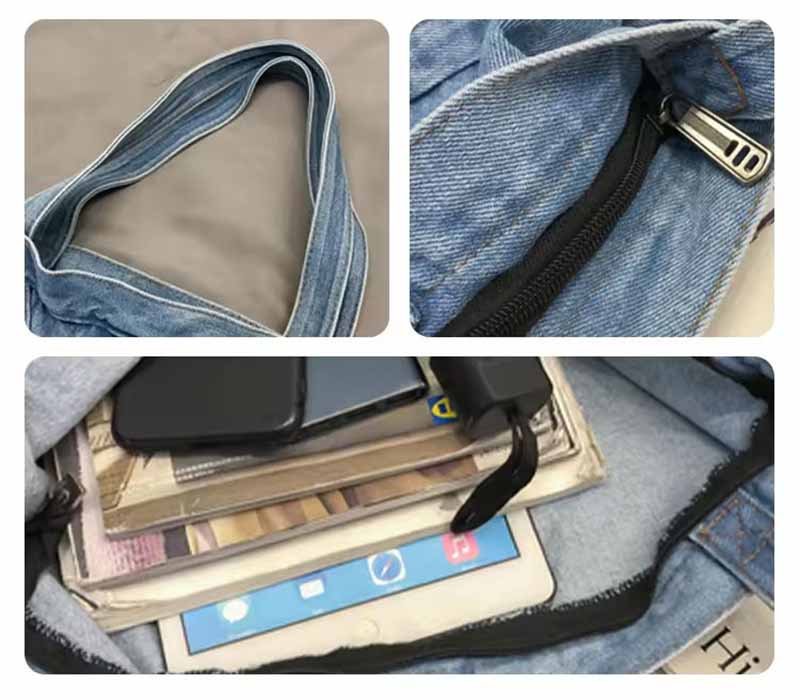
Denim tote bag quality control covers incoming fabric, cutting, logo placement, sewing, reinforcement, washing, dimensions, function, appearance, packaging, and shipment quantity. Inspection should begin before bulk cutting and continue throughout production, because final inspection alone cannot reveal every hidden reinforcement, seam allowance, or material problem.
Material Inspection
Incoming denim should be compared with the approved fabric standard.
Inspection points include:
- Fiber composition
- Fabric weight
- Usable width
- Shade
- Weave
- Surface texture
- Shrinkage
- Colorfastness
- Odor
- Defects
- Coating
- Wash response
Fabric weight may be checked by cutting a defined area and weighing it. Several positions across the roll should be sampled because fabric can vary between center and edge.
Accessories also require incoming inspection.
Zippers should be checked for smooth movement, slider locking, tape color, length, and puller shape.
Webbing should be checked for width, thickness, color, stretch, and edge quality.
Metal hardware should be checked for scratches, sharp edges, coating thickness, function, and corrosion risk.
Lining should be checked for shade, weight, shrinkage, tearing, and color transfer.
A product can fail even when the denim is correct if one accessory is weak or visually inconsistent.
Sewing Inspection
Sewing inspection should cover both appearance and structural security.
Common defects include:
- Skipped stitches
- Broken stitches
- Loose thread tension
- Uneven stitch length
- Wavy seams
- Open seams
- Needle damage
- Raw edges
- Twisted handles
- Uneven handle spacing
- Crooked pockets
- Misaligned gussets
- Uneven top opening
- Missing bar tacks
- Missing reinforcement
- Puckered embroidery
Stitching should be checked at the beginning, middle, and end of each seam. Backstitching or locking should prevent seams from opening.
Handle attachment requires extra attention because failure may occur inside the bag where the reinforcement is hidden.
Inspectors may confirm handle attachment by checking:
- Reinforcement patch size
- Stitch-box dimensions
- Bar-tack position
- Stitch density
- Handle overlap depth
- Symmetry
- Thread security
- Fabric tearing
A visual check alone cannot confirm load performance, so representative samples should also undergo carrying tests.
Measurement Control
Measurements should be taken using one written method. Different operators may produce different results when one stretches the bag and another leaves it relaxed.
The measuring guide should show:
- Where the tape starts and ends
- Whether the bag is flat or standing
- Whether gussets are opened
- Whether handles are measured along the curve
- Whether zipper length includes end stops
- Whether fabric is stretched
Typical measurement points include:
- Body width
- Body height
- Top opening
- Bottom width
- Gusset depth
- Handle length
- Handle drop
- Handle spacing
- Pocket width and height
- Pocket position
- Logo position
- Zipper length
| Measurement | Example Specification | Possible Tolerance |
|---|---|---|
| Body width | 400 mm | ±5 mm |
| Body height | 350 mm | ±5 mm |
| Gusset depth | 120 mm | ±4 mm |
| Handle length | 650 mm | ±5 mm |
| Handle spacing | 160 mm | ±3 mm |
| Pocket width | 200 mm | ±3 mm |
| Logo position | 80 mm below top | ±3 mm |
Tolerances should be agreed before production. Washed denim may require slightly wider tolerances than an unwashed synthetic fabric because the wash process introduces controlled variation.
Color Control
Color inspection should use an approved sample or shade standard under consistent lighting.
The team should compare:
- Overall shade
- Panel-to-panel matching
- Seam abrasion
- Handle shade
- Pocket shade
- Wash contrast
- Logo color
- Thread color
- Lining color
- Hardware finish
One bag should not contain visibly different shade groups unless contrast panels are part of the design.
Lighting affects denim perception. Dark blue may appear black under warm light and brighter under daylight. A controlled light source reduces disagreement.
The factory should define how much natural wash variation is acceptable. A vintage wash cannot be expected to look identical on every unit, but bags should remain within a recognizable approved range.
Load Testing
Load testing checks whether the handles, seams, bottom, reinforcement, and fabric can support the intended contents.
A static test may involve filling the tote with a defined weight and hanging it for a set period.
A repeated-lifting test may involve raising and lowering the loaded bag several hundred times.
A simple development plan may include:
| Bag Use | Test Load | Test Duration |
|---|---|---|
| Lightweight promotional tote | 3 kg | 2–4 hours |
| Daily shopping tote | 8 kg | 4–8 hours |
| Book tote | 10 kg | 8–12 hours |
| Laptop tote | 10–12 kg | 8–12 hours |
| Heavy utility tote | 15 kg | 12–24 hours |
Final requirements should be based on the agreed product claim and market standard.
After testing, inspect:
- Handle extension
- Stitch movement
- Broken thread
- Fabric tearing
- Seam opening
- Bottom sagging
- Hardware movement
- Top-edge distortion
- Permanent bag deformation
A bag should not be approved only because it did not fall apart. Excessive stretching or distortion may still make the product unsuitable.
Colorfastness Testing
Indigo denim needs careful rubbing and staining control.
Dry rubbing checks whether color transfers during normal contact.
Wet rubbing checks transfer caused by rain, perspiration, or damp conditions.
Wash testing checks:
- Shade change
- Staining
- Shrinkage
- Twisting
- Seam appearance
- Logo damage
- Hardware condition
Colorfastness targets depend on fabric, wash, destination market, and retailer requirements.
A dark raw denim tote may have a higher natural transfer risk than a washed reactive-dyed fabric. The product description and care instructions should reflect actual performance rather than promising zero fading.
Packaging should also be tested under pressure and humidity. Dark denim compressed against a white lining or paper insert may transfer color even before the bag reaches the end user.
Needle and Metal Control
Broken needle control is important for sewn products. Factories should maintain procedures for:
- Needle issue and return
- Broken needle reporting
- Fragment recovery
- Machine-area checking
- Product isolation
- Replacement authorization
- Record keeping
Where required, finished bags can pass through needle-detection equipment. Metal hardware may interfere with detection, so the process should be planned according to product construction.
Needle control records can help trace production if a sewing needle breaks during assembly.
Final Inspection
Final inspection should cover appearance, measurements, function, packaging, quantity, and carton information.
A final inspection checklist may include:
- Correct style
- Correct denim
- Correct wash
- Correct logo
- Correct dimensions
- Clean surface
- No offensive odor
- Secure handles
- Working zipper
- Correct pockets
- Correct labels
- Correct care instructions
- Correct barcode
- Correct packing
- Correct carton marks
- Correct assortment
Defects may be divided into critical, major, and minor categories.
Critical defects may involve sharp objects, broken needles, or dangerous hardware.
Major defects may include open seams, wrong logo, unusable zipper, severe shade mismatch, or missing components.
Minor defects may include small thread ends, slight stitch variation, or limited surface marks within the agreed appearance standard.
The inspection standard should be agreed before production. Without written defect definitions, the factory and client may judge the same issue differently.
What Determines Denim Tote Bag Cost?
Denim tote bag cost is determined by fabric consumption, denim weight, wash treatment, structure, lining, pockets, handles, logos, hardware, sewing operations, testing, packaging, order quantity, and shipping terms. A low quotation may exclude reinforcement, testing, private labels, or premium packaging, so prices should be compared using one complete specification.
Fabric Consumption
Fabric consumption is influenced by:
- Bag width
- Bag height
- Gusset depth
- Handle length
- Pocket quantity
- Fabric width
- Cutting direction
- Shrinkage allowance
- Defect allowance
- Marker efficiency
A larger bag does not always use proportionally more fabric. Pattern layout affects how efficiently components fit across the fabric width.
Directional denim must often be cut in one orientation. Such control may reduce marker efficiency compared with plain fabric that can be rotated.
Heavier denim usually costs more per meter and increases finished weight. Freight and carton strength may also rise.
Wash Cost
Wash cost depends on:
- Wash method
- Number of processing steps
- Chemical use
- Machine time
- Drying time
- Target shade
- Order quantity
- Reprocessing risk
- Hardware protection
- Required shade sorting
A rinse wash is generally less complex than stonewashing, bleaching, overdyeing, or multi-stage vintage treatment.
Strong wash effects may increase rejection risk because shade and abrasion become harder to repeat. A lower-cost fabric paired with a difficult wash may cost more than a better fabric with a simpler finish.
Sewing Cost
Sewing cost grows with the number of operations and the difficulty of each operation.
A basic flat tote may involve:
- Main panel joining
- Top hem
- Handle preparation
- Handle attachment
- Thread trimming
A lined commuter tote may add:
- Zipper installation
- Lining assembly
- Internal pockets
- Padded compartment
- Base support
- Multiple labels
- D-rings
- Detachable strap
- Reinforced handle patches
- Topstitching
- Turning and closing
Thick intersections require slower sewing and greater operator skill. Heavy denim with several folded layers may raise labor cost even when the bag has few visible components.
Logo Cost
Logo cost depends on process, size, colors, and complexity.
Embroidery is often priced by stitch count.
Screen printing depends on print area, number of colors, screen quantity, and ink system.
Heat transfer depends on transfer dimensions, film type, and application time.
Metal badges may require molding or tooling.
Custom woven labels may have separate setup and production minimums.
A large logo is not always more expensive than a small one. A small embroidery design containing dense details and fine text may require more stitches and slower production than a large simple outline.
Order Quantity
Order quantity affects:
- Fabric purchasing
- Wash-machine utilization
- Logo setup
- Cutting efficiency
- Sewing-line setup
- Packaging production
- Inspection cost
- Unit freight cost
Low-MOQ production is possible for many denim tote designs, especially when stock fabric, standard hardware, and simple packaging are used.
Custom-dyed denim, custom-woven webbing, molded hardware, or printed boxes may have separate minimums higher than the bag assembly minimum.
For a smaller order, cost can often be controlled by choosing:
- Stock denim
- Standard zipper colors
- Existing hardware shapes
- Embroidery or woven labels
- Standard polybags
- One wash color
- Limited pocket construction
A lower initial quantity may carry a higher unit price but reduce inventory risk.
Cost Comparison
A quotation should clearly state what is included.
| Cost Area | Questions to Confirm |
|---|---|
| Denim | Weight, composition, width, wash |
| Structure | Lining, gusset, pockets, closure |
| Handles | Material, width, reinforcement |
| Logo | Method, size, colors, setup |
| Hardware | Material, finish, custom tooling |
| Labels | Main label, care label, barcode |
| Testing | Included or charged separately |
| Packaging | Polybag, hangtag, box, tissue |
| Inspection | Factory inspection or third-party |
| Shipping | EXW, FOB, DAP, or DDP |
Two quotations can differ because one includes washed denim, lining, reinforced handles, private labels, and individual packing while another covers only an unlined blank tote.
A complete comparison prevents purchasing decisions based on incomplete prices.
How Long Does Denim Tote Production Take?
Production time includes specification review, material sourcing, sample development, revisions, approvals, bulk fabric booking, logo preparation, cutting, sewing, washing, inspection, packing, and shipping. Stock materials and simple structures shorten the schedule, while custom denim, complicated washes, special hardware, multiple samples, and retail packaging add time.
Development Schedule
A general development schedule may include:
| Stage | Approximate Time |
|---|---|
| Specification review | 1–3 days |
| Material sourcing | 2–7 days |
| First sample | 5–10 days |
| Wash development | 3–7 days |
| Sample revision | 4–8 days |
| Logo or packaging proof | 3–7 days |
| Bulk material preparation | 7–20 days |
| Cutting and logo work | 3–10 days |
| Sewing | 7–20 days |
| Washing and finishing | 3–7 days |
| Final inspection and packing | 2–5 days |
Actual timing depends on quantity, structure, material availability, and factory schedule.
A simple tote using stock denim and embroidery may move quickly. A custom-woven recycled denim tote with special wash, molded hardware, printed lining, and retail boxes needs a longer development period.
Approval Delays
Many production delays occur during approvals rather than sewing.
Common delay points include:
- Missing dimensions
- Unclear artwork
- Late logo color confirmation
- Multiple sample revisions
- Packaging files not ready
- Barcode information arriving late
- Wash standard not approved
- Hardware finish changed after sampling
- Testing requested after bulk production
- Shipping method not confirmed
One person should collect and issue final comments. Conflicting instructions from several departments can create unnecessary revisions.
Sample comments should state exact changes, such as:
- Increase handle drop from 240 mm to 280 mm
- Move logo 15 mm upward
- Reduce pocket width by 20 mm
- Change thread from navy to cream
- Add reinforcement behind magnetic snap
- Reduce enzyme wash to keep a darker shade
Comments such as “make it more premium” or “make the wash better” do not provide enough direction.
Production Planning
Before bulk production, the factory should confirm:
- Approved sample
- Approved fabric
- Approved wash
- Approved logo
- Approved hardware
- Approved labels
- Approved packaging
- Final quantity
- Size or color breakdown
- Delivery date
- Inspection requirement
- Shipping terms
Any change after fabric cutting can create waste or rework. Structural changes after sewing begins may require new patterns and replacement materials.
A realistic production schedule includes time for inspection and correction. Shipping should not be booked so tightly that quality problems cannot be repaired before loading.
How Do You Choose a Denim Tote Bag Manufacturer?
Choose a denim tote manufacturer that can manage fabric selection, pattern development, wash control, load-bearing construction, logo application, quality inspection, packaging, and shipment preparation. A capable factory should explain how material and construction decisions affect bag performance, price, and delivery rather than quoting from a photograph without reviewing the intended use.
Manufacturing Questions
Useful questions include:
- What denim weights are available?
- Can fiber composition be verified?
- How is shrinkage tested?
- How are fabric rolls grouped by shade?
- Can completed bags receive garment washing?
- How are handles reinforced?
- What load tests can be performed?
- How is wet rubbing checked?
- Which logo methods are produced in-house?
- Can private labels and retail packaging be supplied?
- How are broken needles controlled?
- Can pre-production samples be provided?
- How are bulk measurements inspected?
- Can inspection reports be shared?
- Which shipping terms are available?
A factory should be able to explain each answer in relation to the proposed bag.
Sample Evaluation
The sample should be evaluated as a working product rather than a display item.
Place the intended contents inside and check:
- Capacity
- Opening width
- Handle comfort
- Bag balance
- Pocket access
- Zipper movement
- Bottom stability
- Logo appearance
- Shape after loading
- Ease of packing
Keep the bag loaded for several hours. Carry it by hand and over the shoulder. Rub the dark denim against a white cloth. Check the lining after movement. Fold and unfold the bag using the planned packing method.
A sample passing only a visual check may still fail during real use.
Production Transparency
A reliable manufacturer should maintain clear records for:
- Material approval
- Pattern version
- Sample comments
- Wash standard
- Logo artwork
- Production quantity
- In-process inspection
- Final measurements
- Packing quantity
- Carton marks
Version control matters when several sample revisions are produced. Bulk production should follow the final approved version rather than an earlier pattern or logo file.
Communication Quality
Good production depends on clear communication. A supplier should identify missing information, explain technical risks, and confirm changes in writing.
Useful communication includes:
- Marked sample photographs
- Measurement tables
- Material swatches
- Wash comparisons
- Logo proofs
- Packaging drawings
- Production updates
- Inspection images
- Carton information
A supplier simply agreeing to every request without discussing construction or material risks may create problems later.
Start a Custom Denim Tote Project with Szoneier
Szoneier is a China-based material development and product manufacturing factory with more than 18 years of experience. The company has established expertise in neoprene material research and the production of custom bags, koozies, sports supports, medical supports, wetsuits, and other sewn products.
Szoneier works with overseas companies, importers, private labels, promotional-product companies, and established brands requiring logo-customized products.
When no complete technical file is available, the Szoneier team can review a reference photograph and help develop the dimensions, material selection, reinforcement, logo method, and sample structure.
A successful denim tote begins with more than choosing a blue fabric. Denim weight must suit the structure. The wash must match the logo. Handles must match the carrying load. Packaging must protect the surface. Each decision should support how the finished bag looks, feels, carries, and performs.
Send your design, artwork, or product idea to Szoneier for a custom denim tote bag evaluation, sample plan, and project quotation.