Skip to content
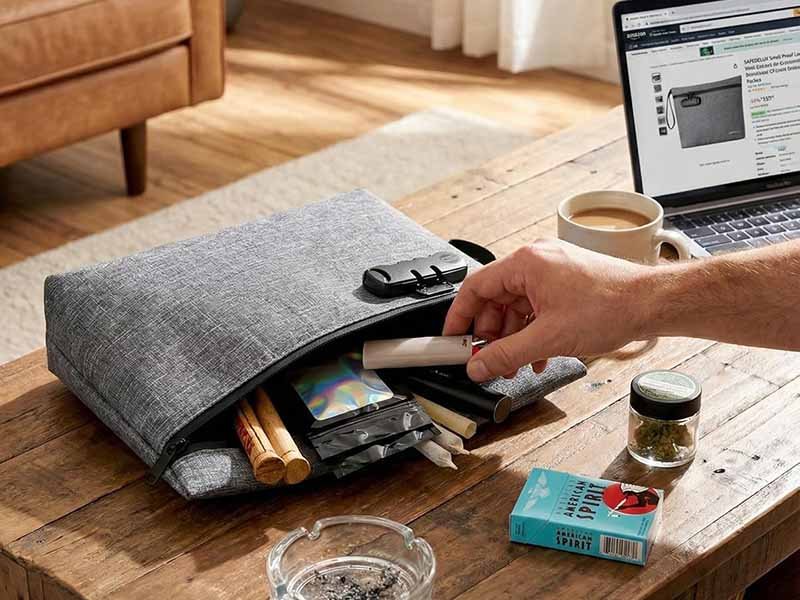
A lot of people think a smell proof bag works because the fabric is thick, the zipper looks strong, or the bag feels heavier than normal. In real production, that is not how odor control is achieved. A bag becomes truly smell proof only when several materials work together as one system. One layer absorbs odor molecules, another slows down transmission, another protects the shape, and another closes the openings where odor would normally escape. That is why two bags that look similar on the outside can perform very differently in actual use.
A well-constructed smell proof bag is usually built with an outer fabric for durability, an odor-blocking barrier layer, an activated carbon layer for adsorption, an inner lining for structure and cleanliness, and a sealing system that limits leakage around the opening. The result is not just a bag that “covers” odor, but a bag that manages odor at several points inside the construction. That difference matters to customers who care about privacy, storage reliability, product quality, and long-term performance.
The real question is not whether a bag contains carbon or uses a zipper. The real question is whether the full material structure has been chosen correctly, assembled correctly, and tested for real daily use. That is where many low-cost smell proof bags fail, and where experienced factories like Szoneier create better results through material selection, layer design, and production control.
What Are Smell proof Bag Materials?
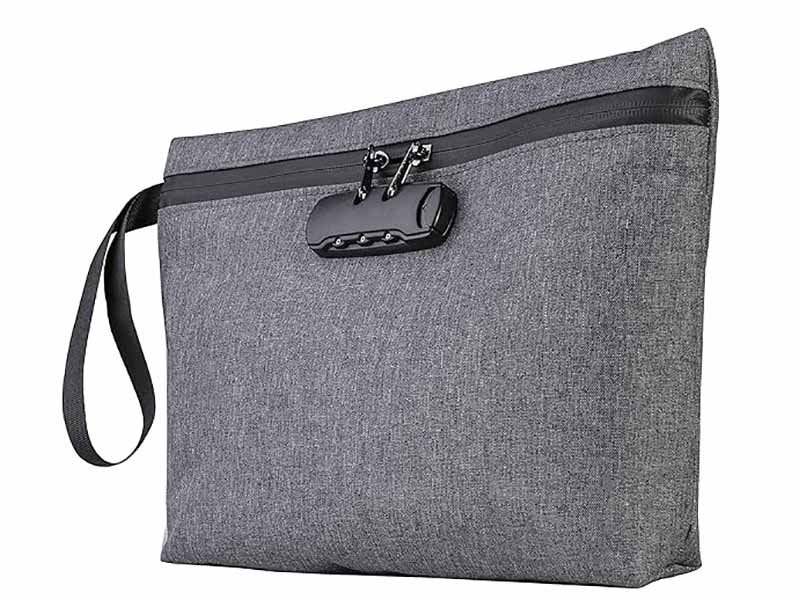
Smell proof bag materials are the combination of odor-control layers, barrier layers, support fabrics, liners, and closure components used to reduce odor leakage. No single material can do the whole job alone. Strong performance comes from how these materials are combined, not from one material by itself.
What Materials Define Smell proof Bag Construction?
The materials used in smell proof bag construction usually fall into five core groups. Each group handles a different part of the job. When customers compare suppliers, this is one of the most important areas to look at, because real performance depends on structure, not marketing words.
1. Adsorption materials
These materials capture odor molecules inside microscopic pores.
- Activated carbon fiber
- Activated carbon nonwoven layers
- Carbon-coated fabrics
- Carbon sponge or carbon foam in some special structures
Among these options, activated carbon fiber is often the strongest premium choice because it combines high surface area with consistent performance and low bulk.
2. Barrier materials
These layers reduce the movement of odor through the bag wall.
- Mylar film
- Aluminum foil laminate
- EVOH barrier film in some engineered products
- TPU or PE composite films in lower-cost designs
Barrier layers do not absorb odor. Their main role is to slow or block transmission.
3. Outer shell materials
These give the bag its strength, appearance, abrasion resistance, and market positioning.
- Polyester
- Nylon
- Oxford fabric
- Canvas in some lifestyle styles
- Neoprene in certain soft-structure designs
The outer shell affects durability, hand feel, printability, and overall cost.
4. Inner lining materials
These help with cleanliness, structure, and user experience.
- Polyester lining
- Nylon taffeta
- PEVA or PU-backed lining in some moisture-resistant designs
- Smooth wipe-clean synthetic liners
A good inner lining also helps protect the carbon layer from friction damage.
5. Sealing materials and components
This is where many bags pass or fail.
- Airtight zipper systems
- Reverse coil zippers with protective flaps
- Rubberized zipper tape
- Hook-and-loop secondary closures
- Fold-over flap structures with compression support
Even with good carbon and film layers, weak closure design can allow odor to leak out quickly.
Below is a simple view of how these materials work together:
| Material Group | Main Job | Common Choices | Why It Matters |
|---|---|---|---|
| Adsorption layer | Capture odor molecules | Activated carbon fiber, carbon nonwoven | Core odor-control function |
| Barrier layer | Slow odor transmission | Mylar, aluminum laminate | Improves containment |
| Outer shell | Protect bag structure | Polyester, nylon, neoprene | Strength, style, durability |
| Inner lining | Protect inside structure | Polyester, nylon lining | Clean finish, layer stability |
| Closure system | Reduce leakage at opening | Airtight zipper, flap seal | Critical to final performance |
A smell proof bag is only as strong as its weakest point. A premium carbon layer with a weak zipper often performs worse than a balanced mid-range structure designed properly from the start.
What Layers Make Smell proof Bags Work?
A good smell proof bag is not a one-layer product. It is a layered construction. The exact structure depends on product type, target cost, intended use, and branding requirements, but most reliable bags use a multi-layer system.
A common construction may look like this:
- Outer fabric layer
- Support or foam layer if shape is needed
- Barrier film layer
- Activated carbon layer
- Protective inner lining
- Closure structure at opening
For pouch products, the structure may stay lighter and flatter. For backpacks, duffle bags, or storage organizers, the structure often needs more reinforcement so the bag does not collapse, wrinkle, or wear out quickly.
The order of the layers matters. If the carbon layer sits too close to abrasion points, it can break down faster. If the barrier layer is poorly laminated, odor can bypass the system through gaps or edge separation. If stitching punctures key odor-control layers without compensation, performance drops.
This is why experienced factories do more than just “add carbon inside.” They engineer the stack.
In practical manufacturing, there are usually three common layer strategies:
Lightweight structure
Used for slim pouches and compact storage bags.
- Lower bulk
- Better portability
- Suitable for small-item storage
- Usually lower cost
Balanced structure
Used for daily-use pouches, shoulder bags, and medium custom bags.
- Good mix of odor control and durability
- Better shape retention
- More room for branding and hardware
Heavy-duty structure
Used for large bags, backpacks, and premium custom lines.
- Stronger outer shell
- Higher-grade barrier layer
- Better zipper system
- More stable long-term use
Below is a simplified comparison:
| Structure Type | Layer Count | Best For | Main Advantage | Main Limitation |
|---|---|---|---|---|
| Lightweight | 3-4 layers | Small pouches | Lower cost, easy carrying | Lower durability |
| Balanced | 4-5 layers | Daily-use bags | Better performance mix | Slightly higher price |
| Heavy-duty | 5-6 layers | Backpacks, premium storage | Stronger and more reliable | Higher material cost |
Customers often focus only on outside style, but real repeat orders usually depend on whether the structure performs well after weeks or months of use. Layer order, lamination quality, and edge sealing all affect that outcome.
What Materials Are Most Common?
In the global custom bag market, several materials appear again and again because they offer a workable balance of cost, function, and manufacturability. That said, “common” does not always mean “best.” There can be a large performance gap between low-grade and high-grade versions of the same material category.
The most common materials include:
Activated carbon fiber
Often used in better smell proof bags because it is lighter and more effective than loose carbon fill. It has a very high internal surface area and works well in multi-layer bag construction.
Carbon nonwoven fabric
Used in many mid-range products. It can work well when paired with strong barrier layers, although consistency depends heavily on carbon loading and fabric quality.
Mylar film
Common because it provides a flexible barrier with good odor-blocking support. It is often used in pouches and flat-panel constructions.
Aluminum foil laminate
Provides a stronger barrier effect, but can be less flexible and may crease more easily. It is often used when odor containment matters more than soft feel.
Polyester outer shell
A standard choice because it is affordable, durable, easy to print, and widely available. It works for many custom projects.
Nylon outer shell
Usually chosen for a more premium hand feel, stronger abrasion resistance, and improved appearance in higher-end styles.
Neoprene
Sometimes used in custom specialty bags because it offers a soft touch, flexible body, and premium feel. Since Szoneier has strong experience in neoprene product development, this material can also be considered for certain structured or lifestyle-oriented smellproof bag concepts when the internal odor-control system is designed correctly.
This is where customers need to be careful: two suppliers may both say they use “activated carbon” or “odor-blocking film,” but the real grade may be very different.
| Material | Entry-Level Version | Better Version | Difference Customers Notice |
|---|---|---|---|
| Carbon layer | Thin carbon print | Activated carbon fiber | Better odor control, longer life |
| Barrier layer | Basic plastic film | Mylar or foil laminate | Lower leakage, more stable |
| Outer shell | Thin polyester | Dense polyester or nylon | Better durability and feel |
| Closure | Standard zipper | Sealed zipper + flap | Less odor escape |
| Lining | Loose low-grade lining | Structured smooth lining | Better appearance and protection |
For custom development, the best material is not always the most expensive one. The best material is the one that matches the actual use case, order budget, product size, and performance expectation.
How Do Smell proof Bag Materials Work?
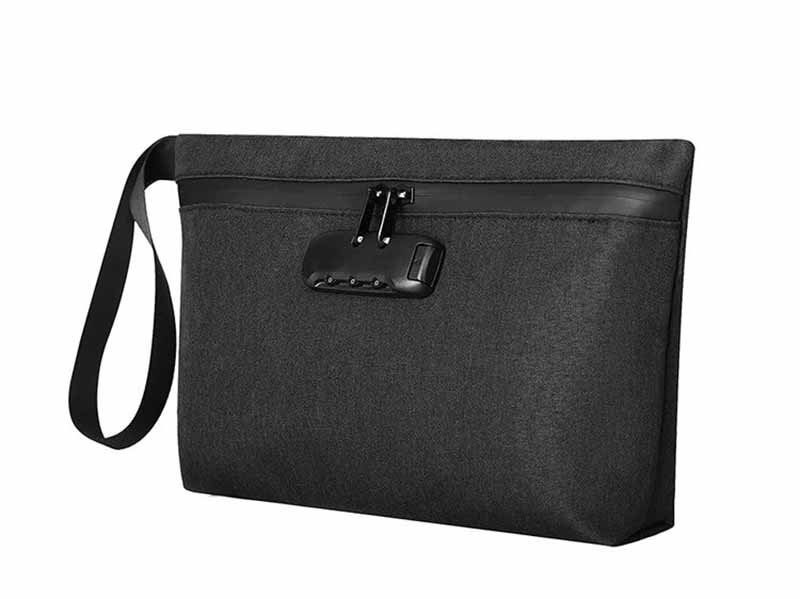
Smell proof bag materials work through a combination of adsorption, blocking, and sealing. Activated carbon captures odor molecules, barrier layers reduce transmission through the bag wall, and closures reduce leakage at the opening. Performance depends on how well these functions support each other.
How Do Smell proof Materials Trap Odors?
The most important concept here is adsorption. Activated carbon does not “soak up” odor the way a towel soaks up water. Instead, it traps odor molecules on a massive internal surface created by millions of microscopic pores.
This matters because many odor molecules are tiny and mobile. If the bag relies only on thick fabric, they can still move through seams, openings, and porous materials. Activated carbon gives these molecules somewhere to go before they escape.
Customers usually care less about the chemistry and more about the result, so here is the practical point: a smellproof bag works better when the carbon layer has enough active surface area, enough thickness, and enough exposure to the air inside the bag.
The effectiveness of carbon is influenced by several production factors:
Carbon quality
Higher-grade carbon usually offers better pore structure and more stable adsorption performance.
Carbon loading
If there is too little active carbon in the material, odor control drops quickly.
Air contact
The carbon layer needs the right placement in the structure. If it is buried poorly, performance can be reduced.
Saturation rate
All carbon layers have a limit. The more odor load placed into the bag, and the longer the use period, the more the carbon layer moves toward saturation.
A practical comparison is helpful:
| Carbon Configuration | Odor Control Level | Service Life | Cost Level |
|---|---|---|---|
| Thin carbon coating | Low | Short | Low |
| Carbon nonwoven | Medium | Medium | Medium |
| Activated carbon fiber | High | Better | Higher |
For many custom projects, a balanced approach is better than simply chasing the thickest carbon possible. Too much bulk can hurt flexibility, sewing stability, and price competitiveness. The smarter goal is to choose the right carbon format for the product size and use scenario.
How Do Layers Improve Smell proof Performance?
One of the biggest mistakes in this product category is assuming the carbon layer does all the work. In reality, carbon handles only one part of the problem. Odor control improves when the full material system is balanced.
Think about what happens inside a bag. Odor molecules move through air gaps, push toward seams, reach the closure, and interact with the bag wall. If the structure only includes carbon, some odor may still find weak points. If the structure only includes a barrier, odor may stay trapped temporarily but the user experience may still suffer once openings are exposed repeatedly. A layered system spreads the workload.
Here is how the layers usually divide the work:
- Carbon layer: captures odor molecules
- Barrier layer: slows movement through the wall
- Outer shell: protects the functional core
- Lining: stabilizes the inner face and improves usability
- Seal system: controls leakage at the opening
This layered approach matters even more in larger bags. A small flat pouch has less internal air space and fewer stress points. A backpack or duffle bag has more volume, more seam length, more fold points, and more zipper length. That means more chances for performance loss if the structure is weak.
A useful way to compare constructions is below:
| Construction Style | Odor Control | Durability | Flexibility | Suitable Product Type |
|---|---|---|---|---|
| Fabric only | Low | Medium | High | Not true smellproof bags |
| Carbon only | Medium | Medium | Medium | Budget products |
| Barrier only | Medium | Medium | Low-Medium | Flat pouches |
| Full multi-layer | High | High | Balanced | Better custom products |
Customers looking for reliable custom development should ask not only “what materials do you use?” but also “how are the layers arranged, laminated, and protected?” That question usually reveals whether the supplier understands the product deeply or is only assembling a simple low-cost bag.
How Do Seals Support Smell proof Construction?
Many smell proof bags fail at the opening, not in the wall material. That is why the closure system is one of the most important parts of the construction. A bag can use good carbon and a strong barrier film, but if the zipper track is loose or the seam design is poor, odor can leak out faster than expected.
The closure system has to solve several problems at once:
- Limit direct air exchange
- Reduce gap formation during repeated opening and closing
- Stay durable after many cycles
- Fit the bag style without making use difficult
Common closure strategies include:
Sealed zipper only
A cleaner look and easier daily use, but quality control must be high.
Zipper plus flap
A stronger structure because the flap acts as a second shield over the zipper area.
Fold-over top with zipper
Often used in larger storage products. It creates extra distance between odor source and outside air.
Hook-and-loop plus zipper combination
Helps stabilize the opening and improve closure security.
The weak points around closure systems are usually:
- Zipper teeth area
- Zipper ends
- Stitch penetration zones
- Corners under pressure
- Areas where the bag is overfilled
This is why better factories often use reinforcement details such as:
- Internal zipper guards
- Extended zipper garages
- Edge binding that protects functional layers
- Better seam layout to reduce stress concentration
For custom projects, it is also worth considering how the bag will actually be used. A pouch opened twice a day may perform well with one zipper design. A backpack opened frequently and packed tightly may need a different closure strategy. Real performance comes from matching the closure to the product, not using one solution for everything.
At Szoneier, this kind of thinking is especially important because customization is not only about printing a logo. It is about adjusting materials, structure, thickness, shape, and construction details so the final bag works well for the client’s market, target price, and end use.
Which Smell proof Bag Materials Perform Best?
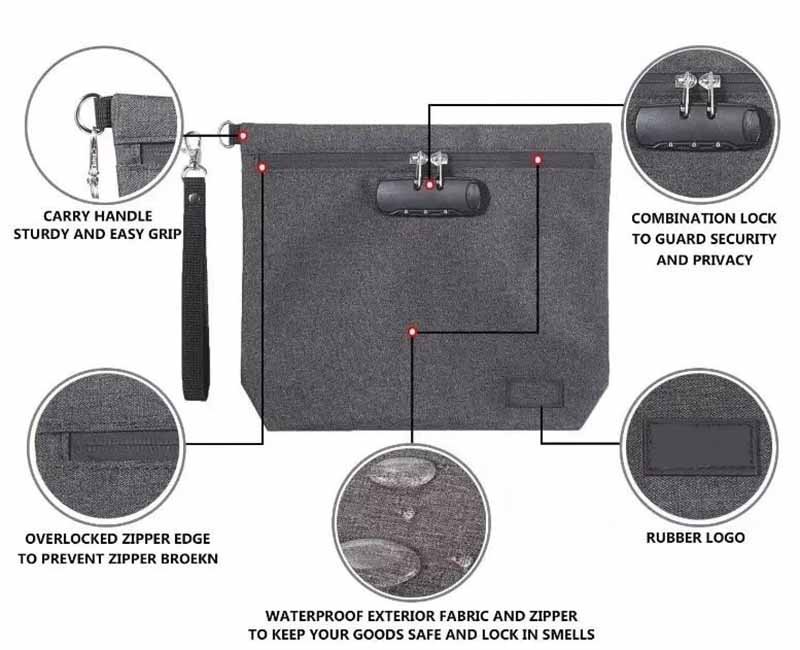
The best smell proof bag materials are those that balance odor control performance, durability, cost efficiency, and usability. In real production, no single material is considered “best” on its own. Performance depends on how carbon, barrier layers, fabrics, and closures are combined and matched to the product’s intended use.
Which Carbon Materials Work Best?
Carbon is the core of any smell proof bag, but not all carbon materials perform the same. The structure, surface area, and consistency of the carbon layer directly affect odor control.
There are three main carbon formats used in manufacturing:
Activated carbon powder (low-end use)
This is often sprayed or coated onto fabric. It is inexpensive but has limited adsorption capacity and inconsistent distribution. Over time, performance drops quickly.
Carbon granules or loose fill (mid-range use)
Granules provide better adsorption than powder, but they are harder to stabilize inside thin bag structures. They are more common in filters than in flexible bags.
Activated carbon fiber (ACF) (high-performance use)
This is the preferred material for premium smell proof bags. It offers:
- High surface area
- Uniform structure
- Faster adsorption speed
- Better consistency across production batches
Here is a performance comparison based on real manufacturing feedback:
| Carbon Type | Adsorption Efficiency | Stability | Weight | Cost Level | Recommended Use |
|---|---|---|---|---|---|
| Carbon coating | Low | Low | Light | Low | Entry-level bags |
| Carbon granules | Medium | Medium | Heavy | Medium | Specialized filters |
| Activated carbon fiber | High | High | Light | Higher | Premium smellproof bags |
From a customer perspective, the key takeaway is simple:
If odor control is a priority, activated carbon fiber is the most reliable choice, especially for repeat-use products.
Which Barrier Materials Block Smell Better?
Barrier materials play a different role from carbon. Instead of trapping odor, they slow or block the movement of odor molecules through the bag wall.
The two most commonly used barrier materials are:
Mylar film (PET-based laminate)
- Flexible and lightweight
- Easy to laminate with fabrics
- Suitable for most pouch and bag designs
- Good balance between cost and performance
Aluminum foil laminate
- Stronger barrier effect
- Lower permeability to odor molecules
- Less flexible and more prone to creasing
- Often used in high-containment designs
In some engineered structures, multi-layer films combine both flexibility and barrier strength.
Comparison below:
| Barrier Material | Odor Blocking Ability | Flexibility | Durability | Cost Level | Typical Use |
|---|---|---|---|---|---|
| Basic plastic film | Low | High | Medium | Low | Low-end bags |
| Mylar film | Medium-High | High | High | Medium | Most custom bags |
| Aluminum laminate | High | Medium | Medium | Medium-High | High-performance bags |
For most custom projects, Mylar is the preferred option because it allows better product design flexibility. Aluminum layers are more suitable when maximum odor containment is required and flexibility is less important.
Which Fabric Materials Add Durability?
Outer fabric is not directly responsible for odor control, but it has a major impact on:
- Product lifespan
- Brand perception
- Weight and portability
- Print quality and customization
The most common fabric choices include:
Polyester
- Cost-effective
- Good abrasion resistance
- Easy to print logos
- Widely used in bulk production
Nylon
- Stronger and lighter than polyester
- Better wear resistance
- More premium appearance
- Often used in higher-end bags
Oxford fabric
- Structured and durable
- Often used in backpacks and tool bags
- Good for heavier products
Neoprene (special applications)
- Soft and flexible
- Premium hand feel
- Good for lifestyle-oriented designs
- Requires proper internal structure to maintain smell proof performance
Fabric selection should match the product positioning. For example:
| Fabric Type | Durability | Appearance | Cost | Best For |
|---|---|---|---|---|
| Polyester | Medium | Standard | Low | Bulk custom orders |
| Nylon | High | Premium | Medium | Branded products |
| Oxford | High | Structured | Medium | Large bags |
| Neoprene | Medium | Premium soft | Medium-High | Lifestyle products |
From a business perspective, fabric choice is often where brands differentiate their products visually while keeping the internal smell proof structure consistent.
Are Advanced Smell proof Materials Worth It?
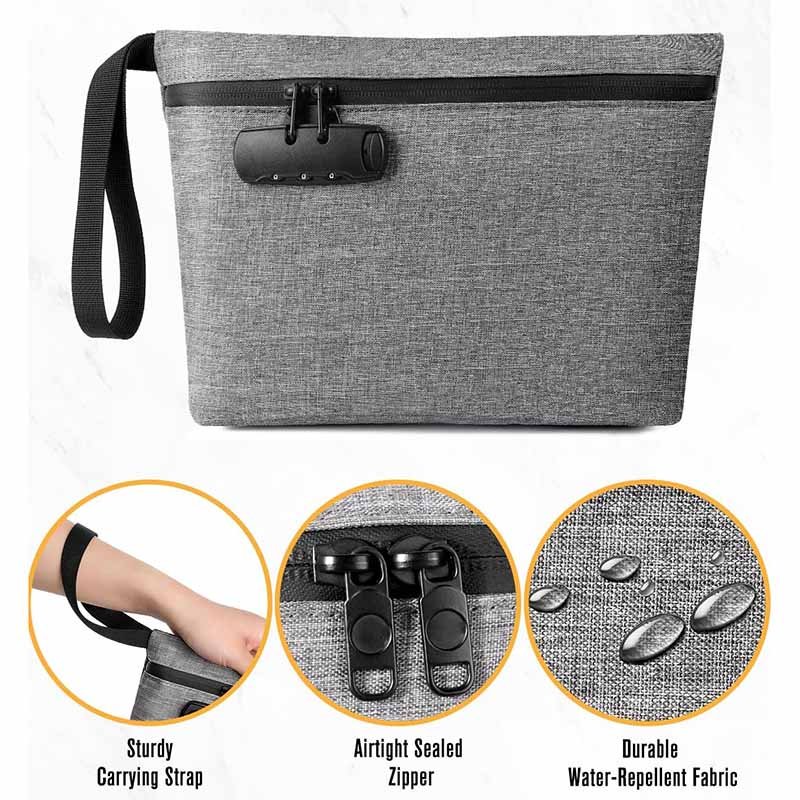
Advanced smell proof materials can improve performance, but they are not always necessary for every product. The decision depends on target market, pricing strategy, and product positioning.
Are Eco Smell proof Materials Effective?
Sustainability is becoming more important, especially for brands selling in Europe and North America. Many customers now ask about eco-friendly options in smellproof bag production.
Some of the available options include:
- Recycled polyester (rPET) outer fabrics
- Water-based coatings instead of solvent-based coatings
- Bio-based carbon sources (in limited applications)
- Reduced-plastic composite layers
However, there are practical considerations:
- Eco materials may have higher cost
- Some eco barrier materials offer slightly lower performance
- Certification (such as GRS) may be required for verification
A balanced approach is often recommended:
| Material Option | Eco Level | Performance | Cost Impact | Recommendation |
|---|---|---|---|---|
| Standard polyester + carbon | Low | High | Low | Cost-sensitive projects |
| rPET + carbon | Medium | High | Medium | Sustainable brands |
| Bio-based materials | Higher | Medium | Higher | Niche positioning |
For most brands, combining recycled outer fabric with standard internal odor-control layers offers a good balance between sustainability and performance.
Are New Materials Improving Smell proof Bags?
Material development in this category is ongoing, although improvements are usually incremental rather than revolutionary.
Recent developments include:
Improved carbon composites
- Better bonding between carbon and fabric
- More consistent adsorption performance
Multi-layer barrier films
- Combining flexibility with stronger odor resistance
- Improved durability during folding and repeated use
Coated zipper systems
- Better resistance to air gaps
- Longer service life
Hybrid structures
- Combining fabric, foam, and barrier layers for better shape retention
These improvements mainly focus on stability, consistency, and durability, rather than completely changing how smell proof bags work.
Are Premium Materials Better for Brands?
Premium materials can improve product performance and customer perception, but only when used correctly.
Advantages of premium materials:
- Better odor control over time
- Stronger durability for repeated use
- Higher perceived product value
- Lower return rates
However, higher cost does not automatically guarantee better results. Poor design or incorrect layer structure can reduce performance even when expensive materials are used.
From a commercial standpoint, brands usually follow three positioning strategies:
| Product Level | Material Strategy | Target Market |
|---|---|---|
| Entry-level | Basic carbon + polyester | Price-sensitive customers |
| Mid-range | Carbon fiber + Mylar + better zipper | Mass market |
| Premium | Optimized multi-layer + nylon + reinforced seals | High-end brands |
For most growing brands, the mid-range structure offers the best balance between cost control and reliable performance, especially when working with an experienced manufacturer like Szoneier.
The biggest mistake is focusing on individual materials instead of system design.
A well-designed mid-range structure often performs better than a poorly assembled premium structure. That is why experienced manufacturers focus on:
- Layer compatibility
- Lamination quality
- Stitching and sealing methods
- Real-use testing
This is also where customization becomes valuable. Instead of using a fixed template, the material system can be adjusted based on:
- Product size
- Intended use
- Target price
- Brand positioning
How to Choose Smell proof Bag Materials?
Choosing the right smell proof bag materials is not about selecting the most expensive components. It is about building a balanced structure that fits your product positioning, price target, and real usage conditions.
Most failed products in the market are not caused by “bad materials,” but by mismatched material combinations.
How to Match Materials to Use Cases?
Different applications require different material priorities. A small daily pouch does not need the same structure as a large travel backpack. If the structure is overbuilt, cost increases unnecessarily. If it is underbuilt, performance fails.
Below is a practical reference based on real custom projects:
| Use Case | Recommended Carbon | Barrier Layer | Outer Fabric | Closure System | Key Priority |
|---|---|---|---|---|---|
| Small pouch | Carbon fiber | Mylar | Polyester | Airtight zipper | Portability + cost |
| Daily carry bag | Carbon fiber | Mylar + film | Nylon | Zipper + flap | Balance |
| Backpack | Carbon fiber thick layer | Aluminum laminate | Oxford/Nylon | Reinforced zipper | Durability |
| Storage bag | Carbon nonwoven | Aluminum layer | Polyester | Fold + zipper | Volume control |
| Premium custom | Carbon fiber high density | Multi-layer barrier | Nylon/Neoprene | Sealed system | Performance + branding |
Material selection should always start from how the bag will be used, not from what materials are trending.
For example:
- A compact pouch benefits more from flexibility and light weight than heavy barrier layers
- A large-capacity bag needs stronger structure and sealing because internal air volume increases odor pressure
How to Combine Materials for Best Results?
Strong smell proof performance comes from correct material pairing, not from a single high-end component.
A reliable combination usually follows this logic:
1. Carbon layer = core function
- Choose activated carbon fiber for better consistency
- Adjust thickness based on product size
2. Barrier layer = control leakage speed
- Use Mylar for flexibility
- Use aluminum laminate for higher containment needs
3. Outer fabric = protect structure
- Polyester for cost efficiency
- Nylon for premium positioning
- Oxford for heavy-duty applications
4. Closure system = control weak points
- Add zipper + flap for better sealing
- Reinforce zipper ends and edges
Here is a comparison of different combinations:
| Structure Type | Odor Control | Durability | Cost Efficiency | Recommended Scenario |
|---|---|---|---|---|
| Carbon only | Medium | Medium | High | Entry-level |
| Carbon + Mylar | High | Medium | High | Best overall balance |
| Carbon + aluminum + nylon | Very high | High | Medium | Premium products |
| Full reinforced system | Maximum | Very high | Lower | High-end brands |
Adding more layers does not always improve performance. If layers are poorly laminated or incorrectly arranged, performance can drop by 20–40% in real use.
That is why structure design is as important as material selection.
How Szoneier Builds Smell proof Bag Construction?
Szoneier approaches smell proof bag production from a system engineering perspective, not just material sourcing.
With over 18 years of experience in fabric development and product manufacturing, especially in neoprene and multi-layer fabric construction, Szoneier focuses on how materials interact in real use.
Here is how Szoneier typically develops custom smell proof bags:
1. Material Matching Based on Product Positioning
Instead of using fixed templates, Szoneier adjusts:
- Carbon type and thickness
- Barrier material selection
- Fabric density and coating
- Closure structure
This ensures the final product matches:
- Target price
- Market positioning
- Functional requirements
2. Layer Structure Optimization
Szoneier tests different layer orders and bonding methods to ensure:
- Stable adhesion between layers
- Reduced internal wear on carbon layer
- Better long-term performance
For example:
- Carbon layers are protected from friction damage
- Barrier layers are positioned to minimize leakage paths
- Stitching areas are reinforced to avoid performance loss
3. Strong Customization Capability
Szoneier supports:
- Custom sizes and structures
- Private label branding (logo, printing, embroidery)
- Different fabric options (polyester, nylon, neoprene, etc.)
- Functional upgrades (waterproof, thermal, reinforced design)
MOQ is flexible, making it suitable for:
- Small and medium brands
- Amazon sellers
- Growing private label businesses
4. Fast Sampling and Production
- Sample development: fast turnaround
- Free design support
- Free sample options available
- Short production lead time
This helps clients move quickly from idea to market.
5. Quality Control and Consistency
Szoneier ensures:
- Stable material sourcing
- Consistent layer construction
- Reliable stitching and sealing
- Batch-to-batch quality consistency
This is especially important for brands that need repeat orders with the same performance standard.
Start Your Custom Smell proof Bag Project with Szoneier
If you are developing a smell proof bag product, the most important step is choosing the right material system from the beginning. That decision affects not only performance, but also cost, customer satisfaction, and long-term brand reputation.
Szoneier provides:
- Over 18 years of manufacturing experience
- Strong expertise in multi-layer fabric and neoprene products
- Flexible MOQ for custom projects
- Free design support to optimize your product
- Fast sampling and short production lead time
- Reliable quality control for repeat orders
Whether you are launching a new product, upgrading an existing design, or building a private label brand, Szoneier can help you develop a smell proof bag that performs consistently in real use—not just in theory.
Send your inquiry today with your idea, target price, and expected use scenario.
Szoneier will help you select the right materials, optimize the structure, and turn your concept into a reliable, market-ready product.