Skip to content
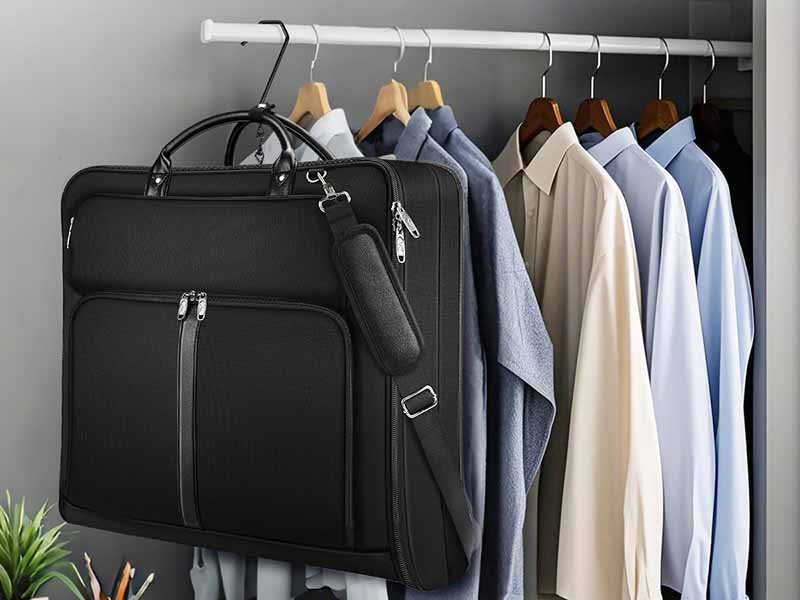
Most travel bags are built to protect “objects.” Garment bags are built to protect something more fragile: a smooth surface. A suit jacket can look perfect in the morning and look tired two hours later if it’s folded wrong and compressed in a crowded overhead bin. That’s why folding garment bags are still popular even in the era of wrinkle-resistant fabrics—because the problem is not only the fabric, it’s the pressure points created by folding and movement.
When brands develop a folding travel garment bag, the goal is simple to say but hard to execute: keep clothing stable, spread pressure evenly, and make the bag compact enough for travel. The folding structure decides almost everything else: where the hanger hook sits, how the zipper path is laid out, whether the bag can be carried on, and how many suits it can realistically hold without crushing the shoulders.
Two folding structures dominate the market: Tri-Fold vs Bi-Fold. Both work, but they fit different travel scenarios and different garment types. Tri-fold designs are usually chosen when compact size is the priority. Bi-fold designs are often chosen when fewer fold lines and garment length are the priority.
Tri-Fold vs Bi-Fold garment bags differ mainly in folding geometry. Tri-fold bags fold garments into three sections to reduce closed length, making them easier to carry and more carry-on friendly. Bi-fold bags fold once, keeping garments longer and reducing fold stress on shoulders and lapels. The best choice depends on garment length, number of suits, and whether the user needs overhead-bin travel or checked-luggage capacity.
A product manager once told us their “best-looking” prototype failed a simple test: after a 15-minute walk, the suit inside came out with hard shoulder creases. The pattern was fine—the folding structure and pressure points weren’t. That’s the difference between a bag that sells and a bag that gets returned.
What Is Tri-Fold vs Bi-Fold Garment Bags?
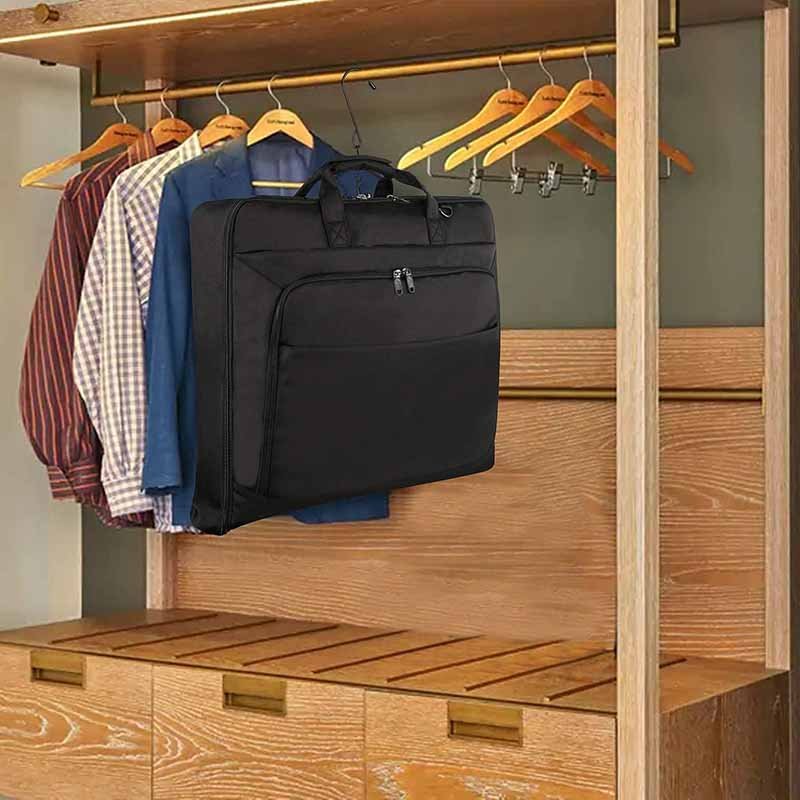
Tri-Fold vs Bi-Fold garment bags refer to two different folding structures used to transport formal clothing such as suits, dresses, uniforms, and coats during travel. Both designs aim to reduce wrinkles and protect garments, but they differ in how the bag folds, how much space it occupies when closed, and how the garment is supported internally.
A tri-fold garment bag divides the garment compartment into three sections using two folding hinges. When the bag closes, the garment is folded twice, allowing the bag to become shorter and more compact. This design is widely used for carry-on travel because the closed size can fit into airline overhead compartments more easily.
A bi-fold garment bag, by contrast, folds the garment only once in the middle. The bag closes like a book, maintaining a longer internal length. This structure reduces the number of fold points applied to clothing and helps maintain smoother lines along jackets, trousers, and dresses.
The key structural difference is shown below.
| Structure Type | Number of Fold Sections | Fold Points on Garment | Closed Size | Best Travel Use |
|---|---|---|---|---|
| Tri-Fold Garment Bag | 3 panels | 2 folds | more compact | carry-on travel |
| Bi-Fold Garment Bag | 2 panels | 1 fold | longer | formalwear transport |
Understanding this structural difference is important for brands and product designers because it affects several real-world performance factors:
- garment wrinkle risk
- travel portability
- garment capacity
- bag weight and structure
What Clothing Is Usually Carried in Tri-Fold vs Bi-Fold Garment Bags?
Garment bags are primarily used to transport clothing that is sensitive to folding pressure or compression. These garments usually include structured fabrics that show visible creases when folded tightly.
Common clothing transported in garment bags includes:
| Clothing Type | Why Garment Bags Are Used |
|---|---|
| business suits | maintain shoulder shape |
| tuxedos | protect lapels and satin details |
| evening dresses | avoid fabric compression |
| uniforms | keep appearance professional |
| long coats | prevent deep folding lines |
Suit jackets are particularly sensitive to folding pressure because of the internal structure of the shoulders and chest canvas. When a jacket is folded incorrectly inside standard luggage, the pressure can flatten the shoulder padding and distort the garment shape.
Garment bags address this problem by allowing the clothing to hang from a hanger or lie across wide folding panels that distribute pressure evenly.
What Are the Typical Sizes of Tri-Fold vs Bi-Fold Garment Bags?
The internal dimensions of garment bags are designed to match the average length of formal clothing. A typical men’s suit jacket measures around 28–32 inches (71–81 cm) from collar to hem, while full dresses and coats can exceed 40 inches (102 cm) in length.
Manufacturers design the bag size based on these garment lengths.
Below is a simplified size comparison used by many travel bag brands.
| Bag Type | Open Length | Closed Length | Typical Capacity |
|---|---|---|---|
| Tri-Fold Garment Bag | 40–45 in | 18–22 in | 1–2 suits |
| Bi-Fold Garment Bag | 40–50 in | 24–28 in | 2–4 suits |
These dimensions explain why tri-fold bags are popular for airline travel. When folded into three sections, the closed bag length falls within common carry-on limits.
Bi-fold bags, on the other hand, preserve more garment length and can accommodate longer items such as dresses or coats.
How Does the Folding Structure Affect Garment Wrinkles?
The number and location of fold zones directly influence wrinkle formation.
When garments are folded sharply, pressure builds along the crease line. During travel, the weight of the clothing above that fold increases the compression.
Tri-fold bags create two folding zones:
- upper fold near the chest area
- lower fold near the waist or thigh area
Bi-fold bags create one central fold, usually around the waist of the jacket.
The following comparison illustrates the pressure distribution.
| Factor | Tri-Fold Structure | Bi-Fold Structure |
|---|---|---|
| number of folds | 2 | 1 |
| crease risk points | moderate | lower |
| garment compression | higher | lower |
| portability | higher | moderate |
However, wrinkle performance is not determined by folding structure alone. High-quality garment bags incorporate additional design features to reduce pressure.
These may include:
- padded fold bars
- internal garment straps
- breathable lining fabrics
- shoulder support panels
With proper design, both tri-fold and bi-fold garment bags can transport clothing with minimal wrinkling.
What Internal Components Are Included in Tri-Fold vs Bi-Fold Garment Bags?
Although garment bags appear simple externally, their internal structure contains several functional elements that help stabilize clothing.
The most common components include the following.
| Component | Function |
|---|---|
| hanger hook | supports garment weight |
| garment straps | prevent clothing movement |
| fold reinforcement | soften folding pressure |
| zipper system | access garment compartment |
| internal pockets | store accessories |
Accessory pockets are often used to store travel items such as:
- ties
- belts
- cufflinks
- dress shirts
Premium travel garment bags sometimes add separate compartments for shoes or toiletry items.
When these features are integrated properly, the garment bag becomes more than just clothing storage—it becomes a compact travel organizer.
Why Do Many Brands Offer Both Tri-Fold and Bi-Fold Options?
Different travelers have different priorities, and no single garment bag structure works best for everyone.
Tri-fold garment bags are preferred when travelers want compact luggage that fits easily into small spaces. These bags are particularly useful for short business trips where the traveler carries only one suit.
Bi-fold garment bags are preferred when travelers need to transport multiple garments or longer clothing items. The longer internal structure reduces garment compression and helps maintain garment shape.
Below is a simple comparison of typical customer preferences.
| Traveler Type | Preferred Structure | Reason |
|---|---|---|
| business travelers | tri-fold | compact carry-on size |
| wedding travelers | bi-fold | protect formal garments |
| fashion professionals | bi-fold | transport long dresses |
| weekend travelers | tri-fold | lightweight portability |
Because of these different use cases, luggage brands often include both options within their product collections.
By offering both tri-fold and bi-fold garment bags, brands can serve a wider range of customers while addressing different travel scenarios.
For companies developing custom travel products, understanding how these structures function is the first step toward building garment bags that truly protect clothing during real-world travel.
What Are the Key Differences in Tri-Fold vs Bi-Fold?
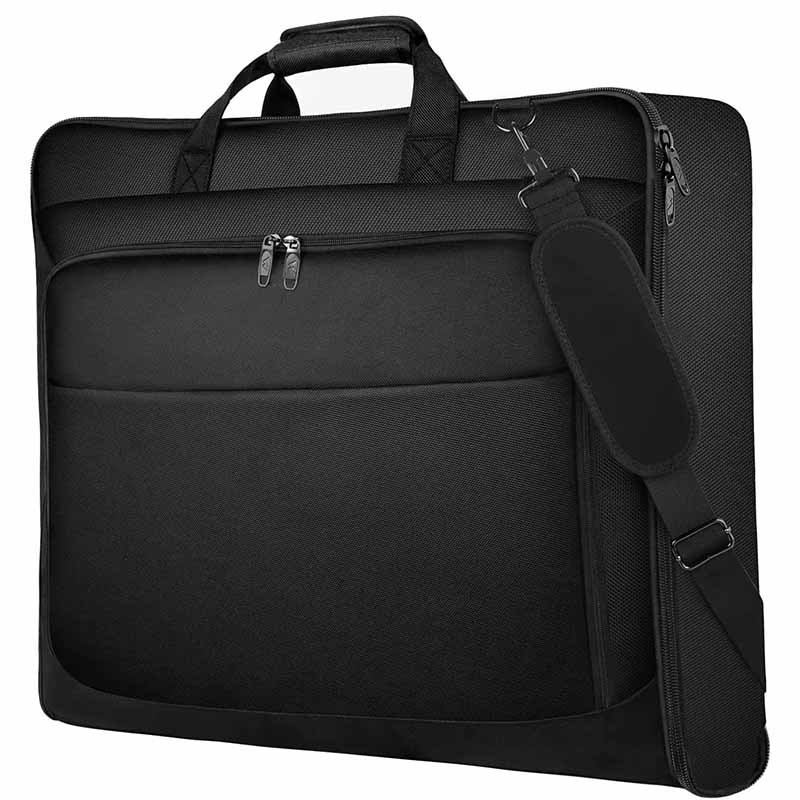
The main differences between Tri-Fold vs Bi-Fold garment bags come down to folding geometry, internal capacity, wrinkle risk, and travel convenience. Both designs aim to protect suits, dresses, and formal clothing, but they prioritize different travel needs. Tri-fold structures focus on compact portability, while bi-fold structures emphasize garment length and wrinkle control.
Understanding these differences helps brands design garment bags that match how customers actually travel. For example, a business traveler who frequently uses airline carry-on luggage will likely prefer a tri-fold garment bag, while someone transporting multiple suits or long dresses may benefit more from a bi-fold design.
When manufacturers develop travel garment bags, they usually evaluate several structural factors before finalizing the folding system.
| Design factor | Tri-Fold vs Bi-Fold (Tri-Fold) | Tri-Fold vs Bi-Fold (Bi-Fold) |
|---|---|---|
| Folding sections | 3 panels | 2 panels |
| Closed bag length | shorter | longer |
| Fold points on garment | 2 | 1 |
| Carry-on compatibility | stronger | moderate |
| Garment length capacity | moderate | higher |
| Wrinkle risk areas | 2 fold zones | 1 fold zone |
These structural differences influence how the bag is engineered internally and how the garment behaves during travel.
Which Is Smaller in Tri-Fold vs Bi-Fold?
One of the biggest advantages of tri-fold garment bags is their compact size when closed.
Because the bag folds into three sections, the final closed length is significantly shorter than a bi-fold design. This makes tri-fold garment bags easier to carry through airports, store in overhead bins, or place inside larger suitcases.
Below is a comparison of common market dimensions.
| Bag type | Closed length | Typical travel use |
|---|---|---|
| Tri-fold garment bag | 18–22 inches | carry-on travel |
| Bi-fold garment bag | 24–28 inches | checked luggage |
For frequent business travelers, this size difference can be important. Many airlines restrict carry-on bag dimensions to approximately 22 inches in length, which aligns well with tri-fold designs.
Tri-fold garment bags are also easier to carry with shoulder straps because the shorter frame distributes weight more evenly.
However, compact size comes with a trade-off. When garments are divided into three sections, the clothing experiences two fold points instead of one.
This means the bag must include stronger wrinkle-prevention features such as padded fold bars or garment stabilization straps.
Which Holds More in Tri-Fold vs Bi-Fold?
Bi-fold garment bags generally hold more clothing because they maintain greater internal garment length and volume.
With only one folding section, the internal compartment can extend further vertically. This allows bi-fold bags to accommodate longer garments and multiple suits without excessive compression.
Typical internal capacity comparisons look like this:
| Bag design | Suit capacity | Ideal travel use |
|---|---|---|
| Tri-fold | 1–2 suits | short business trips |
| Bi-fold | 2–4 suits | formal events or longer trips |
Another advantage of bi-fold bags is that they allow garments to hang more naturally inside the bag. This reduces tension around the shoulders and collar area, which are the most sensitive parts of a suit jacket.
Many bi-fold garment bags also include additional compartments for:
- dress shirts
- ties
- belts
- shoes
These extra storage areas increase overall travel capacity.
For brands designing premium travel bags, bi-fold garment bags often serve as full garment travel systems, combining clothing storage with accessory organization.
Which Wrinkles Less in Tri-Fold vs Bi-Fold?
Wrinkle formation depends on how fabric is compressed during travel. Because tri-fold bags create two folding points, they naturally introduce more potential wrinkle zones.
However, wrinkle performance depends heavily on internal support design, not just the folding structure.
Well-designed tri-fold garment bags use several techniques to reduce creasing:
| Feature | Function |
|---|---|
| padded fold bars | soften fold pressure |
| garment anchor straps | prevent fabric shifting |
| breathable inner lining | reduce friction |
| suit shoulder supports | maintain jacket shape |
Bi-fold bags naturally produce fewer fold points because garments only bend once at the midpoint. This can help maintain smoother jacket fronts and trouser legs.
However, bi-fold bags can still cause wrinkles if the garment shifts inside the bag during transport.
A stable internal layout is essential for both designs.
In practical travel conditions, wrinkle performance depends on:
- garment fabric type
- packing technique
- bag structure
- movement during travel
For example, wool suits tend to recover from minor wrinkles more easily than synthetic fabrics.
Because of this, garment bag design focuses on controlling pressure and movement, not eliminating folds entirely.
Which Is Better for Flights in Tri-Fold vs Bi-Fold?
Air travel creates unique challenges for garment bag design.
Passengers must navigate tight overhead bins, crowded boarding areas, and strict luggage size regulations. Because of these constraints, many travelers prefer tri-fold garment bags.
Tri-fold designs offer advantages such as:
- shorter closed length
- easier overhead storage
- lighter overall weight
Below is a simplified airline travel comparison.
| Travel factor | Tri-fold garment bag | Bi-fold garment bag |
|---|---|---|
| overhead bin fit | easier | sometimes difficult |
| portability | higher | moderate |
| garment capacity | lower | higher |
| wrinkle risk | moderate | lower |
Bi-fold garment bags still perform well for flights when they are carried in the cabin closet or checked as luggage.
Some premium airline cabins even provide dedicated garment hanging areas, which allow passengers to transport suits without folding them at all.
For most travelers, the decision between tri-fold vs bi-fold comes down to balancing convenience and garment protection.
Travelers carrying one suit for a short trip may prioritize compact size and choose tri-fold bags.
Travelers carrying multiple formal garments may prioritize wrinkle reduction and choose bi-fold bags.
How Are Tri-Fold vs Bi-Fold Bags Built?
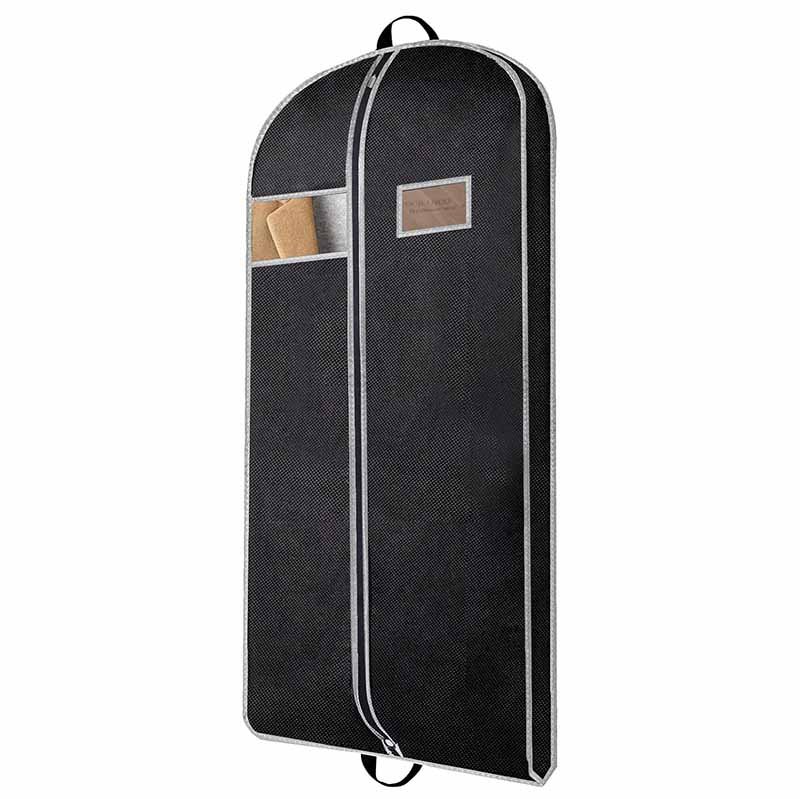
Tri-Fold vs Bi-Fold garment bags may look simple from the outside, but inside they rely on carefully engineered structures. The folding geometry determines how the fabric panels are cut, where reinforcement must be added, how the zipper travels around the bag, and where the garment hanger sits.
For manufacturers developing travel garment bags, the challenge is balancing three factors at the same time:
- compact folding size
- internal garment stability
- long-term durability
A poorly designed garment bag often fails at the fold zones. Repeated folding can weaken seams, distort the bag shape, or create hard crease lines in clothing. Because of this, professional luggage manufacturers reinforce fold areas and structure the internal layout carefully.
The table below shows the core structural differences.
| Construction element | Tri-Fold vs Bi-Fold (Tri-Fold) | Tri-Fold vs Bi-Fold (Bi-Fold) |
|---|---|---|
| Fold hinges | 2 fold panels | 1 fold panel |
| Panel sections | 3 garment panels | 2 garment panels |
| Reinforcement zones | multiple fold bars | central fold bar |
| Zipper path | longer perimeter | simpler layout |
| Structural complexity | higher | moderate |
These differences affect how factories design patterns and assemble the bag during production.
How Is the Folding System in Tri-Fold vs Bi-Fold?
The folding system forms the foundation of the entire bag structure. Designers must determine where the bag will bend and how pressure is distributed across the garment.
Tri-fold garment bags usually contain three main fabric panels connected by flexible hinge zones. These hinge zones allow the bag to collapse without creating sharp angles that could damage clothing.
A simplified tri-fold structure looks like this:
| Panel section | Function |
|---|---|
| upper panel | hanger area and shoulder protection |
| middle panel | jacket body support |
| lower panel | trouser or dress storage |
The hinge points between these panels often include foam reinforcement bars or padded fold channels. These elements reduce crease pressure and allow the garment to bend smoothly.
Bi-fold garment bags use a simpler system. The bag consists of two large panels connected by a single fold zone.
| Panel section | Function |
|---|---|
| upper section | hanger and shoulder area |
| lower section | garment body support |
Because the garment only folds once, the bi-fold structure typically places the fold around the waist area of the suit jacket, where creasing is less visible.
Manufacturers often reinforce this central fold area with:
- padded fold bars
- flexible plastic sheets
- internal reinforcement tape
These components help distribute pressure across a wider area.
How Do Straps Work in Tri-Fold vs Bi-Fold?
Internal straps play an important role in stabilizing garments during travel.
Without straps, clothing can shift inside the bag when the traveler walks, lifts luggage, or places the bag in overhead storage. Even small movements can cause wrinkles to develop.
Most travel garment bags use a two-strap stabilization system.
| Strap position | Purpose |
|---|---|
| upper strap | secures jacket shoulders |
| middle strap | stabilizes garment body |
Some advanced designs also include lower compression straps to control trousers or dresses.
The strap material is usually nylon webbing or elastic webbing. Nylon webbing provides stronger compression, while elastic webbing allows slight flexibility during movement.
Typical strap widths used in production:
| Strap type | Width |
|---|---|
| elastic garment strap | 20–25 mm |
| nylon compression strap | 25–38 mm |
Proper strap placement is critical. If straps sit too close to the garment folds, they may create pressure points and worsen wrinkles.
For this reason, garment bag designers often test multiple strap layouts during the sampling stage.
How Do Hangers Fit in Tri-Fold vs Bi-Fold?
The hanger system is another essential component of garment bag construction.
Most garment bags include a metal hanger hook or reinforced hanger loop at the top of the bag. This allows the bag to hang from closets, hotel doors, or clothing racks.
Common hanger integration systems include:
| Hanger system | Description |
|---|---|
| fixed metal hook | built-in hook attached to frame |
| removable hanger hook | detachable hook for compact storage |
| universal hanger loop | allows standard hangers to pass through |
Many modern garment bags use a pass-through hanger slot, which allows travelers to insert their own hanger through the top of the bag.
This approach offers several advantages:
- compatible with different hanger types
- reduces hardware weight
- simplifies manufacturing
Reinforcement around the hanger area is critical because this zone supports the entire weight of the garments.
Factories often reinforce the hanger zone using:
- double-layer fabric panels
- bartack stitching
- internal webbing reinforcement
These structural details significantly improve long-term durability.
How Do Factories Sew Tri-Fold vs Bi-Fold Bags?
The sewing process for garment bags is more complex than standard travel bags because of the large panels and folding sections.
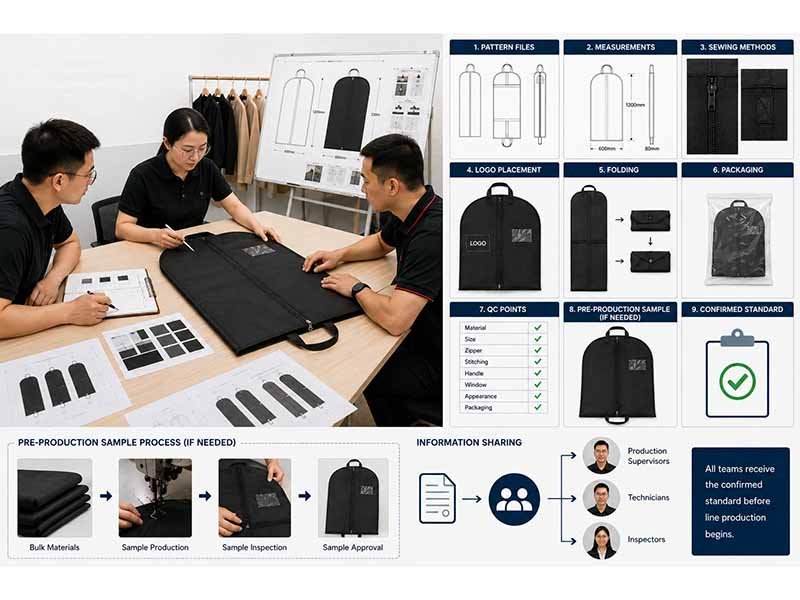
Production usually follows these steps:
| Manufacturing stage | Description |
|---|---|
| pattern cutting | fabric panels cut according to design |
| reinforcement installation | fold bars and internal structures added |
| zipper assembly | perimeter zipper attached |
| panel sewing | outer shell constructed |
| lining installation | internal garment lining added |
| strap installation | stabilization straps sewn |
| hanger reinforcement | hanger loop reinforced |
| final inspection | stitching and alignment checked |
Factories also evaluate stress points in the bag structure.
Common reinforcement locations include:
- fold hinges
- handle attachment points
- zipper corners
- hanger hook area
High-quality garment bags often include double stitching or bar-tack reinforcement in these zones.
These small details significantly increase product durability during long-term use.
How Do Brands Build Tri-Fold vs Bi-Fold Bags?
For brands developing new travel products, building a garment bag involves more than choosing a folding structure. The product must align with customer travel habits, garment types, and luggage regulations.
A structured development process helps ensure the final product meets these expectations.
How Do Designers Plan Tri-Fold vs Bi-Fold Bags?
Product designers usually begin by defining the primary travel scenario.
Examples include:
- business travel with one suit
- wedding travel with multiple garments
- fashion travel with dresses and accessories
Each scenario influences the garment bag’s dimensions.
| Travel use | Recommended bag structure |
|---|---|
| carry-on suit travel | tri-fold |
| long dresses | bi-fold |
| multiple suits | bi-fold |
| compact overnight travel | tri-fold |
Designers also consider airline carry-on restrictions when determining bag size.
Typical airline carry-on limits:
| Dimension | Approx limit |
|---|---|
| length | 22 inches |
| width | 14 inches |
| height | 9 inches |
Tri-fold garment bags are often designed specifically to meet these limits.
How Do OEM Factories Develop Tri-Fold vs Bi-Fold?
OEM development typically begins with product specifications from the client.
These specifications may include:
- bag dimensions
- folding structure
- material selection
- pocket layout
- branding requirements
Factories then create a technical drawing or digital pattern before producing the first sample.
Typical product development timeline:
| Stage | Time |
|---|---|
| design confirmation | 1–2 days |
| sample development | 5–7 days |
| sample revision | 3–5 days |
| bulk production | 25–35 days |
Factories like Szoneier can accelerate this process because they maintain in-house design teams and production facilities.
How Are Features Added to Tri-Fold vs Bi-Fold?
Modern garment bags often include additional travel features beyond garment storage.
Popular add-ons include:
| Feature | Purpose |
|---|---|
| shoe compartments | separate footwear storage |
| tie pockets | protect accessories |
| detachable shoulder strap | easier carrying |
| trolley sleeve | attach bag to suitcase |
| waterproof outer layer | weather protection |
These features transform a garment bag into a complete travel system, allowing users to carry clothing and accessories in one organized bag.
How Does Szoneier Make Tri-Fold vs Bi-Fold Bags?
Szoneier is a Chinese manufacturing company with over 18 years of experience in neoprene material research, development, and product manufacturing.
The company specializes in producing custom products such as:
- neoprene bags
- koozies
- sports protective gear
- medical supports
- wetsuits
- travel bags and accessories
For garment bags, Szoneier offers several customization capabilities.
| Capability | Details |
|---|---|
| material development | neoprene, nylon, polyester |
| custom design | free design support |
| low MOQ production | suitable for small brands |
| rapid sampling | prototypes within days |
| OEM / private label | custom logos and branding |
Because Szoneier controls both material sourcing and product manufacturing, the company can help clients develop travel garment bags with custom fabrics, structures, and features.
Request Custom Tri-Fold or Bi-Fold Garment Bags from Szoneier
Developing a successful travel garment bag requires a deep understanding of materials, folding structures, and real travel conditions.
Brands that work with experienced manufacturers can significantly reduce product development risks and bring better products to market faster.
Szoneier provides:
- professional design assistance
- flexible customization options
- fast sampling services
- reliable manufacturing capacity
- strict quality inspection
If you are planning to launch custom tri-fold or bi-fold garment bags, you are welcome to contact Szoneier to discuss your project.
Whether you are building a new luggage brand or expanding an existing travel product line, the Szoneier team can help transform your ideas into high-quality products ready for the global market