 Skip to content
Stuffed Toys Making : Custom Plush Factory Process Guide
- Eric
- February 4, 2026
- 8:24 am
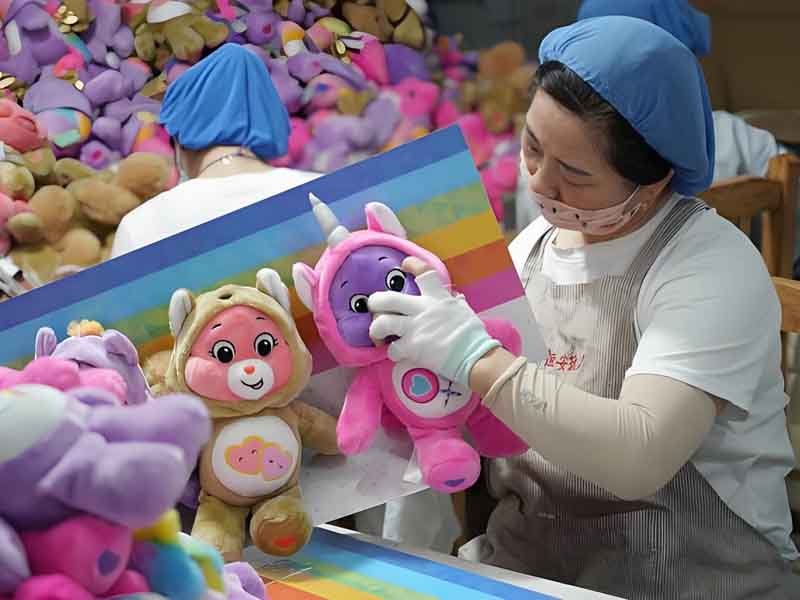
Stuffed toys are easy to love and surprisingly hard to manufacture well. When brands move from “a cute prototype” to “a product line that can be reordered,” the problems usually show up fast: one batch looks slightly different, seams feel weaker, faces lose symmetry, or the toy arrives compressed and never fully recovers. These aren’t random accidents. They come from small decisions in materials, pattern control, stuffing method, and quality checks that were never locked down early.
Stuffed toys making is not “sew and fill.” It’s a repeatable system: every step must be designed so different operators, different days, and different batches still produce the same toy. If the process is not repeatable, the cost doesn’t only show up in defects—it shows up in extra sampling rounds, delays, and customer complaints after launch.
Stuffed toys making is the full process of developing and producing plush or stuffed animals, including material selection, pattern creation, cutting, sewing, stuffing, finishing, inspection, and safety compliance. The goal is to produce toys that feel consistent, hold shape after handling, meet safety requirements, and can be mass-produced with predictable quality and stable cost.
At Szoneier, clients often come to us with a design that looks great on paper but needs factory-level development to become stable in production. Let’s start by defining what stuffed toys making really includes—and what “production-ready” actually means.
What is stuffed toys making?
Stuffed toys making is a structured workflow that converts a design into a repeatable product: materials + patterns + sewing + stuffing + finishing + testing. It is considered successful only when the toy can be produced consistently in bulk, stays within size tolerance, keeps symmetry, survives repeated handling, and passes safety and quality checks.
Why “one good sample” is not real stuffed toys making
A sample is proof that a toy can be made once. Stuffed toys making means it can be made again and again with the same look and feel.
Factories usually separate two standards:
| Stage | What it proves | What it does NOT prove |
|---|---|---|
| Sample looks good | design is possible | bulk consistency |
| Pre-production sample | process is close to stable | long-run stability |
| Mass production | repeatability confirmed | zero variation |
Clients often get surprised because:
- The first sample is hand-finished carefully
- Bulk production is done faster, by multiple operators
- Small pattern or stuffing differences become visible
What defines stuffed toys making?
In real manufacturing, stuffed toys making is defined by repeatability + control. It answers the questions brands care about:
- Can the factory reproduce the same toy in 30 days for a reorder?
- Will the face symmetry look the same across 1,000 pcs?
- Will the plush recover shape after shipping compression?
- Can the cost stay stable without quality dropping?
A factory-grade making process usually has:
- Locked pattern pieces and seam allowances
- Defined stuffing weight ranges
- Clear sewing order and reinforcement points
- Inspection rules that operators actually follow
Below is a simple definition used in many production teams:
| Control item | Why it matters |
|---|---|
| Pattern lock | prevents shape drift |
| Stuffing range | keeps firmness consistent |
| Stitching method | prevents seam failures |
| QC checkpoints | catches variation early |
What steps are in stuffed toys making?
Most stuffed toys making projects follow a sequence that looks simple, but each step has failure points that affect cost and delivery time.
Core steps :
- Material selection (fabric, filling, thread, trims)
- Pattern development (pieces, marks, seam allowances)
- Cutting (size control + pile direction control)
- Sewing (stitch type + reinforcement)
- Stuffing (weight, density, shaping)
- Finishing (closure, trimming, shaping)
- Inspection (appearance + structure + safety)
Here are common “where things go wrong” points:
| Step | Typical problem | What the client sees |
|---|---|---|
| Pattern | seam length mismatch | twisting / uneven face |
| Cutting | pile direction ignored | patchy color look |
| Sewing | weak stress points | seam split complaints |
| Stuffing | uneven density | lumps / flat areas |
| Finishing | closure too visible | “cheap look” |
| Inspection | inconsistent standards | batch variation |
What problems affect stuffed toys making?
Most “quality issues” are actually process issues. They fall into a few high-frequency categories:
- Shape variation Common cause: pattern not locked, seam allowances inconsistent.
- Symmetry drift (especially faces) Common cause: missing center marks, inconsistent panel matching.
- Seam failure at stress points Common cause: no reinforcement, wrong stitch density, weak thread selection.
- Stuffing inconsistency Common cause: no stuffing weight range, untrained stuffing method.
- Compliance / labeling delays Common cause: unclear material declarations, missing test planning.
A useful way to judge risk is to ask: “Which problems appear only in bulk?” Those are almost always caused by weak process control.
Data-style checkpoints clients can request early
To reduce risk, brands can request simple measurable targets early, such as:
| Item | Practical target example |
|---|---|
| Finished size tolerance | small plush ±5–8 mm |
| Stuffing weight tolerance | within a defined range |
| Stitch density | consistent per seam type |
| Pull resistance | reinforced points tested |
| Visual symmetry check | face alignment rule |
You don’t need to overcomplicate it. Even basic targets like these dramatically improve consistency because everyone (design, sewing, QC) works from the same reference.
Which materials suit stuffed toys making?
Materials that suit stuffed toys making are those that remain stable during cutting, sewing, stuffing, and long-term use. Suitable materials must balance softness, structural control, durability, safety compliance, and cost predictability. A good material choice reduces shape distortion, seam failure, and safety risk when production scales from samples to bulk.
Why material choice matters more than design sketches
In real production, materials decide whether a design survives bulk manufacturing. Two toys with the same pattern can behave very differently once sewn and stuffed—only because the fabric or filling reacts differently under tension.
From factory data and experience, material choice directly affects:
- Sewing speed and operator error rate
- Shape recovery after compression
- Defect rate (especially seams and surface appearance)
- Safety testing results
- Cost stability across reorders
Fabric materials that actually work in stuffed toys making
Fabric is the outer skin of the toy. It controls first impression, but also hides or exposes structural flaws.
Below is a production-oriented comparison, not a marketing one:
| Fabric type | Why it’s used | Where it fails | Best use case |
|---|---|---|---|
| Minky | ultra-soft, premium feel | high stretch, shape drift | baby toys, comfort plush |
| Velboa | stable, easy to control | seams visible | character plush |
| Faux fur | hides seams, visual impact | heavy, sound muffling | display or gift plush |
| Fleece | warm, low cost | pulls shape inward | seasonal items |
| Cotton blends | breathable, natural look | less plush | flat or decor plush |
Factory insight:
- High-stretch fabrics (like minky) need tighter patterns and stricter sewing control.
- Long-pile fabrics hide mistakes visually but amplify shape errors after stuffing.
Filling materials and why consistency matters more than brand
Filling defines how a stuffed toy feels in the hand—and how it ages.
Most problems blamed on “bad filling” are actually caused by inconsistent stuffing methods.
| Filling type | Feel & behavior | Production risk | Best use |
|---|---|---|---|
| Polyester fiber | soft, elastic | uneven distribution | general plush |
| PP cotton | resilient, springy | higher material cost | shape-critical toys |
| Foam pieces | structured | hard spots | sitting plush |
| Recycled fiber | eco appeal | density variation | sustainable lines |
Key controls factories use:
- Defined stuffing weight range (not “by feel”)
- Separate density zones (head vs body)
- Training on stuffing direction and pressure
Threads, seams, and the materials clients rarely ask about
Thread choice is often overlooked—but it decides seam life.
Important thread considerations:
- Tensile strength
- Elasticity vs rigidity
- Compatibility with fabric stretch
| Thread issue | Result |
|---|---|
| Too thin | seam splitting |
| Too rigid | puckering |
| Wrong color | visible seams |
Factories often choose slightly stronger thread than needed on samples to protect bulk production.
Accessories and trims: where materials create risk
Eyes, noses, labels, and sound modules are often where safety and quality issues start.
Safer material strategies:
- Embroidered eyes instead of plastic (for young ages)
- Stitched labels instead of glued ones
- Internal pockets for sound modules
| Accessory choice | Risk level |
|---|---|
| Embroidery | low |
| Sewn fabric patches | low |
| Plastic parts | medium to high |
| Glue-fixed trims | high |
How material choice affects cost and reorders
Material choice influences not just unit price, but long-term cost stability.
Hidden cost drivers:
- Fabric shrinkage differences
- Filling compression during shipping
- Supplier inconsistency between batches
| Material behavior | Long-term effect |
|---|---|
| Stable fabric | easier reorders |
| Stretch-prone fabric | more QC |
| Certified materials | faster compliance |
| Unverified materials | testing delays |
How does design shape stuffed toys making?
Design shapes stuffed toys making by determining how patterns, seams, and internal structure behave during sewing, stuffing, and handling. A production-ready design balances appearance with structural logic so the toy keeps its shape, looks consistent across batches, and can be assembled efficiently without excessive rework or quality risk.
Why design decisions affect production more than appearance
In stuffed toys making, design is not decoration—it is engineering. Two toys that look similar on a sketch can behave very differently once fabric is cut and filled.
From factory experience, design decisions directly affect:
- Number of pattern pieces and sewing steps
- Operator error rate
- Stuffing difficulty and time per unit
- Shape consistency across batches
- Rework and rejection rate
A “simple-looking” design with poor balance often costs more to produce than a slightly more complex but well-structured one.
How pattern design controls shape consistency
Patterns are the backbone of stuffed toys making. If the pattern is unstable, no amount of careful sewing will fix it.
Key pattern factors that affect production:
- Seam length balance All connecting edges must match precisely. Even a 1–2 mm mismatch can cause twisting after stuffing.
- Curve smoothness Sharp or uneven curves create wrinkles and tension points.
- Panel logic How panels meet determines whether volume distributes evenly.
| Pattern issue | What happens in bulk |
|---|---|
| Unequal seam lengths | visible twisting |
| Tight curves | wrinkling |
| Loose allowance | size drift |
| Missing center marks | off-center faces |
How size and proportion change production risk
Scaling a stuffed toy is not linear. Doubling the size more than doubles stress on seams and stuffing volume.
When size increases:
- Fabric stretch increases under stuffing pressure
- Seam stress multiplies
- Stuffing weight becomes harder to control
| Size category | Main design risk |
|---|---|
| Small (10–20 cm) | detail distortion |
| Medium (25–35 cm) | balance issues |
| Large (40+ cm) | seam failure |
How internal structure supports stable production
Internal structure is invisible to customers—but critical to factories.
Structural design includes:
- Panel layout
- Reinforcement at stress points
- Internal pockets for sound modules
- Flat bases for sitting plush
Benefits of good structure:
- Faster sewing with fewer errors
- More even stuffing
- Better shape recovery after compression
- Lower defect rate
| Structural feature | Production benefit |
|---|---|
| Reinforced seams | durability |
| Balanced panels | symmetry |
| Defined base | stable sitting |
| Internal pockets | module stability |
How design affects sewing time and cost
Every design choice affects how long it takes to make one toy.
Cost-driving design factors:
- Number of pattern pieces
- Complexity of curves
- Access points for stuffing
- Need for hand finishing
| Design feature | Time impact |
|---|---|
| Fewer panels | faster |
| Complex curves | slower |
| Easy stuffing opening | faster |
| Hidden closures | slower |
Where design creates hidden quality risks
Some design elements look attractive but create production risk:
- Very narrow limbs → hard to stuff evenly
- Deep concave shapes → wrinkles after stuffing
- Heavy heads → balance problems
- Overly thin seams → early tearing
These issues often appear only after shipping or customer use, not during sampling.
How factories evaluate whether a design is production-ready
Before mass production, experienced factories check:
- Can multiple operators sew it consistently?
- Does it recover shape after compression?
- Are stress points reinforced?
- Is stuffing repeatable within tolerance?
A design that passes these checks costs less to produce over time—even if the initial sample took longer.
Design questions clients should ask before approval
Before approving a design for bulk, brands should ask:
- Where does the stress concentrate?
- Which seams must be reinforced?
- How does size affect balance?
- Can the structure support repeated handling?
- Will this design scale cleanly to other sizes?
How is quality controlled in stuffed toys making?
Quality control in stuffed toys making is achieved by controlling patterns, sewing methods, stuffing consistency, and inspection checkpoints throughout production. Reliable quality does not rely on final inspection alone, but on preventing variation at each step so defects do not accumulate in bulk production.
Why quality problems usually appear too late
Most quality complaints do not come from “bad sewing.” They come from variation.
Typical situations brands face:
- The first 50 pcs look fine, later cartons look different
- One factory batch feels softer or flatter than another
- Reorders don’t match the original approved sample
These problems appear late because quality was checked only at the end, not controlled during the process.
Professional stuffed toys making treats QC as process control, not just inspection.
How stitching impacts stuffed toys making?
Stitching determines whether a stuffed toy survives daily use.
Key stitching factors that affect quality:
- Stitch density (too loose = weak seams; too tight = puckering)
- Stitch type (lock stitch vs chain stitch)
- Reinforcement at stress points
Common stress points include:
- Arms and legs
- Neck connection
- Hanging loops
- Zipper or battery access areas
| Stitch issue | Result |
|---|---|
| Low stitch density | seam splitting |
| Uneven stitching | distorted shape |
| No reinforcement | early failure |
How defects appear in stuffed toys making?
Defects usually appear in patterns, not randomly.
High-frequency defect types:
- Shape defects Cause: pattern drift, mismatched seam lengths
- Surface defects Cause: uneven stuffing, rushed finishing
- Structural defects Cause: weak internal fixation, missing reinforcement
- Appearance defects Cause: inconsistent trimming, poor pile control
A useful way to reduce defects is to inspect before the defect becomes visible.
| QC checkpoint | What it catches |
|---|---|
| After cutting | size variation |
| After sewing | seam alignment |
| During stuffing | firmness imbalance |
| Before packing | shape recovery |
How durability is tested in stuffed toys making?
Durability is not guessed—it is simulated.
Common durability checks include:
- Pull testing on seams and accessories
- Repeated squeeze or compression tests
- Drop tests (especially for internal modules)
| Test type | Purpose |
|---|---|
| Seam pull | prevent tearing |
| Compression | shape recovery |
| Drop test | internal stability |
Factories that skip durability testing often rely on “it looks strong,” which rarely holds up in real use.
What safety matters in stuffed toys making?
Safety in stuffed toys making focuses on material compliance, secure construction, and clear labeling. Toys must be designed so parts do not detach, materials meet chemical requirements, and the final product aligns with target market safety standards before shipping.
Why safety should be designed, not checked later
Many delays in stuffed toy projects come from safety issues discovered after production.
Common late-stage problems:
- Accessories fail pull tests
- Fabric documentation is incomplete
- Labels do not match target market rules
These issues are expensive to fix once production has started.
What standards apply to stuffed toys making?
Safety standards depend on the market.
Typical categories include:
- Physical and mechanical safety
- Chemical content limits
- Labeling and traceability
| Market | Focus areas |
|---|---|
| US | small parts, labeling |
| EU | chemical compliance |
| Global | age grading accuracy |
How materials affect stuffed toys making safety?
Materials influence safety more than design shape.
High-risk material issues:
- Loose fibers
- Unverified dyes
- Inconsistent filling sources
Safer material practices include:
- Using pre-tested fabrics
- Locking filling suppliers
- Avoiding glued decorations
| Material choice | Safety impact |
|---|---|
| Embroidery | lower risk |
| Plastic parts | higher risk |
| Certified fabric | predictable testing |
How labels support stuffed toys making?
Labels are part of safety, not decoration.
Key labeling elements:
- Age grading
- Material content
- Manufacturer information
Incorrect labels can:
- Delay customs clearance
- Trigger rework
- Cause product rejection
Work with Szoneier on Stuffed Toys Making
Stuffed toys making becomes predictable only when materials, patterns, sewing, stuffing, QC, and safety planning work together. When any part is treated as an afterthought, problems appear in bulk—when costs are highest.
Szoneier has over 18 years of experience in:
- Stuffed toys and plush animals development
- Material sourcing and validation
- Pattern engineering and structure control
- Sampling, mass production, and inspection
- Packaging design and packaging QC
Whether you are:
- Developing a new stuffed toy line
- Refining an existing design
- Or scaling from samples to mass production
Our team can help you build a stable, repeatable stuffed toys making process that protects your brand and your margins.
Contact Szoneier to discuss your custom stuffed toys project and request a quotation.
manufacturer Categories
- Custom Tote Bags Manufacturer
- custom backpacks Manufacturer
- custom travel bags& Duffle bags manufacturer
- custom makeup bags & toiletry bags manufacturer
- custom cooler bags manufacturer
- custom drawstring bags manufacturer
- custom makeup bags & toiletry bags manufacturer
- custom golf bags manufacturer
- custom fireproof bags manufacturer
- custom dry bags manufacturer
- custom ski bags manufacturer
- custom gym & sports bags manufacturer
- custom laptop bags manufacturer
- custom tactical bags manufacturer
- custom beach bags manufacturer
- custom medical bags manufacturer
- custom camera bags manufacturer
- custom wetsuits manufacturer
- custom leather goods manufacturer
- more personalized products

Can't find the answers?
No worries, please contact us and we will answer all the questions you have during the whole process of plush toys customization.
Make A Sample First?
If you have your own artwork, logo design files, or just an idea,please provide details about your project requirements, including preferred fabric, color, and customization options,we’re excited to assist you in bringing your bespoke plush designs to life through our sample production process.
