
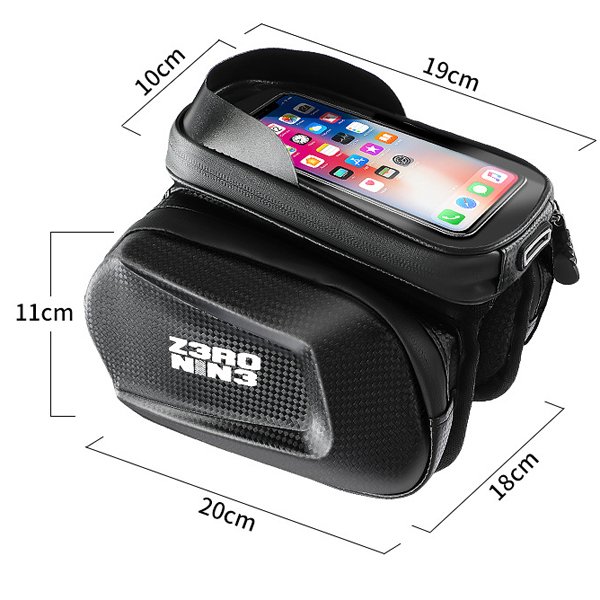
Every cyclist—from urban commuters to long-distance bikepackers—knows that storage makes or breaks the ride. The right bike bag must hold your essentials without compromising speed, balance, or comfort. But as modern bikes evolve with slimmer frames, electronic drivetrains, and unique geometries, so too must the dimensions of the bags that accompany them.
Bike bag dimensions vary by type and riding purpose. Frame bags typically measure 40×10×5 cm, handlebar bags 25×15×15 cm, and panniers 35×30×15 cm. Choosing the right size depends on bike geometry, volume needs, and stability balance.
Think of the difference between a road cyclist’s aerodynamic setup and a mountain biker’s robust gear-hauling kit — one requires precision, the other endurance. Both, however, rely on one principle: proper dimension equals performance.
At Szoneier, with over 18 years of expertise in bag design and OEM manufacturing, we help global brands turn technical sizing into aesthetic perfection — from the first prototype sketch to the final shipment-ready product.
Let’s break down how to size, measure, and design your next custom bike bag collection.
What Are the Standard Bike Bag Dimensions?
Bike bag dimensions depend on type and bike geometry. Standard frame bags measure around 40×10×5 cm, handlebar bags 25×15×15 cm, saddle bags 20×10×10 cm, panniers 35×30×15 cm, and top-tube bags 20×8×7 cm. The right fit balances capacity, aerodynamics, and clearance.
Standard Dimensions by Bag Type
To help you benchmark sizing for OEM production or private-label development, below is a table of commonly accepted market standards:
| Bag Type | Average Dimensions (cm) | Volume (L) | Primary Placement | Typical Usage |
|---|---|---|---|---|
| Frame Bag | 40–45 × 10–12 × 5–7 | 3–8 | Inside main triangle | Tools, spare tubes, nutrition |
| Handlebar Bag | 25–30 × 15 × 15 | 5–10 | Front bar / fork | Jackets, cameras, electronics |
| Saddle Bag | 20 × 10 × 10 | 1–3 | Under saddle | Repair kit, keys, mini pump |
| Pannier (Rear) | 35 × 30 × 15 | 15–25 | Rear rack | Clothes, food, touring gear |
| Pannier (Front) | 30 × 25 × 12 | 10–15 | Front rack | Balance weight for touring |
| Top-Tube Bag | 20 × 8 × 7 | 1–2 | Behind stem | Snacks, phone, GPS battery |
| Handlebar Roll (Bikepacking) | 40–55 × 18–20 (diameter) | 10–15 | Front bar | Sleeping gear, dry goods |
Tip: In design, the first measurement (length) runs parallel to the frame or handlebar; the second (height) defines side profile; and the third (depth) defines how far the bag protrudes from the bike — a critical factor for leg clearance and wind drag.
Volume-to-Ride Ratio:Matching Bag Size with Trip Duration
Choosing the correct dimension isn’t only about where it fits — it’s about how long and how far the rider goes.
| Ride Type | Recommended Capacity | Suggested Bag Combination |
|---|---|---|
| Daily commute / urban ride | 3–8 L | Saddle + Top-Tube |
| Weekend ride / day trip | 8–15 L | Frame + Handlebar |
| Multi-day touring / bikepacking | 25–60 L | Frame + Handlebar + Dual Pannier |
| Expedition / long-distance | 60 L+ | Modular setup with dry roll integration |
How Small Dimensional Changes Impact Function
Even 1–2 cm differences can alter the bike’s feel or the product’s usability:
- Increasing depth by 2 cm improves capacity by ~15 %, but can cause thigh rub.
- Reducing height by 1 cm can eliminate bottle-cage interference on smaller frames.
- Extending length improves packing options but risks handlebar collision during turns.
Material and Construction Influence Size Tolerance
Different fabrics stretch and behave differently during manufacturing:
- TPU-laminated nylon expands slightly when heated during seam sealing.
- PVC-coated polyester maintains rigid form and exact tolerance.
- Oxford or Cordura fabrics shrink 1–2 % during lamination or coating.
That’s why Szoneier uses ±3 mm cutting precision and accounts for fabric deformation in its CNC cutting files. This ensures your final mass-production pieces match the design mockup dimensions exactly.
International Market Differences in Bag Sizing
Cycling trends vary by region — so do bag dimensions:
- Europe: compact, aerodynamic designs (smaller frames).
- North America: larger capacity and adventure setups.
- Japan & Korea: narrow widths for small-frame commuters.
- Australia & New Zealand: off-road endurance gear with extended pannier widths.
For brands selling internationally, Szoneier offers multi-SKU dimension mapping, producing 2–3 variants from one master design to fit different market demands without re-engineering the mold or tooling.
Example — Dimension Balancing in a Bikepacking Setup
A typical bikepacking system (total 40–45 L) may include:
- Handlebar roll bag (12 L) → 45 × 20 cm
- Frame bag (8 L) → 42 × 12 × 6 cm
- Seat bag (10 L) → 40 × 18 × 15 cm
- Rear pannier pair (each 7.5 L) → 33 × 27 × 13 cm
Standard vs Custom Dimension Ranges
| Bag Category | Standard Size (cm) | Customizable Range (cm) | Capacity (L) | Material Notes |
|---|---|---|---|---|
| Frame Bag | 40 × 10 × 5 | 38–45 × 8–12 × 4–7 | 3–8 | TPU/420D Nylon |
| Handlebar Bag | 25 × 15 × 15 | 20–35 × 10–20 × 10–18 | 5–10 | PVC/Tarpaulin |
| Saddle Bag | 20 × 10 × 10 | 15–25 × 8–15 × 8–12 | 1–3 | EVA/Polyester |
| Pannier | 35 × 30 × 15 | 30–40 × 25–35 × 12–18 | 15–25 | PVC Waterproof |
| Top-Tube Bag | 20 × 8 × 7 | 18–25 × 7–10 × 6–9 | 1–2 | Ripstop Nylon |
Which Types of Bike Bags Have Different Dimension Standards?
Each bike bag type follows unique dimension standards based on placement and use. Frame bags fit inside the bike triangle (≈40×10×5 cm), handlebar bags mount at the front (≈25×15×15 cm), saddle bags fit under the seat (≈20×10×10 cm), panniers attach to racks (≈35×30×15 cm), and top-tube bags sit behind the stem (≈20×8×7 cm).
1. Frame Bags
Frame bags are designed to fit snugly within the main triangle formed by the top, down, and seat tubes. Because every bike geometry differs, there are no universal frame bag dimensions — only standard ranges adapted to road, gravel, and MTB categories.
Common Frame Bag Dimensions
| Bike Type | Length (cm) | Height (cm) | Depth (cm) | Capacity (L) |
|---|---|---|---|---|
| Road / Aero | 38–40 | 8–10 | 5–6 | 3–5 L |
| Gravel / Touring | 42–45 | 12–14 | 6–7 | 5–8 L |
| MTB / Enduro | 40–44 | 14–16 | 6–8 | 6–10 L |
Design Insights
- Full-frame bags (covering the entire triangle) offer maximum storage for touring and expedition use.
- Half-frame bags preserve bottle-cage access while providing 3–5 L of capacity.
- Asymmetric shapes accommodate suspension shocks and dropper-post cables.
2. Handlebar Bags
Mounted at the handlebar and head-tube area, these bags must strike a balance between volume, steering clearance, and aerodynamics.
Standard Dimensions
| Type | Width (cm) | Height (cm) | Depth (cm) | Capacity (L) |
|---|---|---|---|---|
| Compact Commuter | 22–25 | 12–14 | 12–14 | 4–6 L |
| Roll-Top Touring | 40–55 | 15–20 (diameter) | – | 10–15 L |
| Box-Shaped Urban | 28–32 | 16–18 | 15–17 | 8–10 L |
Functional Design Considerations
- Roll-top handles allow flexible capacity and water sealing (ideal for bikepacking).
- Rigid-lid box types offer easier access for commuters.
- Clear TPU map windows or touchscreen pouches are common add-ons.
3. Saddle Bags
Saddle bags mount directly beneath the saddle using Velcro straps or clip mounts. They must stay compact to avoid thigh or tire interference.
Size Range by Use
| Use Case | Length (cm) | Width (cm) | Height (cm) | Capacity (L) |
|---|---|---|---|---|
| Minimal / Road | 12–18 | 8–10 | 8–10 | 0.8–1.5 L |
| All-Round / Commuter | 18–25 | 10–12 | 10–12 | 1.5–3 L |
| Touring Seat Pack | 35–45 | 18–20 | 15–18 | 8–15 L |
Material and Structure
- EVA-molded bases keep the bag’s aerodynamic shape.
- Roll-top closures or side zippers enhance waterproofing.
- Reflective piping and tail-light loops improve night visibility.
Szoneier implementation: We use 420D TPU-laminated nylon with ultrasonic seam bonding to achieve IPX6 waterproof performance on large-volume seat packs.
4. Panniers and Rack Bags
Panniers are the workhorses of long-distance and commuting cyclists, mounted on side racks at the rear or front. Their dimensions depend on wheel size, heel clearance, and rack height.
Typical Dimensions
| Position | Height (cm) | Width (cm) | Depth (cm) | Volume (L) |
|---|---|---|---|---|
| Rear Pannier | 35–40 | 30–35 | 15–18 | 20–30 L |
| Front Pannier | 30–35 | 25–30 | 12–15 | 10–20 L |
| Rack-Top Trunk | 35 | 20 | 18 | 8–12 L |
Usage Insights
- Touring panniers focus on balanced load distribution — ideally 30 % front / 70 % rear.
- Commuter panniers are slimmer, reducing wind drag in urban environments.
- Quick-release mounting systems (e.g., KlickFix) standardize international compatibility.
5. Top-Tube and Stem Bags
These smaller bags sit above the frame, near the stem or seatpost. Their primary advantage is immediate access while riding.
Standard Dimensions
| Placement | Length (cm) | Width (cm) | Height (cm) | Capacity (L) |
|---|---|---|---|---|
| Front (Stem) | 18–20 | 7–9 | 7–8 | 0.8–1.2 L |
| Rear (Seatpost) | 22–25 | 8–10 | 8–9 | 1–2 L |
Design Functions
- Touch-screen-compatible phone pouches for commuters.
- Narrow aerodynamic shapes for road cyclists.
- Cable ports for power banks or GPS units.
6. Specialty and Niche Bags
Modern cycling markets demand new bag types that don’t fit traditional dimensions:
| Bag Type | Dimension Range (cm) | Unique Function |
|---|---|---|
| Fork-Mount Cargo Bag | 25×12×12 | Compact dry bag attached to fork cages |
| Down-Tube Tool Pod | 20×10×8 | Hidden utility space near bottom bracket |
| E-Bike Battery Bag | 35×15×10 | Heat-resistant and cable-integrated housing |
| Triathlon Bento Box | 22×7×6 | Aerodynamic nutrition storage on top tube |
7. Dimensional Compatibility Between Bag Types
When multiple bags are mounted simultaneously, coordination is essential:
- Frame + Top-Tube + Handlebar → For road or gravel setups (up to 20 L total).
- Handlebar + Frame + Saddle → For bikepacking (30–45 L total).
- Dual Panniers + Trunk + Frame → For touring and commuting (60 L+ total).
Design rule: Maintain 5–7 cm spacing between bag edges to prevent rubbing, and align attachment straps to the bike’s load centerline for stability.
How Do You Measure Your Bike to Find the Right Bag Size?
To find the right bike bag size, measure your bike’s frame triangle (top tube, seat tube, and down tube), handlebar width, and saddle clearance. Then match the dimensions to bag placement and trip capacity needs. Accurate measurements ensure comfort, aerodynamics, and stability.
Choosing a bike bag that fits perfectly begins long before production or purchase — it starts with measuring your bike’s geometry. Unlike backpacks or totes, a bike bag must follow the exact curves, angles, and clearances of your frame, otherwise it may rub, sag, or disrupt balance.
At Szoneier, every custom project starts with measurement — converting a physical bike’s geometry into a precisely engineered digital fit model. Let’s go step by step through the process.
1. Measure the Frame Triangle (For Frame Bags)
The frame triangle is the heart of your bike — the space formed by the top tube, seat tube, and down tube. It determines the largest possible storage area for a frame bag.
Tools You Need
- Soft tape measure
- Ruler or straight edge
- Marker or masking tape
- Notebook or digital template
Step-by-Step Process
- Top Tube Length (A): Measure from the head tube (front) to the seat tube (rear).
- Typical road bikes: 52–56 cm
- Gravel or touring bikes: 55–60 cm
- Mountain bikes: 48–54 cm
- Seat Tube Height (B): Measure vertically from the bottom bracket center to the top tube intersection. This defines the bag’s height on the rear side.
- Down Tube Clearance (C): Measure from bottom bracket to the head tube base. This ensures enough room for bottle cages and avoids interference.
- Internal Triangle Lengths (D): Measure diagonally across the triangle interior (top-left to bottom-right). Use this to sketch a simple proportional triangle on paper or in software like CAD.
Tip from Szoneier Engineers:
During OEM design, we subtract 1–1.5 cm from each side of the triangle outline to prevent tight fit against frame tubes. A slight offset ensures smooth installation and airflow optimization.
2. Handlebar Width and Tire Clearance (For Handlebar Bags)
Handlebar bags are often mis-sized because users overlook steering and tire clearance. Measuring these points ensures stability, especially for mountain and gravel riders.
| Bike Type | Handlebar Width (cm) | Recommended Bag Width (cm) | Clearance Notes |
|---|---|---|---|
| Road / Gravel | 38–44 | 25–30 | Keep 2–3 cm clearance near shift cables |
| Touring | 44–48 | 30–40 | Allow roll-top or strap wrap space |
| MTB / Adventure | 60–80 | 35–45 | Ensure 5 cm above tire when turning |
Steps
- Measure between handlebar grips for total bar width.
- Check vertical clearance between tire and bar base — critical for full-suspension bikes.
- Simulate steering motion to confirm no collision with cables or headlight mounts.
3. Seatpost Length and Saddle Overhang (For Saddle Bags)
A well-fitted saddle bag should never hit the rear tire or swing side-to-side. The measurement focuses on seatpost exposure and saddle overhang.
Steps
- Measure visible seatpost length (E) — from saddle clamp to frame entry.
- Minimum needed: 12 cm for small bags, 20 cm+ for large seat packs.
- Measure saddle width and rear curve. Some saddles (e.g., Brooks leather models) have longer tails, which reduce usable mounting space.
- Check rear tire clearance.
- Keep 5–7 cm minimum distance between the bottom of the bag and tire when fully compressed (especially on full-suspension bikes).
| Seatpost Exposure | Recommended Bag Volume | Ideal Usage |
|---|---|---|
| <12 cm | 0.5–1.5 L | Minimal commuter setup |
| 12–20 cm | 2–5 L | Standard day-ride gear |
| >20 cm | 5–15 L | Touring or bikepacking |
4. Wheelbase and Tire Size (For Panniers & Racks)
Pannier dimensions depend on rack clearance, heel space, and wheel size. Incorrect measurements can cause heel strike or tilt under load.
Measure:
- Rack Length: Distance between rear stay mounts (typically 30–35 cm).
- Rack Height: From axle center to top platform (28–40 cm).
- Wheelbase: Center-to-center distance of the two wheel axles.
For standard 700c or 29” wheels, bag height should not exceed 40 cm to avoid rubbing.
| Wheel Size | Max Bag Height (cm) | Heel Clearance (cm) | Typical Rack Width (cm) |
|---|---|---|---|
| 26” | 35 | 10 | 12–15 |
| 27.5” | 38 | 12 | 14–16 |
| 700c / 29” | 40 | 15 | 16–18 |
5. Top-Tube and Stem Measurements (For Stem & Bento Bags)
For smaller accessory bags (top-tube or stem-mounted), focus on length, angle, and attachment surface.
- Measure top-tube length from head tube to seat tube.
- Check for brake or shifter cable interference.
- Identify stem angle (typically 6°–10°) to ensure bag doesn’t tilt forward.
Standard Reference:
- Length: 18–25 cm
- Width: 7–10 cm
- Height: 6–9 cm
6. Matching Capacity (Liters) to Trip Duration
Once you know your clearances, match volume (L) to trip duration. This ensures your total setup is functional and not overbuilt.
| Trip Type | Ideal Capacity (L) | Recommended Bag Combination |
|---|---|---|
| Short commute | 3–5 L | Saddle + Top Tube |
| Day trip | 10–15 L | Frame + Handlebar |
| Weekend touring | 25–40 L | Frame + Handlebar + Panniers |
| Multi-day expedition | 50 L+ | Modular system setup |
Are There Recommended Dimensions for Different Riding Styles?
Yes. Road cyclists prefer compact, aerodynamic bags (3–8 L), mountain and gravel riders need medium-capacity, shock-resistant designs (10–20 L), and touring cyclists use larger modular systems (25–60 L). Electric bikes require adjusted shapes to accommodate battery and cable space.
Different riding styles demand very different bike bag dimensions. A minimalist road racer needs just enough storage for a tube and a snack, while a bikepacker crossing mountain passes might carry a sleeping bag, tools, and waterproof layers.
1. Road Cycling & Commuting
Road and city riders prioritize speed, balance, and aerodynamics. Their bags must stay slim, stable, and integrated with the bike silhouette.
Typical Bag Dimensions
| Bag Type | Size (cm) | Capacity (L) | Purpose |
|---|---|---|---|
| Saddle Bag | 18 × 9 × 8 | 1–2 L | Essentials, multitool, tube |
| Frame Bag | 38 × 10 × 5 | 3–5 L | Snacks, phone, mini pump |
| Handlebar Bag | 25 × 12 × 12 | 4–6 L | Jacket, power bank |
| Top-Tube Bag | 20 × 8 × 7 | 1 L | Phone, keys, energy gel |
Design Insights
- Slim Profiles: Maintain a 7 cm maximum side depth to reduce drag.
- Lightweight Materials: 420D TPU-laminated nylon or 600D Oxford fabric.
- Mounting: Quick Velcro loops and anti-slip pads for easy daily removal.
- Aesthetic: Sleek matte or semi-gloss finish for urban appeal.
2. Mountain & Gravel Riding
Mountain and gravel riders face dust, vibration, and impact. Their bags need thicker structure, flexible shape retention, and waterproof integrity under tough conditions.
Typical Bag Dimensions
| Bag Type | Size (cm) | Capacity (L) | Purpose |
|---|---|---|---|
| Frame Bag | 42 × 14 × 6 | 5–8 L | Tools, pump, jacket |
| Handlebar Roll Bag | 45 × 18 (diameter) | 8–12 L | Clothing, sleeping gear |
| Saddle Pack | 35 × 18 × 15 | 8–10 L | Camping gear, rainwear |
| Stem Bag | 20 × 10 × 10 | 1–2 L | Bottle or snack access |
Design Insights
- Shock-Absorbing Base Panels: EVA foam and reinforced stitching absorb vibration.
- Wide Openings: Easier gear access with gloves on.
- Roll-Top Closures: Maintain waterproof seals (IPX6 or IPX7).
- Compression Straps: Prevent swaying on rough trails.
- Reinforced Webbing: Double-stitched 25 mm nylon for durability.
3. Touring & Bikepacking
Touring cyclists and bikepackers require maximum storage with balanced weight distribution. Their bags are often modular, combining frame + handlebar + dual pannier setups.
Typical Combined Capacity
| Bag Zone | Dimensions (cm) | Volume (L) | Recommended Use |
|---|---|---|---|
| Full-Frame | 45 × 15 × 8 | 8–10 L | Tools, heavy gear |
| Handlebar Roll | 50 × 20 | 12–15 L | Sleeping kit |
| Saddle Bag | 40 × 18 × 17 | 10–14 L | Clothes, tent |
| Dual Panniers | 35 × 30 × 15 (each) | 20–25 L × 2 | Food, cookware |
Design Insights
- Balance Rule: Front-to-rear weight ratio ~40:60 for optimal control.
- Waterproof Seams: Welded PVC or TPU materials (≥IPX6).
- Mounting Systems: Quick-release clips + elastic stabilization straps.
- Visibility Add-ons: Reflective logos and rear LED loops.
4. Gravel Adventure & Endurance Racing
Gravel racing blends the aerodynamics of road cycling with the endurance demands of touring. Bags here must be mid-volume but extremely light, offering quick detachment and low sway.
Recommended Dimensions
| Bag Type | Size (cm) | Volume (L) | Material |
|---|---|---|---|
| Frame Bag | 40 × 12 × 6 | 5–7 L | Ripstop TPU |
| Handlebar Bag | 30 × 15 × 15 | 6–8 L | TPU/Nylon hybrid |
| Saddle Pack | 35 × 15 × 14 | 6–8 L | EVA + Oxford |
| Stem / Feed Bag | 20 × 10 × 10 | 1–1.5 L | 600D Nylon |
Performance Priorities
- Ultralight Build: ≤500 g per bag for total 1.5–2 kg setup.
- Slim Fit: Minimal side drag, stable under high cadence.
- Hydration Integration: Optional hydration-port channels for long events.
5. Electric Bikes (E-Bikes)
E-bikes add an extra challenge: integrated batteries and wiring occupy space within the frame and racks. Bag dimensions must account for heat dissipation, access ports, and cable clearance.
Recommended Adjusted Dimensions
| Bag Type | Size (cm) | Capacity (L) | Special Features |
|---|---|---|---|
| Frame Bag | 42 × 10 × 5 | 4–6 L | Battery cut-out panels |
| Handlebar Bag | 30 × 15 × 15 | 6–8 L | Reinforced mounts |
| Pannier | 35 × 30 × 15 | 20–25 L | Cable management loops |
| Rack Trunk | 35 × 20 × 18 | 10–12 L | Heat-resistant base padding |
Design Innovations
- Cable Integration: Eyelets and silicone grommets for battery wiring.
- Thermal Protection: Aluminum foil lining for battery proximity areas.
- Structural Reinforcement: Thicker PE boards to support motor vibration.
Commuter & Urban Cyclists — Everyday Practical Dimensions
Urban riders prioritize convenience, waterproofing, and easy mounting over extreme performance. They typically use medium-size bags that blend practicality with aesthetic appeal.
| Bag Type | Typical Dimensions (cm) | Volume (L) | Usage |
|---|---|---|---|
| Pannier | 32 × 28 × 12 | 15–18 | Laptop, groceries |
| Frame Bag | 38 × 10 × 5 | 3–5 | Documents, tools |
| Handlebar Bag | 25 × 15 × 15 | 5–7 | Phone, charger |
| Backpack Hybrid | 40 × 30 × 15 | 20 | Office + commute use |
Urban Design Essentials
- Quick Detach Mounts: For multi-modal commuting (bike + train).
- Stylish Waterproof Fabrics: Matte TPU or tarpaulin.
- Reflective Piping: Safety for night rides.
- Padded Compartments: For laptops or tablets.
Recommended Bag Dimensions by Riding Style
| Riding Style | Primary Bags | Approx. Dimensions (cm) | Total Volume (L) | Design Priorities |
|---|---|---|---|---|
| Road / Commuter | Saddle, Top-Tube | 20×10×10 / 20×8×7 | 3–8 L | Aerodynamics, light weight |
| Gravel / MTB | Frame, Handlebar, Saddle | 42×14×6 / 45×18×18 / 35×18×15 | 15–25 L | Shock resistance, waterproofing |
| Touring / Bikepacking | Full set (Frame + Panniers + Rolls) | 45×15×8 / 35×30×15 / 50×20 | 40–60 L | Capacity, stability |
| E-Bike | Frame, Rack Trunk, Panniers | 42×10×5 / 35×20×18 / 35×30×15 | 25–40 L | Cable management, heat protection |
| Urban Commuter | Pannier, Frame | 32×28×12 / 38×10×5 | 15–20 L | Accessibility, modern aesthetics |
How to Customize Bike Bags by Dimensions for Your Brand
Brands can customize bike bag dimensions, shapes, and materials through OEM/ODM manufacturing. Adjust volume, pockets, and closures to align with target user and market positioning.
1. OEM/ODM Options for Private Labels
Szoneier supports both OEM (based on your design) and ODM (our in-house templates). We help brands adjust patterns, dimensions, and logo placement for unique market differentiation.
2. Custom Volume and Layout
Options include:
- Expandable or roll-top designs
- Hidden zipper pockets
- Quick-access side compartments
Capacity precision: ±0.5L tolerance, verified during prototype testing.
3. Material Selection
| Material | Waterproof Rating | Weight | Ideal Use |
|---|---|---|---|
| PVC | IPX6 | Heavy | Panniers / Travel |
| TPU | IPX7 | Medium | Handlebar / Frame |
| 600D Nylon | IPX4 | Light | Commuting |
| Ripstop Oxford | IPX5 | Medium | Mountain |
4. Sample Development Process
Szoneier’s prototype cycle includes:
- Digital CAD patterning
- 3D visual mockup for approval
- Material selection and sealing test
- Pre-production sampling within 5 days
Final Thoughts
The ideal bike bag dimensions balance storage, aerodynamics, and comfort. Correct sizing prevents interference, improves stability, and enhances ride efficiency. Custom manufacturing ensures precision for specific frames and user needs.
Whether it’s a road cyclist cutting through wind, a gravel adventurer bouncing over rocks, or a commuter weaving through city traffic, comfort comes from precision — the right bag, in the right place, at the right scale.
At Szoneier, we believe dimensions aren’t numbers — they’re motion equations. We digitally map every prototype to ensure your bike bag integrates seamlessly with the rider’s biomechanics and frame dynamics.
manufacturer Categories
- Custom Tote Bags Manufacturer
- custom backpacks Manufacturer
- custom travel bags& Duffle bags manufacturer
- custom makeup bags & toiletry bags manufacturer
- custom cooler bags manufacturer
- custom drawstring bags manufacturer
- custom makeup bags & toiletry bags manufacturer
- custom golf bags manufacturer
- custom fireproof bags manufacturer
- custom dry bags manufacturer
- custom ski bags manufacturer
- custom gym & sports bags manufacturer
- custom laptop bags manufacturer
- custom tactical bags manufacturer
- custom beach bags manufacturer
- custom medical bags manufacturer
- custom camera bags manufacturer
- custom wetsuits manufacturer
- custom leather goods manufacturer
- more personalized products
Can't find the answers?
No worries, please contact us and we will answer all the questions you have during the whole process of bag customization.
Make A Sample First?
If you have your own artwork, logo design files, or just an idea,please provide details about your project requirements, including preferred fabric, color, and customization options,we’re excited to assist you in bringing your bespoke bag designs to life through our sample production process.
