Skip to content
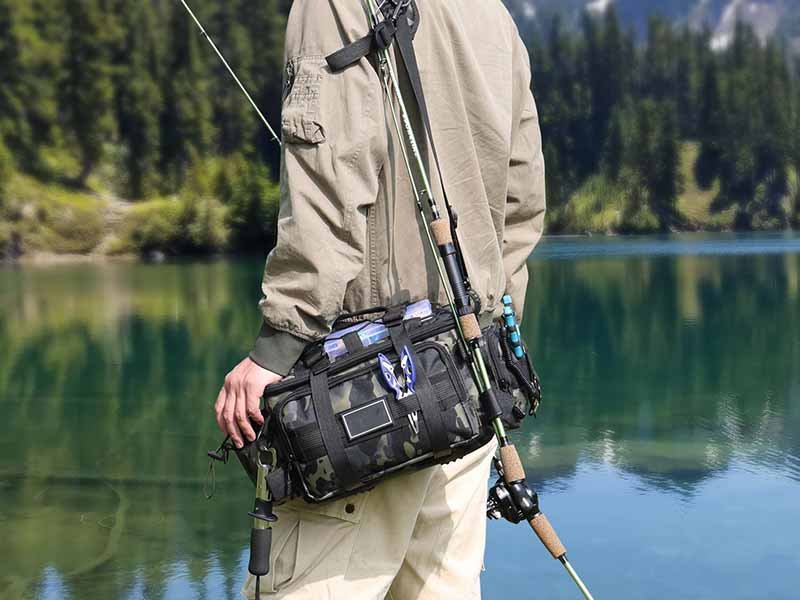
A good tackle bag looks simple on the outside, but the product behind it is not simple at all. Many people assume a tackle bag is just another sewn fishing accessory: some fabric, a zipper, a few pockets, and a shoulder strap. In reality, the difference between a bag that sells well and a bag that gets returned often comes down to dozens of small manufacturing decisions. The fabric weight, foam thickness, zipper grade, seam reinforcement, tray fit, pocket depth, coating type, and even handle position all affect how the bag performs on the water. A tackle bag that sags, absorbs water, rusts at the zipper, or loses shape after one season quickly damages a product’s reputation.
Tackle bag manufacturing is the process of designing, engineering, cutting, sewing, assembling, and testing fishing storage bags so they can organize gear, resist outdoor wear, and support repeated use in wet and dirty conditions. A well-made tackle bag needs durable fabric, functional compartments, reinforced stress points, reliable hardware, and production control that keeps quality stable from sample stage to bulk order.
That is why serious product development starts long before the sewing line. A strong factory does not only make the bag; it helps define the product logic behind the bag. At Szoneier, with more than 18 years of experience in neoprene material development and sewn product manufacturing, this often means helping customers refine structure, materials, logo methods, and cost targets before production begins. In many cases, the final success of a tackle bag is decided before the first panel is ever cut. A fishing brand may start with a simple sketch, but what happens next determines whether the product becomes a reliable seller or an expensive mistake.
What Is a Tackle Bag?
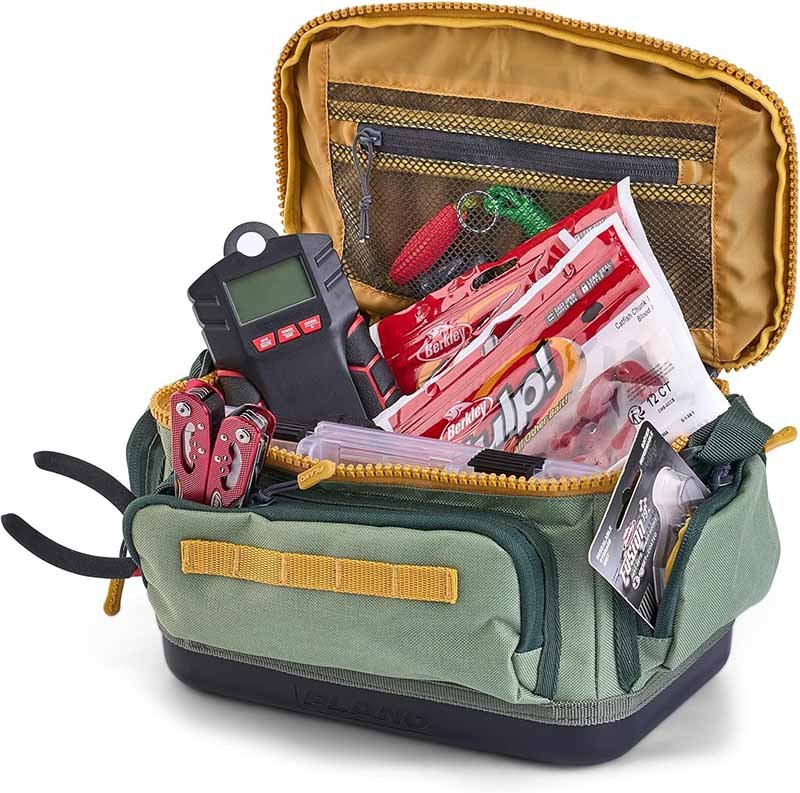
A tackle bag is a portable fishing storage system designed to carry, organize, and protect fishing gear in real outdoor conditions. Unlike rigid tackle boxes, it is built for movement—walking along riverbanks, climbing rocks, boarding boats, or traveling long distances. A well-designed tackle bag keeps gear accessible, prevents damage, and reduces the time anglers spend searching for tools while fishing.
In practical terms, a tackle bag is not just a container. It is a working system that combines storage structure, material durability, and user comfort. The way it is built directly affects how efficiently someone can fish.
What Makes a Tackle Bag Different?
A tackle bag is different from a normal bag because it is designed around use behavior, not just storage space.
In a standard backpack or duffle bag, the goal is simple: carry items from one place to another. In a tackle bag, the goal is different. The user needs to:
- Open the bag quickly with one hand
- Identify gear instantly
- Access tools without removing everything
- Keep wet and dry items separated
- Prevent small components (hooks, swivels) from getting lost
This leads to structural differences:
| Feature | Regular Bag | Tackle Bag |
|---|---|---|
| Internal layout | Open space | Structured compartments |
| Access | Single opening | Multi-direction access |
| Organization | Minimal | High-level segmentation |
| Durability | General use | Outdoor, heavy-duty |
| Water resistance | Optional | Often required |
Another key difference is frequency of use. A tackle bag may be opened 50–100 times in a single fishing trip. Over a season, this can mean thousands of zipper cycles and repeated strain on seams and handles. That is why construction details such as zipper alignment, stitching reinforcement, and fabric coating matter much more than in regular bags.
From a product development perspective, this is where many low-cost products fail. They look similar on the outside but lack internal logic and durability, which leads to poor user experience after short-term use.
What Do Tackle Bags Carry?
A tackle bag needs to handle a wide range of gear types at the same time. This is one of the main reasons why its structure is more complex than other bags.
Typical contents include:
- Plastic tackle trays (lures, soft baits)
- Small hardware (hooks, sinkers, swivels)
- Tools (pliers, cutters, hook removers)
- Fishing line and accessories
- Personal items (phone, keys, wallet)
- Extra items (gloves, towels, water bottles)
Each category has different requirements. For example:
- Hooks require secure, sealed storage to prevent loss
- Tools require quick-access external pockets
- Tackle trays require precise compartment sizing
- Personal items require water-resistant protection
Below is a more detailed breakdown:
| Item Type | Typical Size | Storage Requirement | Design Impact |
|---|---|---|---|
| Tackle trays (3600/3700) | 27–36 cm | Fixed compartment | Defines bag size |
| Hooks & rigs | Very small | Secure pocket | Zippered inner compartments |
| Tools (pliers) | 15–25 cm | Fast access | External sleeves |
| Line spools | Round, bulky | Flexible space | Expandable pockets |
| Phone & wallet | Small valuables | Water protection | Coated pockets |
A common issue in poorly designed tackle bags is mismatched proportions. For example:
- Compartments too shallow for standard trays
- Side pockets too tight for line spools
- Tool holders too loose, causing movement
These problems are not always visible in photos but become obvious in real use. That is why experienced manufacturers usually design around actual gear dimensions rather than estimated sizes.
Why Do Anglers Use Tackle Bags?
Anglers use tackle bags because they improve efficiency, mobility, and comfort during fishing.
In real scenarios, fishing is not static. Anglers often:
- Move between multiple fishing spots
- Carry gear over long distances
- Deal with wet, muddy, or uneven environments
A tackle bag solves several problems at once:
1. Faster access to gear
A well-organized bag reduces time spent searching for lures or tools. This directly improves fishing efficiency.
2. Better mobility
Compared with hard tackle boxes, tackle bags are lighter and easier to carry. Backpack and sling designs allow hands-free movement.
3. Improved comfort
Padded straps and balanced weight distribution reduce fatigue. This becomes important when carrying 5–10 kg of gear.
4. Protection in outdoor conditions
Water-resistant materials and reinforced bases help protect gear from rain, splashes, and dirt.
Here is a simple comparison based on real usage:
| Scenario | Without Tackle Bag | With Tackle Bag |
|---|---|---|
| Gear access | Slow, disorganized | Fast, structured |
| Mobility | Limited | High |
| Comfort | Low | Medium–high |
| Protection | Low | Medium–high |
Another important point is time efficiency. During active fishing, delays matter. If changing lures takes 2–3 minutes instead of 20–30 seconds, the overall experience is affected. Over a full day, that difference becomes significant.
For brands and product developers, this is where real value is created. A tackle bag is not just about storage—it is about helping users fish more efficiently and comfortably. Products that solve these problems tend to perform better in the market, especially in competitive platforms like Amazon or specialty fishing stores.
What Materials Are Used in Tackle Bags?
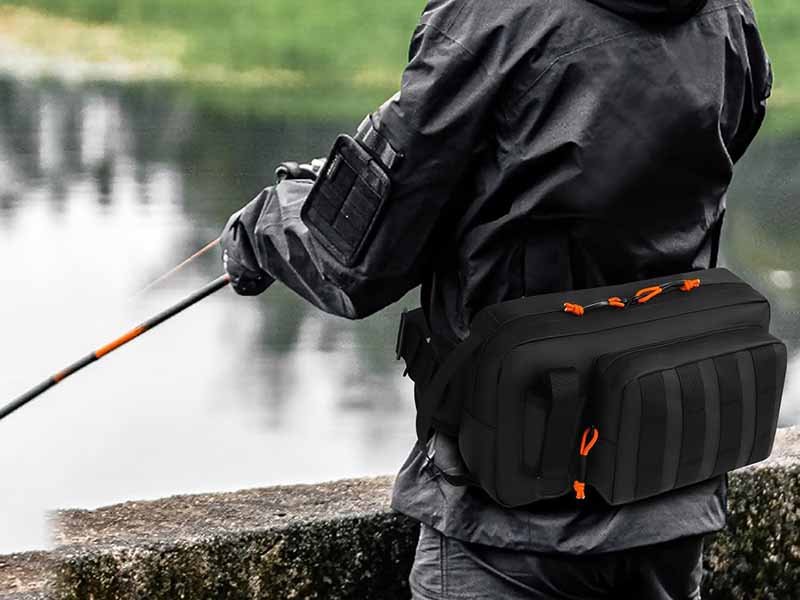
Tackle bags are usually made from synthetic fabrics such as polyester, nylon, and neoprene, combined with foam, lining, webbing, zippers, buckles, and water-resistant coatings. Material choice controls durability, weight, shape retention, water resistance, cost, and product positioning.
Which Fabrics Are Best for Tackle Bags?
The best fabric depends on the target market, price level, and fishing scenario. There is no single material that is right for every tackle bag. A value-priced entry product may prioritize cost efficiency and visual design. A premium fishing bag may prioritize abrasion resistance, heavier structure, better waterproofing, and longer field life.
The three most common outer materials are polyester, nylon, and neoprene.
Polyester is widely used because it is cost-effective, stable in color, and suitable for many mid-range products. In 600D or 900D constructions, it offers a practical balance between durability and cost. For many commercial projects, polyester is the easiest starting point because it supports multiple coating options, printing methods, and color ranges. It is often used for general fishing bags, shoulder tackle bags, and value-driven organizer products.
Nylon is usually chosen for stronger, more demanding applications. It tends to perform better in abrasion-heavy environments, especially when moving across rocks, boat decks, docks, or truck beds. A 1000D or 1680D nylon exterior can significantly increase product life, but it also increases material cost. For a customer developing a more premium tackle bag line, nylon often gives a better performance story and stronger product feel.
Neoprene is different from both. It is not the usual choice for a full large tackle bag shell in every case, but it works very well in selected structures or specialized fishing storage products. It offers cushioning, soft touch, water resistance, and a premium tactile feel. It is especially useful where protection, flexibility, and insulation matter. Szoneier’s long experience with neoprene gives customers more options when they want to develop tackle bags, lure holders, reel covers, bottle sleeves, koozies, or hybrid fishing accessories using neoprene-based construction.
The comparison below is useful when planning a new product:
| Material | Common Range | Key Strength | Main Weakness | Suitable Positioning |
|---|---|---|---|---|
| Polyester | 600D–1200D | Cost control, color stability, wide use | Lower abrasion resistance than heavy nylon | Entry to mid-range |
| Nylon | 600D–1680D | Better abrasion strength, stronger feel | Higher cost | Mid to premium |
| Neoprene | 2mm–5mm | Cushioning, water resistance, soft premium feel | Less rigid, higher material cost | Specialty or premium protection products |
For many customers, fabric choice is also tied to sales channel. Products aimed at online marketplaces need a clear balance of look, cost, and durability. Products aimed at specialty fishing brands often need stronger technical justification, better hand feel, and more robust long-term performance.
Are Neoprene Tackle Bags Better?
Neoprene tackle bags are not automatically better, but they can be much better in the right product role. This is where many people get confused. They compare neoprene only by cost and miss what the material actually adds to the product.
Neoprene offers several advantages:
- Good water resistance
- Natural cushioning for contents
- Soft but substantial hand feel
- Better protection against bumps and impact
- A more premium user impression in many categories
These benefits are especially useful when the product needs to protect small gear, electronics, tools, or accessories rather than simply hold them. Neoprene can also improve perceived value. In many retail situations, touch matters. A softer, denser product often feels more expensive even before the user understands the technical details.
But neoprene also has limits. It is usually more expensive than standard polyester. It is less rigid than woven heavy denier fabrics unless combined with other structural layers. It can also change how the product is sewn, edged, and shaped. That means the factory must understand neoprene construction well. A factory that mainly produces simple woven bags may not get the best result.
For this reason, neoprene works especially well in these situations:
- Protective lure and tackle organizers
- Compact fishing gear bags
- Hybrid soft tackle bags with padded panels
- Fishing accessories that need insulation or cushioning
- Premium branded products where tactile quality matters
Szoneier has more than 18 years of experience in neoprene material development and related product manufacturing. That matters because neoprene is not only about choosing 3mm or 5mm thickness. It also involves lamination quality, fabric surface options, edge finishing methods, logo process compatibility, odor control, and stable bulk production. For customers developing neoprene tackle products, these details often make the difference between an attractive sample and a repeatable bulk product.
What Parts Make Tackle Bags Durable?
Durability does not come from fabric alone. In many failed products, the outer fabric is acceptable, but the bag still breaks down because the supporting components are weak. A tackle bag is a system, and the system is only as strong as its weakest part.
The most important durability components usually include:
- Zippers
- Pullers
- Webbing straps
- Buckles and clips
- Thread
- Foam support
- Bottom panel structure
- Lining quality
- Seam reinforcement
A useful way to think about this is to separate visible durability from hidden durability. Visible durability is what the customer sees first: thick fabric, large zipper, padded handle. Hidden durability is what often decides whether the product survives real use: bartack reinforcement, seam allowance, thread quality, zipper tape strength, and base board stability.
The table below shows where failures often happen and how better manufacturing reduces those risks:
| High-Stress Area | Common Failure | Better Production Method |
|---|---|---|
| Shoulder strap joint | Strap tearing off | Box stitch + bartack reinforcement |
| Main zipper opening | Zipper splitting or jamming | Higher-grade zipper with clean alignment |
| Base corners | Abrasion and wear-through | Reinforced bottom fabric or protective feet |
| Side mesh pockets | Tearing under load | Stronger mesh + elastic quality control |
| Carry handle | Distortion or seam break | Wrapped handle with internal reinforcement |
| Divider panel | Collapse under tray weight | Foam or board support added |
In practical commercial development, customers often focus too much on the shell fabric and logo appearance, while underestimating accessories and reinforcement. Yet many quality claims come from these parts. A zipper that fails after three months can damage the whole product listing even if the fabric still looks fine. A strap that twists or cuts into the shoulder can make the product feel cheap even if the sewing is otherwise good.
This is why a strong factory should control the full bill of materials, not just the main fabric. For tackle bags, a more balanced and durable product usually comes from better component matching rather than from chasing only the heaviest outer material.
How Do Materials Affect Tackle Bag Cost?
Material choice has a direct effect on price, but the effect is rarely limited to raw fabric cost. When materials change, other parts of the product often need to change too. A heavier nylon may require stronger webbing and better needles. A neoprene construction may require different edge finishing. More rigid support may add weight, which affects carton quantity and freight cost. That is why good costing must look at the full product, not just fabric price per meter.
Below is a simplified cost logic many customers can use when comparing material routes:
| Material Route | Relative Material Cost | Relative Sewing Difficulty | Product Position |
|---|---|---|---|
| 600D polyester + standard hardware | Low | Low | Cost-sensitive entry line |
| 900D polyester + reinforced base | Medium | Medium | Strong value line |
| 1000D nylon + upgraded hardware | Medium to high | Medium | Mid to premium |
| Neoprene hybrid construction | High | High | Specialty or premium |
For many brands, the better question is not “Which material is cheapest?” but “Which material gives the right product story at the right margin?” A bag that is too cheap in build may reduce order cost but increase returns, complaints, and rework later. A bag that is too expensive for the market may look strong but struggle to sell.
That is why early development work matters. At Szoneier, customers often ask for help balancing material level, target retail range, logo method, and MOQ requirement. A better-developed product usually controls cost by making smarter choices, not only by cutting quality. In tackle bag manufacturing, that approach is often far more profitable in the long run.
How Are Tackle Bags Designed?
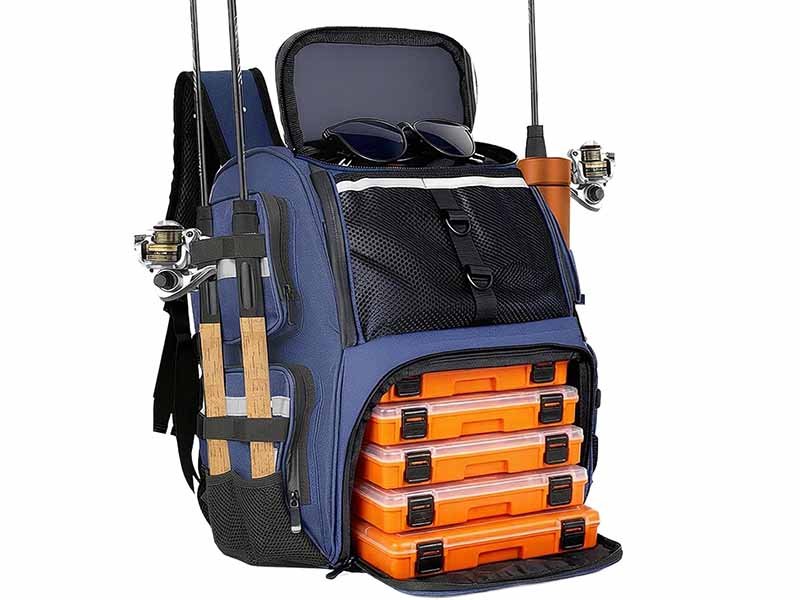
Tackle bag design is the process of turning fishing usage scenarios into a functional structure that balances storage, durability, comfort, and cost. A well-designed tackle bag is not defined by how many pockets it has, but by how efficiently those pockets work together during real fishing use.
How Are Tackle Bag Compartments Planned?
Compartment planning is the foundation of tackle bag design. Most problems in tackle bags—messy storage, wasted space, or poor accessibility—come from poor internal layout rather than poor materials.
A practical design usually starts from standard tackle tray sizes. For example:
| Tray Type | Common Size (cm) | Design Impact |
|---|---|---|
| 3600 series | 27 × 18 × 4 | Medium bags (2–4 trays) |
| 3700 series | 36 × 23 × 5 | Large bags (3–6 trays) |
| Compact trays | 20 × 13 × 4 | Small / travel bags |
The internal compartment must match these sizes with minimal tolerance (usually ±0.5–1 cm). If the fit is too tight, trays get stuck. If too loose, trays move and damage structure.
Beyond tray storage, compartments are usually divided into:
- Main compartment → holds tackle boxes
- Front pocket → quick-access tools and lures
- Side pockets → line spools, bottles, pliers
- Top compartment → soft storage or additional trays
A common mistake is over-designing compartments. Too many small pockets reduce usable space and increase sewing complexity. In actual fishing, users prefer fewer but well-sized compartments.
At Szoneier, we often simplify customer designs by:
- Reducing unnecessary pocket layers
- Increasing main storage efficiency
- Improving opening angle for faster access
Because in real use, speed matters more than structure complexity.
What Makes a Tackle Bag Easy to Carry?
Comfort is one of the most underestimated factors in tackle bag development. A bag may look strong and functional, but if it feels uncomfortable after 20–30 minutes of carrying, it will quickly get negative feedback.
Key ergonomic factors include:
- Shoulder strap width: 3.8–5 cm recommended
- Padding thickness: 5–10 mm EVA foam
- Weight distribution: center of gravity alignment
- Handle design: wrapped handle reduces pressure points
Here’s a simple comparison:
| Feature | Basic Design | Improved Design |
|---|---|---|
| Shoulder strap | Narrow webbing | Wide padded strap |
| Carry handle | Single-layer strap | Foam-wrapped handle |
| Bag balance | Front-heavy | Center-balanced |
| Back panel | Soft fabric | Padded support |
A poorly balanced bag causes shoulder fatigue quickly, especially when fully loaded (often 5–10 kg).
For backpack-style tackle bags, airflow also becomes important. Some higher-end designs include:
- Mesh padding
- Air channels
- Breathable back panels
These details may increase cost by 5–10%, but they significantly improve user experience.
How Are Custom Tackle Bags Developed?
Custom development is where most brands either succeed or fail.
A typical development process looks like this:
- Concept (sketch, reference product, or idea)
- Material selection (fabric, lining, foam, hardware)
- Sample development (5–7 days)
- Sample revision (1–2 rounds)
- Final confirmation → bulk production
At Szoneier, we usually recommend starting with:
- Target price range
- Target user (bank fishing, boat fishing, travel)
- Required tray size compatibility
- Branding method (print, embroidery, rubber patch)
Because these decisions affect almost everything:
- Structure complexity
- Material cost
- Production time
- MOQ feasibility
Here’s a typical development timeline:
| Stage | Time |
|---|---|
| Design confirmation | 1–3 days |
| Material sourcing | 2–5 days |
| Sample making | 5–7 days |
| Sample revision | 3–5 days |
| Bulk production | 25–30 days |
Many delays happen because details are unclear at the beginning. For example:
- Logo size not defined
- Tray size mismatch
- Material expectations not aligned
A good manufacturer helps reduce these risks early. That’s why working with an experienced factory is not just about production—it’s about getting the product right before production starts.
How Are Tackle Bags Manufactured?
Tackle bag manufacturing is a multi-step process that includes material preparation, cutting, sewing, assembly, and quality inspection. Each step directly affects the bag’s durability, appearance, and long-term performance.
How Is Tackle Bag Fabric Cut?
The first step is material cutting. This stage determines shape accuracy and material efficiency.
Most factories use two methods:
- Manual cutting → flexible, suitable for small MOQ
- CNC cutting → precise, suitable for large orders
Cutting includes:
- Outer fabric panels
- Lining panels
- Foam padding
- Reinforcement materials
Accuracy matters here. A deviation of just 2–3 mm can cause:
- Misaligned panels
- Wrinkled surfaces
- Poor zipper installation
Typical cutting tolerance:
- ±1 mm (high-quality production)
- ±2–3 mm (lower-grade production)
At Szoneier, we often use layered cutting (multiple fabric layers stacked) to improve efficiency while maintaining consistency.
How Are Tackle Bags Sewn?
Sewing is the most labor-intensive and skill-dependent step.
A tackle bag usually goes through multiple sewing stages:
- Pocket assembly
- Zipper installation
- Panel joining
- Structure reinforcement
- Final body assembly
Key stitching techniques include:
- Single stitch → basic seams
- Double stitch → stronger seams
- Bartack → reinforcement at stress points
- Binding → clean edge finishing
Critical stress points:
- Shoulder strap joints
- Handle connections
- Zipper ends
- Bottom corners
Here’s a durability comparison:
| Stitch Type | Strength | Use Case |
|---|---|---|
| Single stitch | Low | Decorative or low-load areas |
| Double stitch | Medium | General seams |
| Bartack | Very high | Load-bearing points |
A well-made tackle bag may have 20–40 bartack reinforcements depending on design.
How Are Zippers and Straps Added to Tackle Bags?
Zippers and straps are installed during mid-to-late assembly stages.
Zipper selection is critical:
- #5 zipper → light-duty bags
- #8 zipper → medium-duty
- #10 zipper → heavy-duty tackle bags
Common zipper issues:
- Misalignment → jamming
- Weak teeth → breaking
- Poor stitching → detachment
Straps are usually made from:
- Polypropylene webbing
- Nylon webbing (stronger, more expensive)
Load-bearing capacity:
- Standard webbing: 150–200 kg
- Reinforced webbing: 250–300 kg
Installation includes:
- Reinforced stitching
- Hidden reinforcement layers
- Edge sealing to prevent fraying
A common mistake is using strong fabric but weak straps, which leads to failure under load.
How Are Tackle Bags Tested?
Quality testing ensures the product meets real usage conditions.
Basic tests include:
| Test Type | Standard |
|---|---|
| Load test | 5–10 kg for 24 hours |
| Zipper test | 5,000–10,000 cycles |
| Abrasion test | 500–1000 rub cycles |
| Water resistance | Light spray / coating test |
For higher-end products:
- Drop tests (loaded bag dropped from 1m height)
- Saltwater exposure tests
- UV resistance tests
At Szoneier, quality control includes:
- Inline inspection during sewing
- Final inspection before packing
- Random sampling for bulk orders
Defect rate control:
- Target: <2% for standard production
- Premium projects: <1%
This level of control is important for:
- Amazon sellers (low return rate)
- Brand clients (consistent quality)
Which Tackle Bags Are Most Popular?
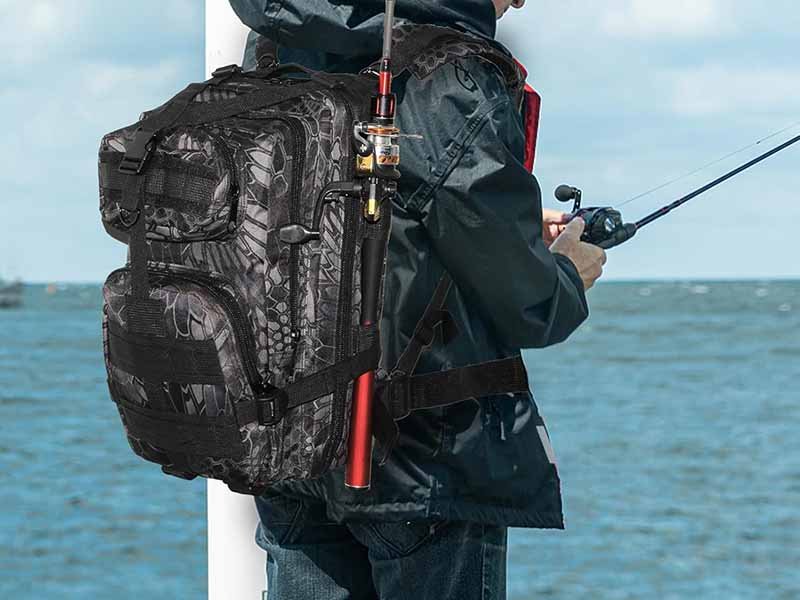
The most popular tackle bags today are those that balance storage capacity, portability, durability, and price. Market demand is no longer driven only by size or appearance, but by how well a bag performs in real fishing scenarios such as shore fishing, kayak fishing, boat fishing, and travel.
Which Tackle Bag Styles Sell Best?
Different markets prefer different tackle bag styles, but a few categories consistently perform well across regions.
| Style | Key Features | Target Users | Price Range |
|---|---|---|---|
| Shoulder tackle bag | Compact, easy access | Casual anglers | Low–mid |
| Backpack tackle bag | Large capacity, hands-free | Active anglers | Mid–high |
| Sling tackle bag | Lightweight, quick rotation | Mobile fishing | Mid |
| Waist tackle bag | Minimal gear carry | Short trips | Low |
| Hard-bottom tackle bag | Structure + protection | Boat fishing | Mid–high |
Backpack-style tackle bags have grown rapidly in demand, especially in North America and Europe. They allow anglers to carry more gear while keeping both hands free, which is critical for hiking or uneven terrain.
Shoulder bags still dominate entry-level markets because they are easier to produce and lower in cost. However, many of these products face strong competition, so differentiation through structure or materials becomes important.
Are Soft Tackle Bags Better Than Hard Boxes?
Soft tackle bags and hard tackle boxes serve different purposes, but in recent years, soft bags have become more popular due to flexibility and portability.
Here is a direct comparison:
| Feature | Soft Tackle Bags | Hard Tackle Boxes |
|---|---|---|
| Weight | Light | Heavy |
| Portability | High | Low |
| Storage flexibility | High | Fixed |
| Protection | Moderate | High |
| Comfort | High | Low |
Soft bags are better for:
- Moving between fishing spots
- Carrying multiple types of gear
- Travel and outdoor use
Hard boxes are still useful for:
- Maximum protection
- Static fishing environments
Many modern products combine both concepts:
- Soft outer bag + hard internal trays
- Reinforced base for structure
This hybrid approach is currently one of the strongest product directions in the market.
Which Tackle Bags Fit Different Fishing Needs?
Not all tackle bags should be designed the same way. Usage scenarios directly affect structure, materials, and size.
| Fishing Type | Recommended Bag Type | Key Requirements |
|---|---|---|
| Shore fishing | Backpack / sling | Mobility + balanced weight |
| Boat fishing | Large tackle bag | Capacity + structure |
| Kayak fishing | Compact waterproof bag | Water resistance + stability |
| Travel fishing | Foldable / lightweight | Portability + compact size |
| Saltwater fishing | Waterproof / corrosion-resistant | Material durability |
For example:
- Saltwater environments require stronger zippers and anti-corrosion materials
- Kayak fishing requires better waterproofing and compact size
- Shore fishing requires ergonomic design for long-distance carrying
Many products fail because they try to fit all scenarios into one design. In reality, the most successful products are those that clearly target one main use case.
How to Choose a Tackle Bag Manufacturer?
Choosing the right manufacturer is one of the most important decisions in tackle bag development. The difference between a reliable factory and an inexperienced one can directly affect product quality, delivery time, and long-term business success.
What Should You Check in Tackle Bag Manufacturing?
When evaluating a manufacturer, focus on real production capability rather than just price.
Key factors include:
- Material sourcing ability (nylon, polyester, neoprene options)
- Sewing experience with functional bags
- Understanding of fishing product structure
- Quality control system
- Customization capability (OEM/ODM)
A factory that only produces simple bags may struggle with:
- Reinforced structure
- Multi-compartment layouts
- Heavy-duty stitching
At Szoneier, we integrate:
- Material R&D
- Product development
- Manufacturing
This reduces communication gaps and improves product consistency.
How Do MOQ and Lead Time Affect Tackle Bags?
MOQ and lead time directly impact your product launch and inventory strategy.
Typical production benchmarks:
| Item | Standard Range |
|---|---|
| MOQ | 100–300 pcs |
| Sample time | 5–7 days |
| Production time | 25–30 days |
Lower MOQ allows:
- Faster market testing
- Lower inventory risk
Shorter lead time allows:
- Faster product updates
- Better response to market trends
However, extremely low MOQ often increases cost per unit. The key is to find a balance between flexibility and cost efficiency.
Szoneier supports:
- Low MOQ customization
- Fast sampling
- Stable bulk production
This is especially helpful for:
- Amazon sellers
- Startup brands
- Private label projects
Why Choose OEM Tackle Bag Manufacturers Like Szoneier?
An experienced OEM manufacturer does more than just produce your design. It helps improve your product before it reaches the market.
Szoneier advantages include:
- 18+ years manufacturing experience
- Strong neoprene product expertise
- Wide material options (nylon, polyester, neoprene, EVA)
- Free design support
- Fast sample development
- Strict quality control (<2% defect rate)
More importantly, we help customers avoid common mistakes such as:
- Overcomplicated designs
- Weak structure planning
- Incorrect material selection
- Poor cost-performance balance
This reduces development risk and improves product success rate.
Are Tackle Bags Changing?
Yes, tackle bags are evolving rapidly. The market is moving toward better materials, smarter design, and more specialized use cases.
Are Waterproof Tackle Bags Trending?
Waterproof performance is becoming a standard expectation rather than a premium feature.
Current solutions include:
- PU coating
- TPU lamination
- Waterproof zippers
- Seam sealing (high-end products)
Fully waterproof bags are especially popular in:
- Kayak fishing
- Saltwater environments
- Outdoor adventure markets
Are Eco Tackle Bags in Demand?
Sustainability is becoming more important, especially in Europe and North America.
Common eco-materials:
- Recycled polyester (RPET)
- Eco-friendly coatings
- Reduced packaging
However, eco materials must still meet durability requirements. A weak eco product will not survive real use.
How Are Smart Tackle Bags Evolving?
Some new trends include:
- Modular storage systems
- Integrated LED lighting
- USB charging ports
- Customizable compartments
While not all of these features are necessary, they show how the category is moving toward more specialized and user-focused designs.
Start Your Custom Tackle Bag Project with Szoneier
If you are planning to develop a tackle bag product, the most important step is choosing the right manufacturing partner.
At Szoneier, we help turn your idea into a real product with:
- Free design support based on your concept
- Material recommendations based on your target market
- Fast sampling in 5–7 days
- Low MOQ for flexible testing
- Stable production with consistent quality
Whether you are building a new fishing brand or expanding your product line, we can support you from concept to final delivery.
Tell us your idea, target price, and product requirements — we will help you create a tackle bag that is competitive, reliable, and ready for the market.
Contact Szoneier today to start your custom tackle bag project.