Skip to content
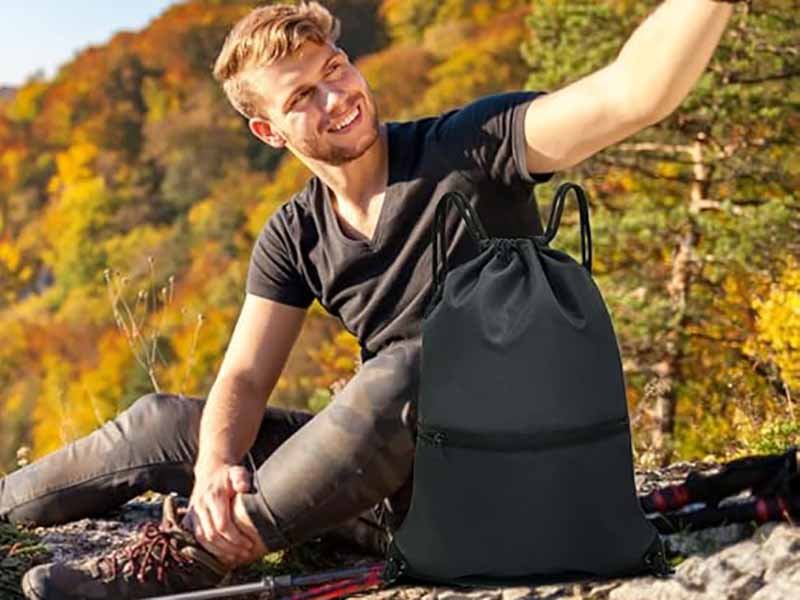
A polyester drawstring bag looks simple, but good manufacturing is never simple. What seems like just two fabric panels and a pair of cords is actually a product that depends on fabric weight, yarn density, cutting accuracy, sewing consistency, print quality, reinforcement structure, and packing efficiency. When these details are controlled well, the result is a lightweight, low-cost bag that is easy to brand, easy to ship, and easy to scale. When they are ignored, the same product can quickly turn into a source of complaints: cords breaking, corners tearing, print cracking, fabric wrinkling, and shipment delays.
Polyester drawstring bag manufacturing is the process of turning polyester fabric into finished custom bags through material selection, pattern cutting, logo printing, sewing, reinforcement, quality inspection, and bulk packing. It is widely used because the process is efficient, scalable, cost-effective, and flexible enough for promotional, retail, sports, school, and event markets.
For importers, brand owners, and sourcing teams, the real value is not just finding a cheap bag. It is finding a production system that can keep quality stable from sample to reorder. A drawstring bag may sell for only a few dollars, but if 10,000 pieces arrive with weak stitching or poor logo placement, the real loss is much bigger than the order value. That is why understanding how these bags are made is not a factory issue alone. It is a brand protection issue, a margin issue, and often the difference between a smooth launch and an expensive problem.
What Is a Polyester Drawstring Bag?
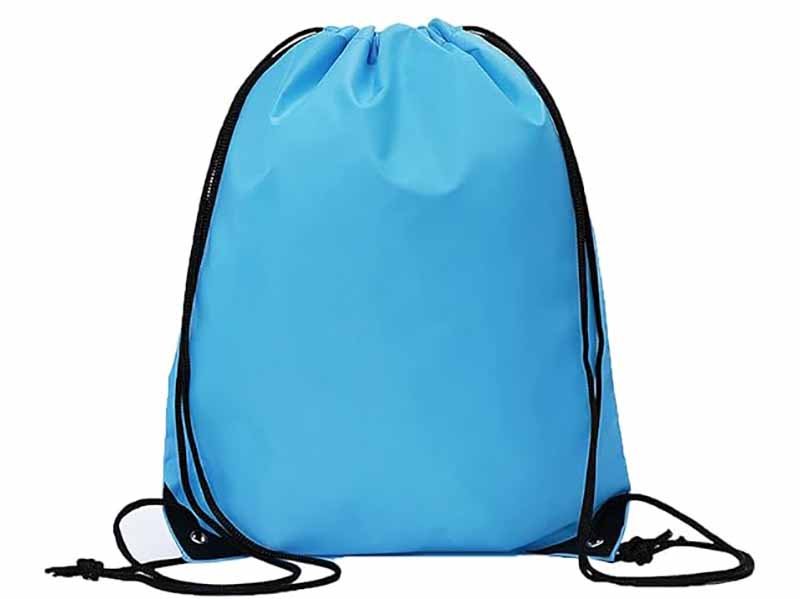
A polyester drawstring bag is a soft, lightweight bag made from polyester fabric, designed with a simple pull-cord closure that also functions as shoulder straps. It is widely used because it offers a practical balance between cost, durability, ease of customization, and fast production.
From a sourcing perspective, this type of bag is one of the easiest products to develop, test, and scale. It does not require complex structure or multiple components, which means fewer production risks, shorter lead times, and more stable quality across bulk orders.
For most customers, the value of a polyester drawstring bag is not just in the product itself, but in what it can do for their business:
- It can serve as a low-cost promotional tool
- It can function as a retail-ready branded product
- It can be used as packaging for other items
- It can increase brand exposure through daily use
Compared to other bags, it is one of the few products that works across multiple scenarios without needing major design changes.
What Defines a Polyester Drawstring Bag?
A polyester drawstring bag is defined by three practical factors: material performance, structural simplicity, and production efficiency.
1. Material Performance (Polyester Fabric)
Polyester is chosen because it is stable, consistent, and cost-effective in large-scale production. It resists stretching, handles moisture better than cotton, and maintains shape under repeated use.
Typical fabric specifications used in production:
| Fabric Type | Weight Range | Common Use |
|---|---|---|
| 190T Polyester | 60–80 gsm | Promotions, giveaways |
| 210D Polyester | 80–120 gsm | Daily use, events |
| 420D–600D Polyester | 150–300 gsm | Sports, heavy-duty use |
For most projects, 210D polyester is the most widely used because it offers a good balance between cost and durability.
2. Structural Simplicity (Low Complexity Design)
The structure of a drawstring bag is intentionally simple:
- Two main fabric panels
- Top channel for cords
- Two drawstrings
- Reinforced bottom corners
- Basic stitching lines
This simplicity reduces production errors and allows factories to produce large quantities quickly.
From a production standpoint, fewer parts mean:
- Lower defect rate
- Faster production speed
- Easier quality control
- More stable repeat orders
3. Production Efficiency (Scalable Manufacturing)
Drawstring bags are designed for volume production. A standard production line can produce 800–1500 pieces per day, depending on complexity.
This makes the product ideal for:
- Large promotional campaigns
- School or event distribution
- Retail restocking
- Brand expansion projects
Customers benefit from shorter lead times and more predictable delivery schedules.
Why Is Polyester Drawstring Bag Popular?
The popularity of polyester drawstring bags comes from real business advantages, not just design preference.
1. Cost Efficiency
Compared with structured bags:
| Bag Type | Average Cost Range (Bulk) |
|---|---|
| Drawstring bag | Low |
| Backpack | Medium–High |
| Tote bag (canvas) | Medium |
A polyester drawstring bag typically uses 30–50% less material and labor cost than a backpack.
2. Easy Customization
Polyester works well with multiple printing methods:
- Screen printing (most cost-effective)
- Heat transfer (multi-color logos)
- Sublimation (full design coverage)
This flexibility allows customers to match different branding needs without changing the product structure.
3. High Usability
Unlike many promotional items that are used once, drawstring bags are often reused.
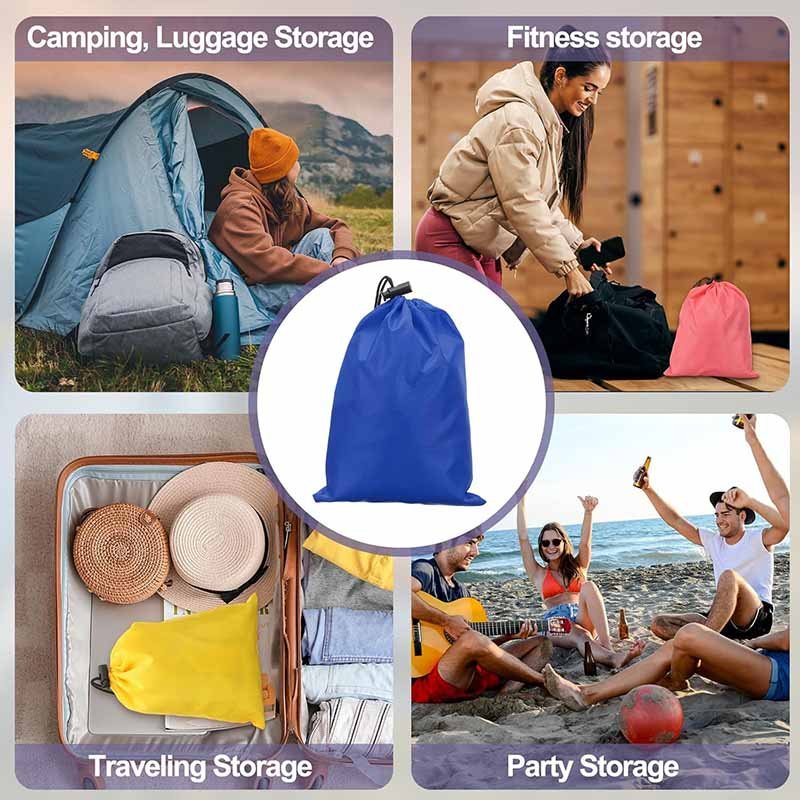
Common real-world uses:
- Gym and sports gear storage
- School daily carry
- Event giveaways
- Travel light storage
This repeated use increases brand exposure over time.
4. Shipping and Storage Advantage
Drawstring bags are easy to fold and pack.
| Factor | Advantage |
|---|---|
| Carton capacity | 300–500 pcs/carton |
| Weight | Lightweight |
| Storage | Space-saving |
This reduces logistics cost, especially for international shipments.
Are Polyester Drawstring Bags Widely Used?
Yes, and they are used across many industries because they solve a very practical problem: how to provide a useful, low-cost, branded item that people actually keep and use.
Key industries using drawstring bags:
| Industry | Application |
|---|---|
| Sports & fitness | Gym bags, shoe storage |
| Education | School activity bags |
| Events & marketing | Promotional giveaways |
| Retail | Merchandise or packaging |
| Travel & outdoor | Lightweight carry bags |
The reason they are widely used is simple: they are easy to produce, easy to customize, and easy to distribute.
From a customer perspective, one important point is often overlooked:
A drawstring bag is not just a cheap product.
It is a high-volume branding tool.
If a bag is used 2–3 times per week over several months, it can generate hundreds of brand impressions per unit. This makes it one of the most cost-effective items in terms of exposure per dollar.
For this reason, experienced buyers do not only look at price. They look at:
- Whether the material matches the target market
- Whether the printing quality reflects the brand image
- Whether the bag will actually be used repeatedly
A slightly better-designed bag often delivers much higher long-term value than the cheapest option available.
If you are planning to develop a polyester drawstring bag, the key is not just choosing a product—it is choosing the right combination of material, structure, and manufacturing approach that fits your business goal.
Which Materials Are Used in Polyester Drawstring Bag?
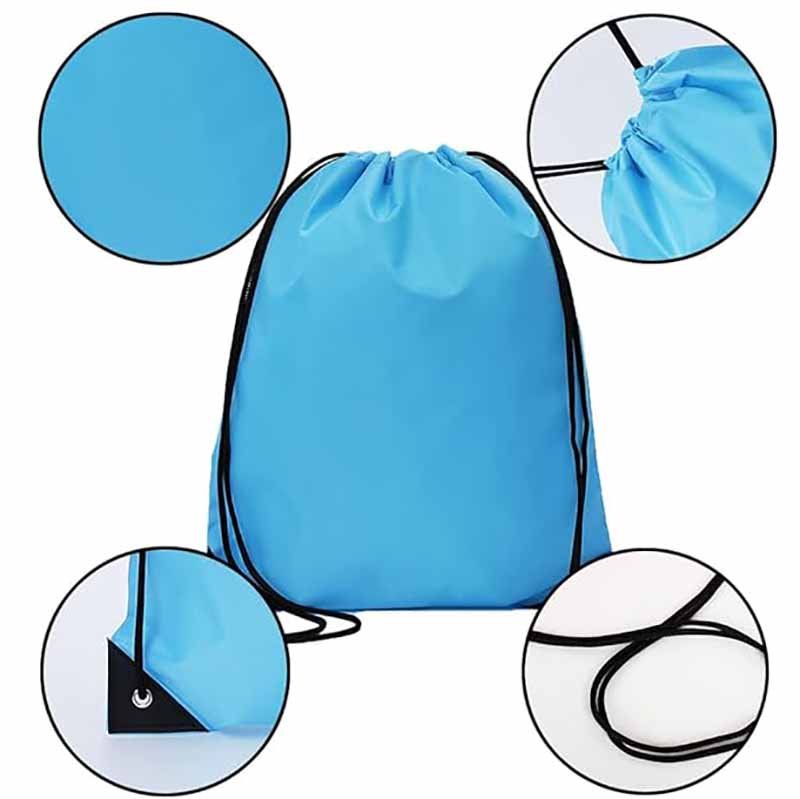
A polyester drawstring bag is not made from just “polyester.” In real production, the final quality depends on a combination of fabric type, thickness, coating, cords, reinforcement materials, and accessories. Each of these choices affects durability, appearance, cost, and how the bag performs in daily use.
For customers, material selection is one of the most important decisions in the whole project. Choosing the wrong material can lead to problems like tearing corners, poor logo printing, uncomfortable straps, or high return rates.
A well-balanced material setup ensures that the bag matches its intended use—whether it is for low-cost promotion, retail sale, sports use, or long-term brand exposure.
Which Polyester Fabric Is Used for Drawstring Bag?
Polyester fabrics used in drawstring bags vary mainly in thickness (denier), weight (gsm), and weaving density. These factors determine how strong, smooth, and durable the bag will be.
Below is a practical comparison used in real production:
| Fabric Type | Thickness (Approx) | Feel | Durability | Typical Use | Cost Level |
|---|---|---|---|---|---|
| 190T Polyester | 60–80 gsm | Thin, smooth | Low | Giveaways, short-term use | Low |
| 210D Polyester | 80–120 gsm | Balanced | Medium | Daily use, events | Medium-Low |
| 420D Polyester | 120–180 gsm | Firm | Medium-High | Sports, retail | Medium |
| 600D Polyester | 200–300 gsm | Thick, structured | High | Heavy-duty, premium | Medium-High |
- 190T polyester is often chosen for very low-cost orders. It works for one-time events but may feel too thin for resale or long-term use.
- 210D polyester is the most common choice because it balances cost and durability. Many school and promotional bags use this specification.
- 420D and 600D polyester are stronger and hold shape better, but they increase cost and shipping weight.
From a sourcing perspective, using a heavier fabric than necessary increases cost without adding real value. On the other hand, choosing fabric that is too thin often leads to complaints and reorders.
What Coatings and Finishes Are Used in Polyester Fabric?
Polyester fabric is often treated with coatings or finishes that improve performance.
Common options include:
| Coating Type | Function | Impact on Use |
|---|---|---|
| PU Coating | Water resistance | Keeps items dry in light rain |
| PVC Coating | Stronger waterproofing | Heavier, less flexible |
| WR (Water Repellent) | Surface protection | Light protection only |
| No Coating | Natural feel | Lowest cost |
- PU coating is widely used because it adds basic water resistance without making the fabric too stiff.
- PVC coating provides stronger protection but increases weight and cost.
- Some coatings can affect printing results. For example, certain coatings may reduce ink adhesion if not properly treated.
Customers should always match coating choice with actual usage. For example, a gym bag may not need heavy waterproofing, while an outdoor promotional bag might.
What Parts Make a Polyester Drawstring Bag?
A polyester drawstring bag includes several components, and each one plays a role in performance.
Main components:
- Body fabric (front and back panels)
- Drawstrings (cords)
- Eyelets or grommets
- Corner reinforcement patches
- Stitching (thread and seams)
- Optional labels, pockets, or linings
Each part has its own material choices.
Drawstrings (Cords)
| Type | Feature | Use Case |
|---|---|---|
| Polyester cord | Durable, cost-effective | Standard bags |
| Nylon cord | Stronger, smoother | Sports use |
| Cotton cord | Softer feel | Premium or eco-style |
Cord thickness usually ranges from 4mm to 8mm. Thicker cords improve comfort when worn on the shoulders.
Eyelets / Grommets
| Material | Advantage | Risk |
|---|---|---|
| Metal | Strong, durable | Can rust if low quality |
| Plastic | Lightweight, no rust | Less durable |
For high-volume promotional bags, plastic eyelets are often used to reduce cost. For sports or heavier use, metal eyelets are more reliable.
Reinforcement Materials
| Type | Benefit |
|---|---|
| Extra fabric layer | Basic strength |
| PU patch | High tear resistance |
| Box stitching | Strongest structure |
Corner reinforcement is critical because it is the main stress point when carrying weight.
How Does Material Affect Polyester Drawstring Bag Quality?
Material choices directly impact how the bag performs in real use.
1. Durability
- Thicker fabric + reinforced corners = longer lifespan
- Weak material = higher risk of tearing
For example, increasing fabric weight from 190T to 210D can improve durability by 20–30% in daily use.
2. Printing Quality
- Smooth fabric → sharper logo edges
- Rough or loose weave → blurred or uneven print
For branding-focused projects, fabric surface quality is just as important as printing method.
3. User Experience
Customers notice these details immediately:
- Fabric feel (soft vs stiff)
- Strap comfort (thin vs thick cord)
- Bag shape (collapses vs holds form)
A better material setup increases the chance that the bag will be reused.
4. Weight and Shipping Cost
| Fabric Type | Approx Weight per Bag | Shipping Impact |
|---|---|---|
| 190T | 30–50g | Lowest cost |
| 210D | 50–80g | Balanced |
| 600D | 100–150g | Higher cost |
Heavier bags increase shipping cost, especially in large orders.
5. Defect Rate and Return Risk
Low-quality materials often lead to:
- Broken cords
- Torn corners
- Print peeling
- Fabric defects
Even a 2–5% defect rate can create significant problems in bulk orders.
How to Choose the Right Material Combination?
The best material choice depends on your product goal.
| Goal | Recommended Setup |
|---|---|
| Low-cost promotion | 190T + basic cord + simple print |
| Standard daily use | 210D + reinforced corners + screen print |
| Sports / active use | 420D + thick cord + strong stitching |
| Premium branding | 600D + custom cord + detailed print |
The key is not choosing the most expensive material, but choosing the right balance.
A small increase in material cost (for example, +$0.10–$0.20 per bag) can significantly improve durability and brand perception. At the same time, unnecessary upgrades can reduce profit margins without clear benefits.
For most customers, the safest approach is:
- Define the end use clearly
- Match material to that use
- Avoid over-specifying or under-specifying
Working with an experienced factory like Szoneier helps simplify this process. Instead of guessing, you can get recommendations based on real production data, reducing risk and improving consistency across orders.
How Is Polyester Drawstring Bag Manufactured?
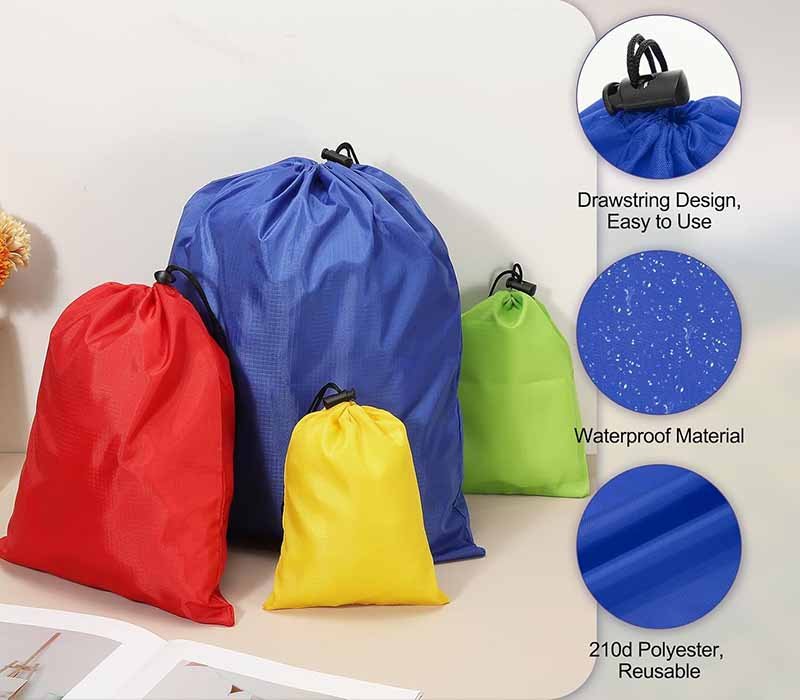
Polyester drawstring bags are produced through a standardized process that includes fabric preparation, cutting, printing, sewing, assembly, inspection, and packing. A well-managed production line ensures consistent quality, controlled costs, and reliable delivery timelines.
What Is the Polyester Drawstring Bag Process?
The manufacturing process follows a clear sequence, but execution quality depends heavily on factory experience, equipment, and workflow control.
A typical production flow looks like this:
| Step | Process | Key Control Point |
|---|---|---|
| 1 | Fabric sourcing | Correct thickness, color consistency |
| 2 | Fabric inspection | Check defects, color deviation |
| 3 | Cutting | Accurate size and shape |
| 4 | Printing | Logo alignment, color accuracy |
| 5 | Sewing | Stitch density, seam strength |
| 6 | Cord installation | Smooth threading, secure fixing |
| 7 | Reinforcement | Corner strength, load resistance |
| 8 | Final inspection | Function, appearance, packaging |
| 9 | Packing | Quantity accuracy, carton standard |
From a customer perspective, three steps are the most critical: printing, sewing, and reinforcement.
Printing determines how your brand is presented. Poor alignment or color mismatch immediately reduces perceived value. Sewing determines whether the bag survives repeated use. Reinforcement determines whether the bag fails under load.
Factories like Szoneier typically run multi-stage inspections, not just a final check. This reduces defect rates significantly compared to factories that only inspect finished goods.
How Is Polyester Drawstring Bag Printed and Sewn?
Printing and sewing are where most quality differences appear between factories.
Printing methods vary depending on design complexity and order quantity:
| Printing Method | Best For | Advantage | Limitation |
|---|---|---|---|
| Screen Printing | Simple logos, large volume | Low cost, strong color | Limited color detail |
| Heat Transfer | Multi-color logos | Good detail, flexible | Slightly higher cost |
| Sublimation | Full coverage designs | High detail, no fading | Requires specific fabric |
Screen printing is still the most widely used option for bulk orders because of its cost efficiency. However, customers often underestimate how important ink quality and curing temperature are. Poor curing leads to cracking or fading after washing or friction.
Heat transfer works well for medium quantities and more complex designs. It provides sharper edges but requires careful temperature control to avoid fabric damage.
Sublimation is often used for all-over designs, especially in sports or fashion projects. It bonds color directly into the fabric, which means no cracking or peeling, but it only works on certain polyester types.
Sewing quality is equally important. Key factors include:
- Stitch density (too low = weak seams)
- Thread quality (cheap thread breaks easily)
- Seam alignment (affects appearance and strength)
- Reinforcement stitching (critical for load-bearing areas)
For example, increasing stitch density from 6 stitches per inch to 9 stitches per inch can improve seam strength by over 20%, but it also slightly increases labor cost. Good factories know where to increase strength without over-engineering the entire bag.
How Is Polyester Drawstring Bag Quality Checked?
Quality control is not just one step at the end. It is a system that runs through the entire production process.
A reliable factory usually applies three levels of inspection:
1. Incoming Material Inspection
- Fabric thickness check
- Color consistency check (batch vs approved sample)
- Defect rate evaluation
2. In-Line Production Inspection
- Printing alignment and color
- Sewing accuracy
- Reinforcement correctness
3. Final Inspection (Before Packing)
- Size measurement
- Function test (cord pulling, load test)
- Appearance check (stains, wrinkles, defects)
Below is a simple quality checklist used in bulk production:
| Check Item | Standard |
|---|---|
| Size tolerance | ±0.5–1 cm |
| Logo position deviation | ≤3 mm |
| Stitch strength | No break under standard pull |
| Fabric defects | ≤2% acceptable rate |
| Cord function | Smooth, no blockage |
Factories with weak quality systems often rely only on final inspection, which increases the risk of large-scale defects. In contrast, factories like Szoneier control quality during production, reducing rework and delays.
What Affects Polyester Drawstring Bag Cost?
The cost of polyester drawstring bags is influenced by materials, size, printing method, quantity, and production complexity. Small design changes can significantly impact the final price.
What Drives Polyester Drawstring Bag Price?
Several key factors determine pricing:
| Cost Factor | Impact Level | Explanation |
|---|---|---|
| Fabric type | High | Thicker fabric increases cost |
| Bag size | Medium | Larger bags use more material |
| Printing method | High | Complex printing raises cost |
| Quantity | High | Higher quantity reduces unit price |
| Accessories | Medium | Eyelets, pockets add cost |
| Packaging | Low–Medium | Custom packaging increases cost |
For example:
- Upgrading from 190T to 210D fabric may increase cost by 10–20%
- Switching from screen printing to heat transfer may increase cost by 15–30%
- Adding a zipper pocket can increase cost by $0.20–$0.50 per unit
One common mistake is focusing only on unit price without considering defect rates. A cheaper bag with a 5% defect rate is often more expensive in the long run than a slightly higher-priced bag with stable quality.
What Is Polyester Drawstring Bag MOQ?
MOQ (Minimum Order Quantity) varies depending on factory capability, material availability, and customization level.
Typical MOQ ranges:
| Product Type | MOQ |
|---|---|
| Standard polyester drawstring bag | 200–500 pcs |
| Custom printed bag | 300–1000 pcs |
| Complex design (multi-color, pockets) | 500–2000 pcs |
Factories like Szoneier support low MOQ starting from around 200 pcs, which is suitable for:
- New brand testing
- Small promotional campaigns
- Sample market validation
However, customers should understand that lower MOQ usually means higher unit cost. The real advantage of low MOQ is flexibility, not price savings.
How Long to Produce Polyester Drawstring Bag?
Production time depends on order size, customization level, and factory schedule.
Typical timelines:
| Stage | Time |
|---|---|
| Sample development | 3–7 days |
| Sample revision | 2–5 days |
| Mass production (1,000–5,000 pcs) | 12–20 days |
| Large orders (10,000+ pcs) | 20–35 days |
Factors that can delay production:
- Frequent design changes
- Unconfirmed artwork
- Special materials not in stock
- Peak season (before holidays)
One important tip: customers who confirm materials and artwork early can reduce total lead time by up to 20–30%.
Factories with stable production systems, like Szoneier, often provide clear production schedules and milestone updates, which helps customers plan logistics and sales timelines more accurately.
How to Customize Polyester Drawstring Bag?
Customizing a polyester drawstring bag is not just about putting a logo on fabric. It is about aligning material, structure, printing, and usage scenario into one consistent product that matches your brand positioning, price target, and customer expectations.
A well-designed bag can increase perceived value, improve user retention, and even extend brand exposure beyond the initial purchase or event.
What Printing Fits Polyester Drawstring Bag?
Choosing the right printing method directly affects how your brand is seen and remembered.
Below is a practical comparison based on real production use:
| Printing Method | Best Use Case | Cost Level | Visual Result | Durability |
|---|---|---|---|---|
| Screen Printing | Simple logos, bulk orders | Low | Solid colors | High |
| Heat Transfer | Multi-color designs | Medium | Sharp details | Medium-High |
| Sublimation | Full coverage design | Medium-High | Photo-quality | Very High |
If your design is simple (1–2 colors), screen printing is the most cost-effective solution for large quantities. It delivers strong color and good durability when properly cured.
For more complex logos or gradient effects, heat transfer provides better detail. However, it requires stable temperature control during production to avoid peeling or edge lifting.
Sublimation is often chosen for sports brands or fashion-oriented products. It allows full-surface printing with no texture change. The color becomes part of the fabric itself, which means no cracking over time.
Key decisions customers should make before production:
- Number of logo colors
- Logo size and placement
- Expected usage (short-term vs long-term)
- Budget per unit
A mismatch between printing method and usage is one of the most common reasons for product dissatisfaction.
How to Design Polyester Drawstring Bag?
Good design is not about adding more features. It is about choosing the right features.
Customers often start with visual ideas, but manufacturing requires practical decisions:
1. Size Selection
| Size | Common Use |
|---|---|
| 30×40 cm | Kids, light items |
| 35×45 cm | Standard daily use |
| 40×50 cm | Sports, shoes, bulk storage |
Choosing the wrong size can affect both usability and cost. Larger bags increase material consumption and shipping volume.
2. Structure Options
- Single-layer (most cost-effective)
- Double-layer (better durability)
- With inner pocket (added functionality)
- With zipper pocket (higher value perception)
3. Reinforcement Choices
| Reinforcement Type | Benefit |
|---|---|
| Double fabric corners | Basic durability |
| PU reinforcement patch | Strong load resistance |
| Box stitching | Maximum strength |
For sports or school use, reinforcement is strongly recommended. Skipping this step to save cost often leads to higher defect rates.
4. Cord Selection
- Thickness (5mm–8mm common)
- Material (polyester, nylon, cotton blend)
- Style (round, flat, braided)
A thicker cord improves comfort and perceived quality, especially for wearable use.
Do OEM Polyester Drawstring Bag Orders Work?
Yes, and they are one of the most common production models in the industry.
OEM (Original Equipment Manufacturing), ODM (Original Design Manufacturing), and private label services allow customers to create unique products without building their own factory.
Here is how they typically work:
| Model | What You Provide | What Factory Does |
|---|---|---|
| OEM | Design, logo | Production, quality control |
| ODM | Idea or concept | Design + production |
| Private Label | Brand identity | Apply to existing product |
Szoneier supports all three models, depending on customer needs.
For new brands, ODM or private label is often faster and lower risk. For established brands, OEM allows full control over product details.
The key advantage is flexibility. Customers can scale from small test orders to large-volume production without changing suppliers.
Is Polyester Drawstring Bag Easy to Scale?
Polyester drawstring bags are one of the easiest bag categories to scale due to their simple structure, stable supply chain, and efficient production process.
Why Is Polyester Drawstring Bag Easy to Produce?
The production efficiency comes from three main factors:
- Simple construction (fewer components)
- Standardized materials (widely available polyester fabrics)
- Fast sewing process (low complexity)
Compared to backpacks or structured bags, drawstring bags require less labor time per unit. This allows factories to produce large quantities in shorter timeframes.
For example:
| Product Type | Avg Production Speed |
|---|---|
| Drawstring bag | 800–1500 pcs/day/line |
| Backpack | 200–500 pcs/day/line |
This difference directly impacts lead time and scalability.
How to Scale Polyester Drawstring Bag Orders?
Scaling production successfully requires planning, not just increasing order quantity.
Key strategies include:
- Locking fabric and color early
- Confirming artwork before production
- Using consistent specifications across orders
- Building long-term cooperation with one factory
Customers who frequently change materials or designs often face delays and inconsistency.
A stable product specification allows factories like Szoneier to optimize production lines, reduce errors, and shorten delivery time.
Are Polyester Drawstring Bags Good for Brands?
Yes, especially for brands focused on visibility, cost control, and repeat exposure.
Advantages for branding:
- Large printable area → strong logo exposure
- Low cost → suitable for mass distribution
- Daily usability → repeated brand impressions
- Lightweight → easy to ship globally
A well-designed drawstring bag can be used hundreds of times, turning a one-time cost into long-term brand visibility.
From a business perspective, this makes it one of the highest ROI promotional products available.
Start Your Custom Polyester Drawstring Bag Project with Szoneier
If you are planning to develop or source polyester drawstring bags, the most important step is choosing a factory that understands both production and your business goals.
Szoneier brings over 18 years of manufacturing experience.
Whether you are launching a new brand, preparing for a promotional campaign, or scaling an existing product line, working with the right manufacturing partner reduces risk and improves consistency.
Instead of guessing which material, structure, or printing method works best, you can get direct recommendations based on real production data and past project experience.
Send your design, idea, or target price today, and Szoneier will help you turn it into a reliable, scalable product.