 Skip to content
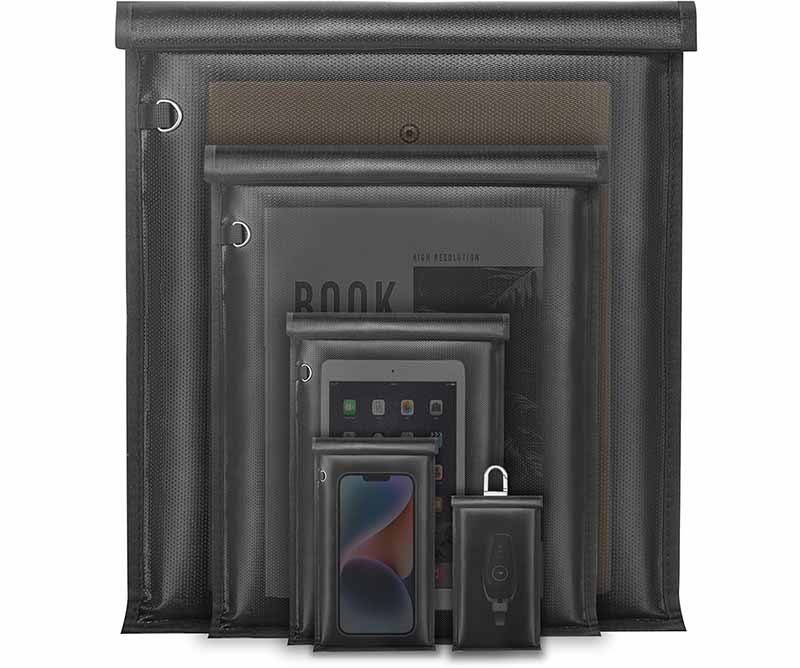
In an era dominated by wireless connectivity, data transmission has become both a convenience and a vulnerability. Every smartphone, car key, or IoT device constantly emits signals that can be intercepted, cloned, or hacked. This has made Faraday bags—also known as signal-blocking or RFID-shielding bags—an essential protective accessory not just for consumers, but also for law enforcement, military, and corporate security operations worldwide.
A Faraday bag is used to block electromagnetic signals such as cellular, Wi-Fi, Bluetooth, GPS, and RFID. It protects devices from hacking, tracking, or data theft and preserves digital evidence from remote tampering. Faraday bags are essential for law enforcement, defense, and industrial applications where secure data containment and electronic shielding are critical.
Faraday technology traces back to the 19th century when Michael Faraday discovered that a conductive enclosure could block external electromagnetic fields. Today, this principle has evolved into portable shielding solutions made from conductive fabrics and layered composites, protecting devices ranging from smartphones to entire drones. Let’s explore how these modern Faraday bags work, what they block, why professionals use them, and how long they last—before concluding with insights on how Szoneier helps OEM partners design industrial-grade custom Faraday bags.
What Is a Faraday Bag?
A Faraday bag is a flexible enclosure made from conductive materials that block electromagnetic fields and prevent any wireless signals—like Wi-Fi, cellular, GPS, or RFID—from entering or leaving. It works on the principle of the Faraday cage, discovered by scientist Michael Faraday in 1836. Industrial-grade Faraday bags are used by law enforcement, military, aerospace, and cybersecurity professionals to protect electronic devices from hacking, data leakage, or electromagnetic pulse (EMP) interference.
Definition and Working Principle
A Faraday bag is essentially a portable electromagnetic shield. It’s engineered to isolate any electronic device placed inside from all forms of external radio frequency (RF) radiation. The bag’s interior lining consists of interwoven conductive fibers—typically a blend of copper, nickel, or silver-plated threads—which form a continuous electrical barrier around the object.
When an external RF or electromagnetic field strikes the bag, electrons in the conductive material redistribute themselves in response, creating a counteracting field that cancels out the incoming radiation. This phenomenon, known as the Faraday effect, ensures that signals such as GSM, Wi-Fi, Bluetooth, and GPS cannot penetrate the bag’s surface.
This shielding effect works in both directions:
- Inbound protection: prevents external signals or hackers from reaching the device.
- Outbound protection: blocks the device from transmitting data or revealing location coordinates.
Industrial Faraday bags are tested using IEEE-STD-299 or ASTM-D4935 to confirm signal attenuation levels, which typically range from 70 dB to 100 dB across frequencies between 100 kHz and 20 GHz. This level of shielding ensures total signal isolation—enough for forensic evidence storage, military communications gear, or anti-espionage field kits.
Historical: From Faraday Cage to Portable Shielding
The concept originates from Michael Faraday’s 1836 experiment, where he demonstrated that a charged conductor distributes electricity only on its exterior surface, leaving the interior unaffected. His “Faraday cage” principle became foundational in electromagnetism, later applied to laboratories, aircraft cabins, and data centers.
Modern innovation has miniaturized this concept. Instead of metal chambers, engineers now use conductive textiles and multi-layer composites to deliver similar protection in lightweight, flexible formats—ideal for portable electronics and field applications. This evolution allowed the transition from rigid shielding rooms to handheld pouches, backpacks, or suitcase enclosures.
Common Materials and Layer Composition
Professional-grade Faraday bags often combine 3 – 5 layers of functional materials, each serving a specific role:
| Layer | Function | Typical Material |
|---|---|---|
| Outer Shell | Durability, abrasion resistance, water repellence | 600D ballistic nylon / TPU-coated polyester |
| Conductive Layer 1 | Primary shielding mesh | Silver-plated nylon or copper-nickel woven fabric |
| Conductive Layer 2 | Redundant attenuation barrier | Aluminum-PET laminate or metallized film |
| Dielectric Spacer | Prevents contact and maintains capacitance | Non-woven aramid or EVA foam |
| Inner Lining | Anti-static, protective padding | Carbon fiber cloth or felt |
Each conductive layer reflects and absorbs electromagnetic waves, while the non-conductive spacer prevents short circuits and mechanical wear. Premium OEM suppliers like Szoneier integrate hydrophobic coatings and anti-oxidation treatments to extend the functional lifespan beyond 5 years—critical for tactical and industrial deployments.
Design Features for Industrial and Law-Enforcement Use
Unlike consumer RFID sleeves, industrial Faraday bags are engineered for operational reliability under harsh conditions. Common design adaptations include:
- Double-roll or triple-seal closures to ensure continuous electrical contact around openings.
- Laser-cut seams and conductive stitching using silver-coated thread to minimize signal leakage.
- RF-tested zippers or magnetic flaps replacing conventional nylon zippers, which can create weak points.
- Layer-bonded composite welding that eliminates micro gaps and prevents delamination from humidity.
- Integrated desiccant or anti-static pockets for long-term forensic storage.
Such configurations achieve consistent field attenuation of 80–100 dB across broad frequency bands, maintaining full isolation even under mobile 5 GHz and satellite communication signals.
Functional Categories of Faraday Bags
- Forensic-Grade Pouches – Designed for law enforcement agencies to store mobile phones or tablets after seizure, ensuring no remote wipe commands can reach the device.
- Military/Defense Pouches – Built for radio sets, drones, or GPS trackers to prevent electronic detection or jamming interference.
- EMP-Protection Cases – Constructed with heavier multilayer metals and foam lining to guard electronics from electromagnetic pulses caused by solar flares or weaponized EMP events.
- Corporate Privacy Bags – Used in boardrooms or R&D labs to protect prototypes and confidential devices from wireless data leakage or tracking.
- Consumer RFID Shields – Lightweight versions for car key fobs, passports, and bank cards, focusing on convenience over industrial durability.
Each type follows the same physical principle but varies in attenuation rating, fabric density, and closure system depending on operational priority—mobility, evidence integrity, or EMP survivability.
Are Faraday Bags Legal?
Faraday bags are completely legal in nearly every jurisdiction worldwide. They are considered passive protective devices, not signal jammers or encryption tools. In fact, they are standard equipment in police departments, customs offices, data-security firms, and defense ministries. However, some countries regulate their export under dual-use technology classifications when integrated with EMP-resistant components, meaning manufacturers must provide documentation such as CE, FCC, or ITAR-compliance reports for export licensing.
Use legality summary:
| Region | Legality | Regulatory Notes |
|---|---|---|
| United States | Legal | Used by DHS, FBI, military |
| European Union | Legal | CE/EMC compliance required for large enclosures |
| Middle East / Asia | Legal | Some import licensing for defense-grade variants |
| Criminal misuse | Illegal | Only if used to conceal evidence or block lawful tracking |
In other words, it’s not the technology that’s illegal—it’s how it’s used. For OEM buyers, this ensures that industrial Faraday bags can be safely produced, branded, and exported when properly documented.
Industrial Testing and Certification Standards
To qualify for law-enforcement or defense use, each Faraday bag must meet specific shielding and quality criteria. Typical standards include:
- IEEE-STD-299 / ASTM-D4935: RF attenuation measurement (0.1–18 GHz).
- MIL-STD-285: Electromagnetic interference (EMI) test for military use.
- ISO 17025 lab certification: Calibration traceability of test equipment.
- REACH / RoHS compliance: Ensures materials are free from toxic heavy metals or halogen compounds.
Many procurement agencies demand verified attenuation graphs demonstrating that performance remains consistent after 10,000 flex cycles or exposure to 95% humidity for 48 hours. Szoneier’s in-house QC protocols can replicate these tests and issue documentation with each production batch.
Which Signals or Devices Can It Block?
A Faraday bag can block nearly all wireless and electromagnetic signals—including cellular (2G–5G), Wi-Fi, Bluetooth, GPS, RFID, NFC, and satellite communications—by isolating devices from external fields. When properly sealed, it prevents both incoming and outgoing transmissions, ensuring total radio silence. Industrial and forensic models are tested to achieve 70–100 dB attenuation across 100 kHz – 20 GHz, effectively blocking smartphones, key fobs, laptops, drones, and other electronic devices from being tracked, hacked, or remotely accessed.
How Faraday Bags Block Signals
To understand what signals a Faraday bag can block, it’s crucial to grasp the frequency behavior of electromagnetic waves and how shielding materials interact with them.
Each type of wireless technology—cellular, Wi-Fi, GPS, RFID, etc.—operates within a specific frequency band and power range. A Faraday bag neutralizes these waves by redistributing electrical charges along its conductive surface. This creates a reflective barrier that cancels both incoming and outgoing radiation.
In technical terms, its effectiveness is measured in decibels of attenuation (dB):
- 40 dB: typical for consumer RFID pouches.
- 60–80 dB: law-enforcement and forensic standard.
- 90–100 dB: military or aerospace grade shielding.
For industrial use, Szoneier’s OEM fabrics are tested for attenuation consistency across multi-band spectra using ASTM D4935 and IEEE STD 299 standards.
Signal Categories and Frequency Ranges
Below is a summary of the most common signal types that Faraday bags are designed to block, including their frequency ranges and field strengths:
| Signal Type | Frequency Range (Hz) | Typical Use | Effectiveness (dB) | Notes |
|---|---|---|---|---|
| Cellular (2G/3G/4G/5G) | 700 MHz – 3.8 GHz | Mobile phones, modems | 80–100 dB | Full isolation, blocks voice, SMS, and data |
| Wi-Fi (802.11 a/b/g/n/ac) | 2.4 GHz – 5.8 GHz | Wireless LANs | 80–95 dB | Eliminates local network access |
| Bluetooth / BLE | 2.4 GHz | Smart wearables, accessories | 80–90 dB | Disables short-range pairing and data sync |
| GPS (L1/L2 bands) | 1.227 – 1.575 GHz | Navigation, tracking | 85–100 dB | Prevents geolocation and timing signals |
| RFID (LF/HF/UHF) | 125 kHz – 915 MHz | ID badges, payment cards | 60–90 dB | Blocks contactless transactions |
| NFC | 13.56 MHz | Mobile payment, access control | 60–80 dB | Common in consumer RFID wallets |
| Satellite / Iridium / GNSS | 1.1 – 1.6 GHz | Field comms, telemetry | 85–95 dB | Neutralizes satellite uplink/downlink |
| Drone / RC / Telemetry | 2.4 – 5.8 GHz | UAV control systems | 85–95 dB | Prevents remote flight activation |
| Radio (VHF/UHF) | 30 – 470 MHz | Walkie-talkies, bodycams | 70–85 dB | Suppresses analog & digital RF chatter |
These numbers represent measured attenuation under lab conditions with double-sealed roll closures. In practical field tests, attenuation above 70 dB means complete signal loss for most consumer and commercial equipment.
Signal Types by Application Sector
| Industry | Primary Threat Signals | Faraday Protection Purpose |
|---|---|---|
| Law Enforcement | Cellular, Wi-Fi, GPS | Preserve seized evidence; prevent remote wipe or tracking |
| Defense & Military | RF, Satellite, GPS | Secure field communications; avoid enemy triangulation |
| Automotive | RFID, Bluetooth, Keyless entry | Stop relay theft and cloning of car key fobs |
| Corporate / Finance | Wi-Fi, NFC, Bluetooth | Prevent data leaks and eavesdropping in boardrooms |
| Aerospace & Aviation | GPS, Telemetry | Protect avionics and test electronics from EMI |
| Energy & Infrastructure | Radio, 5G | Shield control devices from EMP or cyber interference |
Faraday shielding thus acts as a universal firewall for electromagnetic energy, bridging the physical gap between cyber and hardware security.
Devices Commonly Protected
- Smartphones & Tablets Once sealed inside a Faraday bag, phones cannot send or receive calls, messages, or GPS data. This is vital for digital evidence handling, ensuring remote wipe commands from hackers or suspects fail completely.
- Laptops & Portable Drives Business laptops often contain confidential prototypes or encryption keys. Faraday sleeves block both Wi-Fi connectivity and Bluetooth pairing, preventing data theft during international travel.
- Vehicle Key Fobs A major security concern in Europe and North America is relay-attack car theft. A Faraday key pouch—lined with copper-nickel mesh—completely blocks 315 MHz and 433 MHz relay signals. Insurance agencies now recommend them for all keyless-entry vehicles.
- IoT Devices & Drones During R&D or testing, companies isolate IoT modules or drones to prevent remote interference. A shielded container ensures prototype confidentiality before product launch.
- Storage Media (USB / HDD / SSD) For forensic or defense transport, these drives are sealed in Faraday envelopes to preserve data integrity against electromagnetic interference or intentional signal corruption.
- Medical or Industrial Sensors Hospitals and labs use Faraday pouches to protect delicate instruments from external EMI—especially near MRI or high-voltage areas.
The Science of Attenuation and Reflection
Shielding effectiveness depends on four interdependent factors:
| Factor | Description | Impact on Performance |
|---|---|---|
| Conductivity of Fabric | High metal content = better charge redistribution | +10–20 dB improvement |
| Layer Count / Thickness | Each additional conductive layer adds ~10 dB | Greater isolation but higher weight |
| Closure Integrity | Gaps or non-conductive zippers reduce isolation | –20 dB or more loss |
| Ground Continuity | Complete 360° contact around seams | Prevents leakage from corners |
For example, a triple-layer silver-plated nylon composite (surface resistance < 0.05 Ω/sq) can achieve 95 dB attenuation at 2.4 GHz, while a single aluminum film layer may only reach 50 dB.
Industrial users must balance flexibility, weight, and shielding strength based on operational requirements. Law-enforcement bags prioritize maneuverability, while EMP-proof enclosures emphasize multilayer rigidity.
Limitations and Field Realities
Despite excellent performance, some limitations exist:
- Low-frequency magnetic fields (< 100 Hz), such as those from transformers or power lines, penetrate most flexible Faraday fabrics. Specialized mu-metal shielding is needed for those cases.
- Mechanical wear from frequent folding or contamination (e.g., oil, sweat) can degrade conductive surfaces, reducing attenuation by up to 15 dB over 3 years.
- Incomplete sealing—even a 2 mm gap—can leak high-frequency energy.
- Consumer-grade bags often exaggerate performance without lab-certified data.
For consistent results, industrial buyers should demand:
- Frequency-spectrum test reports (IEEE 299 curves).
- Seal integrity validation after mechanical aging cycles.
- Environmental durability tests (humidity, abrasion, salt spray).
Szoneier’s OEM production lines conduct batch-level attenuation testing using calibrated signal generators and network analyzers, providing partners with authentic shielding graphs and compliance data sheets.
Comparative Table: Consumer vs Industrial vs Military Faraday Bags
| Specification | Consumer Grade | Industrial / Forensic Grade | Military Grade (EMP-Shielded) |
|---|---|---|---|
| Shielding (Attenuation) | 40–60 dB | 70–90 dB | 90–110 dB |
| Material | Single aluminum film | Multi-layer silver/copper mesh | Reinforced copper-nickel laminate |
| Closure Type | Simple Velcro | Double-roll magnetic seal | EMI gasket or pressure latch |
| Durability | 6–12 months | 2–5 years | 5–10 years |
| Environmental Resistance | Limited | Water & abrasion resistant | EMP, thermal, chemical resistant |
| Typical Users | Consumers, travelers | Police, labs, OEMs | Defense, aerospace, intelligence |
| Certification | None | ASTM D4935, ISO 11452 | MIL-STD-285, DEF STAN 59-411 |
Why Do People Use a Faraday Bag?
People use Faraday bags to protect sensitive electronics from wireless attacks, electromagnetic interference, or unauthorized tracking. For professionals, they ensure data containment in police, defense, and corporate settings. For consumers, they prevent car theft and privacy invasion. In short, they act as physical cybersecurity barriers for portable devices.
Prevent Data Theft and Tracking
Every phone emits identifiers that can be intercepted by fake base stations or IMSI catchers. By blocking RF signals, Faraday bags eliminate the wireless attack surface, crucial during:
- Confidential corporate travel
- Defense missions
- Diplomatic communications
Protect Vehicles from Key-Fob Relay Attacks
Keyless car thefts increased by over 90% in major cities (source: UK Home Office 2023). Thieves amplify fob signals to unlock cars remotely. A Faraday key pouch prevents the signal from escaping, providing a simple yet effective security measure adopted by many automotive OEMs.
Preserve Digital Evidence for Law Enforcement
Digital forensics teams use Faraday bags to secure smartphones and storage devices from remote erasure. Evidence remains legally admissible since RF isolation ensures data immutability—a key requirement in global chain-of-custody standards like ISO/IEC 27037.
Personal and Corporate Privacy Protection
Journalists, executives, and cybersecurity specialists rely on Faraday sleeves to block microphones, cameras, and GPS tracking. For enterprises handling trade secrets, such shielding prevents data leaks via wireless backdoors.
How Do You Use a Faraday Bag Correctly?
To use a Faraday bag effectively, ensure the device is fully enclosed and the closure (Velcro, zipper, or roll seal) is tightly fastened. Avoid touching conductive layers directly, and regularly inspect for wear or contamination. Test functionality by checking that your device loses all signal reception once sealed.
Proper Sealing and Placement
Incorrect sealing is the most common failure. Always flatten the entry seam, remove trapped air, and keep cables or metal accessories from piercing the lining. Industrial units often include double-layer roll-top closures for consistent sealing.
How to Test If Your Bag Really Works
Simple test: place your smartphone inside, call it, and check signal loss. Professional validation: use spectrum analyzers or RF isolation chambers to measure attenuation (target >70 dB across 2.4 GHz and 5 GHz). Regular quarterly tests are recommended for operational facilities.
How Long Do Faraday Bags Last?
Most high-grade Faraday bags last 2–5 years under normal handling. Durability depends on:
- Frequency of opening/closing
- Exposure to moisture or oils
- Fabric bending radius and oxidation of conductive threads
Maintenance Tips for Longevity
Store bags flat and dry, clean using non-ionic wipes, and avoid detergents. If the bag is used for forensic evidence, dedicate each unit to one case ID to prevent cross-contamination.
Are There Limitations or Misconceptions?
While Faraday bags effectively block most wireless signals, they are not invincible. Improper sealing, fabric degradation, or extreme magnetic fields can reduce shielding. Users should understand limitations and realistic expectations—Faraday bags are physical isolation tools, not digital firewalls.
What Are the Disadvantages of Faraday Bags?
| Drawback | Impact | Mitigation |
|---|---|---|
| Higher cost for industrial grades | Increases procurement budgets | Bulk OEM orders lower unit cost |
| Wear-sensitive conductive layers | Reduced lifespan | Reinforced lamination, protective coatings |
| Limited aesthetic design | Functional appearance | OEM customization solves branding needs |
| Requires regular testing | Operational overhead | Integrate QC into maintenance routines |
Common Misunderstandings
- Myth: “A Faraday bag makes you untraceable forever.” Reality: It only blocks signals when sealed.
- Myth: “All pouches perform equally.” Reality: Attenuation varies from 40 dB (consumer) to 100 dB (mil-spec).
- Myth: “It blocks magnetic radiation.” Reality: It only affects electromagnetic—not static—fields.
What Applications Are Popular Today?
Faraday bags are used today across law enforcement, defense, aerospace, automotive, and corporate sectors to block wireless communication and protect electronics from electromagnetic interference or hacking. They secure mobile devices in forensic investigations, prevent key-fob car theft, shield prototypes in R&D labs, and guard mission-critical systems from EMP damage. The global Faraday bag market—driven by privacy regulations, cybersecurity awareness, and 5G expansion—is projected to surpass US $900 million by 2030, growing at over 7% CAGR.
The Expanding Role of Faraday Bags in Modern Industries
Once limited to police evidence handling, Faraday bags have evolved into multi-industry protection tools. The rapid growth of IoT, 5G, and cloud-connected systems has introduced new electromagnetic vulnerabilities. Every device that transmits or receives signals—from medical wearables to drones—now poses potential risks for data leakage, remote manipulation, or interference.
Global procurement data shows that Faraday bag adoption has increased by more than 60% in the past five years across industrial and government buyers. This growth is strongly tied to the convergence of three factors:
- Data Security Mandates – Governments enforce strict data isolation for digital evidence and classified electronics.
- RF-Intensive Environments – Drones, 5G routers, and automotive radar systems operate in overlapping frequencies, increasing EMI risk.
- Rise of Hybrid Workflows – Engineers, reporters, and executives frequently travel with connected devices, raising privacy concerns.
Let’s examine the major application sectors where Faraday bags have become indispensable.
Law Enforcement and Digital Forensics
Primary Objective: Prevent remote data tampering on seized electronic evidence.
When a smartphone, laptop, or vehicle ECU is confiscated during an investigation, it must be isolated instantly to preserve digital integrity. Without shielding, a suspect or remote accomplice could trigger:
- Data-wipe commands
- GPS tracking deactivation
- Cloud synchronization or auto-encryption
Faraday evidence bags stop all incoming signals (2G–5G, Wi-Fi, GPS, NFC) the moment a device is sealed, ensuring legal admissibility.
Modern forensic workflows use color-coded Faraday pouches for quick device categorization:
| Device Type | Recommended Bag Size | Attenuation | Label Zone |
|---|---|---|---|
| Smartphone | 10×20 cm | ≥80 dB | Chain-of-custody tag |
| Tablet | 25×35 cm | ≥85 dB | Barcode label |
| Laptop | 40×45 cm | ≥90 dB | Evidence ID patch |
International examples:
- The FBI, Interpol, and UK Metropolitan Police all standardize RF-shielded packaging for digital evidence.
- ISO/IEC 27037 explicitly recommends Faraday isolation as a “first response” measure in electronic evidence handling.
Defense and Military Applications
Primary Objective: Maintain electromagnetic security and prevent enemy detection or signal exploitation.
In defense operations, signal discipline is survival. Faraday containment ensures:
- Tactical radios or GPS units can’t be triangulated by adversaries.
- UAV control modules remain shielded during transport.
- EMP-resistant storage protects mission electronics against nuclear or solar events.
Modern EMP-shielded Faraday duffels and tactical laptop cases integrate:
- Copper-nickel composite laminates (90–110 dB attenuation)
- Grounding straps for discharge mitigation
- MIL-STD-285 & DEF STAN 59-411 certification
Faraday shielding now extends beyond pouches to command tents, vehicle compartments, and portable comms racks, forming part of TEMPEST-grade protection suites.
Aerospace and Aviation Engineering
Primary Objective: Protect avionics, navigation, and telemetry systems from electromagnetic interference (EMI).
Aircraft systems depend on precision RF communication. During assembly, maintenance, and testing, Faraday bags and sleeves protect sensitive components such as:
- GPS receivers and inertial sensors
- Flight control computers
- Satellite communication modems
In aerospace test labs, components under calibration are placed in Faraday pouches to simulate signal-neutral environments, avoiding cross-talk between instruments. Moreover, during aircraft storage or shipping, these enclosures prevent accidental electrostatic discharge (ESD) and RF coupling, which could damage microcontrollers or data-logging modules.
NASA and ESA suppliers already integrate Faraday shielding into packaging requirements under ECSS-Q-ST-60C and RTCA DO-160 EMI protocols.
Automotive and Smart Mobility
Primary Objective: Prevent key-fob relay theft and safeguard connected-car modules.
With over 70% of new vehicles now featuring keyless entry, “relay attacks” have become common. Criminals amplify the signal between a parked car and the owner’s fob, unlocking the vehicle remotely. A Faraday key pouch blocks the 315 MHz / 433 MHz transmission entirely, neutralizing this risk.
Beyond theft prevention, automotive OEMs use Faraday bags in:
- ECU testing labs to prevent wireless interference.
- ADAS calibration centers to isolate radar or lidar sensors during diagnostics.
- In-transit protection for data-logging units.
Leading automakers (BMW, Toyota, GM) now include RFID-shielding sleeves in engineering toolkits. For Tier-1 suppliers, Szoneier develops dual-purpose pouches combining EMI shielding + fireproof TPU coating, enabling both thermal and RF protection in one package.
Corporate, Financial, and Industrial Privacy
Primary Objective: Block wireless eavesdropping and unauthorized data exfiltration.
Corporations face sophisticated threats: espionage devices, rogue Wi-Fi access points, and compromised employee phones. Faraday enclosures serve as physical cybersecurity extensions, especially in:
- Boardrooms: executives deposit phones into tabletop Faraday bins during confidential meetings.
- R&D labs: prototype devices remain sealed between test cycles.
- Manufacturing plants: wireless sensors are isolated to prevent remote manipulation.
Financial institutions and data centers also use Faraday sleeves for secure transport of hardware security modules (HSMs) and cryptographic drives. These setups help firms meet compliance frameworks like GDPR, HIPAA, or ISO 27001, which emphasize data isolation during transit.
Szoneier offers custom-branded corporate shielding kits—combining pouches, laptop sleeves, and wall-mount storage racks for unified enterprise deployment.
Aerospace, Energy, and Infrastructure Resilience (EMP & ESD Protection)
Primary Objective: Protect mission-critical control systems from electromagnetic pulse (EMP) or transient surges.
Infrastructure networks—power grids, satellite stations, and oil-gas facilities—depend on continuous electronic monitoring. EMP or high-voltage surges could destroy control circuits in milliseconds. Industrial-grade Faraday storage cases, lined with multi-layer conductive mesh and aluminum composite panels, act as EMP isolation vaults for:
- PLC controllers
- Communication gateways
- Backup hard drives and radios
The U.S. Department of Homeland Security categorizes Faraday containment as part of Critical Infrastructure Protection (CIP-014-3) compliance. With global climate volatility and geomagnetic events increasing, energy companies are investing heavily in EMP-proof storage and field kits.
Consumer, Travel, and Lifestyle Security
Primary Objective: Personal data and privacy protection for travelers and citizens.
For ordinary consumers, Faraday bags have become everyday accessories:
- Travelers use passport and credit-card sleeves to block RFID skimming at airports.
- Journalists store phones in pouches to prevent location tracking.
- Tech-savvy users keep spare electronics sealed to prevent background data collection.
Retail versions typically provide 40–70 dB attenuation, which is sufficient for blocking RFID and NFC transactions.
Emergency Preparedness and “Prepper” Market
Primary Objective: Safeguard essential electronics against EMP, CME, and disaster-related surges.
The “prepper” or emergency-readiness community has driven a distinct submarket for Faraday solutions. Products include EMP-proof backpacks, generator covers, and laptop vaults. These bags typically feature:
- Multiple grounded conductive layers
- Foam impact absorption
- Weatherproof TPU or PVC exteriors
Government emergency agencies recommend storing:
| Device | Protection Goal | Recommended Shielding |
|---|---|---|
| Two-way radios | Maintain communication after EMP | ≥90 dB |
| External hard drives | Backup vital documents | ≥80 dB |
| Power banks & solar chargers | Post-disaster power continuity | ≥85 dB |
Analysts estimate the global EMP-survival gear category will reach US $250 million by 2030, with Faraday containment as a key growth driver.
Conclusion
In a world where nearly every device listens, speaks, and transmits, silence has become the new luxury—and the new security frontier. A Faraday bag, once a niche forensic accessory, has evolved into an invisible guardian of the digital age. It doesn’t hum, blink, or alert. It simply works—blocking every signal that could compromise privacy, data, or control.
For law enforcement, it preserves truth. For defense and aerospace engineers, it ensures mission continuity. For corporations, it secures intellectual property. And for anyone designing the next generation of smart technology, it provides the most fundamental element of security: containment you can trust.
As 5G, IoT, and AI ecosystems expand, electromagnetic shielding will no longer be optional—it will be integral. Governments will demand it. Investors will expect it. And industries will build around it. That’s why forward-thinking OEMs and security buyers partner with manufacturers who understand not just fabrics and stitching, but the physics of protection itself.
At Szoneier, we don’t just make bags—we engineer barriers between chaos and control. Every seam is tested, every fiber certified, every detail designed for the professionals who can’t afford to fail. Whether you need forensic-grade pouches, EMP-hardened duffels, or branded consumer variants, we tailor your solution from lab to logistics with measurable results.
Secure the silence. Partner with Szoneier.
manufacturer Categories
- Custom Tote Bags Manufacturer
- custom backpacks Manufacturer
- custom travel bags& Duffle bags manufacturer
- custom makeup bags & toiletry bags manufacturer
- custom cooler bags manufacturer
- custom drawstring bags manufacturer
- custom makeup bags & toiletry bags manufacturer
- custom golf bags manufacturer
- custom fireproof bags manufacturer
- custom dry bags manufacturer
- custom ski bags manufacturer
- custom gym & sports bags manufacturer
- custom laptop bags manufacturer
- custom tactical bags manufacturer
- custom beach bags manufacturer
- custom medical bags manufacturer
- custom camera bags manufacturer
- custom wetsuits manufacturer
- custom leather goods manufacturer
- more personalized products

Can't find the answers?
No worries, please contact us and we will answer all the questions you have during the whole process of bag customization.
Make A Sample First?
If you have your own artwork, logo design files, or just an idea,please provide details about your project requirements, including preferred fabric, color, and customization options,we’re excited to assist you in bringing your bespoke bag designs to life through our sample production process.
