Skip to content
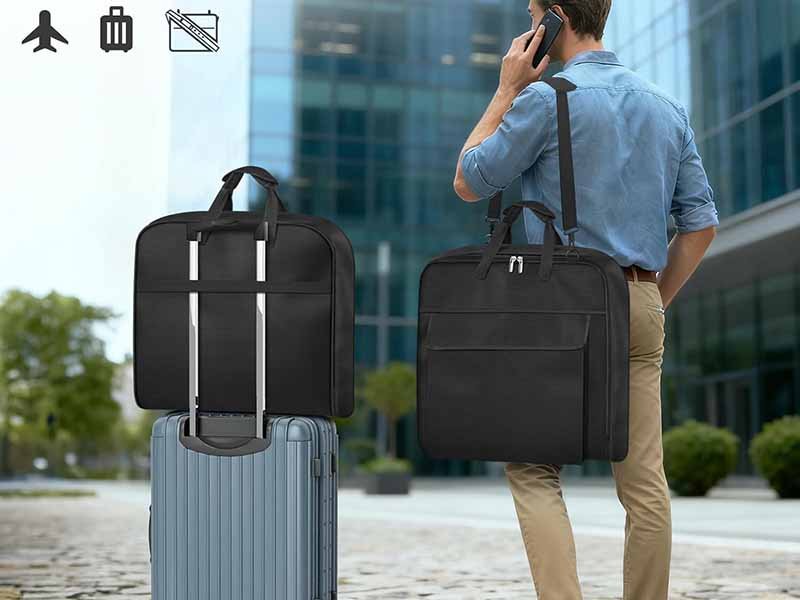
Most travelers don’t notice wrinkles forming—until they unzip the bag and see deep crease lines across a suit front or a dress hem. The frustrating part is that wrinkles aren’t only caused by “bad fabric” or “long trips.” In real travel conditions, wrinkles are usually the result of pressure + friction + uncontrolled folding, amplified by constant movement, stacking, and cabin humidity changes. If your garment bag design doesn’t control those forces, even a premium suit can look tired before the trip truly begins.
A garment bag that minimizes wrinkles works like a portable “clothing stabilizer.” It keeps garments flat where they should be flat, supports them where gravity would collapse fabric, and prevents sharp fold angles from becoming permanent crease lines. That means using the right structure (panels + padding), the right interior (low-friction lining + anchors), and the right folding logic (wide-radius folds instead of hard corners).
Picture this: a client lands after a 10-hour flight, opens the garment bag, and the suit is still crisp enough to wear straight to a meeting. That “no iron needed” moment isn’t luck—it’s design. And once you understand why wrinkles happen inside a bag, you can engineer a product that consistently prevents them.
What Makes Wrinkles in Travel Garment Bags?
Wrinkles happen when clothing fibers are forced into tight bends and held there under pressure—then rubbed by movement. In travel garment bags, the biggest causes are sharp fold geometry, uneven load pressure, fabric-on-fabric friction, and weak internal support that lets garments collapse and shift.
What Causes Clothing Wrinkles During Travel?
Wrinkles are not random. They follow repeatable mechanics. In travel, three forces dominate:
1. Compression pressure (stacking + squeezing)
- When a garment bag is placed under other luggage or squeezed into overhead bins, the clothing inside experiences long-duration pressure.
- The damage is worst when pressure is concentrated on one fold line (lapels, chest area, waistline, shoulder points).
Customer-facing reality:
If your customer travels with carry-ons or checks luggage, the bag will be compressed. So a wrinkle-resistant garment bag must be designed to spread pressure across a larger area, not “accept” it on one crease line.
2. Micro-movement (vibration + handling)
During transit, garments experience thousands of small movements:
- rolling wheels on rough surfaces
- conveyor belts and handling drops
- trunk vibration and cabin movement
These small movements cause rubbing cycles between:
- suit fabric and lining
- fabric layers touching each other
- seams and edges grinding at fold points
That friction sharpens creases and creates “shine marks” on some fabrics.
3. Moisture + temperature shifts (wrinkle setting accelerators)
Travel environments aren’t stable:
- airport humidity changes
- cabin air dryness + temperature differences
- rain exposure during transit
Moisture softens fibers and makes them more likely to “accept” new shapes. That’s why the same suit may look fine in one trip and heavily creased in another.
What Bag Design Factors Affect Wrinkling?
Wrinkle control comes down to whether the bag locks garments into a stable, low-stress position.
The 6 design factors that matter most
| Design Factor | What It Controls | Wrinkle Risk If Done Poorly | Practical Target Range |
|---|---|---|---|
| Folding geometry | Where bends happen | Hard fold line forms “permanent” creases | Prefer wide folds; avoid sharp corners |
| Panel support | Fabric collapse and bending | Chest/shoulder collapse causes deep wrinkles | Semi-rigid panels in key zones |
| Pressure distribution | Localized stress points | One area gets crushed repeatedly | Larger flat surfaces + padding |
| Friction level | Rubbing between layers | Crease sharpening + fabric shine | Smooth, low-friction lining |
| Internal fixation | Garment shifting | Garments slide and wrinkle at seams | Straps + anchors + separators |
| Closure behavior | Squeezing and distortion | Zippers pull fabric tight unevenly | Balanced closure + controlled compression |
Which Parts of Clothing Wrinkle First in Travel?
Customers care about where wrinkles show, because those areas affect appearance immediately.
| Garment Type | Highest Wrinkle Zones | Why It Happens | Bag Design Fix |
|---|---|---|---|
| Suit jacket | lapel, chest front, shoulder | fold stress + compression points | chest panel support + shoulder shaping |
| Dress shirt | collar, placket, cuffs | collar collapse + friction | collar guard + separator sleeves |
| Dress / gown | hemline, waist, skirt pleats | fabric layers slide | internal smooth separators + long-length stability |
| Uniforms | elbows, seat area, seams | folding angles + tight packing | controlled fold boards + anti-shift straps |
What Materials Wrinkle Most Easily (and Why Does That Matter)?
You don’t need laboratory language—customers want simple, useful guidance. Different garments respond differently:
| Fabric | Wrinkle Tendency in Travel | What Causes It | Bag Design Requirement |
|---|---|---|---|
| Cotton | High | fibers bend and set easily | low-friction lining + stable fold geometry |
| Linen | Very high | stiff fibers crease sharply | avoid hard folding; use long hanging structure |
| Wool suit fabric | Medium | holds shape but creases at pressure points | distribute pressure; support chest/shoulders |
| Polyester blends | Low–medium | better recovery but can still crease | reduce fold sharpness; avoid over-compression |
| Silk / satin | Crease + surface marks | friction creates shine and marks | ultra-smooth lining + separators |
Customer concern:
Many travelers pack mixed fabrics (shirts + suit + dress). The bag must be designed for the “worst-case wrinkle fabric,” not just the easiest one.
How Do You Measure “Wrinkle Risk” in a Garment Bag Design?
Brands often ask: “How do we know this design really reduces wrinkles?”
Here are simple, production-friendly evaluation methods customers accept:
Pressure-point mapping (practical approach)
- Pack a standard suit set inside the bag
- Apply controlled weight (simulating stacked luggage)
- Open and check where crease lines form
Design goal: no single fold line should show “hard crease dominance.”
Travel simulation (rolling + vibration)
- Roll the packed bag for a fixed distance
- Include stair bumps / rough ground
- Re-check garment shift and crease formation
Design goal: garment should remain anchored, not drift.
Fold sharpness check (the biggest hidden problem)
- If your fold creates a narrow angle, wrinkles become unavoidable.
Rule of thumb for design teams:
A wider radius fold reduces crease severity dramatically compared to a tight fold.
Practical Design Checklist
This is the kind of checklist customers and product managers actually use.
| Check Item | Pass Standard | Why It Matters |
|---|---|---|
| Garment is anchored | straps prevent sliding | sliding creates seam wrinkles |
| Fold line is controlled | fold board or panel defines fold | prevents random sharp creases |
| Pressure is distributed | padding + panel spreads load | avoids deep chest/lapel creases |
| Lining reduces friction | smooth lining, no rough seams | friction sets wrinkles and shine marks |
| Shoulder area is protected | shaped support or padding | shoulders collapse easily |
Why Design Matters for Wrinkle Prevention
Good garment bag design directly determines whether clothing arrives ready to wear or visibly creased. Wrinkle prevention is not controlled by fabric alone—it depends on how the bag supports shape, distributes pressure, stabilizes garments, and limits friction during motion. Even high-end suits will wrinkle inside a poorly structured bag, while moderate fabrics can stay smooth inside a well-engineered one.
Why Fabric Choice Alone Cannot Prevent Wrinkles
Many brands initially believe wrinkle resistance is solved by selecting “better fabric.”
In reality, bag structure contributes more to wrinkle outcome than garment fabric type during travel.
Key reasons
Travel wrinkles are mechanical, not material-only.
Pressure, folding angle, and movement dominate crease formation.
Even wrinkle-resistant fabrics crease under sharp folding.
Polyester blends recover better than cotton, but a tight fold will still leave a visible line.
Luxury garments often wrinkle faster.
Fine wool, silk, and linen used in premium clothing are more sensitive to pressure and humidity.
Practical comparison
| Scenario | Garment Fabric | Bag Structure | Result After 8–10 hr Travel |
|---|---|---|---|
| A | Polyester blend | Poor support, sharp fold | Visible chest crease |
| B | Cotton shirt | Semi-rigid panel + straps | Minor wrinkles only |
| C | Wool suit | Reinforced structure + wide fold | Ready to wear |
| D | Linen garment | Soft bag, compression | Heavy creasing |
Conclusion customers care about:
Improving bag engineering usually delivers more visible wrinkle reduction than upgrading garment fabric.
Why Structure and Shape Control Wrinkle Outcomes
Structure defines how forces move through the bag.
A well-designed garment bag converts uncontrolled pressure into even, low-stress support.
Three structural principles that reduce wrinkles
Wide-radius folding instead of sharp bending
- Sharp folds create permanent fiber memory.
- Wider curves spread stress across a larger surface.
Design implication:
Use fold boards, curved panels, or tri-fold geometry rather than simple mid-fold designs.
Semi-rigid support in critical zones
Not every part of the bag needs reinforcement.
Customers mainly notice wrinkles in:
- chest front of suits
- shoulder line
- collar and placket
- dress waistline
Targeted reinforcement in these zones provides the biggest visual improvement.
| Support Type | Thickness Range | Effect |
|---|---|---|
| EVA foam panel | 3–6 mm | absorbs compression |
| PE board insert | 0.8–1.5 mm | maintains flat plane |
| Composite panel | foam + board | best wrinkle protection |
Shape stability during motion
If the bag twists while rolling or carrying:
- garments shift
- folds tighten
- seams rub
Shape retention becomes critical for travel performance.
Engineering methods used by premium brands
- perimeter piping or frame strips
- dual-layer fabric shells
- tensioned zipper alignment
These details are invisible in photos but obvious in real travel use—exactly where customers judge quality.
Cost vs. Wrinkle Performance: What Brands Should Know
Wrinkle prevention is often misunderstood as expensive engineering.
In reality, the biggest improvements come from smart design decisions, not just higher material cost.
Example cost–performance comparison
| Design Level | Added Material Cost | Wrinkle Reduction | Market Position |
|---|---|---|---|
| Basic soft bag | — | Low | Budget retail |
| Add smooth lining | +3–5% | Moderate | Entry travel |
| Add fold board + straps | +8–12% | High | Mid-range |
| Add semi-rigid panels | +15–22% | Very high | Premium |
| Full structured system | +25%+ | Maximum | Professional / luxury |
Important insight for product managers
Customers rarely complain about slightly higher price
—but they do complain about wrinkled clothing.
So wrinkle performance often delivers better perceived value than cosmetic upgrades.
What Fabrics Are Best to Reduce Wrinkles?
The best fabrics for wrinkle-reducing garment bags are those that combine surface smoothness, dimensional stability, and moderate flexibility.
Outer materials protect structure, inner linings control friction, and padding layers absorb pressure. Performance depends on the full material system, not a single fabric choice.
Which Outer Materials Provide Stable Protection?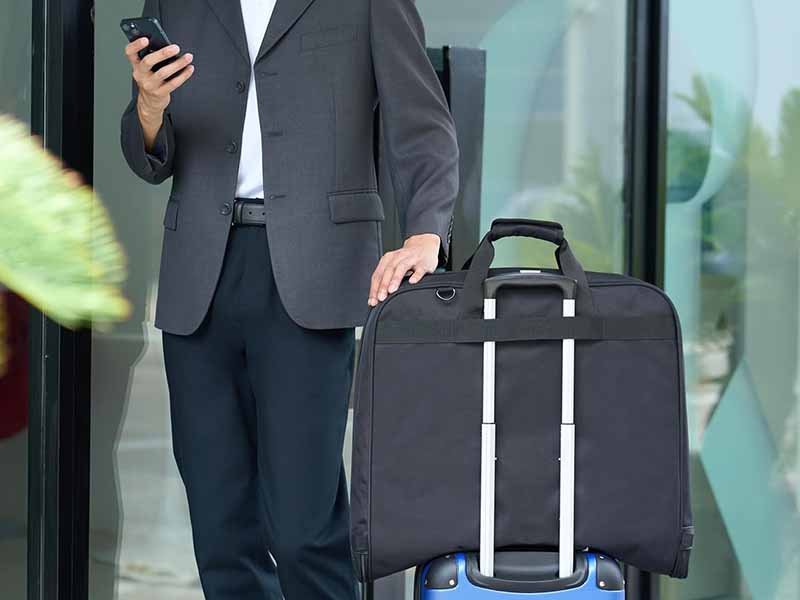
Outer shell fabric determines:
- durability during handling
- resistance to deformation
- long-term shape retention
Common outer fabric comparison
| Material | Durability | Shape Stability | Weight | Typical Use Level |
|---|---|---|---|---|
| 600D polyester | Good | Medium | Light | Mass travel |
| 1680D ballistic polyester | Very high | High | Medium | Premium |
| Nylon twill | High | Medium | Light | Business travel |
| PU-coated fabric | High | High | Medium | Structured bags |
| Leather | Very high | High | Heavy | Luxury market |
Customer-driven takeaway
- Entry products focus on weight + price
- Premium products focus on shape stability, which directly affects wrinkles
Which Lining Fabrics Reduce Friction Most Effectively?
Wrinkle formation accelerates when garments rub against rough surfaces.
So lining selection has a direct visual impact.
Lining performance comparison
| Lining Type | Friction Level | Wrinkle Impact | Cost Level |
|---|---|---|---|
| Standard polyester | Medium | Moderate creasing | Low |
| Smooth satin polyester | Low | Reduced friction marks | Medium |
| Nylon taffeta | Very low | Excellent glide | Medium |
| Brushed fabric | High | Increases wrinkles | Low |
Important manufacturing insight
A lining upgrade costing only a few percent
can noticeably improve wrinkle outcome—
making it one of the highest ROI design choices.
What Padding Materials Absorb Pressure Best?
Padding prevents external force from reaching garments directly.
| Padding Material | Compression Recovery | Weight | Wrinkle Protection |
|---|---|---|---|
| Sponge foam | Medium | Light | Basic |
| EVA foam | High | Light | Strong |
| PE foam | Medium | Very light | Moderate |
| Multi-layer composite | Very high | Medium | Best |
Design reality
Most mid-to-high-end garment bags now use:
- 3–5 mm EVA in fold zones
- 2–3 mm foam in body panels
This balance keeps bags protective but still portable.
How to Design Garment Bag Features for Wrinkle-Free Travel
Wrinkle-free performance ultimately depends on feature integration.
Structure, materials, and interior layout must work together to hold garments in a stable, low-stress position from departure to arrival.
How to Optimize Interior Layout
Interior layout determines whether garments:
- stay flat
- slide downward
- bunch at fold points
| Feature | Function | Wrinkle Benefit |
|---|---|---|
| Adjustable straps | hold garments in place | prevents shifting creases |
| Fold board | controls fold radius | avoids sharp lines |
| Divider panels | separate garments | reduces friction |
| Collar protectors | support shirt collars | keeps structure clean |
Customer expectation trend
Business travelers increasingly expect:
- multi-garment capacity
- organized packing zones
- visible anti-wrinkle function
So interior design is now a selling feature, not just hidden structure.
How Protective Sections Improve Stability
Targeted reinforcement zones produce disproportionately large wrinkle reduction.
High-impact protection zones
- shoulder support area
- chest flat panel
- fold hinge zone
- bottom hem stabilizer
Instead of reinforcing the entire bag,
smart design strengthens only where wrinkles begin—
keeping weight and cost controlled.
How Closures and Compression Must Be Balanced
Too much compression causes wrinkles.
Too little compression causes shifting.
The correct solution is controlled tension.
Closure design comparison
| Closure Style | Stability | Wrinkle Risk |
|---|---|---|
| Loose zipper only | Low | High |
| Tight compression straps | Very high | Can over-crease |
| Balanced strap + panel | High | Low |
Best-practice configuration
- moderate strap tension
- flat support panel beneath
- smooth closing path
This keeps garments secure without distortion.
Do These Design Elements Really Improve Wrinkle Performance?
Yes—when engineered correctly, specific structural and functional elements can measurably reduce wrinkle formation during real travel conditions.
However, effectiveness depends on how components work together, not whether a single feature exists. Many low-cost garment bags advertise padding or straps but still produce wrinkles because the system lacks balance between support, tension, and motion control.
Do Padded Panels Actually Prevent Creases?
Padded panels are one of the most discussed anti-wrinkle features, but their real value depends on placement, density, and thickness.
What padding really does
- Distributes external pressure across a larger surface
- Prevents sharp fold compression at chest and shoulder zones
- Absorbs vibration energy during rolling or handling
Without padding, compression forces concentrate on one narrow fold line, which is where deep wrinkles appear.
Measured performance difference
| Structure Type | Visible Wrinkles After Simulated Travel | Customer Perception |
|---|---|---|
| No padding | High | “Suit needs ironing” |
| Thin sponge only | Medium | “Wrinkles noticeable” |
| EVA panel in fold zone | Low | “Mostly wearable” |
| Multi-layer reinforced panel | Very low | “Ready to wear” |
Padding works best when used selectively in wrinkle-critical zones, not across the entire bag.
Targeted reinforcement delivers higher wrinkle reduction with lower cost and weight.
Do Adjustable Straps and Hanging Hooks Matter?
Yes—garment fixation is one of the most underestimated factors in wrinkle control.
Why fixation matters
If garments are free to move:
- folds tighten during motion
- seams rub repeatedly
- collars collapse
- fabric bunches at the bottom
Even perfect padding cannot compensate for internal shifting.
Functional comparison
| Interior Fixation Method | Garment Movement | Wrinkle Outcome |
|---|---|---|
| No straps | High | Severe creasing |
| Single loose strap | Medium | Uneven wrinkles |
| Dual adjustable straps | Low | Smooth surface maintained |
| Strap + hanger lock system | Very low | Professional appearance |
Customer-relevant takeaway:
Travelers immediately notice whether clothing slides inside the bag.
Stable fixation strongly correlates with premium product perception.
Do Visibility Features Improve Real-World Usability?
Wrinkle prevention is not only structural—it also relates to how users pack garments.
Clear panels, labeled sections, and organized compartments help users:
- avoid over-folding
- separate garment types
- maintain correct orientation
Poor packing is a hidden cause of wrinkles.
Design that guides correct packing behavior indirectly improves wrinkle performance.
Are Rolling or Hanging Garment Bags Better for Wrinkle Prevention?
Both designs can minimize wrinkles when engineered correctly, but they serve different travel scenarios.
The real question is not which type is universally better, but which structure matches the user’s travel pattern.
Rolling Garment Bags: Strengths and Limitations
Advantages
- Reduced shoulder carrying fatigue
- Better weight distribution for long terminals
- Larger internal structure allows flatter folding geometry
Wrinkle risks
- Wheel vibration introduces continuous micro-movement
- Twisting during pulling can distort fold alignment
- Over-packing is more common due to larger capacity
Engineering solutions used in high-quality rolling bags
- reinforced base frame
- anti-shift interior strap matrix
- vibration-absorbing panel layers
When designed well, rolling garment bags achieve excellent wrinkle control for long trips.
Hanging Garment Bags: Strengths and Limitations
Advantages
- Natural vertical drape reduces fold stress
- Minimal compression when carried carefully
- Ideal for short business trips or formal events
Wrinkle risks
- External compression in overhead bins
- Shoulder collapse without structured support
- Limited space encourages tight folding
Best-use scenario
Hanging garment bags perform best when:
- travel time is short
- garments are few
- careful handling is possible
For daily airline travel, structured rolling designs often outperform soft hanging bags in wrinkle prevention.
Real Customer Selection Logic
| Travel Pattern | Recommended Structure | Reason |
|---|---|---|
| Overnight business trip | Hanging structured bag | minimal folding needed |
| Frequent flights | Rolling reinforced bag | better stability + capacity |
| Formalwear transport | Long-length hanging bag | protects drape and hemline |
| Multi-garment travel | Hybrid rolling garment bag | balanced protection |
Understanding customer usage scenarios is essential before product development.
Final Thoughts — Turning Smart Design Into a Successful Product Line
Wrinkle-resistant garment bags are no longer a niche category.
As business travel, destination events, and professional mobility continue to grow, travelers increasingly expect clothing to arrive clean, smooth, and ready to wear immediately.
This expectation creates real opportunity for brands that invest in:
- correct folding geometry
- semi-rigid structural support
- low-friction interior systems
- balanced fixation and compression
- scenario-based product positioning
When these elements are engineered together, wrinkle reduction becomes predictable and repeatable, not accidental.
Request Custom Wrinkle-Resistant Garment Bags from Szoneier
If you are planning to develop a private-label or OEM garment bag collection, working with an experienced manufacturer significantly reduces development risk.
Szoneier has over 18 years of experience in bag R&D, structure engineering, and global custom production, supporting brands with:
- wrinkle-resistant garment bag structural design
- material sourcing across polyester, nylon, PU, EVA, leather, and composites
- rapid sampling and prototype testing
- low-MOQ customization for emerging brands
- stable large-scale manufacturing for established companies
Whether your target is mid-range travel retail, premium business markets, or luxury formalwear transport, Szoneier can help translate performance ideas into real, production-ready products.
Contact Szoneier today to start your custom garment bag project and create travel solutions that keep every arrival looking professional.