 Skip to content
How Does a Garment Bag Work:Easy Guide for Travel Use
- Eric
- February 16, 2026
- 4:20 pm
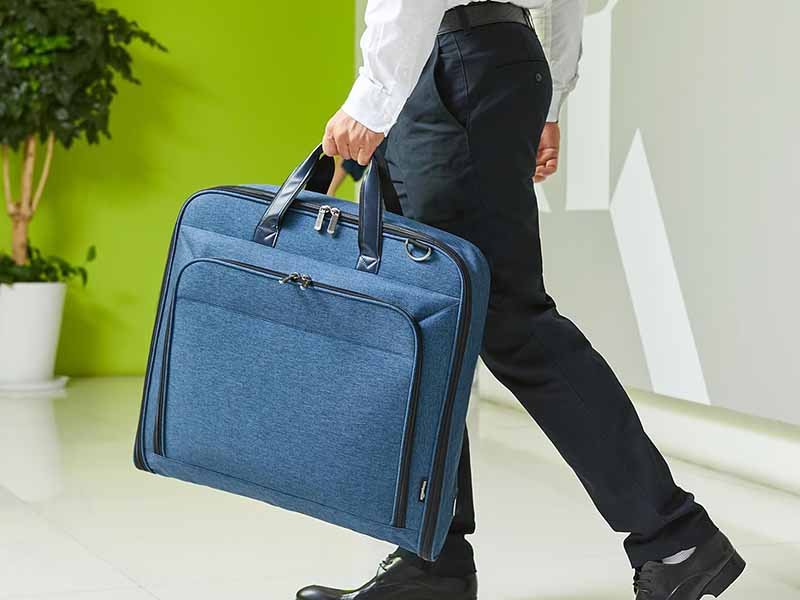
At first glance, a garment bag seems simple—just a long cover for clothes. Yet anyone who has arrived at a meeting with wrinkled suits or opened a suitcase to find a creased dress knows the real value of proper garment protection. Travel today mixes speed, movement, and limited packing space, which makes traditional folding methods unreliable for formal clothing. This is where garment bags quietly solve a problem most travelers only notice after something goes wrong.
A garment bag works by keeping clothing extended along its natural hanging line, minimizing hard folds, shielding fabric from friction, and stabilizing garments during transport. Through structured folding panels, hanger support, protective lining, and secure closures, it reduces wrinkles, protects shape, and allows formal wear to travel safely in carry-on or checked conditions.
For business travelers, wedding planners, fashion professionals, and premium brands, this function is not a small convenience—it directly affects presentation, confidence, and even customer perception. One retailer once noted that customers who switched to structured garment bags reported fewer last-minute steaming emergencies before events. That quiet reliability is what makes garment bags worth understanding in detail.
What Is a Garment Bag and How Does a Garment Bag Work?
A garment bag is a travel bag designed specifically to carry formal or wrinkle-sensitive clothing—such as suits, dresses, uniforms, and coats—while keeping the fabric as close as possible to its natural hanging shape.
Instead of folding clothing into tight layers like a suitcase, a garment bag controls fold angle, pressure distribution, and fabric friction, which are the three main causes of visible wrinkles during travel.
In simple terms, a garment bag works by:
- Supporting clothing lengthwise with a hanger or structured interior
- Reducing sharp bends through wide or guided folding panels
- Separating fabric layers so they do not rub and create crease lines
- Stabilizing garments to prevent shifting during walking, driving, or flying
When these elements are properly designed, many garments can be worn directly after arrival with little or no ironing, which is the main reason travelers choose garment bags.
Why Understanding How a Garment Bag Works Matters
Most people only think about garment bags after a problem happens—for example:
- arriving at a meeting with a deep crease across the jacket front
- discovering shoulder bumps caused by tight suitcase pressure
- needing emergency steaming before a wedding or formal event
These issues are not random. They come from predictable mechanical stress inside traditional luggage.
The three real causes of travel wrinkles
| Cause | What happens inside luggage | Visible result on clothing |
|---|---|---|
| Compression pressure | Heavy items press on folded fabric for hours | Deep crease lines |
| Fabric friction | Clothing rubs against rough surfaces or zippers | Shine marks or wrinkles |
| Movement during transit | Items slide and refold repeatedly | Distorted shape or uneven creasing |
A garment bag is engineered to reduce all three at the same time, which is why it performs differently from normal packing methods.
For frequent travelers, this difference translates into real savings:
- less hotel ironing or steaming time
- fewer dry-cleaning emergencies
- more consistent professional appearance
For brands selling travel products, better wrinkle control also means:
- fewer customer complaints
- stronger product reviews
- higher perceived quality
How a Garment Bag Reduces Wrinkles in Practice
Wrinkles form when textile fibers are bent sharply and held under load.
The longer the pressure lasts, the deeper the crease becomes.
Garment bags reduce wrinkle formation by changing both how fabric bends and how force is applied.
Key structural mechanisms inside a garment bag
- Wide-radius folding
- Garments bend gently instead of sharply.
- Lower fiber stress means shallower creases.
- Vertical or semi-vertical support
- Hanger systems keep weight distributed along the garment length.
- Prevents collapse at shoulders or waistlines.
- Smooth inner lining
- Reduces friction that locks wrinkles into place.
- Protects delicate fabrics such as wool, silk, or satin.
- Internal securing straps
- Hold garments flat so they do not shift during motion.
- Prevents repeated micro-folding while walking or rolling luggage.
Wrinkle depth comparison by packing method
| Packing method | Fold sharpness | Pressure level | Wrinkle depth after travel |
|---|---|---|---|
| Tight suitcase folding | High | High | Deep, visible creases |
| Loose suitcase packing | Medium | Medium | Moderate wrinkles |
| Folded garment bag | Low | Low | Light wrinkles |
| Full-length hanging bag | Very low | Very low | Minimal or none |
This is why garment bags are widely used for:
- business suits that must look pressed
- evening dresses that wrinkle easily
- uniforms or performance wear that require clean presentation
Structural Parts That Make a Garment Bag Function Properly
Customers often judge a garment bag by size or appearance, but performance depends more on internal construction.
Core components and what they actually do
| Component | Practical function | Why it matters in travel |
|---|---|---|
| Hanger hook or loop | Holds garment weight vertically | Prevents shoulder distortion |
| Folding panel system | Controls where fabric bends | Reduces crease sharpness |
| Inner lining fabric | Lowers friction and protects texture | Prevents shine marks and wrinkles |
| Stabilizing straps | Stops garments from sliding | Maintains flat alignment |
| Outer shell material | Shields from dust, moisture, abrasion | Extends garment cleanliness |
If any of these elements are weak—especially hanger strength or zipper durability—the bag may fail even if the fabric looks good.
Real-World Situations Where Garment Bags Make the Biggest Difference
Garment bags are most valuable when:
- travel time is long (creases set deeper over time)
- clothing fabric is delicate (silk, wool, satin wrinkle faster)
- appearance is critical (meetings, ceremonies, stage events)
- ironing access is limited (tight schedules, hotels without steamers)
Travel scenario impact
| Scenario | Without garment bag | With garment bag |
|---|---|---|
| Overnight business trip | Jacket needs ironing | Often wearable immediately |
| Destination wedding | Dress may crease heavily | Shape largely preserved |
| Frequent flying | Repeated wrinkle buildup | Consistent garment condition |
| Long car travel | Compression from other luggage | Reduced pressure and friction |
These everyday outcomes explain why garment bags remain a standard tool in professional travel, even as luggage styles evolve.
The Practical Value Behind a Simple Design
A garment bag may look uncomplicated, but its function is highly specific:
control fabric stress during movement.
By managing:
- fold geometry
- pressure distribution
- surface friction
- garment stability
it protects clothing in ways ordinary suitcases cannot.
For travelers, this means less preparation time and better appearance.
For brands and retailers, it means clear functional value that customers immediately understand.
And that is the real reason garment bags continue to be an essential category in modern travel gear.
Which Types Show How Does a Garment Bag Work Best?
Hanging, foldable, and garment-duffel styles show how a garment bag works in different travel situations: hanging bags maximize wrinkle control, foldable bags balance carry-on convenience and protection, and garment-duffel designs combine a flat garment section with storage for shoes and accessories in one piece.
How Does a Garment Bag Work in Hanging Style
A hanging garment bag keeps clothing closest to its natural form: fully extended. This is why bridal shops, uniform services, and tailoring studios rely on them.
What makes hanging styles perform well:
- full-length interior space (less folding)
- strong hanger hook system
- long zipper track to lay garments in smoothly
- simple interior—less rubbing against pockets and hardware
Where customers love hanging bags:
- weddings and events (dress protection)
- car travel (hang in vehicle)
- home storage (dust protection)
Where hanging bags become inconvenient:
- carry-on flights (length can exceed overhead space)
- crowded transit (harder to maneuver)
In product terms, hanging bags win on wrinkle control, but lose on portability.
How Does a Garment Bag Work in Foldable Style
Foldable garment bags exist because travelers want airline practicality without sacrificing garment protection. These bags use panels and structured folding points so the garment bends gently.
Key design parts that matter to customers:
- bi-fold or tri-fold panel system (controls where the garment bends)
- compression straps (hold clothing flat without crushing)
- corner protection (prevents jacket shoulders from being crushed)
- smooth lining (reduces friction and shine marks)
What customers notice immediately is whether the bag feels “floppy” or “supported.”
Support usually comes from:
- lightweight board sheets or foam inserts
- reinforced edge binding
- stable handle placement so the bag hangs straight when carried
Foldable bags are the go-to for:
- business travel
- interviews
- short formal trips
How Does a Garment Bag Work in Garment Duffel Design
Garment-duffel designs are popular because they remove the “two-bag problem.” You can carry:
- a suit or dress laid flat around the perimeter
- shoes, toiletries, and accessories inside the duffel core
How it works structurally:
- the garment section zips open flat like a panel
- clothing is placed and secured with straps
- the bag zips into a duffel shape, keeping garments wrapped around the outer layer
Customers choose garment duffels when they want:
- one carry-on for a 1–3 day trip
- quick access to garments and shoes
- less wrinkling than suitcase packing
The key risk (and common complaint) is bulging: if the center compartment is overstuffed, it pushes outward and increases creasing. Good designs address this with:
- volume control straps
- structured base panels
- “do not overfill” guidance in product inserts
Customer-Focused Specs People Ask About
These are the questions customers repeatedly ask before buying—so it helps to answer them clearly on the page.
| Question customers ask | Practical guideline | What to look for |
|---|---|---|
| “Will it fit a suit?” | Needs enough length + shoulder room | wide top, stable hanger hook |
| “Will it crease less?” | Needs controlled folds + straps | tri-fold panels, smooth lining |
| “Will it last?” | Needs strong zipper + stitching | #8–#10 zipper, bar-tack reinforcements |
| “Is it heavy?” | Carry comfort matters | padded handles, balanced strap |
| “Can I bring it on flights?” | Size and fold style matter | foldable carry-on shape |
How Do You Pack Clothes and How Does a Garment Bag Work?
Packing clothes in a garment bag works by placing garments along their natural hanging line, using gentle folds instead of tight bends, and securing layers to prevent shifting. Proper packing keeps suits, dresses, and formal wear flatter, reduces pressure points, and minimizes the need for ironing after travel.
Many wrinkle problems blamed on the bag are actually caused by incorrect packing technique.
Even a high-quality garment bag cannot fully protect clothing if garments are:
- twisted before folding
- compressed by heavy shoes or accessories
- left unsecured so they slide during movement
Understanding the correct packing method is just as important as choosing the right bag.
How Does a Garment Bag Work for Suits
Suits are sensitive to fold pressure, shoulder distortion, and fabric shine, especially with wool or blended formal fabrics.
A garment bag protects suits best when the structure supports the jacket’s natural drape and keeps trousers aligned without sharp bends.
Step-by-step suit placement inside a garment bag
- Button the jacket lightly to maintain shape.
- Align shoulders with the hanger edge to prevent collapsing.
- Lay trousers flat along the garment length, not tightly folded.
- Use internal straps to hold garments in place without crushing.
- Fold only along designed panels (bi-fold or tri-fold sections).
Wrinkle risk by packing method
| Suit packing style | Shoulder distortion | Crease depth | Ironing needed |
|---|---|---|---|
| Tight suitcase fold | High | Deep | Very likely |
| Loose suitcase placement | Medium | Moderate | Possible |
| Structured garment bag | Low | Light | Often unnecessary |
For business travelers, avoiding emergency ironing saves time before meetings and keeps clothing looking professionally prepared.
How Does a Garment Bag Work for Dresses
Dresses introduce a different challenge: length and fabric delicacy.
Silk, chiffon, satin, and layered fabrics wrinkle more easily than suiting materials and can snag on rough interiors.
Garment bags protect dresses through:
- full-length or extended folding space
- smooth inner lining that reduces friction
- minimal compression from other items
Best practices for packing dresses
- Place tissue or soft cloth between folds for delicate fabrics.
- Keep beading or embellishments facing inward to avoid abrasion.
- Avoid packing heavy shoes in the same compartment as the dress.
- Use wide folding panels instead of tight bends.
Fabric sensitivity comparison
| Fabric type | Wrinkle sensitivity | Protection need |
|---|---|---|
| Wool blend | Medium | Standard garment bag |
| Polyester dress fabric | Medium–low | Basic protection |
| Silk or satin | High | Smooth lining + careful folding |
| Chiffon/layered | Very high | Minimal compression + long space |
For weddings or formal events, these small packing choices often determine whether steaming is required before wearing.
How Does a Garment Bag Work for Shoes and Accessories
One common mistake is treating a garment bag like a suitcase and filling it with heavy accessories.
Shoes, belts, and toiletry kits create localized pressure that can transfer creases directly into garments.
Well-designed garment bags solve this using:
- separate accessory pockets
- lower compartments away from garment panels
- balanced weight distribution
Safe storage zones inside a garment bag
| Item type | Safe placement | Risk if misplaced |
|---|---|---|
| Shoes | bottom pocket or separate pouch | fabric compression |
| Belt/jewelry | small accessory pocket | snagging or imprint marks |
| Toiletries | waterproof exterior pocket | moisture damage |
| Documents | flat sleeve | corner creasing |
Keeping garments structurally isolated is one of the simplest ways to preserve a clean appearance after travel.
How Does a Garment Bag Work for Flights and Carry-On?
During flights, a garment bag works by folding into carry-on size while maintaining gentle garment support, protecting clothing from overhead compression, and reducing movement during transport. Proper size, fold design, and handle balance determine whether it fits airline storage and keeps garments wrinkle-free.
Air travel introduces the most challenging conditions for formal clothing:
- limited storage space
- pressure from other passengers’ bags
- repeated lifting and repositioning
Garment bags designed for flights focus on compact folding without sharp creases.
How Does a Garment Bag Work as Carry-On
Many foldable garment bags are specifically sized for carry-on travel, allowing passengers to avoid checked-baggage compression.
Key carry-on design elements include:
- bi-fold or tri-fold structure for compact shape
- reinforced handles for upright carrying
- lightweight materials to stay within airline weight limits
Carry-on convenience comparison
| Feature | Foldable garment bag | Standard suitcase |
|---|---|---|
| Wrinkle protection | Higher | Medium |
| Storage flexibility | Medium | Low |
| Overhead fit | Good | Predictable but rigid |
| Weight efficiency | Higher | Lower |
For short business trips, garment bags often provide the best balance between protection and mobility.
How Does a Garment Bag Work with Airline Size Limits
Airline cabins restrict length, width, and thickness, which is why fold geometry matters more than total fabric size.
Typical carry-on compatibility logic
| Bag structure | Airline fit likelihood |
|---|---|
| Full-length hanging bag | Low |
| Bi-fold garment bag | Medium–high |
| Tri-fold garment bag | High |
| Garment duffel hybrid | High |
Designers must balance:
- garment length preservation
- fold compactness
- structural stability
This balance defines whether a garment bag succeeds in real travel use, not just product photos.
How Does a Garment Bag Work in Overhead Storage
Inside overhead bins, the biggest risk is side compression from neighboring luggage.
Garment bags reduce this risk through:
- flat profile packing
- distributed internal tension from straps
- smooth outer fabric that slides instead of catching
Compression resistance comparison
| Storage method | Compression risk | Garment outcome |
|---|---|---|
| Checked suitcase | High | Deep wrinkles possible |
| Overhead suitcase | Medium | Moderate wrinkles |
| Overhead garment bag | Low | Minimal wrinkling |
Positioning the garment bag on top of rigid luggage instead of beneath it further reduces crease formation.
What Features Improve How Does a Garment Bag Work?
The features that most improve how a garment bag works are durable outer materials, smooth protective linings, strong zippers, stable hanger systems, and balanced carrying structures. Together, these elements reduce wrinkles, prevent fabric damage, and ensure the bag performs reliably through repeated travel.
Many travelers focus only on size or appearance, but long-term satisfaction depends on construction quality and structural design.
Small upgrades in materials or hardware often make the difference between:
- a bag that lasts for years
- a bag that fails after a few trips
Understanding these details helps both individual travelers and brands developing custom products make smarter decisions.
How Does a Garment Bag Work with Strong Materials
Material choice directly affects wrinkle control, durability, and weight.
A garment bag must balance three competing needs:
- lightweight carry comfort
- abrasion resistance during travel
- shape stability to support garments
Common material performance comparison
| Material | Weight | Abrasion resistance | Water resistance | Typical use level |
|---|---|---|---|---|
| Polyester | Light | Medium | Medium | everyday travel |
| Nylon | Light–medium | High | Medium | frequent travel |
| Coated nylon/poly | Medium | High | High | outdoor or heavy use |
| Canvas | Medium–heavy | Medium | Low unless treated | lifestyle or fashion |
| Leather | Heavy | High | Medium | premium positioning |
For most business travelers, high-density nylon or coated polyester provides the best balance of:
- durability
- low weight
- professional appearance
Brands targeting premium markets may add leather trim or full leather shells, but this increases both cost and carrying weight.
How Does a Garment Bag Work with Durable Zippers and Hangers
Hardware failure is one of the most common real-world problems.
Even when fabric remains intact, weak zippers or hanger hooks can make a bag unusable.
Critical hardware components
- Main zipper strength determines how well the bag survives repeated opening under tension.
- Hanger hook material affects load capacity when garments are fully packed.
- Internal hanger clips prevent garments from sliding downward during travel.
Zipper grade comparison
| Zipper size | Durability level | Best application |
|---|---|---|
| #5 | Light duty | occasional travel |
| #8 | Medium duty | business trips |
| #10 | Heavy duty | frequent or long travel |
High-quality garment bags usually combine:
- #8 or #10 zippers
- metal or reinforced composite hanger hooks
- bar-tack stitching at stress points
These features significantly extend usable lifespan.
How Does a Garment Bag Work for Business or Wedding Travel
Different travel purposes create different performance priorities.
Business travel needs
- wrinkle-free suits
- lightweight carry-on compatibility
- professional exterior appearance
- quick packing and unpacking
Wedding or formal event needs
- protection for delicate fabrics
- longer internal garment length
- minimal folding pressure
- clean, dust-free storage before the event
Feature priority by scenario
| Travel type | Most important feature |
|---|---|
| Business trip | lightweight foldable structure |
| Destination wedding | full-length garment protection |
| Frequent flyer | durable zippers and fabric |
| Occasional traveler | balanced cost and function |
Designing a garment bag around real usage context leads to far better satisfaction than choosing based on appearance alone.
Custom Garment Bags for Brands and Retailers
Custom garment bags are not only travel accessories—they are functional brand products that directly influence customer experience, product perception, and long-term loyalty.
For brands and retailers, the real question is not simply how to make a garment bag, but how to design one that performs reliably in real travel conditions while supporting clear brand positioning and profitable pricing.
In commercial markets, garment bags are commonly used for:
- business travel collections
- wedding and formalwear packaging
- fashion retail garment protection
- uniform or performance apparel transport
- premium promotional merchandise
Because these use cases differ, successful customization depends on matching structure, material, and cost level to the intended customer scenario, rather than applying one generic design to all markets.
What Brands Actually Need From Custom Garment Bags
When retailers evaluate suppliers, their priorities are usually practical and measurable.
Across global travel-goods sourcing projects, the most common requirements include:
- Wrinkle protection that works in real flights and car travel
- Consistent material quality across bulk production
- Reliable zippers, stitching, and hanger strength
- Brand-accurate color and logo execution
- Predictable lead time and stable pricing
These needs are less about appearance and more about reducing risk after the product reaches customers.
Typical performance expectations in retail markets
| Feature area | Entry-level retail | Mid-range retail | Premium retail |
|---|---|---|---|
| Fabric thickness | 210D–420D | 600D–900D | ballistic nylon / leather |
| Zipper size | #5–#8 | #8–#10 | #10 branded hardware |
| Lining | basic polyester | smooth low-friction | satin / coated lining |
| Logo method | screen print | embroidery / woven label | metal plate / leather emboss |
| Expected lifespan | occasional travel | frequent travel | long-term professional use |
Understanding these tiers helps brands align product cost with customer expectation, avoiding both over-engineering and under-performance.
Structural Customization That Improves Real Travel Performance
The most valuable customization changes are often structural rather than decorative.
Small internal improvements can significantly affect how the garment bag performs after repeated trips.
High-impact structural upgrades
1. Reinforced hanger support
- Prevents tearing at the top seam under garment weight.
- Especially important for wool suits or multi-garment packing.
2. Controlled fold panel geometry
- Bi-fold for shorter carry-on use.
- Tri-fold for better wrinkle reduction in compact size.
3. Smooth, low-friction lining
- Reduces fabric shine and crease locking.
- Critical for dark wool, silk, and satin garments.
4. Balanced carry handles and shoulder straps
- Prevents tilting that causes uneven pressure on clothing.
Real durability improvement from reinforcement
| Upgrade element | Without reinforcement | With reinforcement |
|---|---|---|
| Hanger seam strength | may tear after heavy load | survives repeated travel |
| Fold edge wear | fabric thinning over time | longer structural life |
| Zipper stress at corners | higher failure risk | reduced breakage |
| Overall lifespan | short–medium | medium–long |
These changes usually add only a small percentage to production cost while greatly improving customer satisfaction.
Material choice is one of the clearest signals of brand level and intended usage frequency.
Common commercial material strategies
| Market focus | Preferred materials | Reason |
|---|---|---|
| Promotional or entry retail | lightweight polyester | low cost, easy printing |
| Business travel retail | high-density polyester or nylon | durability + professional look |
| Wedding / formalwear | smooth fabric + padded lining | wrinkle and fabric protection |
| Luxury positioning | leather or leather-trim textile | strong perceived value |
Selecting the right material is not about choosing the most expensive option.
It is about choosing the material that matches how often customers will actually use the bag.
Over-specifying materials can raise price without improving real experience, while under-specifying leads to returns, complaints, and negative reviews.
Logo, Branding, and Retail Presentation
For many brands, garment bags serve as moving brand exposure during travel.
Customization therefore focuses on visibility, durability, and consistency.
Common branding methods and their real-world behavior
| Branding method | Durability | Visual impact | Cost level |
|---|---|---|---|
| Screen printing | medium | clear but flat | low |
| Embroidery | high | textured, premium feel | medium |
| Woven label | very high | subtle brand detail | medium |
| Metal logo plate | very high | strong luxury signal | high |
| Leather emboss | very high | premium, understated | high |
The best choice depends on whether the product is meant for:
- high-volume retail visibility → printed or embroidered logos
- premium gifting or formalwear → leather or metal branding
Production Consistency and Quality Control in Bulk Orders
One of the biggest concerns for brands is not the sample quality, but whether the bulk order matches the sample.
Reliable manufacturers manage this through:
- standardized material sourcing
- controlled sewing specifications
- hardware strength testing
- pre-shipment inspection
Common quality checks for garment bags
| Inspection item | Purpose |
|---|---|
| Stitch tension and density | prevents seam failure |
| Zipper cycling test | ensures smooth long-term use |
| Fabric color consistency | avoids batch mismatch |
| Load test at hanger point | confirms weight capacity |
| Final visual inspection | removes cosmetic defects |
Without these controls, even well-designed products can fail after delivery, creating costly returns or brand damage.
Why Many Global Brands Work With Experienced OEM Manufacturers
Developing custom garment bags involves more than sewing fabric.
It requires coordination across:
- material sourcing
- pattern engineering
- sampling accuracy
- bulk production stability
- export logistics
Manufacturers with long industry experience can reduce:
- sampling delays
- quality variation
- communication errors
- unexpected cost changes
This stability is especially important for growing brands that cannot afford repeated production mistakes.
Start Your Custom Garment Bag Project with Confidence
Understanding how a garment bag works changes how travelers pack, how clothing arrives, and how brands design travel products.
A well-designed garment bag protects more than fabric—it protects appearance, confidence, and time.
For individual travelers, the right structure means:
- fewer wrinkles
- less ironing
- smoother travel preparation
For brands and retailers, the right manufacturing partner means:
- consistent product quality
- scalable customization
- stronger long-term customer trust
If you are planning to develop custom garment bags or travel collections, Szoneier is ready to support your project—from material selection and structural design to sampling and mass production.
Contact Szoneier today to request samples, discuss specifications, and receive a tailored quotation for your next garment bag line.
A reliable garment bag does more than carry clothing—it carries your brand’s reputation wherever your customers travel.
manufacturer Categories
- Custom Tote Bags Manufacturer
- custom backpacks Manufacturer
- custom travel bags& Duffle bags manufacturer
- custom makeup bags & toiletry bags manufacturer
- custom cooler bags manufacturer
- custom drawstring bags manufacturer
- custom makeup bags & toiletry bags manufacturer
- custom golf bags manufacturer
- custom fireproof bags manufacturer
- custom dry bags manufacturer
- custom ski bags manufacturer
- custom gym & sports bags manufacturer
- custom laptop bags manufacturer
- custom tactical bags manufacturer
- custom beach bags manufacturer
- custom medical bags manufacturer
- custom camera bags manufacturer
- custom wetsuits manufacturer
- custom leather goods manufacturer
- more personalized products

Can't find the answers?
No worries, please contact us and we will answer all the questions you have during the whole process of bag customization.
Make A Sample First?
If you have your own artwork, logo design files, or just an idea,please provide details about your project requirements, including preferred fabric, color, and customization options,we’re excited to assist you in bringing your bespoke bag designs to life through our sample production process.
