Skip to content

Importing custom bags is much more involved than finding a factory, negotiating a unit price, and arranging a shipment. A successful importing project requires careful decisions at several stages, including product development, material selection, manufacturing specifications, supplier evaluation, sample approval, bulk production, quality inspection, customs documentation, and international logistics. A seemingly small mistake in any of these areas can create expensive consequences, from inconsistent product quality and delayed deliveries to unexpected import charges and inventory problems. For companies developing their own bag collections, the challenge is not simply finding someone who can manufacture a product, but establishing a reliable process that connects product requirements with actual manufacturing capabilities.
Custom bag manufacturing for importers involves preparing product specifications, selecting a qualified manufacturer, approving samples, confirming costs and production schedules, controlling bulk quality, and coordinating international shipping and customs clearance. The process should begin with a clear technical specification and a realistic landed-cost calculation rather than focusing on factory prices alone. A capable manufacturing partner helps connect product development, material sourcing, production management, quality assurance, packaging, and export delivery.
For importers purchasing from China, the real challenge is finding a manufacturer that understands both the technical requirements of bag production and the commercial needs of international distribution. At Szoneier, we approach custom bag projects through this wider manufacturing perspective, supporting customers from initial designs and reference samples to approved products, controlled bulk orders, and coordinated delivery. The following guide explains how to manage each stage, what information to confirm before committing to an order, and how to avoid common sourcing mistakes. A well-prepared project can make the difference between a product that looks attractive in a sample room and one that performs consistently across thousands of finished units.
What Should Importers Prepare Before Requesting a Custom Bag Quote?
Importers should prepare a product description, reference images, finished dimensions, material preferences, construction details, logo artwork, estimated order quantity, target market, and delivery requirements before requesting a custom bag quotation. These details allow manufacturers to evaluate feasibility, recommend suitable materials, calculate realistic costs, and identify potential production challenges before sampling begins.
Prepare a Complete Product Specification
A successful custom bag project starts with a clear understanding of the product being developed. In actual manufacturing, a bag that looks simple in a photograph may contain several construction details that significantly affect its production cost and performance. Internal compartments, reinforced handles, concealed pockets, special linings, curved panels, and custom hardware all require technical consideration. Without clear specifications, different people may interpret the same design differently, particularly when the project involves several styles or multiple production locations.
A product specification should explain not only what the finished bag looks like, but also how it should function and how its components should be assembled. This distinction is particularly important for importers working with overseas manufacturers because assumptions that seem obvious during a conversation can easily become misunderstandings during production. A clear specification provides a common reference for the design team, pattern makers, sampling personnel, production workers, and quality inspectors.
A practical specification should cover the following information:
- Product dimensions: Length, width, height, gusset depth, handle drop, strap length, and internal compartment measurements.
- Main materials: Fabric type, weight, thickness, color, coating, texture, and surface finish.
- Internal construction: Lining, foam, dividers, pockets, bottom panels, and reinforcement.
- Functional components: Zippers, buckles, magnetic closures, hooks, D-rings, and adjustable straps.
- Branding requirements: Logo artwork, printing or embroidery method, placement, dimensions, and colors.
- Packaging: Individual packaging, hangtags, care labels, barcodes, carton specifications, and shipping marks.
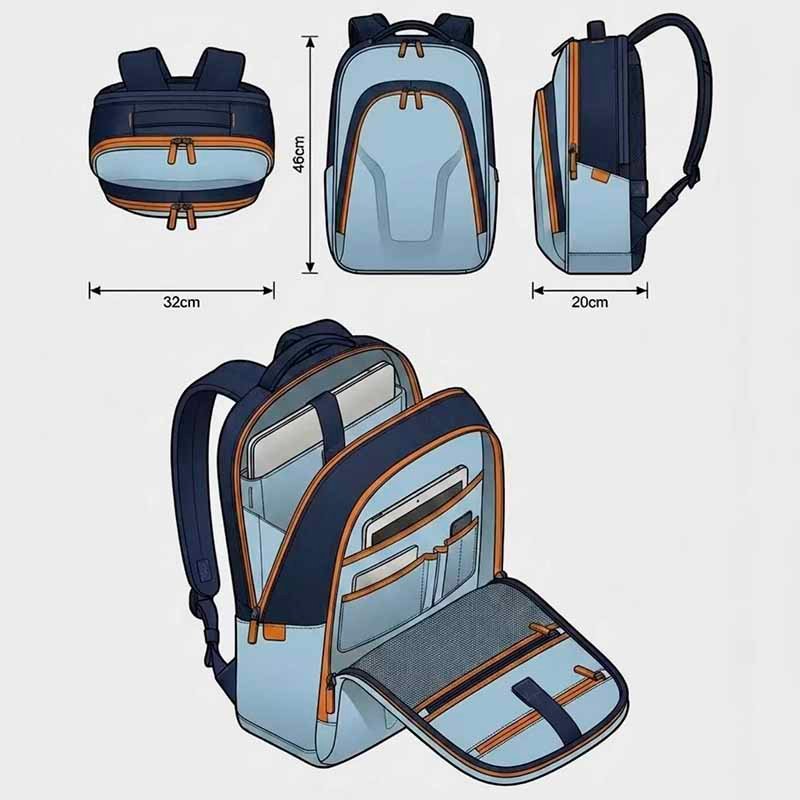
A technical drawing with front, back, side, bottom, and interior views makes these requirements easier to understand. For a backpack, the drawing should identify shoulder strap construction, laptop compartment dimensions, zipper positions, and back padding. For a cosmetic bag, the opening width, lining material, internal pockets, and zipper construction may be more important. If the bag has a special function, such as insulation, water resistance, or load-bearing requirements, those features should be described separately rather than left to interpretation.
Importers do not need to have every technical detail finalized before contacting a factory. A reference product, several clear photographs, or an initial sketch can provide a useful starting point. At Szoneier, our development team can review the available information, identify missing specifications, and help turn an initial idea into a workable manufacturing brief.
Define the Product’s Application and Target Market
The intended application should guide the entire product development process. Two bags with similar external shapes may require completely different materials, construction methods, and quality requirements depending on how customers will use them. A shopping tote, for example, may need a lightweight structure and a practical carrying handle, while a premium retail tote may require heavier fabric, a more structured bottom, refined stitching, and customized packaging.
Before requesting a quotation, importers should define four important factors. First, identify the sales channel. Products intended for Amazon, Shopify, independent retail stores, wholesale distribution, corporate gifts, or promotional campaigns may have different packaging, labeling, and inventory requirements. Second, identify the end user. A travel bag designed for frequent business travelers should prioritize organization, carrying comfort, and durability, while a lightweight promotional bag may prioritize affordability, easy storage, and a large printable surface.
Third, establish the product’s expected market positioning. Entry-level, mid-range, and premium products require different approaches to materials, accessories, workmanship, and packaging. A manufacturer should understand the intended positioning before recommending cost-saving alternatives. Finally, describe the operating environment. Products exposed to rain, sunlight, frequent friction, heavy contents, or repeated washing need appropriate material and construction specifications. A water-resistant coating, for example, should not automatically be treated as proof that the entire finished bag is waterproof.
Szoneier supports a broad range of custom bag applications, including tote bags, backpacks, drawstring bags, cosmetic bags, cooler bags, travel bags, beach bags, neoprene products, leather goods, tool bags, and other functional soft goods. Identifying the intended application early helps our team recommend suitable materials and construction methods rather than simply reproducing an attractive reference photograph.
Provide Drawings, Materials, and Branding Details
A good quotation depends on accurate product information. When an importer provides only a general product description, the manufacturer may need to make assumptions about dimensions, materials, construction, and accessories. These assumptions can create differences between the initial quotation and the final production cost. Providing clear technical details at the beginning helps avoid unnecessary revisions and makes it easier to compare quotations from different factories.
For dimensions, use consistent measurement methods and identify the exact points being measured. A backpack’s height should not be confused with its usable internal height, while a tote bag’s width may need to distinguish between the top opening and the bottom panel. If the bag has a curved shape or expandable gusset, provide additional measurements or a drawing. Material descriptions should also go beyond general names. Specifying polyester does not identify the exact fabric construction. A complete description may include denier, fabric weight, thickness, coating, backing, color, and surface finish.
Branding information should include the original logo artwork, preferred application method, dimensions, and exact placement. Vector files such as AI, EPS, or suitable PDF artwork are generally more useful for manufacturing than small, compressed images. If the logo is an important part of the product’s identity, its appearance should be checked on the actual material rather than approved only from a digital preview.
The following example illustrates the type of information that can help a manufacturer prepare an initial quotation:
| Specification | Example |
|---|---|
| Product type | Travel backpack |
| Finished dimensions | 45 × 30 × 18 cm |
| Main material | 600D polyester |
| Lining | 210D polyester |
| Closure | Nylon zipper |
| Structure | Main compartment, front pocket, laptop compartment |
| Branding | Embroidered logo, 8 × 5 cm |
| Color | Black with customized lining |
| Order quantity | 500 / 1,000 / 3,000 pcs |
| Destination | Confirmed country and delivery address |
| Packaging | Individual polybag and export carton |
These figures are an illustrative specification format, not a universal backpack standard. The actual dimensions and materials should be selected according to the intended product. When some details remain undecided, separate confirmed requirements from optional preferences. This allows Szoneier to assess the essential product first and identify which additional features would affect the final cost.
Which Manufacturer and Sourcing Model Fit Your Project?

The right manufacturing partner should demonstrate relevant product experience, genuine production resources, technical development capabilities, quality management, and export coordination. Importers should evaluate the manufacturer’s ability to develop and reproduce their specific product rather than relying only on website claims, factory photographs, or the lowest quotation.
Verify the Factory Behind the Quotation
One of the most important sourcing decisions is determining who will actually manufacture the bags. Some suppliers operate their own production facilities, while others coordinate production through external factories. Both arrangements can work, but the importer needs to understand where production takes place and who is responsible for quality, scheduling, and technical decisions. A supplier’s commercial office, sample room, and production workshop may not all be located at the same facility, so these details should be verified before a major order is placed.
A factory visit or video inspection can reveal much more than a company introduction. Importers should look at cutting equipment, sewing lines, sample development areas, raw material storage, finished product warehouses, and the way production orders are managed. It is also important to understand whether the supplier has a dedicated development team. Custom bag manufacturing often requires pattern making, material evaluation, structural adjustments, and repeated sample revisions. If these activities are handled by unrelated subcontractors, communication can become slower and technical feedback may lose important details.
Szoneier is a Shenzhen-based custom bags and soft goods OEM/ODM manufacturer with more than 18 years of manufacturing experience. Our documented manufacturing system covers more than 20,000 square meters and is supported by over 180 team members, eight sewing production lines, and more than 160 production and support machines. We also maintain a sample room exceeding 500 square meters and a pattern and sampling workshop exceeding 300 square meters. These resources support product development, material preparation, sampling, production, inspection, and shipment preparation.
Factory size alone should never determine supplier selection. A large facility may still be unsuitable for a highly specialized product, while a smaller manufacturer with strong product-specific expertise may deliver better results. Importers should request evidence covering the actual product category, including production examples, equipment, sampling capabilities, workforce, material sourcing, quality procedures, production scheduling, and export experience.
For larger orders, multi-SKU collections, or long-term programs, importers may also arrange an on-site factory visit, video factory review, or independent third-party audit. These measures provide additional visibility into the production environment and help establish a clearer understanding of the manufacturer’s actual responsibilities.
Choose Between OEM, ODM, and Private Label
OEM, ODM, and private label manufacturing offer different levels of product development and customization. The most suitable model depends on how much design work the importer has completed and how much support is needed from the manufacturer. Understanding these differences before requesting a quotation makes it easier to define responsibilities, estimate development costs, and establish a realistic sample schedule.
OEM is generally suitable for businesses that already have a detailed product design, technical drawings, material specifications, and clear manufacturing requirements. The manufacturer follows the agreed specifications and produces the bags accordingly. This model is useful for established brands with internal design teams or companies that have already developed a proven product.
ODM is more suitable when the importer has a product concept but needs assistance with product development. The manufacturer may help select materials, adjust dimensions, improve construction, recommend accessories, and develop a workable sample. For example, a company may want a travel organizer with several compartments but may not have finalized the internal structure. ODM development allows the factory’s technical team to help turn that idea into a manufacturable design.
Private label manufacturing usually involves adding a customer’s brand identity to an existing or modified product design. This may include customized logos, labels, colors, packaging, and selected structural changes. However, the exact level of customization should be confirmed because different suppliers use the term in different ways.
These models are not always completely separate. A project may begin with ODM product development and move into OEM production after the design and specifications have been approved. Szoneier supports both OEM and ODM custom bag projects, including design assistance, material selection, pattern development, sampling, branding, and bulk manufacturing. This allows importers to discuss product feasibility and manufacturing improvements within a connected development process.
Regardless of the selected model, intellectual property ownership, design usage rights, confidentiality, tooling ownership, and restrictions on unauthorized production should be clearly established in the commercial agreement. These points become particularly important when a project involves original brand artwork, custom molds, or exclusive product structures.
Compare Manufacturers Using Evidence, Not Just Prices
A quotation is useful only when the specifications behind it are understood. Two factories may quote different prices for products that appear identical in a photograph, but the actual differences may involve material weight, lining quality, zipper specifications, reinforcement, logo methods, or packaging. Comparing prices without confirming these details can lead to an incorrect purchasing decision.
For a meaningful comparison, send the same technical requirements to every supplier and request an itemized quotation. Ask each manufacturer to identify any assumptions, exclusions, or proposed substitutions. Confirm whether the same material specifications are being used, whether all accessories are included, and whether sample development, packaging, and export expenses are charged separately.
The ability to explain manufacturing decisions is often more valuable than simply providing a low price. If a factory recommends a different zipper, lining, or reinforcement method, it should explain the practical reason and the effect on cost and product performance. Importers should also ask how production changes are handled. If a material becomes unavailable after sample approval, will the manufacturer request approval before replacing it? If an accessory needs to be modified, will the new specification be documented?
For larger projects, evaluate the supplier across several areas rather than focusing on one attractive quotation. Consider product development capabilities, production resources, sample quality, inspection procedures, delivery reliability, and communication. A supplier that provides clear technical explanations and documents important changes can help reduce problems during production and future replenishment.
At Szoneier, we encourage importers to compare quotations using the same product specifications and to discuss any cost-saving alternatives before sample approval. This helps ensure that price adjustments do not unintentionally reduce important product features or compromise the expected quality.
Which Materials and Construction Choices Should Importers Specify?

Importers should select materials and construction methods according to product application, durability, appearance, weight, budget, and required functionality. The finished bag depends on the interaction between its outer fabric, lining, reinforcement, zippers, hardware, stitching, and accessories, so every major component should be considered as part of one complete construction system.
Select Fabrics According to Product Performance
Fabric selection has a direct influence on the bag’s appearance, weight, durability, manufacturing cost, and intended use. However, choosing a fabric based only on its name is rarely sufficient. Different grades of polyester, nylon, canvas, and coated materials can behave differently even when their general descriptions appear similar. Importers should consider the actual fabric construction, weight, thickness, coating, backing, and finishing before confirming a material.
Polyester is commonly used in backpacks, tote bags, promotional bags, and storage products because it offers a wide range of weights, textures, and coatings. Nylon is frequently selected for travel and outdoor applications where lightweight construction and suitable abrasion performance are important. Canvas provides a more natural appearance and is often used in shopping bags, lifestyle products, and fashion accessories. Oxford fabric is available in different constructions and specifications for backpacks, tool bags, and functional products.
PU and PVC materials are useful for products requiring particular surface appearances, flexibility, or easier surface cleaning. Neoprene is used for selected protective sleeves, bags, and soft accessories because of its cushioning and elastic characteristics. EVA is commonly used in molded or semi-rigid protective cases. RPET can be considered for projects seeking recycled-material options, provided that the material’s composition and relevant documentation are verified.
| Material | Common Applications | Important Specifications |
|---|---|---|
| Polyester | Backpacks, totes, promotional bags | Denier, coating, weight |
| Nylon | Travel and outdoor bags | Fabric weight, weave, finish |
| Oxford | Backpacks, tool bags | Denier, backing, thickness |
| Canvas | Shopping and lifestyle bags | GSM, weave, finishing |
| PU | Handbags, cosmetic bags | Thickness, surface finish |
| PVC | Clear bags, functional products | Thickness, flexibility |
| Neoprene | Protective sleeves, soft bags | Thickness, density, elasticity |
| EVA | Protective molded cases | Density, hardness, structure |
These are common application examples rather than fixed material specifications. Actual suitability depends on the construction, product requirements, and intended environment. Importers should pay particular attention to coating and backing specifications. A fabric described as water-resistant may provide useful protection against light moisture, but the finished bag can still allow water through seams, openings, and zipper areas.
Color consistency is another important issue. When multiple rolls or batches are used, differences in dyeing and finishing may create visible variations between production lots. For repeat orders, retaining approved swatches and documenting material specifications can help reduce this risk. At Szoneier, we help compare available materials according to product application, cost, appearance, and manufacturing feasibility before final sample approval.
Specify Components and Construction Details
The outer fabric creates the bag’s general appearance, but internal components and construction determine much of its practical performance. Many common bag defects occur at stress points, especially where handles, straps, zippers, and hardware are attached. These areas experience repeated pulling, friction, and concentrated loads, so their construction should be reviewed carefully during development.
For a backpack, shoulder strap construction deserves particular attention. The width of the webbing, foam thickness, stitching pattern, reinforcement patches, and attachment position all influence carrying comfort and structural performance. For a travel bag, the bottom panel may need additional reinforcement because it experiences repeated contact with floors and concentrated loading. For a cosmetic bag, zipper alignment and lining construction may be more important because the product is opened and closed frequently.
The main components should be evaluated individually:
- Lining: Consider fabric type, color, coating, cleaning requirements, and internal appearance.
- Zippers: Confirm zipper type, size, length, puller, and opening direction.
- Webbing: Specify material, width, thickness, color, and intended load.
- Hardware: Confirm dimensions, material, surface finish, and attachment method.
- Foam: Specify thickness, density, location, and cushioning requirements.
- Reinforcement: Identify stress points, bottom panels, and handle attachment areas.
- Thread: Confirm suitable thread type, color, and stitching requirements.
It is also important to consider how the product will be manufactured. A design with several narrow pockets, curved panels, and concealed zippers may require more complicated cutting and sewing operations. The appearance may be attractive, but the additional labor and assembly time need to be reflected in the quotation. A professional manufacturer should be able to explain when a particular construction method is difficult to reproduce and whether a small design adjustment could improve durability or manufacturing efficiency.
Choose the Right Branding and Maintain a BOM
Branding is a major part of product identity, especially for private label collections and retail products. The chosen logo technique should match the surface material, artwork complexity, expected usage, and desired appearance. Screen printing works well for many fabric bags with relatively straightforward artwork. Embroidery creates a textured appearance but may not be suitable for extremely small details or lightweight fabrics that distort easily. Heat transfer is useful for selected designs and surfaces, while woven labels provide a practical solution for brand identification and care information.
For more premium products, metal logo plates, embossed branding, molded rubber patches, and custom zipper pullers may be considered. However, some of these options involve mold or tooling costs and may require higher minimum quantities. Importers should confirm whether the branding process needs separate development, whether a standard accessory can be used, and whether the selected technique is compatible with the outer material.
A Bill of Materials, commonly called a BOM, should record the specifications of all important components. It should include the main fabric, lining, foam, zippers, hardware, webbing, labels, logos, thread, and packaging materials. Each component should have an identifiable specification rather than a general description. For example, writing black nylon zipper is less useful than recording the zipper type, size, length, puller specification, and approved appearance.
The BOM should also be linked to the correct product SKU and sample revision. This is particularly important when an importer manages several bag styles with similar appearances but different construction details. Before bulk production, the importer should confirm whether the selected materials and accessories are available in the required quantities. If an alternative component is proposed, its specifications should be reviewed and approved before it enters production.
Maintaining these records makes future orders easier to manage and reduces the risk of unapproved material substitutions. At Szoneier, BOM confirmation and approved material records form part of the product development and production preparation process, helping connect the final sample with the specifications used for bulk manufacturing.
How Do MOQ, Pricing, and Lead Times Affect Import Costs?
MOQ, product complexity, material purchasing, manufacturing labor, branding, packaging, and production scheduling all influence the cost of custom bags. Importers should compare complete project costs rather than factory unit prices alone, while calculating freight, duties, taxes, and destination expenses to understand the actual landed cost of each sellable product.
Understand MOQ and Its Relationship with Manufacturing Costs
Minimum Order Quantity is the smallest production quantity a manufacturer accepts under particular product and material conditions. In custom bag manufacturing, MOQ is influenced by material supplier requirements, production preparation, cutting efficiency, logo processing, hardware sourcing, and packaging arrangements. It is therefore important to understand whether the stated MOQ applies to the total order, each design, each color, or each material specification.
Szoneier supports MOQ starting from 200 pieces for many standard custom bag projects. This provides flexibility for businesses testing new products, launching a small collection, or evaluating demand before committing to larger production quantities. However, 200 pieces should not be interpreted as a universal MOQ for every design. Projects involving custom-dyed materials, specialized functional fabrics, custom hardware, molded logos, jacquard webbing, or complex structures may require higher quantities or additional development costs.
The main factors influencing MOQ include:
- Fabric purchasing: Standard materials and stock colors are generally easier to arrange than custom-dyed fabrics.
- Logo processing: Simple printing may have different production requirements from custom molds or metal accessories.
- Hardware: Special zipper pullers, buckles, and branded components may have supplier minimums.
- Product complexity: More complicated construction can require additional preparation and production coordination.
- Packaging: Customized retail boxes, printed inserts, and branded packaging may introduce separate minimums.
- Color quantities: Multiple colors may require separate material purchases and production arrangements.
Importers should ask whether MOQ applies to the total order, each design, each color, or each material specification. This distinction matters when ordering a collection with several SKUs. One practical way to manage a smaller initial order is to use standard fabric colors, existing accessories, simplified packaging, and a proven product structure. This reduces the number of customized components that need to be purchased or developed separately.
The objective should be to find a quantity that supports reasonable manufacturing costs without creating unnecessary inventory risk. For growing brands, a carefully planned first order followed by repeat replenishment may be more practical than committing to a large quantity before market demand has been established.
Calculate the Complete Cost of a Custom Bag
A factory quotation usually covers the manufacturing cost under a specified trade term, but it may not include every expense associated with importing the finished product. To compare quotations properly, importers should identify which costs are included and which are charged separately. The largest cost driver is not always the outer fabric. Compartments, reinforcement, custom accessories, packaging, and additional production operations can have a significant influence on the final price.
The main cost categories are:
- Product materials and accessories.
- Cutting, sewing, assembly, and finishing labor.
- Logo development and application.
- Sample development and revisions.
- Mold or tooling charges where applicable.
- Individual and export packaging.
- Inspection and testing expenses.
- Export handling and freight.
- Insurance, customs duties, and applicable taxes.
- Destination handling and final delivery.
Consider an illustrative order of 1,000 custom bags:
| Cost Item | Example Cost |
|---|---|
| 1,000 bags at $6.00 each | $6,000 |
| Sampling and development | $180 |
| Additional packaging | $300 |
| Freight and insurance | $900 |
| Import duties and taxes | $1,200 |
| Destination handling | $250 |
| Total project cost | $8,830 |
| Cost per unit | $8.83 |
The figures are hypothetical and do not represent an actual Szoneier quotation. Actual landed costs depend on product specifications, shipment details, destination-country customs rules, and the applicable trade agreement.
This example illustrates an important point: a product quoted at $6.00 per unit can have a landed cost of $8.83 per unit after the other expenses are included. Importers should therefore compare the total cost of receiving sellable goods rather than choosing a manufacturer solely according to the lowest factory quotation.
It is also important to distinguish between fixed development expenses and variable production costs. Sample development, molds, and certain artwork preparation costs may be one-time expenses, while materials, labor, and packaging normally recur with each production order. For long-term product programs, calculating costs at different order quantities can reveal whether a larger production run offers meaningful savings. However, the additional inventory must be justified by realistic sales forecasts and available working capital.
Plan Lead Times and Production Schedules Realistically
Lead time is the period required to complete a specific stage or an entire order. Importers should distinguish sample development time, material purchasing time, bulk production time, inspection time, and international transit time. A quotation that states only the production duration may not represent the actual period from order confirmation to warehouse delivery.
A factory may require time to source custom-colored fabric before cutting can begin. If the product also requires custom hardware, printed packaging, or special labels, those components may introduce additional dependencies. The production schedule should therefore identify which activities can run in parallel and which depend on customer approval.
A practical project schedule should identify the following stages:
- Product specification and technical confirmation.
- Material and accessory approval.
- Sample development and revisions.
- Final sample approval.
- Material purchasing and production preparation.
- Bulk manufacturing.
- In-process inspection and finished product QC.
- Packaging and shipment preparation.
- International transportation and customs clearance.
Szoneier’s indicative bulk production planning references vary according to product complexity and manufacturing requirements. Simple tote and drawstring bags may require approximately 20–30 days, pouches and cosmetic bags around 25–35 days, cooler bags around 30–40 days, backpacks and duffle bags around 35–45 days, and more complicated functional products may require 40–60 days or longer. These are planning references rather than guaranteed delivery periods, and the actual schedule depends on order quantity, material availability, factory workload, and packaging requirements.
For importers preparing for a seasonal launch, it is advisable to establish an internal deadline earlier than the required warehouse receiving date. This provides room for sample revisions, production changes, inspection, and shipping delays without immediately affecting the selling schedule. At Szoneier, our manufacturing and project management teams coordinate material preparation, production scheduling, quality checks, and shipment preparation to keep these activities connected.
How Are Samples, Bulk Production, and Quality Controlled?
Reliable bag production requires a documented approval process and quality checks throughout manufacturing. Importers should confirm the final sample, BOM, material specifications, construction requirements, and inspection criteria before mass production. Materials, cutting, sewing, finished products, and packaging should then be checked against the approved standards to reduce inconsistencies and avoid costly rework.
Develop and Approve Samples Before Bulk Production
Sampling is where a product concept becomes a physical manufacturing reference. It allows the importer and manufacturer to evaluate the actual dimensions, materials, structure, appearance, and functionality before committing to a larger order. A sample should be treated as a development tool rather than simply a smaller version of the final commercial product because it helps identify problems that may not be visible in drawings or photographs.
For example, a backpack may look correct in a technical drawing, but the first physical sample could reveal that the shoulder straps are uncomfortable, the laptop compartment is too narrow, or the front pocket cannot accommodate the intended contents. Similarly, a cosmetic bag may have the correct external dimensions but an opening that is too small for convenient use. These problems are easier to correct during sampling than after bulk production begins.
A typical development process includes:
- Review the product concept, drawings, or reference sample.
- Confirm the basic dimensions and construction.
- Select suitable fabrics, linings, and accessories.
- Prepare patterns and cutting specifications.
- Produce the initial sample.
- Review appearance, function, and workmanship.
- Record feedback and complete necessary revisions.
- Approve the final sample and related specifications.
Importers should provide feedback using specific comments and marked photographs. Instead of saying that a bag looks too soft, identify the panel that needs additional structure and discuss whether a different foam thickness or internal reinforcement would solve the problem. This makes revisions easier to understand and reduces repeated communication.
Szoneier’s sample development facilities include a dedicated sample room and pattern-making workshop, supporting product development from initial concepts and reference samples through physical prototyping. Before approving the sample, check dimensions, material appearance, zipper operation, handle construction, pocket arrangement, logo placement, internal finishing, and packaging where applicable. The approved sample should then be identified and retained as the reference for bulk production.
Control Bulk Production Through Defined QC Stages
Quality control should not be left until all bags have been manufactured. By that point, a problem with material thickness, cutting dimensions, or stitching may already affect hundreds or thousands of products. An effective inspection system checks materials before production, monitors critical manufacturing operations, and verifies finished products before packing.
Szoneier’s quality management approach covers eight major inspection stages:
- Raw material inspection: Check fabric type, color, thickness, coating, and visible defects.
- Accessory inspection: Verify zippers, buckles, hardware, webbing, and other components.
- Pre-production approval: Confirm the approved sample, BOM, patterns, and specifications.
- Cutting inspection: Review panel dimensions, shape, and cutting accuracy.
- Sewing inspection: Check stitching, seam alignment, attachment, and reinforcement.
- Semi-finished inspection: Examine compartments, internal structure, and component attachment.
- Finished product inspection: Check appearance, dimensions, functions, and workmanship.
- Packaging inspection: Verify labels, quantities, carton details, and packing requirements.
The inspection priorities should vary according to the product. For a backpack, attention should be given to shoulder strap attachments, zipper operation, bottom reinforcement, and compartment dimensions. For a cooler bag, inspection should include lining condition, insulation structure, zipper closure, and relevant functional requirements. Cosmetic bags require attention to surface appearance, stitching, logo quality, and internal cleanliness, while tool bags need stronger attention to handle strength, bottom construction, compartment layout, and hardware attachment.
Importers should define acceptable measurement tolerances and defect classifications before production. If an AQL inspection is required, the sampling level, defect categories, acceptance criteria, and applicable inspection standard should be agreed upon in advance. AQL is a statistical sampling method used to make an inspection decision about a production lot; it does not mean that every product is individually tested or guarantee zero defects.
Third-party inspection can provide additional independent verification, especially for large orders or products with strict quality requirements. Szoneier can also coordinate production progress reporting through photographs and videos, helping overseas customers review important stages without needing to visit the factory personally.
Maintain Production Records for Repeat Orders
A product that meets the required quality standard in its first order should be capable of being reproduced consistently in future orders. This is particularly important for companies supplying retail stores, established brands, and online sales channels where product appearance and functionality must remain stable. Repeat-order problems often occur because important specifications were not recorded properly.
The original sample may have used a particular fabric batch, zipper model, or foam thickness, but the next production run may use a slightly different component. Even a small substitution can affect the bag’s appearance, feel, or performance. Maintaining a complete production record for every SKU helps reduce these risks.
The record should include:
- Approved sample and revision number.
- Final technical drawing and measurements.
- Confirmed BOM and material specifications.
- Fabric and accessory references.
- Logo artwork and application details.
- Pattern and construction specifications.
- Approved packaging and labeling artwork.
- Inspection requirements and defect classifications.
- Customer-approved modifications.
When a manufacturer proposes changing a material or accessory, the importer should review the difference before approving it. A substitute zipper may appear similar but have different operating characteristics, while a different lining may change the feel and internal appearance of the product. For orders involving several colors or designs, each SKU should have its own approved specifications.
Production records also help when an importer wants to improve a product after receiving customer feedback. Instead of redesigning the entire bag, the development team can identify the specific component or construction detail that needs adjustment. For long-term cooperation, sample approval, BOM control, production inspection, and change documentation should form one connected process.
At Szoneier, we use approved samples, confirmed material records, production specifications, and inspection procedures to support both first orders and future replenishment. This gives our team a clearer manufacturing reference and helps customers maintain product consistency as their collections grow.
How Do Importers Manage Freight, Customs, and Final Delivery?

Importers should arrange freight, customs, and delivery requirements before bulk production is completed. They need to confirm the applicable Incoterm, shipping responsibilities, customs documentation, HS classification, packaging specifications, destination requirements, and transport method. The most suitable logistics arrangement depends on shipment volume, destination, urgency, budget, and the importer’s ability to manage import procedures.
Select the Right Incoterm and Clarify Responsibilities
Incoterms define the responsibilities of sellers and buyers for delivery, transportation costs, risk transfer, and certain customs formalities. Choosing the correct term helps prevent disagreements about who arranges freight, handles export clearance, pays import duties, or organizes destination delivery. The International Chamber of Commerce’s Incoterms 2020 rules provide standardized definitions for these responsibilities, but they do not replace the complete sales contract.
For custom bag imports from China, EXW, FOB, CIF, DAP, and DDP are frequently discussed.
- EXW (Ex Works): The seller makes the goods available at the agreed location, usually the factory or warehouse. The buyer arranges collection and transportation. Export clearance under EXW can create practical difficulties for overseas buyers, so FCA may be worth considering depending on the shipment arrangement.
- FOB (Free on Board): The seller handles export clearance and delivers the goods on board the vessel at the named port. The buyer arranges the main sea transportation and import clearance.
- CIF (Cost, Insurance and Freight): The seller arranges sea freight and minimum insurance to the named destination port. Risk transfers when the goods are loaded on board the vessel at the origin port, not when they arrive at the destination.
- DAP (Delivered at Place): The seller arranges delivery to the named destination, while the buyer handles import clearance and applicable import duties and taxes.
- DDP (Delivered Duty Paid): The seller takes broader responsibility for delivery and import clearance, including applicable duties and taxes, subject to the seller’s ability to meet the relevant legal and tax requirements.
Importers should confirm the exact named place or port and use the applicable Incoterms 2020 rules. The trade term should also be consistent with the commercial quotation and sales contract. FOB is intended for sea and inland waterway transport, while FCA is often more suitable for containerized or multimodal shipments. This distinction matters when arranging air freight or container shipments that are handed to a carrier before being loaded onto a vessel.
The choice should reflect the actual responsibilities rather than simply the apparent convenience of a quotation. DDP, for example, may simplify destination delivery, but importers should confirm which duties, taxes, unloading charges, inspections, and additional destination fees are included. At Szoneier, we coordinate available shipping arrangements according to the destination, quantity, carton volume, and required delivery conditions.
For reference, importers can consult the International Chamber of Commerce’s Incoterms 2020 guidance and its Incoterms 2020 checklist.
Prepare Customs Documents and Verify Product Classification
Customs clearance depends on accurate shipment information. The commercial invoice, packing list, product description, declared value, country of origin, and transport documents should be consistent with the actual goods. Missing or inconsistent information can lead to customs questions, shipment holds, additional costs, or incorrect duty assessments.
For custom bag shipments, the main documents may include:
- Commercial invoice.
- Packing list.
- Bill of lading or air waybill.
- Certificate of origin, where required.
- Insurance certificate, where applicable.
- Product test reports, when relevant.
- Export and import customs declarations.
- Additional permits or supporting documents required by the destination market.
One of the most important details is the HS code. Different bags may have different customs classifications depending on their outer surface material, construction, intended use, and other classification rules. Textile backpacks, leather handbags, plastic bags, and specialized protective cases should not automatically be assigned the same classification.
Importers should confirm the applicable tariff classification with their customs broker or relevant customs authority before shipment. For US imports, the Harmonized Tariff Schedule is the reference used to determine applicable tariff classifications and rates. The US Customs and Border Protection agency advises new importers to provide a complete description of the merchandise, including its country of origin, composition, intended use, and value. Importers may also seek a written classification ruling where appropriate.
The declared customs value must be accurate and consistent with applicable valuation rules. Importers should not request undervalued invoices or misleading product descriptions to reduce duties. Incorrect declarations can result in customs delays, additional charges, penalties, or other compliance problems. Country of origin should also be confirmed separately from the shipping location. A product shipped from China may have different origin considerations depending on where and how it was manufactured and whether the applicable origin rules are satisfied.
Szoneier can support shipment preparation by coordinating product descriptions, packing information, commercial invoices, packing lists, and other relevant export details. Importers should still confirm destination-specific requirements with their customs broker, particularly when importing products with special materials or functional applications.
Useful references include US Customs and Border Protection’s commercial invoice requirements and its guidance for new importers.
Coordinate Packaging, Freight, and Final Delivery
Packaging and logistics should be considered together because the way a bag is packed affects carton dimensions, shipping volume, product protection, and warehouse handling. A large shipment of soft bags may be packed efficiently when the products can be folded without damaging their shape or surface finish. Structured bags, protective cases, and products containing foam or molded components may require more careful packaging to prevent deformation.
Before production is completed, confirm the following information:
- Individual product packaging.
- Folding or packing method.
- Units per carton.
- Carton dimensions.
- Gross and net carton weight.
- Carton strength and protection requirements.
- SKU and color identification.
- Barcode and carton label placement.
- Shipping marks and pallet requirements.
- Final delivery address and receiving instructions.
For air freight, the carrier may charge according to actual gross weight or volumetric weight, depending on its applicable rules. A large but lightweight shipment can therefore cost more than expected if the cartons occupy considerable space. For sea freight, shipment volume is especially important when arranging LCL cargo. Importers should calculate carton dimensions and total cubic meters before comparing freight quotations.
The choice of transportation method should reflect the actual business requirement. Express courier is useful for samples and urgent small shipments. Air freight is suitable when stock is needed quickly, while sea freight is often more economical for larger commercial orders. Railway transportation may be an alternative on suitable routes, depending on destination, availability, and transit conditions.
Split shipments can also help importers balance launch schedules and freight budgets. For example, an initial quantity may be sent by air to support a product launch, while the remaining goods travel by sea for later replenishment. This approach introduces additional coordination and shipment costs, so the benefits should be compared with the extra expenses.
For Amazon FBA shipments, importers should provide the correct FNSKU files, carton labels, SKU information, packaging instructions, and receiving warehouse details. Szoneier can support product labeling, carton labeling, carton information checks, FBA first-leg shipping, overseas warehouse delivery, and multi-address shipment coordination based on the customer’s requirements.
The final delivery plan should be confirmed before the goods leave the factory. This includes the consignee information, destination address, customs clearance arrangement, shipping method, required documents, and expected receiving schedule. A well-coordinated process allows the manufacturer, freight forwarder, customs broker, and importer to work from the same shipment information. It also reduces the chance of finished goods being delayed because of missing labels, incorrect carton details, or unclear delivery responsibilities.
Conclusion: Build a More Reliable Custom Bag Supply Chain with Szoneier
Successful custom bag importing depends on making the right decisions before, during, and after production. A competitive factory price is important, but it should never be the only factor used to evaluate a manufacturer. Product specifications, material consistency, sampling, production capacity, quality control, customs documentation, and delivery arrangements all influence the final cost and commercial success of an imported bag collection.
For companies working with manufacturers in China, the most practical approach is to establish clear product requirements, verify factory capabilities, approve physical samples, document the BOM, and calculate landed costs before confirming a bulk order. These steps create a more predictable purchasing process and make it easier to manage repeat orders, seasonal launches, and product line expansion.
Szoneier is a Shenzhen-based custom bags and soft goods OEM/ODM manufacturer with more than 18 years of manufacturing experience. Our services cover product development, material sourcing, pattern making, sampling, bulk production, quality inspection, packaging, and international shipment coordination. With many standard custom bag projects starting from 200 pieces, we support importers looking to develop new products, test market demand, and build long-term manufacturing partnerships.
Whether you are sourcing custom tote bags, backpacks, cooler bags, cosmetic bags, travel bags, functional bags, or specialized soft goods, the goal should be the same: develop a product that meets your market requirements, can be manufactured consistently, and can be delivered according to your commercial plan. At Szoneier, we focus on connecting product development with practical manufacturing and delivery capabilities, helping turn product ideas into finished bags ready for their intended markets.
Frequently Asked Questions About Custom Bag Manufacturing for Importers
1. What Is the MOQ for Custom Bag Manufacturing in China?
MOQ depends on product type, material, structure, logo method, accessories, and packaging. Szoneier supports a standard MOQ starting from 200 pieces for many regular custom bag projects, including selected tote bags, drawstring bags, cosmetic bags, pouches, and basic backpacks. Projects involving custom-dyed materials, special functional fabrics, custom hardware, molded logos, or complex construction may require higher quantities. Importers should confirm whether the MOQ applies to the total order, each style, or each color.
2. How Long Does It Take to Manufacture Custom Bags?
Bulk production time depends on product complexity, order quantity, material availability, logo processes, packaging, and factory scheduling. As a general planning reference, simple tote bags may take 20–30 days, cosmetic bags 25–35 days, cooler bags 30–40 days, backpacks 35–45 days, and more complex functional bags 45–60 days or longer. Importers should also allow time for sampling, material purchasing, inspection, shipping, and customs clearance when calculating the complete delivery schedule.
3. How Much Does It Cost to Manufacture Custom Bags?
Custom bag manufacturing costs depend on dimensions, materials, thickness, construction, compartments, zippers, hardware, logo techniques, packaging, and order quantity. Importers should request an itemized quotation based on an approved product specification. They should also calculate sampling, shipping, customs duties, taxes, and destination handling to determine the actual landed cost per unit. Comparing quotations using identical specifications provides a more accurate basis for selecting a manufacturing partner.
4. Can Importers Order Custom Bags with a Low MOQ?
Yes. Many manufacturers support lower quantities for standard bag designs using available materials, regular colors, standard accessories, and simple logo methods. Szoneier supports MOQ from 200 pieces for many standard custom bag projects. Special materials, custom hardware, complicated structures, and customized packaging may increase the minimum order quantity. Choosing standard materials and simplifying unnecessary customization can make smaller production runs more practical.
5. How Can Importers Ensure Custom Bag Quality Before Shipment?
Importers should approve a physical sample, confirm the BOM, establish material and construction specifications, and agree on inspection standards before bulk production. Quality checks should cover incoming materials, accessories, cutting, sewing, semi-finished products, finished bags, and packaging. Third-party inspection can also be arranged when required. Keeping approved samples and production records helps maintain consistency between the initial order and future replenishment.
6. Which Incoterms Are Best for Importing Custom Bags from China?
The appropriate Incoterm depends on the importer’s logistics experience and desired division of responsibilities. FOB is commonly used for sea freight when the buyer arranges the main transportation. CIF includes seller-arranged sea freight and minimum insurance, while DAP and DDP provide more destination delivery support. Importers should confirm the named delivery location, customs clearance, duties, taxes, risk transfer, and any excluded destination charges before signing the agreement.
7. Can Szoneier Ship Custom Bags Directly to Amazon FBA Warehouses?
Szoneier can support Amazon FBA first-leg shipping and related preparation, including product labeling, FNSKU handling, carton labels, packing information, and shipment coordination based on the customer’s approved requirements. Importers should provide the correct SKU information, barcode files, carton specifications, and warehouse destination details. Current Amazon packaging, labeling, and shipment requirements should be verified before production and shipment.