Skip to content
A beautiful sample can make a supplier look convincing, but documentation shows whether that same result can be repeated across thousands of units, several colors, multiple SKUs, different packaging versions, and international shipments. Many expensive manufacturing problems do not begin at the sewing line. They begin much earlier, when an approved material was never recorded, a logo revision remained buried in a message thread, a test report covered a different product, or a packing instruction was understood differently by two teams.
A professional bag manufacturer should provide documents that establish four things: who is responsible for the order, exactly what product has been approved, how production and quality will be controlled, and what evidence is required before shipment. The core file commonly includes company information, quotation and specifications, tech pack or BOM records, sample approvals, quality documents, applicable test reports, packaging instructions, commercial invoice, packing list, and shipment-related paperwork.
The exact package should match the complexity and risk of the project. A straightforward 500-piece canvas tote does not need exactly the same documentation as a children’s backpack, technical waterproof bag, multi-SKU retail launch, or long-term replenishment program. The useful question is therefore not, “How many documents can this factory send me?” It is, “If someone joins this project six months from now, can the documents clearly show what was agreed, produced, inspected, and shipped?” That question usually reveals whether the supplier is merely processing an order or managing a manufacturing program.
What Company Documents Should a Bag Manufacturer Provide?

A bag manufacturer should provide enough company, factory, audit, certification, and commercial information to establish who is accepting the order, where production is managed, and which organization remains responsible for the finished goods. Useful evidence can include business registration, factory details, quotation information, relevant certificates or audits, factory verification materials, and current copies of any documents specifically required by the customer’s sourcing policy.
Verify the Legal and Commercial Entity
The first documents are often the least exciting, yet they can prevent some of the most difficult sourcing disputes. Before committing a substantial deposit, the purchasing team should understand which legal entity is issuing the quotation, which entity will receive payment, where the manufacturing site is located, which organization will appear on commercial documents, and which team is responsible for production and quality decisions.
These names do not always have to be identical. Manufacturing groups may operate a production factory, an export entity, and related business entities under the same group. A supplier may also manage specialist partner facilities for printing, embroidery, molded components, leather processing, or other operations. Those structures are common in manufacturing. What matters is whether the relationship is transparent, logical, and easy to verify rather than appearing only after a problem occurs.
If a quotation comes from Company A, the bank beneficiary is Company B, and production is supposedly handled by Factory C, there should be a clear explanation of how those organizations are connected. Large customers often formalize this through supplier onboarding procedures because the question is not simply whether a factory exists. The real question is who has contractual, financial, manufacturing, and quality responsibility for the order.
| Document or Evidence | What It Helps Verify | What to Check |
|---|---|---|
| Business registration | Legal company identity | Registered name, address, status |
| Quotation / Proforma Invoice | Commercial commitment | Product, quantity, price, terms |
| Payment information | Payment destination | Beneficiary and supplier relationship |
| Factory information | Manufacturing location | Site address and actual production role |
| Management certificate | Certified management scope | Holder, site, scope, validity |
| Social audit | Audited facility conditions | Site, audit date, protocol |
| Factory video or visit | Physical manufacturing activity | Sampling, sewing, QC, packing |
| Product test report | Evidence for a tested sample | Product, material, method, date, result |
Connect Documents to Real Operations
Company documents become more useful when they can be connected to actual manufacturing activities. A certificate can demonstrate that a system or facility was assessed within a defined scope, but it does not tell you how your specific backpack, tote, cosmetic bag, cooler bag, or travel product will move from approved sample to bulk production.
For a significant order, ask operational questions alongside document review. Who keeps the approved reference sample? Who controls BOM revisions? Who checks bulk fabric before cutting? Who verifies the logo position? Who reviews replacement materials when an original component becomes unavailable? Who checks cartons and labels before shipment? A mature factory should be able to explain these responsibilities without treating production as a black box.
Factory visits and live video reviews can also help confirm that the supplier’s documentation corresponds to real manufacturing capability. Sample rooms, fabric and accessory areas, cutting operations, sewing lines, quality stations, packing areas, warehouse space, and project-management records can provide context that a certificate alone cannot provide.
Szoneier, for example, describes its operating model as a Shenzhen-based custom bags and soft goods OEM/ODM manufacturing system that combines product development, material sourcing, sampling, bulk production, quality inspection, packaging, and export-delivery support rather than positioning itself only as a reseller.
Check Scope Instead of Logos
A common sourcing mistake is looking at a recognizable certification or laboratory logo and assuming it proves more than it actually does. An ISO-related certificate, social audit, material test report, finished-product test report, and customer-specific inspection report answer different questions. They should not be treated as interchangeable evidence.
For any document that materially affects supplier approval or product compliance, check the named holder, relevant factory address, issue or validity dates, applicable scope, tested sample, and standard or protocol referenced. If the report concerns a material, confirm that the material is actually used in the product under discussion. If it concerns a facility, confirm that the relevant production takes place at the facility within the scope of the audit or certificate.
The same principle applies when a supplier displays names such as SGS, Intertek, TÜV, Bureau Veritas, or another testing organization. The laboratory name itself is not evidence that every product from that supplier has been tested. A professional review looks at the report number, sample description, test method, date, result, and applicability to the specific project.
Review the File Before Paying a Deposit
Before a meaningful deposit is released, the project should be defined well enough that both sides understand what the payment is authorizing. For a straightforward order, this usually means a quotation or proforma invoice, product description, quantity, price, payment terms, basic material direction, customization details, sample status, estimated production timing, and agreed delivery basis.
More complicated projects require a deeper file because certain costs become difficult to reverse once purchasing starts. Custom-dyed fabric, molded logo pieces, proprietary hardware, printed lining, special zippers, gift boxes, tooling, retailer-specific packaging, third-party testing, or several SKU variations may all require commitments before bulk sewing begins.
A useful internal test is to imagine that the original salesperson and product developer are suddenly unavailable. Could another experienced colleague open the project file and understand what the customer ordered, which sample was approved, what remains unresolved, how the price was calculated, and what needs to happen next? If not, too much critical information is probably still dependent on individual memory or scattered conversations.
Which Product Documents Should Be Confirmed Before Sampling?

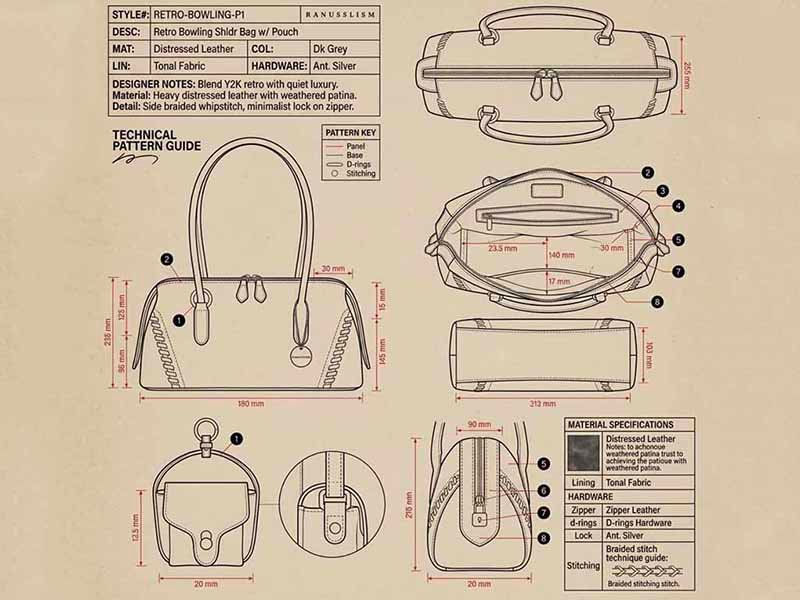
Before sampling begins, the product should be defined well enough that the sample maker is not forced to guess about critical details. The working file commonly covers dimensions, materials, structure, components, colors, logo requirements, functional features, packaging direction, and relevant performance expectations. These details may be organized through a tech pack, specification sheet, BOM, annotated drawing, development brief, or a combination of several controlled documents.
Build a Usable Specification
The purpose of a product specification is to translate commercial language into something that can actually be manufactured. A customer may describe a bag as “premium,” “strong,” “lightweight,” “large,” or “well padded,” but the production team needs measurable information that explains what those descriptions mean in practice.
For a simple tote, this may require only overall dimensions, handle size, material weight, color, seam construction, logo size, and packaging. A technical backpack can require considerably more information because it may contain several shell materials, lining, foam, mesh, multiple zipper sizes, webbings, buckles, internal compartments, laptop protection, reinforcement panels, adjustment hardware, and dozens of dimensional checkpoints.
Measurements should also include sensible tolerances where they matter. Sewn soft goods are flexible products, so dimensional control cannot always be approached in the same way as machined or molded components. Very tight tolerances applied without understanding textile behavior can create unnecessary inspection disputes, while overly loose tolerances can damage product fit or visual consistency.
A good specification therefore focuses precision where it contributes to function, appearance, compatibility, packing, or customer experience.
Control the BOM and Materials
A Bill of Materials turns the design into a controlled component list. Even a bag that looks visually simple may contain many individual material decisions, including outer fabric, lining, interlining, foam, zipper tape, zipper teeth, sliders, pullers, webbing, thread, buckles, elastic, labels, patches, adhesives, printed components, hangtags, polybags, inserts, and cartons.
The BOM becomes especially important after the sample is approved because two components that look similar may behave very differently in production. Two 600D polyester fabrics, for example, may differ in backing, coating, weight, surface texture, color stability, or hand feel. Two pieces of foam with the same thickness may have different density and recovery. Two similar buckles may have different fit, finish, or load performance.
| Product Element | Information Worth Recording | Risk if Uncontrolled |
|---|---|---|
| Shell fabric | Fiber, construction, weight/denier, coating, color | Appearance or performance changes |
| Lining | Material, weight, color | Cost and visual inconsistency |
| Foam | Type, thickness, density where relevant | Shape or protection changes |
| Zipper | Size, type, color, approved source/equivalent | Function and fit problems |
| Webbing | Material, width, color | Strength or color mismatch |
| Buckle / hardware | Size, material, finish | Compatibility or performance issues |
| Logo | Method, dimensions, position, colors | Brand inconsistency |
| Packaging | Unit pack, labels, inserts, carton method | Retail or warehouse problems |
For repeat orders, the BOM becomes part of the product’s manufacturing memory. Instead of trying to reconstruct the first order months later, the team can return to approved component records and identify intentional changes before purchasing begins.
Approve Color and Artwork Properly
Color is one of the easiest product details to describe casually and one of the most difficult to reproduce consistently across different materials. A Pantone reference can create a useful target, but polyester fabric, nylon webbing, zipper tape, sewing thread, coated PU, molded plastic, printed ink, embroidered thread, and plated metal may not reproduce the same target in exactly the same way.
When color is important to the brand, physical swatches and component samples often provide better manufacturing control than screen images alone. Useful records may include fabric swatches, supplier color cards, zipper samples, webbing samples, metal finishes, print strike-offs, embroidery approvals, logo patches, or molded-logo samples.
Artwork requires similar discipline. A vector logo file is only part of the instruction. The production team also needs the approved dimensions, location, orientation, color treatment, application method, and any process-specific details. A 50 mm printed logo, 50 mm embroidered logo, and 50 mm rubber patch can create completely different visual weight even when the artwork dimensions are technically identical.
Whenever branding changes during development, the artwork version used by production should change with it.
Treat Packaging as Product Information
Packaging decisions should not be left until finished goods are already waiting for cartons. The unit pack can affect product protection, retail presentation, labeling, carton utilization, warehouse handling, shipping volume, and total landed cost.
A product may require a simple polybag, recycled packaging, dust bag, hangtag, belly band, insert card, barcode, FNSKU label, display box, gift box, tissue protection, or channel-specific information. If these requirements are not documented early, the factory may complete a technically correct bag that is not ready for the intended sales channel.
Carton quantity also deserves early planning. If an initial plan calls for 30 pieces per carton and the final packing test shows that 20 pieces are safer, the number of cartons rises by 50%. That change can affect freight estimates, warehouse handling, label quantities, pallet planning, and fulfillment costs.
For this reason, product development should eventually define the product as the customer will actually receive and sell it, not only as it appears on the sewing table.
What Sample and Production Documents Should Control Bulk Orders?

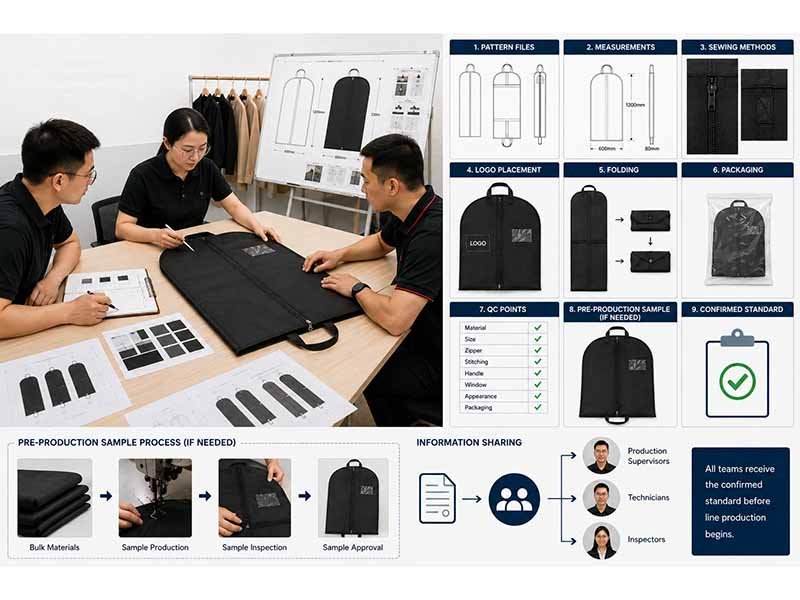
Bulk production should be controlled by an approved reference package rather than a vague instruction to “make everything like the sample.” A reliable production file normally connects the approved physical sample with the current specification, BOM, patterns, material records, logo artwork, packaging requirements, revision history, quality criteria, and customer-specific instructions. Together, those references define what the factory is actually authorized to reproduce.
Link the Approved Sample to a Record
A physical sample remains one of the best references in bag production because it communicates shape, proportion, hand feel, structure, workmanship, and usability more effectively than a spreadsheet alone. The limitation is that the sample cannot explain its own development history or identify which details changed after it was made.
An approved-sample record solves this problem by connecting the physical item to a specific project version. It can identify the SKU, revision, approval date, approved materials, major dimensions, logo version, photographs, packaging status, and any exceptions accepted by the customer.
The record should also make clear whether all requirements are closed. A customer may approve the appearance of a cooler bag while thermal-performance verification remains outstanding, or approve the design of a backpack while a load-related test is still pending. Visual approval should not accidentally become compliance approval or functional approval simply because the word “approved” appears in an email.
For important programs, retained or sealed reference samples can also help the production and inspection teams compare bulk units against the same physical standard that the customer saw.
Use a Pre-Production Sample When Risk Justifies It
Development samples are sometimes made with temporary materials, available accessories, sample-room methods, substitute colors, or provisional packaging because the immediate goal is to confirm design and structure. That approach is normal during early development, but it creates a reason to consider a pre-production sample before a high-risk bulk order.
A pre-production sample brings together the materials and processes that are intended for actual production. It becomes particularly valuable when the project uses custom-dyed fabric, newly developed hardware, complicated embroidery or printing, several revisions, retailer packaging, multiple SKUs, strict inspection requirements, or a first-time production line.
The objective is not to add another approval ceremony. It is to answer a practical question before thousands of pieces are sewn: does the final manufacturing setup produce the product the customer thinks has been approved?
For a mature repeat order with unchanged materials, structure, branding, packaging, and production resources, another full pre-production sample may provide less value. Manufacturing controls should respond to actual risk rather than forcing every project through identical steps.
Keep Revision History Visible
Bag development creates many small changes, and each one can affect another part of the project. A front pocket may move 15 mm, a lining specification may change, a zipper pull may be replaced, the logo may shift upward, the strap may become wider, or the carton quantity may be reduced after a packing test.
None of those changes is difficult by itself. The risk comes when different teams remember different versions.
A simple revision history can prevent that confusion. Instead of leaving decisions scattered across chat messages, meeting notes, annotated photographs, and email threads, each meaningful change can be associated with a version and approval status.
For example:
V1 — Initial prototype based on reference design.
V2 — Front pocket height increased by 15 mm.
V3 — Lining changed to heavier polyester.
V4 — Logo moved 10 mm upward.
V5 — Standard puller replaced with custom molded puller.
V6 — Carton quantity reduced from 30 to 24 pieces.
The critical step is updating the documents affected by each approved change. A new material belongs in the BOM. A dimensional change belongs in the specification. A new logo position belongs in the artwork instruction. A new carton quantity belongs in the packaging file.
Revision control is useful because it converts individual conversations into manufacturing knowledge that the next production team can actually follow.
Freeze the Production Release Package
Before bulk cutting starts, the manufacturing team should be able to identify one current, approved production package. The precise contents depend on the project, but it commonly combines the final sample reference, BOM, measurements, patterns where applicable, materials, colors, artwork, packaging, QC requirements, barcodes or FNSKU information where relevant, carton marks, and shipping instructions.
This becomes increasingly important as SKU count grows. A program with 12 SKUs in three colors already creates 36 product-color combinations. If each combination has its own barcode and quantity allocation, the team is controlling at least 36 barcode relationships in addition to materials, labels, packaging, production quantities, and carton allocation.
At that scale, structured documentation actually saves time because fewer questions need to be rediscovered during production.
The strongest manufacturing partners therefore do not treat the final sample as the only source of truth. They preserve the physical reference while also documenting the details that cannot be seen by looking at the finished bag.
Which Quality Documents Should Buyers Request?

Quality documents should show what was inspected, which approved reference was used, when the check occurred, what defects were found, and what happened when results did not meet the agreed standard. Depending on project risk, useful evidence may include incoming-material records, in-process checks, measurement data, functional checks, final inspection reports, AQL results, product photographs, packaging verification, defect summaries, and corrective-action records.
Build QC Around Production Stages
A strong quality process does not wait until every bag is finished before looking for mistakes. When the wrong fabric has already been cut for 5,000 pieces, a final inspection report cannot undo the lost material and production time. Quality control is most useful when it catches problems near the point where they first appear.
A practical bag-manufacturing process therefore uses several checkpoints, with the exact structure depending on factory organization and product complexity.
| QC Stage | Typical Items Checked | Main Risk Controlled |
|---|---|---|
| Incoming materials | Fabric, lining, zipper, webbing, hardware | Wrong material, color, or component |
| Cutting | Dimensions, defects, orientation | Incorrect panels |
| Branding process | Logo size, color, position | Branding inconsistency |
| Sewing process | Alignment, seams, reinforcement | Construction defects |
| Semi-finished inspection | Shape, assembly, components | Rework before completion |
| Final inspection | Appearance, dimensions, function | Finished-product defects |
| Packaging inspection | Labels, quantity, protection | Packing mistakes |
| Outgoing check | Cartons, SKU allocation, marks | Shipment errors |
The individual QC plan should reflect the product. A cosmetic pouch may emphasize surface cleanliness, zipper operation, symmetry, lining, and logo appearance. A technical backpack may need additional attention around shoulder straps, load-bearing seams, laptop compartments, reinforcement points, buckles, zipper stress areas, and dimensional compatibility.
This is why asking “Do you have QC?” provides limited information. A more useful question is, “Which characteristics will you inspect, at which stage, and against which approved reference?”
Make Final Inspection Understandable
A useful final inspection report should allow someone who was not present in the factory to understand the status of the shipment. It normally identifies the order or project, SKU, total quantity, inspected quantity, inspection date, current approved reference, dimensional results, workmanship findings, functional checks, packaging status, observed defects, and release decision.
Photographs become useful when they document evidence rather than simply making the report look complete. Representative images may show overall product appearance, logo placement, important measurements, inside construction, zipper and hardware, retail packaging, barcodes, carton marks, carton dimensions, and packed goods.
A report that only states “QC passed” provides little insight into what was actually checked. A stronger report connects the inspected goods back to the approved sample, specification, BOM, artwork, and packaging requirements.
For remote sourcing teams, this connection is particularly important because the report may be the final evidence reviewed before a balance payment or shipment release.
Use AQL With the Right Expectations
AQL-based sampling is widely used because inspecting every characteristic of every unit can be impractical for normal production. It provides a structured method for sampling a lot and making an acceptance decision under defined inspection rules. It should not, however, be interpreted as proof that a shipment contains zero defects.
Inspection intensity should match the product and business risk. A first order can justify greater scrutiny than a mature repeat program. A multi-SKU shipment requires attention to every SKU rather than only the total order quantity. A high-value technical bag, product with important load-bearing features, or retailer-controlled program may require functional testing or closer inspection beyond a basic cosmetic check.
Third-party inspection is another option. Some companies require independent pre-shipment inspection as a standard sourcing policy, while others rely increasingly on the manufacturer’s internal QC after a supplier relationship becomes stable. Both models can work when expectations, sampling rules, reference standards, and responsibilities are clearly defined before production finishes.
The most important principle is that final inspection should verify an already controlled production process rather than become the first serious quality activity in the project.
Document Causes, Not Just Defects
A photograph of a defective bag shows what happened. A corrective-action record tries to explain why it happened and what will stop it from happening again.
Suppose 80 bags have logos positioned 12 mm too low. Reworking those 80 pieces addresses the immediate shipment. If the root cause was an outdated placement template still available on the production floor, the same defect can return during the next order unless the template-control problem is corrected.
A useful defect record therefore identifies the issue, potentially affected quantity, suspected or confirmed cause, immediate containment action, rework or disposition, and preventive action. For long-term programs, this information can be linked to future production instructions so recurring defects receive additional attention.
This is one reason mature quality systems become stronger with repeat orders. The manufacturer is not only reproducing a sample; it is accumulating knowledge about where that specific product can fail and how those risks should be controlled.
What Compliance and Testing Documents Are Needed?
Compliance documents depend on the destination market, product category, intended user, materials, performance claims, and sales channel. Factory certificates, material reports, finished-product test reports, and legally required certificates serve different purposes and should not be treated as interchangeable. A professional manufacturer should provide existing evidence accurately, identify what it covers, and coordinate additional testing when the actual product or market requires it.
Start With the Product and Destination
There is no single universal “bag compliance certificate” that proves every bag is suitable for every country. An adult promotional tote, children’s backpack, insulated lunch bag, technical waterproof pouch, coated PVC bag, or product marketed with a special performance claim can raise very different compliance questions.
The correct starting point is therefore the intended market, intended user, product construction, materials, sales channel, and claims made about the product.
In the United States, products designed or intended primarily for children aged 12 or younger can be subject to children’s-product safety requirements. CPSC states that children’s products subject to applicable rules generally require third-party testing by a CPSC-accepted laboratory and certification through a Children’s Product Certificate. For imported products, the U.S. importer is responsible for issuing the CPC based on applicable passing test results.
The process has also become more digital. CPSC states that beginning July 8, 2026, importers of most regulated consumer products must electronically file certificate-of-compliance data with U.S. Customs and Border Protection through the applicable Partner Government Agency message process.
That does not mean an ordinary adult bag automatically becomes a children’s product or needs a CPC. Classification depends on the actual product and applicable requirements.
Distinguish Factory Certificates From Product Evidence
A factory-level certificate tells you something about a facility or management system within its stated scope. A product report tells you something about a tested product, material, or component. The difference is fundamental.
A quality-management certificate does not automatically establish that every product meets every chemical requirement. A social-compliance audit does not establish product performance. A material test report does not necessarily cover a finished bag containing several other components.
When reviewing any compliance document, identify the party named in the report, the sample tested, material or SKU, date, test method, applicable standard, laboratory, and result. If the report covers a particular fabric or component, verify that the same controlled material is being used in the current production.
For European Union sales, REACH can create obligations relating to substances present in articles. ECHA notes that Candidate List substances in articles may trigger legal obligations, and certain notification obligations can apply when a Candidate List substance is present above 0.1% weight by weight and relevant quantity conditions are met.
That illustrates why a broad request such as “Send me your REACH certificate” may not be precise enough. The useful question is which materials, substances, products, and obligations the available evidence actually addresses.
Connect Testing With Material Control
A finished backpack may contain shell fabric, lining, foam, mesh, zipper tape, zipper teeth, metal sliders, painted hardware, plastic buckles, webbing, thread, printing ink, adhesive, labels, rubber patches, and packaging materials. One passing fabric report cannot automatically establish the status of every component in the complete product.
At the same time, efficient compliance management does not always mean retesting every complete SKU from the beginning. Depending on the applicable rule and customer protocol, existing reports on controlled materials or shared components may provide useful evidence. The appropriate testing strategy should be determined according to the actual regulation, product classification, laboratory requirements, sourcing traceability, and customer’s compliance policy.
Material substitution is therefore not only a purchasing issue. If a tested coated fabric becomes unavailable and purchasing replaces it with a visually similar material from another source, the relevance of the existing test evidence may need to be reviewed.
Good compliance management connects laboratory evidence with BOM control so the factory can identify which material was actually used in production.
Decide Testing Before Shipment Is Close
Testing requirements are best discussed during development or pre-production rather than when finished cartons are waiting for collection. Laboratory schedules depend on the protocol, number of materials, test scope, sample preparation, laboratory workload, retesting requirements, and customer-specific procedures, so the timeline should be confirmed for each actual project rather than assumed from a generic number.
A sensible sequence is to identify the destination and product requirements, agree on the testing scope, submit representative materials or finished samples, review the results, and then release the relevant production or shipment milestone.
This becomes particularly important when testing may influence material purchasing. A problem discovered before fabric cutting creates options. The same problem discovered after thousands of products are finished creates inventory, rework, launch, and logistics consequences.
A responsible manufacturer should also avoid describing untested products as “certified” merely because similar materials were previously tested. The strength of a compliance statement should match the evidence behind it.
Which Shipping and Export Documents Should Be Provided?
At shipment stage, the manufacturer should provide or support the commercial and packing information needed to identify the goods, value, quantity, cartons, and delivery arrangement. Common records include the commercial invoice, packing list, carton information, shipping instructions, and data used for bills of lading or air waybills. Additional customs, origin, marketplace, retailer, or warehouse documentation depends on the destination and shipping arrangement.
Keep the Commercial Invoice Accurate
The commercial invoice connects the manufacturing transaction with the customs process. It normally identifies the commercial parties, merchandise, quantities, values, and other information required for the shipment and destination.
For U.S. imports, CBP states that the commercial invoice or acceptable substitute submitted for entry should contain an adequate merchandise description, quantities, values or approximate values, the appropriate eight-digit HTSUS subheading, and information identifying the foreign party responsible for invoicing the merchandise.
Descriptions should be specific enough to identify the merchandise rather than relying on vague terms such as “bags,” “samples,” or “accessories.” CBP separately emphasizes that cargo descriptions should be clear enough to identify the characteristics of the commodity.
Declared value is equally important. CBP’s current guidance explains that customs value is not simply an arbitrary lower figure chosen to reduce duty and warns that undervaluation can lead to penalties.
For that reason, customs documentation should be treated as regulatory information, not as a negotiable extension of the product quotation.
Make the Packing List Match the Goods
The packing list describes how the physical shipment is organized. Depending on the order, it can include product or SKU, color, quantity per carton, carton count, carton numbering, total quantity, dimensions, net weight, gross weight, volume, and destination allocation.
For a single-SKU order shipped to one warehouse, this can remain relatively simple. For a program containing several sizes, colors, SKUs, and destinations, the packing list becomes one of the most important control files in the shipment.
Totals should be reconciled before collection. If the invoice lists 5,000 units while the packing list contains only 4,920, the discrepancy should be resolved before the freight forwarder or customs authority has to question it. The same applies to carton counts, gross weight, destination information, and SKU allocation.
Multi-address shipments deserve particular attention. If different cartons are going to a retailer, distributor, Amazon fulfillment network, or regional warehouse, each destination should have a clear allocation so that packing, labeling, documentation, and freight instructions remain aligned.
Szoneier’s documented export workflow includes support for commercial invoices, packing lists, carton labels, FBA-related labeling, courier, air and sea transportation, DDP evaluation, and multi-address shipment coordination.
Understand Who Issues Transport Documents
The bag factory does not necessarily issue every shipping document itself. Sea freight commonly involves a bill of lading or related ocean-transport document, while air cargo uses an air waybill and courier shipments use carrier waybills or tracking documents. These documents are typically issued by carriers, freight forwarders, NVOCCs, airlines, or express operators according to the shipping arrangement.
The manufacturer’s responsibility is to provide accurate shipment information and coordinate the cargo handoff. That includes actual carton quantities, dimensions, weights, product descriptions, pickup details, invoice data, packing information, warehouse labels, and any other information requested by the appointed logistics provider.
This distinction is useful when evaluating manufacturing capability. A factory does not need to pretend that it is a shipping line or customs broker. It does need enough export experience to prepare cargo properly, communicate with the nominated forwarder, meet pickup requirements, and correct discrepancies before they become expensive destination problems.
For U.S. formal-entry scenarios, CBP guidance identifies invoice, packing information where available, shipping documents, and any special documents applicable to the goods among the records that may be involved in entry processing.
Check Labels and Warehouse Requirements Before Packing
Shipping readiness now involves much more than customs documents. Amazon fulfillment centers, retailers, distributors, and third-party warehouses may require specific unit barcodes, FNSKU labels, carton labels, pallet labels, shipment IDs, carton-content information, packing orientation, carton-size limits, or appointment data.
These requirements should be confirmed before the final packing operation whenever possible. Relabeling ten cartons at the factory may be a minor task. Relabeling hundreds of cartons after they have arrived at an overseas warehouse can become expensive and may delay inventory availability.
The same principle applies to carton quantities and physical dimensions. A change from 30 units to 24 units per carton may improve product protection but changes carton count, shipment volume, labels, warehouse handling, and perhaps the freight quotation. When packaging changes, the shipping data should change with it.
Certificate-of-origin requirements should also be clarified according to the destination, product, trade arrangement, and importer instructions rather than assumed to apply identically to every shipment.
Use a Final Shipment Release Check
Before the goods leave the factory, someone should compare the actual shipment against the approved documents. This is the final point at which errors are usually cheapest to correct.
The release check can confirm:
Final inspection status and any required customer approval.
Actual finished quantity and SKU allocation.
Carton quantity and numbering.
Unit barcodes and marketplace labels where required.
Carton marks and destination labels.
Actual carton dimensions and weights.
Commercial invoice information.
Packing list totals.
Freight-forwarder or carrier instructions.
Destination and consignee information.
Required test or compliance documents.
Origin documentation where applicable.
Booking, tracking, or pickup references.
The important word is “actual.” Shipping documentation should reflect the goods that were ultimately packed rather than continuing to use an estimate created during quotation.
A shipment may have started as a 30-piece-per-carton plan and ended as 24 pieces per carton after compression testing. The correct response is not simply to keep the original spreadsheet because it is convenient. The carton count, volume, packing list, labels, and freight information should be revised to reflect what physically exists.
Documentation closes the loop between development and delivery. When the invoice, packing information, QC records, product file, and physical cartons all describe the same shipment, the project is much easier to hand from the factory to the freight provider, customs process, warehouse, retailer, and ultimately the sales channel.
A reliable bag manufacturer is therefore not defined by how many certificates it can attach to an email. The more meaningful measure is whether the documents form a continuous evidence trail from the first quotation and product definition through sampling, material approval, production, inspection, compliance review, packaging, and shipment.
For a simple promotional tote, that evidence trail can remain lean. For a complex backpack program involving several fabrics, custom hardware, six colors, multiple SKUs, retailer packaging, third-party testing, and international distribution, the documentation naturally needs to become more structured.
The best project files reduce dependence on memory. They allow a new employee to understand what was approved, an inspector to understand what should be checked, a production team to reproduce the product months later, and a logistics team to identify exactly what is inside each carton.
That is why one of the most useful questions to ask a potential manufacturing partner is not only, “Can you make this bag?” Ask how the project will be documented from product definition to final shipment. The answer often reveals how much control the supplier will still have after the first attractive sample has been approved.
For custom bag and soft-goods programs, Szoneier’s manufacturing approach is built around connecting product development, sampling, materials, production control, inspection, packaging, and export delivery rather than treating each stage as an isolated transaction. The purpose of that structure is not to create paperwork for its own sake. It is to make products easier to define, quote, reproduce, inspect, ship, and reorder with fewer avoidable misunderstandings.
What documents should I ask for before placing a bag order?
Before placing a meaningful custom order, request enough documentation to confirm both the supplier and the product. The practical starting set usually includes company and factory information, an approved quotation or proforma invoice, product specification, material information, sample approval status, logo requirements, packaging requirements, payment and delivery terms, and any compliance or testing expectations. Complex projects should also establish the BOM, revision history, QC standards, and responsibilities for third-party testing before bulk purchasing begins.
Is a tech pack necessary when working with a bag manufacturer?
A finished tech pack is extremely useful, but it is not always necessary at the very beginning of development. Experienced manufacturers can often start from a reference sample, drawing, photograph, existing product, basic dimensions, or product concept. What matters is that critical information becomes controlled before bulk production. As the project develops, dimensions, materials, components, colors, logo details, packaging, and revisions should be recorded so production no longer depends on interpretation or memory.
What is the difference between an approved sample and a pre-production sample?
An approved sample normally confirms the product direction that the customer accepts after development and revisions. A pre-production sample is usually made closer to bulk production using the intended production materials, components, branding, and processes. The distinction becomes valuable when development samples used temporary materials or when several changes occurred after approval. For high-risk or first-time orders, the pre-production sample can provide a final opportunity to verify the manufacturing setup before large quantities are produced.
Should a bag manufacturer provide an inspection report before shipment?
For significant custom orders, some form of final quality evidence is useful before shipment, although its format depends on the agreement between the parties. A report may include inspected quantities, measurements, workmanship checks, functional checks, packaging verification, defect observations, and photographs. Large companies may also request AQL-based inspection or independent third-party inspection. The important point is that the inspection should compare finished goods against clearly approved samples, specifications, materials, artwork, packaging, and quality requirements.
Does an ISO certificate mean that every bag from the factory is compliant?
No. A factory management-system certificate and a product-specific compliance document answer different questions. An ISO-related certificate may demonstrate that a management system has been certified within a specified scope, while product compliance depends on the actual product, materials, target market, applicable rules, and supporting evidence. A test report on one fabric, component, color, or SKU should not automatically be assumed to cover unrelated products. Important compliance claims should always be checked against the actual document and its scope.
Which shipping documents does a bag manufacturer usually provide?
The manufacturer normally provides or supports the commercial and packing information needed for export and freight handling. The most common documents include a commercial invoice and packing list, together with carton dimensions, weights, product descriptions, quantities, marks, and pickup information. Depending on the shipment, the manufacturer may also support Certificate of Origin documentation, customs information, marketplace labels, or freight-forwarder requirements. Bills of lading and air waybills are generally issued by the relevant carrier or logistics provider.
How can documentation reduce problems on repeat bag orders?
Good documentation allows a repeat order to be produced from controlled records rather than from people’s memories of the previous production run. Approved samples, BOMs, material references, patterns, measurements, artwork, packaging files, QC records, and past corrective actions can all help preserve consistency. When a component must change, the difference can be identified and approved deliberately. This becomes increasingly important when repeat programs expand into additional colors, sizes, SKUs, warehouses, or seasonal production periods.