...

A Trusted China Manufacturer Since 2007!

Electrician Tool Bag Manufacturer | OEM & ODM Bag Factory

Custom tool bags engineered around real electrical tools, demanding jobsite conditions, brand specifications, and repeat production requirements.
Szoneier develops and manufactures electrician tool totes, hard-bottom bags, tool backpacks, technician bags, pouches, and modular storage systems.
  • Tool-specific pocket and compartment development
  • Reinforced handles, bases, seams, and hardware
  • Custom materials, colors, logos, and retail packaging
  • Sampling, bulk production, inspection, and global shipping
  • MOQ from 200 pieces for selected configurations
  • Support for professional brands, retailers, and industrial programs
electrician bag (1)

Manufacturing Support for Serious Tool Bag Programs

Szoneier combines product development, material sourcing, structured sampling, controlled sewing production, inspection, packaging, and international delivery within one coordinated manufacturing system. 

18+ Years Experience

More than 18 years of custom bag and sewn soft goods manufacturing experience supports projects involving heavy materials, complex pockets, load-bearing handles, internal organization, branded components, and repeat production records.

MOQ From 200 Pieces

Selected tool bag configurations can begin from 200 pieces when using available fabrics, standard colors, established accessories, regular logo methods, and efficient packaging. Complex molded bases or custom hardware may require higher quantities.

3–20+ Day Sampling

Simple developments may take about 3–7 days, standard samples about 7–12 days, and complex structured tool bags about 12–20 days or longer, depending on materials, molds, logos, and revisions.

20–60 Day Production

Bulk production generally requires about 20–60 days after final sample, material, artwork, packaging, and order approval. Quantity, structural complexity, accessory readiness, and seasonal capacity affect the final schedule.

Multi-Stage Inspection

Inspection covers incoming materials, cutting, pocket positioning, sewing, reinforcement, hardware, semi-finished assembly, finished appearance, load-bearing areas, packaging, labeling, and shipment preparation.

Global Delivery Support

Available shipping coordination includes express, air freight, sea freight, EXW, FOB, CIF, DAP, DDP, FBA first-leg delivery, overseas warehouse delivery, and split shipment planning.

Built for Professional Tool and Hardware Programs

Different sales channels require different materials, structures, packaging systems, and production controls. Szoneier develops each program around its intended market and operating environment.

Professional Tool Brands

Professional tool brands often need more than one generic bag. Product lines may include open totes, meter bags, technician backpacks, hard-bottom bags, belt pouches, and modular organizers. Szoneier supports:
  • New product engineering
  • Competitive product review
  • Tool-based compartment planning
  • Premium material upgrades
  • Custom hardware and branding
  • Multi-SKU development
  • Repeat production records

Hardware Retailers

Retail programs require consistent presentation, accurate labeling, controlled carton quantities, and reliable production schedules across multiple stores or distribution centers. Szoneier supports:
  • Retail hangtags
  • UPC and barcode labels
  • Instruction cards
  • Color and SKU separation
  • Shelf-ready packaging
  • Carton marking
  • Pre-shipment inspection coordination

Industrial Equipment Companies

Equipment and maintenance companies may need bags matched to electrical meters, diagnostic instruments, drills, batteries, cables, replacement parts, or installation kits. Development can follow:
  • Equipment dimensions
  • Tool inventories
  • Kit configuration
  • Department identification
  • Field-service workflows
  • Protective padding needs
  • Project-specific packing lists

Importers and Distributors

Importers and distributors need dependable product specifications, cost control, mixed ranges, stable replenishment, and export documentation. Szoneier can maintain:

  • Approved patterns
  • Material specifications
  • Bill of materials
  • Logo and artwork files
  • Packaging files
  • Carton details
  • Repeat-order inspection standards

Common Electrician Tool Bag Production Risks

A tool bag may look acceptable when empty and still fail after repeated loading. Development must address tool weight, sharp edges, frequent access, outdoor conditions, and concentrated stress.

Weak Handle Connections

Handles often fail where webbing joins the main body. Surface stitching alone may not distribute a heavy load across the surrounding panels.
Szoneier reviews:
  • Webbing width and thickness
  • Hidden reinforcement layers
  • Stitching area
  • Bartack locations
  • Box-X construction
  • Bottom-to-handle load paths

Collapsing Bag Bottoms

An unsupported base may sag, twist, or allow sharp tools to damage the lining. A suitable base depends on expected load, bag size, storage method, and target price.
Options include:
  • Multi-layer fabric bases
  • PE or PP boards
  • Foam-supported boards
  • Wrapped abrasion panels
  • Molded PP bases
  • EVA protection structures

Incorrect Pocket Depths

Too-shallow pockets allow pliers and screwdrivers to fall out. Excessively deep pockets slow access and hide small tools. Elastic loops can also lose control when the diameter is not matched to the tool.
Development requires:
  • Tool dimensions
  • Pocket depth planning
  • Elastic recovery checks
  • Access testing
  • Loaded appearance review

Unstable Hardware

Thin D-rings, hooks, buckles, and swivel clips may deform under repeated loads. Plating and surface treatment also influence corrosion resistance and finished appearance.
Inspection focuses on:
  • Material thickness
  • Connection method
  • Edge finish
  • Plating consistency
  • Pull points
  • Movement under load

Sample-to-Bulk Variation

Pocket positions, webbing lengths, base stiffness, zipper direction, and reinforcement stitches may drift without fixed production references.
Control tools include:
  • Approved pattern sets
  • Sealed samples
  • Positioning templates
  • BOM records
  • Pre-production samples
  • In-process measurements

Misleading Performance Claims

Water-resistant fabric does not make an entire sewn bag waterproof. A strong-looking bag also does not prove a specific load rating without an agreed test method.
Szoneier separates:

  • Material characteristics
  • Structural performance
  • Internal factory checks
  • Client-defined protocols
  • Third-party testing
  • Marketing claim boundaries

Electrician Tool Bags We Can Manufacture
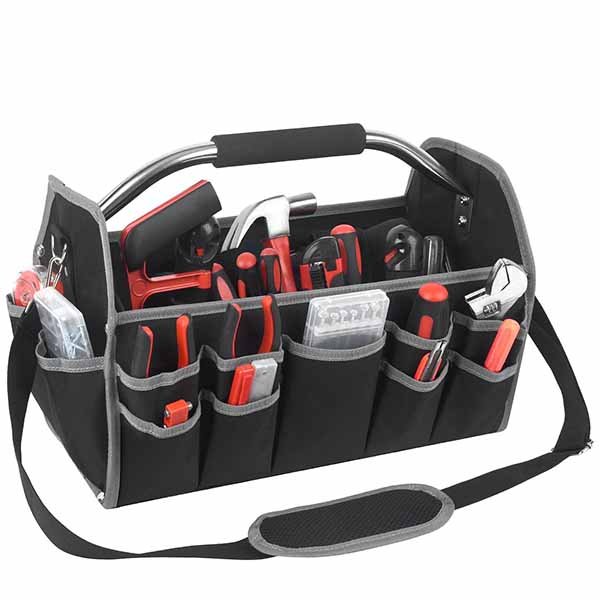
Choose a structure according to tool volume, access frequency, travel distance, jobsite conditions, storage method, and retail positioning.
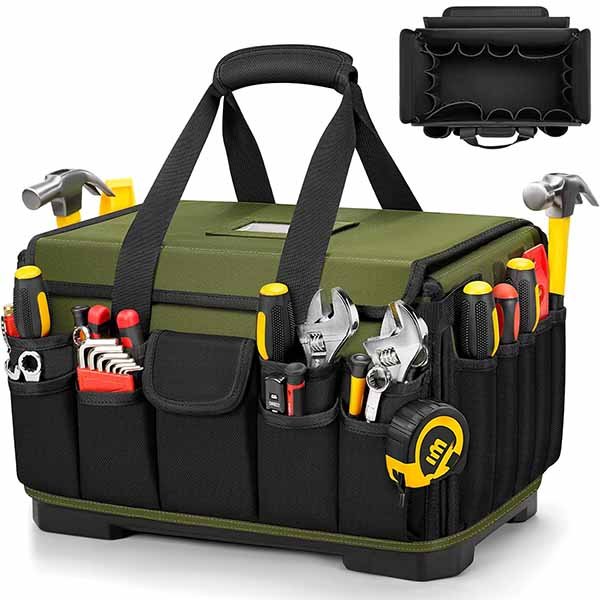
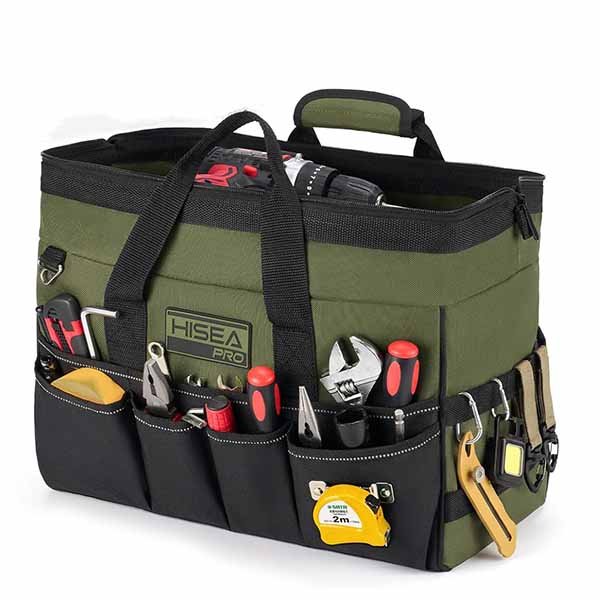
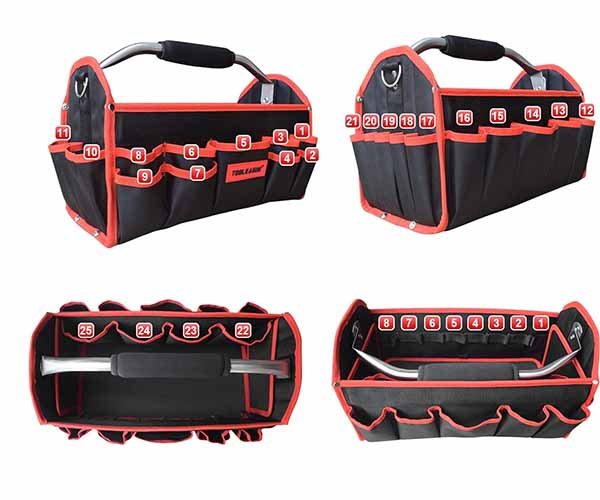
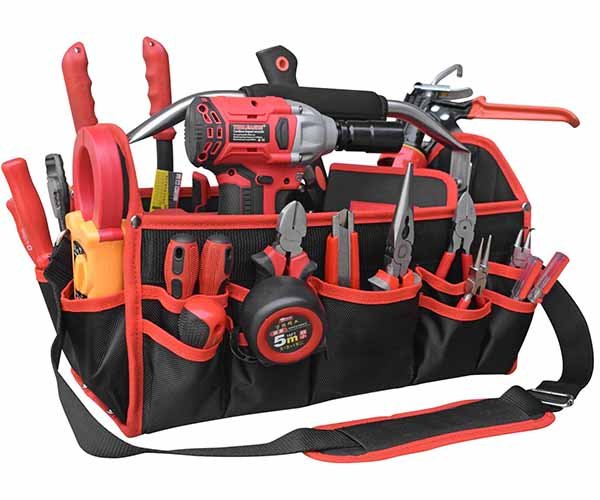
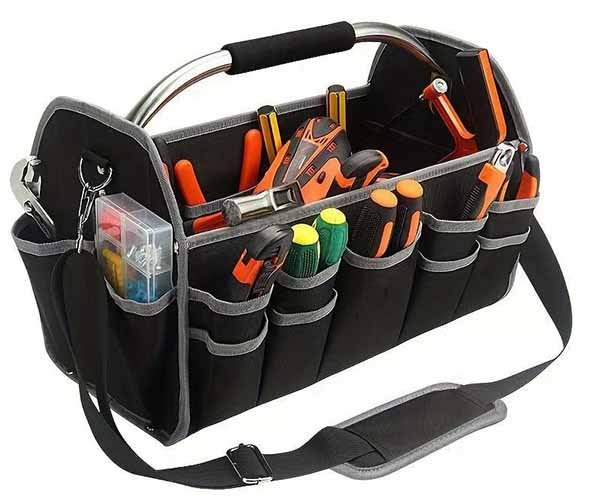
1. open tool tote

Open Tool Tote

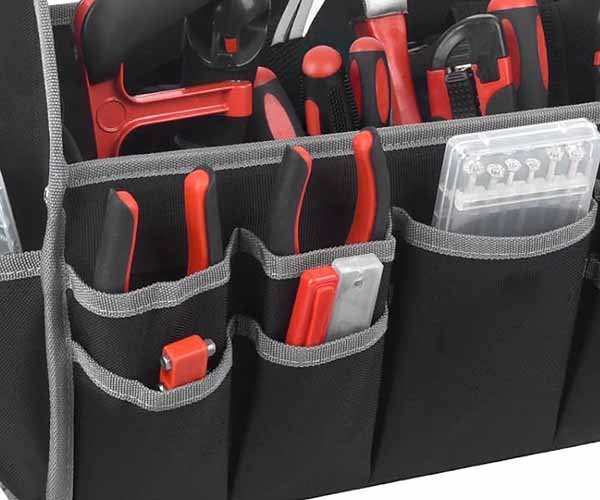
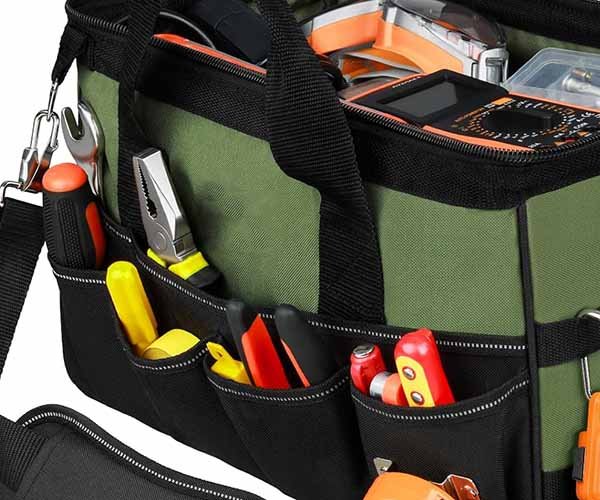
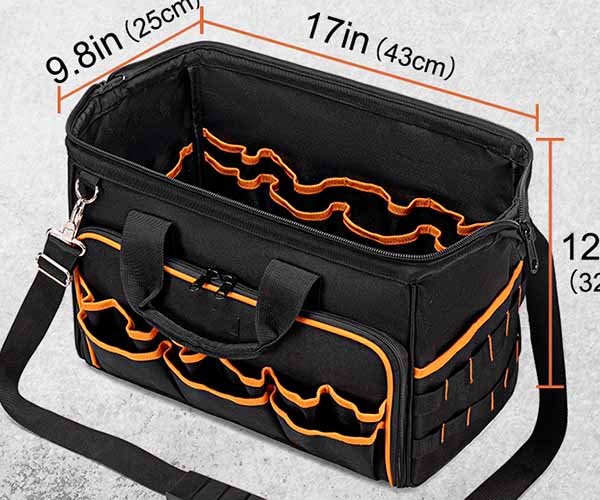
A wide open top gives fast access to pliers, screwdrivers, meters, tape, and small components. Reinforced rims help the opening maintain shape during repeated use.
  • External vertical tool pockets
  • Central equipment space
  • Reinforced carry handle
  • Optional rigid or molded base
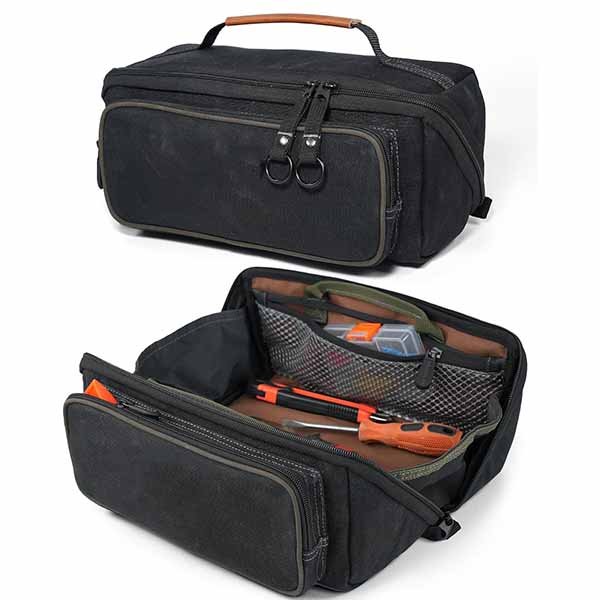
2. zippered tool bag

Zippered Tool Bag

A zippered structure protects tools during vehicle transport and warehouse handling. Opening geometry must still provide clear access when the bag is fully loaded.
  • U-shaped or straight zipper
  • Internal mesh or slip pockets
  • Lockable zipper pull options
  • Padded or reinforced walls
3. hard bottom tool bag

Hard-Bottom Tool Bag

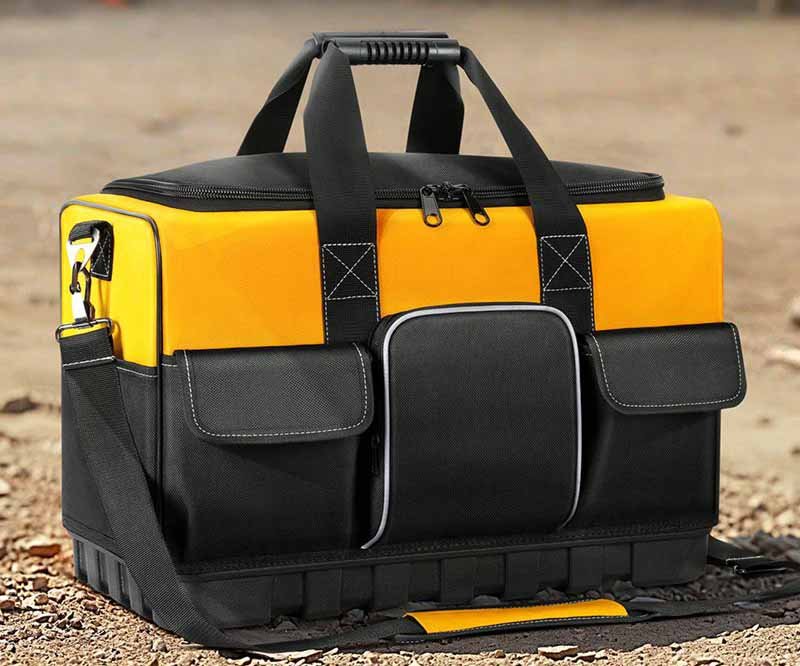
A molded or structured bottom helps the bag stand upright, protects against wet or abrasive surfaces, and separates tools from direct ground contact.
  • Molded PP base
  • Reinforced wrapped base
  • Raised feet options
  • Bottom-to-body connection testing
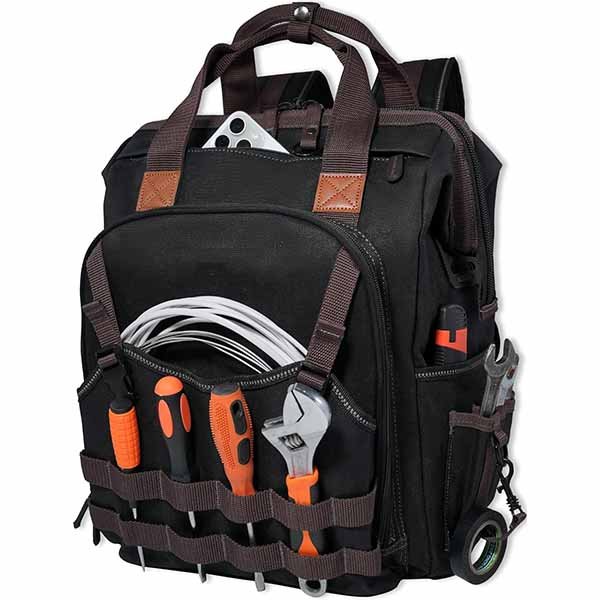
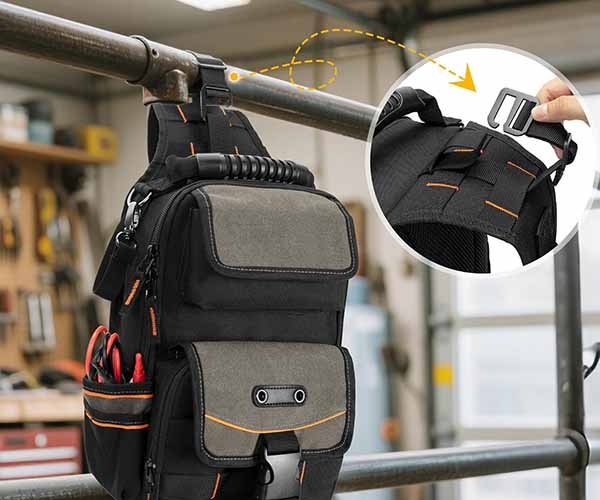
4. electrician backpack

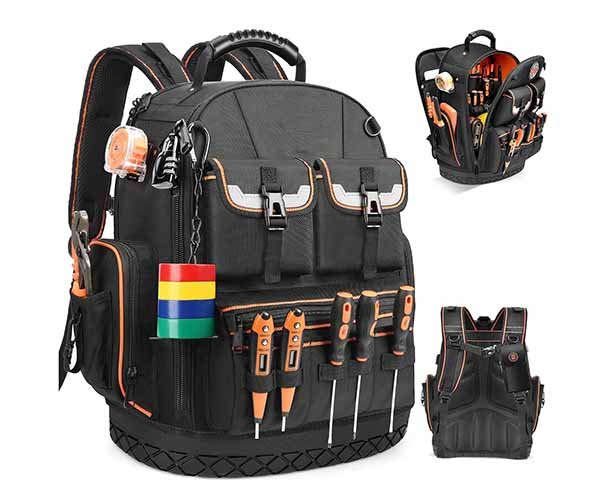
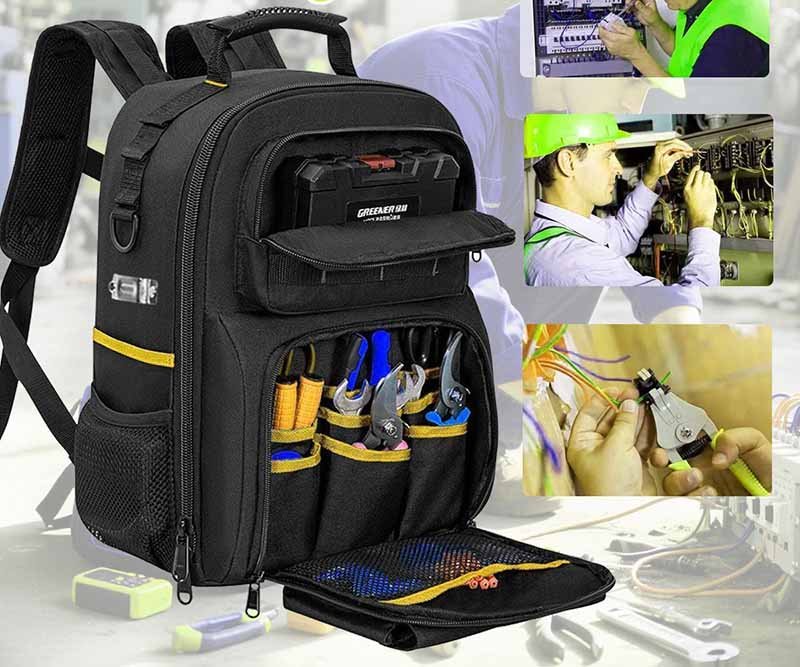
Electrician Backpack

A backpack leaves both hands free when moving across large facilities, climbing stairs, or carrying additional equipment.
  • Dual shoulder straps
  • Reinforced upper handle
  • Tool panels on both sides
  • Meter and laptop compartments
  • Padded back structure
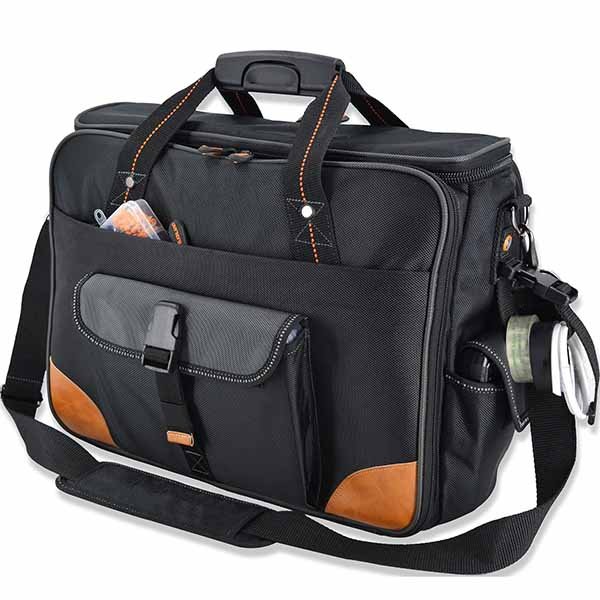
5. technician service bag

Technician Service Bag

Technician bags balance organized access with a professional appearance. They can carry instruments, cables, hand tools, documents, and service components.
  • Structured main opening
  • Instrument protection
  • Cable organization
  • Identification window
  • Shoulder strap options
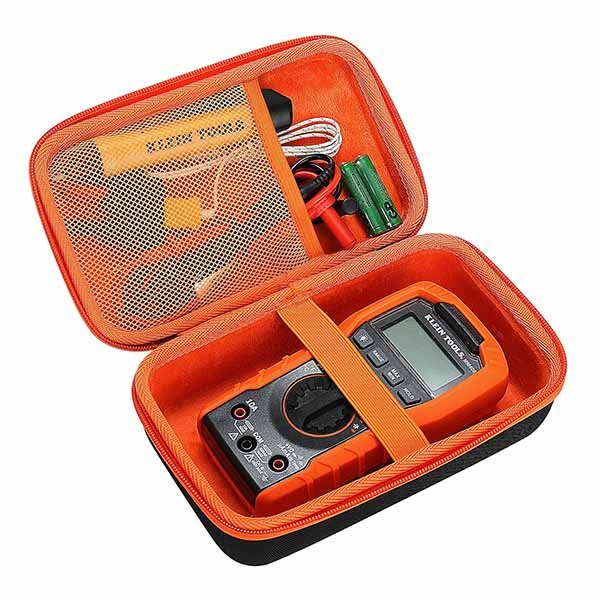
6. meter protection bag

Meter Protection Bag

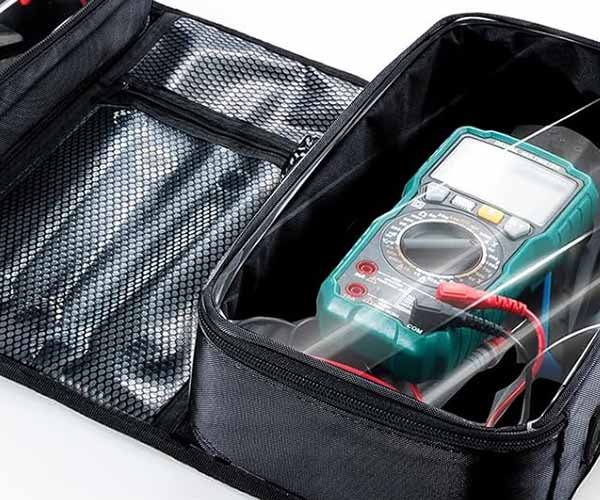
Meters and diagnostic instruments need more protection than ordinary hand tools. Foam, lining, divider thickness, and zipper clearance must suit the equipment dimensions.
  • Custom foam placement
  • Anti-scratch lining
  • Cable storage
  • Adjustable dividers
  • Model-specific sizing
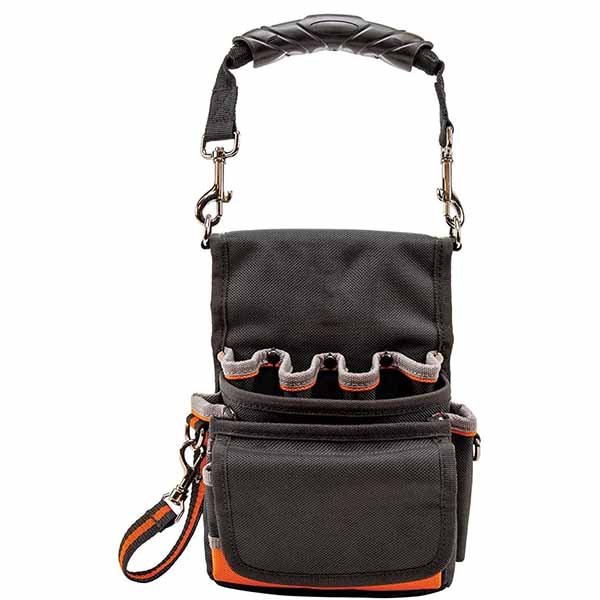
7. electrician tool pouch

Electrician Tool Pouch

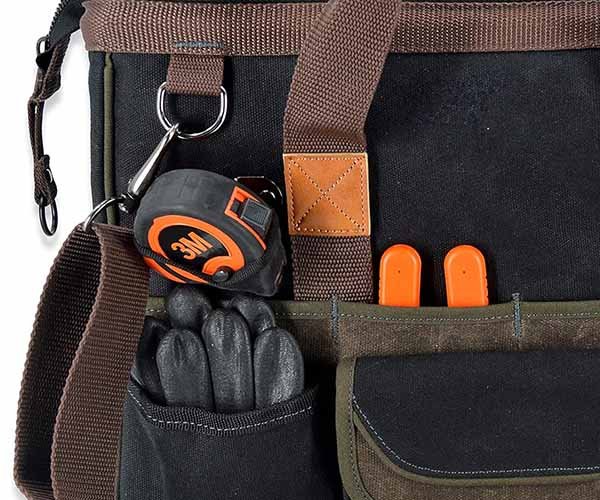
Compact pouches hold frequently used tools while reducing unnecessary load. They may attach to a belt, larger bag, ladder, trolley, or modular system.
  • Belt loops
  • Metal clips
  • Reinforced openings
  • Tool-specific pockets
  • Tape measure holder
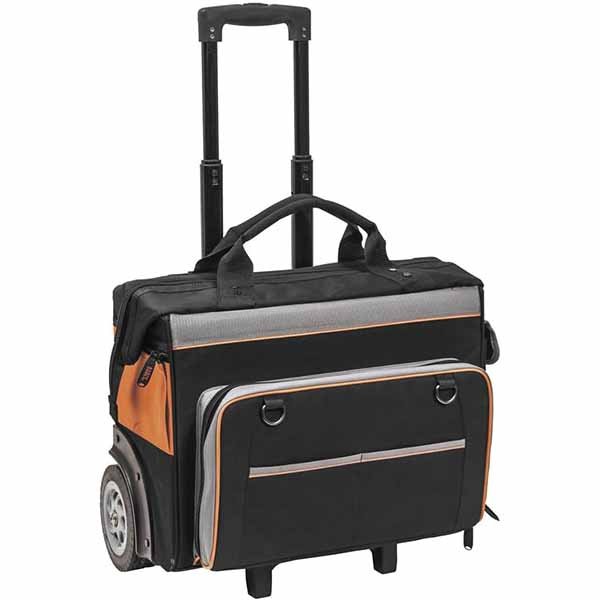
8. rolling tool bag

Rolling Tool Bag

Rolling structures suit heavier kits carried across airports, commercial sites, warehouses, or service facilities. Wheel position, frame stability, and telescopic handle construction require careful development.
  • Reinforced wheel base
  • Internal frame
  • Telescopic handle
  • Protective wheel housing
  • Balanced loading
9. modular tool system

Modular Tool System

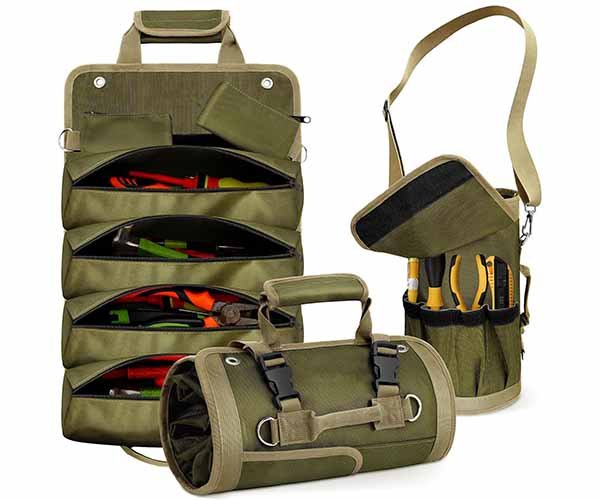
A modular range may combine a main tote, meter pouch, accessory roll, drill bag, removable panels, or small organizer pouches.
  • Shared material and color system
  • Matching logo applications
  • SKU identification
  • Set packaging
  • Individual replenishment support

Designed Around Real Electrical Tools

Product development should begin with the tools, not with an arbitrary pocket count. A useful electrician bag supports fast access, stable organization, safe transport, and repeatable production.

Start With a Tool Inventory

The most reliable input is a list of the tools intended for the bag. Helpful information includes tool names, dimensions, approximate weights, usage frequency, and preferred orientation. Typical groups include:
  • Long screwdrivers
  • Combination and long-nose pliers
  • Wire strippers and crimpers
  • Voltage testers
  • Multimeters
  • Drill drivers and batteries
  • Tape measures
  • Cable ties and connectors
  • Small fasteners
  • Documents or tablets
A clear tool inventory allows Szoneier to calculate pocket depth, elastic-loop size, main-compartment volume, opening width, base reinforcement, and expected load distribution. A bag carrying primarily hand tools needs many vertical positions. A bag carrying a drill, batteries, charger, and meter requires a different central volume and greater base support. A field-service bag may also need document storage, identification labels, or a padded electronic compartment.

Plan Access by Working Frequency

Frequently used tools should remain visible and reachable without removing several other items. Less frequently used components can occupy internal zipped pockets or lower compartments. Access planning considers:
  • Whether the bag is used on the floor, ladder, vehicle, or workbench
  • Whether gloves are worn
  • Whether tools must be identified at a glance
  • Whether loose components need sealed pockets
  • Whether the bag must remain open while working
  • Whether the bag must close completely during transport
Pocket quantity alone is not a measure of good organization. Ten well-sized pockets can perform better than thirty undersized pockets. Szoneier reviews tool dimensions and prototypes the layout before production records are fixed.

Protect Sharp and Heavy Items

Sharp tool ends can wear through ordinary lining. Heavy equipment can distort the base and pull surrounding seams out of alignment. Suitable protection may include:

  • Double-layer pocket bases
  • High-abrasion lining
  • PE or PP reinforcement
  • Foam protection around meters
  • Webbing reinforcement behind pockets
  • Bound pocket edges
  • Structured dividers
  • Removable internal panels

The final structure must balance protection, weight, production cost, folding volume, and retail price. Szoneier can develop premium and cost-controlled configurations from the same functional brief.

Materials for Professional Electrician Tool Bags

Material OptionMain CharacteristicsSuitable ApplicationsMain Considerations
600D Polyester OxfordLightweight, cost-controlled, widely available, printableEntry-level bags, promotional programs, lightweight pouchesLower abrasion resistance than heavier fabrics; stress areas need reinforcement
900D–1200D OxfordBalanced durability, structure, weight, and costMid-range totes, technician bags, utility organizersCoating, yarn density, backing, and actual construction should be confirmed
1680D Polyester or NylonDense appearance, strong abrasion resistance, firm structureProfessional tool bags, backpacks, heavy-duty rangesHigher material cost, thicker seam areas, greater sewing requirements
Heavy CanvasThick hand feel, traditional industrial appearance, natural visual characterHeritage-style tool totes, utility bags, premium canvas linesMay absorb moisture; color, shrinkage, and surface finish need control
PVC-Coated or Tarpaulin FabricEasy-clean surface, improved moisture resistance, strong industrial appearanceJobsite bags, wet environments, hard-use service kitsStiffness, fold marks, odor, temperature performance, and sewing method require evaluation
Reinforced Bottom FabricHigher abrasion protection at ground-contact areasSoft-bottom totes, backpacks, drill bags, service bagsDoes not replace internal support when a rigid standing base is required
EVA and Foam ComponentsCushioning, shaping, instrument protection, impact reductionMeter sections, protected compartments, structured panelsThickness, density, rebound, and lamination method affect performance
PE, PP, or Molded Base ComponentsRigidity, standing stability, ground separation, puncture resistanceHard-bottom totes and professional electrician bagsMold cost, component MOQ, fit tolerance, packaging volume, and assembly method

Bottom Structures Built for Loaded Tool Bags

The bottom carries concentrated tool weight and repeatedly contacts vehicle floors, concrete, metal platforms, wet ground, and work surfaces. Its construction affects standing stability, puncture resistance, moisture protection, and long-term shape.

Reinforced Soft Bottom

A reinforced soft bottom combines outer fabric, internal board, foam, lining, and wear-resistant layers. It remains more foldable than a molded base and can support a controlled price level. A typical structure may include:
  • Double outer fabric
  • Abrasion-resistant lower panel
  • PE or PP board
  • Foam cushioning
  • Bound internal seams
  • Webbing crossing the base
  • Raised rubber or metal feet
A soft structure works well for lighter and mid-weight tool kits. Board thickness and surrounding seam strength must match the expected load. Excessively thin boards bend, while excessively rigid boards can damage seams or increase shipping volume.

Molded Hard Bottom

A molded PP, EVA, or related base creates a stable standing platform and separates the contents from direct ground contact. It is often selected for professional tool totes used in wet, dusty, or abrasive environments. Development considerations include:
  • Mold ownership
  • Mold dimensions
  • Wall thickness
  • Surface texture
  • Drainage design
  • Bag-to-base attachment
  • Edge protection
  • Color matching
  • Component MOQ
  • Carton volume
The connection between the molded base and sewn upper section is as important as the molded component itself. Stitch holes, rivets, screws, hidden plates, binding, or combined attachment methods must distribute stress without damaging the fabric.

Choosing the Right Base

Not every electrician bag needs a molded bottom. A suitable choice depends on:

  • Expected loaded weight
  • Professional or entry-level positioning
  • Ground exposure
  • Standing requirement
  • Folding and carton efficiency
  • Target MOQ
  • Mold budget
  • Reorder volume
  • Replacement-cycle expectations

Szoneier can prepare two configurations during development: a cost-controlled reinforced soft base and a professional molded-base version. Comparing both structures helps a brand match product performance to its intended retail tier. 

Pocket Layout Based on Electrical Workflows
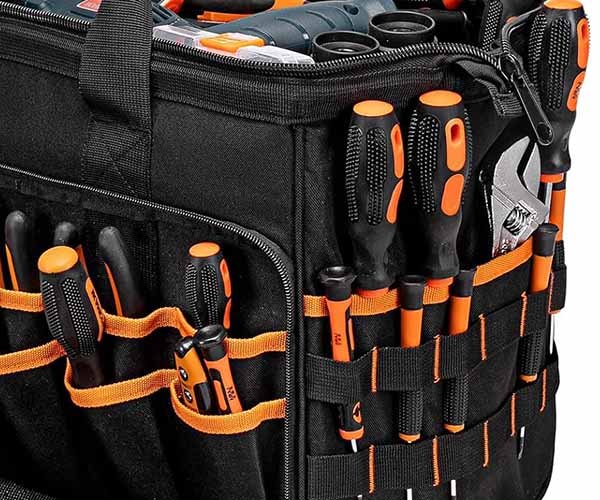
Each pocket should have a clear purpose. Dimensions, opening angle, reinforcement, and location are developed around the target tools and working sequence.
1. long tool slots

Long Tool Slots

Screwdrivers, nut drivers, and long pliers require enough depth to remain stable without disappearing below the opening.
Development checks include:
  • Tool length and handle width
  • Pocket depth
  • Opening tension
  • Bottom reinforcement
  • Visibility during access
  • Clearance from the zipper
2. pliers and cutters

Pliers and Cutters

Pliers, cutters, crimpers, and strippers vary significantly in head width and handle shape. Uniform pockets may fit one tool and fail with another.
Szoneier can adjust:
  • Pocket width
  • Tapered shapes
  • Elastic sections
  • Reinforced pocket edges
  • Individual or shared positions
  • Left-right working preference
3. meter protection

Meter Protection

Meters and electrical testers need stable placement, scratch protection, and enough clearance for removal.
Possible structures include:
  • Padded meter pockets
  • Zippered instrument areas
  • Removable dividers
  • Elastic retention straps
  • Anti-scratch lining
  • Cable and probe storage
4. drill and battery storage

Drill and Battery Storage

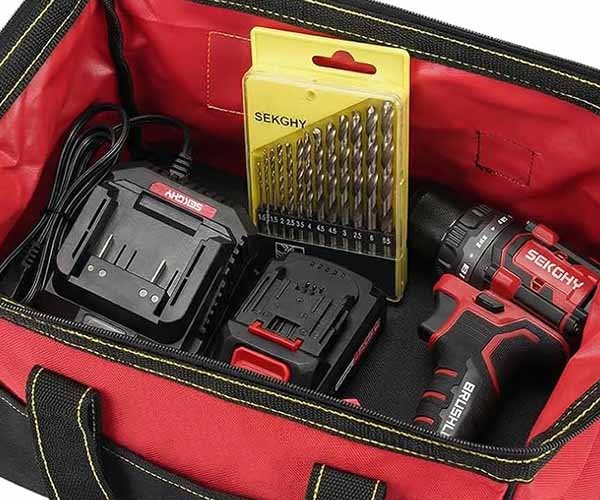
Drills, drivers, chargers, and batteries create concentrated weight. They should not distort adjacent pockets or crush smaller tools.
Development may include:
  • Central load zones
  • Reinforced divider walls
  • Board-supported bases
  • Battery sleeves
  • Charger cable pockets
  • Weight-balancing placement
5. small parts storage

Small Parts Storage

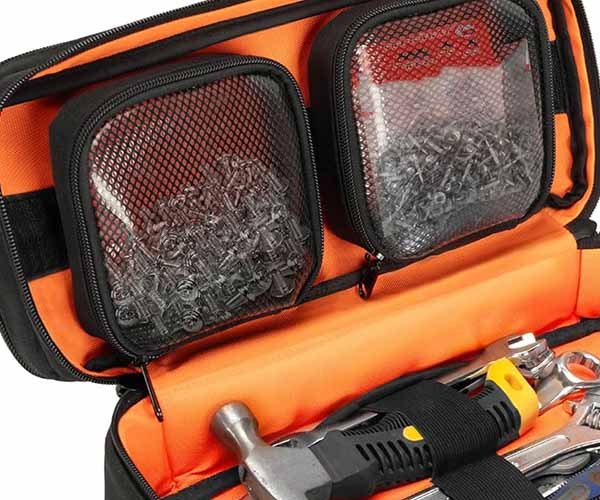
Connectors, terminals, screws, fuses, cable ties, and small components require secure storage.
Options include:
  • Zipper mesh pockets
  • Transparent pockets
  • Removable component pouches
  • Color-coded modules
  • Internal lidded sections
  • Label windows
6. quick access pockets

Quick Access Pockets

Frequently used tools should remain accessible without opening the entire bag.
Suitable locations include:

  • Front vertical pockets
  • Side tape-measure clips
  • Exterior meter slots
  • Top document pockets
  • Pen and marker sleeves
  • Key or ID attachments

Reinforcement Where Tool Bags Commonly Fail
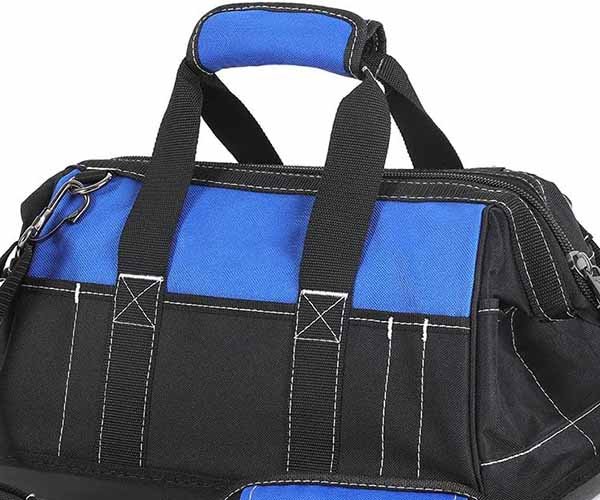
Heavy tools concentrate stress around handles, shoulder straps, pocket openings, bottom seams, zippers, and hardware. Reinforcement must be built into the pattern rather than added cosmetically.
1. handle attachments

Handle Attachments

Handle webbing may extend down the side panels or wrap beneath the base to spread weight over a larger area.
Control points include:
  • Webbing width
  • Layer count
  • Hidden reinforcement
  • Box-X dimensions
  • Bartack count
  • Stitch density
  • Symmetry
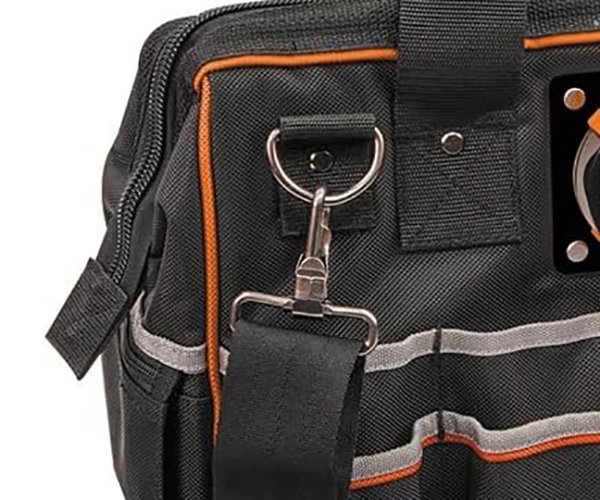
2. shoulder strap roots

Shoulder Strap Roots

Shoulder strap D-rings and tabs carry dynamic loads while walking. Short tabs or small sewing areas can pull away from the side panels.
Suitable construction may use:
  • Extended webbing tabs
  • Multiple fabric layers
  • Reinforced D-ring patches
  • Box-X stitching
  • Bartacks
  • Metal or high-strength polymer hardware
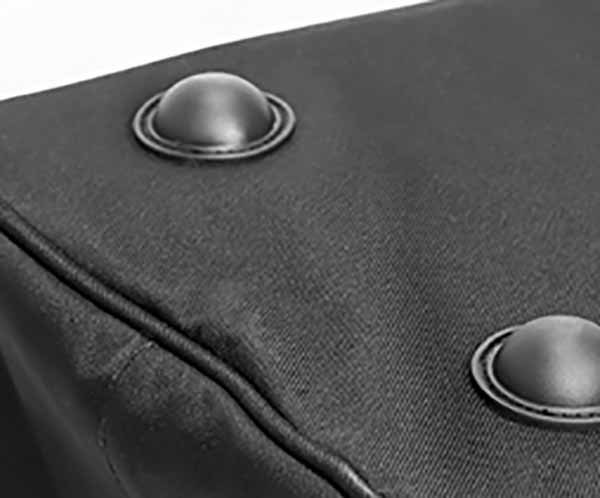
3. bottom to side seams

Bottom-to-Side Seams

A loaded bottom pulls continuously against the side panels. Seam allowance, binding, board position, and reinforcement layers determine whether the bag holds its shape.
Inspection covers:
  • Seam width
  • Stitch consistency
  • Corner transitions
  • Board alignment
  • Binding coverage
  • Reinforcement continuity
4. pocket openings

Pocket Openings

Tool pockets experience repeated insertion and removal. Openings can fray, stretch, or tear when sharp tools catch the edge.
Protection options include:
  • Bound edges
  • Folded double layers
  • Webbing reinforcement
  • Bartacks at pocket corners
  • Abrasion-resistant lining
  • Elastic with controlled tension
5. hardware mounting

Hardware Mounting

D-rings, hooks, buckles, and clips need enough surrounding material to resist pull and twisting.
Szoneier checks:
  • Hardware thickness
  • Mounting orientation
  • Webbing width
  • Stitching area
  • Edge clearance
  • Movement under simulated use
6. zipper end stops

Zipper End Stops

Zipper ends carry force when a fully packed bag is opened and closed. Weak end construction may separate or tear surrounding fabric.
Control measures include:
  • Reinforced zipper ends
  • Extended zipper tape
  • Protective end tabs
  • Controlled corner radius
  • Double stitching
  • Zipper operation checks

Components Selected for Daily Professional Use

A professional tool bag depends on more than its outer fabric. Zippers, webbing, hooks, D-rings, boards, foam, and reflective details influence durability, cost, and finished appearance.

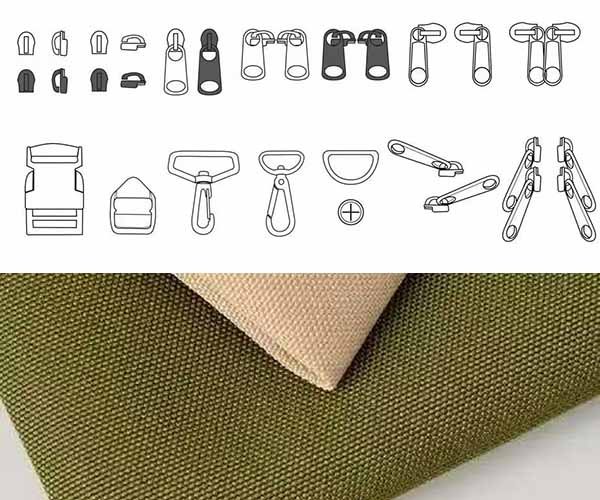
Heavy-Duty Zippers

Larger zipper gauges are often selected for main openings and heavily loaded compartments. Selection depends on opening shape, curve radius, expected filling level, and market position.
Checks include:
  • Slider movement
  • Tape strength
  • Puller size
  • End reinforcement
  • Alignment
  • Repeated opening

Metal D-Rings

Metal D-rings provide a firm connection for shoulder straps and accessories. Thickness, weld quality, plating, shape, and attachment direction should match the expected load.
Available considerations include:
  • Steel or alloy options
  • Matte or polished finish
  • Black, nickel, gunmetal, or custom finish
  • Standard or custom geometry

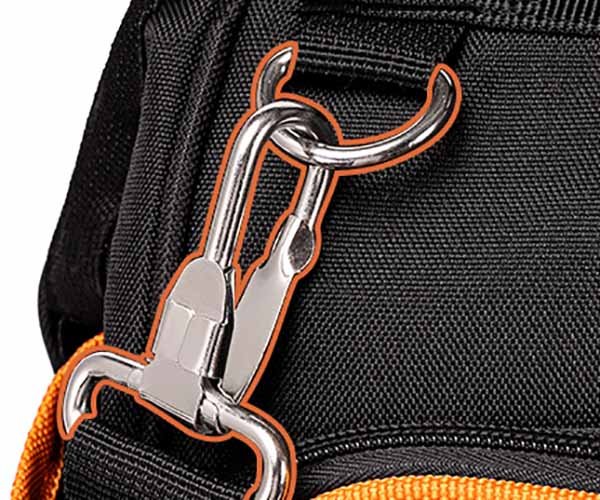
Snap Hooks

Shoulder strap hooks need sufficient opening width, spring strength, rotation clearance, and material thickness.
Szoneier reviews:
  • Hook size
  • Swivel movement
  • Surface finish
  • Pull direction
  • Attachment loop
  • Compatibility with D-rings

Reinforced Webbing

Webbing can form handles, shoulder straps, attachment loops, base reinforcement, or decorative brand elements.
Selection covers:
  • Width
  • Thickness
  • Weave density
  • Hand feel
  • Color consistency
  • Logo jacquard options
  • Load-bearing application

Reflective Details

Reflective piping, strips, prints, or patches can improve visibility under certain light conditions and strengthen an industrial visual identity.
Reflective material should be described accurately. A visibility detail is not automatically a certified safety feature unless the material and finished product meet the required test or standard.

Internal Support Parts

Boards, foam, binding, elastic, mesh, hook-and-loop materials, and reinforcement sheets control shape and organization.
Important specifications include:
  • Board thickness
  • Foam density
  • Elastic recovery
  • Mesh strength
  • Hook-and-loop holding power
  • Lining abrasion resistance

Carrying Systems for Different Work Environments

The best carrying structure depends on load weight, travel distance, access frequency, climbing requirements, vehicle storage, and the way tools are used on site.

Reinforced Hand Carry

Hand-carry tool totes provide fast access and are easy to move between a vehicle and a nearby work area. Development should consider:
  • Handle diameter
  • Grip material
  • Handle drop
  • Balanced placement
  • Webbing extension
  • Loaded hand clearance
  • Connection reinforcement

Padded Shoulder Carry

A removable shoulder strap helps distribute weight over longer distances while retaining an open or zippered tote format. Important details include:
  • Shoulder pad width
  • Anti-slip surface
  • Strap adjustment range
  • Hook strength
  • D-ring attachment
  • Bag balance under load
  • Strap storage when removed

Backpack Carry

Backpack structures support longer walking distances and leave both hands available for ladders, doors, drawings, or other equipment. Development should address:
  • Shoulder strap width
  • Upper and lower anchor points
  • Back padding
  • Weight distribution
  • Main-compartment access
  • Tool-panel stability
  • Reinforced upper handle

Rolling Carry

A rolling electrician bag reduces lifting during long-distance movement through airports, industrial sites, warehouses, and commercial facilities. Engineering includes:

  • Wheel diameter
  • Wheel housing
  • Internal frame
  • Telescopic handle
  • Base reinforcement
  • Standing balance
  • Stair and curb exposure

Logo Solutions for Professional Tool Brands

Szoneier recommends branding methods according to fabric, quantity, artwork, abrasion exposure, budget, desired appearance, and long-term use.
embroidered logo​

Embroidered Logo

Embroidery creates a durable textile appearance and works well on Oxford, canvas, and reinforced panels. Confirm before sampling:
  • Artwork line thickness
  • Thread colors
  • Stitch count
  • Backing material
  • Placement near pockets or seams
  • Surface stability
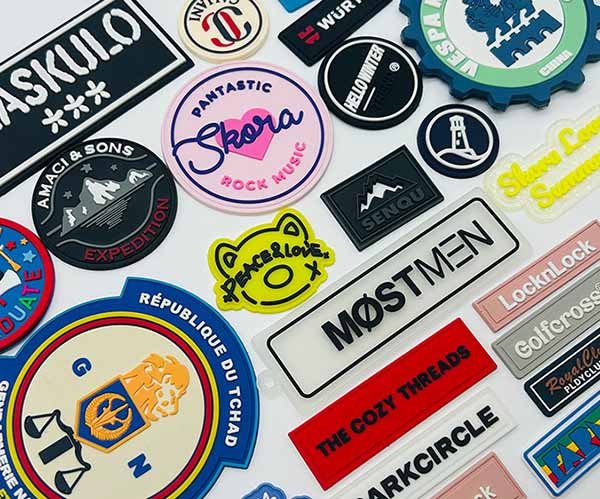
rubber patch

Rubber Patch

A molded rubber patch suits outdoor, industrial, and professional tool products. It creates a three-dimensional appearance and can support multiple colors. Project factors include:
  • Mold fee
  • Minimum quantity
  • Patch thickness
  • Edge shape
  • Sewing holes
  • Color matching
  • Attachment method
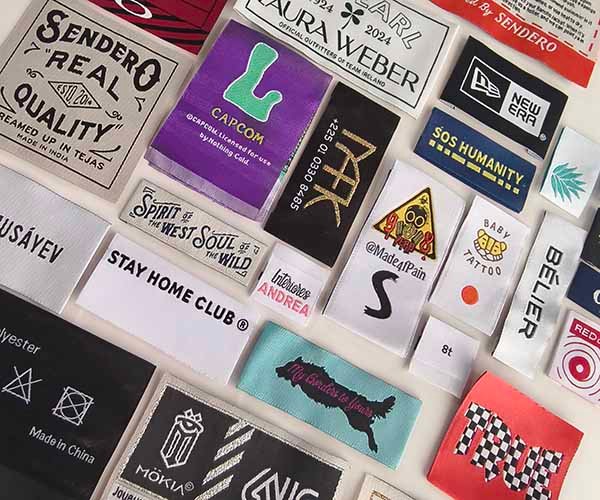
4. woven labels

Woven Label

Woven labels reproduce smaller text and detailed graphics more cleanly than embroidery. They work well for side seams, internal labels, product families, and cost-controlled branding. Options include:
  • Flat label
  • Folded label
  • End-fold label
  • High-density weave
  • Printed care information
  • Serialized product identification
1. screen printing

Screen Printing

Screen printing suits clear logos with a limited number of colors. It can provide efficient branding on polyester, canvas, lining, and selected coated materials. Sampling should confirm:
  • Ink adhesion
  • Color appearance
  • Print position
  • Surface texture
  • Abrasion exposure
  • Multi-color registration
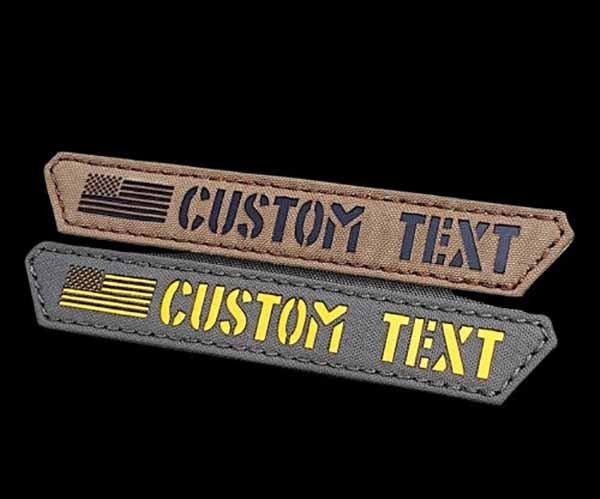
20. reflective tags

Reflective Branding

Reflective prints or patches can strengthen an electrician or industrial visual direction. Performance depends on the material, print method, surface, and viewing conditions. Use reflective branding for:
  • Exterior logo marks
  • Safety-inspired styling
  • Technician ranges
  • Night-service visual details
  • High-visibility color collections
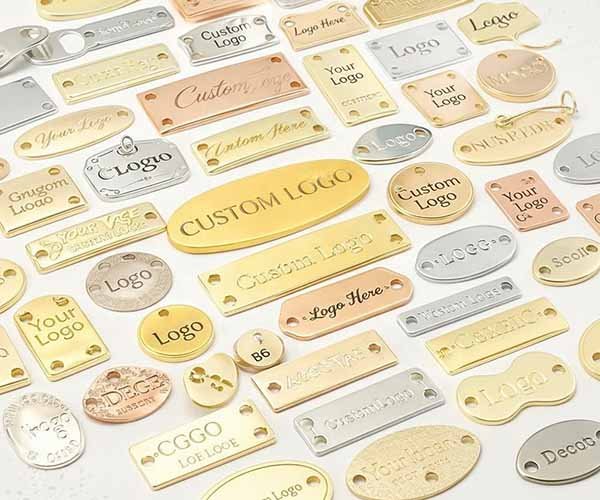
7. metal logo plate

Metal Badge

Metal plates provide a premium appearance for professional product lines. They require secure attachment and sufficient backing support. Development considerations include:

  • Mold fee
  • Plate thickness
  • Finish and plating
  • Edge shape
  • Rivet or prong attachment
  • Hidden backing plate
  • Scratch protection during packing

From Tool List to Production-Ready Design

A custom electrician tool bag needs more than a low quotation. Structure, materials, sewing feasibility, component supply, packaging, and quality checkpoints must be reviewed before bulk production.

Project Inputs We Can Review

A project can begin from one or several of the following:
  • Tech pack
  • Product sketch
  • Reference photograph
  • Physical sample
  • Existing product needing improvement
  • Competitor product link
  • Tool inventory
  • Tool dimensions
  • Target quantity
  • Target retail level
  • Target price
  • Packaging requirement
  • Destination market
  • Launch schedule
Incomplete information does not prevent an initial review. Szoneier can identify the missing dimensions, material details, load requirements, artwork files, and packaging specifications needed for reliable sampling.

Design-for-Manufacturing Review

Before pattern development, the team reviews whether the proposed structure can be sewn consistently and inspected clearly. Key questions include:
  • Can tools enter and leave each pocket without interference?
  • Is the opening wide enough after the bag is fully loaded?
  • Will the base support the expected equipment?
  • Are handles connected to suitable reinforcement areas?
  • Can thick seam intersections pass through production equipment?
  • Are zipper curves too tight?
  • Can all pockets be positioned consistently?
  • Do customized accessories meet the intended MOQ?
  • Will the final product fit efficient carton dimensions?
Early review prevents expensive changes after molds, materials, or packaging have already been ordered.

Premium and Cost-Controlled Configurations

Szoneier can prepare different configurations around a common product concept. A premium version may use:

  • 1680D fabric
  • Molded base
  • Heavy-gauge zippers
  • Metal hardware
  • Molded rubber branding
  • Additional padding
  • Branded retail packaging

A cost-controlled version may use:

  • Standard Oxford fabric
  • Reinforced fabric base
  • Regular zipper specifications
  • Standard hardware
  • Woven or printed branding
  • Simplified pocket construction
  • Efficient export packing

Cost reduction should protect the structural points that matter most: handles, base, pocket attachment, zipper ends, and critical hardware. 

Electrician Tool Bag Sample Development Process
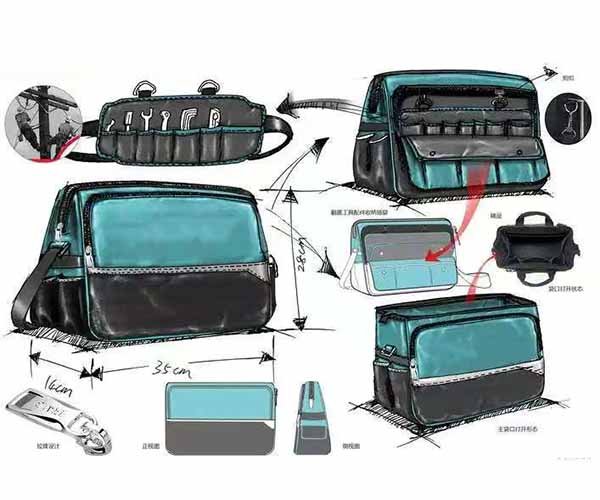
Sampling converts an idea into a measurable product. Every stage creates a reference for material, structure, workmanship, cost, and future bulk production.
1. project review

Project Review

We review product use, tool inventory, dimensions, target load, quantity, price direction, branding, packaging, and delivery plans before confirming the sample scope.
  • Identify missing information
  • Review structural risks
  • Confirm development objectives
2. material confirmation

Material Confirmation

Outer fabric, lining, boards, foam, webbing, zippers, hardware, binding, elastic, and reinforcement materials are selected before cutting.
  • Confirm available colors
  • Review thickness and stiffness
  • Check MOQ implications
3. pattern development

Pattern Development

Pattern makers translate dimensions and structure into production pieces. Pocket positions, seam allowance, reinforcement panels, and opening geometry are documented.
  • Establish size relationships
  • Plan seam intersections
  • Prepare positioning references
4. pocket positioning

Pocket Positioning

Tool pockets are arranged according to tool length, diameter, frequency of use, and weight distribution.
  • Check pocket depth
  • Review elastic-loop sizes
  • Balance left and right loading
2. logo methods — real performance at low moq

Logo Trial

Logo size, color, material compatibility, and placement are confirmed on the intended fabric or component.
  • Review embroidery density
  • Check print adhesion
  • Confirm patch attachment
6. sample sewing

Sample Sewing

The sample team assembles the bag using the planned sequence for panels, zippers, pockets, reinforcement, lining, bottom, handles, and final closing.
  • Record difficult operations
  • Review seam thickness
  • Adjust production feasibility
7. internal inspection

Internal Inspection

Before presentation, the sample is checked for dimensions, appearance, pockets, zippers, hardware, base stability, reinforcement, and finishing.
  • Compare with design files
  • Record deviations
  • Prepare improvement notes
8. photo and video review

Photo and Video Review

Detailed images or videos can be provided before shipment to review overall proportions, internal layout, branding, hardware, and critical construction.
  • Reduce avoidable shipping delays
  • Confirm visible details
  • Identify revision points early
9. revision and approval

Revision and Approval

Comments are converted into a controlled revision list. Approved changes are reflected in patterns, BOM records, and the final reference sample.

  • Lock approved specifications
  • Confirm bulk-production basis
  • Preserve revision history

Sample Lead-Time Reference:

  • Simple structures: approximately 3–7 days
  • Standard custom bags: approximately 7–12 days
  • Complex electrician tool bags: approximately 12–20 days or longer
  • Molded bases, custom hardware, special colors, or packaging prototypes require separate scheduling

What We Check Before Bulk Production

A visually acceptable sample still needs functional review. Validation should reflect the intended tools, carrying method, usage frequency, packaging, and marketing claims.

Tool Fit Check

Target tools are placed in the planned positions to confirm pocket depth, width, retention, and access. Review includes:
  • Tool insertion
  • Tool removal
  • Visibility
  • Interference
  • Sharp-edge contact
  • Loaded organization

Pocket Access Check

The bag is reviewed in the position where it will be used: on the floor, workbench, shoulder, back, or rolling base. Checkpoints include:
  • Opening angle
  • Gloved access
  • Zipper clearance
  • Pocket visibility
  • Small-item retrieval
  • Tool replacement

Static Load Check

A defined internal load may be used to observe bag shape, handle position, bottom deflection, panel distortion, and seam stress. The load method should be agreed for each project. Internal checks do not automatically create a certified marketing load claim.

Handle Pull Check

Handles, webbing, D-rings, hooks, and attachment points can receive internal pull checks or third-party tensile testing according to project requirements. Review covers:
  • Connection movement
  • Stitching deformation
  • Hardware bending
  • Fabric tearing
  • Uneven loading
  • Permanent distortion

Bottom Stability Check

The filled bag is placed on a flat surface to review standing stability, base shape, balance, and contact protection. Checks include:
  • Side-to-side tipping
  • Board movement
  • Molded-base fit
  • Seam stress
  • Tool concentration
  • Ground clearance

Water-Resistance Check

Material and finished construction are evaluated separately. A coated outer fabric may resist light moisture while sewn seams and openings still permit water entry. Possible checks include:

  • Surface water repellency
  • Lining leakage
  • Zipper exposure
  • Base wet-surface contact
  • Project-specific laboratory testing
  • Clear performance wording

Planning MOQ, Sample Time, and Production Cost

Planning ItemTypical DirectionMain Cost or Schedule Impact
MOQFrom 200 pieces for selected standard configurationsCustom-dyed fabrics, molded bases, customized hardware, complex branding, and special packaging may require higher quantities
Common Tote WidthApproximately 14–22 inches, fully customizableLarger dimensions increase material usage, board size, zipper length, packaging volume, and loaded stress
Sample Time7–12 days for many standard developments; 12–20 days or longer for complex tool bagsMaterial sourcing, molded parts, custom logos, revisions, and packaging prototypes extend development
Bulk ProductionApproximately 20–60 days after approvalsQuantity, pocket count, material readiness, molded components, packaging, SKU count, and peak season affect scheduling
Outer Fabric600D, 900D, 1200D, 1680D, canvas, or coated fabricsFabric weight, coating, yarn density, origin, color availability, and supplier MOQ influence cost
Pocket ComplexityBasic exterior pockets through multi-panel tool organizationMore pattern pieces, elastic loops, bindings, bartacks, and positioning checks increase labor
Bottom StructureReinforced fabric, internal board, wrapped base, EVA, or molded PPMolded bases may involve tooling, component MOQ, assembly control, and higher carton volume
Logo MethodPrint, embroidery, woven label, rubber patch, reflective mark, or metal badgeColor count, stitch count, mold fees, material, attachment, and quantity influence cost
PackagingExport polybag, hangtag, retail card, printed box, FBA packing, or industrial kit packingPrinted packaging MOQ, barcode control, carton size, protection, and assembly labor affect total cost
ShippingExpress, air, sea, DDP, FBA, overseas warehouse, or appointed forwarderCarton size, gross weight, volume weight, destination, clearance, and delivery speed determine landed cost

Controlled Production From Approved Sample

Bulk consistency depends on documented specifications, controlled materials, fixed patterns, clear checkpoints, and disciplined packaging release.

Approved Sample Record

The approved sample becomes the visual and structural reference for production.
Records may include:
  • Sample photographs
  • Measurements
  • Revision notes
  • Logo placement
  • Pocket count
  • Construction details

Bill of Materials

The BOM identifies approved outer fabric, lining, boards, foam, zippers, webbing, elastic, hardware, labels, packaging, and color references.
A controlled BOM reduces unauthorized substitutions and supports repeat-order consistency.

Pattern Locking

Final patterns are labeled and stored after approval. Critical pocket pieces, reinforcement panels, bottom structures, and zipper paths receive controlled references.
Pattern changes require documented approval.

Incoming Inspection

Materials and accessories are checked before production.
Review may cover:
  • Fabric color and surface
  • Coating condition
  • Zipper specifications
  • Hardware finish
  • Webbing width
  • Board and foam thickness

Cutting Control

Accurate cutting protects dimensions, pocket alignment, seam matching, and material efficiency.
Control measures include:
  • Marker review
  • Bundle labeling
  • Directional fabric control
  • Color-lot separation
  • Quantity counting
  • Critical-piece inspection

Pocket Positioning

Templates and measurements help maintain consistent pocket placement across production units.
Checks cover:
  • Pocket height
  • Spacing
  • Elastic length
  • Symmetry
  • Opening width
  • Bartack locations

Sewing and Reinforcement

Production sequences cover panel sewing, zipper installation, binding, pocket assembly, lining, handle attachment, bottom construction, bartacking, hardware installation, and final closing.
High-risk areas receive additional process checks.

Semi-Finished Inspection

Problems are identified before final assembly and packing.
Inspection may include:
  • Structure
  • Dimensions
  • Pocket layout
  • Webbing position
  • Hardware installation
  • Reinforcement stitching
  • Zipper operation

Packing Release

Finished units move to packing only after required inspections and corrections are completed.
Packing release checks:

  • Product cleanliness
  • Shape
  • Label accuracy
  • Accessories
  • Packaging materials
  • Carton quantity
  • Shipping marks

Quality Control for Loaded Electrician Tool Bags

Tool bag inspection must examine structural risk, not only surface appearance. Szoneier applies checks from incoming material through packed shipment.

Fabric and Coating

Outer fabric is reviewed for color, surface defects, coating condition, contamination, visible weaving issues, and consistency with the approved material.
  • Compare material reference
  • Separate color lots
  • Check coated surfaces
  • Record visible defects

Zippers and Hardware

Zippers, D-rings, hooks, buckles, rivets, and other hardware are checked for specification, finish, movement, attachment, and visible damage.
  • Confirm size and finish
  • Operate zippers
  • Check sharp edges
  • Review attachment direction

Cutting Accuracy

Cut pieces influence overall size, pocket alignment, zipper shape, and base fit.
  • Check critical panels
  • Confirm pair symmetry
  • Verify grain or direction
  • Control bundle quantities

Pocket Positioning

Each production unit must maintain the approved number, position, depth, opening width, and reinforcement of tool pockets.
  • Use positioning templates
  • Measure critical pockets
  • Check elastic tension
  • Compare sealed sample

Reinforcement Stitches

Bartacks, Box-X patterns, multiple stitching lines, bindings, and hidden reinforcement panels are examined at defined stress points.
  • Handle roots
  • Strap tabs
  • Pocket corners
  • Zipper ends
  • Bottom seams
  • Hardware loops

Handle and Strap Roots

Load-bearing connections are reviewed for alignment, stitching area, skipped stitches, loose threads, fabric distortion, and hardware placement. Internal pull checks or third-party tests can be coordinated when specified.

Bottom Construction

Base boards, foam, molded parts, wrapped panels, feet, and surrounding seams are checked for fit and stability.
  • Confirm board position
  • Review molded-base attachment
  • Check standing balance
  • Inspect corner stress

Finished Load Review

Selected units may be loaded according to an agreed internal inspection method to observe shape, handles, pockets, hardware, and base behavior. Any formal load claim requires a defined protocol and appropriate records.

Packaging Inspection

Before shipment, inspection covers product count, labels, barcodes, FNSKU where required, polybags, warnings, inserts, retail cards, carton quantity, carton marks, gross weight, and shipment documents. 

Packaging for Retail, Distribution, and FBA

Packaging should protect the bag, control presentation, identify each SKU, and support efficient shipping without unnecessary volume.

Export Packing

Standard export packing may include shape control, folded straps, protective wrapping, polybags, carton dividers, and master cartons. Planning covers:
  • Folding method
  • Product protection
  • Carton quantity
  • Carton dimensions
  • Gross weight
  • Shipping marks

Retail Hangtags

Hangtags can carry brand information, features, barcodes, warnings, country-of-origin information, and product specifications. Szoneier can coordinate:
  • Printed hangtags
  • String or plastic attachments
  • Barcode placement
  • Multi-language content
  • SKU differentiation
  • Pack-out instructions

UPC and Barcode Labels

Accurate barcode control is essential for retail warehouses and distribution systems. Checks include:
  • Artwork file
  • Number-to-SKU match
  • Label placement
  • Print clarity
  • Scan verification
  • Carton-level identification

Amazon FBA Packing

FBA projects may require FNSKU labels, polybag warnings, product separation, carton labels, carton weight control, and warehouse-specific shipment preparation. Project information should include:
  • Marketplace
  • SKU count
  • FNSKU files
  • Packing quantity
  • Destination warehouse
  • Forwarding method

Carton and Pallet Planning

Tool bags can create high shipping volume when rigid bases or structured panels prevent folding. Carton planning should begin before production ends. Szoneier reviews:
  • Folding limits
  • Product deformation risk
  • Carton strength
  • Pallet requirements
  • Container utilization
  • Warehouse handling

DDP and Warehouse Delivery

Shipping can be evaluated by express, air freight, sea freight, DDP, FBA first-leg delivery, overseas warehouse delivery, or an appointed forwarder. Commercial invoices, packing lists, product descriptions, carton data, and basic export documents can be coordinated. Import requirements should be confirmed with the destination broker or importer. 

Factory-Based Tool Bag Development and Production

Szoneier is a Shenzhen-based custom bags and soft goods OEM/ODM manufacturer with in-house development coordination and a controlled South China supply network.

Material Review

Materials are selected according to use, target cost, structure, abrasion exposure, water-resistance needs, brand position, quantity, and availability. Recommended image: Material rolls, coated fabrics, webbing, boards, foam, and hardware reviewed together.

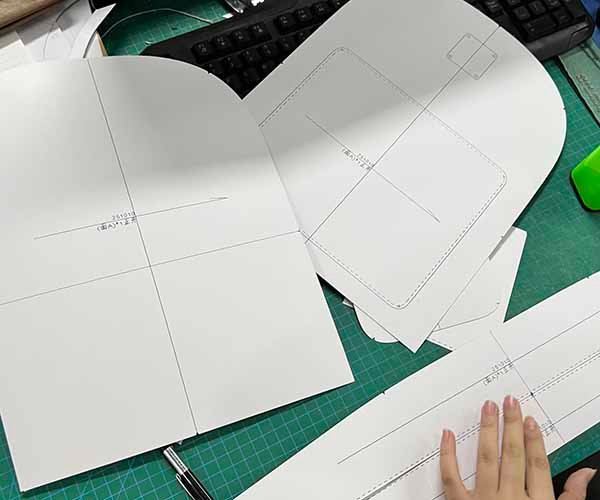
Pattern Development

Pattern work converts product dimensions and functional requirements into repeatable production components. Recommended image: Paper patterns for tool pockets, side panels, base pieces, and reinforcement layers.

Sample Room

The sample team develops prototypes, reviews sewing feasibility, tests layouts, and records revisions before bulk preparation. Recommended image: Electrician tool bag sample under construction with visible internal pocket panels.

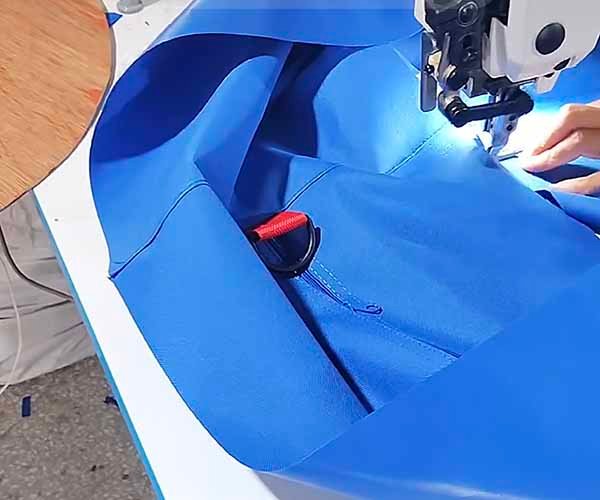
Sewing Production

Szoneier’s manufacturing system includes:
  • 8 production lines
  • 120+ production personnel
  • 160+ sewing and supporting machines
  • 8,000+ square meters of sewing workshop space
  • Tool bag and functional soft goods capability
Recommended image: Walking-foot sewing, bartacking, binding, and heavy-material assembly.

Quality Inspection

An independent inspection structure covers incoming materials, in-process work, semi-finished products, final products, packaging, and shipment preparation. Recommended image: Inspector checking handle roots, pocket depth, base structure, and zipper operation.

Capacity Coordination

The production system combines Szoneier’s factory-based operations with more than 10 controlled satellite partner factories. Documented capacity includes:

  • Monthly production capacity of approximately 120,000–200,000 pieces across multiple product categories
  • Annual capacity of approximately 1.5–2.4 million pieces
  • Ability to coordinate approximately 20–35 production orders in parallel, depending on complexity and material readiness

Tool bag schedules are planned separately according to structure, material, pocket count, base components, inspection requirements, and packaging.

Electrician Tool Bag Development Cases
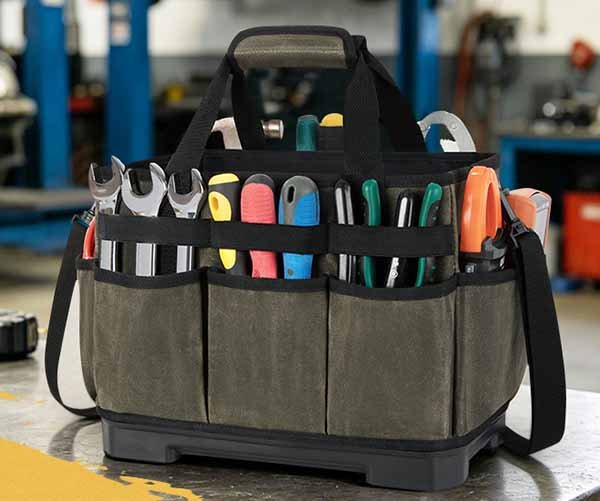
The following anonymized formats demonstrate how professional tool bag projects can be presented. Confirm all figures against internal order records before publication.
1. hard bottom open electrician tote bag

U.S. Tool Brand Program

Market: United States Product: Hard-bottom open electrician tote Order Quantity: 1,500 pieces Sample Development: 3 prototype rounds Production Schedule: 42 days after final approvals The original concept used a narrow opening, shallow exterior pockets, and handle webbing ending midway down the side panels. Loaded review showed poor access to long screwdrivers and visible stress near the handle attachments. The revised construction included:
  • Wider structured opening
  • 1680D exterior panels
  • Molded PP bottom
  • Extended handle webbing
  • Box-X stitching and bartacks
  • Padded meter pocket
  • Deep vertical tool slots
  • Removable shoulder strap
  • Rubber logo patch
  • Retail hangtag and UPC label
Inspection focused on handle roots, molded-base attachment, pocket depth, zipper operation, standing stability, barcode accuracy, and carton quantity. The production records preserved the approved pattern, BOM, branding files, packaging files, and inspection points for later replenishment.
2. technician bag, meter pouch, and tool roll

European Distributor Range

Market: Germany, Netherlands, and France Products: Technician bag, meter pouch, and tool roll Combined Quantity: 2,700 pieces SKU Count: 6 Production Schedule: 48 days after final material and packaging approval The distributor needed three related products with a unified material, color, zipper, webbing, and branding system. Each country required separate language cards and SKU labels. Szoneier coordinated:
  • Shared 1200D Oxford fabric
  • Common lining and webbing
  • Matched zipper and hardware finish
  • Embroidered exterior logo
  • Woven internal product labels
  • SKU-specific barcode files
  • Country-specific inserts
  • Separate carton marks
  • Mixed container loading plan
Production control used individual BOM sheets, approved patterns, color-lot records, pocket-position templates, packaging instructions, and final SKU counting. Shared materials reduced unnecessary fragmentation while separate inspection records protected each product specification.
3. electrician backpack

Online Professional Range

Market: United States
Product: Electrician backpack
Initial Order: 800 pieces
Replenishment: 1,600 pieces
Sample Development: 2 main revisions
Initial Production: 36 days after approval
The first sample carried the intended tools but placed too much weight in the rear compartment. The meter pocket also interfered with the main zipper when fully loaded.
The second development adjusted:

  • Meter pocket position
  • Internal weight distribution
  • Shoulder strap anchor points
  • Back-panel padding
  • Reinforced upper handle
  • Battery compartment board
  • Exterior quick-access pockets
  • Reflective logo detail
  • FNSKU and polybag warning placement

Selected finished units received loaded appearance reviews, zipper operation checks, shoulder-root inspection, base review, and packaging verification. Repeat production used the stored pattern, BOM, FNSKU file, carton configuration, and inspection reference from the first order.

Electrician Tool Bag Frequently Asked Questions
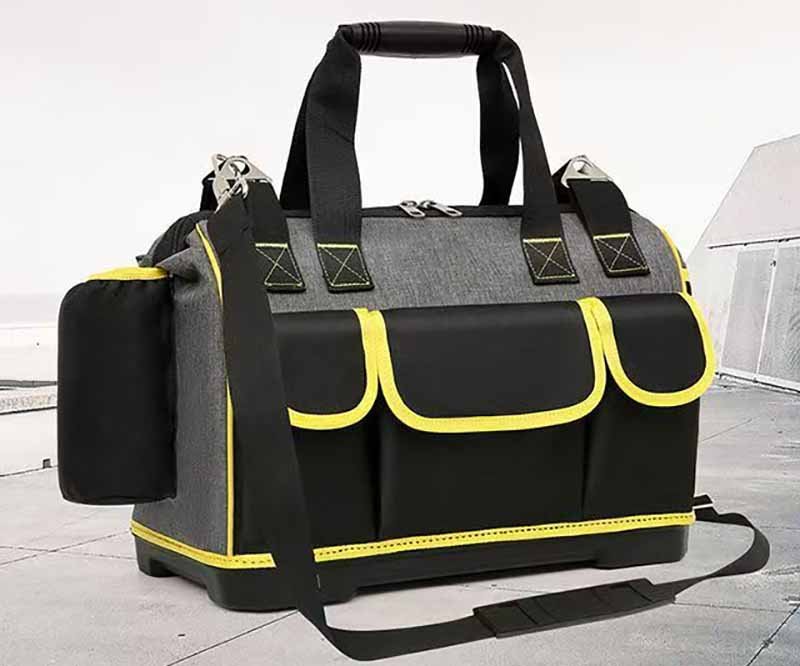
Common options include 600D, 900D, 1200D, and 1680D Oxford, nylon, heavy canvas, coated fabrics, reinforced bottom materials, foam, PE or PP boards, and molded bases. Selection depends on expected load, abrasion exposure, standing requirements, target cost, desired weight, and market position.
Yes. A tool list with dimensions, weights, photographs, and preferred positions helps us plan pocket depth, elastic-loop sizes, main-compartment volume, protective padding, opening width, base support, and expected load distribution. A physical tool sample or model can also support more accurate validation.
Yes. Available directions include internal boards, reinforced wrapped bases, EVA-supported bottoms, and molded PP bases. The suitable structure depends on load, ground exposure, standing stability, budget, tooling, MOQ, packaging volume, and reorder plans.
MOQ starts from 200 pieces for selected configurations using available materials, standard colors, established accessories, regular branding, and efficient packaging. Molded bases, custom-dyed materials, customized hardware, special packaging, and complex structures may require higher quantities.
Simple developments may require about 3–7 days, standard samples about 7–12 days, and complex electrician tool bags about 12–20 days or longer. Molded parts, custom accessories, special colors, logo tooling, packaging prototypes, and revisions affect the final schedule.
Szoneier can perform internal pull and load checks and coordinate client-defined or third-party tensile testing for handles, shoulder straps, webbing, D-rings, hooks, buckles, zipper ends, and other load-bearing points. Test methods and acceptance requirements should be confirmed before production.
Yes. Pocket quantity, depth, width, opening, elastic tension, reinforcement, location, and orientation can be developed around the intended tools. Tool dimensions or a physical reference help reduce fit problems and unnecessary sample revisions.
Durability depends on material, placement, abrasion exposure, and attachment method. Embroidery, woven labels, molded rubber patches, and secured metal badges are common for professional ranges. Screen printing and reflective branding can also work when the fabric and intended use are suitable.
Yes. Available support includes polybags, warnings, hangtags, UPC labels, FNSKU labels, instruction cards, printed packaging, SKU separation, carton labels, shipping marks, packing lists, and DDP or FBA first-leg delivery coordination.
Szoneier can preserve approved patterns, BOM records, material specifications, artwork, logo placement, packaging files, carton details, FNSKU files, and inspection points. Material availability and current production conditions are reconfirmed before each repeat order.

Start Your Electrician Tool Bag Project

Send Szoneier the information already available, even when the design is not fully finished. A photograph, sketch, competitor reference, physical sample, tech pack, or tool list can provide a starting point. Our project team will review the intended use, dimensions, tool configuration, material direction, reinforcement, pocket layout, base structure, branding, packaging, order quantity, target schedule, and destination. We will then identify missing specifications and explain the next steps for quotation or sample development. For a faster review, include:
  • Product type or reference image
  • Target dimensions
  • Tool list and approximate loaded weight
  • Preferred outer fabric
  • Required pocket arrangement
  • Soft or molded bottom preference
  • Carrying method
  • Logo artwork
  • Order quantity
  • Packaging requirements
  • Delivery country
  • Target launch or delivery date
  • Target cost, when available
electrician backpack 1

Ask For A Quick Quote

We will contact you within 24 Hours, please pay attention to the email with the suffix“@szoneier.com”

For all inquiries, please feel free to reach out at:

Ask For A Quick Quote

We will contact you within 24 Hours, please pay attention to the email with the suffix“@szoneier.com”

Contact Us

Send us a message if you have any questions or request a quote. We will be back to you ASAP!

For all inquiries, please feel free to reach out at:

Contact Us

Send us a message if you have any questions or request a quote. We will be back to you ASAP!

Exclusive Offer for First-Time Customers

For first-time customers, we will send you a free color card for you to choose.Once you have confirmed the fabric and color, our factory will make a free sample proofing for you.

For customers who frequently cooperate with us, we will send new color charts free of charge several times a year.

For all inquiries, please feel free to reach out at: