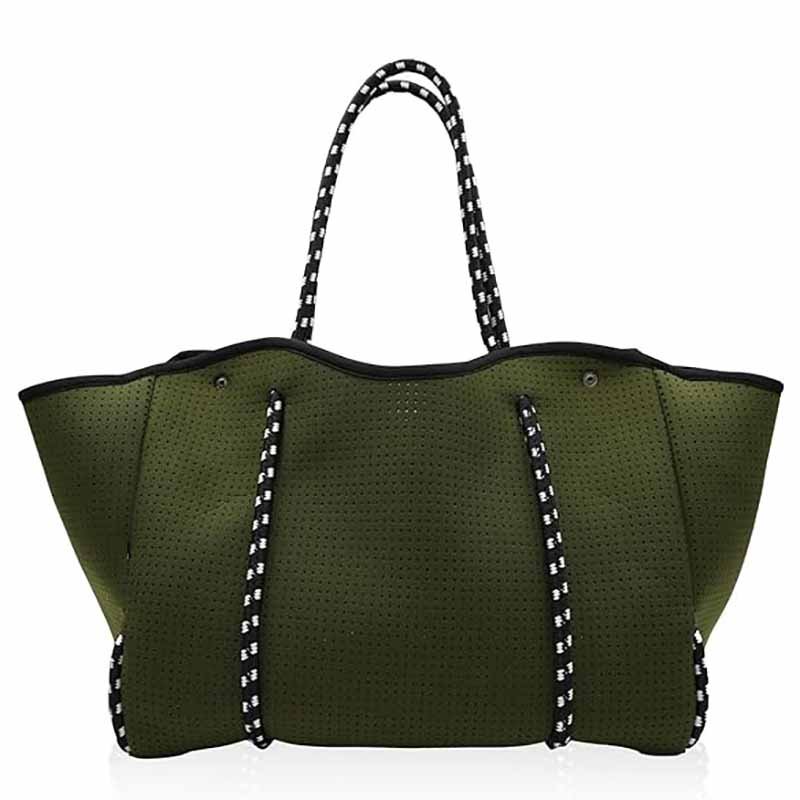
A beach bag may look like a simple summer accessory, but for companies selling beachwear, resort gifts, travel products, promotional items, or private label lifestyle goods, it can directly affect customer satisfaction and repeat sales. A good beach bag must carry wet towels, sunscreen, water bottles, phones, sunglasses, clothes, snacks, and sometimes kids’ items, all while staying comfortable, clean-looking, and easy to use. That is why neoprene beach bag manufacturing has become a serious product development topic for companies that want more than a cheap seasonal tote.
Neoprene beach bag manufacturing is the process of turning neoprene material into finished beach bags through material selection, product design, pattern making, logo application, cutting, stitching, inspection, and packaging. The goal is to create beach bags that are soft, flexible, water-resistant, durable, easy to clean, and suitable for custom branding.
For companies planning a custom beach bag project, the key question is not only “How much does one bag cost?” A better question is: “Will this bag still look good and work well after real beach use?” Many product issues start from small early decisions: material too thin, handles too weak, logo method unsuitable, opening too narrow, zipper too cheap, or packaging not planned for ecommerce shipping. These details are not always obvious in a photo, but customers notice them immediately when they use the product.
Szoneier has more than 18 years of experience in neoprene fabric research, development, and product manufacturing. The company supports custom neoprene products such as bags, koozies, sports supports, medical supports, wetsuits, and related neoprene items. For beach bag projects, Szoneier helps overseas companies develop custom, private label, OEM, and ODM products with free design support, low MOQ customization, fast sampling, free sample support for suitable projects, short lead times, and 100% quality assurance.
What Is Neoprene Beach Bag Manufacturing?
Neoprene beach bag manufacturing means developing and producing beach bags from neoprene material, including design planning, material matching, pattern making, logo customization, sample approval, bulk production, quality inspection, and packaging. A strong manufacturing process helps companies create bags that feel soft, hold their shape, resist moisture, carry daily beach items, and present a custom logo clearly.
Neoprene Material
Neoprene is a flexible synthetic rubber material often laminated with fabric surfaces such as polyester or nylon. In beach bag production, neoprene is valued because it combines softness, cushioning, stretch, and water resistance. Unlike ordinary woven fabric, neoprene has body and thickness, so a beach bag can feel more structured without becoming hard or uncomfortable.
For beach bags, neoprene thickness is one of the first decisions. Many beach bag projects use material between 2mm and 5mm, depending on the required structure, cost, weight, and product positioning. A lightweight travel beach tote may use thinner neoprene to reduce cost and shipping weight. A premium beach tote or large family beach bag may need thicker neoprene to improve shape and load support.
The surface fabric also matters. Smooth laminated surfaces are better for clean printing and modern fashion styles. Textured surfaces may feel more premium and hide small marks better. Some companies prefer solid colors for a simple retail look, while others need full-print patterns for swimwear matching, tropical themes, resort collections, or promotional campaigns.
| Neoprene Choice | Common Use | Main Advantage | Possible Concern |
|---|---|---|---|
| 2mm neoprene | Lightweight beach totes, foldable bags | Lower weight, easier packing | Less structure for large bags |
| 3mm neoprene | Standard custom beach bags | Balanced cost, feel, and shape | Needs correct pattern support |
| 4mm neoprene | Premium totes, larger bags | Better body and durability | Higher material cost |
| 5mm neoprene | Heavy-duty or structured styles | Stronger feel and premium look | Heavier and less foldable |
| Smooth surface | Logo printing, fashion bags | Clean appearance | May show stains more easily |
| Textured surface | Lifestyle and outdoor bags | Better hand feel, hides marks | Logo method needs testing |
Szoneier’s experience in neoprene fabric R&D gives customers more material choices instead of forcing every project into one standard option. This is useful because beach bags can serve very different markets. A boutique swimwear label, an Amazon private label seller, a resort gift shop, and a promotional campaign do not need the exact same material solution.
Beach Bag Function
A beach bag must perform in conditions that are more demanding than everyday shopping or office use. It may carry wet swimsuits, sandy towels, sunscreen bottles, beach toys, food containers, books, and electronics. Customers often place it on sand, near pool water, inside cars, on boats, or in hotel rooms. Because of this, the bag needs to be easy to carry, easy to clean, and strong enough for repeated use.
Neoprene is especially suitable for beach bags because it does not feel stiff like some waterproof materials and does not absorb moisture like cotton canvas. It offers a soft, cushion-like feel while still giving the product a modern look. For many companies, this makes neoprene a good choice for higher-value beach accessories.
A useful neoprene beach bag should consider the following details:
Capacity should match real customer use. A small tote may be fine for sunscreen and a towel, but family beach bags need more room and stronger handles.
Opening width should allow users to place large towels and clothing inside easily. A beautiful bag with a narrow opening can become frustrating in daily use.
Handle length should fit shoulder carrying. Beach bags are often carried for longer distances, from parking lots to beaches, hotel rooms to pools, or boats to docks.
Inner structure should help users find small items. Even one zipper pocket can improve the customer experience.
Bottom design should support weight. A weak bottom may sag after loading bottles, towels, and accessories.
For custom projects, Szoneier usually recommends confirming the target use before designing the bag. A product made for resort retail should not follow the exact same structure as a high-volume promotional giveaway. When function is clear, material thickness, size, handle design, pocket layout, and logo position become much easier to decide.
Neoprene vs Canvas
Canvas has a natural and classic look, but it absorbs water and can become heavy when wet. Mesh drains sand and water quickly, but it offers less privacy and often feels less premium. Polyester is affordable and easy to produce, but it may not create the same soft, high-value feeling. PVC can be waterproof, but it may feel stiff or plastic-like. Neoprene sits between lifestyle, function, and comfort.
For many companies, neoprene is chosen because it makes a beach bag feel more like a branded accessory instead of a disposable tote. It gives the bag a soft touch, better shape, and a modern appearance. It also works well with color-block designs, contrast handles, printed patterns, and custom logos.
| Material | Best Strength | Weak Point | Better For |
|---|---|---|---|
| Neoprene | Soft, flexible, water-resistant, premium feel | Higher cost than basic polyester | Custom branded beach bags, resort bags, swimwear accessories |
| Canvas | Natural texture, classic style | Absorbs water, slower drying | Casual lifestyle totes |
| Mesh | Lightweight, drains sand | Less privacy, less structure | Budget beach and pool bags |
| Polyester | Low cost, easy printing | Less premium hand feel | Promotional bags |
| PVC | Wipe-clean waterproof surface | Can feel stiff, less soft | Transparent or waterproof designs |
The right material depends on product goals. If a company wants the lowest possible cost, polyester or mesh may be enough. If the goal is a better hand feel, stronger brand presentation, and higher perceived value, neoprene is often a stronger choice.
Szoneier helps customers compare materials from both product and business angles. This includes unit cost, logo effect, shipping weight, customer use, retail positioning, and expected order quantity. This practical comparison helps reduce product mistakes before sampling begins.
Customer Groups
Neoprene beach bag manufacturing is suitable for many business types. Some companies need a stylish summer product to sell directly to consumers. Others need a branded gift for events, hotels, beach clubs, or travel campaigns. Some need low MOQ testing for a new ecommerce listing, while others need stable OEM production for repeat orders.
Common customer groups include:
Swimwear brands that need matching beach bags for seasonal collections.
Resort and hotel suppliers that want branded guest gifts or gift shop products.
Amazon and Shopify sellers that need private label beach bags with custom packaging.
Promotional product companies that need logo bags for summer events, beach campaigns, and corporate gifts.
Travel and lifestyle brands that want lightweight bags for vacation, pool, and weekend use.
Sports and outdoor companies that need soft water-resistant carry bags for towels, gear, and accessories.
Boutique retailers that want small-batch custom colors, patterns, or logo styles.
Each group has different priorities. A swimwear brand may care about color accuracy and fashion appearance. A promotional company may care about logo clarity and delivery time. An Amazon seller may care about packaging, weight, size, photo appeal, and customer reviews. A resort customer may care about premium feel and guest experience.
| Customer Type | Main Concern | Useful Manufacturing Support |
|---|---|---|
| Swimwear brand | Color matching, premium look | Custom color, pattern, logo placement |
| Amazon seller | Cost, packaging, reviews | Low MOQ, sample testing, retail packaging |
| Resort supplier | Guest experience, durability | Soft material, clean logo, strong handles |
| Promotional company | Deadline, logo visibility | Fast sampling, simple structure, bulk capacity |
| Boutique retailer | Small order, unique design | Low MOQ, free design, flexible customization |
| Travel brand | Lightweight, foldable use | Thin neoprene, smart packing, travel structure |
Szoneier works with small and medium overseas customers as well as higher-end brand customers. The company’s low MOQ customization, free design support, fast sample development, and OEM/ODM service are especially helpful for companies that want custom products without taking unnecessary early inventory risk.
Which Styles Fit Neoprene Beach Bag Manufacturing?
The most suitable styles for neoprene beach bag manufacturing include classic beach totes, large family bags, zipper beach bags, foldable travel bags, and pocket-friendly designs. These styles make good use of neoprene’s soft body, water resistance, flexibility, color performance, and custom logo space. The best style depends on customer use, sales channel, target price, and order quantity.
Classic Totes
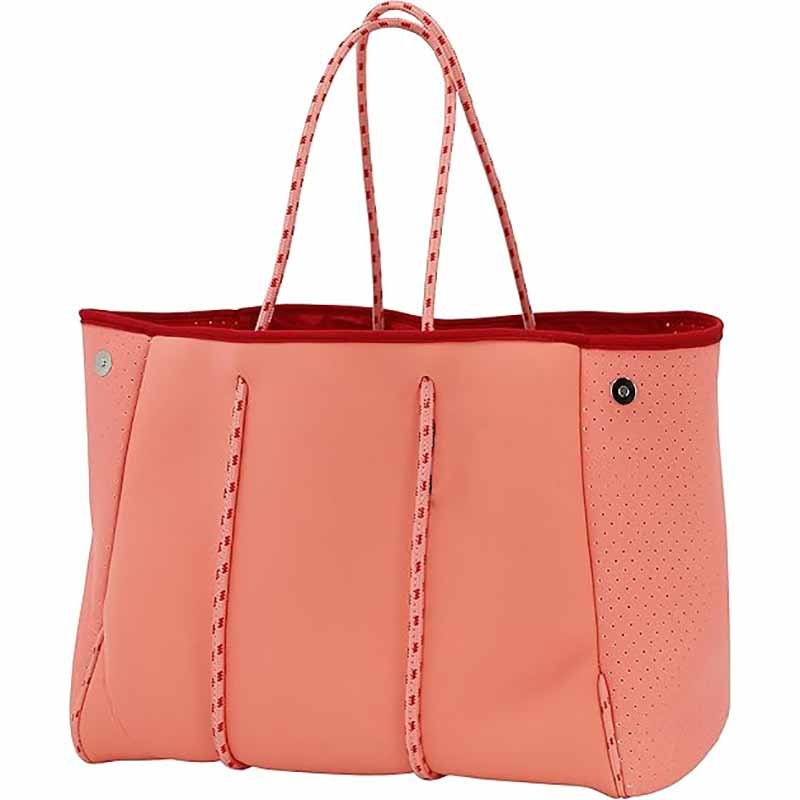
The classic neoprene beach tote is one of the most requested styles because it is simple, useful, and easy to customize. It usually has a wide opening, soft handles, a large body panel, and enough space for beach towels, swimsuits, sunscreen, water bottles, books, and daily accessories. This style works well for swimwear brands, resort shops, travel brands, gift companies, and ecommerce sellers.
A classic tote also provides a large front panel for logo placement. This makes it suitable for screen printing, heat transfer, rubber patches, woven labels, and other custom branding methods. For companies that want a clean and recognizable product, this style is often the easiest starting point.
However, a simple tote still requires careful manufacturing. The bag should not look shapeless when empty. The bottom should not sag too much when filled. The handles should not stretch or twist after repeated use. Stitching should stay clean because beach totes often use minimal design, making workmanship more visible.
Key design points for classic neoprene beach totes include:
Bag width should match real beach use, not only photo appearance.
Handle drop should allow comfortable shoulder carrying.
Bottom width should support towels and bottles without making the bag too bulky.
Logo size should look balanced from a normal viewing distance.
Material thickness should create enough structure without making the bag too heavy.
For many first-time custom projects, Szoneier may recommend starting with a clean tote structure, then adding value through color, handle detail, logo method, pocket design, or packaging. This keeps the product practical while still giving it a custom look.
Large Beach Bags
Large neoprene beach bags are designed for customers who need more carrying space. They are popular for family beach trips, pool days, boating, weekend travel, gym use, and resort vacations. A large bag usually has a wider body, deeper capacity, stronger handles, and sometimes multiple pockets.
Large styles can sell well because customers often prefer one roomy bag instead of carrying several smaller bags. But from a manufacturing point of view, large size also creates more pressure on the material and seams. A bag that looks attractive when empty may perform poorly when loaded with wet towels, bottles, and personal items.
For large neoprene beach bags, the main risks include:
Handles pulling away from the body after heavy use.
Side panels stretching when the bag is full.
Bottom sagging too much under weight.
Opening becoming too wide and losing shape.
Shipping volume increasing due to size and packing method.
Because of these risks, Szoneier pays attention to reinforcement during sample development. Handle attachment can be strengthened. Stitching density can be adjusted. The bottom structure can be improved. Neoprene thickness can be upgraded if needed. These details help the bag feel reliable in real use.
| Large Bag Detail | Recommended Focus | Reason |
|---|---|---|
| Handle attachment | Reinforced stitching | Supports heavier loads |
| Bottom panel | Wider and stronger structure | Reduces sagging |
| Side panels | Balanced pattern shape | Helps bag keep form |
| Material thickness | Usually 3mm–5mm | Improves body and durability |
| Inner pocket | Zipper or slip pocket | Helps organize small items |
| Packing method | Flat or controlled folding | Protects appearance during shipping |
Large beach bags are often better suited for companies that want a higher retail price or more practical lifestyle value. They may cost more to produce, but customers can clearly understand the benefit when the design is done well.
Zipper Bags
A zipper neoprene beach bag gives customers more security. It helps protect wallets, phones, keys, sunglasses, cosmetics, and travel documents from falling out. This style is useful for travel, hotels, resorts, boating, pool clubs, and retail products positioned above basic open totes.
Zipper design can be added in several ways. A full top zipper gives the strongest closure. A partial zipper keeps the bag easier to access. An inner zipper pocket protects valuables without changing the open tote shape. A detachable zipper pouch adds extra value and can be used separately.
The zipper choice should match the product level. A cheap zipper can make the whole bag feel low quality, even if the neoprene itself is good. Zipper smoothness, puller strength, stitching alignment, and top opening shape should all be checked during sampling.
Important zipper decisions include:
Full top zipper for security and travel use.
Inner zipper pocket for valuables while keeping the tote open.
Water-resistant zipper for higher-end outdoor positioning.
Large zipper pullers for easier use with wet hands.
Color-matched zipper tape for cleaner appearance.
Contrast zipper color for a sporty or fashion look.
Szoneier can develop zipper structures based on customer needs and test them during sampling. This is important because neoprene has stretch, and zipper installation must be controlled carefully to avoid waves, pulling, or uneven top edges.
Foldable Bags
Foldable neoprene beach bags are suitable for travel, ecommerce, gifts, and lightweight summer products. Customers like bags that can be packed into luggage, stored in a car, carried as an extra beach bag, or used for shopping during vacation. For online sellers, foldable designs may also reduce shipping volume if the packing method is planned correctly.
The challenge is finding the right balance between foldability and structure. A very thick neoprene bag may feel premium but may not fold neatly. A very thin bag may fold well but may not feel strong enough. The pattern and seam design also affect how smoothly the bag folds.
Foldable styles often work well for:
Travel accessory brands.
Resort gift programs.
Summer promotional campaigns.
Lightweight ecommerce products.
Swimwear add-on products.
Beach club or event giveaways.
For foldable projects, Szoneier can help test material thickness, bag size, seam placement, folding method, and package size. The goal is to make the product easy to store without making it look weak when opened.
| Foldable Design Choice | Benefit | Manufacturing Note |
|---|---|---|
| Thin neoprene | Easier folding | Less structure |
| Medium neoprene | Better balance | Needs good pattern design |
| Simple open tote | Lower cost | Less security |
| Pouch packing | Better gift value | Adds labor and material cost |
| Flat folding | Lower shipping volume | Needs crease control |
| Snap or strap closure | Cleaner storage | Adds accessory cost |
Foldable beach bags are a good choice when the product needs to be practical, lightweight, and easy to ship. They are also useful for companies testing new market demand with lower inventory pressure.
Pocket Designs
Pockets can make a neoprene beach bag much more useful. Beach customers often carry many small items, including phones, keys, sunscreen, lip balm, cards, sunglasses, snacks, and water bottles. Without pockets, these items can easily disappear under towels and clothing.
Pocket design should be practical rather than excessive. Too many pockets can increase cost, slow production, and make the bag look complicated. The best pocket layout depends on the user. A family beach bag may need side bottle pockets and a large inner pocket. A fashion tote may only need one hidden zipper pocket. A travel beach bag may benefit from a removable pouch.
Common pocket options include:
Inner zipper pocket for valuables.
Open slip pocket for quick access.
Side bottle pocket for water or sunscreen.
Wet pocket for swimsuits or damp items.
Removable pouch for phone, cards, and cosmetics.
Exterior pocket for easy-access travel items.
| Pocket Type | Main Use | Best Product Match |
|---|---|---|
| Inner zipper pocket | Protects valuables | Travel and resort bags |
| Slip pocket | Quick access | Daily beach totes |
| Side pocket | Holds bottle or sunscreen | Family beach bags |
| Wet pocket | Separates damp items | Swimwear and sports products |
| Removable pouch | Adds value | Fashion and gift sets |
| Exterior pocket | Easy access | Travel and pool bags |
Szoneier helps customers choose pocket designs based on the product’s sales channel and target price. For many projects, one or two well-planned pockets are better than several unnecessary compartments. This keeps the bag useful, attractive, and cost-controlled.
How Does Neoprene Beach Bag Manufacturing Work?
Neoprene beach bag manufacturing usually follows a clear process: product requirements, material selection, pattern making, sample development, logo testing, bulk cutting, sewing, inspection, packing, and shipping. A good process helps customers control product quality, avoid costly revisions, improve launch speed, and make sure the final beach bag matches the intended market, price level, and brand image.
Material Selection
Material selection is the foundation of neoprene beach bag manufacturing. Before discussing logo, packaging, or price, the first question should be: what type of neoprene is suitable for this product? A beach bag used for resort retail, Amazon private label sales, swimwear matching, or promotional giveaways may need different material thickness, surface fabric, elasticity, and structure.
For many beach bag projects, neoprene thickness usually falls between 2mm and 5mm. A 2mm material can be useful for lightweight foldable bags, gift bags, and lower-cost summer campaigns. A 3mm material is often a balanced choice for standard beach totes because it provides softness, moderate structure, and reasonable cost. A 4mm or 5mm material may be selected for larger bags, premium totes, or products that need stronger body and better shape retention.
Surface lamination is also important. Neoprene itself is usually laminated with polyester, nylon, or other fabric layers to improve appearance, touch, printing performance, and durability. A smooth surface works well for clean logo printing and modern fashion styles. A textured surface can create a stronger lifestyle look and hide small marks better during use. For full-print designs, the surface fabric and printing method need to be tested carefully before bulk production.
Color is another part of material selection. Some customers want standard black, navy, beige, or grey for a clean retail look. Others prefer bright summer colors such as coral, turquoise, lemon yellow, pink, orange, or tropical prints. For private label brands, color consistency is important because different production batches should not look noticeably different.
| Material Decision | Common Option | What It Affects | Customer Concern |
|---|---|---|---|
| Thickness | 2mm–5mm | Weight, structure, cost | Will the bag feel too soft or too heavy? |
| Surface fabric | Polyester, nylon, textured fabric | Touch, logo effect, appearance | Will the logo look clean? |
| Color | Standard color or custom color | Brand style, MOQ, lead time | Can the color match my collection? |
| Elasticity | Soft or firmer neoprene | Shape and carrying feel | Will the bag stretch too much? |
| Lamination | Standard or upgraded bonding | Durability and surface quality | Will the surface peel or bubble? |
| Odor control | Normal or improved process | Customer experience | Will the bag smell strong after opening? |
Szoneier’s advantage is that the company has more than 18 years of neoprene fabric research and manufacturing experience. This means customers are not limited to one basic material choice. Szoneier can recommend a more suitable material plan according to bag size, use scenario, order quantity, target price, and logo method. This helps reduce the chance of choosing a material that looks good in quotation but performs poorly in real use.
Pattern Making
Pattern making decides how the beach bag looks, stands, carries, folds, and holds weight. In neoprene beach bag manufacturing, a pattern is more than a flat drawing. It controls the real shape of the finished bag. A small difference in bottom width, side panel angle, handle position, or seam allowance can change the whole user experience.
For example, a beach tote with a wide top opening may be easy to load, but if the side panels are not balanced, the bag may look too open or lose shape. A deep bag may hold more items, but customers may have trouble finding small products at the bottom. A large bottom can improve capacity, but it may also increase shipping volume. These details must be considered before making the first sample.
Pattern making also affects cost. A design with too many curved panels, complex stitching, or multiple inner compartments may look interesting but require more labor. A clean pattern with smart proportions can often create a better product at a more controlled price. This is why experienced factories review product structure before quoting mass production.
Key pattern details include:
Bag height, width, depth, and opening size.
Bottom shape and bottom support.
Side panel design and angle.
Handle position, length, and attachment area.
Pocket position and pocket size.
Seam allowance and stitching route.
Logo area and front panel balance.
Folding method for shipping or storage.
For customers who already have a technical file, Szoneier can follow the design and review production feasibility. For customers who only have reference photos or product ideas, Szoneier can provide free design support and develop a workable pattern. This is especially useful for startups, ecommerce sellers, and private label customers who may not have in-house product engineers.
A strong pattern should support both appearance and function. The bag should look attractive in product photos, but it should also feel right when customers carry it with towels, bottles, clothes, and accessories inside.
Sample Development
Sample development is one of the most important stages in custom neoprene beach bag manufacturing. A sample allows customers to check material feel, size, capacity, logo effect, stitching quality, handle comfort, pocket layout, zipper smoothness, color appearance, and packaging method before bulk production.
Many product problems are easier and cheaper to solve during sampling. For example, the bag may look too small after real items are placed inside. The handle may feel too short for shoulder carrying. The logo may look too low on the front panel. The zipper may make the top opening less flexible. The material may be too thick for foldable packing. These are common issues that can be corrected before mass production.
A complete sample review should include both visual and practical checks. Customers should not only look at the sample on a table. It should be filled with items similar to actual beach use: towel, bottle, sunscreen, phone, sunglasses, clothing, and small accessories. This gives a more realistic understanding of capacity, shape, and comfort.
| Sample Check Item | What to Review | Why It Matters |
|---|---|---|
| Size | Width, height, depth, opening | Confirms real carrying capacity |
| Material | Thickness, softness, surface | Affects product feel and value |
| Logo | Size, position, color, durability | Protects brand presentation |
| Handle | Length, comfort, strength | Affects daily use |
| Pockets | Position, size, access | Improves organization |
| Zipper | Smoothness and alignment | Affects security and appearance |
| Stitching | Straightness and strength | Affects durability |
| Packing | Folding, shape recovery | Affects delivery and unboxing |
Szoneier supports fast sample development and free sample support for suitable projects. Customers can provide logo files, reference images, sketches, target size, preferred color, order quantity, and packaging ideas. The Szoneier team can then help turn these details into a real sample for confirmation.
Fast sampling does not only save time. It also helps customers make better decisions. A physical sample gives more confidence than photos, especially for neoprene products where softness, stretch, structure, and thickness matter.
Bulk Production
After sample approval, the project enters bulk production. This stage includes material preparation, cutting, logo application, sewing, trimming, finishing, inspection, packing, and shipment arrangement. The goal is to make every bulk item match the approved sample as closely as possible.
Bulk production for neoprene beach bags requires careful control because neoprene is soft and flexible. Cutting must be accurate. If panels are not cut consistently, the finished bags may have uneven shapes. Sewing tension must be controlled. If the tension is too tight, the seams may look wavy. If it is too loose, durability may be affected. Logo placement must also be fixed by clear production standards, especially when the order includes multiple colors or sizes.
Before bulk production begins, customers should confirm several points:
Final approved sample.
Final material thickness and color.
Logo file, size, position, and method.
Bag dimensions and tolerance.
Pocket and zipper structure.
Handle design and reinforcement.
Packaging method.
Carton marks and shipping information.
Inspection standard.
The more clearly these details are confirmed, the lower the chance of production mistakes. A good factory should not rely on guesswork. It should have clear internal standards for each production step.
| Production Stage | Main Work | Key Control Point |
|---|---|---|
| Material preparation | Neoprene sheets, surface fabric, accessories | Color, thickness, lamination quality |
| Cutting | Cut panels according to pattern | Size consistency and clean edges |
| Logo process | Print, patch, label, embroidery | Position, color, adhesion |
| Sewing | Assemble body, handles, pockets | Stitching tension and seam strength |
| Finishing | Trim threads, shape bag | Clean appearance |
| Inspection | Check function and appearance | Match approved sample |
| Packing | Fold, bag, carton | Protect product during transport |
Szoneier supports OEM and ODM bulk production for custom neoprene beach bags. The company’s experience with neoprene bags and other neoprene products helps improve production control. For customers selling into overseas markets, this kind of factory coordination is important because it reduces the risk of receiving products that look different from the sample.
Quality Inspection
Quality inspection should happen throughout the manufacturing process, not only after the bags are finished. If a problem is found at the end, it may already affect hundreds or thousands of pieces. A better approach is to check material, cutting, logo, sewing, and final packing at different stages.
For neoprene beach bags, inspection should focus on both appearance and performance. A bag may look acceptable at first glance but still have weak handle stitching, uneven logo placement, poor zipper movement, or strong material odor. These details affect customer reviews and repeat purchases.
Important quality inspection areas include:
Material thickness and surface quality.
Color consistency across panels and batches.
Lamination strength and surface bonding.
Cutting accuracy and panel shape.
Logo clarity, position, and durability.
Stitching line, thread tension, and seam strength.
Handle reinforcement and load-bearing areas.
Zipper function and puller quality.
Pocket size and position.
Bag dimensions and tolerance.
Odor, stains, marks, and loose threads.
Packing method, barcode labels, and carton condition.
For custom brand projects, consistent appearance is very important. If products are sold online, customers compare product photos with what they receive. If products are sold in retail shops, multiple bags may be displayed together, making color and shape consistency more visible.
| Inspection Area | Common Problem | Prevention Method |
|---|---|---|
| Material | Uneven thickness or odor | Material check before cutting |
| Color | Batch color difference | Confirm color standard before production |
| Logo | Misalignment or poor adhesion | Logo test during sample stage |
| Sewing | Wavy seams or loose thread | Control sewing tension |
| Handles | Weak attachment | Reinforced stitching |
| Zipper | Sticking or uneven top edge | Use suitable zipper and sewing method |
| Packing | Creases or deformation | Test folding and carton size |
Szoneier provides 100% quality assurance and pays attention to quality control from material to final packing. For customers, this means fewer surprises after shipment and better protection for the final selling experience.
How to Customize Neoprene Beach Bags?
Neoprene beach bags can be customized by size, shape, thickness, color, print, logo method, handle design, pockets, zipper, lining, accessories, packaging, and private label details. The best customization plan is not about adding every possible feature. It is about choosing the details that improve appearance, use, customer satisfaction, and product value.
Logo Options
Logo customization is one of the main reasons companies choose custom neoprene beach bag manufacturing. A beach bag has a large visible surface, so the logo can become part of the product design rather than just a small mark. The right logo method can make the bag look clean, sporty, premium, playful, or promotional.
Common logo methods include screen printing, heat transfer printing, sublimation printing, rubber patch, woven label, embroidery, silicone badge, and leather patch. Each method has different cost, appearance, durability, and suitable order quantity.
Screen printing is often used for simple logos and promotional products. It works well for clean designs with limited colors. Heat transfer can create sharper details and is useful for more colorful artwork. Sublimation printing is suitable for full-panel or all-over printed designs, especially when customers want patterns, gradients, tropical graphics, or swimwear matching. Rubber patches and woven labels can create a more premium and retail-ready look. Embroidery may work for some styles, but it needs testing because neoprene thickness and elasticity can affect the final result.
| Logo Method | Best For | Main Advantage | Note |
|---|---|---|---|
| Screen printing | Simple logos, bulk orders | Cost-effective and clean | Better for fewer colors |
| Heat transfer | Detailed logos | Sharp effect | Needs adhesion testing |
| Sublimation print | Full-print designs | Colorful and expressive | Surface fabric must match |
| Rubber patch | Premium logo display | Strong 3D look | Mold cost may apply |
| Woven label | Fashion and retail bags | Soft, neat, brand-like | Usually smaller logo area |
| Embroidery | Textured logo effect | Premium hand feel | Must test on neoprene |
| Silicone badge | Sporty and modern styles | Durable and raised | Higher cost than printing |
| Leather patch | Lifestyle bags | Premium visual style | Material choice affects price |
For custom beach bags, logo placement also matters. A logo that is too small may look weak. A logo that is too large may make the bag feel promotional instead of stylish. Szoneier can help customers adjust logo size and placement during the design and sample stage.
Color Choices
Color is a major selling point for beach bags. Beach products are often linked with summer, travel, vacation, swimming, sunshine, and lifestyle photography. A good color choice can make the product more attractive online and easier to match with swimwear, towels, sandals, resort clothing, or seasonal collections.
Popular color directions include black and white classics, navy and beige coastal tones, bright tropical colors, pastel summer shades, color-block combinations, striped designs, gradient prints, floral patterns, and custom brand colors. For promotional programs, customers often use brand colors. For fashion and lifestyle brands, seasonal palettes may be more important.
Color decisions affect production in several ways. Standard colors may be faster and easier to source. Custom colors may need higher MOQ or longer preparation time. Printed patterns require artwork checking and printing tests. Bright colors may need closer color control, especially if multiple batches are produced over time.
A practical color plan should consider:
Target customer age and style.
Selling season.
Product photography.
Brand color consistency.
Stain visibility.
Matching with other products.
MOQ and lead time.
Printing or logo contrast.
| Color Direction | Product Feeling | Suitable Market |
|---|---|---|
| Black, navy, grey | Clean and practical | Travel, sports, unisex products |
| Beige, cream, sand | Soft coastal lifestyle | Resort and boutique retail |
| Pink, coral, yellow | Bright summer feeling | Swimwear and fashion brands |
| Blue, turquoise, green | Ocean and pool style | Beach and vacation products |
| Stripes | Classic beach look | Retail and resort collections |
| Tropical prints | Strong vacation style | Gift shops and ecommerce |
| Color block | Modern and sporty | Active lifestyle brands |
Szoneier can support solid colors, contrast trims, printed patterns, and customized color combinations. For customers building a product line, Szoneier can also help keep colors consistent across different neoprene items such as beach bags, koozies, bottle sleeves, laptop sleeves, or sports accessories.
Handle Designs
The handle is one of the most used parts of a beach bag. It affects comfort, appearance, strength, and customer satisfaction. A beautiful bag can still receive complaints if the handle is uncomfortable or weak. In beach use, customers often carry heavier items than expected, especially wet towels and water bottles.
Common handle types include neoprene handles, webbing handles, rope handles, padded handles, detachable shoulder straps, and adjustable straps. Each option gives the product a different feeling.
Neoprene handles create a soft and integrated look. They are comfortable and match the bag body well. Webbing handles are strong, cost-effective, and suitable for sporty or promotional designs. Rope handles create a relaxed nautical style, often used for resort or coastal products. Padded handles improve comfort for larger bags. Adjustable straps add function, but they also increase accessory cost and production complexity.
| Handle Type | Style Feel | Main Benefit | Best Use |
|---|---|---|---|
| Neoprene handle | Soft and clean | Matches bag body | Fashion beach totes |
| Webbing handle | Sporty and strong | Good load support | Large beach bags |
| Rope handle | Coastal and casual | Decorative look | Resort and lifestyle bags |
| Padded handle | Comfortable | Better for heavier loads | Family beach bags |
| Adjustable strap | Functional | Crossbody or shoulder use | Travel beach bags |
| Detachable strap | Flexible | Adds value | Premium custom bags |
Handle length should be tested carefully. Short handles may work for hand carry but feel uncomfortable on the shoulder. Long handles may be comfortable but may make the bag hang too low. For most beach totes, shoulder carry is important because users often walk with other items in hand.
Szoneier can help customers test handle width, length, material, stitching, and reinforcement. For large bags, reinforced handle attachment is strongly recommended. This small detail can make a big difference in long-term durability.
Inner Structure
Inner structure decides how easy the bag is to use. A simple open tote is easy to produce and easy to access, but it may not organize small items well. A bag with pockets, zipper compartments, wet sections, or removable pouches can offer better function, but it also increases cost and production time.
The right structure should match the customer’s real use. A resort gift bag may only need one clean main compartment and a logo. An Amazon beach tote may need pockets because customers often compare features before buying. A swimwear brand may need a wet pocket for damp swimsuits. A family beach bag may need side pockets for bottles and sunscreen.
Useful inner structure options include:
Inner zipper pocket for valuables.
Open slip pocket for phone or cards.
Wet compartment for swimsuits.
Bottle pocket for water or sunscreen.
Key clip for convenience.
Removable pouch for small items.
Lining for a more finished appearance.
Reinforced bottom for better shape.
| Structure Option | Customer Benefit | Cost Impact |
|---|---|---|
| Open main compartment | Easy loading | Low |
| Inner zipper pocket | Protects valuables | Medium |
| Wet pocket | Separates damp items | Medium to high |
| Side bottle pocket | Better organization | Medium |
| Removable pouch | Adds perceived value | Medium |
| Lining | Cleaner inner finish | Medium |
| Reinforced bottom | Better support | Medium |
| Key clip | Small convenience feature | Low to medium |
Not every bag needs many compartments. Over-design can make a product expensive and harder to produce. Szoneier helps customers choose the structure that adds real value for their target market. For many projects, a clean main compartment plus one secure pocket is enough to improve use without making the bag too complex.
Retail Packaging
Packaging should be planned before bulk production, not after the bags are finished. For custom neoprene beach bags, packaging affects product presentation, shipping cost, storage, barcode labeling, and customer unboxing experience.
Simple wholesale orders may only need individual polybags and export cartons. Private label ecommerce products may need hangtags, barcode stickers, insert cards, branded polybags, carton labels, or Amazon-ready packaging. Resort or gift products may need a nicer presentation, such as a paper sleeve, drawstring dust bag, or custom card.
Neoprene beach bags can be packed flat, folded, or rolled depending on size, material thickness, and customer requirements. Flat packing can protect shape but may increase carton size. Folded packing can reduce shipping volume but must be tested to avoid heavy creases. Thicker neoprene may recover better in some cases, but fold marks can still affect appearance if packing is not planned properly.
| Packaging Option | Suitable For | Advantage |
|---|---|---|
| Standard polybag | Wholesale and bulk orders | Cost-effective |
| Branded polybag | Private label products | Better brand presentation |
| Hangtag | Retail display | Adds product information |
| Insert card | Ecommerce sales | Improves unboxing and instructions |
| Barcode sticker | Amazon and retail | Supports inventory management |
| Dust bag | Premium gifts | Higher perceived value |
| Paper sleeve | Resort or boutique retail | Clean shelf presentation |
| Custom carton mark | Export shipment | Easier warehouse handling |
Szoneier provides packaging support for OEM and private label projects. Customers can provide packaging artwork or ask Szoneier’s design team for support. For ecommerce sellers, Szoneier can help consider product size, folding method, label placement, and carton packing details to reduce shipping and handling problems.
How to Choose a Neoprene Beach Bag Manufacturer?
Choosing a neoprene beach bag manufacturer should not be based only on the lowest unit price. A reliable factory should understand neoprene material, beach bag structure, logo methods, sampling, MOQ, quality control, packaging, and export delivery. The right manufacturer helps customers reduce product risk, improve custom design, control cost, and receive goods that match the approved sample.
Factory Experience
Factory experience matters because neoprene is not handled like ordinary canvas, polyester, or non-woven fabric. Neoprene has stretch, thickness, cushioning, and recovery. It needs suitable cutting, sewing tension, lamination control, logo testing, and packing methods. A factory without real neoprene experience may produce bags that look acceptable in photos but fail during daily use.
A professional neoprene beach bag manufacturer should understand how different material thicknesses affect product structure. For example, 2mm neoprene may work well for light foldable totes, but it may not support a large family beach bag. A 4mm or 5mm material can improve body and durability, but it may increase weight, shipping volume, and cost. A good factory should explain these trade-offs clearly before sampling.
Customers should also check whether the factory has experience with related neoprene products. A factory that can manufacture neoprene bags, koozies, sports supports, medical supports, wetsuits, sleeves, and protective products usually understands the material more deeply. This experience can help prevent issues such as poor lamination, strong odor, uneven edges, weak seams, unsuitable logo methods, or poor shape recovery after packing.
Szoneier has more than 18 years of experience in neoprene fabric research, development, and manufacturing. The company produces custom neoprene products across several categories, including bags, koozies, sports supports, medical supports, wetsuits, and other neoprene-based products. This gives Szoneier a stronger understanding of material performance, product structure, and real customer use.
When customers work with Szoneier, they can discuss not only price, but also material thickness, product positioning, logo process, pocket layout, handle structure, packaging, and lead time. This is important for overseas companies that need a factory capable of supporting product development, not just mass production.
| What to Check | Why It Matters | What Szoneier Provides |
|---|---|---|
| Neoprene material experience | Prevents wrong thickness and weak structure | 18+ years of neoprene R&D and production |
| Bag production experience | Ensures better pattern and stitching control | Custom neoprene bags in multiple styles |
| Logo customization ability | Protects brand image | Printing, labels, patches, embroidery support |
| Product category range | Shows deeper material knowledge | Bags, koozies, supports, wetsuits, sleeves |
| Export order experience | Reduces communication and delivery risk | OEM, ODM, private label service |
| Quality control process | Protects final customer experience | 100% quality assurance |
A strong factory should make customers feel clearer after communication, not more confused. If a supplier only gives a low price but cannot explain material, structure, logo, packing, or inspection details, the project may become risky after the order is placed.
Sampling Speed
Sampling speed is important because many neoprene beach bag projects are seasonal. Summer products, resort programs, promotional campaigns, Amazon listings, and trade show samples often have fixed timelines. If the sample stage moves too slowly, the full launch schedule can be delayed.
Fast sampling does not mean rushing without control. A useful sample should be close enough to the final product for customers to check size, material feel, carrying comfort, logo effect, pockets, zipper, stitching, and packing method. A quick but inaccurate sample can create more problems later. The best sampling process is fast, clear, and realistic.
Before making a sample, customers should prepare basic information. This helps the factory avoid repeated questions and improves sample accuracy.
Useful information includes:
Product reference photo or sketch.
Target size or capacity.
Preferred neoprene thickness.
Logo artwork file.
Logo method preference.
Color or Pantone number.
Pocket and zipper requirements.
Handle style and handle length.
Expected order quantity.
Target selling market.
Packaging preference.
Expected delivery time.
Szoneier supports fast sampling and free design support. Customers can send ideas, reference pictures, technical drawings, or physical samples. Szoneier’s team can help review whether the design is practical for production, recommend material choices, and develop the sample based on the confirmed direction.
| Sampling Step | Customer Provides | Factory Confirms |
|---|---|---|
| Design idea | Photo, sketch, drawing, or sample | Structure feasibility |
| Size | Width, height, depth, handle length | Pattern and capacity |
| Material | Thickness preference or target use | Suitable neoprene choice |
| Logo | AI, PDF, PNG, or vector file | Logo size, method, position |
| Color | Pantone or reference color | Material availability |
| Function | Pockets, zipper, lining, pouch | Production complexity |
| Packaging | Polybag, hangtag, retail pack | Packing method and cost |
Sample review should be practical. Customers should place real items inside the sample, carry it on the shoulder, test the zipper, check pocket access, review logo position from a normal distance, and observe whether the bag keeps shape after loading. These checks are much more useful than only looking at the sample on a table.
For suitable projects, Szoneier can provide free sample support. This helps customers reduce early development cost and confirm the product more confidently before bulk production.
MOQ Flexibility
MOQ is one of the biggest concerns in custom neoprene beach bag manufacturing. Many companies want to test a new product before ordering large quantities. This is especially true for seasonal products, fashion colors, Amazon listings, resort collections, and promotional campaigns. A flexible MOQ can help customers enter the market with lower inventory pressure.
MOQ is affected by several factors. Standard material colors usually allow more flexible quantities. Custom colors may require higher MOQ because material needs to be specially prepared. Simple logos may be easier for small orders, while special rubber patches, custom molds, full-print designs, or unique packaging may raise the starting quantity. Bag structure also matters. A simple open tote is easier to produce in smaller runs than a complex bag with multiple pockets, zippers, linings, and accessories.
Customers should understand that MOQ is not only a factory rule. It is connected to material purchasing, cutting efficiency, labor setup, logo process, packaging preparation, and production planning. A good manufacturer should explain MOQ clearly and offer practical options when possible.
| Project Type | MOQ Pressure | Reason |
|---|---|---|
| Standard color + simple logo | Lower | Easier material and logo setup |
| Custom Pantone color | Higher | Material preparation requirement |
| Full-print design | Medium to higher | Printing setup and testing needed |
| Rubber patch logo | Medium | Mold and patch production |
| Multi-pocket structure | Medium | More labor and production steps |
| Custom retail packaging | Medium | Packaging supplier requirements |
| Multiple colors in one order | Medium | More material and production management |
Szoneier supports low MOQ customization, making it easier for small and medium overseas customers to start custom neoprene beach bag projects. This is valuable for customers who want to test a new market, compare colors, launch a limited collection, or prepare a first private label order.
A flexible starting quantity allows companies to collect real market feedback before scaling. After the first order performs well, customers can reorder with larger quantities, add new colors, upgrade packaging, or expand into related neoprene products such as koozies, bottle holders, cosmetic bags, laptop sleeves, or sports accessories.
Low MOQ should still come with clear quality standards. Szoneier helps customers develop smaller custom orders while keeping attention on material, logo, stitching, inspection, and packaging. This allows companies to test products without making the final item feel unfinished or low quality.
Quality Control
Quality control is one of the most important parts of choosing a neoprene beach bag manufacturer. A beach bag must look good when new, but it also needs to handle weight, moisture, sun, sand, folding, and repeated carrying. Poor quality can create customer complaints, returns, bad reviews, and lost repeat orders.
Good quality control starts before production. Material should be checked before cutting. Logo methods should be tested during sampling. The approved sample should become the production standard. During bulk production, the factory should control cutting, sewing, logo placement, handle reinforcement, zipper function, and packing method.
For neoprene beach bags, several quality points deserve special attention:
Material should have consistent thickness and surface finish.
Color should match the approved sample.
Lamination should be stable without bubbling or peeling.
Cutting edges should be clean and consistent.
Stitching should be neat, straight, and strong.
Handles should be reinforced for real carrying weight.
Logos should be clear, correctly positioned, and firmly applied.
Zippers should move smoothly without pulling the top edge.
Pockets should be correctly sized and easy to use.
Finished bags should be clean, without stains, strong odor, loose threads, or shape problems.
Packaging should protect the product during shipping.
| Quality Area | Common Risk | What Should Be Checked |
|---|---|---|
| Material | Strong odor, uneven thickness | Thickness, smell, surface quality |
| Color | Batch difference | Compare with approved color sample |
| Cutting | Uneven bag shape | Panel size and cutting accuracy |
| Sewing | Loose stitches, wavy seams | Stitch density and tension |
| Handles | Weak load support | Reinforcement and pull strength |
| Logo | Cracking, peeling, misalignment | Logo test and placement check |
| Zipper | Stuck zipper, uneven opening | Smoothness and alignment |
| Packing | Creases, deformation | Folding method and carton size |
Szoneier provides 100% quality assurance and follows quality control from material preparation to final shipment. For customers, this means the production process is not only about completing the order, but also about protecting the product’s performance and brand image.
A good quality system also supports long-term cooperation. Once the first project is successful, customers can reorder with more confidence. This is especially important for private label products, where consistency across repeat orders affects customer trust.
OEM and ODM Support
OEM and ODM support are important for companies that want custom neoprene beach bags with their own logo, size, style, packaging, or product concept. OEM production is suitable when customers already have a design, technical file, or physical sample. ODM support is useful when customers have only an idea, reference picture, market direction, or target price and need help turning it into a finished product.
A strong OEM/ODM manufacturer should help customers review product feasibility. Some ideas look good in a mockup but may not work well in production. A bag may be too large for the selected material. A logo may not work on the chosen surface. A pocket may be difficult to sew cleanly. A handle may need reinforcement. A packaging method may save space but create creases. These details should be discussed before bulk production.
Szoneier supports both OEM and ODM neoprene beach bag projects. Customers can request custom size, custom shape, custom thickness, custom color, custom print, custom logo, custom handle, custom pockets, custom zipper, custom packaging, and private label service.
| Service Type | Best For | What Szoneier Can Do |
|---|---|---|
| OEM | Customers with finished design | Produce according to sample or tech pack |
| ODM | Customers with product idea | Help design, sample, and develop structure |
| Private label | Brands selling under own name | Add logo, labels, hangtags, packaging |
| Custom logo | Promotional or retail products | Print, patch, label, embroidery options |
| Custom packaging | Ecommerce and retail sales | Polybag, hangtag, insert card, carton mark |
| Product line development | Repeat orders and collections | Add colors, sizes, related neoprene products |
For customers planning long-term product lines, OEM/ODM support can save time and reduce mistakes. Instead of managing material, pattern, logo, packaging, and production separately, customers can work with one team to move from idea to finished goods.
Szoneier’s combination of free design support, fast sampling, low MOQ, short lead times, free sample support for suitable projects, and custom manufacturing experience makes it easier for companies to develop neoprene beach bags for different markets.
Why Work With Szoneier?
Szoneier is a China-based neoprene product factory with more than 18 years of experience in neoprene fabric R&D and product manufacturing. For neoprene beach bag manufacturing, Szoneier supports custom design, low MOQ, fast sampling, free sample support, OEM/ODM production, private label branding, short lead times, and 100% quality assurance for overseas customers.
Neoprene Experience
Szoneier’s experience with neoprene is not limited to one product type. The company develops and manufactures neoprene bags, koozies, sports supports, medical supports, wetsuits, and other neoprene products. This wide product range helps the team understand how neoprene behaves under different conditions, including stretching, compression, stitching, bonding, printing, folding, and repeated use.
For beach bags, this experience is useful because the product combines fashion and function. It must look attractive, feel soft, carry weight, handle moisture, and support custom branding. Material that works for a small pouch may not work for a large beach tote. A logo method that works on one surface may not work on another. A factory with deeper neoprene experience can guide these decisions more effectively.
Szoneier can help customers choose suitable neoprene thickness, surface fabric, color, lamination, handle structure, pocket design, logo method, and packaging plan. This support is especially useful for overseas companies that cannot visit the factory easily and need clear communication before production.
For a new customer, this means fewer blind choices. For repeat customers, it means faster product development because the factory already understands material behavior and production details.
Free Design
Many customers want custom neoprene beach bags but do not have complete technical drawings. They may have a logo, a product photo, a rough sketch, a target size, or an idea from the market. Szoneier provides free design support to help turn these early ideas into workable product plans.
Free design support can include bag shape suggestions, size adjustment, color matching, logo placement, pocket layout, handle design, and packaging ideas. This is useful for customers launching a new private label product, preparing an Amazon listing, developing a resort gift, or building a beach accessory collection.
A good design is not only about appearance. It should also consider production cost, material behavior, MOQ, lead time, packing method, and real user experience. For example, a larger bag may look attractive but may need stronger handles. A full-print pattern may look strong online but may need more sampling time. A small zipper pocket may improve use without adding too much cost.
Szoneier helps customers find a practical balance between design and manufacturability. This makes the project easier to move from concept to sample and then to bulk order.
Low MOQ
Szoneier supports low MOQ customization for neoprene beach bags, helping companies reduce early inventory pressure. This is important for new brands, ecommerce sellers, boutique retailers, seasonal product companies, resort shops, and promotional programs that want custom products but do not want to start with a very large order.
Low MOQ allows customers to test one style, one color, or one logo version first. After market feedback is clear, they can add more colors, upgrade packaging, adjust structure, or place larger repeat orders. This is a practical way to develop products because beach bags often depend on season, trend, retail timing, and customer response.
Low MOQ is especially helpful in the following situations:
First private label product launch.
Small resort or boutique retail order.
Amazon product testing.
Seasonal summer collection.
Limited promotional campaign.
Color testing before large order.
Gift program with custom logo.
Szoneier helps customers review which customization details are suitable for lower MOQ and which may increase the starting quantity. This honest discussion helps customers plan more realistically before spending money on samples and materials.
Fast Samples
Fast sample development helps customers save time and make decisions faster. In neoprene beach bag manufacturing, a sample is important because it shows real material feel, carrying comfort, size, structure, logo result, pocket layout, and packing effect. These details cannot be fully judged from a digital mockup.
Szoneier can support sample development based on customer sketches, reference images, technical files, logo artwork, or physical samples. The team can also provide suggestions when the customer is unsure about material thickness, logo method, handle design, or bag structure.
A good sample should help customers answer practical questions:
Is the bag large enough for the intended use?
Does the material feel soft and valuable?
Does the logo look clear and well-positioned?
Are the handles comfortable on the shoulder?
Does the bag keep shape when filled?
Are the pockets easy to use?
Does the zipper work smoothly?
Is the packaging suitable for shipping or retail?
For suitable projects, Szoneier can provide free samples. This helps customers reduce development cost and confirm product details before making a bulk order. Fast sample support is especially useful for seasonal launches, trade show preparation, promotional deadlines, and ecommerce product testing.
Short Lead Times
Lead time is critical for beach products. Missing the summer season, a resort launch, a campaign deadline, or an ecommerce launch window can reduce sales opportunities. A good manufacturer should help customers plan the full timeline from design confirmation to sample approval, material preparation, bulk production, inspection, packing, and shipping.
Lead time depends on several factors, including material availability, custom color requirements, logo method, order quantity, bag structure, packaging, and revision times. Simple standard-color bags with basic logos are usually faster. Custom colors, full prints, special patches, complex structures, or retail packaging may take longer.
Szoneier supports short lead times through experienced production coordination and neoprene product knowledge. The team can help customers reduce unnecessary delays by confirming key details early, such as material, logo file, color, size, structure, packaging, and shipping plan.
| Timeline Factor | Can Shorten Lead Time | Can Extend Lead Time |
|---|---|---|
| Material | Standard available colors | Custom colors or special surfaces |
| Logo | Simple one-color print | Multi-color print, patch mold, embroidery |
| Structure | Open tote | Multiple pockets, zipper, lining |
| Sample | Clear requirements | Repeated design changes |
| Packaging | Standard polybag | Custom retail packaging |
| Order size | Small to medium order | Large multi-style production |
| Approval speed | Fast customer feedback | Slow sample confirmation |
Szoneier’s goal is to help customers receive products on time without sacrificing quality. This is especially valuable for overseas customers who need reliable communication and clear production planning.
Cost Factors in Neoprene Beach Bag Manufacturing
Neoprene beach bag cost depends on material thickness, bag size, logo method, structure, handles, pockets, zippers, packaging, MOQ, and order complexity. The lowest price is not always the best choice. A well-planned product should control cost while still giving customers a bag that feels useful, durable, attractive, and worth buying.
Material Cost
Material is one of the largest cost factors in neoprene beach bag manufacturing. Thicker neoprene costs more because it uses more material and may require different handling. Custom colors may increase cost or MOQ because material preparation becomes more specific. Special surface fabrics, textured finishes, or upgraded lamination can also affect pricing.
Customers should choose material based on product positioning. A low-cost promotional bag may not need 5mm neoprene. A premium retail beach tote may look weak if made from very thin material. The right choice depends on target price, user expectations, and sales channel.
Szoneier can help compare material options so customers do not overpay for unnecessary thickness or choose material that is too light for the product.
Logo Cost
Logo cost depends on method, size, color quantity, placement, and durability requirements. Simple screen printing is usually more cost-effective. Rubber patches, silicone badges, embroidery, and woven labels may increase cost but can make the bag look more premium. Full-print designs can create strong visual impact, but they require artwork checking and printing tests.
Logo should be chosen based on product use. A promotional event bag may need large, clear, low-cost branding. A boutique beach tote may need a more subtle and premium logo. An Amazon product may need a logo that looks attractive in photos but does not make the product feel too promotional.
Structure Cost
The more complex the bag structure, the higher the labor cost. A simple open tote is easier to produce. Adding zippers, inner pockets, wet compartments, side pockets, removable pouches, linings, reinforced bottoms, or adjustable straps increases production steps.
This does not mean customers should avoid structure. Useful features can increase product value. The key is to choose features that customers will actually care about.
| Feature | Cost Impact | Customer Value |
|---|---|---|
| Open tote body | Low | Easy use and lower cost |
| Inner zipper pocket | Medium | Protects valuables |
| Side pocket | Medium | Holds bottles and sunscreen |
| Full top zipper | Medium to high | Better security |
| Wet compartment | Medium to high | Useful for swimwear |
| Removable pouch | Medium | Adds gift value |
| Reinforced bottom | Medium | Better shape and load support |
| Adjustable strap | Medium to high | More carrying options |
Szoneier helps customers review which features improve product value and which may make the product too expensive for the target market.
Packaging Cost
Packaging can be simple or detailed depending on the sales channel. Wholesale orders may use standard polybags. Private label ecommerce products may need hangtags, barcode stickers, insert cards, branded bags, and carton labels. Premium resort or gift products may use dust bags, paper sleeves, or custom boxes.
Packaging also affects shipping cost. A large beach bag packed flat may look better but take more space. A folded bag may reduce carton volume but needs crease testing. Customers should decide packaging early, not after bulk production is finished.
Szoneier supports packaging customization and can help customers balance presentation, protection, and shipping efficiency.
Start Your Custom Neoprene Beach Bag Project With Szoneier
Neoprene beach bag manufacturing is about much more than producing a soft tote. A successful product needs the right material, comfortable handles, practical capacity, clean logo work, strong stitching, suitable packaging, and reliable delivery. These details decide whether customers enjoy using the bag, leave good reviews, reorder the product, or recommend it to others.
Szoneier helps companies develop custom neoprene beach bags for retail, ecommerce, resort, promotional, swimwear, travel, and lifestyle markets. With more than 18 years of neoprene fabric R&D and manufacturing experience, Szoneier supports custom design, low MOQ orders, fast sample development, free sample support for suitable projects, OEM/ODM production, private label branding, short lead times, and 100% quality assurance.
Customers can work with Szoneier on many custom details, including:
Bag size and shape.
Neoprene thickness and surface fabric.
Solid colors or printed patterns.
Logo printing, patch, label, or embroidery.
Handle style and reinforcement.
Zipper, pockets, pouches, or wet compartments.
Retail packaging, hangtags, barcode labels, and carton marks.
OEM, ODM, and private label production.
To begin a custom neoprene beach bag project, send Szoneier your logo file, reference image, target size, order quantity, preferred color, packaging idea, and expected delivery time. Szoneier can help review the best material, structure, logo method, sample plan, and quotation for your market.